Health Systems Strengthening through
Community Mobilization for
Postabortion Care
By Rachel Scheckter, The University of North Carolina at Chapel Hill With editorial assistance from USAID’s PAC Champion, Carolyn Curtis, RN, MSN,
CNM, FACNM
A paper presented to the faculty of The University of North Carolina at Chapel Hill in partial fulfillment of the requirements for the
degree of Master of Public Health
in the Department of Maternal and Child Health.
Chapel Hill, N.C. April 11, 2011
Approved by:
First Reader
Second Reader
2 Abstract: Efforts to strengthen health systems in the developing world have often failed to thoroughly involve communities. Community mobilization activities in Bolivia, Kenya, and Senegal to improve postabortion care provide examples of how governments and development agencies can engage communities and how small-scale, targeted
projects can lead to broad health systems strengthening. Community mobilization allows community members to explore barriers to care, develop and implement action plans to address these problems, evaluate effectiveness, and plan next steps. By adapting the community mobilization curriculum for implementation in each country context, groups in all three nations were able to improve leadership, service delivery, the health
3 According to the World Health Organization (WHO), a health system includes all the organizations, resources, people, and activities that promote, restore, or maintain health (1). Under the WHO model, there are six building blocks that make up a health system: service delivery; the health workforce; information; medical products, vaccines, and technologies; financing; and leadership and governance (1). Health systems
strengthening (HSS) is the ongoing process of improving the six building blocks to create a well functioning health system that ensures all people have access to high quality services where and when they are needed. Strong health systems also make it possible for people to participate in decisions affecting their health and health system (2). HSS may be guided by the work of country governments, international donor agencies, or nongovernmental organizations (1,2). Community members have also been recognized as important stakeholders in strengthening the health system, especially by providing input to human resources for health and service delivery improvement.
Although involving communities in health systems strengthening has been identified as an effective strategy, pressure from donor agencies often causes
4 mobilization allows community members to plan, carry out, and evaluate health
improvement activities using a participatory approach (5). This article will focus on the USAID supported community mobilization projects in Bolivia, Kenya, and Senegal aimed at improving postabortion care and how these activities have also strengthened the health systems in the communities and districts where the programs took place.
Community Mobilization and PAC
The community mobilization process enables communities to pool resources, build solidarity, resolve problems, achieve common goals related to their health and well-being, and control their own development (3,5). Community mobilization models vary quite significantly, but similar objectives include:
Sensitizing the community to their existing development status and communal needs relating to health, development, and quality of life;
Empowering community members to take an active role in development efforts;
Sharing information and fostering an environment of open communication;
Building leadership capacity within the community;
Identifying local resources and current gaps in services;
Planning, implementing, and evaluating community-based projects;
Encouraging self-reliance and sustainable development (4)
5 Community mobilization has been implemented in a variety of areas, but is an especially appropriate strategy to address sensitive reproductive health topics, such as postabortion care (PAC), because it provides a clear structure for initiating community conversations about issues that may be taboo (6). Postabortion care provides treatment to women who experience complications of hemorrhage and sepsis related to incomplete abortions, which claim the lives of 70,000 women each year (7). PAC also reduces the unmet need for family planning by incorporating family planning counseling and services into the care provided at health facilities, a proven strategy for preventing unintended pregnancy that may result in repeat unsafe abortion, maternal morbidity, and maternal death (8, 9). Since 1994, the United States Agency for International Development (USAID) has supported PAC programs through financial aid and technical leadership in over 40 countries (8). In 2003, USAID revised its Postabortion Care Model to include community empowerment through community awareness and mobilization as a key component of PAC services (10).
6 The Community Action Cycle
Community mobilization for postabortion care (PAC) is a participatory process that combats unsafe abortion by actively engaging participants in projects that strengthen the health systems delivering postabortion care services (11). To guide the community mobilization process, the USAID PAC Working Group has utilized the Community Action Cycle in Bolivia, Kenya, and Senegal since 2004. Known as the Warmi methodology, this process was developed by Save the Children in Bolivia to improve maternal and newborn health in rural areas. The methodology was field-tested in 50 communities between 1990 and 1993 and contributed to successfully reducing perinatal mortality in these areas by 65 percent. It is unlikely that sampling biases or demographic changes accounted for these differences and the methodology has since been recognized as a gender-sensitive, participatory, and sustainable approach to development that can be applied to varied settings and issues (12, 13). In the case of postabortion care, the Community Action Cycle provides a structured, culturally flexible framework to guide community members through in depth discussions about cultural norms, reproductive health care needs, and service delivery gaps. Completing the Community Action Cycle process builds local capacity, especially that of women and adolescents, and helps communities identify clear action plans to address their self-identified needs (6).
The Community Action Cycle for PAC consists of five overarching stages, each made up of specific steps for community members to follow that will enable them to recognize early signs of complications resulting from miscarriage and abortion and to learn how to prevent these complications from occurring (14). The five stages include:
7 2) Exploring health issues and setting priorities;
3) Developing a Community Action Plan;
4) Implementing and following-up on the Community Action Plan; 5) Participatory evaluation (15).
Once the community groups have completed their participatory evaluations, the cycle repeats, starting at the second stage.
Each time the community completes the five stages of the cycle, a greater level of community empowerment and control over the process is achieved, eventually reaching a point when the activities are completely community-led (14). Communities spend a total of approximately 24 hours together moving through one action cycle over a period of three to six months. Three to six cycles are typically needed for complete community autonomy in carrying out these activities (6).
The Community Action Cycle
8 Stage 1: Organizing the community to take action
In the first stage of the cycle, local environments near health facilities offering postabortion care are analyzed and existing community groups consisting of men, women and youth are identified for inclusion in the activity. Each group, consisting of 16 to 25 members, identifies at least two leaders who will represent their group at a central leaders’ group known as the core group. At the core group, the leaders identified by the community receive training in the Warmi methodology, which they will implement once they return to their community groups. The focus group leaders are responsible for facilitating the community mobilization process and helping to gather information about complications of bleeding during pregnancy (15).
Stage 2: Identifying and Defining Priority of Needs
Stage two of the community action cycle begins when the identified community group leaders have completed their training and return to their groups. During this stage, participants reflect on pregnancy-related problems in the community, including
9 the types of services offered and the cost for services. The final step of this stage is for the groups to identify and define the problems and needs within the community and to prioritize them according to whom the problems affect (i.e. the community at large, individual families, or individuals alone) (15).
Stage 3: Developing a Community Action Plan
The third stage of the community action cycle focuses on identifying real, attainable, and viable solutions to the problems relating to post-abortion care that the community identified in the second stage. Each problem identified in Stage two has a corresponding goal for addressing the problem that is detailed in the group’s Action Plan. Community members develop their own unique indicators for measuring problems, monitoring progress toward their goals, and evaluating the success of their efforts. Once these goals and metrics have been established, members of the groups divide to form committees to address each of the Action Plan’s goals with health centers, other
neighborhood committees, and local authorities. Persons responsible for completing the planned actions are identified and noted on the Action Plan (15).
Stage 4: Implementation and Monitoring Phase
During the implementation and monitoring phase of the Community Action Cycle, the participants apply the solutions developed in their previous meetings, with the goal of influencing not only the communities they belong to, but also the health centers that serve them. Through a framework of shared management, the community
participates in health center planning and service delivery. These activities can improve the health system delivering post-abortion care services and assist in leveraging
10 fourth stage, the community also provides support to strengthen service delivery at the health center by monitoring and evaluating activities, advocating for trainings for health care providers and community members, and improving relationships between health workers and their clients (15).
Stage 5: Participatory Evaluation
The fifth stage of the Community Action Cycle is participatory evaluation to ascertain the degree to which the plan has been implemented and fulfilled. This
evaluation utilizes the community-defined indicators from the third stage of planning and assists the group in identifying new problems to address in the next cycle. At this point in the process, participation is extended to health center staff, other neighborhood groups, community leaders, and supporting institutions (15). Upon completion of the fifth stage, the community action cycle repeats, beginning at Stage 2, to garner increased community capacity in completing the community action cycle and addressing identified problems. Focus Countries for PAC
In 2003, the USAID PAC Working Group chose seven focus countries for the implementation of PAC activities. Focus countries were selected based on their high induced abortion and maternal mortality rates, high total fertility rates, and low
11 Estimates from Bolivia, for instance, attribute 27% to 35% of maternal deaths to
complications from abortion (6).
To begin the community mobilization process, each country selected the USAID-funded implementing partner it wanted to help carry out the programs. In 2004, Bolivia was the first country to initiate community mobilization for PAC (6). Programs in Kenya, started in 2005, and Senegal, started in 2007, were both modeled after the activities in Bolivia. USAID arranged study tours to Bolivia to learn the community mobilization methodology for the staff from Kenya and Senegal who were to implement the activities in their countries (18,19). The Bolivian facilitators’ guide and Community Action Cycle curriculum were adapted for use in the unique sociocultural and health contexts of Kenya and Senegal and pilot sites in both countries tested and validated the tools for broader application (12,19). In all three of the countries where the Community Action Cycle methodology has been implemented, the overarching goals have been similar and include mobilizing the community to address complications resulting from miscarriage and abortion in an effort to decrease maternal mortality and morbidity (6,18,19). More specific goals and objectives of each of the country programs are noted in Table 2.
12 Focus Country Priority Needs
Community mobilization efforts in Bolivia, Kenya, and Senegal included men’s, women’s, and youth groups. Bolivia also included mixed sex groups while Senegal incorporated grandmothers into PAC activities in an effort to benefit from the opinions, life experiences, and expertise of the entire community (20). The priority needs the groups identified through the self-diagnosis process and the action plans that followed drove all of the PAC activities communities carried out and were centered around the three phases of delay in care seeking for pregnancy complications: recognizing the problem, deciding to seek care and reaching the facility, and resolving the problem at the health facility (15).
Phase 1: Recognizing the problem
Recognizing that medical problems or complications exist is the first step in seeking care for bleeding in the first half of pregnancy. Many community groups
13 or unwanted pregnancies and that education initiatives focusing on family planning were an important first step toward helping community members realize their reproductive goals and prevent bleeding during pregnancy. A review of 27 action plans in 2008 found that 25 of them identified ignorance of family planning methods, a lack of available information about family planning at health centers, poor education for youth and adolescents about contraception, and numerous myths and rumors about family planning methods as major problems needing to be addressed through improved family planning education, service delivery, and utilization. Additionally, nearly half of all action plans detailed that women who do experience bleeding do not know that it is a danger sign of pregnancy complications (20). In Bolivia, for example, women said they often attributed vaginal bleeding to other causes like lifting heavy objects or suffering a fall (14). Others are too fearful of possible repercussions from husbands, mothers-in-law and other family members, or health workers to disclose their concerns about hemorrhage (20).
To address concerns about family planning knowledge and availability, community groups across the three countries initiated a variety of activities for both community members and health center staff including community workshops on family planning methods, meetings for parents and adolescents about how to discuss
14 Phase 2: Deciding to seek care and reaching the facility
Once a woman has recognized that there is a potential pregnancy complication, the length of time it takes to decide to seek care and reach a health care facility has an enormous impact on the health outcomes for the woman and, at times, for her fetus as well. PAC community mobilization groups identified a number of barriers related to care seeking, including a lack of community organization, a failure to coordinate with health centers providing PAC services, a dearth of reproductive health services in their
communities, insufficient finances to address medical emergencies and inadequate knowledge of public insurance benefits, and difficulty accessing transportation. Specific concerns about the quality of services at health centers also discouraged their utilization; community groups cited discrimination, poor provider attitudes, limited hours, and staffing shortages or unexplained absences, especially at night, as reasons for delaying care seeking (20).
To address these barriers, community PAC groups met with other community based organizations, health center committees, local governments, and health center directors to encourage collaboration and request specific improvements to increase care seeking behaviors in the community and decrease transportation delays. Examples of specific activities included educating community members about public insurance plans, setting up a community emergency medical fund for PAC, building roads, leveraging resources to purchase new emergency transport vehicles, and facilitating transportation agreements with local drivers. PAC groups also organized meetings with local
15 and accountability. Some groups asked for community workshops to learn about health centers’ annual work plans and provide feedback.
Phase 3: Resolving the problem at the health facility
Service quality and the relationship between the community and the health clinic also affect how long it takes to resolve postabortion complications once at the facility. Ten out of 27 community action plans felt that the connection between community based organizations and health centers was weak. The community mobilization activities also revealed concerns that even emergencies did not receive timely care at health facilities and that the clinics often ran out of important medications needed to properly address post-abortion complications (20).
PAC groups called for meetings with health center directors and community health committees to address some of these concerns. Some groups called for additional trainings and certifications for health center staff, while others demanded that untrained to disrespectful staff be replaced altogether. Many of the action plans also included steps to ensure a stable supply of essential medicines for postabortion care and training
sessions for community members to help them understand their rights and responsibilities as patients.
Community Mobilization and HSS
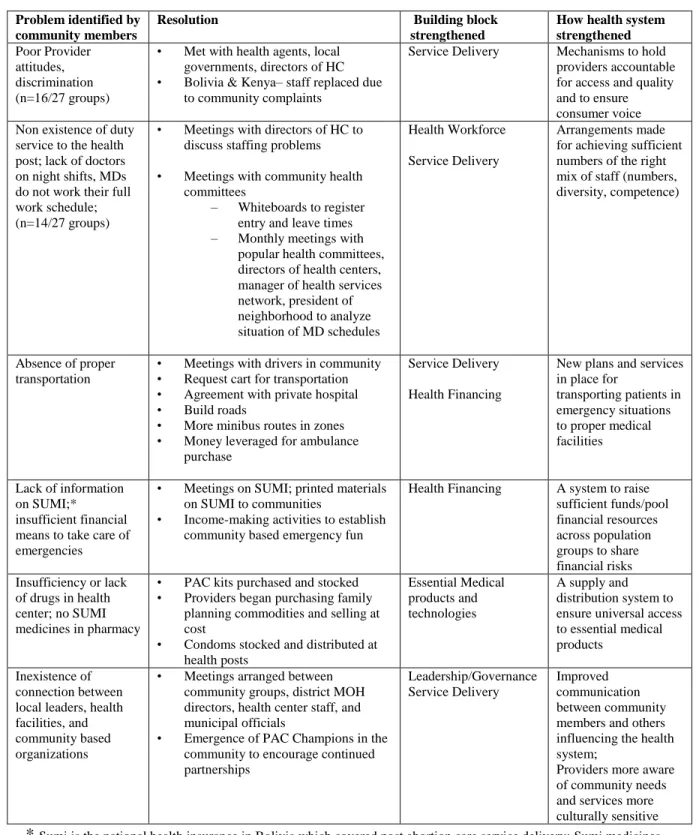
16 community mobilization activities often made improvements to postabortion care by strengthening the entire health system. Use of the Community Action Cycle improved five of the six health system building blocks identified by the WHO including leadership, service delivery, the health workforce, health financing, and medical supplies (See Table 3). Because of this broad health systems strengthening, the regions participating in PAC community mobilization have experienced improvements in health extending beyond the provision of postabortion care. In Kenya, for example, a knowledge, attitudes, and practices survey revealed that not only did knowledge of danger signs during pregnancy increase in participating regions, but so did the number of new and continuing users of family planning. From 2005 to 2006, the number of new users increased from 2,034 to 4,362 and the number of continuing users grew from 8,565 to 13,807 (18). A similar survey in Bolivia revealed that from October 2005 to August 2006, the percentage of people who believed that the health facility resolved their problem more than doubled (from 32% to 73%) (6).
Discussion
Involving communities is an effective, yet often neglected, strategy to improve postabortion care and strengthen health systems. As with all methodologies, however,
17 there are challenges community mobilization may present. Community mobilization is initially very labor-intensive and requires great dedication from participants. If the goals of the organization supporting the community mobilization activities differ from those of the community, it may be difficult to generate enough interest in the project to make it viable. In Bolivia, for instance, program staff had to work diligently to explain the benefit of preventative healthcare before community members were willing to join in PAC activities (6). Some communities may be easier to engage than others and more receptive to the idea of working together. In Kenya, groups in urban areas tended to be more difficult to engage than groups in rural areas due to more complicated
neighborhood structures, politics, and healthcare misconceptions in densely populated areas (18). At times community groups encountered opposition from doctors and other medical professionals who were territorial or resistant to change, making it difficult for groups to follow through on the action plans they developed (16,19). The programs in Bolivia, Kenya, and Senegal all included sustainability plans from their inception, but a lack of municipal financial support and fundraising efforts for the modest costs associated with transportation and administrative needs occasionally made it difficult to sustain the activities of some groups (6).
Conclusion
19 References
1. World Health Organization. Everybody’s business: Strengthening Health Systems to Improve Health Outcomes, WHO’s framework for action. WHO; 2007. Available from: http://www.who.int/healthsystems/strategy/everybodys_business.pdf. Accessed July 13, 2010.
2. U.S. Agency for International Development. USAID Support in Health Systems Strengthening. Available at:
http://www.usaid.gov/our_work/global_health/hs/index.html. Accessed March 27, 2011. 3. Rosato M, Laverack G, Grabman LH, Tripathy P, Nair N, Mwansambo C, et al. Community participation: lessons for maternal, newborn, and child health. The Lancet 2008;372(9642):962-971.
4. World Health Organization. Community empowerment for health and development. WHO; 2003.
5. Howard-Grabman L, Snetro G. How to mobilize communities for health and social change. Baltimore, MD: Health Communication Partnership/USAID; 2003.
6. Ottolenghi E, Riveros P, Blanding S. Assessment of the Bolivia postabortion care community mobilization program. The ACQUIRE Project/EngenderHealth; 2008. 7. Postabortion Care Consortium. Available at:
http://www.pac-consortium.org/site/PageServer. Accessed April 1, 2011.
8. Curtis C, Meeting Health Care Needs of Women Experiencing Complications of Miscarriage and Unsafe Abortion: USAID’s Postabortion Care Program. J.Midwifery Womens Health 2007 8;52(4):368-375.
9. Curtis C, Huber D, Moss-Knight T. Postabortion Family Planning: Addressing the Cycle of Repeat Unintended Pregnancy and Abortion. International perspectives on sexual and reproductive health 2010;36(1):44-48.
10. United States Agency for International Development. Postabortion care strategy paper. Washington, DC: USAID; 2004. Available from: www.usaid.gov. Accessed June 3, 2010.
11. Corbett MR, Turner KL. Essential Elements of Postabortion Care: Origins, Evolution and Future Directions. International Family Planning Perspectives 2003 Sep.;29(3):106-111.
20 13. Howard-Grabman L. Demystifying community mobilization: An effective strategy to improve maternal and newborn heatlh. USAID; 2007.
14. Tsuyuki K. Implementing Bolivia’s first community mobilization model. The Michigan Fellows Newsletter. Spring 2005; 4-7.
15. USAID Bolivia. Community PAC program: Facilitator’s manual: USAID Bolivia; 2006.
16. AbouZhar C, Wardlaw T. Maternal mortality in 2000: estimates developed by WHO, UNICEF and UNFPA. WHO; 2003.
17. Measure DHS. Stat Compiler. Available at: http://www.statcompiler.com/. Accessed March 29, 2011.
18. Wickstrom J, Russell N, Escando I. Engaging communities as partners in
postabortion care: A desk review of the community postabortion care project in Nakuru, Kenya. The ACQUIRE Project/EngenderHealth; 2008.
19. The ACQUIRE Project. Community mobilization for postabortion care, Senegal: Summary Report. The ACQUIRE Project/USAID Senegal, 2010.
23 Bolivia
(2003)
Kenya (2003)
Senegal (2005)
Total Fertility Rate 15-49 3.8 4.9 5.3
Contraceptive Prevalence Rate 15-49 39.3% 28.4% 8.7%
Unmet need for family planning 22.7% 24.5% 31.6%
24
Bolivia Kenya Senegal
Overall Goal:
Reduce maternal mortality and morbidity caused by complications of abortion
Overall Goal: Increase community
awareness and utilization of PAC and other reproductive health services, thereby reducing maternal mortality and morbidity
Overall Goal:
Organize communities to prevent complications from bleeding in the first half of pregnancy and decrease the number of unintended pregnancies
Objectives:
Identify existing barriers, including social, physical, financial, and attitudinal, to preventing unintended pregnancy and treating complications of abortion Educate community members about family planning and PAC services
Develop feasible and effective community plans to address health problems, especially barriers to PAC and FP services
Identify local resources and build local capacity to meet the health needs associated with unintended pregnancy and abortion complications as well as other health problems in the community
Objectives:
Develop action plans to prevent unsafe abortion and improve treatment for pregnancy complications, including bleeding
Strengthen referral services and develop a sustainable community-based
emergency transportation plan
Develop a payment scheme for PAC and other
emergency obstetric services
Educate community members on issues such as available health services, family planning to prevent unintended pregnancy, and when to seek postabortion care
Objectives:
Sensitize the community to problems caused by
unintended pregnancy and bleeding in the first half of pregnancy
Teach the community about the three delays in receiving appropriate care for
maternal complications
Build the capacity of community members to identify reproductive health problems, formulate plans to solve them, and
implement these plans Encourage community cohesion and work toward self governance in
addressing problems of reproductive health.
25 Problem identified by
community members
Resolution Building block
strengthened
How health system strengthened Poor Provider
attitudes, discrimination (n=16/27 groups)
• Met with health agents, local governments, directors of HC • Bolivia & Kenya– staff replaced due
to community complaints
Service Delivery Mechanisms to hold providers accountable for access and quality and to ensure consumer voice Non existence of duty
service to the health post; lack of doctors on night shifts, MDs do not work their full work schedule; (n=14/27 groups)
• Meetings with directors of HC to discuss staffing problems
• Meetings with community health committees
– Whiteboards to register entry and leave times – Monthly meetings with
popular health committees, directors of health centers, manager of health services network, president of neighborhood to analyze situation of MD schedules
Health Workforce
Service Delivery
Arrangements made for achieving sufficient numbers of the right mix of staff (numbers, diversity, competence)
Absence of proper transportation
• Meetings with drivers in community • Request cart for transportation • Agreement with private hospital • Build roads
• More minibus routes in zones • Money leveraged for ambulance
purchase
Service Delivery
Health Financing
New plans and services in place for
transporting patients in emergency situations to proper medical facilities
Lack of information on SUMI;*
insufficient financial means to take care of emergencies
• Meetings on SUMI; printed materials on SUMI to communities
• Income-making activities to establish community based emergency fun
Health Financing A system to raise sufficient funds/pool financial resources across population groups to share financial risks Insufficiency or lack
of drugs in health center; no SUMI medicines in pharmacy
• PAC kits purchased and stocked • Providers began purchasing family
planning commodities and selling at cost
• Condoms stocked and distributed at health posts
Essential Medical products and technologies
A supply and distribution system to ensure universal access to essential medical products
Inexistence of connection between local leaders, health facilities, and community based organizations
• Meetings arranged between community groups, district MOH directors, health center staff, and municipal officials
• Emergence of PAC Champions in the community to encourage continued partnerships Leadership/Governance Service Delivery Improved communication between community members and others influencing the health system;
Providers more aware of community needs and services more culturally sensitive * Sumi is the national health insurance in Bolivia which covered post abortion care service delivery; Sumi medicines were those covered by the National Health Insurance Plan.