1 Demographic and Educational Attributes that Affect the Likelihood of a Registered Nurse
Practicing in a Rural/Underserved North Carolina County By
Hannah Crook
Senior Honors Thesis
Department of Health Policy and Management University of North Carolina at Chapel Hill
May 3rd, 2019
Approved:
Dr. Erin Fraher, Primary Advisor
2
Table of Contents
Abstract ... 3
Introduction ... 5
Research Questions ... 6
Literature Review... 7
Methods... 12
Results ... 17
Discussion ... 25
Conclusions ... 32
Appendices ... 33
3
Abstract
Introduction and Research Objectives: North Carolina (NC) suffers from a maldistribution of medical professionals, including Registered Nurses (RNs). Rural and underserved areas are the most affected by this problem and have worse health outcomes. To solve maldistribution
problems, it is critical to understand what factors are associated with the likelihood of practicing in a rural/underserved area. I aim to explore this maldistribution and to determine what different demographic and educational factors affect the likelihood that an RN is working in a
rural/underserved area two years after graduation. Specifically, I examine the proportion of graduates in rural practice by each NC educational program, type of program (2- vs. 4-year), Historically Black College and Universities (HBCU) status, public/private status, and program location (rural vs. non-rural program location).
Methods: This study is a descriptive, quantitative, secondary data analysis. The study includes 2015 RN graduates from NC nursing education programs who were still in active practice in NC in 2017- a total of 3419 RNs. The data used are 2015 graduation data and data from the 2017 RN licensure renewal process. I calculated descriptive statistics on the demographic characteristics of the dataset and the proportion of 2015 RN graduates working in a rural/underserved area in 2017 by education program and program attributes. Pearson Chi-Square tests were then performed to determine if the differences in proportions between different education program attributes were statistically significant. Finally, a logistic regression model was run to determine the effects of demographic and educational factors on the likelihood of practicing in a rural/underserved area.
Principal Findings: The dataset was largely female (89.5%) and white (78.4%). In total, 25.7% of 2015 NC RN graduates who were in active NC practice in 2017 were working in a
rural/underserved county. The median proportion by educational program of 2015 graduates working in a rural/underserved area was 23.3%. Two-year-year programs had a significantly higher proportion of graduates working in a rural/underserved county than 4-year programs (31.4% vs 14.8%, p<0.000), public programs had a significantly higher proportion of graduates working in a rural/underserved area than private programs (29% vs 10%, p<0.000), and
programs located in a rural/underserved area had a significantly higher proportion of graduates working in rural/underserved areas than programs not located in a rural/underserved area (59.5% vs 8.4%, p<0.000). There were no statistically significant differences in the proportions of rural working graduates from HBCUs vs non-HBCUs (17.7% vs 14.2%, p=0.19). In the logistic regression model, factors associated with an increased likelihood of practicing in a
rural/underserved area were being female, being non-white, attending a two-year educational program, attending a public educational program, and attending an educational program in a rural/underserved area.
Discussion: Both demographic factors (being female, non-white) and attributes at the
4 were associated with an increased likelihood of 2015 RN graduates working in a NC
5
Introduction
Introduction and Problem Statement
Registered nurses (RNs) play a critical role in the American healthcare system. RNs
provide a variety of functions integral to patient health and outcomes, including delivering and
coordinating care, assessing and monitoring patients, and educating patients and caregivers.1 Inadequate nursing staff has been found to lead to increased lengths of stay, rates of infections,
and deaths.2 Therefore, it is vital that the supply of nurses is sufficient to meet demand in all geographic areas, as the lack of RNs in the right specialties and geographies can lead to access of
care issues.
While it is often stated that North Carolina (NC) is facing a nursing shortage, recent
studies have shown the true problem to be maldistribution.3 Rural and underserved areas in NC have fewer RNs per 10000 population than urban areas (112.6 vs 80.7), and this gap is
increasing.3 A sufficient supply RNs is needed in these areas, both to increase access to care and improve outcomes.1,4
To ensure an adequate supply of RNs in underserved areas we first must understand the
factors that affect the supply of RNs. Studies have shown that being older, having children, and
being more experienced are factors known to increase the likelihood that an RN stays in the
workforce or works full time.5 However, it is also important to know the factors that affect the likelihood of an RN changing practice location, also known as migration. RN migration can be
defined as international, between states, or within states (called intra-state movement). Research
shows that RNs are more likely to move within states if they are younger, male, single, less
6 nurses or prospective nurses already in the community - may be promising ways to recruit and
retain nurses in rural and underserved areas.7
However, little research has been done on how nursing education programs affect the
migration of RNs, especially to underserved areas. Research has found that RNs in North
Carolina with Associate Degrees in Nursing (ADN) are more likely to practice in rural areas than
those with a Bachelor of Science in Nursing (BSN) degree, but little else is known about how
specific educational programs in North Carolina affect RN migration.3 No research has been done on the relationships between individual RN educational programs in North Carolina and
migration.
This study examines how the proportion of RNs working in rural and underserved
counties varies by nursing education program in North Carolina. This study also examines the
demographic characteristics and educational attributes that increase the likelihood of a RN
graduates working in a rural or underserved area.
Research Questions
• How does the proportion of registered nurse graduates practicing in a rural/underserved
North Carolina county two years after graduation vary by educational program?
• Which nursing education programs send the highest proportion of their graduates
practicing as registered nurses to rural/underserved North Carolina counties?
• Do these proportions significantly differ by different program attributes? (i.e. location,
institution type, etc.)
o Do public educational programs send a higher proportion of their nursing
7
o Do Historically Black Colleges and Universities (HBCUs) send a higher
proportion of their nursing graduates to rural/underserved areas?
o Do programs located in a rural/underserved county send a higher proportion of
their nursing graduates to rural/underserved areas?
Literature Review
The Importance of Nursing in Rural Healthcare
Healthcare and health status are generally worse in rural areas. Those in rural areas are
older, poorer, and have worse health outcomes than those in urban areas.8,9 Rural areas also have higher rates of preventable deaths and lower life expectancy than urban areas.9 Specifically in North Carolina, those in rural areas have higher rates of negative health outcomes and mortality
than those in urban areas.8Rural areas also have less access to adequate healthcare than urban areas and rural hospitals are closing- 5 rural hospitals have closed in NC since 2010.8 Nursing is also important to healthcare and health outcomes. One study by Fields et al. found that both RNs
per capita and overall levels of health decreased as the rurality of the county increased.10 This study also found that higher RN-to-population ratios were associated with significantly better
health outcomes in both rural and urban areas; an effect that increased in magnitude as rurality
increased.10
Nursing shortages are a common issue for rural areas. While previous work has shown
the overall number of nurses in the US and in NC to be adequate, maldistribution is a crucial
issue.3,11 There are significantly more nurses per capita in urban areas than rural, and this gap is growing.3,11 Other studies have also demonstrated nursing shortages in rural areas, both
8 commonly needed allied health profession in rural hospitals in the US.14 Nursing shortages were also prevalent at Community Health Centers (CHCs) which frequently serve rural and poorer
patients. These shortages were greater and longer-term at rural CHCs than urban CHCs.15 Nursing shortages may be exacerbated by the relative geographic immobility of new RNs;
Kovner et al. found that 52.5% of new RNs in 15 states worked within 40 miles of their high
school.16 This immobility highlights the need for more knowledge on RN practice location choice, and how to increase movement to rural areas. Beyond their importance to healthcare,
rural nurses are also unique due to their “generalist” nature. Many rural nurses, both in the US
and internationally, report feeling as if they need a broad knowledge base to properly serve their
communities.17 As a side effect of this generalist nature, rural nurses often find themselves taking on increased roles, such as medication education, working with interpreters, and administrative
duties.17,18
Facilitators and Barriers to Rural Nursing
Nurses report specific facilitators and barriers in rural nursing that may affect the
decision of a nurse to go into rural practice. Engagement has been cited as a facilitator to rural
nursing, which is predicted by nursing practice environment.19 Engagement is the extent to which a nurse feels involved and supported in their work which tends to be a challenge in rural
areas. Other reported facilitators include technology, sense of community, and a slower pace of
life.20 Nurses who choose to practice in rural areas typically enjoy the culture and environment of rural communities. Nurses also have expectations of the characteristics of rural practice. A
common expectation is that employers will provide the supportive learning environment
9 Continuing education is a factor that can be both a facilitator and a barrier. Nurses often
report a lack of needed knowledge and skills, which continuing education could help address.20,22 However, if continuing education is not accessible, affordable, and relevant to rural practice, it
can be a barrier to success in rural areas.22,23 Professional isolation is also often cited as a barrier to rural practice by both physicians and nurses, as rural providers do not have access to the larger
networks available in more urban areas.20,23–25 Rural nurses have been found to consider social support networks of peers and managers especially important, expecting more guidance from
management than urban nurses expect.26 Other work has shown that the presence of social supports can be the difference between perceiving rural workplace challenges as stimulating or
overwhelming.27 Therefore, to encourage nurses to practice in rural areas it is important to ensure professional networks and sufficient social support.
The “generalist” nature of rural nursing described earlier is also sometimes perceived as a
barrier.17,28 One study found older nurses felt that new nurses were more likely to choose specialized practice opportunities, which are more commonly found in urban areas.17 Kidd et al found that the sporadic and diverse nature of rural nursing led to a lack of confidence in skills.28 Furthermore, the increased workload and scope of practice associated with this generalist nature
has also been reported as a challenge.24 However, other literature has also found the generalist nature of rural nursing to attract some nurses to be a facilitator for these nurses.20 The perception of the generalist nature may determine by the individual nurse and to what degree the nurse is
supported in their role. Other barriers to rural nursing include inadequate undergraduate
education, safety issues, lack of professional development, lack of anonymity, and
10 While many nurses choose rural practice on their own, it is also critical to recruit nurses
to rural areas as the current workforce is inadequate. Many universities or health systems run
programs specifically designed to get nurses interested in rural practice and bring them to rural
areas.29,30 For example, Leeper et al describes a program for undergraduate students at a rural Alabama university designed to draw health students to this area and impart them with necessary
skills.29 The program resulted in the development of competencies related to rural practice and over 80% of participants indicated they would consider working in a rural area after
graduation.29 Other similar programs have also resulted in enhanced willingness for rural placements.30 Other organizations have recognized the importance of recruiting students from rural areas to increase rural practice after graduation, but, not as much progress has been made in
this aspect as in rural clinical placements.31
Financial incentives for undergraduates may also be an effective strategy to get students
into rural clinical placements- a factor known to increase the likelihood of rural nursing. One
study indicated students would be more willing to complete a rural clinical placement if they
were to be provided with travel stipends and housing.32
Some hospitals or health systems employ a “grow your own” strategy in which students
are recruited for nursing training directly from the rural communities in which they live.7 These types of strategies have been found to be effective, but do not address the issue of bringing RNs
from non-rural areas to rural areas.7 Other programs designed to recruit rural RNs and other health professionals start much earlier. These programs attract students from high schools and
middle schools to get them interested in healthcare careers. It is often hard to track these
outcomes long term, but they have shown some positive effects such as high numbers of
11 Once nurses have been recruited to rural areas, retention programs are needed to keep
them there. One type of nurse retention program found to be especially effective are “Nurse
Residency” programs, in which a new RN functions much like a medical resident. They are
slowly given more autonomy and responsibilities, all while being mentored and trained by more
experienced nurses.34 New nurses often report feeling overwhelmed and unsupported in their roles, and structured training programs such as these may help reduce these feelings. These
programs have demonstrated success; multiple nurse residency programs have been shown to
reduce turnover of new RNs in rural areas.34,35
Other factors that nurses report as important to retention include being part of a team, job
satisfaction, and the rural lifestyle.18 Retention also varies by demographic characteristics; one study found intent to stay (retention) was highest among those 46-56 years old and those
working fewer than 1 hour of overtime per week.36
Continuing education can also be a method used to recruit and retain nurses in rural areas.
These programs often use distance learning to allow rural nurses interested in doctoral or masters
programs to complete these degrees while staying in their communities.37 However, the RNs who participate in these continuing education programs also report challenges and the need for
support.38
Lack of Literature on the Effect of Education on the Likelihood of Rural Nursing Much work has previously been done on the general characteristics of the nursing
workforce both nationally and in NC. One 2007 study shows that the NC nursing workforce is
aging and that only 50% of newly licensed RNs each year in NC are new graduates; the rest are
12 challenge to healthcare as well.39 Work has also been done of the workforce characteristics of advanced practice registered nurses (APRNs), with results generally showing that Nurse
Practitioners (NPs) are more likely to practice in rural areas than other APRNs.40,41
As mentioned earlier, there is some general knowledge on the effect of education on rural
nursing likelihood. Those with rural clinical placements in school, those who attended school in
a rural area, and those who attained an ADN degree were all more likely to practice in rural areas
than their counterparts. However, it is unclear if the likelihood of rural nursing practice differs on
other characteristics of education, such as public, private, or HBCU status.
No research has been done on how the likelihood of rural practice differs given individual
educational program or by program attributes in North Carolina. Currently, the only research
done in NC on the effect of education has shown that the likelihood of rural practice differs by
type of educational program (2- vs 4-year colleges), but little else is known. Research to
determine what affects the likelihood of rural practice is particularly important and timely given
that NC is often projected to have one of the worst nursing shortage and maldistribution
problems in the near future.42
Methods
Research Design
This research study is a quantitative, descriptive analysis. All the data were collected
before the start of the study.
13 All nursing data were derived through initial and renewal licensure files gathered by the
North Carolina Board of Nursing (NCBoN). The data on demographic characteristics, active
status, and practice county of the RNs are obtained through the NC licensure renewal process,
which is required every two years. The data was then cleaned by and housed at the North
Carolina Health Professions Data System at the University of North Carolina at Chapel Hill.
To conduct the analyses, graduation data from 2015 was matched to 2017 licensure data.
Thus, for every NC nursing graduate in 2015 who was working in NC in 2017, data exists as to
what county the RN was working in. I use this data to determine the proportion of each nursing
education program’s 2015 graduates who were working in a rural/underserved county in 2017. I
also use this data to determine if the proportion of graduates working in rural/underserved areas
significantly differs between 2- and 4-year educational programs, public and private educational
programs, Historically Black Colleges and Universities (HBCUs) and non-HBCUs, and between
educational programs located in rural/underserved counties and urban counties. Finally, I use this
and demographic data to create logistic regression models to what factors affect the likelihood of
a 2015 NC graduate practicing in a rural/underserved NC county in 2017.
Defining Rural/Underserved
I define a county as rural or underserved if it meets any of the three criteria below.
1. The county is designated as rural (Micropolitan or Non-Metropolitan) by the Office of
Management and Budget (OMB). Counties that meet this designation can be found here:
https://www.hrsa.gov/sites/default/files/ruralhealth/resources/forhpeligibleareas.pdf
2. The county is designated as a 2019 Tier 1 North Carolina County, which are the 40 most
14 given by the North Carolina Depart of Commerce. Tier 1 designated counties can be
found here:
https://www.nccommerce.com/grants-incentives/county-distress-rankings-tiers
3. The county is designated as a whole-county primary-care Health Professional Shortage
Area (HPSA). Primary-care HPSAs are designated by the Health Resources and Services
Administration. Primary-care HPSAs can be found here:
https://data.hrsa.gov/tools/shortage-area/hpsa-find
Categorizing a county as rural or underserved if it matches any three of the definitions
above provides the widest, most comprehensive view of rurality, erring on the side of including
too many counties designated as rural rather than too few.
Defining Private/Public Status
Four-year educational programs are deemed public if they are part of the University of
North Carolina System, which includes 17 campuses. Public NC educational programs can be
found here: https://www.northcarolina.edu/content/our-17-campuses. If a four-year educational
program is not included in the University of North Carolina system, it is considered private.
Two-year educational programs are deemed public if they are part of the North Carolina
Community College system; colleges in this system can be found here:
https://www.nccommunitycolleges.edu/about-us/main-campuses. Other 2-year educational
programs, including for-profit 2-year nursing programs (such as ECPI University) are considered
private.
Defining Historically Black Colleges and Universities
Since Historically Black College and University (HBCU) status is unique to four-year
four-15 year educational program is considered an HBCU if it is listed here:
https://www.ncpedia.org/education/hbcu, on the “NCpedia.” The NCpedia is a resource on North
Carolina specific information run by the North Carolina Department of Natural and Cultural
Resources. The NCpedia list was cross-referenced with other resources on HBCUs to ensure
accuracy.
Rural/underserved Status for Educational Programs
Educational programs are designated as in a rural/underserved area if the county they are
located in meets any of the three conditions mentioned above (OMB designated rural, Tier 1 NC
county, primary-care HPSA).
Sampling
No sampling was needed for this study. As each RN in NC is required to renew their
license, the data set includes the entire population of licensed RNs. However, this study cannot
account for those who studied outside of NC and are now working in NC or those who graduated
from a NC program in 2015 but worked outside the state in 2017. Therefore, an RN is included
in the analysis only if they both graduated from a NC nursing educational program in 2015 and
were working in NC in 2017.
Data Analysis
The first analysis generated overall demographic characteristics of the population, such as
age, race, and gender. The overall proportion of RNs that work in rural or underserved counties
was also generated. I then calculated the proportion of 2015 RN graduates from each college in
NC who were working in a rural or underserved county in 2017. These proportions are listed
16 underserved counties for HBCUs/non-HBCUs, private/public educational programs, and
educational programs in rural/underserved areas vs educational programs not in
rural/underserved areas. Separate chi-square tests were then run to determine if the proportion of
RN graduates working in rural or underserved areas was significantly different between private
and public educational programs, HBCUs and non-HBCUs, and rural/underserved located and
non-rural/underserved educational programs. Chi-square tests are the most appropriate way to
compare two unpaired groups with binomial outcomes when the sample size is large.43 Logistic regression models were then completed to determine if variables of interest (HBCU status,
public/private status, etc.) affected the likelihood of practicing in a rural/underserved area after
controlling for demographic and other educational program characteristics. All analyses were run
using StataSE 15.
Data Limitations
This study’s main limitation is its inability to account for demographics at the education
program level. It is likely that some nursing education programs enroll a higher proportion of
students originally from rural areas- a factor known to increase the likelihood of rural practice.
We also do not have data on where student nurses complete their clinical training, another factor
known to influence practice location choice. Further studies will be needed to account for the
mentioned college level demographics and factors, as well as to determine how large of a role
individual college choice plays in the relationship between education and the likelihood of rural
practice. Furthermore, all data on employment status, county, and setting are self-reported by the
RNs during the licensure process, however, there is no reason to believe this data would be
17
Results
Demographics
In 2015, there were a total of 4526 NC nursing graduates. Of those, 3848 then initially
licensed as an RN in NC in 2015. In 2017, 3419 of these graduates remained in the NC RN
licensure file. In total, 85% of 2015 NC RN graduates became licensed in NC, and 75.5% were
still in active practice in 2017. Of the 2015 RNs graduates remaining in the 2017 licensure file,
3059 were female (89.5%) and 360 were male (10.5%). Of the RNs who reported a race, 2671
were white (78.4%) while 736 were non-white (21.6%)- 12 RNs did not report a race. The mean
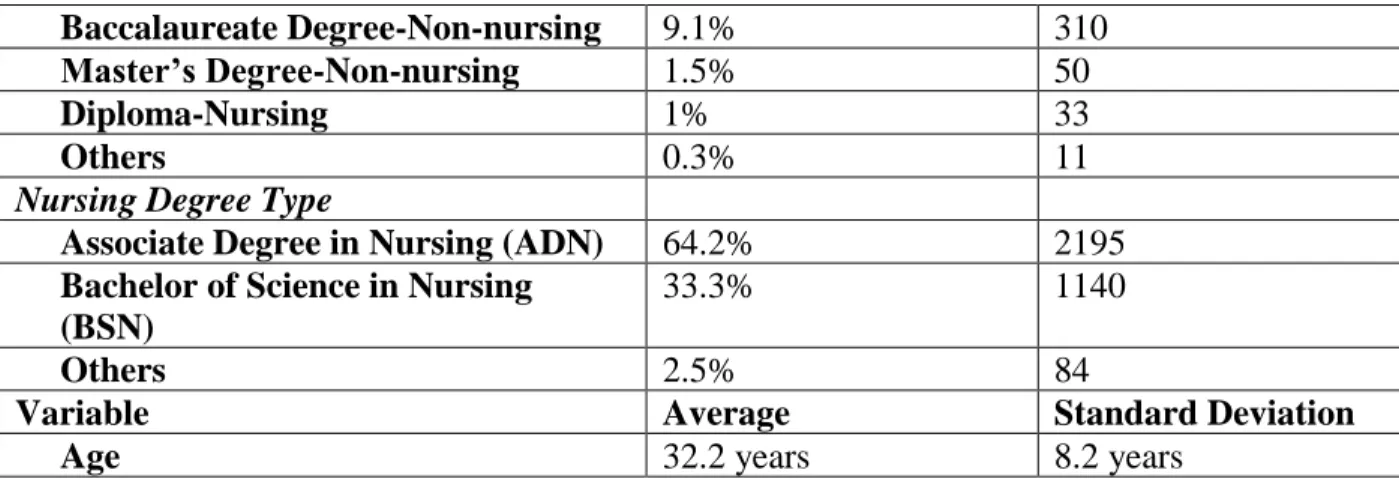
age was 32.2 years old, as of October 31, 2017. Further details on demographics can be seen in
Table 1 below.
Table 1: Demographic characteristics of 2015 NC RN graduates who appeared in the 2017 NC licensure file
Variable Proportion of Dataset N
Total 3419
Sex
Female 89.5% 3059
Male 10.5% 360
Dichotomized Race
White 78.4% 2671
Non-White 21.6% 736
Race Breakdown
White 78.4% 2671
Black/African American 12.8% 436
Hispanic 3.2% 110
Asian 2.2% 76
American Indian/Alaskan Native 1.3% 43
Native Hawaiian/Pacific Islander 0.2% 7
Other 1.9% 64
Highest Degree Earned
Associate Degree-Nursing 50.7% 1723
18 Baccalaureate Degree-Non-nursing 9.1% 310
Master’s Degree-Non-nursing 1.5% 50
Diploma-Nursing 1% 33
Others 0.3% 11
Nursing Degree Type
Associate Degree in Nursing (ADN) 64.2% 2195 Bachelor of Science in Nursing
(BSN)
33.3% 1140
Others 2.5% 84
Variable Average Standard Deviation
Age 32.2 years 8.2 years
Overall Proportions in Rural Nursing by Educational Program
878 (25.7%) of the 2015 NC RN graduates in the 2017 licensure file reported working in
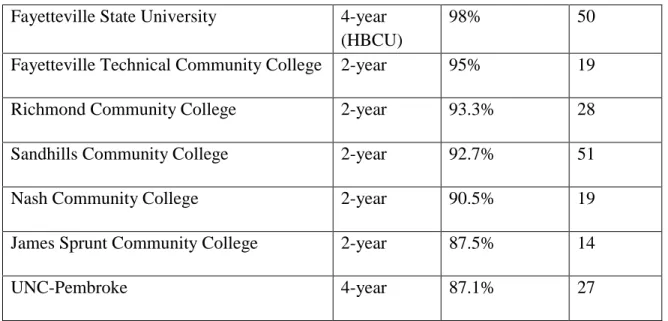
a rural/underserved NC county. The NC educational programs with the 10 highest and 10 lowest
proportions of 2015 RN graduates practicing in rural/underserved areas are shown in Tables 2
and 3 below. A full listing of every educational program can be found in Appendix 1. As the
tables show, the proportion of graduates working in a rural/underserved area in 2017 ranged
from 0% to 100%. The 10 educational programs with the highest proportions were all public,
located in rural/underserved areas, and the majority were 2-year programs. The 10 colleges with
the lowest proportions were all located in urban areas, 4 were private programs, and the majority
were 2-year programs. The median proportion of 2015 NC RN graduates practicing in a
rural/underserved area in 2017 for all educational programs was 23.3%.
Table 2: The top 10 NC educational programs with the highest proportions of 2015 NC RN graduates in rural/underserved areas in 2017
Program 2- vs 4-year Proportion N in
Rural
Robeson Community College 2-year 100% 18
Bladen Community College 2-year 100% 12
19 Fayetteville State University 4-year
(HBCU)
98% 50
Fayetteville Technical Community College 2-year 95% 19
Richmond Community College 2-year 93.3% 28
Sandhills Community College 2-year 92.7% 51
Nash Community College 2-year 90.5% 19
James Sprunt Community College 2-year 87.5% 14
UNC-Pembroke 4-year 87.1% 27
Table 3: The bottom 10 NC educational programs with the lowest proportions of 2015 NC RN graduates in rural/underserved areas in 2017
Program 2- vs 4-year Proportion N in
Rural
Wingate University 4-year 0% 0
Cabarrus College of Health Sciences 2-year 0% 0
Alamance Community College 2-year 0% 0
Mitchell Community College 2-year 0% 0
Queens University 4-year 0% 0
Carolinas College of Health Sciences 2-year 1.1% 1
UNC-Chapel Hill 4-year 1.6% 2
Central Piedmont Community College 2-year 1.7% 1
Cape Fear Community College 2-year 1.9% 1
Catawba Valley Community College 2-year 2.1% 1
20 Overall, 66 of NC’s 100 counties met at least one of the three criteria to be considered
rural/underserved. 40 counties were Tier 1 NC counties, 54 counties were designated rural by the
OMB, and 19 counties were whole-county primary care Health Professional Shortage Areas
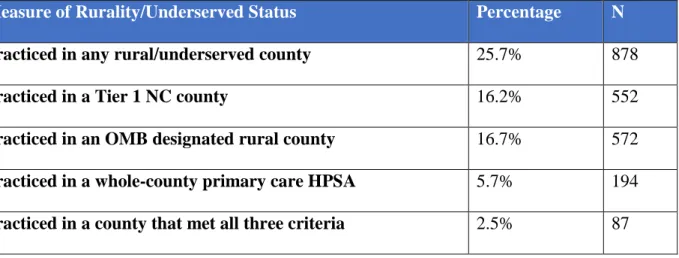
(HPSAs). 9 counties met all three measures of rurality. 25.7% of the dataset practiced in a county
that met any criteria to be considered rural/underserved, 16.2% practiced in a Tier 1 NC county,
16.7% in an OMB rural designated county, and 5.7% in a whole-county primary care HPSA.
Only 2.5% of the dataset practiced in a county that met all three criteria for rural/underserved
status.
Table 4: Number and proportion of 2015 NC RN graduates practicing in rural/underserved counties by different measures of rural/underserved status (n=3419)
Measure of Rurality/Underserved Status Percentage N
Practiced in any rural/underserved county 25.7% 878
Practiced in a Tier 1 NC county 16.2% 552
Practiced in an OMB designated rural county 16.7% 572 Practiced in a whole-county primary care HPSA 5.7% 194 Practiced in a county that met all three criteria 2.5% 87
Demographic Differences
The proportions of graduates working in a rural or underserved county varied by
demographic characteristics. Females were significantly more likely than males to work in a
rural or underserved county. (26.5% vs 19.2%, X2=8.94, p = .003) Non-white RNs were more likely to practice in a rural/underserved county than white RNs, but the effect was not
21 Table 5: Numbers of RNs in rural/underserved and non-rural/under counties by sex (n=3419)
Female Male Total
Non-rural/underserved
2250 (73.6%) 291 (80.8%) 2541
Rural/Underserved
809 (26.5%) 69 (19.2%) 878
Total 3059 360 3419
Table 6: Numbers of RNs in rural/underserved and non-rural/under counties by dichotomized race (n=3407, 12 RNs did not report race)
Non-White White Total
Non-rural/underserved
532 (72.3%) 2000 (74.9%) 2532
Rural/underserved
204 (27.7%) 671 (25.1%) 875
Total 2671 736 3407
Proportions of rural nursing by HBCU vs non-HBCUs (4-year colleges only)
In total, 203 NC RN 2015 graduates in the 2017 licensure file attended a HBCU- this
accounts for 5.9% of the total dataset and 17.3% of the graduates from 4-year colleges. RNs
from HBCUs were predominately female (79.1%) and non-white (66.5%), with a mean age of
30.8 years. RNs from HBCUs were more likely to work in a rural/underserved NC county than
RNs from non-HBCUs, although the effect was not significant (17.7% vs 14.2%, X2=1.65, p = .199). Only RNs from 4-year educational programs are included in the chi-square analysis, as
HBCU status is only applicable to 4-year schools.
Table 7: Numbers of RNs in rural/underserved and non-rural/underserved counties by HBCU status (n=1174)
Non-HBCU HBCU Total
Non-rural/underserved
833 (85.8%) 167 (82.3%) 1000
Rural/underserved
138 (14.2%) 36 (17.7%) 174
22 Proportions of Rural Nursing by Private vs Public Colleges
In total, 598 NC RN 2015 graduates in the 2017 licensure file attended a private college.
This accounts for 17.5% of the total dataset, 13.8% of graduates from 2-year educational
programs, and 24.5% of the graduates from 4-year colleges. RNs from private educational
programs were again predominately female (88.9%) and white (80.1%), with a mean age of
30.68 years. RNs from public educational programs were more likely to work in a
rural/underserved NC county than RNs from private educational programs. (29% vs 10%,
X2=92.97, p = .000)
Table 8: Numbers of RNs in rural/underserved and non-rural/underserved counties by public vs private status (n=3419)
Public Private Total
Non-rural/underserved
2003 (71%) 538 (90%) 2541
Rural/underserved
818 (29%) 60 (10%) 878
Total 2821 598 3419
Proportions of Rural Nursing by 2-year vs 4-year colleges
In total, 1174 of the NC RN 2015 graduates in the 2017 licensure file attended a 4-year
educational program (34.3%) while 2245 attended a 2-year educational program (65.7%). The
proportion of females was similar between 2- and 4-year programs, (89.5% vs 89.4%, X2=.03, p = .871), however, the proportion of non-white RNs was significantly lower at 2-year educational
programs than 4-year educational programs (18.4% vs 27.8%, X2=40.64, p=.000). RNs from 2-year educational programs were much more likely to work in a rural/underserved NC county
than RNs from 4-year educational programs (31.4% vs 14.8%, X2=110.46, p = 0.000).
23
2-year 4-year Total
Non-rural/underserved
1541 (68.6%) 1000 (85.2%) 2541
Rural/underserved
704 (31.4%) 174 (14.8%) 878
Total 2541 1174 3419
Proportions of Rural Nursing by college location
In total, 1184 NC RN 2015 graduates in the 2017 licensure file attended a college located
in a rural/underserved county (34.6%) while 2235 did not (65.4%). The proportion of females
was significantly higher at schools in rural/underserved counties vs schools in
non-rural/underserved counties, (91.5% vs 88.4%, X2=7.68, p = .006). Additionally, the proportion of non-white RNs was significantly lower at rural/underserved colleges than non-rural colleges
(19.3% vs 22.8%, X2=5.35, p=.021)
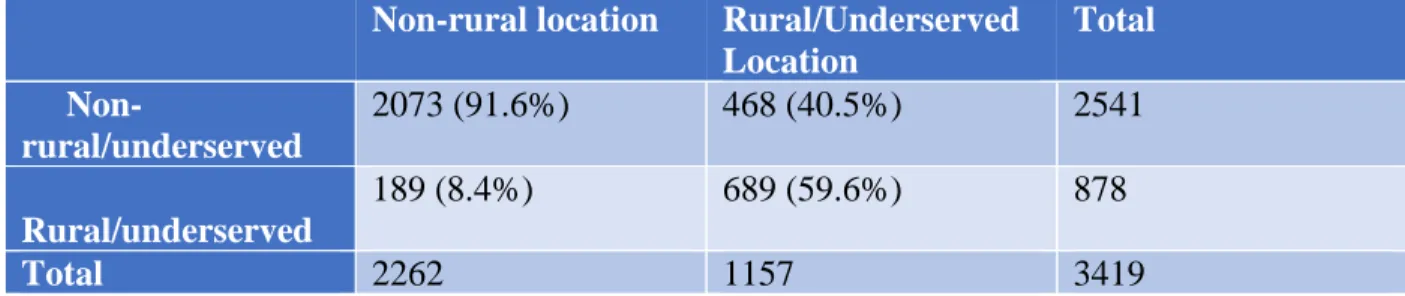
RNs from colleges in rural/underserved areas were much more likely to work in a
rural/underserved NC county than RNs from colleges non-rural/underserved areas (59.6% vs
8.4%, X2=1000, p = 0.000)
Table 10: Numbers of RNs in rural/underserved and non-rural/underserved counties by college county location (n=3419)
Non-rural location Rural/Underserved
Location
Total
Non-rural/underserved
2073 (91.6%) 468 (40.5%) 2541
Rural/underserved
189 (8.4%) 689 (59.6%) 878
Total 2262 1157 3419
Logistic Regression Models
The overall logistic regression model is shown in Table 11. The dependent variable tested
in practicing in any rural/underserved county while the independent variables include 2-year
24 analysis includes 3407 RNs- the 12 RNs who did not report race were omitted. All the variables
tested significantly increased the odds of practicing in a rural/underserved county.
Table 11: Logistic Regression Analysis for all educational programs (n=3407)
Odds Ratio Std. Err. P-value 95% Conf. Interval
Two-Year Program 1.35 .15 .009 1.08 1.69
Public Program 2.38 .39 .000 1.73 3.27
Rural Program 14.5 1.46 .000 11.91 17.66
Female 1.41 .24 .039 1.02 1.97
Non-white 1.48 .17 .001 1.18 1.86
Constant .02 .01 .000 .02 .04
Table 12 shows the logistic regression analyses when only considering 2-year programs.
The dependent variable tested is again practicing in any rural/underserved county while the
independent variables include public status, rural/underserved program location, being female,
and being non-white. The total number of RNs in this model is 2239- all 2-year program
graduates in the dataset that reported race. All variables tested increased the odds of an RN
practicing in a rural/underserved county, however, the effect of non-white race was not
significant when only considering 2-year educational programs.
Table 12: Logistic Regression Analysis for 2-year Educational Programs (n=2239)
Odds Ratio Std. Err. P-value 95% Conf. Interval
Public Program 3.18 .84 .000 1.9 5.32
Rural Program 18.7 2.36 .000 14.61 23.94
Female 1.56 .31 .025 1.06 2.31
Non-white 1.31 .19 .063 .98 1.75
Constant .02 .01 .000 .01 .04
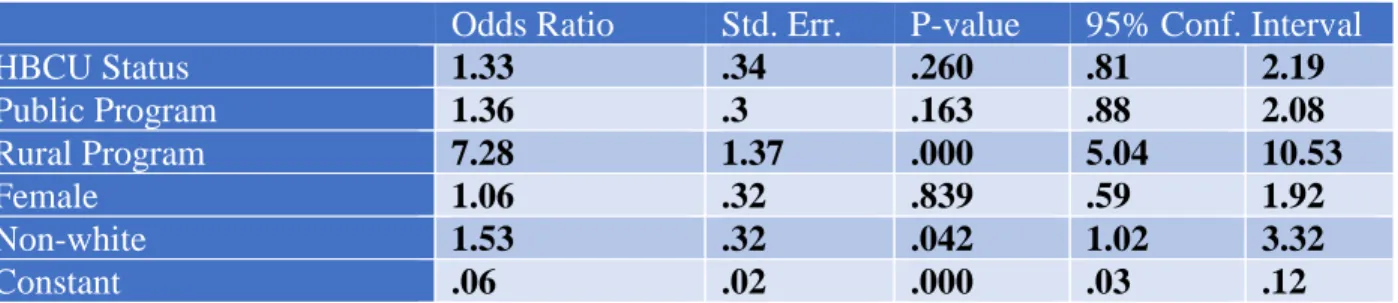
The logistic regression model for only 4-year educational programs is shown below in
Table 13. The dependent variable tested is again practicing in any rural/underserved county
while the independent variables in include HBCU status, public status, rural/underserved
25 model is 1168- all 4-year program graduates who reported race. All factors tested were found to
increase the odds of an RN practicing in a rural/underserved county, but the only factors found to
be significant when considering only 4-year educational programs were educational program
location and non-white race.
Table 13: Logistic Regression Analysis for 4-year educational programs (n=1168)
Odds Ratio Std. Err. P-value 95% Conf. Interval
HBCU Status 1.33 .34 .260 .81 2.19
Public Program 1.36 .3 .163 .88 2.08
Rural Program 7.28 1.37 .000 5.04 10.53
Female 1.06 .32 .839 .59 1.92
Non-white 1.53 .32 .042 1.02 3.32
Constant .06 .02 .000 .03 .12
Discussion
This study looked at the factors that increased the likelihood that a 2015 NC graduate RN
would practice in a rural/underserved NC county in 2017. Overall, 25.7% of graduates worked in
a rural or underserved county. However, the proportion of graduates from each educational
program working in a rural/underserved county ranged from 0-100%, with a median of 23.3%.
Females, non-whites, RNs from 2-year educational programs, RNs from public educational
programs and RNs from a program in a rural/underserved county were more likely to work in a
rural/underserved county than their counterparts. RNs from HBCUs were also more likely to
work in a rural/underserved county, but the effect was not statistically significant.
Educational Programs That Sent the Highest and Lowest Proportions of Graduates to Rural/Underserved Areas
The top 10 educational programs with the highest proportions of graduates working in
26 were 2-year programs (8 out of 10), one program was a HBCU. In contrast, the bottom 10
educational programs with the lowest proportions of graduates working in rural/underserved area
were all located in urban areas. Most were also 2-year programs (8 out of 10), but 4 of these
programs were private. These findings are consistent with previous literature that indicate that
graduates from 2-year programs and programs located in rural/underserved areas are then more
likely to work in rural areas.3 Ideally, educational programs should take advantage of this study and examine the proportion of their graduates that go on to practice in rural/underserved areas.
Demographic Differences
Females were significantly more likely than males to work in a rural/underserved county
(26.5% vs 19.5%). However, there were few males in the overall sample and a total of only 69
males working in a rural or underserved county. This trend may also change or decrease over
time- the nurses in this sample were young and recently graduated. Females may move towards
urban areas as they gain more experience or move for familial or other reasons. Non-white RNs
were also slightly more likely to work in a rural/underserved county (27.7% vs 25.1%), however,
this may be related to the overall racial breakdown of rural/underserved counties.
HBCU Status
Graduates from HBCUs were more likely to work in rural/underserved areas, although
this effect was not significant in neither the chi-square test or logistic regression model. This may
be due to a small sample size- only 203 RNs in the dataset attended a HBCU and only 36 went
on to practice in a rural/underserved county. Furthermore, the majority of HBCUs in NC are
located in urban areas- this may be confounding the effect of HBCU status in the chi-square
27 RN degrees in 2015. It is not possible to build more HBCUs in an attempt to increase the number
of RNs in rural practice, as HBCU designation is based on the history of the school. However, it
may be possible to increase the size of each program or create nursing programs at HBCUs that
do not currently offer a nursing degree.
Private/Public Status
Those who graduated from public educational programs were more likely to practice in a
rural/underserved county than those from private educational programs. These differences may
be due to the unmeasured characteristics of those who attend private schools vs those who attend
public schools. It is unknown if private educational programs in NC admit fewer students from
rural/underserved areas or higher income students. These factors may also affect the practice
location choice of an RN but are not measured in this study. It is also important to consider that
there are relatively few private educational programs in NC, especially for 2-year programs.
Type of Educational Program (2- vs. 4-year)
RN graduates from 2-year educational programs were more likely to practice in a
rural/underserved county than those from 4-year educational programs. This is in line with
previous literature on this topic.3 There are a high number of 2-year educational programs in rural/underserved counties in NC, which may be one reason for this finding. Furthermore, 4-year
educational programs tend to provide more extensive or specialized training. RNs from these
schools may be unable to find positions that match their skill set and interests in
rural/underserved areas, as most specialized nursing positions exist in urban areas.
28 Educational program location was found to have the highest effect on the likelihood that
an RN practiced in a rural/underserved county. This is unsurprising, given the previous literature
that indicates the geographic immobility of RNs- one study found the majority of RNs work
within 40 miles of where they went to high school.16 It appears as if the majority of RNs in NC are not moving from the county in which they trained within 2 years of graduation. Given that
very few RNs from educational programs in urban areas go into rural practice (8.4%) these
programs should consider recruiting and admitting more heavily from rural areas.
Regression Analyses
In the overall regression analysis, the factors shown to be significantly associated with an
increased likelihood of practicing as an RN in a rural/underserved county were being female,
non-white, and attending a 2-year educational program, a public educational program, and an
educational program located in a rural/underserved county. Attending an HBCU also increased
these odds in the 4-year analysis, but the effect was not significant. HBCU status could not be
incorporated into the overall regression analysis, as HBCU status only applies to 4-year
educational programs and was thus colinear with this variable. These results are consistent with
the chi-square tests performed as well. Interestingly, some of the variables tested were significant
in the 2-year analysis but not the 4-year analysis and vice versa. This finding could implicate that
the factors that affect practice location choice may differ between ADN and BSN nurses.
However, this effect could also be caused by the smaller sample sizes used for each group in the
separate analyses.
29 Strengths of this study include the research design and data used. First, there is complete
data for the cohort of nurses studied (2015 NC RN graduates working in NC in 2017). The
licensure renewal process requires that each active RN provides this data, thus demographic data,
county of practice, and school attended is available for every RN in the study. While some RNs
did not provide data on race, or degree type, these numbers were small (less than 1% of the
dataset) and unlikely to significantly change any analyses. Second, the data provided is likely to
be accurate. The licensure renewal process collects basic information which is not likely to be
incorrectly reported or suffer from any kind of bias.
However, this study also has some limitations. First, the study only accounts for a small
percentage of the total number of RNs in NC. This study only looks at RNs who graduated from
a NC college in 2015 and actively worked in NC in 2017- only 3419 of the 122,000 RNs in
NC.44 Therefore, these results may not be generalizable to the entire RN population in NC. This study also only accounts for a two-year period- it is possible that the data may look different in
previous years or differ in the future. Second, this study does not account for some factors known
to be associated with rural practice choice, such as attitudes towards rural nursing or experiences
in rural areas.
Implications for Policy and Practice
The most important implications from this study are the opportunities for getting more
RNs to rural/underserved counties in NC. RNs from 2-year educational programs were more
likely to work in a rural/underserved county than those from a 4-year educational program.
Given the need for more RNs in rural/underserved counties, this may indicate a need for larger
and more RN programs at community colleges, and thus more ADN degrees. This may be
30 recommended that 80% of nurses have a BSN by 2020.45 While nurses with BSNs are suggested to be more prepared and better equipped to handle the increasing complexity of nursing, they are
also less likely to practice in rural or underserved areas. This could lead to rural areas being left
with less educated and less prepared nurses, as well as overall inadequate numbers of RNs. This
movement could also lead to RNs who currently hold an ADN to seek a BSN degree, which
could lead to them leaving rural or underserved areas.
Graduates from educational programs in rural/underserved counties were also much more
likely to work in a rural/underserved county. As the number of RNs in rural NC counties is
currently inadequate, this indicates a need for more and larger nursing education programs in
these areas. These programs should also draw heavily from the rural communities in which they
are located, as RNs with previous connections with rural areas are more likely to practice in rural
areas. Very few RNs from urban located educational programs went on to practice in a
rural/underserved NC county. Therefore, increasing the number of RNs trained at a school in a
rural area may be a more effective strategy to combat the maldistribution problem than trying to
bring RNs from urban schools into rural areas.
Four-year educational programs (which award BSN degrees) should consider increasing
initiatives designed to interest students in rural practice or recruiting more heavily from rural and
underserved areas to combat the maldistribution problem. Increased funding or larger program
sizes for public, 2-year, and rural educational programs may also be a potential mechanism to
increase the number of RNs in rural/underserved counties. Rural clinical placements could also
be a strategy to expose student RNs to rural practice. The percentage of student RNs who
31 incentivizing rural clinical placements would expose more RN students to rural practice, which
may increase the number of graduates who go on to work in a rural area.
Certain demographic characteristics were also associated with an increased likelihood of
rural nursing- females and non-white RNs were more likely to practice in a rural/underserved
county. Given that this cohort of nurses is already heavily female (89.47%) it may not be
necessary, or possible, to recruit more females into nursing programs. However, non-white RNs
were more likely to work in rural/underserved counties but accounted for only a small percentage
of this dataset (21.6%). Given that roughly 30% of NC’s total population in non-white, it may be
possible to recruit more non-white students into RN education programs or design initiatives to
increase interest in nursing for this population.46
This study focuses heavily on the proportions of graduates working in rural/underserved
areas rather than the overall number of graduates working in rural/underserved areas. While it is
important to know what percentage of graduates from each educational program goes into rural
practice, it is also important to consider the overall number of graduates from each educational
program. For example, a small program that sends 80% of its graduates to a rural/underserved
county may send fewer overall RNs than a large program that sends 50% of its graduates to
rural/underserved counties.
Implications for Future Research
This study gives important insight as to what factors may affect the practice location
choice of recently graduated RNs. However, more research is needed to build upon these
findings. Future studies should consider accounting for the hometown of the RN or clinical
32 likelihood of rural practice. Furthermore, future studies may consider taking a more qualitative
approach and assessing attitudes around rural nursing and reasons for and against rural practice.
Studies such as these could provide more detailed insights as to how RNs choose to practice.
Finally, future studies should consider using data that spans multiple years or includes RNs that
were educated outside of NC. This study only examines one cohort of NC RNs which represents
only a small fraction of the total number of nurses in NC- including more nurses or a longer
timeframe in the dataset could help to give a more comprehensive picture or reveal longer trends.
Furthermore, many of NC’s nurses were trained outside of NC and including them in a study is
necessary to understand the entirety of NC’s nursing workforce. Studies such as these are
important and timely, as multiple models predict a nursing shortage or maldistribution in NC and
the nation.
Conclusions
Given the importance of RNs in healthcare and the poor health outcomes in
rural/underserved counties, it is critical to understand what factors affect the likelihood of an RN
practicing in a rural area. I found that being female, being non-white, attending a 2-year
educational program, attending a public educational program, and attending an educational
program in a rural/underserved county were factors associated with an increased likelihood of
rural practice. Future research should consider incorporating a higher percentage of the overall
NC RN population and a longer time-frame. However, these results may have important
implications as to what groups or educational programs could be tapped to combat the
33
Appendices
Appendix 1: Proportions of 2015 NC RN graduates appearing in the 2017 licensure files working in a rural/underserved NC county by college, high to low
Name of School Proportion of 2015
grads appearing in 2017 licensure file in rural areas
N in Rural 2- year/4-year HBCU Status (4-year only) Public/Private
Robeson Community College 100.00% 18 2-year - Public
Bladen Community College 100.00% 12 2-year - Public
Roanoke-Chowan Community College 100.00% 11 2-year - Public
Fayetteville State University 98.04% 50 4-year Yes Public
Fayetteville Technical Community College 95.00% 19 2-year - Public
Richmond Community College 93.33% 28 2-year - Public
Sandhills Community College 92.73% 51 2-year - Public
Nash Community College 90.48% 19 2-year - Public
James Sprunt Community College 87.50% 14 2-year - Public
UNC-Pembroke 87.10% 27 4-year No Public
Sampson Community College 85.71% 24 2-year - Public
Wayne Community College 82.61% 19 2-year - Public
Halifax Community College 80.95% 17 2-year - Public
College of The Albemarle 80.00% 16 2-year - Public
Methodist University 78.57% 11 4-year No Private
Coastal Carolina Community College 76.47% 13 2-year - Public
Southeastern Community College 75.00% 15 2-year - Public
Southwestern Community College 75.00% 15 2-year - Public
Wilson Community College 72.34% 34 2-year - Public
Central Carolina Community College 70.97% 22 2-year - Public
Foothills Nursing Consortium 69.05% 29 2-year - Public
Rockingham Community College 63.64% 7 2-year - Public
Carteret Community College 62.50% 10 2-year - Public
Edgecombe Community College 61.54% 16 2-year - Public
Wilkes Community College 60.00% 12 2-year - Public
Mayland Community College 60.00% 12 2-year - Public
Lenoir-Rhyne University 54.17% 13 4-year No Private
Stanly Community College 48.39% 15 2-year - Public
Beaufort Community College 45.83% 22 2-year - Public
Surry Community College 42.50% 17 2-year - Public
34 Caldwell Community College and Technical
Institute
40.63% 13 2-year - Public
Johnston Community College 40.63% 13 2-year - Public
Craven Community College 38.24% 13 2-year - Public
Piedmont Community College 35.48% 11 2-year - Public
Region A Nursing Consortium 35.14% 13 2-year - Public
Vance-Granville Community College 33.33% 13 2-year - Public
Blue Ridge Community College 28.57% 10 2-year - Public
Gardner-Webb University 27.27% 12 4-year No Private
East Carolina University 23.27% 47 4-year No Public
Pfeiffer University 18.75% 3 4-year No Private
South College 18.52% 5 4-year No Private
Pitt Community College 17.44% 15 2-year - Public
Gaston College 16.13% 10 2-year - Public
Appalachian State University 12.50% 4 4-year No Public
Randolph Community College 12.00% 3 2-year - Public
ECPI University - Charlotte 12.00% 3 2-year - Private
North Carolina Central University 11.90% 5 4-year Yes Public
South Piedmont Community College 11.11% 2 2-year - Public
Wake Technical Community College 11.03% 15 2-year - Public
Western Carolina University 10.71% 6 4-year No Public
North Carolina A & T State University 10.34% 3 4-year Yes Public
Winston-Salem State University 8.04% 9 4-year Yes Public
ITT Technical Institute 7.14% 2 2-year - Private
Durham Technical Community College 6.90% 2 2-year - Public
UNC-Wilmington 6.49% 5 4-year No Public
Lenoir Community College 6.25% 2 2-year - Public
UNC-Greensboro 6.25% 5 4-year No Public
Brunswick Community College 5.88% 1 2-year - Public
Watts School of Nursing 4.88% 2 2-year - Private
Duke University - Accelerated 4.88% 4 4-year - Private
Davidson County Community College 4.65% 2 2-year - Public
Forsyth Technical Community College 4.27% 5 2-year - Public
Rowan-Cabarrus Community College 4.08% 2 2-year - Public
Guilford Technical Community College 3.90% 3 2-year - Public Asheville Buncombe Technical Community
College
3.90% 3 2-year - Public
Western Piedmont Community College 3.70% 1 2-year - Public
Mercy School of Nursing 2.70% 1 2-year - Private
UNC-Charlotte 2.41% 2 4-year No Public
Catawba Valley Community College 2.17% 1 2-year - Public
Cape Fear Community College 1.92% 1 2-year - Public
35
UNC-Chapel Hill 1.64% 2 4-year No Public
Carolinas College of Health Sciences 1.09% 1 2-year - Private Queens University of Charlotte -
Presbyterian
0.00% 0 4-year No Private
Mitchell Community College 0.00% 0 2-year - Public
Alamance Community College 0.00% 0 2-year - Public
Cabarrus College of Health Sciences 0.00% 0 2-year - Private
Wingate University 0.00% 0 4-year No Private
Citations
1. Needleman J, Hassmiller S. The Role Of Nurses In Improving Hospital Quality And Efficiency: Real-World Results. Health Affairs. 2009;28(4):w625-w633.
doi:10.1377/hlthaff.28.4.w625
2. Medicine I of, Services B on HC, Safety C on the WE for N and P. Keeping Patients Safe: Transforming the Work Environment of Nurses. National Academies Press; 2004.
3. Fraher E. The Nursing Workforce: Trends and Challenges. Presented at the: March 1, 2016.
http://www.shepscenter.unc.edu/wp-content/uploads/2016/09/Fraher_NCGenAssembly_Mar2016.pdf. Accessed December 10, 2018.
4. Salmond SW, Echevarria M. Healthcare Transformation and Changing Roles for Nursing.
Orthop Nurs. 2017;36(1):12-25. doi:10.1097/NOR.0000000000000308
5. Brewer CS, Kovner CT, Wu Y-W, Greene W, Liu Y, Reimers CW. Factors Influencing Female Registered Nurses’ Work Behavior. Health Serv Res. 2006;41(3 Pt 1):860-866. doi:10.1111/j.1475-6773.2006.00527.x
6. Siow E, Ng J. Internal Migration of Nurses In the United States: Migratory Prompts And Difference in Job Satisfaction Between Migrants and Non-Migrants. Nursing Economics; Pitman. 2013;31(3):128-136.
7. Johnson I. A Rural “Grow Your Own” Strategy: Building Providers From the Local Workforce. Nursing Administration Quarterly. 2017;41(4):346-352.
doi:10.1097/NAQ.0000000000000259
8. Holmes M. Rural Healthcare by the Numbers. Presented at the: Cecil G. Sheps Center for Health Services Research.
https://www.ncleg.gov/documentsites/committees/bcci-6715/January%208,%202018/3.%20Holmes,%20Rural%20Healthcare%20by%20the%20Nu mbers.pdf. Accessed April 8, 2019.
9. Rural Health Disparities Introduction - Rural Health Information Hub.
36 10. Fields BE, Bigbee JL, Bell JF. Associations of Provider-to-Population Ratios and Population
Health by County-Level Rurality. J Rural Health. 2016;32(3):235-244. doi:10.1111/jrh.12143
11. NC Health Workforce. Sheps Health Workforce NC. https://nchealthworkforce.unc.edu/. Accessed April 7, 2019.
12. Lacey L, McNoldy T. North Carolina Trends in Nursing: 1987-2006. North Carolina Center for Nursing; 2007. http://digital.ncdcr.gov/cdm/ref/collection/p249901coll22/id/21397. Accessed May 3, 2019.
13. Cramer M, Nienaber J, Helget P, Agrawal S. Comparative Analysis of Urban and Rural Nursing Workforce Shortages in Nebraska Hospitals. Policy, Politics, & Nursing Practice. 2006;7(4):248-260. doi:10.1177/1527154406296481
14. MacDowell M, Glasser M, Fitts M, Nielsen K, Hunsaker M. A national view of rural health workforce issues in the USA. Rural Remote Health. 2010;10(3):1531.
15. Rosenblatt RA, Andrilla CHA, Curtin T, Hart LG. Shortages of medical personnel at community health centers: implications for planned expansion. JAMA. 2006;295(9):1042-1049. doi:10.1001/jama.295.9.1042
16. Kovner CT, Corcoran SP, Brewer CS. The Relative Geographic Immobility Of New Registered Nurses Calls For New Strategies To Augment That Workforce. Health Affairs. 2011;30(12):2293-2300. doi:10.1377/hlthaff.2011.0108
17. Montour A, Baumann A, Blythe J, Hunsberger M. The changing nature of nursing work in rural and small community hospitals. Rural Remote Health. 2009;9(1):1089.
18. Hegney D, Plank A, Watson J, Raith L, McKeon C. Patient education and consumer
medicine information: a study of provision by Queensland rural and remote area Registered Nurses. J Clin Nurs. 2005;14(7):855-862. doi:10.1111/j.1365-2702.2005.01203.x
19. Sullivan Havens D, Warshawsky NE, Vasey J. RN work engagement in generational cohorts: the view from rural US hospitals. J Nurs Manag. 2013;21(7):927-940. doi:10.1111/jonm.12171
20. Leipert B, Anderson E. Rural nursing education: a photovoice perspective. Rural Remote Health. 2012;12:2061.
21. Bennett P, Brown J, Barlow V, Jones D. What do new graduate registered nurses say they want from jobs in remote communities? Aust J Rural Health. 2010;18(5):212-213.
37 23. Jukkala AM, Henly SJ, Lindeke LL. Rural perceptions of continuing professional education.
J Contin Educ Nurs. 2008;39(12):555-563.
24. Lenthall S, Wakerman J, Opie T, et al. What stresses remote area nurses? Current knowledge and future action. Aust J Rural Health. 2009;17(4):208-213.
doi:10.1111/j.1440-1584.2009.01073.x
25. Lindeke L, Jukkala A, Tanner M. Perceived barriers to nurse practitioner practice in rural settings. J Rural Health. 2005;21(2):178-181.
26. MacPhee M, Scott J. The role of social support networks for rural hospital nurses: supporting and sustaining the rural nursing work force. J Nurs Adm. 2002;32(5):264-272.
27. Hunsberger M, Baumann A, Blythe J, Crea M. Sustaining the rural workforce: nursing perspectives on worklife challenges. J Rural Health. 2009;25(1):17-25. doi:10.1111/j.1748-0361.2009.00194.x
28. Kidd T, Kenny A, Meehan-Andrews T. The experience of general nurses in rural Australian emergency departments. Nurse Educ Pract. 2012;12(1):11-15.
doi:10.1016/j.nepr.2011.05.001
29. Leeper J, Hullett S, Wang L. Rural Alabama Health Professional Training Consortium: six-year evaluation results. Fam Community Health. 2001;24(2):18-26.
30. Page AT, Hamilton SJ, Hall M, et al. Gaining a ‘proper sense’ of what happens out there: An ‘Academic Bush Camp’ to promote rural placements for students. Australian Journal of Rural Health. 2016;24(1):41-47. doi:10.1111/ajr.12199
31. Lyle D, Klineberg I, Taylor S, Jolly N, Fuller J, Canalese J. Harnessing a university to address rural health workforce shortages in Australia. Aust J Rural Health. 2007;15(4):227-233. doi:10.1111/j.1440-1584.2007.00895.x
32. MacRae M, van Diepen K, Paterson M. Use of clinical placements as a means of recruiting health care students to underserviced areas in Southeastern Ontario: part 1 - student
perspectives. Aust J Rural Health. 2007;15(1):21-28. doi:10.1111/j.1440-1584.2007.00845.x
33. Bumgarner SD, Means BH, Ford MJ. Building bridges: from high school to healthcare professional. J Nurses Staff Dev. 2003;19(1):18-22; quiz 23-24.
34. Keahey S. Against the Odds: Orienting and Retaining Rural Nurses. Journal for Nurses in
Professional Development. 2008;24(2):E15. doi:10.1097/01.NND.0000300875.10684.be
35. Thrall TH. Nursing Residency program helps rural hospitals attract, keep nurses. Hosp Health Netw. 2007;81(12):24-25.
38 37. Komnenich P, Hayes JS, Magilvy K, McNeil PA. Learning through collaboration: the
NEXus consortium as a winning collaborative. J Nurs Educ. 2013;52(2):71-75. doi:10.3928/01484834-20130122-01
38. Bowen L, Kable A, Keatinge D. Registered nurses’ experience of mentoring undergraduate nursing students in a rural context: a qualitative descriptive study. Contemp Nurse. August 2018:1-14. doi:10.1080/10376178.2018.1513808
39. MacLeod MLP, Stewart NJ, Kulig JC, et al. Nurses who work in rural and remote communities in Canada: a national survey. Hum Resour Health. 2017;15.
doi:10.1186/s12960-017-0209-0
40. Kippenbrock T, Stacy A, Gilbert-Palmer D. Educational strategies to enhance placement and retention of nurse practitioners in rural Arkansas. J Am Acad Nurse Pract. 2004;16(3):139-143.
41. Odell E, Kippenbrock T, Buron W, Narcisse M-R. Gaps in the primary care of rural and underserved populations: the impact of nurse practitioners in four Mississippi Delta states. J
Am Assoc Nurse Pract. 2013;25(12):659-666. doi:10.1111/1745-7599.12023
42. Supply and Demand Projections of the Nursing Workforce: 2014-2030. July 2017.
https://bhw.hrsa.gov/sites/default/files/bhw/nchwa/projections/NCHWA_HRSA_Nursing_R eport.pdf. Accessed May 3, 2019.
43. Ling. Pearson’s Chi-square Test for Independence. University of Pennslyvania.
https://www.ling.upenn.edu/~clight/chisquared.htm. Published 2018. Accessed December 10, 2018.
44. The State of the Nursing Workforce in North Carolina. University of North Carolina
Wilmington Online. https://onlinedegree.uncw.edu/articles/nursing/nursing-workforce-north-carolina.aspx. Published July 25, 2017. Accessed May 3, 2019.
45. Schneider A. Driving Factors Behind the 80% BSN by 2020 Initiative. RN.com.
https://www.rn.com/headlines-in-health/driving-factors-behind-the-80-percent-bsn-by-2020-initiative/. Published 2016. Accessed May 3, 2019.