Loneliness among African American Students: Examining the transition from high school to the first semester of college
Crystal Ibe
University of North Carolina at Chapel Hill Spring 2015
A thesis presented to the faculty of The University of North Carolina at Chapel Hill in partial fulfillment of the requirements for the Bachelor of Science degree with Honors in Psychology.
Committee Chair________________________ Dr. Mitchell Prinstein
Committee Member________________________ Dr. Peter A. Ornstein
Acknowledgements
I would like to thank Dr. Mitch Prinstein, Dr. Laura Widman, and Dr. Peter Ornstein greatly for the time, effort, and mentorship they have provided me with. This project could not have been completed without your assistance. This project was funded by a Summer
Abstract
African American students underperform and it is important to identify key factors in this process to help inform remediation efforts. Attempts to improve African American student academic performance should give greater attention to social-psychological factors driving experiences with educational environments that are in effect before students even enter college, particularly experiences of loneliness and racial disparity. A confidential email survey was sent to incoming African American students at a large southeastern university the summer before matriculation and then again after students completed their first semester. Responses were received from 203 students (74% female, 18-20 years old) on a number of well-validated
Loneliness among African American Students: Examining the transition from high school to the first semester of college
African American enrollment is typically low in universities, and dismal retention rates add to the issue of academic disparities. Only 35 percent of all eligible African American students in 2009 were enrolled in college, as compared to 46 percent of all college aged whites (Kim, 2011). Moreover, it was noted in the American Council of Education’s 2011 Minorities in Higher Education report (Kim, 2011) that a mere 24 percent of all bachelor’s degrees granted in 2008 were given to people of color. In terms of retention, a 2010 study of 4-year graduation rates for UNC students found the graduation rate for African American females lags about 10% behind Caucasian females, and African American males have graduation rates 20% lower than Caucasian males, with as few as 64% of African Americans graduating (UNC, 2010). African American college students are underperforming and it is important to identify key factors in this process, which can then inform remediation efforts.
Traditionally research on African American students in higher education has either focused on solely describing the achievement gap between minority and majority members or on strictly assessing poor academic characteristics. It may be that attempts to improve African American student academic performance should give greater attention to social and
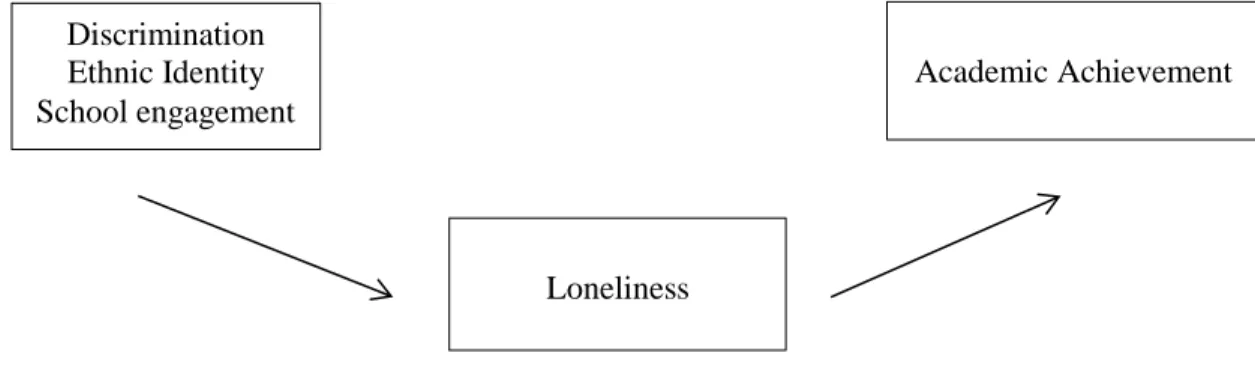
Figure 1. The hypothesized model.
Ethnic Identity, Discrimination Experiences, and Academic Performance
Ethnic identity pertains to an individual’s degree of self-categorization and sense of belonging to an ethnic group often developed through experiences, knowledge, and interactions with one’s ethnic in-group and other out-groups. Much research has been conducted on the possible buffering role of a strong positive racial identity on the relationship between racial discrimination among African American youth and one’s mental health. Sellers, Linder, Martin, and Lewis (2006) found that adolescents with lower levels of public regard, how positively or negatively one thinks society views his or her ethnic community, had a greater risk of
experiencing racial discrimination. Furthermore, low public regard also served as a buffer against the impact of racial discrimination on one’s psychological functioning. African Americans with a greater sense of public regard were seen to have more positive psychological functioning. Ethnic identity and discrimination experiences could become especially significant for African
Americans in predominately white institutions in which their minority status is often highlighted. Students who already have low racial public regard, feel disconnected with their racial group, and experience greater racial discrimination are of course likely to have greater difficulty engaging and integrating into the new social and academic environment of college.
Discrimination Ethnic Identity School engagement
Loneliness
Academic achievement has proven to be a social process in addition to an intellectual one. African American adolescents who had a strong connection to their ethnic group and high levels of perceived racial discrimination performed academically just as well or almost as well as their peers who perceived little to no racial discrimination (Eccles, Wong, & Peck, 2006). The effects of discrimination on youth can be lasting and follow adolescents later on in life, not only in regards to academic achievement, but also motivation (Eccles, Wong, & Peck, 2006).
Chavous, Rivas-Drake, Smalls, Griffin, and Cogburn (2008) found that classroom and peer discrimination experiences served as risk factors for later academic adjustment in an adolescent’s life. African American adolescents’ perceptions of peer discrimination in 8th grade were linked to their rating of school importance in 11th grade.
Loneliness
The transition from home and high school to college is one that likely warrants many issues with attachment security. Feelings of emotional distress, like loneliness, are often
Cutrona, 1980). Moreover, it has been suggested that having active attachment and a strong sense of connection to one’s ethnic group is an integral part of ethnic identity and a key factor in mental health maintenance (Eccles, Wong, & Peck, 2006). It could be that involvement in racially based activities can help minority students reach and maintain a stable mental health status as well as succeed academically in relation to their peers of various races.
This issue of proper integration into one’s university may worsen when considering an African American student attending a predominately white institution (PWI). African American students at PWIs commonly experience difficulties with social as well as academic integration (Davis, 1995). The majority of the research conducted on African American student performance and mental health in PWIs focuses on cultural and socioeconomic between group differences amongst African Americans and Caucasians. Little research has been done on the within group variances of African American students, such as divergences in personal backgrounds, high school experiences, socioeconomic status, and college experiences had specifically by African American students. This would be in opposition to the more common study format of using race as a categorizing variable for multiple race studies (Stage, 1989). With greater and more in depth information on the individuals within this group and their specific interactions with their higher education environments researchers may be better able to describe the educational experiences and thus outcomes of African American students and better inform college retention efforts. Loneliness, School Engagement, and Academic Achievement
extreme minority in PWIs (Smedly, Myers, & Harrell, 1993), they are driven to increasingly seek the company and support of other African Americans. Smedly et al. (1993) also report that the most devastating stressors for minority students involved factors that hindered their academic confidence and ability to bond to the institution. These types of stressors were seen to come both from within an individual as well as from the institution’s social environment and composition.
It has also been seen that student engagement and involvement in the campus environment has an important association with student retention (Kuh, 1995). Kuh (1995) describes the idea that the more time, psychological energy, and physical energy a student puts into educationally intended activities the more they will benefit from the university experience all together. Hausmann, Schofield, and Woods (2007) found that, when controlling for
background and other variables, sense of belonging to one’s university predicted student
intentions to persist at the institution. Additionally, sense of belonging was seen to increase over time for African American students who reported greater peer support. It is evident that
engagement with an individual’s environment not only helps with feelings of belonging, but also with motivation to continue in such an environment.
surpassed that of White students (Kuh et al., 2008). Likewise, Harper and Quaye (2007) found a clear link between “Black identity status, the selection of venues for out-of-class engagement, and the use of student organizations as platforms for racial uplift and the advocacy of
racial/ethnic minority student interests” in their qualitative study of African American male student leaders at six predominantly White universities.
The Current Project
The overall goal of this study is to determine the relationships between psychosocial factors that predict mental well-being and academic achievement, critical aspects of the
achievement and retention gap held by African American undergraduates. This study specifically aims to test one component of the model previously described. Specifically, we hypothesize that 1) African American students coming from high schools with a greater African American presence will be more inclined to participate in African American targeted and dominated organizations; 2) African American students who join more African American based groups in college will experience less loneliness; and 3) African American students involved in fewer African American based groups in college will perform worse academically.
Method Participants
the study. In the sample 84.7% of the student’s had at least one parent who completed some college, has a college degree, or has graduate education or beyond. Participants were also asked to report their approximate family income per year. Of those who knew their approximate yearly family income (90.8%), 56.4% had family incomes of $50,001 or greater. The majority of participants came from southeastern high schools (69.5%). As for racial composition, 50.3% of participants came from high schools composed of 25% or less African American students, 21.7% came from high schools composed of 26-50% African American students, 10.5% came from high schools composed of 51-75% African American students, and 17.5% came from high schools composed of 76-100% African American students.
In the follow-up survey there was a 79.8% response rate leaving the sample at 162 participants. Students self-reported their high school grade point averages (M= 3.76, SD= 0.19) at time 1 and then later reported their first semester college grade point averages (M= 3.02, SD= 0.54), both on a 4-point scale from 0.00-4.00.
Procedure
also received a gift card of five dollars. Participants were not required to provide their names or any other personal identifying information except university email addresses for follow-up reasons and compensation distribution.
Measures
Students completed a number of well-validated surveys on ethnic identity, sense of belonging both within and outside of the African American community, racial discrimination experiences, high school involvement, college involvement both within and outside of the African American community, and loneliness. Additionally, students were asked to report the approximate percentage of African American students in their high school given the options of less than 10%, 10-25%, 26-50%, 51-75%, 76-90%, and more than 90%. This measure was accepted based on face validity. The measure of loneliness was used as the primary outcome of this study.
Loneliness. UCLA Loneliness Scale- Version 3 was used to assess subjective feelings of
loneliness and feelings of social isolations (Russell, 1996). This latest revised version aimed to simplify the wording and response format of the previous scale. The scale is made up of 20 items measured on a 4-point Likert scale of 1: Never, 2: Rarely, 3: Sometimes, and 4: Often.
African American Community Involvement. As a way to measure school engagement within ones’ racial group, we looked at whether or not a student joined any African American groups in college. Students were asked whether or not as well as how many of a particular type of group they had joined in college on a scale ranging from 0 to 6 and above. For describing the type of group, participants were given the options of leadership positions, community service based organizations, religious based organizations, professional or career oriented organization, arts and cultural groups, and fraternities or sororities. If a participant indicated that they had joined one of these group types they were then prompted to report whether the group was within the African American community in their university. Responses were scored first into a
dichotomous measure of those who had joined zero African American clubs and those who has joined one or more clubs. Another measure of the total number of African American groups participants joined was created by taking the total number of students who had joined one, two, or three groups. No student reported joining more than three groups in the African American community at their school.
Data Analysis Plan
have poor academic achievement during college. This hypothesis was also tested through the use of a hierarchical multiple regression.
Results
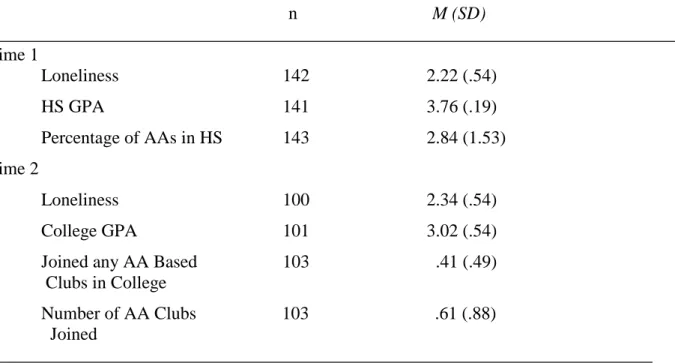
Preliminary Analyses. As seen in Table 1, means and standard deviations were calculated
for all variables used in this study. Pearson correlations were conducted to examine bivariate associations among all study variables (see Table 2): Loneliness at time 1 and time 2, high school grade point average, approximate percentage of African American students in one’s high school, college grade point average thus far, whether or not a student joined any African
American based clubs during their first semester of college, and how many African American clubs were joined. Significant correlations at the p<.05 level were seen between a participant’s college grade point average and the percentage of African Americans in their high school as well as between one’s high school grade point average and whether the participant joined any African American based clubs in college. At the p<.01 level, significant correlations were seen between loneliness at time point 1 and at time point 2, high school and college grade point average, loneliness at time point 2 and the percentage of African Americans in a participant’s high school, and finally the percentage of African Americans one’s high school and whether the participant joined any African American based clubs in college.
To examine whether high school African American percentage predicted college
loneliness at time 2 a hierarchical multiple regression was created. In the model, loneliness time 1 scores were controlled on an initial step while loneliness at time 2 was used as the dependent variable. On a second step, African American high school percentage was entered, see Table 3 for results. In addition to including the percent of African Americans in one’s high school we also included the measure of whether or not a participant joined any African American targeted clubs in college. No analyses showed that joining African American based clubs in college was a relevant predictor in this model. Results suggest a marginal effect indicating that higher
percentages of African American students in one’s high school are related longitudinally to higher levels of loneliness, after controlling for prior levels of loneliness.
The final hypothesis was that college grade point average could be predicted by a
student’s involvement in African American based groups in their university. This was also tested using a hierarchical multiple regression using college grade point average as the dependent variable and controlling for high school grade point average. Next, the measure of whether or not a participant joined any African American targeted clubs in college, the percent of African Americans in one’s high school, and loneliness scores at time 1 were entered. Controlling for loneliness at time 1 helped to ensure that college grade point average was being considered aside from its possible connection to loneliness. Again, no analyses showed that joining African American based clubs in college was a relevant predictor in this model. The results shown in Table 4 suggest a significant effect demonstrating that higher percentages of African American students in one’s high school are related longitudinally to lower grade point averages, after controlling for one’s previous high school grade point average and loneliness at time 1.
The study of African American engagement and thus disengagement within PWIs serves an important role in understanding low African American enrollment in universities and the dismal retention rates that are only adding to this academic disparity. 4-year graduation rates at UNC suggest that as few as 64% of African American students graduate from PWIs. Moreover, In comparison to Caucasians, African American graduation rates are 10% lower for females and 20% lower for males. More research is needed to understand the more precise factors that lead to academic success and retention among African American students.
Results for hypothesis one indicated a positive correlation such that higher percentages of African Americans in one’s high school was related to greater participation in African American based groups in college. This is important because it shows who is more likely to join these African American based clubs in college. The results also fall in line with the idea that minority students in predominately white institutions try to find their own racial niche on a PWI campus (Smedly, Myers, & Harrell, 1993). Based off of this present study, it is evident that African American students coming from high schools with greater amounts of students of the same race may be more inclined to seek ways to replicate or maintain a similar racial composition in college. Higher education institutions should therefore focus efforts on developing high quality racial niches through campus organizations. These groups can also serve as a way for
institution altogether (Neto & Barros, 2000). Moreover, increased university management and improvement of African American clubs could allow the institution to escalate feelings of school attachment and directly apply retention support methods to those who may need it most (Kuh, Cruce, Shoup, Kinzie, & Gonyea, 2008).
In the second hypothesis there was a marginal effect longitudinally relating higher high school percentages of African Americans to higher levels of loneliness. Again this aligns with research on not only the desire, but also the psychological need, for minority students in
predominately white institutions to find a racial niche campus (Smedly, Myers, & Harrell, 1993). As previously mentioned, loneliness felt from feelings of not belonging can be remedied by involvement and inclusion with one’s school (Berman & Sperling ). This information coupled with the links seen between a lack of school engagement and academic persistence helps show that universities should concentrate retention efforts in student organizations (Hausmann, Schofield, & Woods, 2007). Further implications of this finding can be thought of in conjunction with hypothesis 3.
While again assessing if participants joined any African American clubs on campus was not shown to be a relevant predictor, hypothesis 3 indicted a longitudinal relationship between higher high school percentages of African Americans and lower grade point averages in college. Similarly to the implications of the previous results discussed, this finding highlights the great disadvantage faced by students coming from schools with increasing amounts of African Americans.
that areas with greater amounts of African Americans may also be low socioeconomic regions with a unique set of student and school resources due to this low socioeconomic status (Kim, 2011). For instance, while many schools in low socioeconomic areas lack the physical means to support their students, oftentimes these areas have opportunities for minority enrichment
programs. Students accustomed to competing with peers of similar upbringings or accustomed to a certain amount of academic support in school may be unprepared for the lack of specific attention placed on minority students at PWIs (Harper & Quaye, 2007).
Furthermore, in Harper and Quaye’s 2007 the most successful of the African American males enrolled in PWIs were those able to maintain their black identities within the context of predominantly White student organizations as opposed to trying to adjust their ethnic identities to their surroundings. Students habituated to a certain amount of African American peers around them may not be equipped in preserving their ethnic identities in varying contexts involving differing races. These social factors may be contributing to the low academic achievement seen in students coming from high schools with greater amounts of African Americans. Further research should be done on the role of African American ethnic identity formation and stability when students are entering the new environments of higher education institutions.
grow in their understanding of and relation to other historically disadvantaged groups.
Furthermore, student engagement has been seen to help minority students compensate for the shortcomings often experienced by historically underserved students (Kuh et. al, 2008). Diverse cultural exposure would help African American students who experience the most difficulty adjusting to the racial composition of a PWI by cultivating their skills to thrive in more racially diverse settings. PWIs must focus efforts on aiding students who from high school are less familiar with the racial makeup of such institutions. Universities should make efforts to help students find a social niche both within and outside of the African American community at their institution to foster student success and mental well-being.
The present study represents advancement in the research of African American student academic, psychological, and social success at predominately white institutions. The study was unique in its consideration of high school factors and their effects on subsequent student academic performance and mental health at a university. Additionally, while the use of a completely African American sample was beneficial in focusing solely on factors prominent in the African American community, future studies should use both Caucasians and African
Americans for better understanding of the social interactions at a PWI. This would also allow for the consideration of the loneliness experiences of all incoming students to more precisely
identify racially relevant factors in loneliness.
thus could have missed more subtle feeling of alienation or a lack of belonging. Future studies should look for a measure outside of loneliness that captures general feelings of unhappiness and low life satisfaction that is not as connected to clinically diagnosed feelings of sadness.
Table 1. Means (and standard deviations) for Primary Variables at Time 1 and Time 2 n M (SD)
______________________________________________________________________________ Time 1
Loneliness 142 2.22 (.54)
HS GPA 141 3.76 (.19)
Percentage of AAs in HS 143 2.84 (1.53) Time 2
Loneliness 100 2.34 (.54)
College GPA 101 3.02 (.54)
Joined any AA Based 103 .41 (.49)
Clubs in College
Number of AA Clubs 103 .61 (.88) Joined
Table 2. Bivariate Associations Among Primary Variables
Loneliness HS Percentage Loneliness College Joined any Number of T1 GPA of AAs T2 GPA AA Clubs AA Clubs in HS in College Joined
Time 1
Loneliness -
HS GPA -.16 -
Percentage of AAs in HS .15 .01 -
Time 2
Loneliness .56** -.08 .34** -
College GPA -.05 .32** -.28* -.07 -
Joined Any AA Based Clubs in College .17 -.25* .34** .19 -.16 -
Number of AA Clubs Joined .15 -.27* .34** .08 -.11 .85** - * p < .05
Table 3. Prediction of Loneliness at Time 2 by Joined Any African American Clubs in College and High School Percentage of African Americans
DV= Loneliness Time 2
ΔR2
b (SE b) β
Step 1 .315***
Loneliness Time 1 .503 (.095) .500**
Step 2 .054
Joined Any AA Clubs in College .119 (.110) .106
Percentage of AA in HS .065 (.036) .180† †p = .08
Table 4. Prediction of College GPA by Joined Any African American Clubs in College, High School Percentage of African Americans, and Loneliness at Time 1
DV= College GPA
ΔR2
b (SE b) β
Step 1 .315***
HS GPA .932 (.332) .305**
Step 2 .054
Joined Any AA Clubs in College -.024 (.130) -.021
Percentage of AA in HS -.098 (.042) -.262*
Loneliness Time 1 .056 (.109) .055 *p < .05
References
Allen, W. R. (1992). The color of success: African-American college student outcomes at predominantly white and historically black public colleges and universities. Harvard
Educational Review, 62(1), 26-45.
Berman, W. H., & Sperling, M. B. (1991). Parental attachment and emotional distress in the transition to college. Journal of Youth and Adolescence,20, 427–440.
Chavous, T. M., Rivas-Drake, D., Smalls, C., Griffin, T., & Cogburn, C. (2008). Gender matters, too: The influences of school racial discrimination and racial identity on academic
engagement outcomes among African American adolescents. Developmental
Psychology, 44(3), 637.
Davis, J.E. (1995). College in Black and White: Campus environment and academic achievement of African American males. Journal of Negro Education, 63 (4), 620-633.
Eccles, J. S., Wong, C. A., & Peck, S. C. (2006). Ethnicity as a social context for the
development of African-American adolescents. Journal of School Psychology, 44(5), 407-426.
Ford, D. Y., & Whiting, G. W. (2011). Beyond testing: Social and psychological considerations in recruiting and retaining gifted black students. Journal for the Education of the
Gifted, 34(1), 131-155.
Harper, S. R., & Quaye, S. J. (2007). Student organizations as venues for black identity expression and development among African American male student leaders. Journal of
Hausmann, L. R., Schofield, J. W., & Woods, R. L. (2007). Sense of belonging as a predictor of intentions to persist among African American and white first-year college
students. Research in Higher Education, 48(7), 803-839.
Joiner, T. E. (1997). Shyness and low social support as interactive diatheses, with loneliness as mediator: Testing an interpersonal–personality view of vulnerability to depressive
symptoms. Journal of Abnormal Psychology, 106, 386–394.
Kim, Y. M. (2011). Minorities in higher education: Twenty-fourth status report 2011 supplement. Washington, DC: American Council on Education.
Kuh, G. D. (1995). The other curriculum: Out-of-class experiences associated with student learning and personal development. The Journal of Higher Education, 123-155.
Kuh, G. D., Cruce, T. M., Shoup, R., Kinzie, J., & Gonyea, R. M. (2008). Unmasking the effects of student engagement on first-year college grades and persistence. The Journal of Higher
Education, 79(5), 540-563.
Neto, F., & Barros, J. (2000). Psychosocial concomitants of loneliness among students of Cape Verde and Portugal. The Journal of Psychology, 134(5), 503-514.
Nicpon, M. F., Huser, L., Blanks, E. H., Sollenberger, S., Befort, C., & Robinson Kurpius, S. E. (2006). The relationship of loneliness and social support with college freshmen's academic performance and persistence.Journal of College Student Retention: Research, Theory and
Practice, 8(3), 345-358.
Sellers, R. M., Copeland‐Linder, N., Martin, P. P., & Lewis, R. (2006). Racial identity matters: The relationship between racial discrimination and psychological functioning in African American adolescents. Journal of Research on Adolescence,16(2), 187-216.
Smedley, B. D., Myers, H. F., & Harrell, S. P. (1993). Minority-status stresses and the college adjustment of ethnic minority freshmen. Journal of Higher Education 434-452.
Stage, F.K. & Hossler, D. (1989). Differences in family influences on college attendance plans for male and female ninth graders. Research in Higher Education, 30(3), 301-315.
The University of North Carolina. (2010). The Undergraduate Retention Study. Chapel Hill, NC: The Retention Task Force.