1316
Headmaster’s Competency In Preparing
Vocational School Students For Entrepreneurship
Dina Apriana, Muhammad Kristiawan, Dessy WardiahAbstract - This study originated from the results of a preliminary study that the Headmaster of State Vocational school (SMK) 6 Palembang has an important role and function in achieving the vision, mission and goals of education. One form of competency development is developing entrepreneurship at State Vocational school 6 Palembang. The purpose of this study was to analyze entrepreneurial competency of the headmaster of State Vocational school 6 Palembang in preparing vocational students for entrepreneurship. This study uses a qualitative research model. The subjects in this study were the heads of State Vocational school 6 Palembang. The results of this study concluded that entrepreneurial competency of the headmaster of State Vocational school 6 Palembang played an important role in advancing the school. From the results of the Headmasters' entrepreneurial competency indicators in terms of innovative and creative competencies, it shows that Headmasters create new ideas/ideas about school plans and programs. The headmaster of the Palembang 6th State Vocational School cooperates with several industries. The Headmaster's entrepreneurial competency in terms of hard work competency, shows that the headmaster of State Vocational school 6 Palembang is always on time and comes home later than the teacher and staff, never satisfied with the success of the school, and works and is responsible as the Headmaster. The Headmaster's entrepreneurial competency in terms of motivational competency, efforts made such as the frequent holding of seminars with the release of famous entrepreneurs, invites alumni who have succeeded in entrepreneurship and are also given honorariums if these students get a large number of orders so the students become more enthusiastic and motivated. The Headmaster's entrepreneurial competency in terms of abstinence, this shows that when failing activities, the Headmaster builds up and rises to complete, the Headmaster is principled towards good direction for school, the Headmaster is calm and in no hurry to take action, and the Headmaster follows and applies the development of science and technology through the media.
Index Terms – Headmaster’s Competency; Students; Entrepreneurship.
—————————— ——————————
1 INTRODUCTION
Unemployment is generally caused by the number of workforce or job seekers is not proportional to the number of jobs that are able to absorb it. Unemployment is often a problem in the economy because with unemployment, productivity and income of the community will decrease so that it can cause poverty and other social problems. The amount of unemployment is usually in line with the increase in population and is not supported by the availability of new jobs or reluctance to create jobs (at a minimum) for themselves or indeed it is not possible to get employment or not to create jobs. Actually, if someone creates jobs, creating jobs (at a minimum) for themselves will have a positive impact on other people as well, for example, from some of the results obtained can be used to help others even a little.
In a developed economy, most people who become unemployed get jobs in a short time. Unemployment is also caused by the still weak quality of education and finding employment. Then, one of the government's efforts to reduce unemployment in Indonesia is to increase vocational schools (SMK). According to the Central
Statistics Agency (2018) the level of Open Unemployment (TPT) for vocational schools (SMK) is highest among other levels of education, which is 8.92 percent. This figure illustrates the still high unemployment and poverty in Indonesia. Unemployment and poverty occur because the comparison of the number of job opportunities is not comparable to the supply of new labor or the number of graduates from all levels of education (Saiman, 2009).
This problem is a challenge for the Indonesian nation in the future especially by Vocational Schools in preparing the next generation who master science and technology and are able to transform science into action as the application of knowledge. The implementation of good education basically as an improvement in the quality of education, one of the factors driving the success of the implementation and management of education is good and competent human resources in the field of education.
institutions such as High Schools (SMA), Vocational schools (SMK) are required to produce graduates who are
ready to work, have attitudes, character and
entrepreneurial behavior as well as life skills to work in all fields in accordance with the needs of the industrial world. Integrated entrepreneurship education development is needed that is needed on soft skills and Competency Based Training (CBT) then it can improve the quality of creating student entrepreneurship soul on the level of personal maturity, student competency attainment, reduction on workforce needs gap, reduction on unemployment rates , and improvement in numbers of entrepreneurs who become the power of national economy (Marliyah et al., 2018).
Vocational education can produce an individual who has expertise according to his talents and interests in certain fields, both in the fields of technology,
administration, agro-industry and others. Human
resources can be a determinant of success because it can be used as an investment, both short and long term, so many organizations continue to develop their own resources. Therefore it is necessary to realize human resources that have intellectual intelligence, spiritual intelligence, and emotional intelligence, so as to print human resources that have quality education. Vocational education is a system that cannot be separated from the overall education system. However, the reality of the current situation is that the diversity of expertise is not balanced with learning support facilities and there are still very few teachers who are truly experts in the field of vocational expertise. The Headmaster is the most influential element in the education process. This is in accordance with what was stated by Mulyasa (2007), that the Headmaster is one of the components of education that has the most role in improving the quality of education. From these explanations the Headmaster has an important role because it must be able to influence, guide, coordinate and mobilize other people related to the development of the science of education and the implementation of education and learning so that the activities carried out can be more effective and efficient in achieving educational goals and learning.
The Headmaster is responsible for micro-education management, which is directly related to the learning process in school. As stated in PP 28 article 12 of 1990 paragraph 1, that Headmasters are responsible for organizing educational activities, school administration, fostering other educational personnel, and utilizing and maintaining facilities and infrastructure. The issuance of the Minister of National Education Regulation No. 28 of 2010 concerning the Assignment of Teachers to become
School Headmasters complements the previous regulation, namely the National Education System Law Number 20 of 2003 which stipulates that assignments to be Headmasters must be in accordance with the standards, because Headmasters play an important role. standard leadership ability. These abilities or skills that someone needs to show when doing something.
To understand the vision and mission and to have good integrity is not enough. To be successful, Headmasters must have the competencies required to be able to carry out their responsibilities properly and correctly (Fitria, 2018). As leaders, Headmasters must be able to encourage the emergence of strong will with enthusiasm and confidence of the teachers, staff and students in carrying out their respective duties (Irmayani et al, 2018) (Wandasari et al, 2019). It also provides guidance and direction to the teachers, staff and students and provides encouragement to drive and stand in front for progress and inspire the school to achieve its goals (Lian et al, 2018). One program that must be carried out by the Headmaster is the ability of the Headmaster to carry out entrepreneurial competencies (Sarina et al, 2019). This was stated by the Directorate General of Education Personnel of the Directorate General of Quality Improvement of Educators and Education Personnel (DG PMPTK) who had compiled material to strengthen the ability of school Headmasters and school supervisors. The Vocational Curriculum contains 3 subject groups namely Adaptive, Normative and Productive. Entrepreneurial education is getting new sources of income. Institutions are focusing on new inventions and knowledge, which can be exploited by new ventures (Zulfiqar, et al, 2017).
Government Regulation No. 19 of 2005, National Education Standards Article 26 paragraph 3, concerning the purpose of Vocational schools (SMK) is to prepare graduates to (a) enter employment and can develop professional attitudes within the scope of business and management expertise; (b) able to choose a career, be able to compete and be able to develop themselves within the scope of business and management; (c) becoming a mid-level workforce to fill the needs of the business and industry at present and in the future in the business and management sphere; and (d) become productive, adaptive and creative citizens. Thus, vocational students are intentionally prepared to enter employment opportunities through career paths to become middle-level workers and become self-employed (entrepreneurship). Therefore, vocational students need to be equipped with learning and knowledge that leads to the world of work and business.
in primary and secondary education based on the national policy items contained in the 2010-2014 RPJMN, namely increasing access to quality, affordable, relevant and efficient education towards elevating welfare people, independence, nobility of character, and strong national character. The development of the education sector is directed towards achieving economic growth supported by the harmony between the availability of educated workers and the ability to 1) create employment or entrepreneurship; and 2) answering the challenges of labor needs. In Vocational schools (SMK), entrepreneurship is one of the subjects taught to students (Sudarmiatin, 2009). Tobari et al (2018) to compete in the ASEAN market, Indonesia as one of the ASEAN countries is dealt with the challenge to improve the quality of human resources. Improving the quality of Indonesian human resources is one of the efforts to build productivity to compete with ASEAN countries. One of the most important efforts in improving the quality of human resources is through the education sector.
The rearrangement of the school curriculum is divided into national, regional and school level curriculums so that it can encourage the creation of student outcomes that are able to answer the integrity of human resources to support
national and regional growth by including
entrepreneurship education, such as what occurs in Vocational Schools where the curriculum incorporates entrepreneurship education as an eye compulsory lessons and adding hours outside of the learning time in the afternoon. The nature of the provision of entrepreneurial material provides provision of capabilities in the form of basic competencies related to the independence of graduates in order to be able to work independently (Subijanto, 2012). According to Timmons et al. (2004) entrepreneurship is a way of thinking, studying, and acting based on business opportunities, a holistic approach, and balanced leadership. According to
Zimmerer (2002) suggests that entrepreneurs
(entrepreneurs) are those who create a new business by taking risks and uncertainties to achieve profit and growth by identifying opportunities and combining various resources.
The development of entrepreneurial values in Vocational Schools (SMK) has begun to be seen since using the 2013 curriculum. Vocational schools must have a special place for the application of entrepreneurial values, namely through production units, school canteens, business centers, cooperative students, student practice
rooms , product processing, handicrafts and
extracurricular activities. The existence of a production unit plays a very important role because students are
trained to become entrepreneurs in order to actualize their abilities as entrepreneurship in production units which are used as a place for training for students in developing the values of their entrepreneurial spirit. Entrepreneurship values developed are social values (characteristics) such as being innovative, working hard, motivating, never giving up, confident, and always looking for solutions. According to Suryana (2001) entrepreneurship arises when an individual dares to develop new ideas and efforts.
Vocational education has three main benefits, namely 1) for students as self-improvement, increasing opportunities
for employment, increasing opportunities for
entrepreneurship, increased income, preparation of further education, self-preparation for society, nationhood, statehood, adaptation to change and the environment; 2) for the industrial world can obtain high-quality workforce, ease the cost of business. Helping advance and develop business; 3) for the community can improve people's welfare, increase national productivity, increase state income, and reduce unemployment (Sudira, 2009). Entrepreneurship is a mental and soul attitude that is always active or creative empowered, created, created and modest and strives to increase income in its business activities. Entrepreneur is one who develops new products or ideas and builds business around the new concept (Lambing, 2000).
Vocational Subjects (MPK) are a number of subjects that lead to specific vocational mastery and abilities, in the educational process that is closely related to the mental readiness of vocational graduates working is the learning process in these vocational subjects. Activities in Vocational Subjects are divided into two, namely theory and practice activities. Vocational Subject Theory is a theory that becomes a source of knowledge to understand practice. Vocational Subject Theory is a reference for a practical activity, if an error occurs in the use of the theory it will cause errors in practical activities. Practical activities are concrete steps and proof of what is contained in the theory, in other words that practical activities are works based on theory.
Increasing entrepreneurial figures Vocational schools students are provided with various skills in accordance with their fields. Vocational education also provides entrepreneurship education that is in line with existing competencies Entrepreneurship education in general is an
educational process that applies principles and
Entrepreneurial activities are classified into two categories, namely entrepreneurship because they see
business opportunities (entrepreneur activity by
opportunity) and entrepreneurship because they are forced to have no other alternative for the future except by doing certain business activities (Winarto, 2003). But entrepreneurship is not just making money, but producing something that is needed by the community through creative and innovative ideas, as well as enthusiasm to make a positive contribution to society. Because
entrepreneurship is a combination of creativity,
innovation, and courage to face the risk that is done by working hard to form and maintain a new business. Creativity here is "thingking new thing" (thinking something new), while innovation is "doing new things" (doing something new).
The results of the analysis of the needs of the skill industry products show the superiority of local products, such as local handicrafts as Craft and Entrepreneurial substances using a learning approach oriented to social reconstruction (Sarina et al, 2019). Furthermore, the Directorate of Vocational school Development (SMK) of the Ministry of Education and Culture (Kemendikbud) continues to develop entrepreneurship among SMK
students. Through the assistance program the
development of entrepreneurial learning, Headmasters are challenged to give birth to more young entrepreneurs from vocational schools. subdirectorate curriculum of the
directorate of vocational development. Vocational
entrepreneurship education is implemented in various forms of production and business based learning, such as teaching factory. This entrepreneurship printing school program is to integrate the concept of work, study and entrepreneurship.
In developing entrepreneurial spirit in vocational students, not only the skills education needed by other factors needed is motivation or encouragement from the Headmaster's entrepreneurial policy program which causes students to have confidence in entering the world of entrepreneurship. The motivation in question is to give students a program of activities and psychological enthusiasm in starting a business. Every business that
starts always starts from zero, and even in
entrepreneurship things cannot be avoided such as failure. The main requirement that students must have for entrepreneurship is having entrepreneurial spirit and character. The spirit and character of entrepreneurship will be influenced by three factors, namely skills, knowledge, and abilities or competencies. Competency will be determined by business knowledge and experience. Entrepreneurship readiness is a set of skills and behaviors
needed for entrepreneurship under any circumstances (Firdaus, 2012). Entrepreneurial readiness of individual's cognitive attributes of capability and willingness to direct behavior in an entrepreneurial context (Lau, 2007).
From the results of Wibowo's (2011) study that the interest of SMK students in entrepreneurship after graduating from school can be caused by internal factors, external factors, learning factors and instrument readiness factors. According to Kurniati (2015) which influences the interest of entrepreneurship in outline can be grouped into two factors, namely the first Intrinsic factor is the factors that arise because of the influence of stimuli from within the individual itself namely income, self-esteem, feeling happy. Extrinsic factors are factors that influence individuals because of the influence of external stimuli. Factors that influence individuals because of the influence of external stimuli, namely the family environment, community environment, opportunities, and education. The interest in entrepreneurship is not taken from birth but grows and develops according to the influencing factors. Factors that influence the growth of decisions for entrepreneurship are the results of the interaction of several factors, namely the character of one's personality and environment.
According to Kodrat (2015) there are at least three main characteristics of an entrepreneur, namely 1) the ability to see business opportunities; 2) innovative and creative; and 3) the ability to calculate risks. the ability to see business opportunities is different from what others see, even those that are not taken into account at all. Opportunities have interesting features, last long according to time and related to a product or service that gives more value to its users. Entrepreneurial readiness for individuals with readiness for individuals with readiness for entrepreneurship as especially competent to observe and analyze their environment in such a way that they channel their creativity and productive potentials, so they may deploy them capability to dare and need for self-achievement "(Coduras et al, 2016).
various efforts called "learning"; and 3) learning entrepreneurship can be done through various efforts, for example: thinking alone (our brains are rich for thinking), reading (books, journals, internet/web-sites), internships, short courses, learning from successful entrepreneurs, direct observation in the field, dialogue with successful entrepreneurs, attending seminars, inviting successful entrepreneurs, listening to entrepreneurial events on television, or other ways that are considered appropriate for him to study entrepreneurship.
Regulation of the Minister of National Education of the Republic of Indonesia Number 13 of 2007 requires Entrepreneurship competencies that must be present in a school Headmaster, as follows.
Table 1. Headmaster Entrepreneurship Competencies (Permendiknas of the Republic of Indonesia Number 13 of
2007)
Dimmensions Competency
Entrepreneurship
1. Creating innovations that are
useful for the development of schools
2. Work hard to achieve school
success as an effective learning organization.
3. Having a strong motivation for
success in carrying out their main tasks and functions as school leaders
4. Never give up and always look
for the best solutions to the obstacles faced by schools
5. Having entrepreneurial
instincts in managing school production/service activities as
learning resources for
students.
According to Hakim (2010) Headmasters who have an entrepreneurial spirit in general have certain goals and expectations outlined in a realistic vision, mission, goals and strategic plans. In essence entrepreneurship in this school does not have to be interpreted as activities that are able to generate profits for the school materially (money) but the productivity of the school as a learning tool for students for the wider community. Headmasters play an important role in the quality of education found in schools, so that the abilities that must be possessed are in
accordance with the needs carried out in the interests of the quality of education in schools. By having these competencies, the Headmaster can use them for the progress of the school. Competency can be interpreted as knowledge, skills and abilities of individuals that directly affect performance (Fithri and Amanda, 2012). So that it can be interpreted that a successful entrepreneur is someone who has the knowledge, skills and qualities of individuals which includes attitudes, values, and behaviors needed to carry out work or activities. Entrepreneurship is an asset of a nation to be able to support the country's economic growth. Entrepreneurship acts as an agent of change, bringing ideas to markets and stimulating growth because of the tendency to innovate.
Rivai and Sagala (2010) suggest that Headmasters who have entrepreneurial spirit reflect personality, giving strength to schools to have a culture of sustainable achievement. The culture of achievement of the Headmaster is characterized by good entrepreneurship planning, good entrepreneurship program management, and the implementation of entrepreneurial programs creatively and innovatively.
According to Heru (2009), it is also stated that entrepreneurial competencies are divided into seven, as follows: a) Relationships between people, entrepreneurial competencies related to the ability to maintain, develop, develop, good relations with people, and those with an interest in company activities, such as with: coworkers, employees, goods suppliers, material suppliers, investors, creditors, the community; b) Technical competencies, entrepreneurial competencies related to techniques, methods, materials and labor that produce anger and services produced by the company; c) Competency of
marketing, entrepreneurial competency related to
entrepreneurial ability in the field of product marketing. This capability includes expertise in conducting market research, choosing a marketing strategy, combining a profitable marketing mix; d) Financial competency, entrepreneurial competency in managing finances, especially looking for the cheapest funding sources, using and investing profitable funds, making the right budget and dividing profits from business profits by satisfying all
interested parties; e) Conceptual competencies,
competencies possessed by entrepreneurs related to the ability to manage time efficiently.
The Headmaster is also required to have several
principles of entrepreneurship. Principles of
Entrepreneurship according to Sunarya (2011), the most important entrepreneurial principles are Dare or get out of Fear of failure. Brave meaning here is an action where we must be able to take a stand on the opportunities that arise in life, especially the opportunity to set up a business. An entrepreneur knows no level of education but knows at the level of someone who is willing to take risks. Even though education is important but its role here is precisely at the level of courage for the effort we will make. The ability that must be possessed by the Headmaster applies entrepreneurial principles in creating innovations that are useful for school development, namely (a) being able to act creatively and innovatively in carrying out work through ways of thinking and how to learn; (b) able to empower school potential optimally into various productive activities that benefit the school; and (c) able to foster an entrepreneurial (creative, innovative, and productive) spirit among school members (Rivai & Sagala, 2010).
Follow-up of the competency of the Headmaster in developing entrepreneurial competencies that will create entrepreneurial policies and programs that can be used as facilities and infrastructure for students to have great entrepreneurship. The education ministry of South Sumatra Province 2018 has data of 249 State Vocational or Private Vocational Schools. Researchers Choosing the object of research at State Vocational school 6 Palembang in South Sumatra Province is located at Jl. Major Ruslan, Duku Subdistrict, Ilir Timur 2 District, Palembang 30114, South Sumatra Province, which has prepared students who are great at entrepreneurship. The management and learning system at State Vocational school 6 Palembang is considered good and can be used as an example of a school that is able to prepare vocational students for entrepreneurship. The researcher chose SMK Negeri 6 with the management success criteria and strategies that
the Headmaster in taking policies related to
entrepreneurial competency, as an effort to prepare vocational students for entrepreneurship.
2 RESEARCH METHODS
The purpose of this study was to analyze the entrepreneurial competencies of the headmaster of State
Vocational school 6 Palembang in preparing
entrepreneurial vocational students. The research method used is qualitative research. As stated by Creswell (2012) that in qualitative research the purpose of the statements are that they can be best learned from participants. you
research a single phenomenon of interest and state this
phenomenon in purpose statement. Furthermore
according to Creswell in this qualitative research we can collect data and develop forms, called protocols, for recording data, as the study proceedings. In this qualitative research, we can collect data to be learned from other people in research and can be developed in a form, called a protocol, to record data during research.
Furthermore Sugiyono (2010) means that qualitative research is based on postpositivism philosophy in the sense that other objects are needed to be used to find the essential truths of research without changing the state or object of research, so that objects are left naturally (as opposed to experiments) where the researcher is an instrument the key, sampling data sources was done by purposive and snowball, collection techniques with triangulation (combined), data analysis was qualitative inductive, and the results of qualitative research emphasized the meaning rather than generalization. Then according to Moelong (2011) said that qualitative research emphasizes the process of searching data or information until the data is felt enough to make a conclusion. The subjects in this study were the heads of State Vocational school 6 Palembang. Data collection techniques used were observation, interviews and documentation. Data analysis uses qualitative data analysis techniques, Miles and Huberman, namely through the process of data reduction, display and verification.
3 RESULTS AND DISCUSSION
School Headmasters assume the greatest responsibility in efforts to realize innovation, or the development of independent schools (Kristiawan et al, 2017). Therefore, there are several keys to building entrepreneurship for school people, namely (1) generating courage in entrepreneurship, (2) cultivating dreams of the future, (3) giving opportunities to create and innovate, (4) implementation of students' skills, and (5) make it a habit for them to keep trying (Saroni, 2012).
State Vocational school 6 Palembang has implemented a 9001: 2015 Quality Management System from the TUV Certificate Body with Certificate Registration 16 100 0851 ready to become an education center and tourism training center. In addition, one of the strategic objectives of improving the quality and relevance of learning that is oriented towards character building is to increase the
relevance of vocational education by increasing
entrepreneurial skills theoretically and practically. Many
factors influence the process of forming this
entrepreneurial readiness, one of which is
knowledge, entrepreneurial education and knowledge to youth in order to gain skills and create their own source of income through business or jobs (Zulfiqar et al, 2017).
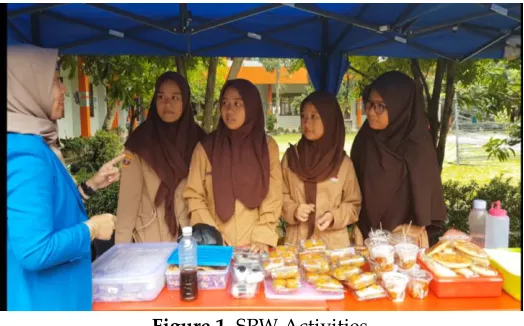
A school Headmaster must be able to find and take advantage of opportunities that arise to be able to generate additional income for the implementation of school activities so that it does not necessarily depend only on the government (Renata et al, 2018). Through the SMK Entrepreneurship Learning Development Assistance program, the Headmaster of State Vocational school 6 Palembang is challenged to give birth to more young entrepreneurs from Vocational Schools. State Vocational school 6 Palembang is expected to become an entrepreneurial printing school (SPW). The spirit of entrepreneurship should be sown since students study at school, so that they can become entrepreneurs without waiting for school to graduate. So that the SPW program can be started from grade X students through Vocational Course Integration namely Creative Products and Entrepreneurship, which is packaged through Digital Simulation and Communication (SIMDIG).
Figure 1. SPW Activities
Rohmah, et al. (2017) explained that Headmasters as agents of change in developing and improving their school performance through entrepreneurial leadership by organizing their own human resources to achieve common goals by behaving like an entrepreneur are proactive, optimizing risks, innovating to take advantage of opportunities, take personal responsibility, improve school productivity, and manage change in a dynamic environment for the interests of school organizations in carrying out the task of providing excellent service to school consumers.
The motivation work is have an effect significantly to the performance of SMK teachers in Palembang, its mean that the better of motivation work, then its more too for the performance of teachers SMK in Palembang (Andriani et al, 2018). The Headmaster must be creative and innovative in utilizing these opportunities (Irmayani et al, 2018) (Lian
et al, 2018) (Wandasari et al, 2018). Therefore, Headmasters are required to have entrepreneurial competencies. Competency The Headmaster has to be able to lead the school in order to make optimal use of school resources. A leader is said as an entrepreneur must be creative, innovative, hard working, resilient, and have an entrepreneurial instinct. As with the headmaster of the State Vocational school 6 Palembang, they must be able to act as entrepreneurs, able to identify new opportunities, inspire and motivate others to do something.
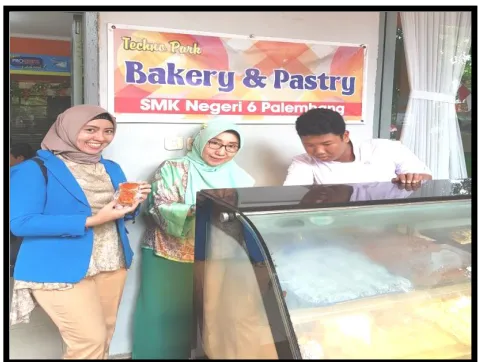
Thanks to the efforts of the Headmaster's hard work and support from the teacher, State Vocational school 6 Palembang received funding from the directorate of vocational schools for the management of Tekno Park in the procurement of daily necessities for the citizens of State Vocational school 6 Palembang. The ability of Headmasters to motivate, work hard, find solutions, and take advantage of opportunities, so that all production units in State Vocational school 6 Palembang can be utilized optimally as a source of income as well as a learning tool for students and teachers to form strong entrepreneurial souls. so students are expected to compete in this global era.
Facilitating various production units at SMK Negeri 6 Palembang, but also always giving an overview, direction and guidance, as well as becoming a model in transforming entrepreneurial values to teachers and students, this can be seen in the management of production units in the business center, student practice rooms , waserda, multi-purpose building, and school canteen. If there is a lack of facilities in the production unit, the Headmaster tries to complete the facility so that the maximum production unit yield/income can be obtained.
Headmasters who have entrepreneurial spirit in general have certain goals and expectations outlined in realistic vision, mission, goals, objectives and strategic plans. Between this vision, mission, goals and objectives, they are synergistic and illustrated and described. Realistic means that goals are adjusted to resources, both human resources and other supporting resources owned. The clearer the goals set, the greater the chance to realize them. Thus, Headmasters with entrepreneurial spirit must have clear and measurable goals in developing schools. To find out whether these goals can be achieved, the vision, mission, goals and objectives are developed into indicators that are more detailed and measurable for each aspect or dimension, dimensions as in Permendiknas No. 13 of 2007. The indicators can also be developed into programs and
sub-programs that will further facilitate their
According to Permendiknas Article 13 of 2007, Headmaster Competency Standards must be possessed, one of which is the entrepreneurial competency of the Headmaster. It is the most effective use of curricula is made. In this respect, countries need education reforms. The readiness and willingness of educators for these reforms may play an important role in training success in these reforms. In Finland, the curriculum is defined as a document that guides teaching. As a matter of fact, it is stated that there is a strong desire to solve problems and implement reforms in Finland (Seikkula-Leino, et al 2012).
Competency is a skill that is needed when a task is carried out, which is obtained through practice and theoretical learning. This includes; skills, knowledge and
experience. The Headmaster's entrepreneurial
competencies which include innovation and creativity, hard work, strong motivation, never give up and entrepreneurial instincts that must be possessed by the Headmaster. There fore, entrepreneurial competencies are the underlying characteristics possessed by an individual which helps them to execute tasks in a manner that is most befitting (Lazar & Paul, 2015).
The success of State Vocational school 6 Palembang in terms of entrepreneurship is not only from its leaders, in this case the Headmaster, it is also supported by educators, students, alumni, parents/guardians and stakeholders involved in the school. These stakeholders are involved in the development and growth of schools, because schools are an organization that must work together in building a school-developed system. The role of the Headmaster becomes important in school development if each stakeholder synergizes, because the Headmaster is the regulator or the decision maker in each policy.
Ruskovaara et al. (2016) state that entrepreneurship education prioritizes training systems for head masters and teachers, so (Bikse et al., 2014) it is needed education levels including all lessons, administration, teachers, students, and organizations. Success in life is more determined by soft skills (Sailah, 2008) than of hard skills, because of the attitude and behavior change starting from soft skills of each individual's level of entrepreneurship education results (Martin & Lucu, 2014). The planned entrepreneurship education covers four aspects: craft, engineering, cultivation, and processing aimed at developing products using technology that is in accordance with the scale of the home industry. Successful entrepreneurial skills are measured at the institutional level.
The role of Headmasters and teachers in
entrepreneurship programs as influential factors in
determining the entrepreneurial attitude of the
entrepreneur needs educators to internalize the values of entrepreneurship education in students so that students can be intrigued within themselves. Entrepreneurial learning is defined as knowledge, skills and attitudes that affect the willingness and ability to perform the entrepreneurial job of new value creation (Lackeus, 2015). Entrepreneurial readiness of individual's cognitive attributes of capability and willingness to direct behavior in an entrepreneurial context (Lau, 2007). The dimensions of student entrepreneurship readiness are (1) Coursework to an entrepreneur, (2) Achievement test, and (3) Average score of entrepreneurial subjects. Student performance on all indicators show significant readiness disparities (Roderick et al., 2009).
According to Mitchelmore & Rowley (2010)
entrepreneurial competencies are used by government agencies and others in their drives for economic development and business success, the core concept of entrepreneurial competencies, its measurement and its relationship to entrepreneurial performance and business success is in need of further rigorous research and development in practice. The innovation is one of the indicators of entrepreneurial competencies possessed by the Headmaster. Not all Headmasters can make innovations for their schools. But not so for the headmaster of State Vocational school 6 Palembang has made an innovation that is very useful for students. Gupta et al. (2004) stated that entrepreneurial leadership has three key characters, namely (1) being inclined to take more business related risk; (2) favoring cange and innovation to obtain competitiveadvantage; and (3) competing aggressively with other firms.
A competent headmaster must focus on the work and responsibilities he carries. The Headmaster is the driving force for the school, the success or failure of a school depends on how the Headmaster works. Likewise with teachers and employees, they will also be compelled to work hard and responsibly when they see the Headmaster also a hard worker. Hardworking is one of the characteristics of an entrepreneur. From all dimensions of entrepreneurial competency, the attitude of the hard work of SMK Negeri 6 Palembang is the most powerful character it has. Entrepreneurial competencies Launching a new business requires different resources varying from
financial to behavioral resources. Six types of
entrepreneurial competencies in terms of entrepreneurial personality traits which include: opportunity, relationship, conceptual, organizing, strategic and commitment competencies (Man, Lau, & Chan, 2002).
obstacles faced by the school with a calm attitude to find solutions. As well as acting as a leader, to have entrepreneurial instincts, Headmasters can get along with
teachers, students and stakeholders respond to
suggestions and criticisms, are innovative, flexible, have many sources, are versatile and know a lot of scientific and technological developments, social and cultural schools and Headmasters has a forward-looking outlook and school perspective.
Strong motivation for success must be owned by a competent headmaster. Strong motivation for success can be seen from a person's personality and behavior. Strong motivation for success is also evident from his daily life in carrying out his main duties and functions as the Headmaster. The headmaster of State Vocational school 6 Palembang has also proven that he has a strong motivation for success. This can be seen from everyday life which is always uplifting. Also seen from the way in motivating students, teachers, and employees to succeed. Motivation for success has resulted in various good achievements for school.
In the results of the study revealed that the headmaster of State Vocational school 6 Palembang had repeatedly failed but with strong determination and effort until it finally succeeded. This attitude shows that never giving up to achieve success. Unyielding attitude is one of the characteristics of an entrepreneur. An entrepreneur even almost all of them have failed. However, true entrepreneurs never give up until they finally achieve success. Failure after failure is used as a lesson and platform for more success. Studies reveal that the nature of competencies, perceived capability and opportunities refer to skills of entrepreneurs where role models and less fear of failure are targeted to define entrepreneur's personality (Zali et al., 2013). The need for achievement requires an unyielding attitude that includes character-oriented management of products and services for student learning facilities, perseverance and steadfastness, determination and hard work, great motivation, energetic and initiative, ability to take risks means to like challenges.
To complete in the ASEAN market Indonesia as one of the ASEAN countries is a challenge to improve the quality of human resources. Improving the quality of Indonesia efforts to build productivity to compete with ASEAN countries. One of the most important efforts in importing the quality of human resources through the education sector (Tobari et al., 2018). The Headmaster is required to have these competencies in carrying out the task because it is beneficial for the Headmaster in developing the school, achieving school success, carrying out basic tasks and
functions as a leader, facing school constraints, and managing school activities as a source of student learning.
The competency of the Headmaster includes various aspects of the attitude of a leader in carrying out the duties and role of the Headmaster as an educator and manager of education. With these competencies, the Headmaster can carry out activities in the school environment in accordance with the school goals set by the government, so that the quality of the school's education has increased not in decline. Although businesses are not aware of the significant role of competencies in business performance, studies that show there are incisable relationship between competencies and business performance (Ahmed, Rafiq, & Saad, 2003; Tien, Wang, & Tsai, 2005). Since entrepreneurial competencies are related to business performance (Mitchelmore & Rowley, 2010), entrepreneurs must pay special attention to their competency improvement in order to boost performance. On the other hand, business environment has diverse impacts on business perfor-mance (Ahmad, Ramayah , Wilson, & Kummerow, 2010).
The above obstacles are not an obstacle in the implementation of the Headmaster's entrepreneurial competencies. The Headmaster must be able to encourage the emergence of strong will with enthusiasm and confidence in carrying out entrepreneurial competencies. The Headmaster's entrepreneurial competency is very important because it can encourage teachers to conduct the learning process to be able to foster the ability of creativity, innovative power, problem solving skills, critical thinking and entrepreneurial instinct for students as a product of an education system. Based on these facts in order to support the role of the Headmaster in improving the quality of school education, the competent headmaster is required so that the Headmaster can guide, become an example, and mobilize (teachers, students and stakeholders) in improving the quality of education in schools. Therefore, the school Headmaster strengthening program is a very important effort to produce competent Headmasters in the desired quality (teachers, students and stakeholders) that is creative or innovative, critical thinking, never giving up,
strong motivation and entrepreneurial spirit
(entrepreneurship).
ambiguity; they make promises about obstacles that are considered insurmountable by others; and they are flexible to adapt to change (Burdus, 2010).
The above statement implies that a school Headmaster must be able to find and take advantage of opportunities that arise to be able to generate additional income for the implementation of school activities so that it does not necessarily depend solely on the government. The Headmaster must be creative and innovative in utilizing these opportunities. Therefore, Headmasters are required to have entrepreneurial competencies. Thus, based on the description above, the headmaster of the SMK Negeri 6 Palembang already has entrepreneurial competency as stipulated in Permendiknas No. 13 of 2007. Efforts of school Headmasters to increase community participation in the field of education through approaches with all school members and the community, involving parents in fostering students in the academic and non-academic fields, transparency and accountability in the use of funds. Competencies of entrepreneurs are one of the significant factors determining for success, performance and growth or failure of business operations (Brinckmann, 2008;
Kiggundu, 2002; Mitchelmore & Rowley, 2013).
Entrepreneurial competencies are carried out by individuals, who are and grow their businesses (Zizile & Tendai, 2018).
The Headmaster Leadership Strategy in empowering Human Resources at State Vocational school 6 Palembang by means of an approach through creativity and innovation to teachers and employees, and students so that they can motivate them to further improve quality and
empower potential. Entrepreneurship competencies
possessed by Headmasters have an influence on school development.
The results of the study are supported by previous research conducted by Maryono (2013) that the forms of entrepreneurial competency of Headmasters, namely innovation and creativity, have the nature of hard work, unyielding and entrepreneurial instincts. The efforts of Headmasters in increasing community participation in the field of education through an approach with all school people and the community, involving parents in fostering students in the academic and non-academic fields, transparency and accountability in the use of funds, supporting factors for increasing community participation in the education sector schools and communities about the importance of school programs related to student development while the inhibiting factors, the community does not fully understand the responsibility of education.
The competency of the headmaster of the Vocational School (SMK) school plays an important role in the
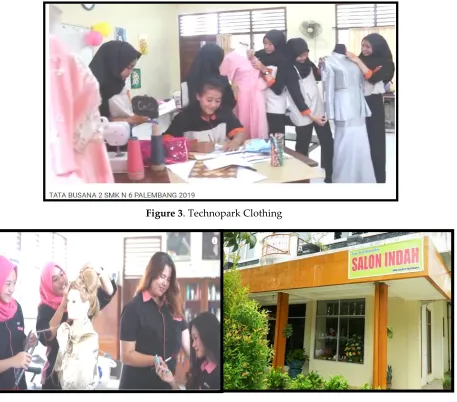
progress of the school. Entrepreneurship-based and ready-to-work Vocational Businesses were quickly responded to by State Vocational school 6 Palembang by developing Tekno Park, with Tekno Park in addition to student learning, the school wanted students to learn to develop industries for public consumption.
Figure 3. Technopark Clothing
Figure 4. Technopark Beauty
Figure 5. Technopark Hospitality
concluded that the entrepreneurial competencies of
Headmasters towards State Vocational school 6
Palembang are proven as follows.
a.
The Headmaster's entrepreneurial competency in termsof innovative and creative competencies, shows that the Headmaster creates new ideas/ideas for school plans and programs. The headmaster of the Palembang 6th State Vocational School cooperates with several industries. Such collaboration can be in the form of teacher internships, student marketing sites, guest teachers and making joint curriculum. It is hoped that teachers and students can obtain competencies that are in accordance with the demands of the industry so they can be more innovative and creative in producing a product/service to meet existing market opportunities.
b.
Headmaster entrepreneurial competency in terms ofhard work competency, shows that the headmaster of State Vocational school 6 Palembang is always on time and comes home later than the teacher and staff, never satisfied with the success of the school, and works and is responsible as the Headmaster. The effort to work hard is very necessary to form a school that is expected to fit the vision, mission and goals of the school. The Headmaster also always accompanies students to practice outside the effective hours of learning. Like accompanying children in cooking, which sometimes they are still on holiday. Because they have the opportunity to have business opportunities to meet market needs during holidays due to activities production is often carried out outside of effective hours, so the indicator of hard work is more emphasized. Intensively evaluates the resulting product to create industrial products that are capable of meeting market needs.
c.
The Headmaster's entrepreneurial competency in termsof motivational competency, this shows that the Headmaster is able to make changes to the school. This change was made by the Headmaster as a motivator for students to be enthusiastic about entrepreneurship. The efforts made such as the frequent holding of seminars with the introduction of famous entrepreneurs, inviting alumni who have succeeded in entrepreneurship and also given honorariums if these students get a large number of orders so that students become more enthusiastic and motivated.
d.
Headmasters' entrepreneurial competency in terms ofabstinence, this shows that when failing activities, the Headmaster builds up and rises to complete, the Headmaster Headmasters are towards good direction for school, the Headmaster is calm and in no hurry to take action , and the Headmaster follows and applies
the development of science and technology through the media. As is the case in looking for business opportunities. When we are confused or difficult to sell our products and services, we must take the initiative to be more enthusiastic in marketing our products or services, for example online. By utilizing technology now the process of marketing or selling goods/services is increasingly easier and practical. For example through websites, Whatsapp, Facebook, Instagram and so on. Never giving up is also shown by motivating students to continue to study hard and never give up. Not to be afraid of trying something new. Unyielding attitude is also shown by continuing to be enthusiastic to provide the best for their students and for the progress of the school.
5 REFERENCES
[1] Ahmad, NH, Ramayah, T, Wilson, C, & Kummerow,
L, (2010). Is entrepreneurial competency and business
successrelationship contingent upon business
environment?: A study of Malaysian SMEs. International Journal ofEntrepreneurial Behaviour & Research, 16(3), 182–203.
[2] Ahmed, PK, Rafiq, M, & Saad, NM. (2003). Internal marketing and the mediating role of organisational
competencies. European Journal of Marketing, 37(9),
1221–1241.
[3] Andriani, S., Kesumawati, N., & Kristiawan, M.
(2018). The Influence Of The Transformational Leadership And Work Motivation On Teachers Performance. International Journal of Scientific & Technology Research, 7(7).
[4] Badan Pusat Statistik Tahun 2018.
[5] Bikse, V., Riemere, I., & Rivza, B. (2014). Improved management of entrepreneurial education in Latvia. Procedia-Social and Behavioral Sciences, Vol 140, pp 69-76.
[6] Brinckmann, J. 2008. Competency of top management
teams and success of new technology-based firms: Springers.
[7] Burduş, E. (2010). Fundamentals of entrepreneurship.
Review of International Comparative Management, Vol 11 No (1), pp 33-42.
[8] Coduras et al., (2016). Measuring readiness for
entrepreneurship: An information tool proposal. Journal of Innovation & Knowledge, Vol 1, pp. 99-108. [9] Creswell, W. J. (2012). Educational Research, planning
conducting, & Evaluating Quantitative Research. University Of Neberaska-Lincoln: Pearson.
[10] Firdaus, Z.Z. (2012). Pengaruh Unit Produksi,
Kerja Siswa SMK [The Effect of Production, Labor and Family Support Units on Work Readiness of Vocational Students]. Diperoleh 20 Januari 2014, dari http://journal.uny.ac.id/index.php/jpv/article/downloa d/1045/846.
[11] Fithri, P. dan Amanda, F. S, (2012). Analisis
Kompetensi Kewirausahaan Industri Kecil Suku
Cadang di Kota Padang [Entrepreneurship
Competency Analysis of Small Parts Industry in
Padang City]. Optimasi Sistem Industri, Volume 11
Nomor 2, hal 280.
[12] Fitria, H. (2018). The Influence of Organizational
Culture And Trust Through The Teacher Performance
in The Private Secondary School in
Palembang. International Journal of Scientific &
Technology Research, 7(7).
[13] Gupta, Vipin., MacMillan, Ian C., dan Surie, Gita.
(2004). Entrepreneurial Leadership: Developing and
measuring a Croos Cultural Construct. Journal of
Bussiness Venturing. Elsevier Inc, Vol 19, pp 241-260.
[14] Hakim, A. (2010). Model Pengembangan
Kewirausahan Sekolah Menengah Kejuruan Dalam Menciptakan Kemandiriab Sekolah [Model of Vocational school Entrepreneurship Development in Creating School Self-Reliance]. Riptek , Volume 4, No 1, pp 1-14.
[15] Heru K. R, (2009). Kewirausahaan Entrepreneurship
Pendekatan Manajemen dan Praktik, Edisi Pertama [Entrepreneurship Entrepreneurship Management and Practice Approaches, First Edition]. Yogyakarta: Graha Ilmu.
[16] Irmayani, H., Wardiah, D., & Kristiawan, M. (2018). The Strategy of SD Pusri In Improving Educational Quality. International Journal of Scientific & Technology Research, 7(7).
[17] Kiggundu, M. N. (2002). Entrepreneurs and
entrepreneurship in Africa: What is known and what
needs to be done. Journal of developmental
entrepreneurship, 7 (3): 239.
[18] Kodrat, S. D. (2015). Entreprenuership Sebuah Ilmu
[Entreprenuership A Science]. Jakarta: Erlangga.
[19] Kristiawan, M., Ahmad, S., Tobari, T., & Suhono, S. (2017). Desain Pembelajaran SMA Plus Negeri 2 Banyuasin III Berbasis Karakter Di Era Masyarakat Ekonomi ASEAN [Design of Characteristics of High School 2 Banyuasin III in ASEAN Economic Community]. Jurnal Iqra’: Kajian Ilmu Pendidikan, Vol 2, No 2, pp 403-432.
[20] Tobari., Kristiawan, M., & Asvio, N. (2018). The Strategy of Headmaster on Upgrading Educational Quality In Asean Economic Community (AEC) Era.
International Journal of Scientific & Technology Research, 7(4).
[21] Kurnianti, E. D. (2015). Kewirausahaan Industri
[Industrial Entrepreneurship]. Yogyakarta: Depublish.
[22] Lackeus, M. (2015). Entrepreneurship education (what,
why, when, how). Entrepreneurship360 Background Paper.
[23] Lambing, P. C. (2000). Entrepreneurship. Nuw Jersey:
Prentice Hall Lnc.
[24] Lau, Shaffer, A. (2007). Entrepreneurial career success
from a Chinese perspective: conceptualization,
operationalization, and validation. Journal of
International Business Studies, Volume 38, pp 126 – 146.
[25] Lazar, N., and G. Paul. 2015. Entrepreneurial
competencies in a business enterprise – An overview. International Journal of Scientific Research, 4 (1): 226-227. [26] Lian, B., Kristiawan, M., & Fitriya, R. (2018). Giving
Creativity Room To Students Through The Friendly School’s Program. International Journal of Scientific & Technology Research, 7(7).
[27] Man, T.W.Y., Lau, T., & Chan, K.F. (2002). The
competitiveness of small and medium enterprises: a
conceptualization withfocus on entrepreneurial
competencies.Journal of Business Venturing, 17(2), 123– 142
[28] Marliyah, L., Sugiyo, Masrukhi, Rusdarti. (2018).
Model of Entrepreneurship Education in Vocational
School on Agribusiness Study Programme. Journal of
Entrepreneurship Education. Vol 21, Issue: 4.
[29] Martin, C., & Iucu, R.B. (2014). Teaching
entrepreneurship to students of education.
Procedia-Social and Behavioral Sciences, Vol 116, pp 4397-4400.
[30] Maryono. (2013). Kompetensi Kewirausahaan Kepala
Sekolah dalam Meningkatkan Partisipasi Masyarakat di Bidang Pendidikan Malang [Headmaster Entrepreneurship Competency in Increasing Community Participation in Education in Malang]. UIN: Malang.
[31] Mitchelmore, S., and Rowley, J. (2013).
Entrepreneurial competencies of women
entrepreneurs pursuing business growth. Journal of
Small Business and Enterprise Development, 20 (1): 125-142.
[32] Mitchelmore,S., Rowley,J. (2010) "Entrepreneurial
competencies: a literature review and development
agenda", International Journal of Entrepreneurial
Behavior & Research, Vol. 16 Issue: 2, pp.92-111.
[33] Moelong. (2011). Metodologi Penelitian Kualitatif
[Qualitative Research Methodology.]. Bandung: Remaja Karya.
[34] Mulyasa. (2007). Menjadi Kepala Sekolah Profesional
remaja Rosdakarya.
[35] Peraturan Menteri Pendidikan Nasional No 28
tahun 2010.
[36] Peraturan Menteri Pendidikan Nasional Republik
Indonesia Nomor 13 Tahun 2007 Kompetensi Kewirausahan Kepala Sekolah
[37] Peraturan Pemerintah No 28 pasal 12 Tahun 1990.
[38] Renata, R., Wardiah, D., & Kristiawan, M. (2018). The
Influence of Headmaster’s Supervision And
Achievement Motivation On Effective
Teachers. International Journal of Scientific & Technology Research, 7(4).
[39] Rivai, V. & Sagala, S. (2010). Manajemen Sumber Daya Manusia untuk Perusahaan dari Teori ke Praktik [Human Resource Management for Companies from Theory to Practice]. Jakarta: PT Raja Grafindo.
[40] Roderick, M.D., Nagaoka, J., & Coca, V. (2009).
College readiness for all: the challenge for urban high schools. The Future of children, Vol 19, No1, pp 185-210.
[41] Rohmah, W., Nurjanah, A.M. & Hayati, D.N. 2017.
Kepemimpinan Kewirausahaan Kepala Sekolah dalam Meningkatkan Teacherpreneurshp di Era MEA
[Headmaster Entrepreneurship Leadership in
Increasing Teacherpreneurshp in the MEA Era] . Seminar Nasional Pendidikan PGSD UMS & HDPGSDI Wilayah Jawa. Vol. 2 (9). 522-535.
[42] Ruskovaara, E., Hämäläinen, M., & Pihkala, T. (2016).
The HEAD teacher manages entrepreneurial
education - empirical evidence from general
education. Teaching Education and Teachers, Vol 55,
pp155-164.
[43] Sailah, I. (2008). Soft skills development in higher education. Development team of the directorate general of higher education: Higher education.
[44] Saiman, & Leonardus. (2009). Kewirausahan Teori,
Praktek, dan Kasus-kasus[Theory, Practice, and Case-Entrepreneurship]. Jakarta: Salemba Empat.
[45] Sarina., Kristiawan, M., & Wardiah, D. (2019). Module
Development the Utilization of Patchwork Fabric As Teaching Materials Crafts on the Subjects of Craft and
Entrepreneurship For High School Students.
International Journal of Scientific & Technology Research, 8(5).
[46] Saroni, M. (2012). Mendidik Dan Melatih
Entrepreneur Muda, Membuka Kesadaran Atas
Pentingnya Kewirausahaan Bagi Anak Didik
[Educating and Training Young Entrepreneurs,
Opening Awareness of the Importance of
Entrepreneurship for Students]. Jogjakarta: Ar-Ruzz Media.
[47] Seikkula-Leino, J., Ruskovaara, E., Hannula, H., &
Saarivirta, T. (2012). Facing the changing demands of Europe: integrating entrepreneurship education in finnish teacher training curricula. European Educational Research Journal, Vol 11, No (3), pp 382-399. doi: 10.2304/eerj.2012.11.3.382
[48] Slamet PH. (2010). Kewirausahaan untuk Pengawas
Sekolah [Entrepreneurship for School Supervisors]. Jakarta: Kementerian Pendidikan Nasional.
[49] Subijanto. (2012). Analisis Pendidikan Kewirausahaan
di Sekolah Menengah Kejuruan [Analysis of Entrepreneurship Education in Vocational schools]. Jurnal Pendidikan dan Kebudayaan, Volume 18, Nomor 2, pp 163-173.
[50] Sudarmiatin. (2009). Entrepreneurship dan Metode
Pembelajarannya di Sekolah Menengah Kejuruan (SMK) [Entrepreneurship and Learning Methods in Vocational schools (SMK)]. Jurnal Ekonomi Bisnis , No. 2.
[51] Sudira. (2009). Tantangan Guru SMK Abad 21 Direktorat
Jenderal Pendidikan Menengah Kementrian Pendidikan dan Kebudayaan (2013). Tantangan Guru SMK Abad 21[Challenges of 21st Century Vocational Teachers Directorate General of Secondary Education Ministry of Education and Culture (2013). Challenges of 21st Century Vocational Teachers.]
[52] Sugiyono. (2010). Metodologi Penelitian Kualitatif dan R
& D [Qualitative Research Methodology and R & D]. Bandung: CV Alfabeta.
[53] Sunarya, PO Abas. (2011).
Kewirausahaan[Entrepreneurship]. Yogyakarta: ANDI
[54] Suryana. (2001). Kewirausahaan [Entrepreneurship].
Jakarta: Salemba Empat.
[55] Tien, S-W, Wang, M-L, & Tsai, C-H (2005). An
evaluation of the relationship between origins of corporate competenciesand business performance of Taiwan’s SMEs. Asian Journal on Quality, 6 (3), 153–172.
[56] Timmons, J. A. (2004). New Venture Creation
(Terjemahan Julinto Agung Saputro). London: McGraw (Buku Asli di Terbitkan Tahun 2004).
[57] Undang-Undang Nomor 20 Tahun 2003 tentang
Sistem Pendidikan Nasional.
[58] Wandasari, Y., Kristiawan, M., & Arafat, Y. (2019). Policy Evaluation of School’s Literacy Movement on Improving Discipline of State High School Students. International Journal of Scientific & Technology Research, 8(4).
[59] Wibowo, M. (2011). Pembelajaran Kewirausahaan dan
Minat Wirausaha Lulusan SMK [Entrepreneurship Learning and Entrepreneurship Interest of Vocational Graduates]. Jurnal Ekplanasi , Volum 6. Nomor 2.
dan Budaya Keluarga Terhadap Minat Berwirausaha Pada Siswa SMKN 1 Wonosari dan SMKN 2 Wonosari di Kabupaten Gunung Kidul [The Influence of Entrepreneurship and Family Culture Soul on Entrepreneurship Interest in Students of SMK 1 Wonosari and SMK 2 Wonosari in Gunung Kidul Regency]. Artikel Ilmiah.
[61] Winarto. (2003). Entrepreneurship : Semangat untuk
memberikan solusi bagi masyarakat [Passion to provide solutions for the community]. Diakses Melalui http;//www.epsikologi.com/pengembangan/ pada tanggal 19 januari 2019.
[62] Zali, M. R., Bastian, B. L., & Qureshi, S. (2013). Promoting innovation in the MENA region: the role of social norms and individual factors in entrepreneurial
networks. International Journal of Business and
Globalisation, 11(4), 413–426.
[63] Zimmerer, T. W. (2002). Esensials Of Entrepreneurship and Samll Business Manajement. New Jersey:Prentice Hall, Inc. Edisi 2.
[64] Zizile, T., & Tendai, C. (2018). The Importance Of Entrepreneurial Competencies On The Performance Of Women Entrepreneurs In South Africa. The Journal of Applied Business Research. Volume 34, Number 2, 223-236.
[65]
Zulfiqar, S., Asmi, F., Chandia, K. E., Sarwar, B. & Aziz Saira. (2017). Measuring Entrepreneurial Readiness among Youth in Pakistan through Theory of PlannedBehavior (TPB) Based Approach. Business and