Gap Analysis of Interprofessional Communication
Between Pharmacists and Oral Health Care Providers in
Community Practices
Katharine G. Woodworth and Kimberly A. Sanders
Authors’ Information: Katharine G. Woodworth, B.S., is PharmD Candidate, and Kimberly A. Sanders, PharmD, BCPS, is Clinical Assistant Professor, at the Eshelman School of Pharmacy, University of North Carolina at Chapel Hill, in Chapel Hill, North Carolina.
Correspondence may be addressed to Kimberly A. Sanders, Division of Practice Advancement and Clinical Education, UNC Eshelman School of Pharmacy, CB#7574, 2201 Kerr Hall, Chapel Hill, NC 27599; or emailed to [email protected].
Disclosure: No authors of this presentation have any disclosures concerning possible financial or personal relationships with commercial entities that may have a direct or indirect interest in the subject matter of this presentation.
Acknowledgements: The authors would like to acknowledge Austin Companion and Kim Leadon in the CE office at the UNC Eshelman School of Pharmacy for assistance in survey distribution.
Funding Support: The authors have no funding support to disclose.
Previous Presentation: Portions of this work were presented previously at the American Pharmacists Association Annual Meeting, Nashville, TN, March 17, 2018.
Potential Journal for Publication: Journal of the American Pharmacists’ Association (JAPhA)
Article Type: Research Notes
Abstract
Introduction: Current interprofessional communication techniques are inefficient and ineffective,
leading to provider frustration, suboptimal patient care, and community-wide implications. Oral health care providers (OHCPs) in the United States prescribe high numbers of antibiotics and immediate release opioids, and have practice sites that are physically isolated from other healthcare professionals, making communication more challenging. This study was conducted to identify barriers to effective communication between community pharmacists and oral health care providers in order to: (1) inform processes for improving provider education and (2) inform training methods of future pharmacists.
Methods: A mixed-methods approach was used. Community pharmacists with an active North Carolina
(NC) license were eligible to participate, and were recruited via email from Continuing Education offices. The electronic survey assessed current communication methods, obstacles to optimal communication, and comparisons of OHCPs to other prescribers. Survey participants were asked to self-identify their interest in telephone interviews, which used thematic coding to assess the role of the pharmacist in combatting public health issues such as opioid abuse through interprofessional collaboration.
Results: There were 125 participants (response rate 9%) for the survey and 7 participants for the
interviews. The most common reasons pharmacists contact OHCPs are to address incomplete prescriptions (40%) and medication-related problems (35%), with the most common medication-related problems being adverse drug reactions (35%) or cost issues (25%). Obstacles to communication identified as more challenging included lack of time and lack of professional relationships. Pharmacists’ impressions of OHCPs were largely positive.
Conclusion: Possible strategies to address identified communication barriers include creation of a
universal communication system and establishment of networks between pharmacists and community providers. This study lays the groundwork for future efforts in the field of interprofessional education research and practice, which can be used to improve delivery of community-based care.
Abstract Word Count: 292
Keywords: dental; oral health care provider; interprofessional collaboration; continuing education;
community pharmacy; pharmacy practice; opioids; antibiotics; prescribing errors
Introduction
The relationship between pharmacists and oral health care providers (OHCPs) has been defined as a system of checks and balances, wherein the OHCP diagnoses a patient and recommends therapy, and the pharmacist validates the prescription.1 This relationship, while functional, presents many
opportunities for care optimization as a result of the prevalence of prescribing errors, the inappropriate prescribing of common drug classes like antibiotics and opioids, and the lack of efficient communication strategies and team-based care models in existence in North Carolina (NC).
Clear communication between both parties is required in order to provide optimal patient care. Currently, this communication typically occurs in a reactive manner as part of an intervention made during the process of dispensing. United States pharmacists identify issues with 4-9% of prescriptions they receive, with the most common concerns being omitted information or dosing disputes.2,3
Prescribing errors can result in delay of therapy to the patient and loss of productivity at work. In a majority of cases, the pharmacist’s response to a prescription error involved a consult with the prescriber.2
Because communication between pharmacists and OHCPs is essential, it follows that this communication should be efficient. However, both pharmacy and dental practices are typically isolated from other providers, which may make communication difficult.4 In its current state, communication
occurs largely over the phone or via fax, with limited, if any, face-to-face contact.4 While anecdotal
evidence points to many barriers that may prohibit effective communication between pharmacists and OHCPs, these obstacles have yet to be clearly evaluated and defined.
In addition to prescribing errors, another feature that suggests a natural relationship between pharmacists and oral health care providers is the high volume of prescriptions that are involved. Although OHCPs represent a smaller subset of overall prescribers, they do write a significant number of prescriptions, typically confined to select drug classes. Population level data indicates that OHCPs in the US prescribe around 10% of all antibiotics and 11% of all opiates used in the country each year.5,6 The
overuse of antibiotics is a contributing factor towards the development of antibiotic resistance, a growing problem in recent years.7 One possible cause of this resistance is the prophylactic use of
antibiotics. Currently, only 39% of OHCPs follow published guidelines for antibiotic prophylaxis.7 This
indicates that more education may be required to decrease inappropriate prescribing rates.
The overuse of opioids poses a significant problem as well and contributes to the alarming rates of abuse and overdose occurring in the US. Oral health care providers are the second-highest prescribers of immediate-release opioids in the United States, which are the most commonly abused opioid analgesics.8 A 2016 survey of South Carolina dentists noted that just 44% of dentists screen for
prescription drug abuse. They also found that dentists rarely requested old medical records for their patients, and only 5% checked controlled substance databases on a regular basis.9 This indicates a lack of
education or realization surrounding opioid abuse and the role of the OHCP in reducing the risk of diversion and abuse.
patients, pharmacists, and prescribers would help to dissuade abuse.10 In the realm of antimicrobial
stewardship, several pharmacist-led programs have been initiated to reduce antibiotic prescribing. As compared to nurses, pharmacist-led programs were found to decrease inappropriate prescriptions in the emergency department by 30%.11 These studies and others suggest that education and collaboration
between pharmacists and oral health care providers has the potential to decrease inappropriate prescribing, which will benefit not only individual patients but communities as a whole.
Collaborative practice settings between pharmacists and OHCPs as part of a team-based approach to care have other potential advantages beyond reduction in inappropriate prescribing patterns. It is already known that involving pharmacists in patient care within a primary care model improves safety, quality, and cost of care, and yet there are few examples of collaboration between pharmacists and OHCPs.12 Understanding key components of effective team-based care can help inform
these possible collaborations. In general, pharmacists’ ability to improve care in past projects was hindered by perception of hierarchy, concerns over confidentiality, and lack of well-defined roles within the team.12 In order for these models to be effective, clear understanding of team roles, intensive
training, and financial and temporal support are required. A key factor that was noted as pivotal to the success of any team-based effort was shared communication methods and tools.12 Similar factors were
highlighted in a meta-analysis of interdisciplinary teams involving nurses that further defined barriers to teamwork in a primary care setting. These included large team size, separate bases or buildings, low occupational diversity, lack of organizational support, infrequent communication, problems with professional identity, and lack of understanding regarding individual roles and responsibilities.13 Some of
these barriers may translate to relationships between other types of providers as well, and could inform future collaborations between pharmacists and OHCPs.
Objective
The purpose of this study was to identify barriers to effective communication between community pharmacists and oral health care providers in North Carolina communities in order to inform processes for developing and improving student and provider education.
Methods
A mixed-methods approach was used. First, the survey was electronically distributed to pharmacists in community practices. The survey was not piloted prior to distribution but was externally validated by the Odum Institute Survey Research Group at the University of North Carolina at Chapel Hill. Data collection began on January 5 and ended on February 9, 2018. One reminder e-mail was sent during the data collection period. From February 6 to April 2, 2018, participants who had expressed interest were contacted via email up to three times for interviews. This study was considered exempt by the Institutional Review Board at the University of North Carolina at Chapel Hill. Informed consent was obtained electronically from all participants.
Survey administration
North Carolina license, defined as having worked within the past 12 months; those with a primary practice site outside of a community setting were excluded. The survey assessed demographics, current communication preferences, obstacles to optimal communication, and perceptions that pharmacists have of oral health care providers.
Interview administration
Through the initial survey, respondents were asked to self-identify their interest in follow-up interviews; interviews were conducted via telephone using a semi-structured format and interview guide (Appendix 2). The interviews assessed the role of the pharmacist in various situations involving inappropriate or incomplete prescriptions and allowed respondents to discuss survey responses in more detail.
Data analysis
Survey data was analyzed using descriptive statistics compiled with the use of Microsoft Excel. Interview data was analyzed using thematic coding from interview transcripts.
Results
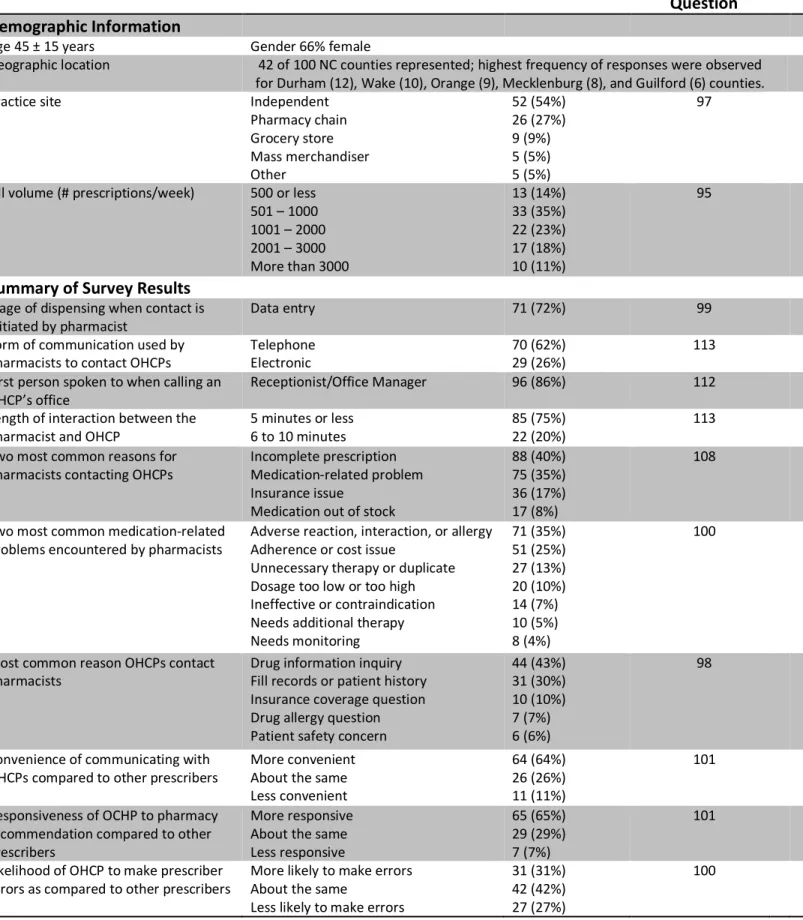
A total of 125 pharmacists (response rate 9%) completed the survey; 7 were interviewed. Participants were not required to answer all survey questions; thus total number of respondents varies slightly for each question. A wide variety of fill volume, insurance coverage of patients, types of practice sites, and geographic locations was observed. The average age of participants was 45 ± 15 years; 66% were female.
Survey results
Reports of current communication methods described how communication occurs presently; a summary of results is provided in Table 1. The majority of pharmacies contact OHCPs via telephone (n=70; 62%) and electronic methods (n=29; 26%), with most interactions lasting 5 minutes or less (n=85; 75%). Pharmacists are most likely to initiate contact during data entry (n=71; 72%), and when calling an OHCP, the majority of pharmacists (n=96; 86%) first speak to a receptionist or office manager. The most common reasons pharmacists contact OHCPs are to address incomplete prescriptions (n=87; 40%) and medication-related problems (n=75; 35%). The most common medication-related problems included an adverse drug reaction, drug-drug interaction, or allergy (n=71; 35%) and an adherence or cost issue (n=51; 25%). When presented with a list of possible barriers to optimal communication, time, professional relationships, and knowledge were identified as more challenging than interest, trust, and funding.
Interview results
In total, seven interviews were conducted. All interview participants felt that communicating with other healthcare providers is “extremely” or “very” important in terms of providing better care and helping the pharmacist have a complete understanding of their patients. All participants stated that the telephone was their ideal method of communication, and expressed dislike of leaving voicemails or going through receptionists.
When asked to describe the role of the pharmacist in combatting several key communication issues, all participants mentioned that correcting prescribing errors was “100%” or “absolutely” the main job of a pharmacist; most described troubleshooting prescribing issues themselves prior to contacting the prescriber if possible. Of note, most participants stated they would address a seemingly inappropriate opioid prescription by discussing with the patient and prescriber, refusing to fill if necessary. However, participants were much less likely to contact a prescriber for an inappropriate antibiotic, preferring to counsel the patient on appropriate use instead.
As in the survey, overall impressions of oral health care providers were positive. Participants noted that OHCPs are less likely to prescribe large quantities of opioids. In addition, the typically smaller office size made it easier for pharmacists to contact the prescriber directly. However, this made it more difficult to get in touch with OHCPs after hours or on weekends. Many participants also alluded to prescribing patterns among OHCPs that make it easy for the pharmacist to form a relationship with the prescriber and know what to expect.
Discussion
As the United States healthcare system gravitates toward a team-based care model, it is important to consider the ease and feasibility of collaboration among different providers. While an emphasis on team-based care has been largely implemented and studied in hospital settings, to date there is little knowledge about communication and collaboration between two typically isolated groups, community oral health care providers and pharmacists. This project lays the groundwork for future efforts in the field of interprofessional education and practice by providing a systematic approach to barrier identification that creates a comprehensive picture of the current status of communication between pharmacists and oral health providers practicing in North Carolina.
Inefficient workflow processes and lack of professional relationships pose significant limitations to current communications between pharmacists and OHCPs. Possible strategies to address these barriers include creation of a universal system for communication and establishment of networks between pharmacists and providers in the community. Quality improvement efforts should focus on increased knowledge and awareness of controlled substance reporting systems, identification of oral health issues in a community pharmacy setting, and early and frequent interprofessional collaboration programs. The importance of advocacy, professional networking, and continuing education in enhancing communication efforts, improving delivery of community-based healthcare, and improving provider satisfaction cannot be understated.
population. In addition, there is potential for non-response bias due to a low response rate (9%). In addition, the conclusions drawn from interview results may not be representative of the entire surveyed population given that just seven respondents were interviewed. Finally, while the information gathered from a pharmacist’s prospective provides some background for these educational efforts, a more comprehensive picture of the status of communication would be obtaining by surveying oral health care providers as well; this analysis is planned for future study.
Conclusion
Table 1. Summary of selected results from survey participants (N = 125).*
N (%) Total N for
Question
Demographic Information
Age 45 ± 15 years Gender 66% female
Geographic location 42 of 100 NC counties represented; highest frequency of responses were observed for Durham (12), Wake (10), Orange (9), Mecklenburg (8), and Guilford (6) counties. Practice site Independent
Pharmacy chain Grocery store Mass merchandiser Other 52 (54%) 26 (27%) 9 (9%) 5 (5%) 5 (5%) 97
Fill volume (# prescriptions/week) 500 or less 501 – 1000 1001 – 2000 2001 – 3000 More than 3000
13 (14%) 33 (35%) 22 (23%) 17 (18%) 10 (11%) 95
Summary of Survey Results
Stage of dispensing when contact is
initiated by pharmacist Data entry 71 (72%) 99
Form of communication used by
pharmacists to contact OHCPs Telephone Electronic 70 (62%) 29 (26%) 113 First person spoken to when calling an
OHCP’s office Receptionist/Office Manager 96 (86%) 112 Length of interaction between the
pharmacist and OHCP 5 minutes or less 6 to 10 minutes 85 (75%) 22 (20%) 113 Two most common reasons for
pharmacists contacting OHCPs
Incomplete prescription Medication-related problem Insurance issue
Medication out of stock
88 (40%) 75 (35%) 36 (17%) 17 (8%)
108
Two most common medication-related
problems encountered by pharmacists Adverse reaction, interaction, or allergy Adherence or cost issue Unnecessary therapy or duplicate Dosage too low or too high Ineffective or contraindication Needs additional therapy Needs monitoring 71 (35%) 51 (25%) 27 (13%) 20 (10%) 14 (7%) 10 (5%) 8 (4%) 100
Most common reason OHCPs contact
pharmacists Drug information inquiry Fill records or patient history Insurance coverage question Drug allergy question Patient safety concern
44 (43%) 31 (30%) 10 (10%) 7 (7%) 6 (6%) 98
Convenience of communicating with OHCPs compared to other prescribers
More convenient About the same Less convenient
64 (64%) 26 (26%) 11 (11%)
101
Responsiveness of OCHP to pharmacy recommendation compared to other prescribers
More responsive About the same Less responsive
65 (65%) 29 (29%) 7 (7%)
101
Likelihood of OHCP to make prescriber
errors as compared to other prescribers More likely to make errors About the same Less likely to make errors
31 (31%) 42 (42%) 27 (27%)
100
*Not all participants answered every survey question; therefore, total number of respondents may vary. Number of
Figure 1. Comparison of oral health care providers to other types of prescribers, such as primary care providers. Pharmacists’ impressions of communication with OHCP were fairly positive overall.
64% 65%
31%
26% 29%
12% 11%
7%
27%
0% 10% 20% 30% 40% 50% 60% 70%
How convenient do you find
communicating to be? How responsive are OHCPsto recommendations? How likely are OHCPs tomake prescribing errors? More
References
1. Jacobsen PL, Lofholm PW. Dentist/pharmacist relations: professional responsibility, scope of practice, and rational prescription writing. Interview by Debra Belt. J Calif Dent Assoc. 2008;36(10):781-789.
2. Warholak TL, Rupp MT. Analysis of community chain pharmacists’ interventions on electronic prescriptions. J Am Pharm Assoc . 2009;49(1):59-64.
3. Gilligan AM, Miller K, Mohney A, et al. Analysis of pharmacists’ interventions on electronic versus traditional prescriptions in 2 community pharmacies. Res Social Adm Pharm. 2012;8(6):523-532.
4. Valle-Oseguera C, Boyce EG. Dentists and Pharmacists: Paradigm Shifts and Interprofessional Collaborative Practice Models. J Calif Dent Assoc. 2015;43(10):591-595.
5. Suda KJ, Roberts RM, Hunkler RJ, Taylor TH. Antibiotic prescriptions in the community by type of provider in the United States, 2005-2010. J Am Pharm Assoc . 2016;56(6):621-626.e1.
6. Dionne RA, Gordon SM, Moore PA. Prescribing Opioid Analgesics for Acute Dental Pain: Time to Change Clinical Practices in Response to Evidence and Misperceptions. Compend Contin Educ Dent. 2016;37(6):372-378.
7. Oberoi SS, Dhingra C, Sharma G, Sardana D. Antibiotics in dental practice: how justified are we. Int Dent J. 2015;65(1):4-10.
8. Denisco RC, Kenna GA, O’Neil MG, et al. Prevention of prescription opioid abuse. J Am Dent Assoc. 2011;142(7):800-810. 9. McCauley JL, Leite RS, Melvin CL, et al. Dental opioid prescribing practices and risk mitigation strategy implementation:
Identification of potential targets for provider-level intervention. Subst Abus. 2016;37(1):9-14.
10. Hagemeier NE, Gray JA, Pack RP. Prescription drug abuse: a comparison of prescriber and pharmacist perspectives. Subst Use Misuse. 2013;48(9):761-768.
11. Davis LC, Covey RB, Weston JS, Hu BBY, Laine GA. Pharmacist-driven antimicrobial optimization in the emergency department. Am J Health Syst Pharm. 2016;73(5 Suppl 1):S49-S56.
12. Supper I, Catala O, Lustman M, et al. Interprofessional collaboration in primary health care: a review of facilitators and barriers perceived by involved actors. J Public Health . 2015;37(4):716-727.
Appendix 1. Survey
1. Within the past 12 months, have you worked as a licensed pharmacist in the state of North Carolina?
ú Yes
ú No
2. What is the most common method of communication you/your pharmacy team uses to contact oral health care providers?
ú Electronic (e-mails, electronic facsimile, electronic health records)
ú Facsimile
ú In Person
ú Telephone
3. When calling an oral health care provider’s office, who is the first person that you/your pharmacy team typically speak to?
ú Dental Assistant or Dental Hygienist
ú Operator/Voicemail
ú Oral Healthcare Provider
ú Receptionist/Office Manager
4. When you/your pharmacy team interact with an oral health care provider or their office, how long does the interaction typically take?
ú 5 minutes or less
ú 6 to 10 minutes
ú 10 to 20 minutes
ú 21 minutes or more
5. Think about the reasons you/your pharmacy team contact oral health care providers. Over the past 12 months, what has been the most common reason for you contacting an oral health care provider?
ú Incomplete prescription (missing dose, quantity, DEA, etc.)
ú Insurance issue (product not covered, needs prior authorization)
ú Medication out of stock
ú Medication related problem (inappropriate dose, allergy, duplicate, etc.)
6. Thinking more about medication related problems, please select the most common problem among those listed below that requires you/your pharmacy team to contact an oral healthcare provider.
ú Unnecessary medication therapy or duplicate
ú Needs additional medication therapy
ú Ineffective medication or contraindication
ú Dosage too low or too high
ú Needs additional monitoring
ú Adverse medication reaction, interaction, or allergy
ú Adherence or cost issue
7. At what stage in the dispensing process are you/your pharmacy team most likely to contact an oral healthcare provider?
ú Prescription receipt (drop-off)
ú Data entry
ú Production
ú Verification
ú Product distribution (pick-up)
8. When oral healthcare providers contact you/your pharmacy team beyond providing a prescription, what is the most common method they use to do so?
ú Electronic
ú Facsimile
ú In Person
ú Telephone
ú Other: _______________
9. Thinking about reasons that an oral healthcare provider contacts you/your pharmacy team beyond providing a prescription, what is their most common reason for doing so?
ú Drug allergy question
ú Drug information inquiry
ú Insurance coverage question
ú Patient safety concern
ú Other: __________________
10. How often do you/your pharmacy team check a drug-monitoring program before dispensing controlled substances (Schedule II to Schedule V) written by oral healthcare providers?
ú Always
ú Often
ú Sometimes
ú Rarely
ú Never
11. Please think about what makes collaboration between pharmacists and oral health care providers challenging. Several possibilities are listed below. How much of a challenge is each of the following to you/your practice?
Not challenging at all
Slightly
challenging Moderately challenging Very challenging Extremely challenging
Lack of interest c c c c c
Lack of funding c c c c c
Lack of knowledge or training c c c c c
Lack of professional relationships c c c c c
Lack of time c c c c c
Lack of trust between
professions c c c c c
12. How important do you consider communicating with local oral health care providers to be?
ú Not at all important
ú Somewhat important
ú Very important
13. Think about oral health care providers as compared to other types of prescribers, like primary care physicians. When comparing oral health care providers to other types of prescribers, how convenient do you find communicating to be?
ú Less convenient
ú About the same
ú More convenient
14. Think about oral health care providers as compared to other types of prescribers, like primary care physicians. When comparing oral health care providers to other types of prescribers, how responsive do you find oral health care providers to be to pharmacy recommendations?
ú Less responsive
ú About the same
ú More responsive
15. Think about oral health care providers as compared to other types of prescribers, like primary care physicians. When comparing oral health care providers to other types of prescribers, how likely are oral health care providers to make prescribing errors?
ú Less likely
ú About the same
ú More likely
16. How interested are you in opportunities for collaboration with oral health care providers?
ú Not at all interested
ú A little interested
ú Somewhat interested
ú Very interested
17. How interested are you in continuing education for pharmacists and oral health care providers about optimizing communication strategies?
ú Not at all interested
ú A little interested
ú Somewhat interested
19. What is your sex?
ú Female
ú Male
20. Please select the NC county that you work in. If you work in more than one county, please select the county in which you work the most hours.
21. What best describes your practice site? If you have worked in more than one setting over the past 12 months, answer the following questions for the setting that you worked the most hours.
ú Pharmacy Chain (CVS, Walgreens, Rite Aid, etc.)
ú Grocery store (Kroger, Harris Teeter, etc.)
ú Mass Merchandiser (Wal-Mart, Costco, Sam’s Club, etc.)
ú Independent, single location
ú Independent, multiple locations
22. Please estimate how many prescriptions are filled per week at your practice.
ú 500 or less
ú 501 – 1000
ú 1001 – 2000
ú 2001 – 3000
ú More than 3000
23. What percentage of patients at your practice site have the following types of insurance coverage? Your best estimate is fine.
Insurance Percentage (%)
Private Insurance (Express Scripts, United HealthCare, etc.) Medicare Part D
Medicaid Government Insurance No Insurance
24. What suggestions do you have for improving communications with oral healthcare providers?
25. Please list potential Continuing Education topics related to oral health that would be helpful for you or of interest to you.
Appendix 2. Interview Guide
1. What is your perspective on the value of communicating with other healthcare providers? 2. Describe your ideal process for communicating with other health care providers.
a. What method of communication do you prefer? Why? b. How closely does your practice model fit your ideal process?
3. What do you see as the role of the pharmacist in correcting prescribing errors or medication related problems? a. Are there types of errors or issues that you would not feel comfortable attempting to solve?
b. What role does the pharmacist have in combatting antibiotic resistance? c. What role does the pharmacist have in combatting the opioid crisis?
4. Elaborate on differences you have noticed between other types of prescribers, like physicians, and oral health care providers. Why do you think these differences exist?
5. On the survey you took a few weeks ago, there were a series of questions that asked you to consider what makes collaboration between pharmacists and oral health care providers challenging – we included things like interest, funding, knowledge/training, professional relationships, time, and trust. The barrier you selected as most challenging was _______. Please elaborate on why you believe this represents a particular challenge.
a. What steps could be taken to overcome this barrier?
b. Please elaborate on what you feel are some other barriers to collaboration and why you think they are important.
6. What unique challenges to efficient communication do you experience in your practice site?