Jeanne Stroud. The Reality of Providing Professional Development in the Work
Responsibilities of School Librarians. A Master's paper for the M.S. in L.S. degree. April, 2016. 47 pages. Advisor: Sandra Hughes-Hassell.
This study describes a survey given to school librarians regarding their provision of professional development opportunities for teachers. Librarians who are members of AASL Forum and LM_NET were emailed the survey. The purpose of this study was to investigate the time allocated and/or spent by school librarians on staff development related activities and to identify the variables within the school community which inhibit or contribute to those activities.
School Librarians’ professional development activities were assessed using the AASL’s Empowering Learners: Guidelines for School Library Programs. The survey results of 230 participants showed that librarians provide large group PD about 0.57 times per month and one-on-one PD about 5.3 times per month; however, most librarians would ideally provide more PD opportunities than they currently provide. Responses also showed that the most common factors contributing to and inhibiting the provision of PD were teacher cooperation and lack of time, respectively.
Headings:
Library Media Specialists School Library Standards Surveys
THE REALITY OF PROVIDING PROFESSIONAL DEVELOPMENT IN THE WORK RESPONSIBILITIES OF SCHOOL LIBRARIANS
by Jeanne Stroud
A Master's paper submitted to the faculty of the School of Information and Library Science of the University of North Carolina at Chapel Hill
in partial fulfillment of the requirements for the degree of Master of Science in
Library Science.
Chapel Hill, North Carolina April, 2016
Approved by:
Introduction
The 2001 No Child Left Behind Act called for schools to hire only “highly qualified teachers” starting in 2005, which means that all new teachers must now have a state certification and a bachelor’s degree; high school teachers must also demonstrate subject-area competence (U.S. Department of Education, 2002). While these new qualifications are valuable, they only affect new teachers. The best way to improve the attitudes and methods of all teachers is to meet them at their point of need with
professional development opportunities. Research shows gains in student achievement in the classrooms of teachers who have attended teacher training professional development (Barrett, Cowen, Toma, & Troske, 2015). Additionally, Penuel, Fishman, Yamaguchi, and Gallagher (2007) found that teachers also felt more appreciated in schools that provided professional development.
The Blueprint for Reform released under President Obama in 2010 calls for schools “to support educators in improving their instructional practice through effective, ongoing, job-embedded, professional development that is targeted to student and school needs” (U.S. Department of Education, 2010, p.15). In order to meet this requirement, many schools bring in outside educators or consultants to provide professional
development for teachers, but these outsiders rarely have any knowledge of the specific needs of the teachers or of the school, thus often making these sessions largely ineffective (Clarke & Hollingsworth, 2002). Furthermore, outsourcing PD to outside experts
teachers of the ability to solve their local, contextually specific issues” (Roseler & Dentzau, 2013, p.622).
So, if outside PD experts are not effective, then what should professional development actually look like? According to Adem Bayar’s (2014) research, the six elements of effective professional development (PD) are matching PD to teacher needs, matching PD to school needs, teacher involvement in the design and planning of PD, active participation opportunities, long-term engagement, and high-quality instructors. No one is better or more naturally suited to provide these six elements than school librarians.
Because the school librarian is in the school every day of the week, she is in a position to work with teachers to develop the PD they truly need. Most importantly, the school library, and the school librarian, is often the center of collaboration in a school, and collaboration among educators is crucial to student achievement (Ronfeldt et al., 2015). Professional development provided by the school librarian opens the door for further collaboration between librarians and teachers on lesson planning and curriculum development (Montiel-Overall & Hernandez, 2012).
The American Association of School Librarians (AASL) agrees that providing professional development is an important piece of the school librarian’s job. The AASL’s Empowering Learners: Guidelines for School Library Programs is the national standard for all duties related to being a school librarian. This text outlines leadership as a
(2009, p.43). In order to make the guideline easily understandable, the AASL also includes specific actions for a librarian to take in order to fulfill that guideline. Some of the professional development actions are “the school librarian ensures access to
professional development opportunities for professional and paraprofessional staff, and the school librarian seeks opportunities to teach new skills to the faculty and staff, whether in a classroom setting or one-on-one instruction” (2009, p.43). The AASL goes on to explain that long-term planning, hands-on-learning opportunities, and collaboration are all important aspects to valuable professional development.
Research Problem
While it is clear that school librarians should provide PD for teachers and other school staff, there has been little research done to gain an understanding of exactly how professional development looks in the real lives of school librarians today. One survey study in 1991 by Charles Stoddard looked at the experiences of school librarians with professional development, but it focused on the overall umbrella of “Instructional development” of which PD is only a small part. Stoddard based his study on the 1988 AASL standards entitled Information Power: Guidelines for School Library Programs. In these standards school librarians are merely asked to “offer teachers assistance in using information resources, acquiring and assessing instructional materials, and incorporating information skills into the classroom curriculum” (1988. p.39). Because of the combined standard, Stoddard’s survey partly collected information on the time spent by school librarians on curriculum development and partly on their time spent in professional development.
picture of how today’s school librarians are working with the professional development standard outlined in Empowering Learners. The current study is based on Stoddard’s 1991 study. The survey instrument has been modified to better represent the current standards, but it investigates similar research questions.
The purpose of this study is to investigate the time allocated and/or spent by school librarians on professional development related activities and to identify the
variables within the school community which hinder or contribute to the active pursuit of these activities.
How often do school librarians believe they should provide professional development?
How often do school librarians estimate they actually provide professional development?
What factors inhibit provision of professional development?
What factors contribute to the provision of professional development?
Literature Review
Defining Professional Development
Over the years in the world of education, professional development has been called many names including staff development, training, continuing education, faculty development, teacher improvement, and teacher education. This study uses the term professional development because it is the term used most often in the government education documents and in the professional standards for school librarians.
The 2001 No Child Left Behind Act provides an extensive definition of
over twenty activities that can be considered PD, but the sentence that most succinctly summarizes the definition is as follows:
The term professional development includes activities that advance teacher understanding of effective instructional strategies that are based on scientifically based research . . . and of strategies for improving student academic achievement or substantially increasing the knowledge and teaching skills of teachers. (No Child Left Behind, 2002)
Two other excellent definitions of PD found in the professional literature are PD “is defined as the provision of activities designed to advance the knowledge, skills, and understanding of teachers in ways that lead to changes in their thinking and classroom behavior” (Fenstermacher & Berliner, 1985, p.283); and, PD “exist[s] to improve student learning by making teachers more effective in the work of teaching” (Venables, 2011, p.10). These definitions are valuable because together they portray the main goal of professional development, to bring about a positive change in teacher habits that will improve student achievement.
History and Evolution of Professional Development for Educators
Originally, professional development was an informal activity that teachers chose to participate in either by reading current research on pedagogy, talking to other teachers, or attending higher education courses in order to qualify for salary increases. The more formal PD that is seen in schools today “came to the forefront in the 1960’s to assist educators in developing the necessary skills to teach a more diverse student population to achieve at high levels” (Murphy-Latta, 2008, p.12).
to model the factories that drive the American economy: “the students would move past the teacher in large blocks, one after another, and the teacher would stamp them with a lesson as they move by on the conveyor belt” (Darling-Hammond, 1994, p.6).
Professional development took on the same model, and as a result teachers often reported that PD sessions felt like a waste of time (Sparks & Hirsh, 2000; Turchi, 2002).
Professional Learning Communities
The professional learning community or PLC is the current standard for effective professional development. A PLC is a small group of teachers, and sometimes
administrators as well, that come together on a regular basis to “continuously seek and share learning, and act on their learning . . . to enhance their effectiveness as
professionals for the students' benefit” (Hord, 1997, p.10). PLC’s were first introduced in late 1980’s when they were called “Critical Friends Groups” (Venables, 2011, p.9). These groups slowly grew in popularity throughout the 1990’s, but their use dropped
dramatically after the No Child Left Behind Act passed in 2002.
NCLB changed the conversation in American education from student learning to student performance. “The value of teachers working collaboratively on examining and improving their craft took a backseat to the drive to raise test scores—as if the two were mutually exclusive” (Venables, 2011, p.10). Around 2005, educators were reminded that student learning is the basis of student performance and student learning improves with teacher collaboration. The renewed appreciation of teacher collaboration has steadily increased the use of PLC’s over the last decade.
The Evolving Roles of the School Librarian
Eventually, those libraries grew in size and needed librarians to manage them. The first graduate of a school librarian training program entered the workforce in 1900, and a more formalized approach to the school library began. Twenty-five years later, the first school librarian job standards were published entitled Elementary School Library Standards, but more commonly referred to as the Certain Standards. The majority of the Certain
Standards dealt with the physical space of the library and the collection, but it did include a list of the duties of the school librarian:
1) To organize the library and look after all details of administration
2) To teach the use of libraries and books through close cooperation with the departments of the school
3) To encourage reactional reading in every way possible
4) To make recommendations to the principal of the school concerning administrative policy, materials, and books for the library
5) To confer with other elementary school supervisors, the supervisor of the school libraries, members of the public library who are interested, on the selection of books and materials needed
6) To assist the teachers of the school in every way possible in securing material for their teaching
7) To be in charge of the library full time (Certain, 1925, p.12)
The Certain Standards have been updated by the AASL many times over the last century, the most current reincarnation being the 2009 Empowering Learners: Guidelines for School Library Programs. Empowering Learners delves deeper into the specific duties of today’s school librarian, but those duties still share three common themes with the original Certain Standards: school librarians as instructional partners, as information specialists, and as school leaders.
As Instructional Partners
material for their teaching.” Providing teachers with instructional materials is the most basic form of collaboration, and it is still one of the most common methods of
collaboration in schools today.
The ALA quickly realized that school librarians were capable of more than simply providing resources. In 1945, School Libraries for Today and Tomorrow: Functions and Standards was published, and it called for school librarians to hold “planned library periods for improving ability in the use of books and libraries through group instruction and guidance under combined librarian and teacher leadership” (American Library Association, 1945, p.13). This was the first formal call for school librarians to co-teach with the classroom teachers.
The 1960 standards pushed the instructional role of the school librarian one step further by stating that “a professional library staff member serves on any all-school committees concerned with curriculum development” (American Association of School Librarians,1960, p.48). School librarians stood out as leaders and experts in resources, teaching, and curriculum development. School librarians have been called to be instructional partners in more than one dimension for over fifty years, yet popular
literature tends to discuss co-teaching and curriculum development as a more modern job role.
As Information Specialists
it was available on computers, then on tablets. The increase of technology in schools gave the necessary push for professional development to become a formal job role of the school librarian. The library was often the place where new technology was first implemented in a school because it was a shared space, and so it fell on librarians to become experts in the new technology so they could advocate for the library’s newest resource. This new role was reflected in the 1988 school library standards: under the category of instructional consultant, the standards call for librarians to “provide leadership in the assessment, evaluation, and implementation of information and instructional technologies” (American Association of School Librarians, 1988, p.39).
In the late 1990’s and early 2000’s technology had a large enough presence in public schools that teachers began to use it in lessons, but very few schools had taken the next step of hiring a technology specialist to maintain the technology or educate teachers and students on how to use it. Some schools would bring in an outside technology expert to provide PD on a certain kind of technology, but “teachers work in an atmosphere of collegial support and prefer to learn from their peers, rather than from an outside trainer or someone they perceive as too technical” (Anderson, 2002). School librarians knew how to use the technology, and they were a part of the school community, so teachers turned to them for technology help.
Now, many public schools have an educational technology specialist to take the lead on technology PD, but the formal PD role of the school librarian never went away. As Leaders
professional school librarian “provides informal in-service training for teachers about library resources, sources of information for printed and audio-visual materials, the evaluation of materials, and related topics” (American Association of School Librarians, 1960, p.66). However, the professional development only needed to be about how to use the library’s materials. Again in the 1988 standards, “library media specialists provide staff development opportunities for teachers and school administrators in the selection, use, evaluation, and production of media resources” (American Association of School Librarians, 1988, p.34). School librarians were required to provide PD opportunities, but they were not yet asked to be leaders in anything other than library materials.
It wasn’t until the 1998 standards when the term leadership was first used in relation to school librarians providing staff development. “The school library media specialist takes a proactive role in promoting the use of technology by staff, in
determining staff development needs, in facilitating staff learning explorations, and by serving as a leader in staff development activities” (American Association of School Librarians, 1998, p.52). The 1998 description of the leadership role expanded the school librarian’s sphere of influence beyond the walls of the library. By 2009, the professional development leadership role grew in importance and became one of the five essential roles of the school librarian.
Why School Librarians Should Be Providers of Professional Development
on school committees. Librarians work in conjunction with teachers and administrators to develop the school’s curriculum and improvement plan. “School librarians are keenly aware of school culture” because they are in the unique position to have a relationship with all the teachers and administrators in the school (Howard, 2010, p.1).
Not only do school librarians understand the needs of the school community, but they work in the school every day and are available for questions and support. “A common criticism of professional development activities designed for teachers is that they are too short and offer limited follow-up to teachers once they begin to teach” (Penuel, et al., 2007, p.929). When PD is provided by the school librarian, teachers have access to an expert that they can trust and confide in five days a week.
Finally, school librarians should provide professional development because they are the school experts on inquiry based education. According to a 2007 study, “the most effective professional development strategy was to focus on promoting student inquiry in initial professional development sessions” (Penuel, et al., p.950). PD that focuses on student inquiry is PD that is easier to translate to real life classroom situations, and that immediate usability is an essential ingredient in effective PD.
Methods
school librarians across the country in a limited amount of time.
The online survey was distributed via two email listservs for school librarians, AASL Forum and LM_NET. Members of the school librarian community have elected to participate in these professional listservs in order to communicate about new research and best practices in the field. An email invitation letter, including information about
participation consent and confidentiality, was sent to members of the AASL Forum and LM_NET. The letter can be found in Appendix B of this document. The link to the survey was included at the bottom of the letter. The survey remained open for three weeks, and a reminder email was sent out on both listservs after two weeks. Once the survey was closed, quantitative methods of analysis were run on the data using the web-based survey tool Qualtrics. The open-ended questions were coded by the researcher for common themes.
Survey Questionnaire
The survey began with a section of four simple questions about the librarian as a professional. The questions collected general information about work place, years of experience, and academic credentials. These questions were placed at the beginning of the survey to make the participants feel confident and comfortable.
The survey then moved into the main question of the survey. Question five asked the participants to rate the twelve professional development guidelines in Empowering Learners: A guideline for School Library Programs on a five-point Likert scale that corresponded to the frequency of participation in those activities.
to gauge the importance the librarian, the school administration, and the school district place on professional development activities. This section of questions also asked the participants to approximate how often they participate in certain professional
development activities, and it ended with three questions asking the participant about their formal job descriptions and if those descriptions included information about PD responsibilities.
The final section of the survey asked participants to identify factors that contribute to or inhibit their ability to perform PD. This section also sought to gain information on the impact that Empowering Learners has on the lives of school
librarians. The survey ended with an open ended question inviting the participant to share any other thoughts they have on professional development.
Results
The Population
While the exact number of librarians invited to take the survey is unknown, sending the survey through the two professional listservs resulted in 255 responses. 25 responses were excluded from the data set due to incompletion, leaving 230 responses. Surveys with partial completion remained in the data set as long as the first five questions were answered.
Figure 1: School Type (n = 230)
The study also asked about the type of certification (see figure 2) held by the participant school librarians. Respondents were allowed to choose more than one answer if both certifications applied to them, so 87% of respondents reported having a teaching certification, while 77% reported having a media certification. One respondent
commented on the complicated nature of certification in the open-ended question at the end of the survey; she explained that “in NC, the school library media certification IS a teaching certification--more people [teachers, administration] need to be made aware of this. So, it's not either or: Teacher or Media.” 10% of respondents were not certified.
Figure 2: Certification (n=230)
73 50
83 23
0 10 20 30 40 50 60 70 80 90
Elementary School Middle School
High School Other
Number of Responses
Place
o
f E
m
p
loy
m
en
t
201 176 10
0 50 100 150 200 250
Teacher Certified Media Certified Non-Certified
PD Differences in Regards to Years of Experience
As shown in Figure 3, new school librarians, 1-5 years of experience, made up the largest percentage of the population at 29%. School Librarians with 6-10 years of
experience made up 22% of the population, librarians with 11-15 years of experience made up 19% of the population, and librarians with 16-20 and 20+ years of experience made up 12% and 18% of the population respectively.
Figure 3: Years of Experience as a School Librarian (n=230)
Responses to this question were used to determine if librarian professional development practices varied by years of experience. Respondents were grouped into three categories, and participant responses to four professional development questions on the survey were analyzed and compared between the groups. The three groups were librarians with 1-5 years of experience, 6-15 years of experience, and 16+ years of experience. The questions analyzed were the four parts of survey question five: how frequently does the school librarian teach new skills to staff in a group setting, teach new skills to staff in a one-on-one setting, provide hands-on learning opportunities for staff, and provide professional development about educational technology.
67 50
44 27
42
0 10 20 30 40 50 60 70 80
1-5 6-10 11-15 16 - 20 20 +
Number of Responses
Ye
ar
As shown in Figure 4, the analysis of the number of respondents who answered “frequently” to each question found that school librarians with 16+ years of experience provide more one-on-one instruction and hands-on learning instruction than the less experienced school librarians.
Figure 4: Percentage of "Frequently" Responses per Group (n=230)
The analysis of the number of respondents who answered “occasionally” to each question found that school librarians with more than 16 years of experience provide more group instruction that the other groups of librarians, but new school librarians provide more educational technology instruction than their more experienced peers (see Figure 5).
Considering these two sets of information together, responses of “frequently” or “occasionally,” the analysis found that school with 16+ years of experience provide more professional development in all categories except educational technology instruction (see Figure 6). Additionally, new school librarians provide more PD in the areas of group instruction and educational technology instruction than school librarians with 6-15 years of experience.
13.2%
41.7%
17.9%
23.8% 21.7%
42.5%
22.3%
25.5%
18.8%
49.2%
33.3%
23.1%
0.0% 10.0% 20.0% 30.0% 40.0% 50.0% 60.0%
Group Instruction One-on-one Instruction Hands-on Learning
Instruction
Educational Technology Instruction
Figure 5: Percentage of "Occasionally” Responses per Group (n=230)
Figure 6: Percentage of "Occasionally" and "Frequently" Responses per Group (n=230)
PD Differences in Regards to Number of Teachers Served
The final demographic question on the survey asked respondents to report the number of teachers they serve in their school (see figure 7). According to our results, the participating school librarians serve about 84 teachers on average.
42.6% 34.3% 37.3% 40.2% 30.4% 37.2% 38.2% 27.6% 50.7% 39.1% 33.3% 23.1% 0.0% 10.0% 20.0% 30.0% 40.0% 50.0% 60.0%
Group Instruction One-on-one Instruction Hands-on Learning
Instruction
Educational Technology Instruction
1-5 years experience 6-15 years experience 16+ years experience
55.8% 76.1% 55.2% 64.1% 51.0% 79.7% 60.6% 53.1% 69.5% 88.4% 66.6% 63.7% 0.0% 10.0% 20.0% 30.0% 40.0% 50.0% 60.0% 70.0% 80.0% 90.0% 100.0%
Group Instruction One-on-one
Instruction
Hands-on Learning Instruction
Educational Technology Instruction
Number of Teachers Served Number of Responses
0 to 50 117
51 to 100 71
100 + 42
Figure 7: Distribution of Respondents Regarding Number of Teachers Served (n=230)
Responses to this question were used to determine if librarian professional
development practices varied by size of the faculty. Respondents were grouped into three categories, and participant responses to four professional development questions on the survey were analyzed and compared between the groups. The three groups were
librarians who serve 50 teachers or less, librarians who serve between 51 and 100 teachers, and librarians who serve more than 100 teachers. The questions analyzed were the four parts of survey question five: how frequently does the school librarian teach new skills to staff in a group setting, teach new skills to staff in a one-on-one setting, provide hands-on learning opportunities for staff, and provide professional development about educational technology.
As shown in Figure 8, the analysis of the number of respondents who answered “frequently” to each question found that school librarians serving less than 50 teachers perform less professional development in each category than the other two groups of librarians.
Figure 8: Percentage of "Frequently" Responses per Group (n=230)
Figure 9: Percentage of "Occasionally" Responses per Group (n = 230)
Considering these two sets of information together, responses of “frequently” or “occasionally,” the analysis found that librarians who serve less than 50 teachers provide
14.7% 40.5% 14.6% 21.5% 21.2% 50.7% 32.3% 28.1% 23.8% 40.4% 35.7% 23.8% 0.0% 10.0% 20.0% 30.0% 40.0% 50.0% 60.0%
Group Instruction One-on-one Instruction Hands-on Learning
Instruction
(l.) Educational Technology Instruction
< 50 Teachers 51 - 100 Teachers 100 + Teachers
33.0% 37.0% 38.7% 30.1% 46.4% 36.2% 36.6% 38.0% 50.0% 40.4% 30.9% 45.2% 0.0% 10.0% 20.0% 30.0% 40.0% 50.0% 60.0%
Group Instruction One-on-one Instruction Hands-on Learning
Instruction
Educational Technology Instruction
less professional development in all categories (see Figure 10). Librarians who serve 51-100 teacher provide slightly more PD in the areas of one-on-one instruction and hands-on learning instruction, while librarians serving more than 100 teachers provide slightly more PD in the areas of group instruction and educational technology instruction.
Additionally, 0% of librarians serving more than 100 teachers reported “never” providing PD in these four categories.
Figure 10: Percentage of "Occasionally" and "Frequently" Responses per Group (n=230)
School Librarians and the Empowering Learners Guidelines
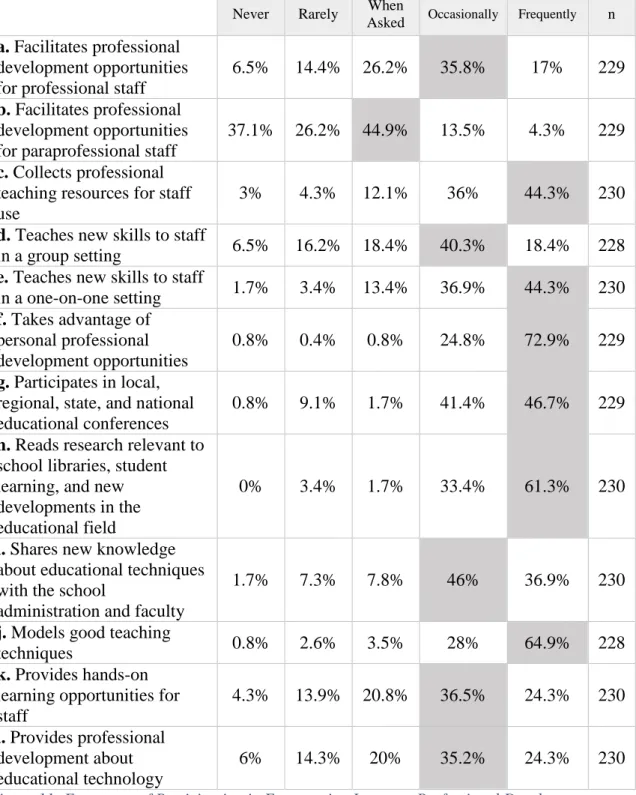
Empowering Learners: Guidelines for School Library Programs outlines 12 aspects of the professional development role of the school librarian. Question five of the survey asked respondents to select the answer on a five point Likert scale that
corresponded to the frequency of their participation in those activities. As Figure 11 shows, School librarians most frequently participate in attending librarian professional development opportunities, reading educational research, and modeling good teaching
47.8%
77.5%
53.4% 51.7%
67.6%
86.9%
69.0%
66.1% 73.8%
80.9%
66.6% 69.0%
0.0% 10.0% 20.0% 30.0% 40.0% 50.0% 60.0% 70.0% 80.0% 90.0% 100.0%
Group Instruction One-on-One Instruction Hands-on Learning
Instruction
Educational Technology Instruction
techniques. School librarians do not frequently participate in providing professional development opportunities for professional staff, for paraprofessional staff, or teaching new skills in a group setting.
Never Rarely When
Asked Occasionally Frequently n
a. Facilitates professional development opportunities for professional staff
6.5% 14.4% 26.2% 35.8% 17% 229
b. Facilitates professional development opportunities for paraprofessional staff
37.1% 26.2% 44.9% 13.5% 4.3% 229
c. Collects professional teaching resources for staff use
3% 4.3% 12.1% 36% 44.3% 230
d. Teaches new skills to staff
in a group setting 6.5% 16.2% 18.4% 40.3% 18.4% 228
e. Teaches new skills to staff
in a one-on-one setting 1.7% 3.4% 13.4% 36.9% 44.3% 230
f. Takes advantage of personal professional development opportunities
0.8% 0.4% 0.8% 24.8% 72.9% 229
g. Participates in local, regional, state, and national educational conferences
0.8% 9.1% 1.7% 41.4% 46.7% 229
h. Reads research relevant to school libraries, student learning, and new developments in the educational field
0% 3.4% 1.7% 33.4% 61.3% 230
i. Shares new knowledge about educational techniques with the school
administration and faculty
1.7% 7.3% 7.8% 46% 36.9% 230
j. Models good teaching
techniques 0.8% 2.6% 3.5% 28% 64.9% 228
k. Provides hands-on learning opportunities for staff
4.3% 13.9% 20.8% 36.5% 24.3% 230
l. Provides professional development about educational technology
6% 14.3% 20% 35.2% 24.3% 230
Question 19 of the survey asked participants to rank the importance of the five roles of the school librarian as defined in Empowering Learners, with 1 being the most important and 5 being the least important (see Figure 12). Ranked by mean score, respondents considered their role as information specialist most important, and their role as program administrator least important. The role of teacher was ranked third by mean score, and the role of leader, the role that is most directly related to professional development activities, was ranked fourth.
Rank Role *Mean
1 Information Specialist 2.53
2 Instructional Partner 2.61
3 Teacher 2.62
4 Leader 3.16
5 Program Administrator 4.08
Figure 12: The Roles of the School Librarian Ranked in Order of Importance (n=190)
* The mean was calculated by adding the number that corresponded to the vote, 1 through 5, and then dividing by the number of votes.
Question 20 asked participants if Empowering Learners assisted them in
understanding and/or interpreting their role in providing professional development, and the second half of the question asked them to elaborate on their answer. As shown in Figure 13, 56% of respondents reported “no,” Empowering Learners has not assisted them. The negative answers to the open-ended question fell into three major categories: they have not read it, they have read it but do not use it, and they do not like it.
The positive answers to the open-ended question also fell into three main
“but I have not had the means to carry them out.”
Main Category Sub Category Number of
Comments
Has not read it
Has not read it 21
Has never heard of it before 17
Does not own a copy 5
Has read it, but does not use it
Read it a long time ago, or read an older version 14 Has read it, but has not implemented anything in it 6 Does not like it Does not find it useful for real life librarianship 13
Does not like the way it is written 2
Figure 13: Reported Reasons Why Participants Found Empowering Learners Unhelpful for PD Role (n=78)
Positive Responses to Question 20
Category Number of
Comments
It is well-written and thorough 6
It has provided useful program guidelines 25 It has helped the librarians to better understand the job 11
Figure 14: Reported Reasons Why Participants Found Empowering Learners Helpful for PD Role (n=42)
Perceptions of Professional Development
Figure 15: School Librarian Perceptions of PD Importance (n=218)
Time Spent Providing Professional Development
Questions 9 and 11 asked participants to report how many times per month they facilitate large group and one-on-one professional development sessions. Questions 10 and 12 asked participants to share how many times a month a school librarian should ideally facilitate large group and one-on-one professional development sessions. The averages of the responses show that school librarians provide large group PD about 0.57 times per month, but they would ideally provide large group PD about 1.39 times per month. The averages of the responses show that school librarians provide one-on-one PD about 5.3 times per month, but they would ideally provide one-on-one PD about 10.57 times per month. Sixty-six percent of survey participants reported that they would ideally provide more large group PD sessions than they currently provide, while only 57% of participants reported that they would ideally provide more one-on-one PD sessions than they currently provide. See Figure 16 and 17 for results.
0%
6%
27% 30%
36%
28% 32% 19%
13% 7%
36% 28%
23% 11%
3%
0% 5% 10% 15% 20% 25% 30% 35% 40%
Not Important Somewhat Important
Important Very Important Essential
Times per month Number of Responses
Actually Provided (Q9) Ideally Provided (Q10)
0 126 12
0.1 – 0.5 13 3
1 62 135
> 1 15 62
Figure 16: Large Group Professional Development (n=216)
Times per month Number of Responses
Actually Provided (Q11) Ideally Provided (Q12)
0 28 5
1 - 5 120 103
6 - 10 44 68
> 10 20 30
Figure 17: One-on-one Professional Development (n=215)
Factors that Inhibit Professional Development
Survey question 17 asked participants to choose factors from a list that inhibit or restrict their involvement in professional development. Participants were allowed to choose all factors that apply from the list of lack of time, not enough media center staff, financial restrictions, and lack of support from teachers and administration. As shown in Figure 18, lack of time was the most common inhibiting factor followed by lack of support from teachers and administration.
in charge of PD, such as the technology specialist or a curriculum resource teacher. Nine other respondents felt that teachers and administrators don’t fully understand the
knowledge and capabilities of the school librarian, so they are not thought of when choosing someone to provide professional development.
Figure 181: Factors that Inhibit Professional Development (n=200)
Factors that Contribute to the Implementation of Professional Development
Survey question 16 asked participants to choose factors from a list that contribute to their implementation of professional development. Participants were allowed to choose all factors that apply from the list of teacher cooperation, time provided specifically for PD, supportive administration, and strong school culture of collaboration. Participants reported that teacher cooperation and time provided specifically for PD were the two factors that most contribute to their provision of PD (see Figure 19).
Participants were also allowed to choose “other” in order to provide their own contributing factors that were not included on the survey. The open responses fell into two categories: the librarian’s own personal determination or skills, and PD topics being chosen on an as-needed basis. Six participants explained that they are able to do PD
157 123 86 40 0 20 40 60 80 100 120 140 160 180
Lack of Time Lack of Support from
Teachers and Administration
because they have special knowledge in a subject area or because they volunteer/demand to provide PD. Four participants explained that they are successful in providing PD because they wait to see the need for it in the school; teachers are more receptive to them because they are providing relevant information.
Figure 19: Factors that Contribute to Professional Development (n=194)
Question 18 expanded to the list of contributing factors by asking which of the items in the list would be helpful to them in their struggle to provide professional development. Participants were allowed to choose all factors that apply from the list of support staff in the media center, financial support for the media program, additional education for the librarian, support from the school administration, and support from the school district. Respondents identified support from the administration and from the school district as the two factors that would most assist them in providing PD (See Figure 20).
Participants were also allowed to choose “other” in order to provide their own contributing factors that were not included on the survey. Eleven respondents provided an open response explaining that it would help them if teachers were allotted more free time
157 157 124 101 0 20 40 60 80 100 120 140 160 180
Teacher Cooperation Time Provided
Specifically for PD
Supportive Administration
in their work schedules to attend professional development.
Figure 20: Factors that Would Assist the Librarian in Providing PD (n=191)
Additional Comments on Professional Development
The final question of the survey invited participants to share any other thoughts they had regarding professional development, and those open responses were coded for common themes. The six major themes found in question 22 were lack of respect from school administration, lack of teacher interest in PD, technology changing the PD role, lack of time, the preference of small group or on-on-one PD, and comments on the importance of the school librarian’s PD role.
Support and Respect from School Administration
Seventeen participants provided statements relating to the respect and support they receive from their school administration and their school district. While most of these statements were negative, a few respondents were thankful for the support they receive from their administration. One participant perfectly summarized the effect administration has on professional development:
137 110 94 59 49 0 20 40 60 80 100 120 140 160
Support from the School Administration
Support from the School District
Support Staff in the Media Center
Additional Education for the
Librarian
Financial Support for the Media
I fully believe the school climate, led by the administration, makes a huge difference in whether or not a school library media specialist is supported and valued as a leader/collaborator/professional development expert. These things trickle down from administration. When you have an administration that results in teachers despising their jobs and generally being in a bad mood all the time, it's hard to get the teachers excited about using new technology and/or creating fun, new lessons
Teacher Interest in Professional Development
Eleven participants cited a lack of teacher interest as a barrier to their ability to provide effective professional development. Some participants merely explained that their teachers are already receiving so much PD that the librarian’s PD is information overload. “Teachers are sick to death of being told how to teach and what they need to teach.”
The other comments on this theme revolved around the misperception of the job of the librarian. Respondents mentioned that teachers viewed them as mere “babysitters” instead of professionals. One respondent explained, “I am a new librarian, and I am still trying to change the way the library is perceived on my campus. The teachers are used to the old way, so I am working toward changing that.”
Technology is Changing the Professional Development Role
Eight participants commented of the effects technology is having on their role as providers of professional development. A few participants mentioned that the
implementation of new technology is the guiding force behind when and why they provide professional development for teachers. “We are going 1:1 next year and that might make the need for technical and informational partnership pressing.”
our schools, our technology specialist has become the go to person for a lot of the necessary information for our teachers.” Participants felt that their role overlapped the technology specialist in the area of professional development, so they let the technology specialist take over that role as they focus on the other aspects of librarianship.
Lack of Time
Fourteen respondents used question 22 as an opportunity to elaborate on how they prioritize their time at work. Some participants explained how the school schedule is so tight that there simply is not any time for professional development: “If you teach 9 classes a day, the only time you can do staff development is before or after school.” However, most of the comments in this theme dealt more with the fact that the school librarian wears many hats, and the professional development hat is not their highest priority. Furthermore, when they do have time for professional development related activities, they prefer to spend that time on their own personal professional development. “Sometimes I feel that my leading staff development prevents me from attending staff development that would help me. There are not enough hours in the day to do it all. It is more important that the librarian be seen as an instructional partner rather than another instructional coach/facilitator.”
Preference for Small Group or One-on-one Professional Development
group settings where the PD applies and closely aligns to their curriculum/goals.” The Importance of the School Librarian’s Professional Development Role
Finally, ten participants ended their survey by emphasizing their beliefs in the importance of the professional development role. These librarians feel that they are truly making a difference in their school communities when they provide professional
development. Two participants eloquently stated the benefits of school librarians providing professional development:
I truly believe that the more staff development we do the easier it will be to make a fluid transition for both students and staff to 21st century skills. It will also open their eyes to what we have to offer. I find that many teachers are
astounded by what they discover when I teach a lesson in their class or show them resources that I have to share.
I feel that it is a wise decision that the school/district utilize library media specialists employed within a district to lead/guide/facilitate professional
development. We are well rounded in curriculum, resources and teaching. We can offer insights and lead our colleagues to resources that they are not aware of and methods that they may not implement, and administration does not have to go to an outsider or pay an outsider. They can use trusted personnel already
employed that have a rapport with their fellow colleagues.
Summary
The last two research questions that guided this study were what factors inhibit provision of professional development, and what factors contribute to the provision of professional development? According to the survey results, lack of time was the most common inhibiting factor (157 respondents) followed by lack of support from teachers and administration (123 respondents). 157 participants reported that teacher cooperation and time provided specifically for PD were the two factors that most contribute to their provision of PD.
Discussion
Larger Faculty, More Professional Development
The results of this survey study found that librarians who serve larger faculties provide more professional development opportunities. As mentioned in the literature review, one definition of professional development is that PD “exist[s] to improve student learning by making teachers more effective in the work of teaching” (Venables, 2011, p.10). The ultimate goal of professional development is to improve student
achievement. Librarians in large schools cannot teach every student enough times during the year to make an impact. Instead, it appears librarians at large schools choose to spend more time providing professional development so that they can maximize their impact on students.
The Importance of Being a Leader
While the survey respondents viewed their role as professional developers to be essential or very important, few of them ranked the role of “leader” to be the most important. Respondents also mentioned in the open-response question that they are too often viewed as “babysitters” by teachers and administrators instead of as professionals. Perhaps, when school librarians begin to view themselves more as leaders within their school, then so will the teachers and administrators. Stepping out of the comfort zone to create relationships with teachers and share knowledge may result in respect and
opportunity. In other words, once the librarian becomes a visible leader, the other elements of librarianship will fall into place. Empowering Learners explains this idea more fully:
The profession remains challenged by misconceptions about the school librarian’s role in teaching and learning. Leading Librarians embrace these challenges and opportunities to empower learning through their roles as instructional partners, information specialists, teachers, and program administrators. (American Association of School Librarians, 2009, p.46)
School librarians have been called to be school leaders since the 1960 job
standards required school librarians to serve on school committees. School librarians who take ownership of the leadership role in their schools will also be leaders in the
profession as they make real impacts in student achievement.
Moving Forward with Small Group Professional Development
Survey respondents identified lack of time and lack of support from teachers and administration as major inhibiting factors in their efforts to provide professional
of an individual teacher.
Moving forward, emphasis should be put on more informal small group or one-on-one professional development because it caters better to teacher needs, it does not require permission or scheduling from administration, and it is easier to incorporate into an average school day. Empowering Learners agrees that “the school library program must offer leadership from a peer level—leadership for both faculty and administrators” (American Association of School Librarians, 2009, p.47).
As discussed in the literature review, President Obama’s 2010 Blueprint for Reform calls for schools “to support educators in improving their instructional practice through effective, ongoing, job-embedded, professional development that is targeted to student and school needs” (U.S. Department of Education, 2010, p.15). According to the results of this survey regarding school librarians’ lack of time, the most effective way to provide on-going, job-embedded PD is to meet teachers individually at their point of need. In the words of one survey participant,
Ideally, I would that we teach library skills and staff development at the point of need. We communicate with good tools and in person with staff, faculty and the school community to determine their needs and desires for professional and staff development. Then we create instruction designed specifically to meet that need at the optimum time that it's most helpful to the learning community, in this case the school faculty and staff.
Study Limitations and Suggestions for Further Research
Limitations
While the responses to the demographic question of place of employment are technically spread evenly among elementary, middle, and high schools, the results are not actually a balanced representation of the school library population. There are far more elementary schools in the United States than high schools, so more balanced results would have more elementary school librarians than high school librarians. The results from this study are slightly biased toward the high school librarian’s experience based on the population of respondents.
The survey asked participants to measure the amount of professional development they provide in one month. School librarians who do not often provide professional development found it difficult to answer those questions because they measure their professional development in yearly increments. One participant explained,
Each school year and season of a year presents new learning challenges for administrators, teacher-librarians, and teachers. There are times, even years at a time, when I may need to be part of the learning community as opposed to providing the PD. It’s too simplistic to ask an ideal number per month.
However, it would be difficult for some librarians to estimate the number of professional development they provide in a year. Either way this question is worded, it will be
difficult for some librarians to answer, which affects the survey results. Further Research
not use them. A future study on this topic should look into why school librarians don’t like the guidelines if they have read them—are they too long or too technical? The study should also look into why the guidelines are not being taught in more library science school media master’s programs. Finally, a study could look into the feasibility of providing a free copy of the guidelines to every certified school librarian so that this important information is not ignored.
Conclusion
The school librarian wears many hats and if often pulled in a dozen different directions each and every school day. Our study showed that providing professional development to teachers is one of the roles that often gets pushed aside for another day, but the responses also clearly expressed that our nation’s librarians desire to do better. School librarians have the content knowledge, collaboration skills, and determination to make a difference in student achievement. One respondent stated the value of the school librarian:
I think the media specialist is in a unique role. We know all of the teachers and see them on a daily basis. We have opportunities to get to know their students in a different environment. We have more flexibility to plan and to help create
References
American Library Association. Committee on Post-War Planning. (1945). School Libraries for Today and Tomorrow: Functions and Standards. Chicago: American Library Association.
American Association of School Librarians. (1960). Standards for School Library Programs. Chicago: American Library Association.
American Association of School Librarians (1988). Information Power: Guidelines for School Library Media Programs. Chicago: American Association of School Librarians.
American Association of School Librarians (2009). Empowering Learners: Guidelines for School Library Programs. Chicago: American Association of School Librarians.
Anderson, M. A. (2002). The Value of Staff Development. School Library Journal, 48(11), 34-35.
Barrett, N., Cowen, J., Toma, E., & Troske, S. (2015). Working with what they have: Professional development as a reform strategy in rural schools. Journal of Research in Rural Education (Online), 30(10), 1-18.
Becker, H. J. (1998). Running to Catch a Moving Train: Schools and Information Technologies. Theory Into Practice, 37(1), 20-30.
Certain, C.C. (1925). Elementary School Library Standards. Chicago: The American Library Association.
Clarke, D., & Hollingsworth, H. (2002). Elaborating a model of teacher professional growth. Teaching and Teacher Education, 18, 947-967.
Darling-Hammond, L. (1994). Professional Development and Standards. Professional Development: International and National Perspectives. Washington: American Association for Higher Education.
Fenstermacher, G. D., & Berliner, D. C.. (1985). Determining the Value of Staff Development. The Elementary School Journal, 85(3), 281–314.
Hord, S.M. (1997). Professional learning communities: Communities of continuous inquiry and improvement. Austin: Southwest Educational Development Laboratory.
Howard, J.K. (2010). The Relationship between School Culture and the School Library Program: Four Case Studies. School Library Media Research, 13(1).
Montiel-Overall, P., & Hernandez, A. R. (2012). The Effect of Professional Development on Teacher and Librarian Collaboration: Preliminary Findings Using a Revised Instrument, TLC-III. School Library Research, 15, 1-25.
Murphy-Latta, T. (2008). A comparative study of professional development utilizing the missouri commissioner's award of excellence and indicators of student
No Child Left Behind Act of 2001, P.L. 107-110, 20 U.S.C. § 9101 (2002).
Penuel, W. R., Fishman, B. J., Yamaguchi, R., & Gallagher, L. P. (2007). What makes professional development effective? Strategies that foster curriculum
implementation. American Educational Research Journal, 44(4), 921-958. Ronfeldt, M., Farmer, S. O., McQueen, K., & Grissom, J. A. (2015). Teacher
Collaboration in Instructional Teams and Student Achievement. American Educational Research Journal, 52(3), 475-514.
Roseler, K., & Dentzau, M.W. (2013). Teacher Professional Development: A Different Perspective. Cultural Studies of Science Education, 8(3), 619-622.
Sparks, D., & Hirsh, S. (2000). A national plan for improving professional development. National Staff Development Council. Oxford, Ohio. p. 9.
Stoddard, C. G. (1991). School library media professionals in instructional development activities: Perceived time expectations and the identification of variables that enhance or limit instructional development practices (Order No. 9222295). Available from ProQuest Dissertations & Theses Global. (303959700). Turchi, L. (2002). The Impact of Accountability on the Professional Development
Teachers: Preliminary Evidence from Case Studies in Six Southern States. A paper prepared for presentation at the Annual Meeting of the American Educational Research Association. New Orleans, LA.
U.S. Department of Education (2010). A Blueprint for Reform: The Reauthorization of the Elementary and Secondary Education Act. Washington, DC: Office of Planning, Evaluation and Policy Development.
Venables, D.R. (2011). The Practice of Authentic PLC’s: A Guide to Effective Teacher Teams. Thousand Oaks: Corwin.
Appendix A: Survey Instrument Thank you for agreeing to participate in our survey.
Please answer each of the following questions as completely as possible. Completion of the survey should take approximately 10 minutes.
Remember: Participation in this survey is voluntary. You are free to answer or not answer any particular question and have no obligation to complete answering the questions once you begin.
1. How many years have you served as a school library media specialist (SLMS)? 1-5 years
6-10 years 11-15 years 16-20 years 20 + years
2. At what level of school do you work? Elementary school
Middle school High school Other __________
3. How many faculty members do you serve? _________
4. Do you hold current teaching credentials? Teacher certified
Media certified Non-certified
5. The following are staff development related activities defined by Empowering Learners: Guidelines for School Library Programs. Please select the answer that corresponds to the frequency of your participation in these activities.
Never Rarely When Asked
Occasionally Frequently
a. Facilitates professional development
opportunities for professional staff
b. Facilitates professional development
opportunities for paraprofessional staff c. Collects professional teaching
resources for staff use
d. Teaches new skills to staff in a group
e. Teaches new skills to staff in a
one-on-one setting
f. Takes advantage of personal
professional development opportunities g. Participates in local, regional, state,
and national educational conferences
h. Reads research relevant to school libraries, student learning, and new developments in the educational field
i. Shares new knowledge about
educational techniques with the school administration and faculty
j. Models good teaching techniques
k. Provides hands-on learning
opportunities for staff
l. Provides professional development
about educational technology
6. What importance do you place on the staff development role of the school library media specialist?
Not important Somewhat important Important Very Important Essential
7. What importance do you believe your administration and faculty place on the staff development role of the SLMS?
Not important Somewhat important Important Very Important Essential
8. What importance do you believe your school system places on the staff development role of the SLMS?
Not important Somewhat important Important Very Important Essential
9. About how many times per month do you facilitate large group staff development sessions? ___________
10. How many times per month do you think a SLMS should ideally facilitate large group staff development sessions? _________
12. How many times per month do you think a SLMS should ideally facilitate one-on-one development sessions? _________
13. Do you have a written job description approved by your local school board? Yes
No
14. Does your job description include statements about your responsibility for staff development related activities?
Yes No
15. Briefly describe the statements below.
16. What factors contribute to your performing staff development related activities? Choose all that apply.
Teacher cooperation
Time provided specifically for staff development related activities Supportive administration
Strong school culture of collaboration Other ____________________
17. What factors inhibit or restrict your involvement in staff development related activities? Choose all that apply.
Lack of time
Not enough media center staff Financial restrictions
Lack of support from teachers and administration Other ____________________
18. If you rated staff development as an important role and you have difficulties in providing staff development, which of the following would be helpful in assisting you? Choose all that apply.
Support staff in the media center
Financial support for the media program Additional education for myself
Support from the school administration Support from the school district
19. Empowering Learners: Guidelines for School Library Programs defines five roles for the school library media specialist. Please rank them in order of importance, with 1 being the most important and 5 being the least important.
Ranking Leader
Instructional Partner Information Specialist Teacher
Program Administrator
20. Has Empowering Learners: Guidelines for School Library Programs assisted you in understanding and/or interpreting your role in providing staff development?
Yes No
21. Why or why not?
22. Please add any comments you might have regarding the staff development role of the school library media specialist.
23. Please enter your email address if you would like to be entered into a drawing for an Amazon gift card. Your email address will remain confidential.
Appendix B: Email Participant Recruitment Letter Dear School Librarian,
We are conducting a research study entitled "The Reality of Staff Development in the Work Responsibilities of School Librarians.” The purpose of this study is to
investigate the time allocated and/or spent by school library media specialists on staff development related activities and to identify the factors within the school community which hinder or contribute to the active pursuit of these activities. Participation in the study is voluntary. The study is based on the national standards for school librarians as outlined in Empowering Learners: Guidelines for School Library Programs.
To participate in the study you will complete an electronic survey that is linked to this email. Completing the survey connotes your consent to be a participant in this study. The survey consists of a combination of closed ended and open ended questions.
Demographic data will also be collected to describe the respondents to this study. Completion of the survey should take approximately 10 minutes. You are free to answer or not answer any particular question and have no obligation to complete answering the questions once you begin.
Your participation is confidential. You will not be asked for any identifying information in the survey questions. All data obtained in this study will be reported as group data. No individual can be or will be identified. The only persons who will have access to the data are us, as the Principal Investigators. There are neither anticipated risks should you participate, nor anticipated personal benefits from being involved in the study. However, there will be educational or professional benefit from this study. The
information obtained will be communicated through publication in the literature and presentations at professional meetings. There is no cost to you for your participation.
If you are interested in being entered into a drawing for one of ten $20 Amazon gift cards, please include your email address at the conclusion of the survey. We will not share your email address or use your email for any reason other than to notify you if you are selected to receive a gift card. Your e-mail address will not be kept or stored with any survey information.
All research on human volunteers is reviewed by a committee that works to protect your rights and welfare. If you have questions or concerns about your rights as a research subject you may contact, anonymously if you wish, the Institutional Review Board at 919-966-3113 or by email to [email protected].
Thank you for considering participation in this study. If you would like to participate in the study, please follow the link to the survey. If the link does not work, please copy the URL into your browser.
https://unc.az1.qualtrics.com/SE/?SID=SV_6WJ3dx5lU0bORZH
Sandra Hughes-Hassell Professor
School of Information & Library Science University of North Carolina at Chapel Hill Chapel Hill, NC 27599
Jeanne Stroud Masters Student
School of Information & Library Science University of North Carolina at Chapel Hill Chapel Hill, NC 297599