67
On the digital lane to citizenship?
patterns of internet use and civic engagement amongst Flemish
adolescents and young adults
Jessy Siongers
Gil Keppens
Bram Spruyt
Filip Van Droogenbroeck
Vrije Universiteit Brussel –
Ghent University Vrije Universiteit Brussel Vrije Universiteit Brussel Vrije Universiteit Brussel
– Internet or traditional media use for information gathering, increases in conventional politics as well as in alternative forms of political participation.
– Entertainment oriented Internet use can be an accelerator for young people to be active in alternative forms of political participation.
Purpose. The rise of online communication possibilities has revived the debate surrounding
the impact of media on political participation, especially with respect to young people who are considered prime users of online communication technologies. Against that background this paper examines the relationship between the use of new and old media and institutionalized and non-institutionalized forms of political participation.
Design. We rely on data of a representative sample of Flemish young people aged 14-30
(N=2488). Ordinal logistic regression models are used to model (1) institutional political participation and (2) alternative forms of political participation. We not only focus on whether young people used the Internet but also assess differences according to the purpose of Internet use.
Findings. Even after taken into account a significant number of background characteristics,
different views on politics and other media use, Internet use remains positively related to both conventional and alternative forms of political participation. Internet use for pleasure appears quite strongly associated with alternative political participation, but is not related to conventional political participation. Internet use directed towards gaining information is strongly related to both conventional and alternative forms of political participation by strengthening young people’s political efficacy, interest and political competences.
Keywords civic engagement, political participation, Internet use, media
Corresponding Author:
Jessy Siongers
Department of Sociology – Vrije Universiteit Brussel/ Department of Sociology – Ghent University Pleinlaan 2, 1050 Brussels
Tel.: +32-26148151
68 1 Introduction
Europe is undergoing considerable demographic, economic, cultural and socio-political change. Globalisation and transnationalization as well as the increasing use of information and communication technologies (ICTs) have a profound impact on the notion of citizenship (Harvey, 1989; Beck, 1994; Giddens, 1994; Castells, 1996, 2009; Fitoussi & Rosanvallon, 1996; Bennett, 1998; Held, McGrew, Goldblatt & Perraton, 1999; Norris, 2002). Citizenship identities have been challenged by the increasing globalisation of the world economy, ecological and demographic pressures, innovations in communication and mobility, processes of European integration and the migration of people into and across Europe (Cammaerts & Van Audenhove, 2005; Faas, 2007).
Paralleling these developments has been the growing concern in the media, amongst politicians, educators and policy makers about the loss of social cohesion. A number of authors claim that citizens no longer feel involved in the way in which society operates (e.g. Bennett, 2008; Delli Carpini, 2000; Farthing, 2010; Furlong & Cartmel, 2007; Harris, Wyn & Younes, 2010; Loader, 2007; Snell, 2010; Weinstein & Forrest, 2005). Especially young people are thought to become increasingly disengaged from politics and the democratic system. This appears to be confirmed by evidence from a number of studies. Young people turn out to vote in lower numbers than their older contemporaries, are less involved in and less trusting of political parties, trade unions or even youth organisations, have lower civic knowledge, etc. (e.g. Bennett, 2008; Delli Carpini, 2000; Elchardus & Siongers, 2015; Furlong & Cartmel, 2007; Harris, Wyn & Younes, 2010; Loader, 2007; Milner, 2010).
Opposite such a pessimism, the argument is posited that young people are not less connected to politics, but rather in a different way (e.g. Elchardus & Herbots, 2010; Elchardus & Vanhoutte, 2009a, 2009b; Harris, Wyn & Younes, 2010; Hooghe & Boonen, 2015; Thijssen, Siongers, Van Laer, Haers & Mels, 2015). In the digital age, young people are often portrayed as the vanguard of a new generation of citizens longing for a different and above all more direct relationship between citizens and politics (Bennett, 1998; Loader, 2007; Norris, 2002).
The opportunities created by online communication, flared up the debate surrounding the impact of media on political participation and this in particular with regard to young people since they are the chief users of online communication technologies. The question of whether these technologies can actually close the gap between citizens and the political process is not easy to answer. On the one hand pessimistic interpretations assume that new media, and in particular certain uses of new media, contribute to personal isolation, personal biases and reinforce disillusion and thereby finally culminate in a loss of social capital (Kraut, Patterson, Lundmark, Kiesler, Mukophadhyay & Scherlis, 1998; Putnam, 2000; Nie, 2001; Wellman, Haase, White & Hampton, 2001). However, more recent studies, show that new media allows for different and more accessible forms of political participation. In that way, so the reasoning goes, online participation may offer a stepping stone for (offline) political participation (Gil de Zúñiga, Jung & Valenzuela, 2012; Gil de Zúñiga & Valenzuela, 2011; Kann, Berry, Gant & Zager, 2007; Shah, Cho, Eveland & Kwak, 2005; Shah, Kwak & Holbert, 2001; Quintelier & Vissers, 2008; Vitak, Zube, Smock, Carr, Ellison & Lampe, 2008). Young people are here the group par excellence to examine since, as Shah, Kwak and Holbert (2001) already showed in their study on the impact of the Internet, Internet use has the strongest impact on the civic engagement of young people.
69
argued that new media have created new opportunities for non-institutional forms of political participation, many studies use a single one-dimensional indicator for offline political participation; and either focus on participation in the more conventional forms of institutionalized politics (e.g. voting intention) or include non-institutional and institutional forms of participation in the same scale. Thus, it remains unclear whether any found difference between non-institutionalized and institutionalized participation is not specifically due to the operationalization of the latter. In this paper we clearly distinguish between institutional forms of political participation (in which we focus on voting intentions) and alternative or less institutionalized forms of participation. Between so-called digital natives, secondly, significant differences can be found with regard to the purpose for which the Internet is used. In this paper we relate the different uses to the more traditional media (radio, TV, magazines) and we compare their effects on the two distinct forms of political participation. This provides a more detailed picture of the paths leading to political participation and makes it possible to develop better communication strategies that have the potential to increase the active political participation of young people. To our knowledge, only Bakker and Vreese (2011) related different types of traditional and new media to various forms of political participation. The authors themselves acknowledge that their study is based on an online survey of a non-representative sample of young people (age 16-24). Finally, we believe that the specific context of the Belgian voting legislation can reveal relevant insights. In contrast to most other countries, voting is compulsory in Belgium. Much of the understanding of youth civic participation comes from regions where voting is voluntary and most studies that have reported a positive influence of Internet use on civic engagement and political participation took place in the United States, often during the course of presidential campaigns in which Internet is extensively used (e.g. Oser, Hooghe & Marien, 2013; Shah et al., 2005). Therefore, further research in other contexts, like the Belgian one, is needed to test the generalizability of earlier findings.
In this study, we will examine the relationship between the use of (new) media and various forms of political participation based on survey data, gathered in 2013 among 2488 adolescents and young adults (age 14-30) living in Flanders (Dutch speaking region in Belgium). Our results show that the use of new media for different purposes is differently related to conventional and alternative forms of political participation. In the conclusion, we discuss the implications of these findings.
2 Theoretical background of the study
2.1 Youth apathy or youth disillusionment with institutional politics?
70
the header of the ‘disengaged youth paradigm’, which also worries ‘about the personalization or privatization’ of political and other spheres (young people living in heavily commercialized online worlds). According to Putnam (2000) civic disengagement is the result of this trend towards the privatization of leisure, especially among the young.
A more optimistic scenario states that the lower participation of young people is not a result of apathy but of ‘engaged scepticism’ or disillusionment with conventional politics (Geniets, 2010; Harris et al., 2010; Henn, Weinstein & Forrest, 2002). In that view, young people are seen as interested in political matters1 and supportive of the democratic process2,
but at the same time as disillusioned and critical about the political power. In everyday conversation ‘politics has become a dirty word rather than a commonly accepted vocabulary for personal expression’ (Bennett, 2008, p.1). According to this ‘cultural displacement’ perspective young people are not less interested in politics than adults but “traditional political activity no longer appears appropriate to address the concerns associated with contemporary youth culture” (Loader, 2007, p.1-2). Bennett (2008, p.2) describes this as the ‘engaged youth paradigm’, which holds politicians and governmental institutions themselves responsible for the “decline in the credibility or authenticity of many public institutions and discourses that define conventional political life”. Politicians, so the reasoning goes, have distanced themselves from young people by failing to adapt to changes in young people’s lives and to understand the growing importance of peer networks and online communities (Buckingham, 2007; Loader, 2007; Hull, Cecez-Kecmanovic, Kennan & Nagm, 2009; O’Toole, forthcoming). Kirshner, Strobel & Fernandez (2003,p.2) state that “terms such as ‘cynical’ or ‘alienated’ that are used to categorize broad demographic groups misrepresent the complexity of youth’s attitudes towards their communities. Young people are often cynical and hopeful, or both critical and engaged” (see Banaji, 2007).
Besides this gap between conventional politics and young people’s concerns and values, young people’s lack of meaningful opportunities to participate is often highlighted. Younger age groups, and issues that matter to them, are often ignored by traditional political institutions and organisations (this is strengthened by the ageing of society and the concomitant ‘shrinkage’ of the younger population in the electorate, which makes younger age groups less interesting for politicians). Finally, young people experience barriers to get engaged, of which the lack of information is the biggest problem, according to Delli Carpini. Young people are
not disengaged because they are satisfied with the current state of affairs, because they are apathetic, or because they do not care about their fellow citizens. Rather they are disengaged because they are alienated from the institutions and processes of civic life and lack the motivation, opportunity and ability to overcome this alienation,
he concludes (Delli Carpini, 2000, p.6).
2.2 Alternative forms of participation
71
This kind of participation is thought to be particularly appealing to young people. The ‘engaged youth paradigm’ focuses on changes in identity associated with globalization and life in late modernity, which implies more self-actualization, personal expression and individuality, instead of focusing on the more traditional model of citizenship which evaluates young people on the basis of duties and obligations towards public affairs (Bennett, 2008).
The definition of politics is undergoing significant change, Aydemir (2007: 66) argues, partly also due to the increasing importance of the media;
[…] the fragmentation of shared common public cultures, mediatisation of everyday life, the centrality of consumerism and more pronounced individuality […] are factors to consider in this renewed meaning of politics and engagement.
According to these advocates of the engaged youth paradigm, in post-industrial societies younger generations have become less willing than their predecessors to channel their political energies through traditional agencies such as parties. Instead, they are more likely to express themselves through a variety of ad hoc, contextual and specific activities of choice. Norris (2002) therefore uses the metaphor of a phoenix, referring to the fact that disengagement from traditional forms of participation appears to have created new resources which have reinvented political activism. Rather than calling the contemporary youth apathetic she argues that they diversified their participation through cause-oriented activism that supplements traditional modes. Various authors follow this line of thinking and agree that while conventional forms of political participation are in decline in Western societies, non-institutionalised forms of participation, such as ethical or political consumerism, ad-hoc participation and civic sharing, are on the rise (Hirzalla & van Zoonen, 2008; Marien, Hooghe & Quintelier, 2010; Stolle, Hooghe & Michelleti, 2005). Especially younger persons would opt for participation in less hierarchical informal networks as well as more lifestyle related, single issue, cause oriented and ad hoc movements characterized by fuzzier boundaries and informal forms of support, rather than take up long-term engagements and participation in bureaucratic organizations characterized by formal rules and hierarchical structures (Bennett, 1998; Loader, 2007; Eliasoph, 1998; Norris, 2002; Quintelier, 2008). This engagement in single issue political campaigns and the ‘politics of lifestyle’ focused on environment, global justice, anti-poverty, sexuality, etc. are thought to better fit the way of life and values of young people (Loader, 2007; De Groof, Elchardus, Franck & Kavadias, 2010).
Recent international and cross-national studies support the idea of this shift by showing, among other things, a growth of new social movements (Norris, 2002). Further, studies indicate that participation in new social movements is positively related to protest activities like signing petitions or attending demonstrations (Norris, 2002). Evidence can also be found of a steep and steady rise of these activities, just as the purchase or boycott of certain products based on ethical or political considerations (Norris, 2002; Stolle, Hooghe & Michelleti, 2005)3.
2.3 Opportunities and Limitations of (New) Media for Political Participation
The rise of new media technologies and applications has also revived the debate about the impact of the media on citizenship and social participation, especially among young people who are known to be early adopters (Hartmann, 2004).
72
civic engagement relied heavily on Gerbner’s cultivation theory (Gerbner et al., 1994) and ‘time displacement’ theory. Both theories focus on the time spent on watching TV. However, more recently researchers point out that it is not media use as such that is to blame. They claim that consuming specific media contents (i.e. entertainment programs) has a negative effect on the development of committed citizenship (Norris, 1996; Putnam, 2000; Prior, 2005). Robert Putnam, for example, made the following comparison:
TV-based politics [and, by extension, radio-based politics] is to political action as watching ER (popular US hospital drama programme) is to saving someone in distress. Just as one cannot restart a heart with one’s remote control, one cannot jump-start citizenship without face-to-face participation. Citizenship is not a spectator sport. (Putnam, 2000, p.41).
A decade later, the same discussion took place concerning Internet use. Some authors note that there is indeed some sort of time displacement that goes at the expense of the time devoted to social participation (Kraut et al., 1998; Nie, 2001; DiMaggio, Hargittai, Neuman & Robinson, 2001). In that respect, also the new media could contribute to a drop in social contacts and a loss of social capital. Putnam (2000) calls it the ‘cyber-balkanisation’ of society, with every person at his computer being a small island. Other authors claim that new media might create a time displacement, however not with respect to the time devoted to maintaining one’s social contacts (Quintelier & Vissers, 2008) but rather regarding the consumption of other media (Haythornwaite, 2001). The reason is to be found in the way in which people use those new media within normal, everyday cultural practise (Haythornwaite, 2001; Katz, 2001; Wellman et al., 2001). More recent empirical studies indeed find support for the connecting role of new media (Gil de Zúñiga & Valenzuela, 2011; Shah, Kwak & Holbert, 2001).
The huge increase of internet users, certainly among young people and the increased possibilities that are offered by this kind of media, have therefore also created optimism among several authors. They argue that ‘alternative’ forms of democratic participation – participation in single issue and ad hoc movements, ethical consumption …
–
rely very strongly on online participation (Geniets, 2010). And precisely young people have become the prime users and drivers of online communication technologies.According to several authors new media can therefore create new possibilities for participation in line with the values and interests of young people. The Internet can for instance lower the threshold for ethical consumerism by providing new and informal ways of addressing young people simultaneously as citizens and as consumers (Kann et al., 2007; Banaji & Buckingham, 2009). New media can also facilitate innovative and more accessible forms of democratic participation (Gil de Zúñiga & Valenzuela, 2011; Kann et al., 2007). The Internet created opportunities for a more interactive use. Social network sites and online communication can give access to weak ties and can initiate discussions on social and political topics with nonproximal individuals (Gil de Zúñiga & Valenzuela, 2011; Jung, Kim & Gil de Zúñiga, 2011). This also led to new forms of democratic participation which can be captured with the concept ‘civic sharing’ and that encompasses among others sending emails to friends and family about political and civic issues, participating in online discussion forums, and signing online petitions (Hirzalla & van Zoonen, 2008). Research of Gil de Zúñiga and Valenzuela (2001) confirmed that engaging in online conversations on public affairs is stronger related to these new types of civic envolvement than offline conversations are.
73
Internet and social media to seek information and news is linked to greater political participation (Gil de Zúñiga, Molyneux & Zheng, 2014; Shah et al., 2005). However, nearly all studies indicate that young people use the Internet mainly for communicating with friends. If they use it to find information, then it concerns almost exclusively entertainment and lifestyle issues (Hirzalla & van Zoonen, 2008; Boonaert & Siongers, 2010, Livingstone, Bober & Helsper, 2005). Only a small part of the young use the Internet for political or civic participation. Young people are only modestly interested in sites about political parties, electoral politics, or other civic or political websites (Hirzalla & van Zoonen, 2008). They are more interested in websites and blogs on music, movies, news, chatting, and fashion/lifestyle (Hirzalla & van Zoonen, 2008).
Also the mobilisation effect of online participation is contested. Some scholars see online participation as a stepping stone for offline social and political participation (Kann et al., 2007; Quintelier & Vissers, 2008). Kann et al. (2007), for example, suggest that an online participatory culture promotes values that support democracy, such as openness and involvement. Online participation is by some also considered a good tool for practising citizenship skills: Internet exposes young people to diverse political arguments and ideas and can as such broaden their views and knowledge, which can be applied to political problem-solving. Finally, the political mobilisation advocates state that the Internet has the capacity to engage those currently on the periphery of traditional political systems (e.g. Gil de Zúñiga & Valenzuela, 2011; Kann et al., 2007).
Others dispute the mobilisation effect of online participation. Participation in offline and online activities turn out to be strongly positively correlated, demonstrating that online and offline are complementary to each other, rather than substitutive (Hirzalla & van Zoonen, 2008). Young people who have already developed civic interest offline or who participate offline consider the Internet as a valuable tool for pursuing the already-developed interests (Livingstone et al., 2005). On the other hand young people who are difficult to engage offline, seem also the least engaged online (Geniets, 2010). Oser, Hooghe and Marien (2013) found support for the mobilization thesis as far as it concerned age and gender inequalities but not regarding socioeconomic status inequalities. On the contrary, socioeconomic inequalities were reinforced in online political participation.
In this article we investigate how the use of different media types and contents is related to institutionalized and non-institutionalized forms of political participation. This literature review indicates that the relationship between new media and political participation has already been the topic of several empirical studies. However, most of these studies don’t distinguish between more conventional or institutional forms of political participation and the more alternative or non-institutional types of political participation. Moreover, most often they focus on offline and conventional political participation (e.g. Quintelier & Vissers, 2008). That research practice starts from the question whether (new) media motivates young people to engage in conventional political participation.But if the 'digital natives' process information in a different way, if they are frustrated by the lengthy bureaucratic procedures related to conventional politics and desire to ventilate their opinion without delay (Prensky, 2001; Bennett, Maton & Kervin, 2008), then it is likely that the use of (new) media mainly will increase alternative and less institutional forms of participation. For this reason, we distinguish between the two forms of political participation (alternative and institutional political participation) and we assess if they have different determinants.
74
Internet use can be associated with the use of more traditional media (radio, TV, magazines). We also compare their mutual effects on the two forms of political participation. The distinction between new and traditional media leads to a better understanding of the ways in which media can influence political participation among young people.
When both elements are combined, this results in a research design in which the relationship is examined between two kinds of media use and two ways of political participation. To test this empirically, we will right from the start take into account the classical determinants of political participation and check the added value of the different forms of media use.
3 Data and Operationalization
3.1 Data
In order to answer our research questions we rely on data from a survey of a simple random sample (drawn from the National Register which contains records of all Belgian citizens) of the Flemish population (the Dutch speaking people of Belgium) aged 14-30 years old4. The data
were gathered in the spring of 2013 by means of a postal questionnaire. At the end of the field work 3133 persons completed the questionnaire and returned this questionnaire (response rate: 44%). Since we make use of listwise deletion in our analyses, our results are not based on the total sample but on the answers of 2488 respondents.
A low response rate increases the probability of systematic sample biases. So, we controlled the data for the under and overrepresentation of certain groups, based on their educational background, age and gender. We found a -rather small- underrepresentation of the lowest educated and the ‘older’ young. This underrepresentation was higher for boys than for girls. Therefore, the data were weighted by the combination of age, gender and educational level (highest weight = 1.69; technical details available on request).
3.2 Indicators
3.2.1 Dependent Variables
75
One of the key indicators of institutional or conventional political participation in political research is voting behaviour. However, because a large portion of the respondents are not yet entitled to vote and has not voted yet we could not measure voting. Therefore, we focus on the voting intentions of young people. Voting intentions were measured by two items, ‘Would you vote if you were not obligated to vote?’, and having a valid vote intention. This last item measured if the respondent would cast a valid vote if there were elections now or would not vote, vote invalid or blank. This distinction is extremely relevant in the Belgian context since attendance is compulsory in elections. People can opt not to vote by leaving their ballot blank or by voting invalid. Based on these two items an indicator with three categories was constructed: 1) Non-participating youth: young people who would not vote if voting was not compulsory and who also have not the intention to bring out a valid vote if there would be an election (14.4%); 2) doubting young people: on the one hand, young people who would not vote if not mandatory, but who would bring out a valid vote if there were elections and on the other hand, young people who would vote if voting was not obligatory, but who would bring out an invalid vote in case of elections (27.1%); and 3) participating young people: young people who would vote and would cast a valid vote (58.5%). Higher scores on the scale therefore imply more support for conventional political participation.
3.2.2 Independent Variables
We constructed two scales that assess how respondents use the Internet. Internet for pleasure
was measured by five items and indicated that Internet was used for ‘downloading or listening to music’, ‘chatting with friends (e.g. Facebook, Skype)’, ‘watching/downloading videos, films, clips and series’, ‘Maintaining/creating a profile on a social network (e.g. Facebook, MySpace, Google+,...)’ and ‘Playing online games’. Higher scores on the scale reflect more Internet use for pleasure (eigenvalue=2,41; R²=48%; Cronbach Alpha=,71).
Using Internet for informational purposes was measured by three items: ‘Using search engines like Google, YouTube or Bing...’, ‘Searching information online (e.g. public transport timetables, travel directions, newspaper,...)’ and ‘Using the Internet for studies or work’. Higher scores on the scale imply more frequent Internet use for informational purposes (eigenvalue=1,91; R²=64%; Cronbach Alpha=,68).
In this study, we explicitly take into account that the Internet is only one of the possibilities of media contact. Therefore we also have to take into account how young people use and perceive the more traditional media. To measure media preference, the respondents were asked to evaluate 5 TV channels and 4 radio-stations on a five-point scale, allowing the expression of both likes and dislikes. In addition, the respondents had to indicate out of a list of seven types of magazines which one they liked the most (e.g. men's magazines, women's magazines, TV magazines, sports magazines). By means of a non-linear principal component analysis (CATPCA) two scales were constructed: the first one expresses the likes and dislikes for the more information geared TV channels. The second scale expresses the likes and dislikes for the more information geared radio channels. Both scales were included in a CATPCA together with magazine preference to construct the media preference scale (eigenvalue=1,81; R²=60,33%; Cronbach Alpha=,67). Higher scores indicate a preference for more information geared media.
76
Political efficacy is measured by four items ‘Voting has no use. Parties do whatever they want’, ‘As soon as politicians are elected, most politicians don’t care about people like me anymore’, ‘Political parties are only interested in my vote and not in my opinion’, ‘My vote doesn’t matter because so many people vote’ (eigenvalue=2,48; R²=62%; Cronbach Alpha=,79).
Political Interest was measured on the basis of how interested the respondents were in politics, how much they read about politics and if they switched the TV channel if there is a political discussion on television (reversed coded) (eigenvalue=2,17; R²=72%; Cronbach Alpha=,81). Higher scores indicate more political interest.
The scale on political competences measures if respondents considered themselves politically competent. As such it reflects a sense of internal political efficacy. Respondents were asked if they ‘know more about politics than most of their peers’, ‘understand most political issues’ and ‘normally have an opinion when there is a discussion about political issues’ (eigenvalue=2,10; R²=68%; Cronbach Alpha=,79). Higher scores indicate more political competence.
We used multivariate ordinal logistic regressions to assess the impact on alternative and institutional political participation. In all models we control for age, gender, educational level of the parents (at least one parent has a higher educational degree vs. none of the parents has a degree of higher education), educational track (general, technical or vocational), having voted before, and how well one’s family can manage with the monthly family income.
4 Results
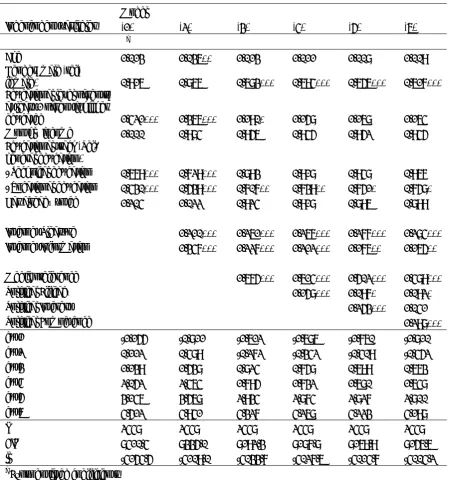
In order to answer our research question, six analyses were conducted for both conventional and alternative political participation. Tables 1 and 2 give the odds ratios for these analyses. Model 1 of tables 1 and 2 shows that both forms of political participation are strongly related to young people’s educational background. Young people with higher educated parents participate more in both alternative forms as well as conventional forms of political participation. The same holds for their own educational career. Adolescents who are enrolled in general education or have finished their secondary education in a general track participate more than their peers who are enrolled in or have finished their secondary education in the technical or vocational track. Striking is that the educational level of the parents is much more strongly related to conventional political participation than to alternative political participation. Also income is significantly related to conventional but not to alternative political participation5. None of the participation forms are related to gender. There are however some
differences concerning the effects of age and life stage. While alternative political participation is not related to age, the view one holds regarding conventional political participation is. When young people grow up, they become more convinced of the importance of institutional politics. Also, adolescents and young adults who already had the opportunity to vote, hold a more positive attitude towards conventional political participation. Alternative political participation shows only a moderate link with voting experience. Once controlled for media use, this relationship is no longer significant.
77
of other relevant features mediates the positive impact that this kind of media use has on alternative political participation. This suggests that even entertainment oriented use of the Internet can be an accelerator for young people to be active in this newer and less institutionalized forms of political participation.
Finally, the mediating factors political efficacy, interest and competences are entered to the model (models 4, 5 and 6). In these three last models we test if (new) media use influences political participation indirectly by strengthening young people’s political efficacy, interest and competences. Since indicators of political interest, political efficacy and political competences are highly correlated, we introduce them simultaneously in the analyses6. Although the three
indicators are strongly related, we find that with regard to institutional political participation all three indicators have an independent effect. Young people who have faith in the government and are confident in their impact on political affairs, hold a more positive attitude towards conventional political participation. This positive attitude even grows when the adolescent is interested in politics or when he or she feels politically competent. Taking into account these three factors, the effect parameters of both new as traditional media become twice as small. This may indicate that the more information oriented use of Internet and of traditional media influences institutional political participation indirectly by strengthening young people’s political efficacy, interest and competences.
78 Table 1. Ordinal logistic regression analysis on institutional political participation among Flemish youth (14-30; N: 2448)
Model
Independent variables (1) (2) (3) (4) (5) (6)
βa β β β β β
Age 1,065*** 1,063*** 1,031* 1,028 1,020 1,018
Gender: male (ref:
female) 1,338*** 1,395*** 1,094 1,228* 1,076 0,953 Educational level
parents: at least 1 parent is higher
educated 1,638*** 1,585*** 1,349** 1,238* 1,276* 1,281* Monthly income 1,181*** 1,161*** 1,128** 1,068 1,094* 1,079 Educational track (Ref.
general education)
- Technical education 0,666*** 0,701*** 0,880 1,012 1,106 1,161 - Vocational education 0,369*** 0,469*** 0,648*** 0,814 0,837 0,852 Has already voted 1,914*** 1,710*** 1,627*** 1,676*** 1,654*** 1,690***
Internet Pleasure 0,935 0,960 0,962 0,986 0,989
Internet Information 1,421*** 1,305*** 1,267*** 1,178** 1,156*
Media preference 1,851*** 1,585*** 1,317*** 1,284***
Political Efficacy 2,200*** 1,955*** 1,974***
Political Interest 1,930*** 1,341***
Political Competence 1,703***
cut1 0,691 0,578 -0,404 -0,731 -0,978 -1,145
cut2 2,298 2,208 1,294 1,108 0,951 0,828
N 2448 2448 2448 2448 2448 2448
BIC 4355,5 4325,7 4187,9 3950,7 3811,3 3760,3 ll -2142,6 -2120,0 -2047,1 -1924,7 -1851,0 -1821,6
a Exponentiated coefficients
79 Table 2. Ordinal logistic regression analysis on alternative political participation among Flemish youth (14-30; N: 2448)
Model
Independent variables (1) (2) (3) (4) (5) (6)
βa β β β β β
Age 1,013 1,036** 1,013 1,011 1,008 1,009
Gender: male (ref:
female) 0,916 0,866 0,683*** 0,694*** 0,656*** 0,617*** Educational level parents:
at least 1 parent is higher
educated 1,421*** 1,366*** 1,190* 1,158 1,168 1,164 Monthly income 1,000 0,984 0,956 0,945 0,952 0,945 Educational track (Ref.
general education)
- Technical education 0,679*** 0,729*** 0,893 0,918 0,948 0,967 - Vocational education 0,430*** 0,539*** 0,707** 0,739** 0,751* 0,758* Has already voted 1,204 1,022 0,924 0,918 0,896 0,899
Internet Pleasure 1,210*** 1,261*** 1,267*** 1,277*** 1,284*** Internet Information 1,347*** 1,227*** 1,212*** 1,176** 1,165**
Media preference 1,675*** 1,614*** 1,502*** 1,489***
Political Efficacy 1,158*** 1,097* 1,092*
Political Interest 1,253*** 1,041
Political Competence 1,298***
cut1 -1,155 -0,811 -1,612 -1,686 -1,760 -1,810
cut2 0,112 0,489 -0,272 -0,342 -0,409 -0,452
cut3 1,139 1,538 0,824 0,758 0,699 0,663
cut4 2,052 2,464 1,795 1,732 1,680 1,648
cut5 3,146 3,568 2,934 2,874 2,827 2,800
cut6 4,512 4,941 4,327 4,268 4,223 4,198
N 2448 2448 2448 2448 2448 2448
BIC 8410,4 8335,0 8192,3 8187,8 8169,9 8156,6 ll -4154,5 -4109,0 -4033,7 -4027,6 -4014,7 -4004,2
a Exponentiated coefficients
80
5 Conclusion and Discussion
Against the background of a growing concern about the political involvement of citizens in general and of youth in particular, we investigated the relationship between the use of different types of (new) media on the one hand and conventional and alternative forms of political participation on the other. Several authors stress that the introduction of the Internet and especially the speed of its spread among the population has caused a fundamental shift in the way people interact with information and knowledge. Some therefore speak of 'Netizens' instead of 'Citizens'. According to Milner (2010), the initiation of the Internet meant a simultaneous transformation of both the nature and the content of communication. The Internet indeed lead to an astronomic increase of the amount of available information - to the extent that no one can even retain an overview - offered by an infinite number of producers (many of whom are not professional) that can be consulted at any place at any time. Such an evolution has several consequences which in view of civic engagement have different and possibly even contradictory effects. Potentially the Internet reduced, firstly, the threshold for political participation and to acquire information. However, precisely the fact that people could never obtain information so easily, also increases the likelihood that people look for information that confirms their beliefs and avoid those contradicting it. This characteristic of the Internet potentially provides an inequality enhancing capacity. What does our research teach in that context?
Consistent with previous research (e.g. Bakker & de Vreese, 2011) we found that the use of Internet - even after taken into account a significant number of background characteristics, different views on politics and other media use - is positively related to both types of political participation. In addition, however, each use does not lead to the same result. Internet usage for pleasure appears quite strongly associated with alternative political participation, but is not related to conventional political participation (in this article, the voting intention). On the other hand, Internet for the purpose of gaining information is quite strongly related to both types of political participation, a finding that strengthens the idea that information and knowledge are often underestimated factors in the prediction of political participation (Milner, 2010). Such a pattern is part of a more general pattern which suggests that both types of political participation have different determinants. Alternative political participation seems, at first, much less embedded in the classical conceptions of and attitudes towards politics. This suggests the presence of a remarkable alternative path to politics. The latter also because, secondly, the Internet literally brings such alternative forms of political participation to people’s home. The big challenge at that level, however, are the differences in effect between the two paths. A difference in the way people are involved in politics is not problematic in itself, but becomes problematic, as Quintelier (2014) rightly points out, if those forms of engagement are different in the influence they have on the political process itself. In this sense, the discussion about the impact of the introduction of the Internet will not be considered separately from the more general discussion about whether our current organization of political decision-making is still sufficiently adapted to a changing social context.
81
the more general media preferences and both forms of political participation are considerably stronger than the relationship with the Internet, but in terms of direction they are similar. If both findings are combined, the question arises to what extent we are dealing with 'independent' relationships or unravel artificial effects. The study of the role the media have in general, and their impact on political involvement in particular, is still permeated by a relatively simple effect logic in which exposure to a medium also has clearly identifiable influences on certain, often very specific, outcomes. Precisely the previously mentioned characteristics of the Internet, all of which greatly increase the risk of self-selection, suggest that young people may never have had so many opportunities to develop their own lifestyles in which political involvement is more or less present. We know that media use plays a very crucial role in defining such styles (Elchardus, Herbots & Spruyt, 2013; Elchardus & Siongers, 2007). The relationships found between media use and political participation in this contribution should therefore also be partly attributed to the fact that already socially engaged young people consult other media than young people that are not so strong socially engaged. Today advocates for a stronger political commitment in young people often too easily take for granted that the Internet is the panacea to engage young people in politics and society.
Yet considering the additive effect of media on top of that of political attitudes, we can conclude that the digital highway can bring youth closer to the political process, provided that these young people know the correct information channels and are willing to use them. The latter can be only achieved if the political field pays more attention to the concerns and aspirations of young people.
References
Adsett, M. (2003). Changes in political era and demographic weight as explanations of youth “disenfranchisement” in federal elections in Canada, 1965-2000. Journal of Youth Studies, 6(3), 247-264.
Aydemir, A. T. (2007). Young People, Politics and the Internet. In Civicweb (Ed.), D4 Report: young people, the internet and civic participation: state of the art report. London: Institute of Education.
Bakker, T. P., & de Vreese, C. H. (2011). Good News for the Future? Young People, Internet Use, and Political Participation. Communication Research, 38(4), 451-470. doi: 10.1177/0093650210381738
Banaji, S. (2007). Civic Learning: Political Socialisation and Citizenship Education. In Civicweb (Ed.), D4 Report: young people, the internet and civic participation: state of the art report. London: Institute of Education.
Banaji, S., & Buckingham, D. (2009). Civic sell: young people, the internet, and ethical consumption. Information, Communication and Society, 12(8), 1197-1223.
Beck, U. (1994). The Reinvention of Politics: Towards a Theory of Reflexive Modernisation. In U. Beck, A. Giddens & S. Lasch (Eds.), Reflexive Modernization: Politics, Tradition and Aesthetics in the Modern Social Order (pp. 1-55). Cambridge: Polity Press.
Bennett, W. L. (1998). The Uncivic Culture: Communication, Identity and the Rise of Lifestyle Politics. Political Science & Politics, 31(4), 741-761.
82 Boonaert, T., & Siongers, J. (2010). Jongeren en media: van mediavreemden tot hybride meerwaardezoekers. In N. Vettenburg, J. Declerck & J. Siongers (Eds.), Jongeren in cijfers en letters. Bevindingen uit de JOP-monitor 2 (pp. 135-159). Leuven: Acco.
Buckingham, D. (2007). Beyond technology: children's learning in the age of digital culture. Cambridge: Polity Press.
Cammaerts, B., & Van Audenhove, L. (2005). Online political debate, unbounded citizenship, and the problematic nature of a transnational public sphere. Political Communication, 22(2), 147-162.
Castells, M. (1996). The Rise of the Network Society - Vol 1-3. Oxford: Blackwell Publishers.
COM. (2001 - 681 final). European Commission White Paper. A new impetus for European Youth (pp. 76). Brussels: EC.
Dalton, R. J. (2008). The good citizen: How a younger generation is reshaping American politics. . Washington DC: SAGE.
De Groof, S., Elchardus, M., Franck, E., & Kavadias, D. (2010). Vlaanderen in ICCS 2009. Brussels: Onderzoeksgroep TOR, Vrije Universiteit Brussel/Vlaams Ministerie van Onderwijs & Vorming.
Delli Carpini, M. X. (2000). Gen.com: Youth, civic engagement, and the new information environment. Political Communication, 17(4), 341-349.
DiMaggio, P., Hargittai, E., Neuman, E., & Robinson, J. (2001). Social implications of the internet. Annual Review of Sociology, 27 (1) (307-336).
Elchardus, M., & Herbots, S. (2010). Jongeren en democratisch burgerschap. Conventionele, alternatieve en aanvullende participatie. In N. Vettenburg, J. Deklerck & J. Siongers (Eds.), Jongeren in cijfers en letters. Bevindingen van de JOP-monitor 2, (pp. 181-212). Leuven: Acco.
Elchardus, M., & Siongers, J. (2015). The Often Announced Decline of the Modern Citizen. An empirical, comparative analysis of European Young people’s political and civic engagement. In P. Thijssen, Siongers, J., Van Laer, J., Haers, J., & Mels, S. (eds.). Political Engagement of the Young in Europe. Youth in the crucible (pp. 133-160). Abingdon: Routledge.
Elchardus, M., & Vanhoutte, B. (2009). Genderverschillen in de groei naar democratisch burgerschap. In N. Vettenburg, J. Deklerck & J. Siongers (Eds.), Jongeren binnenstebuiten. Thema’s uit het jongerenleven onderzocht (pp. 105-132). Leuven: Acco.
Elchardus, M., & Vanhoutte, B. (2009). Onderwijsvorm en de groei naar democratisch burgerschap. In N. Vettenburg, J. Deklerck & J. Siongers (Eds.), Jongeren binnenstebuiten. Thema’s uit het jongerenleven onderzocht (pp. 133-150). Leuven: Acco.
Elchardus, M. & Siongers, J. (2007) Ethnocentrism, taste and symbolic boundaries. Poetics. 35(4/5): 215-239.
Elchardus, M., Herbots, S., & Spruyt, B. (2013): Keeping on track and growing apart: An empirical analysis of the role of education and media in attitude formation. Poetics, 41 (5), 524-544
Eliasoph, N. (1998). Avoiding politics. How Americans produce apathy in everyday life. Cambridge: Cambridge University Press.
83 Farthing, R. (2010). The politics of youthful antipolitics: representing the ‘issue’ of youth participation in politics. Journal of youth studies, 13(2), 181-195.
Fitoussi, J.-P., & Rosanvallon, P. (1996). Le nouvel âge des inégalités. Paris: Seuil.
Furlong, A., & Cartmel, F. (2007). Young People and Social Change: New Perspectives Buckingham: Open University Press.
Geniets, A. (2010). Lost in translation: Why civic online efforts in Britain have failed to engage young women from low socioeconomic backgrounds. European Journal of Communications, 25(4), 398-412.
Gentzkow, M. A. (2006). Television and Voter Turnout. The Quarterly Journal of Economics, 121(3), 931-972.
Giddens, A. (1994). Beyond Left and Right: The Future of Radical Politics. Cambridge: Polity Press.
Gil de Zúñiga, H., Jung, N., & Valenzuela, S. (2012). Social media use for news and individuals' social capital, civic engagement and political participation. Journal of Computer Mediated Communication, 17 (3), 319-36.
Gil de Zúñiga, H., Molyneux, L., & Zheng, P. (2014). Social media, political expression, and political participation: Panel analysis of lagged and concurrent relationships. Journal of Communication, 64 (4), 612-34.
Gil de Zúñiga, H., & Valenzuela, S. (2011). The mediating path to a stronger citizenship: Online and offline networks, weak ties, and civic engagement. Communication Research, 38 (3), 397-421.
Gilliam, F. D., & Iyengar, S. (2000). Prime Suspects: The influence of Local Television News on the Viewing Public. American Journal of Political Science, 44(3), 560-573.
Harris, A., Wyn, J., & Younes, S. (2010). Beyond apathetic or activist youth: 'Ordinary' young people and contemporary forms of participation. Young, 18(1), 9-32.
Hartmann, M. (2004). Young People = ‘Young’ Uses? Questionning The ‘Key Generation’. In N. Carpentier, C. Pauwels & O. Van Oost (Eds.), Het On(be)grijpbare Publiek. The Ungraspable Audience. Een Communicatiewetenschappelijke verkenning van het Publiek (Vol. 355-376). Brussel: VUBPress.
Harvey, D. (1989). The Condition of Postmodernity: An Enquiry into the Origins of Cultural Change. Oxford: Blackwell.
Haythornwaite, C. (2001). Introduction. The Internet in Everyday Life, American behavioral scientist (45), 363-382.
Held, D., McGrew, A., Goldblatt, D., & Perraton, J. (1999). Global Transformations. Cambridge: Polity Press.
Henn, M., Weinstein, M., & Forrest, S. (2005). Uninterested youth? Young people's attitudes towards party politics in Britain. Political studies, 53(3), 556-578.
Hirzalla, F., & van Zoonen, L. (2008). CivicWeb. Report: Uses of the Web for Civic Participation. London: Institute of Education.
84 Hooghe, M., & Boonen, J. (2015). Youth Engagement in Politics: Generational Differences and Participation Inequalities. In: Thijssen, P., Siongers, J., Van Laer, J., Haers, J., & Mels, S. (2015). Political Engagement of the Young in Europe. Youth in the crucible (pp. 13-28). Abingdon: Routledge.
Hull, D., Cecez-Kecmanovic, D., Kennan, M. A., & Nagm, F. (2009). Youth online participation and consultative processes: Report on a pilot project in "better futures". Sydney: Information Systems, Technology and Management, Australian School of Business, The University of New South Wales.
Jung, N., Kim, Y., & de Zúniga, H. G. (2011). The mediating role of knowledge and efficacy in the effects of communication on political participation. Mass Communication and Society, 14 (4), 407-30.
Kann, M. E., Berry, J., Gant, C., & Zager, P. (2007). The Internet and youth political participation. First Monday, 12(8).
Kirshner, B., Strobel, K., & Fernández, M. (2003). Critical Civic Engagement Among Urban Youth. Penn
GSE Perspectives on Urban Education, 2(1),
http://www.urbanedjournal.org/archive/Issue3/articles/article0010.html.
Kraut, R., Patterson, M., Lundmark, V., Kiesler, S., Mukophadhyay, T., & Scherlis, W. (1998). Internet paradox: A Social Technology that Reduces Social Involvement and Psychological Well-being?, American Psychology, 53 (9), 1011-1031.
Livingstone, S., & Bober, M. (2005). UK Children go online. Final report of key project findings. London: Department of Media and Communications.
Livingstone, S., Bober, M., & Helsper, E. J. (2005). Active participation or just more information? Young people’s take up of opportunities to act and interact on the internet. Information, Communication and Society, 8(3), 287-314.
Loader, B. (Ed.). (2007). Young citizens in the digital age: Political engagement, young people and new media. Abingdon: Routledge.
Marien,S., Hooghe,M., & Quintelier,E. (2010). Inequalities in Non-institudionalized forms of political participation. A multilevel analysis for 26 countries. Political studies, 58(1), 187-213.
Milner, H. (2010). The internet generation: engaged citizens or political dropouts: UPNE.
Nie, N. H. (2001). Sociability, Interpersonal Relations and The Internet. Reconciling Conflicting Findings. American Behavioral Scientist, 45 (3), 420-435.
Norris, P. (1996). Does television erode social capital? A reply to Putnam. Political Science and Politics, 29(3), 474-480.
Norris, P. (2002). Democratic phoenix: political activism worldwide. New York: Cambridge University Press.
Norris, P. (2004, 27-28th November). Young People & Political Activism: From the Politics of Loyalties to the Politics of Choice? Paper presented at the Report for the Council of Europe Symposium: "Young people and democratic institutions: from the disillusionment to participation, Strasbourg.
Oser, J., Hooghe, M., & Marien, S. (2013). Is online participation distinct from offline participation? A latent class analysis of participation types and their stratification. Political Research Quarterly, 66 (1), 91-101.
85 Prior, M. (2005). News vs. entertainment: How increasing media choice widens gaps in political knowledge and turnout, American Journal of Political Science, 49 (3), 577-592.
Putnam, R. (2000). Bowling alone. The collapse and revival of American community. New York: Simon & Schuster.
Quintelier, E. (2008). Who is Politically Active: The Athlete, the Scout Member or the Environmental Activist? Acta Sociologica, 51(4), 355-370.
Quintelier, E. (2014). Politiek: iets voor jongens of meisjes? Een studie naar politieke participatie, political efficacy en politieke interesse In B. Spruyt & J. Siongers (Eds.), Gender(en). Over de constructie en deconstructie van gender bij Vlaamse jongeren (pp. 221-236). Leuven: Acco.
Quintelier, E., & Vissers, S. (2008). The Effect of Internet Use on Political Participation: An Analysis of Survey Results for 16-Year-Olds in Belgium. Social Science Computer Review, 26(4), 411-427.
Romer, D., Jamieson, K. H., & Aday, S. (2003). Television News and the Cultivation of Fear of Crime. Journal of Communication (March), 88-104.
Shah, D. V., Cho, J., Eveland, W. P., & Kwak, N. (2005). Information and expression in a digital age modeling Internet effects on civic participation. Communication Research,32 (5), 531-65.
Shah, D. H., Kwak, N., & Holbert, R. L. (2001). " Connecting" and" disconnecting" with civic life: Patterns of Internet use and the production of social capital. Political communication,18 (2), 141-62.
Snell, P. (2010). Emerging adult civic and political disengagement: A longitudinal analysis of lack of involvement with politics. Journal of Adolescent Research, 25 (2), 258-287.
Stolle, D., Hooghe, M., & Michelleti, M. (2005). Politics in the Super-Market: Political Consumerism as a Form of Political Participation. International Review of Political Science, 26 (3), 245-269.
Thijssen, P., Siongers, J., Van Laer, J., Haers, J., & Mels, S. (Eds.) (2015). Political Engagement of the Young in Europe. Youth in the crucible. Abingdon: Routledge.
Van Audenhove, L., Cammaerts, B., Frissen, V., Engels, L., & Ponsioen, A. (2002). Transnational Civil Society in the Networked Society: A Study on the Relation between ICTs and the Rise of a Transnational Civil Society, Study in the framework of TERRA 2000, EU Project under IST 2000 for Institute of Infonomics.
Vitak, J., Zube, P., Smock, A., Carr, C. T., Ellison, N., & Lampe, C. (2011). It's complicated: Facebook users' political participation in the 2008 election. CyberPsychology, behavior, and social networking, 14 (3), 107-114.
Vrcan, S. (2002). Youth: Politics, Sub-Politics and Anti-Politics. The Case of Croatia since the mid-eighties. In B. Tivadar & M. e. Polona (Eds.), Flying Over or Falling Through the Cracks? Young People in the Risk Society. Ljubljana: Office for Youth of the Republic of Slovenia.
86 Endnotes
1 Different public consultations have revealed that young people want to become more involved in
participatory processes, but feel that they are given neither the resources nor the information and training that would enable them to play a more active role (White Paper Youth (COM, 2001-681: 24).
2 In the International Civic and Citizenship Education Study one notices that 78% of European 13- to
14-year-olds think voting is an important trait of a good citizen, 75% considers respecting government representatives important and 71,5% following political issues in the media (De Groof et al., 2010). However, there are large differences between European countries.
3 Although there is evidence for the higher participation of young people in social movement,
alternative, one-off … activities, numerous authors have also pointed to the fact that participation in civic life does not follow zero-sum rules, in that one form of participation goes at the expense of the other. On the contrary, participation appears to be a cumulative process in which people who are active in traditional politics or associations tend to be more active in non-organized or one-off activities as well, and vice versa (Barnes & Kaase, 1979; Elchardus & Herbots, 2010).
4 The collection of this data was funded by the Flemish Government (ministries of Scientific Research
and Youth).
5 After controlling for media preference in model 3, we find a significant but small negative effect of
income. In other words, when the media preferences of young people are taken into account, income appears to have a significant but not substantial influence on the alternative political participation.
6 In general, young politically interested people consider themselves more competent, have more faith
in government and in the impact of their actions upon politicians and their actions than not interested young people have. Pearson correlations: political competences and political interest: 0,754; political competences and political efficacy: 0,324; political efficacy and political interest: 0,393.
Dr. Jessy Siongers works at Ghent University and Vrije Universiteit Brussel as the coordinator and postdoctoral researcher at the Knowledge Centre on Cultural and Media Participation and supervisor of the Youth Research Platform. She co-edited the book Political Engagement of the Young in Europe. Youth in the crucible, published by Routhledge, 2015.
Dr. Gil Keppens is a senior researcher at Vrije Universiteit Brussel, Research group TOR. His main research interests include youth research, sociology of education and cultural sociology. He is actively engaged in truancy research and is currently involved in the Policy Center for Educational Research. He wrote a PhD. on truancy. His recent work has been published in among others Educational Studies, Research papers on education and Young.
Bram Spruyt is an associate professor of sociology at the Vrije Universiteit Brussel and member of the research group TOR. His research interests include the study of intergroup relations, cultural sociology and public opinion research. His recent work on ethnic prejudice has been published inPolitical Psychology, Political Research Quarterly, Acta PoliticaandSocial Science Quarterly.