M AY 2 0 1 1
A Practical Guide
to Designing
Comprehensive
Teacher Evaluation
Systems
A Tool to Assist in the
Development of Teacher
Evaluation Systems
A Practical Guide to Designing Comprehensive
Teacher Evaluation Systems
Laura Goe, Ph.D. ETS
Lynn Holdheide Vanderbilt University Tricia Miller, Ph.D.
Contents
Rationale and Structure . . . . 1
Introduction . . . . 2
State Accountability and District Responsibility in Teacher Evaluation Systems . . . . 3
Key State Roles . . . . 4
Models for State and District Evaluation Systems . . . . 5
Factors for Stakeholder Consideration . . . . 8
Development and Implementation of Comprehensive Teacher Evaluation Systems . . . . 9
Component 1: Specifying Evaluation System Goals . . . . 9
Component 2: Securing and Sustaining Stakeholder Investment and Cultivating a Strategic Communication Plan . . . . 14
Component 3: Selecting Measures . . . . 19
Component 4: Determining the Structure of the Evaluation System . . . . 34
Component 5: Selecting and Training Evaluators . . . . 37
Component 6: Ensuring Data Integrity and Transparency . . . . 40
Component 7: Using Teacher Evaluation Results . . . . 43
Component 8: Evaluating the System . . . . 47
Conclusion and Recommendations . . . . 50
References . . . . 51
Rationale and Structure
Across the nation, states and districts are in the process of building better teacher evaluation systems that not only identify highly effective teachers but also systematically provide data and feedback that can be used to improve teacher practice . A Practical Guide to Designing Comprehensive Teacher Evaluation Systems is a tool designed to assist states and districts in constructing high-quality teacher evaluation systems in an effort to improve teaching and learning . This tool is not a step-by-step guide to devising a teacher evaluation system . Rather, it is intended to facilitate discussion and promote coherence in the development process . The following assumptions have guided its construction: In response to federal initiatives and priorities as well as state legislation, states are motivated to improve their current evaluation systems to better identify successful teachers, assist less successful teachers, and help all teachers improve their practice .
Most current definitions of teacher effectiveness (e .g ., the Race to the Top definition) include teachers’ contributions to student learning growth, and states need to consider measuring these contributions for all teachers .
States are interested in systems that use multiple measures to assess various aspects of teachers’ performance and instructional practice .
States may be in various stages in terms of creating or revising teacher evaluation systems . This tool allows states to focus on the specific components of the system that are most relevant for them .
In states where districts have substantial control over teacher evaluation systems, this tool may be used by districts or consortiums of districts for discussion and guidance .
Teachers play a critical role in ensuring that the evaluation system is fair, valid, and successful, and they should be active participants in designing, developing, implementing, and evaluating the system . The guide begins with an overview of the factors influencing teacher evaluation reform today and continues with a discussion of approaches to balancing state accountability and district autonomy . The next section of the guide is structured around the following essential components of the design process as supported through research:
Component 1: Specifying Evaluation System Goals
Component 2: Securing and Sustaining Stakeholder Investment and Cultivating a Strategic Communication Plan
Component 3: Selecting Measures
Component 4: Determining the Structure of the Evaluation System
Component 5: Selecting and Training Evaluators
Component 6: Ensuring Data Integrity and Transparency
Component 7: Using Teacher Evaluation Results
Component 8: Evaluating the System Each subsection includes an overview of the component, resources and practical examples, and a series of guiding questions designed to help states organize their work and move strategically toward an evaluation system that functions to improve student learning and teacher performance .
Introduction
The research community has long recognized the importance of teachers to student achievement . Although research has shown that teachers are the most significant school-based factor in student achievement, traditional methods of evaluating teachers have not been able to capture or explain differences between effective and ineffective teachers .
Initial efforts to ensure quality education focused on teacher qualifications and degrees; however, research does not indicate that these factors significantly influence teacher effectiveness . For example, Rivkin, Hanushek, and Kain (2005) analyzed results from thousands of teachers and their students in Texas and determined that there were strong teacher effects on academic achievement, but variation in these effects could not be explained by education or experience .
Further, mounting evidence indicates that the United States is losing ground in comparison to other countries in terms of educational outcomes . One international study showed that U .S . students were outperformed in mathematics by students in 20 of the other 28 industrialized countries studied (Lemke et al ., 2004) . In addition, a recent Program for International Student Assessment study found that only 5 of the
other 33 participating countries had lower scores in mathematics literacy than the United States (Fleischman, Hopstock, Pelczar, & Shelley, 2010) . These types of findings resulted in increased concern about determining the best way to improve student learning through teacher performance and a shift in focus from analyzing teacher inputs (e .g ., education, certification, and experience) to measuring teacher effects (e .g ., student achievement and classroom practice) . Improving teacher quality and effectiveness is a complex issue, and the ability to identify high-performing and low-performing teachers is a necessary step toward pinpointing instructional strategies and pedagogy that result in improved student growth (e .g ., evidence-based instructional strategies, strong student-teacher relationships) . Unfortunately, traditional evaluation methods have not proven to be useful in meeting this challenge . In the past, teacher evaluation systems have varied widely in their rigor and utility . Most systems were based on classroom observations, usually conducted by principals but sometimes conducted by trained evaluators (see Practical Example: “Cincinnati Public Schools Evaluation System”) . The steps taken after the observations differed considerably across states, districts, and even schools, with some schools linking results to professional growth plans for teachers and others filing the results away
with little or no follow-up . The perfunctory, compliance-oriented approach to teacher evaluation in some districts likely did not contribute to tangible improvement in teaching and learning . Unfortunately, there has been little research on how these different approaches to classroom observation influenced teacher performance .
PRACTICAL EXAMPLE
Cincinnati Public Schools Evaluation System Cincinnati teachers participate in a “comprehensive evaluation” during their first and fourth years of teaching, after which, they are evaluated every five years. Teachers are observed four times by teacher evaluators and once by a school administrator. Before they can become teacher evaluators, teachers must complete a three-step application process to become lead teachers. Lead teachers may then apply for positions such as teacher evaluators, consulting teachers, and program facilitators. Those selected for teacher evaluator positions are required to undergo extensive training in collecting and scoring evidence. Using videos, they are certified through a process of verifying the agreement of their scores with those of “master raters.” Through this process, a high degree of reliability is ensured, meaning that a teacher’s observation score is likely to be the same or nearly the same, regardless of which trained evaluator conducts the observation.
In 2009, an investigation into the compliance-oriented approaches of evaluation systems conducted by The New Teacher Project sent shockwaves through the policy world . The study, titled The Widget Effect: Our National Failure to Acknowledge and Act on Differences in Teacher Effectiveness, examined large and small districts across several states where evaluation consisted primarily of classroom observations (Weisberg, Sexton, Mulhern, & Keeling, 2009) . The following conclusions emerged from the study:
Nearly all teachers received high ratings (good or great) .
Districts failed to recognize and reward excellence .
Professional development was rarely tied to results and when it was, little support was offered to teachers .
New teachers generally were rated above satisfactory, and tenure was seldom denied to teachers based on observation results .
Poor performance rarely led to teacher dismissal .
The inability of evaluation systems to differentiate factors contributing to teacher effectiveness suggests that classroom observations, at least as they were used in most districts in the study, are of little use for improving and rewarding performance or identifying teachers who need support and
Through funding opportunities including the American Recovery and Reinvestment Act (ARRA) and the Race to the Top competition, the federal government has encouraged states and districts to develop rigorous evaluation systems for use in high-stakes decisions including teacher advancement, compensation, distribution, and retention . These opportunities, coupled with the evidence of poorly functioning teacher evaluation systems, have resulted in a national urgency to create and implement comprehensive, strategic systems for evaluating teacher performance that identify, support, and develop teacher effectiveness and student growth .
In response to this urgency, many states have passed legislation mandating the development of rigorous, high-quality evaluation systems for use in high- stakes situations related to teacher employment and advancement . Advisory boards, committees, and multistate consortia are meeting to gather information on research and best practices related to the development, implementation, and use of these evaluation systems . This Practical Guide provides education policymakers and stakeholders with guidance on the key areas that should be addressed during the development and implementation of a new evaluation system .
State Accountability
and District Responsibility
in Teacher Evaluation
Systems
Until recently, teacher evaluation has largely been considered the purview of districts or schools without much, if any, involvement from states . Starting with the highly qualified teacher requirements as codified in the Elementary and Secondary Education Act (ESEA), as reauthorized by the No Child Left Behind Act (NCLB), and continuing through the ARRA reform goals and assurances, states are expected to play an increasingly larger role in ensuring the quality and effectiveness of the nation’s teaching force . This expectation creates a challenge for many states with a long history of local autonomy in most education matters . Specific to teacher evaluation systems, states now must decide the extent to which the teacher evaluation model will make allowances for local flexibility and provide a balance between local and state control that encourages collective responsibility and accountability . This section includes an overview of several key roles states may play in assisting districts in the implementation of new evaluation requirements and descriptions of several models that balance state accountability with local autonomy .
Key State Roles
Interpreting Federal and State Regulations
Spurred on by the Race to the Top competition, many states have either recently passed new legislation or pointed to existing legislation concerning teacher evaluation, most of which are directly related to the four ARRA reform goals or assurances: the quality of standards and assessments, improving the collection and use of data, increasing teacher effectiveness and equitable distribution, and supporting struggling schools (Learning Point Associates, 2010) . The language of this federal and state legislation permits varying degrees of flexibility in terms of how the evaluation system is to be implemented . As such, the responsibility for interpretation and implementation falls primarily to states . Implementing new teacher evaluation laws and policies usually involves interpretation and overcoming challenges that may not have been anticipated by the policymakers . Recognition of these challenges and their potential variations according to local contexts should inform the training needs of personnel and contribute to the development of the evaluation model . Accordingly, states need to take proactive steps in helping districts interpret the new legislation and determining the best course of action toward full implementation .
TQ CENTER RESOURCES
Approaches to Evaluating Teacher Effectiveness: A Research Synthesis http://www.tqsource.org/publications/EvaluatingTeachEffectiveness.pdf
This research synthesis examines how teacher effectiveness is measured and provides practical guidance for evaluating teacher effectiveness. It evaluates the research on teacher effectiveness and various measures. In addition, it defines components and indicators that characterize effective teachers, extending this definition beyond teachers’ contributions to student achievement gains to include how teachers affect classrooms, schools, and colleagues as well as how teachers contribute to other important outcomes for students.
Methods of Evaluating Teacher Effectiveness
http://www.tqsource.org/publications/RestoPractice_EvaluatingTeacherEffectiveness.pdf This brief is intended to help regional comprehensive centers and state policymakers as they consider evaluation methods to clarify policy, develop new strategies, identify effective teachers, or guide and support districts in selecting and using appropriate evaluation methods for various purposes. Included in this brief is a five-point definition of teacher effectiveness the authors developed by analyzing research, policy, and standards that address teacher effectiveness and by consulting experts in the field.
A Practical Guide to Evaluating Teacher Effectiveness http://www.tqsource.org/publications/practicalGuide.pdf
This guide offers a definition of teacher effectiveness that states and districts may adapt to meet local requirements, provides an overview of the many purposes for evaluating teacher effectiveness, and indicates which measures are most suitable to use under different circumstances. The guide also includes summaries of various measures, such as value-added models, classroom observations, analysis of classroom artifacts, and portfolios. The summaries include descriptions of the measures, along with a note about the research base and strengths and cautions to consider for each measure. Challenges in Evaluating Special Educators and English Language Specialists (Research & Policy Brief)
http://www.tqsource.org/publications/July2010Brief.pdf
This brief provides the results of an inquiry conducted by the TQ Center with support from the Council for Exceptional Children and several national experts in the context of current research and practice in teacher evaluation. It offers policy and practice recommendations for regions, states, and districts to help in their efforts to create valid, reliable, and comprehensive evaluation systems for all teachers as they work to improve the achievement of all students.
For example, the Race to the Top application indicated that student achievement was to be a “significant” component of teacher evaluation . However, the federal government did not define significant, and there is not currently a research base to support differential weighting of the components in an evaluation system . As a result, many states looked to their own legislation to resolve any discrepancies in interpretation or implementation .
For example, several states codified the weight (percentage) of student achievement in the teacher evaluation system (e .g ., Tennessee specified 50 percent, Rhode Island specified 51 percent, and Colorado specified 50 percent) . Such state legislation was intended to drive changes in evaluation systems and provide better information about teachers’ contributions to student learning growth . However, the legislation often did not address the other logistical and procedural aspects of teacher evaluation (e .g ., how growth would be measured, the frequency of the evaluation, who would conduct the evaluations, and how evaluators would be trained) . States should play a critical role in interpreting such legislation and be prepared to help districts address specific challenges, unintended
consequences, and implementation considerations at the district level .
Interpreting/Conducting Research The dearth of available research-based methods and models of comprehensive teacher evaluation hinders states’ abilities to offer assistance to districts . Although some research on the utility of specific measures of teacher performance exists (Goe, Bell, & Little, 2008), albeit limited, most has been conducted in low-stakes environments . Therefore, many states have chosen to assemble task forces and engage national experts in evaluation and measurement to secure recommendations and inform the conversation concerning teacher effectiveness and evaluation policy . In many cases, states and districts may need to identify measures and conduct research during and after implementation . Given potential resource and human capacity limitations at the district level, states may need to play an active role in conducting research to ensure that the evaluation model is technically sound and therefore defensible, especially in situations in which teacher evaluation results will be used to make personnel and compensation decisions . These conversations and preliminary research could be instrumental in ensuring the validity of the results from comprehensive teacher evaluation systems and gaining educator and stakeholder support .
Models for State and
District Evaluation Systems
Historically, models of teacher evaluation varied among schools, districts, and states and were largely dependent on the context in which the model evolved and was implemented . However, as federal guidance and policy lean toward more state responsibility for ensuring teacher quality and monitoring district teacher evaluation, states must determine their role and level of involvement—from providing limited guidance to taking a more directive approach . For example, some states may elect to mandate a particular evaluation model, governing logistics (e .g ., how often teachers are evaluated), format (e .g ., selection of measures), and personnel decisions (e .g ., what a rating means in terms of teacher tenure) . Others may provide specific guidelines for the evaluation model while allowing the district flexibility in adapting those guidelines locally and in the implementation of the system . The level of flexibility will likely vary according to many factors (e .g ., political context, local bargaining agreements, state size, and district capacity) and the state’s goals . Some states, like Delaware, have mandated a statewide evaluation system . Other states allow every district to determine its own
model for teacher evaluation as long as stated requirements are met . States also may create or facilitate consortiums among districts in the same region or those that share similar challenges (e .g ., a rural consortium encompassing several contiguous districts or a statewide consortium of urban districts) .
Various state options and accompanying stakeholder considerations are discussed in the following subsections . Note that this is not an exhaustive listing of options . State-Level Evaluation System
Within a state-level evaluation system, the state provides a strict interpretation of legislation and prescribes the requirements for the teacher evaluation model . The state determines the components of the teacher evaluation model, which measures are to be used, how often evaluations are to be conducted, and by whom . Therefore, the state is instrumental in the design, implementation, and evaluation of the teacher evaluation model . Delaware is currently in the process of implementing this type of system (See Practical Example: “Delaware’s Evaluation System”) . With significant contribution from local practitioners, the state has led the
efforts related to the development of a comprehensive teacher evaluation model . After the model is finalized, all Delaware districts will be required to implement the model with little flexibility . Elective State-Level Evaluation System Within this system, states may elect to provide a strict interpretation of state or federal legislation and dictate certain aspects of the evaluation model but allow flexibility in others . For example, the state may have legislation that mandates the use of student achievement as a significant factor, and district models would have to include measures of student achievement . Or the state may have specific language about which aspects of teacher evaluation are subject to local decision making and which aspects are state mandates that are not open to negotiation . The state may mandate the type of growth model and other measures the districts use to determine student growth, the attribution of growth to teachers, and the weight (percentage) of the components of the teacher evaluation system . The possible components of the evaluation model (e .g ., observation protocols, portfolios, student/parent surveys) and processes for using them would be determined by the district .
For instance, the state might offer Charlotte Danielson’s (2007) Framework for Teaching as an option that districts could elect to use but allow districts to choose different observation models as long as certain criteria are maintained . Thus, the state plays a major role in ensuring that certain components are part of the district models but allows for local flexibility in other aspects of the system . This option allows a continuance of established district models, provides flexibility for bargaining agreements, and continues the tradition of local control over teacher evaluation that exists in many states (See Practical Example: “New York’s Evaluation System”) . District Evaluation System
With Required Parameters
States that find it impractical to adopt a single statewide evaluation system may still deem it necessary to provide guidance to districts in implementing regulations and state priorities for teacher evaluation . Within this system, states play a much smaller role in the design and implementation of the teacher evaluation system at the district level . Guidance may be somewhat general, such as requiring states to implement an evaluation system that includes several components (e .g ., observations, evidence of professional responsibilities, and evidence of teachers’ contributions to student achievement) .
The guidance also may be more restrictive, particularly if some aspects of the evaluation system are already in place . In this case, the state provides some level of guidance to districts and specifies the parameters for the district models . The state, therefore, does not play a major role in the evaluation
process but provides some type of screening/approval to ensure district compliance in selecting models as well as an audit or follow-up mechanism to ensure that districts are working within the defined parameters . For instance, the state may indicate that districts can select their own
evaluation model but require that new teachers be observed three times per year for at least 20 minutes per visit . The district has flexibility in the model selection, but the logistical parameters need to be met (See Practical Example: “Ohio’s Guidelines to Evaluation”) .
PRACTICAL EXAMPLES Delaware’s Evaluation System
Delaware already had a statewide evaluation system in existence prior to being awarded Race to the Top funds. This system included classroom observation and opportunities for professional growth. However, Delaware’s existing system lacked a mechanism to measure student growth. Therefore, an external evaluation was conducted that included soliciting feedback from teachers and administrators through surveys, interviews, and focus groups. The state department collaborated with union representatives to ensure that the system would be accepted as comprehensive, valid, and fair. These results contributed to the design of a statewide model. However, given the timelines and implementation demands, it is not clear whether Delaware will ultimately use this model; alternatives are still being considered.
Adapted from Measuring Teachers’ Contributions to
Student Learning Growth for Nontested Grades and Subjects by L. Goe and L. Holdheide. Copyright ©
2011 National Comprehensive Center for Teacher Quality, p. 12
New York’s Evaluation System
New York’s system is an example of an elective state model, providing clear guidance about how new evaluation requirements will be phased in over several years. The system is based on a 100-point scale; 60 percent of the evaluation score will be based on locally negotiated processes (e.g., classroom observations by trained evaluators), and 40 percent will be based on a combination of state standardized tests and local assessments and measures, which would have to be developed by each school system.
Year 1: 20 percent of student growth is based on state assessments or comparable measures for teachers in the common branch subjects or ELA and mathematics in Grades 4–8 only, and 20 percent is based on other locally
selected measures that are rigorous and
comparable across classrooms.
Year 2: After two years, 25 percent would be based on standardized tests, and 15 percent would be based on locally selected measures.
Source: New York State Education Department (2011)
Ohio’s Guidelines to Evaluation
Ohio has developed state teacher evaluation guidelines as follows.
The teacher evaluation system adopted by the district should:
“Align to the Standards for Ohio
Educators.”
“Be systematic and ongoing in order to promote professional development and student learning.”
“Take into account experience, skill, longevity, and responsibility.”
“Use a variety of measures to collect evidence.”
“Include differentiated effectiveness levels of performance using multiple rating categories of teachers and encourage continuous professional growth.”
Source: (Ohio Department of Education, n.d.,
Slides 16–17)
Note: Components of this system are being piloted
Factors for Stakeholder
Consideration
Stakeholders might consider the following factors in selecting a particular model:
Grant requirements as applicable (e .g ., Race to the Top, School Improvement Grants, Teacher Incentive Fund)
Existing or impending state legislation that affects the evaluation process
Goals and priorities at the state and district levels
State-level role in district practice
The role of unions and bargaining agreements in local and state decisions
The number and diversity of districts within a state as well as geographical distance between them
The human and resource capacity at the state and local levels
The training needed to implement the system with fidelity
Stakeholder support for changes in teacher evaluation
Technological capacity, including the ability to link teachers with students
District models already in use and their level of acceptance at the local level
Teachers’ and administrators’ preferences for certain types of measures
Note: Race to the Top and ARRA indicate that total district-level control with no state-level involvement or accountability is not supported at the federal level .
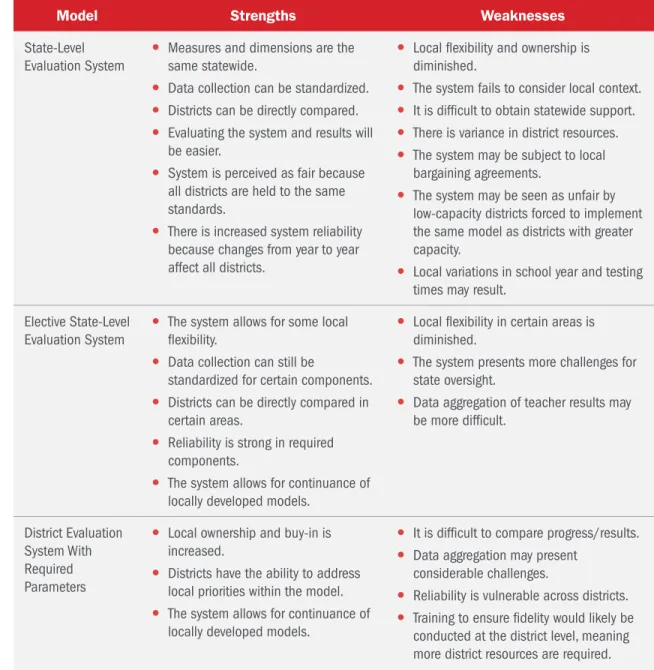
Table 1 lists some potential strengths and weaknesses within the various models . Table 1. Evaluation Models Strengths and Weaknesses
Model Strengths Weaknesses
State-Level Evaluation System
Measures and dimensions are the same statewide.
Data collection can be standardized. Districts can be directly compared. Evaluating the system and results will
be easier.
System is perceived as fair because all districts are held to the same standards.
There is increased system reliability because changes from year to year affect all districts.
Local flexibility and ownership is diminished.
The system fails to consider local context. It is difficult to obtain statewide support. There is variance in district resources. The system may be subject to local
bargaining agreements.
The system may be seen as unfair by low-capacity districts forced to implement the same model as districts with greater capacity.
Local variations in school year and testing times may result.
Elective State-Level Evaluation System
The system allows for some local flexibility.
Data collection can still be
standardized for certain components. Districts can be directly compared in
certain areas.
Reliability is strong in required components.
The system allows for continuance of locally developed models.
Local flexibility in certain areas is diminished.
The system presents more challenges for state oversight.
Data aggregation of teacher results may be more difficult.
District Evaluation System With Required Parameters
Local ownership and buy-in is increased.
Districts have the ability to address local priorities within the model. The system allows for continuance of
locally developed models.
It is difficult to compare progress/results. Data aggregation may present
considerable challenges.
Reliability is vulnerable across districts. Training to ensure fidelity would likely be
conducted at the district level, meaning more district resources are required. Resources may be limited.
Development and
Implementation of
Comprehensive Teacher
Evaluation Systems
This section is divided into eight subsections describing the components that comprise the critical phases of designing a
comprehensive teacher evaluation system:
Component 1: Specifying Evaluation System Goals
Component 2: Securing and Sustaining Stakeholder Investment and Cultivating a Strategic Communication Plan
Component 3: Selecting Measures
Component 4: Determining the Structure of the Evaluation System
Component 5: Selecting and Training Evaluators
Component 6: Ensuring Data Integrity and Transparency
Component 7: Using Teacher Evaluation Results
Component 8: Evaluating the System Each subsection discusses the relevance of the component in the design process and concludes with a series of questions to guide the development process .
Specifying Evaluation
System Goals
Goal-setting is an imperative, and often challenging, first step in designing a teacher evaluation system . The establishment of explicit, well-defined goals lays the foundation for a comprehensive, sustainable evaluation system . Some states have defined teacher evaluation goals and purposes in recent legislation and/or policy . In most scenarios, however, stakeholders are left to define effective teaching and achieve consensus on the evaluation system’s purpose . There is a general tendency to oversimplify this crucial step; however, agreement about goal selection focuses and guides all decisions throughout the design process . The methods and weighting used for various components of the resulting system and any actions informed by evaluation results (e .g ., professional development targeted to a challenge area) should reflect the evaluation system goals .
Stakeholders should exercise caution when selecting goals, keeping in mind that the ultimate objective of teacher evaluation is to improve teaching and learning . Systems designed exclusively for accountability are less likely to have an impact on teacher practice than those tied to professional learning opportunities and growth .
At the same time, if a goal of the teacher evaluation system is to make personnel and compensation decisions, there is an increased need to ensure that measures are technically defensible . The higher the stakes, the greater the need to establish reliable and valid measures that can accurately differentiate among more and less effective teachers . Likewise, if the goal of the evaluation system is to improve teacher practice, ensuring a link to professional learning within the evaluation cycle is crucial .
Reviewing current state and district initiatives is another important step of the goal selection process . Gaining clarity in state and district reform initiatives enables consistency among programs and prevents fragmentation in which human resource capacity and professional development decisions are made in isolation . Integrating and embedding the evaluation system goals into large state and district reform initiatives will facilitate coherence and strengthen the system’s credibility and implementation .
Stakeholders might consider the guiding questions for Component 1 as they work to develop the overall vision and goal of the evaluation system .
SYSTEM GOALS AND PURPOSES 1 . Have the goals
and purposes of the evaluation system been determined?
GUIDING QUESTIONS
¡ What type of impact do stakeholders hope to achieve (e .g ., better teacher retention, improved student test scores, increased teacher capacity)?
¡ Will teacher evaluation results be used for personnel and compensation decisions?
¡ Will teacher evaluation results be used to improve teacher practice?
¡ Will teachers be held accountable for student academic growth?
¡ What type of reform efforts are most important to the teachers union? (if applicable)
¡ Will incentives be offered to teachers according to performance?
¡ Will support be available for teachers identified in need?
¡ What financial and human capital resources are available?
¡ Are state teacher performance standards established?
NOTES
GUIDING QUESTIONS
¡ Are the goals stated in measurable terms?
¡ Can a model of teacher evaluation conceivably meet these goals?
¡ Do all the training and explanatory materials portray a consistent message?
GUIDING QUESTIONS
¡ Are there other teacher quality initiatives occurring within the state?
¡ How will the efforts in teacher evaluation affect other quality initiatives (e .g ., curriculum, professional learning, certification)?
¡ How can reform efforts be aligned to create a coherent system?
¡ Is there flexibility for district input/alignment with district initiatives? GOAL DEFINITION
2 . Are the goals explicit, well-defined, and clearly articulated for stakeholders? GOAL ALIGNMENT
3 . Have the evaluation system goals been aligned to the state strategic plan or other teacher reform initiatives?
Guiding Questions
Establishing Standards
After the goals and purposes of an
evaluation system are determined, the state or district needs to ensure alignment between these goals and teacher standards . This task often begins with defining the term effective teacher then breaking that definition into teacher standards, competencies, and achievement-related outcomes (See “Defining Teacher Effectiveness”) . Most states already have teacher standards in place, for use in hiring and traditional evaluation processes . However, as outlined previously, Race to the Top requirements and potential forthcoming mandates in the reauthorization of ESEA demand evaluation systems with the capacity to determine teacher effectiveness through measures of teacher performance and student growth . It is important, therefore, that teacher standards not only define what is valued in a teacher but indicate
knowledge, skills, or practices that can be measured reliably, correlated to student growth, and aligned with professional learning opportunities . Finally, the standards or criteria should include concise descriptions so that the broad statements are clearly articulated in a meaningful way at the practitioner level for shared understanding . These standards will form the basis from which definitions of desired behaviors can be created—the rating scale for the evaluation system .
Many states have referred to the National Board for Professional Teaching Standards (2011) for reference in standard development . In addition, the Council of Chief State School Officers Interstate Teacher Assessment and Support Consortium (InTASC) released its new Model Core Teaching Standards: A Resource for State Dialogue in April 2011 . These standards are an update of the 1992
InTASC Standards that were primarily designed for licensing new teachers (See Council of Chief State School Officers, 2011) . The professional practice standards can be used for all stages of a teacher’s career . Both sets of standards have either been adopted or used as the basis for standard development .
State stakeholders might consider the guiding questions on p . 13 as they develop or revise teacher standards .
DEFINING TEACHER EFFECTIVENESS
TQ Center Definition
“Effective teachers have high expectations for all students and help students learn, as measured by value-added or other test-based growth measures, or by alternative measures.
“Effective teachers contribute to positive academic, attitudinal and social outcomes for students such as regular attendance, on-time promotion to the next grade, on-time graduation, self-efficacy, and cooperative behavior.
“Effective teachers use diverse resources to plan and structure engaging learning opportunities; monitor student progress formatively, adapting instruction as needed; and evaluate learning using multiple sources of evidence.
“Effective teachers contribute to the development of classrooms and schools that value diversity and civic-mindedness.
“Effective teachers collaborate with other teachers, administrators, parents and education professionals to ensure student success, particularly the success of students with special needs and those at high risk for failure” (Goe et al., 2008, p. 8).
Federal Definition
“Effective teacher means a teacher whose students achieve acceptable rates (e.g., at least one grade level in an academic year) of student growth (as defined in this notice). A method for determining if a teacher is effective must include multiple measures, and effectiveness must be evaluated, in significant part, on the basis of student growth (as defined in this notice). Supplemental measures may include, for example, high school graduation rates (as defined in this notice) and college enrollment rates, as well as evidence of providing supportive teaching and learning conditions, strong instructional leadership, and positive family and community engagement” (Secretary’s Priorities for Discretionary Grant Priorities, 2010, p. 47288). “Student growth means the change in student achievement (as defined in this notice) for an individual student between two or more points in time. A State may also include other measures that are rigorous and comparable across classrooms” (Secretary’s Priorities for Discretionary Grant Priorities, 2010, p. 47290).
“Student achievement means—
“(a) For tested grades and subjects: (1) A student’s score on the State’s assessments under the ESEA; and, as appropriate, (2) other measures of student learning, such as those described in paragraph (b) of this definition, provided they are rigorous and comparable across schools.
“(b) For non-tested grades and subjects: Alternative measures of student learning and performance, such as student scores on pre-tests and end-of-course tests; student performance on English language proficiency assessments; and other measures of student achievement that are rigorous and comparable across schools” (Secretary’s Priorities for Discretionary Grant Priorities, 2010, p. 47290).
DEFINITION OF EFFECTIVE TEACHER 1 . Has the state
defined what constitutes an effective teacher?
GUIDING QUESTIONS
¡ Will the state or district go beyond a teacher’s ability to improve student learning in its definition of an effective teacher?
¡ Will the use of evidence-based teaching practices be a factor in identifying an effective teacher?
¡ Will behavioral and social outcomes be a factor in identifying an effective teacher?
¡ Will effective collaboration be a contributing factor in identifying an effective teacher?
¡ Will a teacher’s professionalism be a factor in identifying an effective teacher?
¡ What characteristics, behaviors, and values should a highly effective teacher demonstrate?
¡ What type of classroom environment should a teacher create in his or her classroom?
¡ Should a highly effective teacher demonstrate leadership? If so, what might that look like?
¡ What content knowledge do the teachers need to translate to their students?
NOTES
GUIDING QUESTIONS
¡ Are there existing state teaching standards that can be used to guide system development?
¡ Are the standards written in a manner that reflects measures of teacher performance and student growth?
¡ Do the standards explicitly define desired teaching competencies?
¡ Have levels of teaching performance been established within the standards?
¡ Have the standards been written in a manner in which evaluation system results will yield reliable information on teacher performance according to the identified standards?
¡ Have sample performance indicators been developed to provide examples of observable behavior?
¡ Was public comment a step in developing teaching standards? TEACHING
STANDARDS 2 . Has the state
established teaching standards?
Guiding Questions
Securing and Sustaining
Stakeholder Investment and
Cultivating a Strategic
Communication Plan
Stakeholder Investment
Evaluation systems are much more likely to be accepted, successfully implemented, and sustained if stakeholders are included in the design process . Stakeholder involvement throughout the design, implementation, assessment, and revision of teacher evaluation systems increases the likelihood that the system is perceived as responsive, useful, and fair . Potential stakeholder representation could include the following:
Teachers (including various levels, content areas, and specialists)
Teacher union representatives
Related services personnel
School board members
Superintendents
School principals
Teacher preparation programs, parents
Students
Business and community leaders Involving teachers in the initial stages of development and throughout the
implementation process will likely increase
teachers’ collaboration, support, and promotion of state and district efforts . Teachers are in the best position to inform this process, as they can discern what will work in their classrooms .
Clarifying expectations in terms of stakeholder purpose, level and duration of commitment, and authority in decisions will assist in sustaining stakeholder investment throughout the process . Individual members bring to bear unique sets of skills, experiences, and interests, and the level of involvement of each stakeholder may shift during the process of designing and implementing the evaluation system . Defining stakeholders’ roles and responsibilities, while capitalizing on their expertise, may cultivate a high level of active participation . Stakeholders could play an integral role in the following tasks:
Determining the standards and criteria for the system
Mobilizing administrator, teacher, and community support
Facilitating practitioner groups to obtain input and feedback
Marketing the system and publicizing the findings
Interpreting policy implications
Investigating and/or securing federal, state, or private sector funding
Communication Plan
Early on in the process, stakeholders should consider communication needs . A strategic communication plan detailing steps to inform the broader school community about implementation efforts, results, and future plans may increase the potential for statewide adoption . Misperceptions and opposition can be minimized if the state and districts communicate a clear and consistent message . A strategic communication plan first identifies the essential messages and audiences . Potential key audiences could include pilot participants, school personnel, families, and the external community .
TQ CENTER RESOURCE
Communication Framework for Measuring Teacher Quality and Effectiveness: Bringing Coherence to the Conversation
(http://www.tqsource.org/publications/ NCCTQCommFramework.pdf)
This framework can be used by regional comprehensive center staff, state education agency personnel, and local education agency personnel to promote effective dialogue about the measurement of teacher quality and effectiveness. The framework consists of the following four components: communication planning, goals clarification, teacher quality terms, and measurement tools and resources.
Stakeholders would then determine the most effective channel of communication for its purpose and target audience . Written, spoken, and/or electronic communication strategies may include the following:
Online communications
Community information nights
Quarterly memos
Weekly e-mail updates
Media relations materials
Word of mouth Events Workshops Videos CDs Press releases Newsletters
Communication plans should take into account the duration of the process of improving the evaluation system including its initiation and all implementation phases . For example, communication needs during the design of the system will be different from those during implementation and the process of gathering feedback . Plans should include updates on efforts to build the evaluation system, celebrations of successes as the work moves forward, and recognition of stakeholder contributions . Communicating success in terms of implementation efforts, changes in teacher practice, and student outcomes can be a powerful way to ensure buy-in and secure stakeholder investment . Highlighting successes also reinforces, inspires, and energizes teachers .
Stakeholders might consider the guiding questions for Component 2 as they develop a strategic communication plan .
GUIDING QUESTIONS
¡ Will the group have authority in making decisions, or will it serve in an advisory capacity?
¡ What is the group’s purpose? Will it help design the system, provide recommendations, and/or provide approval?
¡ What level of commitment will stakeholders be required to make (e .g ., how frequently the team will meet, for how many months)?
¡ Does legislation dictate the work of the stakeholder group? GUIDING QUESTIONS
¡ What skills, experience, and knowledge does each stakeholder bring to the table?
¡ What roles need to be filled (e .g ., marketing, mobilizing support, interpreting legislation)?
¡ Will some stakeholders be involved in designing the system? Communicating plans and progress? Designing research? STAKEHOLDER
GROUP 1 . Has the
stakeholder group been identified for involvement in the design of the evaluation model?
GROUP ROLES AND EXPECTATIONS 2 . Have the group
expectations and individual roles been established?
GUIDING QUESTIONS
¡ Who are the crucial stakeholders (e .g ., teachers, union representatives, teacher preparation faculty, community members, administrators, state and local personnel and leaders)?
¡ What state departments will be affected by changes in teacher evaluation? Should a representative be included in the stakeholder group?
¡ Are other stakeholder groups already established? If yes, could one of these groups be expanded to include teacher evaluation work?
¡ Do representatives from other stakeholder groups need to be appointed to this stakeholder group to ensure that reform efforts are aligned?
Group Expectations Stakeholder Roles NOTES
Guiding Questions
GUIDING QUESTIONS
¡ What information needs to be communicated to stakeholders?
¡ Will pilot results be communicated?
¡ Will progress on the design, implementation, and success of the evaluation system be shared?
¡ Will teacher evaluation results be reported? COMMUNICATION
PLAN
3 . Does the group have a strategic communication plan to keep the broader school community informed?
GUIDING QUESTIONS
¡ Which stakeholders should be kept informed about the development, implementation, and results of efforts related to teacher evaluation?
¡ Who will be the target audience (e .g ., pilot participants, teachers, administrators, students, parents, community)?
¡ Will communication efforts be varied according to audience (e .g ., board members require more detailed updates than community members)?
¡ How will personnel outside of the stakeholder group be kept informed?
GUIDING QUESTIONS
¡ Do channels of communication with stakeholders already exist?
¡ Does the state have a public communications department that could assist in marketing?
¡ What forms of communication will be utilized (e .g ., website, e-mails, newsletters, public announcements)?
GUIDING QUESTIONS
¡ Does the plan include communication strategies throughout the development process (e .g ., in the beginning, during, and after each phase)?
¡ Has the plan considered optimal timing for communicating evaluation efforts and results?
Content
Target Audience
Mode
FEEDBACK 4 . Has the stakeholder group determined a process to ensure that constituent feedback is integrated into the systems’ redesign efforts?
Who
Methods
Response
GUIDING QUESTIONS
¡ From whom does the group wish to solicit feedback
(e .g ., pilot participants, teachers, legislators, administrators, parents)?
GUIDING QUESTIONS
¡ What methods will the state use to obtain feedback from affected school personnel during the design process (e .g ., surveys, focus groups)?
¡ Are there teacher groups or electronic mailing lists that could be accessed to obtain stakeholder feedback?
¡ Are there teachers of certain student populations and content areas in which focus groups should be considered?
¡ Has the group considered an internal or external evaluation to determine the effectiveness of the system (from a teacher/ principal perspective) during implementation?
GUIDING QUESTIONS
¡ Who will consolidate the stakeholder feedback? How will it be incorporated into the redesign process?
¡ How will the group respond to stakeholder feedback (e .g ., Q&A document, FAQ newsletter?)
¡ What weight will constituent feedback hold?
¡ Will student outcomes be considered before changes are considered?
Selecting Measures
The evaluation system’s purpose and teacher standards should inform the types of outcomes and practices that will be assessed through the evaluation system, which in turn, will inform the methods and measures to be used . Selecting appropriate measures is a critical component of the design process . Measures should yield reliable information on whether teaching standards have been demonstrated and evaluation system goals have been realized . Current federal definitions of teacher effectiveness have focused strongly on student growth . This focus was made clear in the Race to the Top competition, which required states to develop evaluation systems that “differentiate effectiveness using multiple rating categories that take into account data on student growth . . . as a significant factor” (Race to the Top application, D[2][ii], p . 34) . Race to the Top guidance also indicates that multiple measures of evaluating teacher performance should be used, a belief that is echoed by the research and policy communities . Multiple measures of teacher outcomes allow for a more comprehensive view of a teacher’s effectiveness based on a variety of evidence . Although summative student achievement data are relevant, data on teacher performance are most useful for
targeting professional development and specifically addressing areas in which growth is needed .
According to Goe and Holdheide (2011), multiple measures:
Strengthen teacher evaluation .
¡ Provide a more complete picture of teachers’ contributions to student learning .
¡ Contribute to greater confidence in the results of teacher evaluations .
¡ Provide more information about collaboration for student success .
Contribute to teachers’ professional growth .
¡ Create opportunities for teachers to learn from their colleagues .
¡ Provide teachers with greater insights into how their instruction affects student learning .
Set the stage for improved teaching and learning .
¡ Offer more complete evidence about students’ learning growth, particularly in nontested subjects and grades .
¡ Provide more complete evidence of learning growth for English language learners (ELLs) and students with disabilities .
¡ Contribute to a more comprehensive view of students’ strengths and areas in which they need improvement .
TQ CENTER RESOURCE
Guide to Evaluation Products
http://www3.learningpt.org/tqsource/GEP/ This guide can be used by states and districts to explore various evaluation methods and tools that represent the “puzzle pieces” of an evaluation system.
The guide includes detailed descriptions of more than 75 teacher evaluation tools that are currently implemented and tested in districts and states throughout the country. The following information is provided for each tool:
Research and resources
Information on the teacher and student populations assessed
Costs, contact information, and technical support offered
There are many potential measures of teacher performance that a state or district could use as part of the evaluation process . Measures of student growth provide specific feedback as to whether a student has progressed as expected in the course of a year . Potential measures include the following:
Value-added models
Other growth models
Other measures (e .g ., curriculum-based measures)
Student learning objectives
Subject specific tests
Although evidence of teacher effectiveness can be demonstrated, in part, through student growth measures, such measures are limited in distinguishing evidence of
instructional quality . These measures are better able to capture teacher practice, identify learning needs, and guide professional growth . Potential measures include the following:
Observation instruments
Performance rubrics
Portfolios/evidence binders
Teacher self-assessments
Parent/student surveys
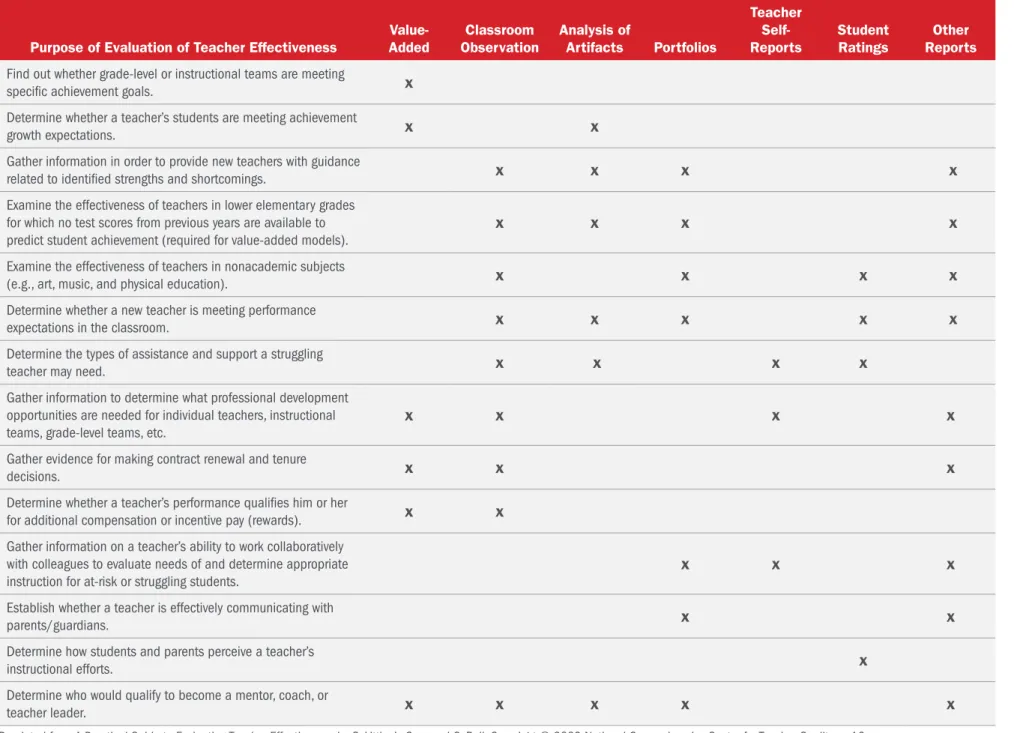
Each measure has its inherent strengths and weaknesses (See Little, Goe, & Bell, 2009) . Likewise, each measure could fulfill a particular evaluation system purpose . Therefore, measure selection is dependent on the overall purpose of the evaluation system . For instance, if the purpose of the system is to improve teacher capacity and
collaboration, the selected measures might include an assortment of measures that provide evidence of instructional quality . Table 2 reviews potential teacher evaluation goals and identifies the measurement types that are most appropriate to meet those goals . Research and policy has not suggested a particular number of measures that should comprise an evaluation “system”; however, policy does indicate that evidence of student learning should be a “significant” component within teacher evaluation . Hence, a measure of student growth is necessary to provide the “hard” data that effective instructional practices (as demonstrated through evidence of instructional quality measures) lead to student growth (as demonstrated through student growth model measures) .
Table 2. Matching Measures to Specific Purposes
Purpose of Evaluation of Teacher Effectiveness
Value-Added Classroom Observation Analysis of Artifacts Portfolios Teacher Self-Reports Student Ratings Other Reports Find out whether grade-level or instructional teams are meeting
specific achievement goals. x
Determine whether a teacher’s students are meeting achievement
growth expectations. x x
Gather information in order to provide new teachers with guidance
related to identified strengths and shortcomings. x x x x
Examine the effectiveness of teachers in lower elementary grades for which no test scores from previous years are available to
predict student achievement (required for value-added models). x x x x
Examine the effectiveness of teachers in nonacademic subjects
(e.g., art, music, and physical education). x x x x
Determine whether a new teacher is meeting performance
expectations in the classroom. x x x x x
Determine the types of assistance and support a struggling
teacher may need. x x x x
Gather information to determine what professional development opportunities are needed for individual teachers, instructional
teams, grade-level teams, etc. x x x x
Gather evidence for making contract renewal and tenure
decisions. x x x
Determine whether a teacher’s performance qualifies him or her
for additional compensation or incentive pay (rewards). x x Gather information on a teacher’s ability to work collaboratively
with colleagues to evaluate needs of and determine appropriate
instruction for at-risk or struggling students. x x x
Establish whether a teacher is effectively communicating with
parents/guardians. x x
Determine how students and parents perceive a teacher’s
instructional efforts. x
Determine who would qualify to become a mentor, coach, or
Adoption of particular measures can be guided by the following factors:
Evaluation system purpose
Strength of measures
Application to all student populations and teaching contexts
Human and resource capacity strengths and limitations
Evaluation System Purpose
As mentioned previously, goal selection guides all decisions in the design process, particularly in measure selection . Systems designed with higher stakes (e .g ., personnel dismissal and renewal decisions) point to measures that are technically defensible (e .g ., valid and reliable); whereas, systems designed to improve teacher capacity point to measures of instructional quality . Frequent reflection on the evaluation system’s purpose will help direct measure selection .
Strength of Measures
All measures have their own inherent strengths and weaknesses . Not all measures are equally useful nor equally valid and reliable . Measures should be selected based on the following:
Ability to accurately measure student progress
Demonstrated impact on student achievement
Demonstrated impact on teacher practice Federal priorities (Secretary’s Priorities for Discretionary Grant Programs, 2010) provide guidance on student growth measures stipulating that such measures must:
Be rigorous .
Measure progress between two points in time .
Be comparable across classrooms . At the same time, these measures must be valid and reliable for their intended purposes . In other words, the measure or assessment must accurately and fairly measure what the student is supposed to learn, whether the student learned the material, and how results can be attributed to individual teachers (Herman, Heritage, & Goldschmidt, 2011) . Existing potential measures of student growth are not yet likely to meet all these criteria; therefore, stakeholders should factor the measure’s strength in terms of the technical adequacy of the instrument as measurement selection is being considered . Likewise, measuring teacher practice through observations or a review of classroom artifacts requires trained raters so that the scores teachers receive are not dependent on who observes them or analyzes artifacts . Demonstrated validity
and reliability within such measures also should guide the selection process . Appendix A provides an overview of measures
including descriptions, research base, strengths, and cautions .
Application of Measures to All Student Populations and Teaching Contexts Applicability to all teaching contexts and student populations also should be considered in the measure selection process . A measure’s validity and reliability with all teachers, student populations, and local contexts play an important role in maintaining implementation fidelity and yielding valid and useful results . For example, implementing teacher evaluation systems in rural districts may be more
TQ CENTER RESOURCE
Alternative Measures of Teacher Performance (Policy-to-Practice Brief)
http://www.tqsource.org/pdfs/TQ_Policy-to-PracticeBriefAlternativeMeasures.pdf This Policy-to-Practice Brief introduces five current examples of measures of teacher performance. The goal is to assist regional comprehensive centers and state education agencies in building local capacity to incorporate the use of alternative measures of teacher performance into the overhaul of state evaluation systems—especially in states with looming legislative deadlines.
challenging . These districts may lack the financial and human resources to implement a system with fidelity, which will likely result in less management support and fewer resources for professional learning . Likewise, the increasing diversity of our nation’s classrooms is another factor to consider in measure selection . For example, certain measures may not be appropriate or yield useful information for teachers of students with disabilities, ELLs, or gifted students . In a recent TQ Center Research & Policy Brief, Holdheide, Goe, Croft, and Reschly (2010) address the following specific challenges in evaluating teachers of at-risk populations and measuring student growth in these populations:
Statewide assessment results may be unavailable (e .g ., students working toward alternative standards) or not viable .
Learning trajectories may be different for students with disabilities and ELLs .
The “ceiling effect” for gifted students may prevent adequate measurement of student growth .
Attribution of student growth when multiple teachers are responsible for instruction and observation of teacher practice with multiple teachers in the classroom can be complicated .
Investigation into how measures apply to all teachers and contexts may increase the overall validity and reliability of measures . States need to consider these specific challenges and, if chosen, help districts develop feasible solutions to ensure successful implementation .
Human and Resource Capacity Strengths and Limitations
Each potential measure has associated expenses that need to be factored into the decision-making process . Likewise, some measures require more human capacity than others . Both human and resource capacity strengths and limitations need to be considered in the selection of measures . Implementing measures without regard to the demands they place on teachers, administrators, and others will likely yield results that lack validity or are not implemented with fidelity and thus fail to affect teacher performance and student learning .
Stakeholders may consider the following guiding questions for Component 3 during the measurement selection process .
TQ CENTER RESOURCE
Challenges in Evaluating Special Educators and English Language Learner Specialists (Research & Policy Brief )
(http://www.tqsource.org/publications/ July2010Brief.pdf)
This Research & Policy Brief offers the following recommendations for states and districts::
Include special education and ELL administrators and teachers in the process of revamping/designing evaluation models.
Identify a common framework that defines effective teaching for all teachers. Where appropriate, include differentiated criteria for special education teachers and ELL specialists.
In addition to—or in the absence of— appropriate standardized assessment data, incorporate other concrete evidence of teachers’ contributions to student learning.
GUIDING QUESTIONS
¡ Does the selected measure provide data to inform progress on the evaluation system’s goals?
¡ Does the measure match the purpose of the evaluation?
¡ If necessary, does the measure provide valid and reliable data to make high-stakes decisions (e .g ., dismissal)?
¡ Does the measure provide data on effective teaching practices and professional development needs?
GUIDING FACTORS IN MEASURE SELECTION
1 . Did stakeholders consider all the recommended factors in selecting measures?
GUIDING QUESTIONS
¡ Does the measure have research on its:
Ability to measure student progress?
Demonstrated impact on student achievement?
Demonstrated impact on teacher practice?
¡ What processes are in place (or need to be) to ensure the fidelity of the measure?
¡ Is the measure an accurate and fair indicator of what a student is supposed to learn?
¡ Is the measure an accurate and fair indicator of teacher practice?
GUIDING QUESTIONS
¡ Do teaching context and student populations need to be differentiated to provide reliable and valid data?
¡ Are there specific training needs that should be considered for various teaching contexts and student populations?
¡ Can the measure be implemented with limited human and resource capacity?
¡ Can the measure of student growth be attributed accurately to multiple teachers? Evaluation System’s Purpose Strength of Measures Application to All Teaching Contexts and Student Populations NOTES
Guiding Questions
Selecting Measures
GUIDING QUESTIONS
¡ What human and resource capacity is necessary to implement the measure reliably and with validity?
¡ Can resources be pulled between and within districts to implement the measure?
Human and Resource
GUIDING QUESTIONS
¡ Will the other measures be rigorous and comparable across classrooms?
¡ Is there evidence that the other measures can differentiate among teachers who are helping students learn at high levels and those who are not?
¡ Will excluding student achievement as a factor be acceptable to the state legislature and the community?
TEACHERS’
CONTRIBUTIONS TO STUDENT LEARNING GROWTH
1 . Does the state intend to use teachers’ contributions to student learning growth (determined using standardized test results) as a factor in teacher evaluation (e .g ., value-added models and other growth models)?
GUIDING QUESTIONS
¡ Are legislative changes required to implement an evaluation system that includes student growth as a component?
¡ Who would support or oppose linking teacher and student data? Why? How will these concerns be addressed?
¡ Will the other measures be rigorous and comparable across classrooms? Plan to Use Other Measures Satisfied With Current System Plan to Use Student Achievement Growth NOTES GUIDING QUESTIONS
¡ What statistical model of longitudinal student growth will promote the most coherence and alignment with the state’s accountability system? Examples: Colorado Growth Model, value-added models
¡ How will the state or district choose a model? Will the task force meet with experts? Will the state assessment office investigate options?
¡ Do these measures meet the federal requirements of rigor: between two points in time
and comparability?
TEACHERS OF TESTED SUBJECTS 2 . Has a growth
model for teachers of tested subjects been selected?
Guiding Questions
GUIDING QUESTIONS
¡ What percentage will be supported by the education community?
¡ What will the state define as significant?
¡ Is legislation necessary to determine the percentage?
¡ Are the assessments reliable and valid to support a significant portion of the evaluation to be based on student progress?
PERCENTAGE OF RESULTS BASED ON GROWTH MODEL 3 . Has the percentage
of teacher evaluation results that will be based on the growth model been determined?
GUIDING QUESTIONS
¡ Will all teachers of tested subjects be included?
¡ What is the minimum number of students required for a teacher to be evaluated with student growth (e .g ., five students per grade/ content area)?
¡ Are there certain student populations in which inclusion in value-added or other growth models may raise validity questions (e .g ., students with disabilities, ELLs)?
¡ Can students working toward alternative assessments be included in the growth model?
¡ How will the state or district choose a model? Will the task force meet with experts? Will the state assessment office investigate options?
IDENTIFICATION OF TEACHERS 4 . Have teachers for
whom the growth model will be factored into evaluation results been identified? Teacher Inclusion/ Exclusion Criteria