DESCRIPTION
The UC1526 is a high performance monolithic pulse width modulator circuit designed for fixed-frequency switching regulators and other power control applications. Included in an 18-pin dual-in-line pack-age are a temperature compensated voltpack-age reference, sawtooth os-cillator, error amplifier, pulse width modulator, pulse metering and setting logic, and two low impedance power drivers. Also included are protective features such as soft-start and under-voltage lockout, digital current limiting, double pulse inhibit, a data latch for single pulse metering, adjustable deadtime, and provision for symmetry cor-rection inputs. For ease of interface, all digital control ports are TTL and B-series CMOS compatible. Active LOW logic design allows wired-OR connections for maximum flexibility. This versatile device can be used to implement single-ended or push-pull switching regu-lators of either polarity, both transformerless and transformer cou-pled. The UC1526 is characterized for operation over the full military temperature range of -55°C to +125°C. The UC2526 is characterized for operation from -25°C to +85°C, and the UC3526 is characterized for operation from 0° to +70°C.
Regulating Pulse Width Modulator
FEATURES• 8 To 35V Operation
• 5V Reference Trimmed To ±1% • 1Hz To 400kHz Oscillator Range • Dual 100mA Source/Sink Outputs • Digital Current Limiting
• Double Pulse Suppression • Programmable Deadtime • Under-Voltage Lockout • Single Pulse Metering • Programmable Soft-Start
• Wide Current Limit Common Mode Range • TTL/CMOS Compatible Logic Ports • Symmetry Correction Capability • Guaranteed 6 Unit Synchronization
BLOCK DIAGRAM
ABSOLUTE MAXIMUM RATINGS (Note 1, 2) Input Voltage (+VIN) . . . +40V
Collector Supply Voltage (+VC) . . . +40V
Logic Inputs . . . -0.3V to +5.5V Analog Inputs . . . -0.3V to +VIN
Source/Sink Load Current (each output) . . . 200mA Reference Load Current . . . 50mA Logic Sink Current . . . 15mA Power Dissipation at TA = +25°C (Note 2) . . . 1000mW Power Dissipation at TC = +25°C (Note 2) . . . 3000mW Operating Junction Temperature . . . +150°C Storage Temperature Range . . . -65°C to +150°C Lead Temperature (soldering, 10 seconds) . . . +300°C Note 1: Values beyond which damage may occur.
Note 2: Consult packaging section of databook for thermal limitations and considerations of package. CONNECTION DIAGRAMS
UC2526 UC3526
DIL-18, SOIC-18 (TOP VIEW) J or N Package, DW Package
RECOMMENDED OPERATING CONDITIONS (Note 3) Input Voltage . . . +8V to +35V Collector Supply Voltage . . . +4.5V to +35V Sink/Source Load Current (each output) . . . 0 to 100mA Reference Load Current . . . 0 to 20mA Oscillator Frequency Range . . . 1Hz to 400kHz Oscillator Timing Resistor . . . 2kΩ to 150kΩ Oscillator Timing Capacitor . . . 1nF to 20µF Available Deadtime Range at 40kHz . . . 3% to 50% Operating Ambient Temperature Range
UC1526 . . . -55°C to +125°C UC2526 . . . -25°C to +85°C UC3526 . . . -0°C to +70°C Note 3: Range over which the device is functional and
parameter limits are guaranteed.
PACKAGE PIN FUNCTION
FUNCTION PIN N/C 1 +Error 2 -Error 3 Comp. 4 CSS 5 Reset ______ 6 - Current Sense 7 + Current Sense 8 Shutdown _________ 9 RTIMING 10 CT 11 RD 12 Sync 13 Output A 14 VC 15 N/C 16 Ground 17 Output B 18 +VIN 19 VREF 20 PLCC-20, LCC-20 (TOP VIEW) Q and L Packages ELECTRICAL CHARACTERISTICS:
PARAMETER TEST CONDITIONS UC1526 / UC2526 UC3526 UNITS
MIN TYP MAX MIN TYP MAX
Reference Section (Note 4)
Output Voltage TJ = + 25°C 4.95 5.00 5.05 4.90 5.00 5.10 V
Line Regulation +VIN = 8 to 35V 10 20 10 30 mV
Load Regulation IL = 0 to 20mA 10 30 10 50 mV
Temperature Stability Over Operating TJ 15 50 15 50 mV
Total Output Voltage Range
Over Recommended Operating Conditions
4.90 5.00 5.10 4.85 5.00 5.15 V
Short Circuit Current VREF = 0V 25 50 100 25 50 100 mA
Under -Voltage Lockout
RESET _______
Output Voltage VREF = 3.8V 0.2 0.4 0.2 0.4 V
VREF = 4.8V 2.4 4.8 2.4 4.8 V
Note 4: IL = 0mA.
+VIN = 15V, and over operating ambient temperature, unless otherwise specified, TA = TJ.
ELECTRICAL CHARACTERISTICS:
PARAMETER TEST CONDITIONS UC1526 / UC2526 UC3526 UNITS
MIN TYP MAX MIN TYP MAX
Oscillator Section (Note 5)
Initial Accuracy TJ = + 25°C ±3 ±8 ±3 ±8 %
Voltage Stability +VIN = 8 to 35V 0.5 1 0.5 1 %
Temperature Stability Over Operating TJ 7 10 3 5 %
Minimum Frequency RT = 150kΩΩ, CT = 20µµF 1 1 Hz
Maximum Frequency RT = 2kΩΩ, CT = 1.0nF 400 400 kHz
Sawtooth Peak Voltage +VIN = 35V 3.0 3.5 3.0 3.5 V
Sawtooth Valley Voltage +VIN = 8V 0.5 1.0 0.5 1.0 V
Error Amplifier Section (Note 6)
Input Offset Voltage RS≤≤ 2kΩΩ 2 5 2 10 mV
Input Bias Current -350 -1000 -350 -2000 nA
Input Offset Current 35 100 35 200 nA
DC Open Loop Gain RL≥ 10MΩΩ 64 72 60 72 dB
HIGH Output Voltage VPIN1-VPIN2≥≥ 150mV, ISOURCE = 100µµA
3.6 4.2 3.6 4.2 V
LOW Output Voltage VPIN2-VPIN1 ≥≥ 150mV, ISINK =100µµA 0.2 0.4 0.2 0.4 V
Common Mode Rejection Rs ≤ 12kΩ 70 94 70 94 dB
Supply Voltage Rejection +VIN = 12 to 18V 66 80 66 80 dB
PWM Comparator (Note 5)
Minimum Duty Cycle VCOMPENSATION = +0.4V 0 0 %
Maximum Duty Cycle VCOMPENSATION = +3.6V 45 49 45 49 %
Digital Ports (SYNC, SHUTDOWN, and RESET)
HIGH Output Voltage ISOURCE =40µµA 2.4 4.0 2.4 4.0 V
LOW Output Voltage ISINK = 3.6mA 0.2 0.4 0.2 0.4 V
HIGH Input Current VIH = +2.4V -125 -200 -125 -200 µA
LOW Input Current VIL = +0.4V -225 -360 -225 -360 µA
Current LImit Comparator (Note 7)
Sense Voltage RS≤≤ 50ΩΩ 90 100 110 80 100 120 mV
Input Bias Current -3 -10 -3 -10 µA
Soft-Start Section
Error Clamp Voltage RESET = +0.4V 0.1 0.4 0.1 0.4 V
Cs Charging Current RESET =+2.4V 50 100 150 50 100 150 µA
Output Drivers (Each Output) (Note 8)
HIGH Output Voltage ISOURCE = 20mA 12.5 13.5 12.5 13.5 V
ISOURCE = 100mA 12 13 12 13 V
LOW Output Voltage ISINK = 20mA 0.2 0.3 0.2 0.3 V
ISINK = 100mA 1.2 2.0 1.2 2.0 V
Collector Leakage VC = 40V 50 150 50 150 µA
Rise Time CL = 1000pF 0.3 0.6 0.3 0.6 µs
Fall Time CL = 1000pF 0.1 0.2 0.1 0.2 µs
Power Consumption (Note 9)
Standby Current SHUTDOWN
____________
= +0.4V 18 30 18 30 mA
+VIN = 15V, and over operating ambient temperature, unless otherwise specified, TA = TJ. Note 4: IL = 0mA. Note 5: FOSC = 40kHz (RT = 4.12kΩ ± 1%, CT = 0.1µF ± 1%, RD = 0Ω) Note 6: VCM = 0 to +5.2V Note 8: VC = +15V Note 9: +VIN = +35V, RT = 4.12kΩ
UC2526 UC3526 APPLICATIONS INFORMATION
Voltage Reference
The reference regulator of the UC1526 is based on a tem-perature compensated zener diode. The circuitry is fully active at supply voltages above +8V, and provides up to 20mA of load current to external circuitry at +5.0V. In sys-tems where additional current is required, an external PNP transistor can be used to boost the available current. A rugged low frequency audio-type transistor should be used, and lead lengths between the PWM and transistor should be as short as possible to minimize the risk of os-cillations. Even so, some types of transistors may require collector-base capacitance for stability. Up to 1 amp of load current can be obtained with excellent regulation if the device selected maintains high current gain.
Under-Voltage Lockout
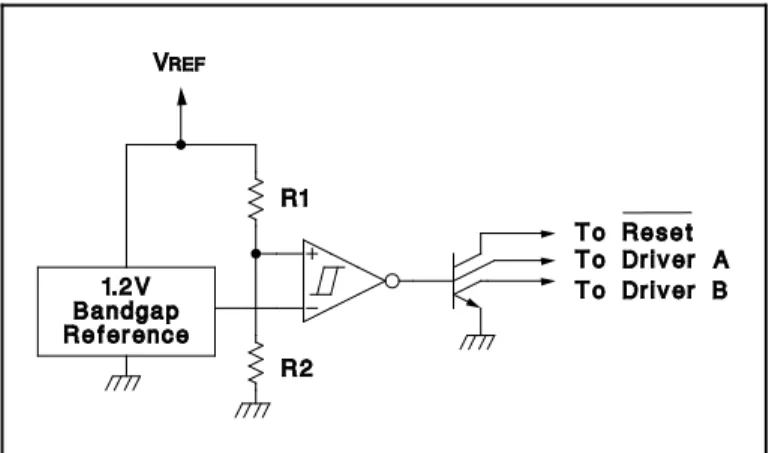
The under-voltage lockout circuit protects the UC1526 and the power devices it controls from inadequate supply voltage, If +VIN is too low, the circuit disables the output drivers and holds the RESET
_______
pin LOW. This prevents spurious output pulses while the control circuitry is stabi-lizing, and holds the soft-start timing capacitor in a dis-charged state.
The circuit consists of a +1.2V bandgap reference and comparator circuit which is active when the reference voltage has risen to 3VBE or +1.8V at 25°C. When the ref-erence voltage rises to approximately +4.4V, the circuit enables the output drivers and releases the RESET
_______ pin, allowing a normal soft-start. The comparator has 200mV of hysteresis to minimize oscillation at the trip point. When +VIN to the PWM is removed and the reference drops to +4.2V, the under-voltage circuit pulls RESET _______ LOW again. The soft-start capacitor is immediately dis-charged, and the PWM is ready for another soft-start cy-cle.
The UC1526 can operate from a +5V supply by connect-ing the VREF pin to the +VIN pin and maintaining the
sup-ply between +4.8 and +5.2V.
Soft-Start Circuit
The soft-start circuit protects the power transistors and rectifier diodes from high current surges during power supply turn-on. When supply voltage is first applied to the UC1526, the under-voltage lockout circuit holds RESET _______ LOW with Q3. Q1 is turned on, which holds the soft-start
capacitor voltage at zero. The second collector of Q1
clamps the output of the error amplifier to ground, guaran-teeing zero duty cycle at the driver outputs. When the supply voltage reaches normal operating range, RESET _______ will go HIGH. Q1 turns off, allowing the internal 100mA current source to charge CS. Q2 clamps the error ampli-fier output to 1VBE above the voltage on CS. As the soft-start voltage ramps up to +5V, the duty cycle of the PWM linearly increases to whatever value the voltage regula-tion loop requires for an error null.
Digital Control Ports
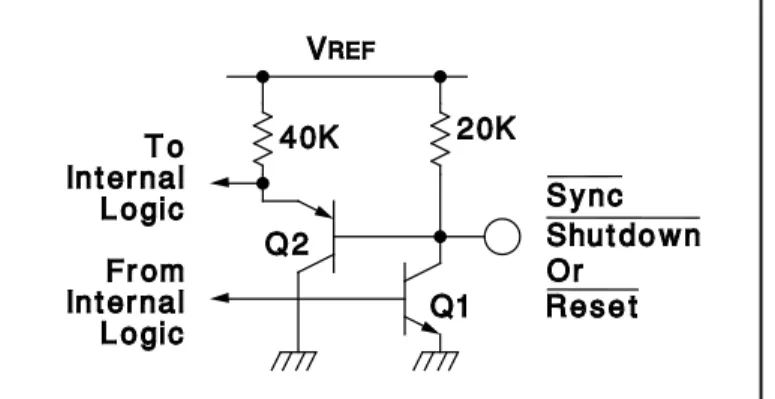
The three digital control ports of the UC1526 are bi-direc-tional. Each pin can drive TTL and 5V CMOS logic di-rectly, up to a fan-out of 10 low-power Schottky gates. Each pin can also be directly driven by open-collector Figure 2. Under-Voltage Lockout Schematic
Figure 1. Extending Reference Output Current
TTL, open-drain CMOS, and open-collector voltage com-parators; fan-in is equivalent to 1 low-power Schottky gate. Each port is normally HIGH; the pin is pulled LOW to activate the particular function. Driving SYNC
______
LOW in-itiates a discharge cycle in the oscillator. Pulling SHUTDOWN
____________
LOW immediately inhibits all PWM output pulses. Holding RESET
_______
LOW discharges the soft-start capacitor. The logic threshold is +1.1V at +25°C. Noise immunity can be gained at the expense of fan-out with an external 2k pull-up resistor to +5V.
Oscillator
The oscillator is programmed for frequency and dead time with three components: RT, CT and RD. Two waveforms are generated: a sawtooth waveform at pin 10 for pulse width modulation, and a logic clock at pin 12. The follow-ing procedure is recommended for choosfollow-ing timfollow-ing val-ues:
1. With RD = 0 (pin 11 shorted to ground) select values for RT and CT from Figure 7 to give the desired oscillator period. Remember that the frequency at each driver out-put is half the oscillator frequency, and the frequency at the +VC terminal is the same as the oscillator frequency. 2. If more dead time is required, select a large value of RD. At 40kHz dead time increases by 400ns/Ω .
3. Increasing the dead time will cause the oscillator fre-quency to decrease slightly. Go back and decrease the value of RT slightly to bring the frequency back to the nominal design value.
The UC1526 can be synchronized to an external logic clock by programming the oscillator to free-run at a fre-quency 10% slower than the sync frefre-quency. A periodic LOW logic pulse approximately 0.5µs wide at the SYNC ______ pin will then lock the oscillator to the external frequency.
Multiple devices can be synchronized together by pro-gramming one master unit for the desired frequency and then sharing its sawtooth and clock waveforms with the slave units. All CT terminals are connected to the CT pin
of the master, and all SYNC ______
terminals are likewise con-nected to the SYNC
______
pin of the master. Slave RT
termi-nals are left open or connected to VREF. Slave RD
terminals may be either left open or grounded. Error Amplifier
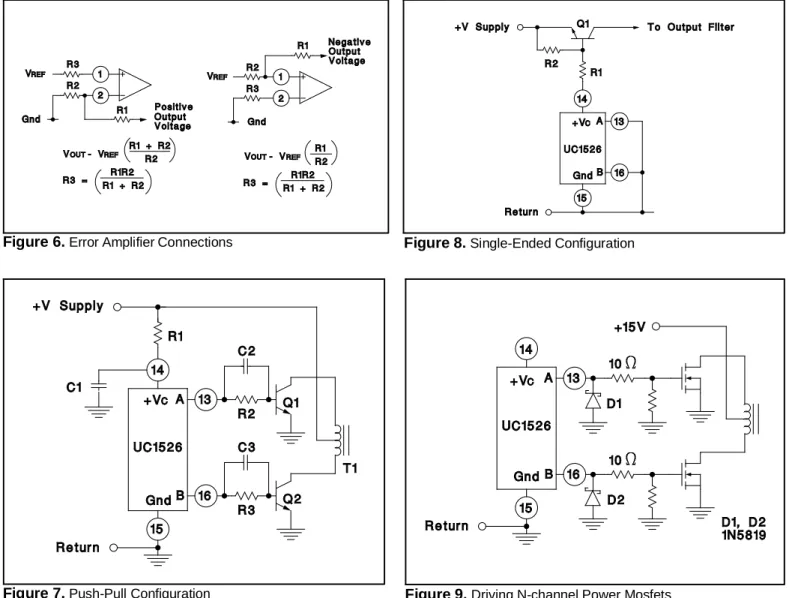
The error amplifier is a transconductance design, with an output impedance of 2MΩ . Since all voltage gain takes place at the output pin, the open-loop gain/frequency characteristics can be controlled with shunt reactance to ground. When compensated for unity-gain stability with 100pF, the amplifier has an open-loop pole at 800Hz. The input connections to the error amplifier are deter-mined by the polarity of the switching supply output volt-age. For positive supplies, the common-mode voltage is +5.0V and the feedback connections in Figure 6A are used. With negative supplies, the common-mode voltage is ground and the feedback divider is connected between the negative output and the +5.0V reference voltage, as shown in Figure 6B.
Output Drivers
The totem-pole output drivers of the UC1526 are de-signed to source and sink 100mA continuously and 200mA peak. Loads can be driven either from the output pins 13 and 16, or from the +VC, as required.
Since the bottom transistor of the totem-pole is allowed to saturate, there is a momentary conduction path from the +VC terminal to ground during switching. To limit the re-sulting current spikes a small resistor in series with pin 14 is always recommended. The resistor value is deter-mined by the driver supply voltage, and should be chosen for 200mA peak currents.
Figure 5. Oscillator Connections and Waveforms
UC2526 UC3526
Figure 6. Error Amplifier Connections
Figure 7. Push-Pull Configuration
Figure 8. Single-Ended Configuration
Figure 9. Driving N-channel Power Mosfets
Oscillation Period
TYPICAL CHARACTERISTICS
UNITRODE INTEGRATED CIRCUITS
7 CONTINENTAL BLVD. • MERRIMACK, NH 03054 TEL. (603) 424-2410 • FAX (603) 424-3460
TYPICAL CHARACTERISTICS
Shutdown Delay Output Driver Saturation Voltage
Output Driver Deadtime vs RD Value Under Voltage Lockout Characteristic
www.ti.com 17-Dec-2015
PACKAGING INFORMATION
Orderable Device Status
(1)
Package Type Package Drawing Pins Package Qty Eco Plan (2) Lead/Ball Finish (6) MSL Peak Temp (3)
Op Temp (°C) Device Marking
(4/5)
Samples
8551501VA ACTIVE CDIP J 18 1 TBD A42 N / A for Pkg Type -55 to 125 8551501VA UC1526J/883B UC1526J ACTIVE CDIP J 18 1 TBD A42 N / A for Pkg Type -55 to 125 UC1526J UC1526J883B ACTIVE CDIP J 18 1 TBD A42 N / A for Pkg Type -55 to 125 8551501VA
UC1526J/883B UC2526AJ ACTIVE CDIP J 18 1 TBD A42 N / A for Pkg Type -25 to 85 UC2526AJ
UC2526N ACTIVE PDIP N 18 20 Green (RoHS & no Sb/Br)
CU NIPDAU N / A for Pkg Type -25 to 85 UC2526N UC2526NG4 ACTIVE PDIP N 18 20 Green (RoHS
& no Sb/Br)
CU NIPDAU N / A for Pkg Type -25 to 85 UC2526N UC3526AJ ACTIVE CDIP J 18 1 TBD A42 N / A for Pkg Type 0 to 70 UC3526AJ UC3526DW ACTIVE SOIC DW 18 40 Green (RoHS
& no Sb/Br)
CU NIPDAU Level-2-260C-1 YEAR 0 to 70 UC3526DW UC3526DWG4 ACTIVE SOIC DW 18 40 Green (RoHS
& no Sb/Br)
CU NIPDAU Level-2-260C-1 YEAR 0 to 70 UC3526DW UC3526DWTR ACTIVE SOIC DW 18 2000 Green (RoHS
& no Sb/Br)
CU NIPDAU Level-2-260C-1 YEAR 0 to 70 UC3526DW UC3526N ACTIVE PDIP N 18 20 Green (RoHS
& no Sb/Br)
CU NIPDAU N / A for Pkg Type 0 to 70 UC3526N UC3526NG4 ACTIVE PDIP N 18 20 Green (RoHS
& no Sb/Br)
CU NIPDAU N / A for Pkg Type 0 to 70 UC3526N
(1)
The marketing status values are defined as follows:
ACTIVE: Product device recommended for new designs.
LIFEBUY: TI has announced that the device will be discontinued, and a lifetime-buy period is in effect.
NRND: Not recommended for new designs. Device is in production to support existing customers, but TI does not recommend using this part in a new design. PREVIEW: Device has been announced but is not in production. Samples may or may not be available.
OBSOLETE: TI has discontinued the production of the device.
(2)
Eco Plan - The planned eco-friendly classification: Pb-Free (RoHS), Pb-Free (RoHS Exempt), or Green (RoHS & no Sb/Br) - please check http://www.ti.com/productcontent for the latest availability information and additional product content details.
TBD: The Pb-Free/Green conversion plan has not been defined.
Pb-Free (RoHS): TI's terms "Lead-Free" or "Pb-Free" mean semiconductor products that are compatible with the current RoHS requirements for all 6 substances, including the requirement that
www.ti.com 17-Dec-2015
Addendum-Page 2
Pb-Free (RoHS Exempt): This component has a RoHS exemption for either 1) lead-based flip-chip solder bumps used between the die and package, or 2) lead-based die adhesive used between
the die and leadframe. The component is otherwise considered Pb-Free (RoHS compatible) as defined above.
Green (RoHS & no Sb/Br): TI defines "Green" to mean Pb-Free (RoHS compatible), and free of Bromine (Br) and Antimony (Sb) based flame retardants (Br or Sb do not exceed 0.1% by weight
in homogeneous material)
(3)
MSL, Peak Temp. - The Moisture Sensitivity Level rating according to the JEDEC industry standard classifications, and peak solder temperature.
(4)
There may be additional marking, which relates to the logo, the lot trace code information, or the environmental category on the device.
(5)
Multiple Device Markings will be inside parentheses. Only one Device Marking contained in parentheses and separated by a "~" will appear on a device. If a line is indented then it is a continuation of the previous line and the two combined represent the entire Device Marking for that device.
(6)
Lead/Ball Finish - Orderable Devices may have multiple material finish options. Finish options are separated by a vertical ruled line. Lead/Ball Finish values may wrap to two lines if the finish value exceeds the maximum column width.
Important Information and Disclaimer:The information provided on this page represents TI's knowledge and belief as of the date that it is provided. TI bases its knowledge and belief on information
provided by third parties, and makes no representation or warranty as to the accuracy of such information. Efforts are underway to better integrate information from third parties. TI has taken and continues to take reasonable steps to provide representative and accurate information but may not have conducted destructive testing or chemical analysis on incoming materials and chemicals. TI and TI suppliers consider certain information to be proprietary, and thus CAS numbers and other limited information may not be available for release.
In no event shall TI's liability arising out of such information exceed the total purchase price of the TI part(s) at issue in this document sold by TI to Customer on an annual basis.
OTHER QUALIFIED VERSIONS OF UC1526, UC2526, UC2526AM, UC3526, UC3526AM :
•
Catalog: UC3526, UC2526A, UC3526M, UC3526A•
Military: UC2526M, UC1526, UC1526ANOTE: Qualified Version Definitions:
•
Catalog - TI's standard catalog productTexas Instruments Incorporated and its subsidiaries (TI) reserve the right to make corrections, enhancements, improvements and other changes to its semiconductor products and services per JESD46, latest issue, and to discontinue any product or service per JESD48, latest issue. Buyers should obtain the latest relevant information before placing orders and should verify that such information is current and complete. All semiconductor products (also referred to herein as “components”) are sold subject to TI’s terms and conditions of sale supplied at the time of order acknowledgment.
TI warrants performance of its components to the specifications applicable at the time of sale, in accordance with the warranty in TI’s terms and conditions of sale of semiconductor products. Testing and other quality control techniques are used to the extent TI deems necessary to support this warranty. Except where mandated by applicable law, testing of all parameters of each component is not necessarily performed.
TI assumes no liability for applications assistance or the design of Buyers’ products. Buyers are responsible for their products and applications using TI components. To minimize the risks associated with Buyers’ products and applications, Buyers should provide adequate design and operating safeguards.
TI does not warrant or represent that any license, either express or implied, is granted under any patent right, copyright, mask work right, or other intellectual property right relating to any combination, machine, or process in which TI components or services are used. Information published by TI regarding third-party products or services does not constitute a license to use such products or services or a warranty or endorsement thereof. Use of such information may require a license from a third party under the patents or other intellectual property of the third party, or a license from TI under the patents or other intellectual property of TI.
Reproduction of significant portions of TI information in TI data books or data sheets is permissible only if reproduction is without alteration and is accompanied by all associated warranties, conditions, limitations, and notices. TI is not responsible or liable for such altered documentation. Information of third parties may be subject to additional restrictions.
Resale of TI components or services with statements different from or beyond the parameters stated by TI for that component or service voids all express and any implied warranties for the associated TI component or service and is an unfair and deceptive business practice. TI is not responsible or liable for any such statements.
Buyer acknowledges and agrees that it is solely responsible for compliance with all legal, regulatory and safety-related requirements concerning its products, and any use of TI components in its applications, notwithstanding any applications-related information or support that may be provided by TI. Buyer represents and agrees that it has all the necessary expertise to create and implement safeguards which anticipate dangerous consequences of failures, monitor failures and their consequences, lessen the likelihood of failures that might cause harm and take appropriate remedial actions. Buyer will fully indemnify TI and its representatives against any damages arising out of the use of any TI components in safety-critical applications.
In some cases, TI components may be promoted specifically to facilitate safety-related applications. With such components, TI’s goal is to help enable customers to design and create their own end-product solutions that meet applicable functional safety standards and requirements. Nonetheless, such components are subject to these terms.
No TI components are authorized for use in FDA Class III (or similar life-critical medical equipment) unless authorized officers of the parties have executed a special agreement specifically governing such use.
Only those TI components which TI has specifically designated as military grade or “enhanced plastic” are designed and intended for use in military/aerospace applications or environments. Buyer acknowledges and agrees that any military or aerospace use of TI components
which havenotbeen so designated is solely at the Buyer's risk, and that Buyer is solely responsible for compliance with all legal and
regulatory requirements in connection with such use.
TI has specifically designated certain components as meeting ISO/TS16949 requirements, mainly for automotive use. In any case of use of non-designated products, TI will not be responsible for any failure to meet ISO/TS16949.
Products Applications
Audio www.ti.com/audio Automotive and Transportation www.ti.com/automotive
Amplifiers amplifier.ti.com Communications and Telecom www.ti.com/communications
Data Converters dataconverter.ti.com Computers and Peripherals www.ti.com/computers
DLP® Products www.dlp.com Consumer Electronics www.ti.com/consumer-apps
DSP dsp.ti.com Energy and Lighting www.ti.com/energy
Clocks and Timers www.ti.com/clocks Industrial www.ti.com/industrial
Interface interface.ti.com Medical www.ti.com/medical
Logic logic.ti.com Security www.ti.com/security
Power Mgmt power.ti.com Space, Avionics and Defense www.ti.com/space-avionics-defense
Microcontrollers microcontroller.ti.com Video and Imaging www.ti.com/video
RFID www.ti-rfid.com
OMAP Applications Processors www.ti.com/omap TI E2E Community e2e.ti.com
Wireless Connectivity www.ti.com/wirelessconnectivity
Mailing Address: Texas Instruments, Post Office Box 655303, Dallas, Texas 75265 Copyright © 2015, Texas Instruments Incorporated