GENERAL
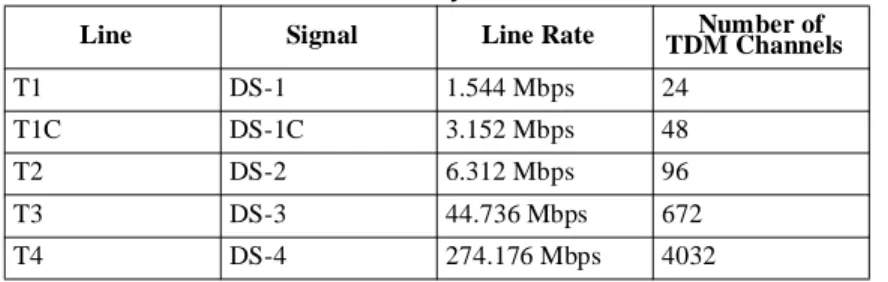
T1 refers to the primary digital telephone carrier system used in North America. T1 is one line type of the PCM T-carrier hierarchy listed in Table D-1. T1 describes the cabling, signal type, and signal regeneration requirements of the carrier system.
T1 was first installed in the early 1960s and was used only to carry voice trunks between central offices. Since then, T1 facilities have been provided by telephone companies to customers who need many outside lines. Since a T1 line supports up to 24 simultaneous voice and / or data calls, a large savings in both cable and service cost can be realized by replacing many individual local loops with a single T1 link to the Central Office. In addition to telephone-company provided T1 services, many private T1 networks have been implemented such as LAN gate-ways and PBX-to-PBX links.
Table D-1. PCM T-Carrier Hierarchy
Line Signal Line Rate TDM Channels Number of
T1 DS-1 1.544 Mbps 24
T1C DS-1C 3.152 Mbps 48
T2 DS-2 6.312 Mbps 96
T3 DS-3 44.736 Mbps 672
Since zero bits are no pulses, the AMI code does not allow long strings of zero data. A minimum ones density is required on the T1 line so that receiving equipment and line repeaters can recover clocking informa-tion. An alternative line code which allows long strings of zeros is called bipolar with eight zero substitution (B8ZS). This method replaces strings of eight zeros with a specific double bipolar violation sequence. The double bipolar violation sequence consist of two bipolar violations. The bipolar violation sequence is recognized by receiving equipment and converted back to zeros. The violation sequence provides the neces-sary pulse density.
FRAMING FORMATS
The Data Signal Level Zero (DS0) is the standard 64 kbps data signal used for both voice and data transmission on a T1 line. The T1 signal is organized as a series of frames with 24 DS0 time slots and 1 framing time slot for each frame. Each DS0 time slot consists of an 8-bit data channel while the framing time slot is just one bit long. This results in a single frame which is 193 bits long (24 channels x 8 bits per channel + 1 frame bit). The resulting frame rate is 8000 frames per second (1.544 Mbps).
Figure D-1 shows the Superframe Format (SF). SF framing, also known as D4 framing and the M24 multiplexer format, defines a group of 12 frames as a superframe. The 193rd bit of each frame is referred to as the multiframe alignment bit or F bit. T1 receiving equipment uses the F bit to identify the beginning of a superframe as well as the position of each frame in the superframe.
1 Superframe = 12 Frames
F1 F2 F3 F4 F5 F6 F7 F8 F9 F10 F11 F12
1 1 1 1 1 1 1 0 0 0 0 0 0 1 Frame
125 us, 193 bits
1
F 1 2 3 4 5 6 7 8 1 2 3 4 5 6 7 8 Bit # 1 2 3 4 5 6 7 8 2
1.5 ms, 2316 bits
Frame # 1 2 3 4 5 6 7 8 9 10 11 F 1 0 0 0 1 1 0 1 1 1 0 d1 V V V V V V V V V V V d2 V V V V V V V V V V V d3 V V V V V V V V V V V d4 V V V V V V V V V V V d5 V V V V V V V V V V V d6 V V V V V V V V V V V d7 V V V V V V V V V V V d8 V V V V V A V V V V V Time
Slot # 24
V = Bit used for voice / data A & B = Signaling bits d = Data (information) bits
Signaling Frame
8 - Bit Voice
7 - Bit Voice
kbps (7 bits per DS0) data can be transmitted without the inherent error due to signaling. Voice transmission is unaffected by robbed bit signaling.
ESF Framing
Figure D-2 shows the Extended Superframe Format (ESF). ESF format or Fe framing is the newest DS1 framing format. This format extends the multiframe structure from a 12 frame superframe to a 24 frame extended superframe. Data channeling for ESF framing is the same as SF (24 DS0 channels per frame), but the function of the framing (F) bit position in each frame is redefined for ESF. The new F bit contains the following three functions:
• Cyclic redundancy check
• Facility data link
• Framing pattern sequence
This redefinition of the F bit allows several new features for mainte-nance and performance monitoring which are not available with SF framing.
The Cyclic Redundancy Check (CRC-6) is an error check sequence which is transmitted in the F bit position. The T1 receiving equipment receives this sequence and compares it with a locally computed check value which is based on the received data in all DS0 channels in the extended superframe. This process gives the equipment the ability to detect most errors which occur in the DS1 signal. The CRC-6 data is transmitted at a rate of 2 kbps.
Figure D-2
Extended Superframe Format
The Facility Data Link (FDL) is also transmitted in the F bit position and provides a separate low speed data channel on the T1 circuit which does not interfere with the main data transmission. This out-of-band
Extended Superframe 4632 bits FR 1 FR 2 FR 3 FR 4 FR 5 FR 6 FR 7 FR 8 FR 9 FR 10 FR 11 FR 12 FR 16 FR 13 FR 14 FR 15 FR 17 FR 18 FR 19 FR 20 FR 21 FR 22 FR 23 FR 24 Frame 193 bits CH 1 CH 2 CH 3 CH 4 CH 5 CH 6 CH 7 CH 8 CH 9 CH 10 CH 11 CH 12 CH 16 CH 13 CH 14 CH 15 CH 17 CH 18 CH 19 CH 20 CH 21 CH 22 CH 23 CH 24 M1 Frame Overhead 1 bit 192 bits Channel 8 bits
Call supervision signaling is provided in the same way as SF framing (Robbed Bit Signaling) with one difference. Since the extended super-frame is 24 super-frames long, super-frames l8 and 24 in addition to super-frames 6 and 12 contain signaling information in bit 8 of each DS0 channel.
An alternative method of providing signaling is called Common Channel Signaling. Instead of robbing a bit from each data channel, an entire DS0 channel is reserved for signaling. Since bits are no longer robbed in the remaining 23 data channels, these channels may be used for 64 kbps data transmission. This is the preferred method for achieving clear channel capability in the emerging Integrated Services Digital Network (ISDN) environment.
Framing Format Conversion
Much of the presently installed customer T1equipment is compatible only with SF framing. When ESF lines are installed, conversion from ESF to SF at the customer premise may be necessary to use SF equip-ment. A CSU with this conversion option usually performs the conver-sion. The conversion process replaces the ESF F bit sequence with the SF F bit sequence on the receive side and inserts the ESF F bit sequence on the network transmit side.
PERFORMANCE MONITORING
An operator or network manager can monitor the quality of a T1 link to enable quick response to line or equipment failure. Also, monitoring equipment can maintain a line quality history to identify increasing error rate trends.
SF T1 equipment is limited to monitoring the following conditions:
• BPV count. Receiving Equipment can detect and count bipolar violations to measure error caused by line or repeater problems. Logic errors or errors in data encoding which the transmitting equipment or repeaters can introduce cannot be detected.
• LOS. Loss of signal.
• Ones density. T1 specifications require a minimum pulse density of 12.5%. CSUs insert pulses in the outgoing signal if necessary to insure the minimum density is transmitted.
ESF framing allows logic errors to also be detected due to the CRC-6 error check sequence embedded in the F bit. When the receiving equip-ment obtains error information, it can communicate the information to the far end of the T1 link over the FDL channel. Two standard protocols report errors using the FDL: AT&T Publication 54016 and ANSI T1.403.
The AT&T method requires that the T1 terminating equipment, the CSU for example, maintain a 24-hour performance error history. This error history is transmitted to the Central Office over the FDL after an error history request message is received from the Central Office. In many CSUs, an alternate set of registers is maintained in the CSU to allow customer access to the same error information.
The ANSI method requires that the CSU transmit a performance report message (PRM) each second over the FDL. This PRM is not sent to any specific remote location, but is broadcast so that any PRM receiving device on the T1 line can intercept the message. Rather than transmit-ting an entire 24-hour history, the PRM contains error information pertaining to only the previous 4 seconds. It is the responsibility of the PRM receiver to accumulate the information and store it for 24 hours or the time desired. This method allows performance monitoring points at different locations along a T1 network so that error localization can be determined.
Other proprietary methods of collecting and reporting ESF error infor-mation have been implemented to enhance the remote T1 device main-tenance capabilities. Besides ESF error information, CSU configuration and loop testing functions can be performed remotely using the FDL