Sanjay K. Dhurandher, Satya Jyoti Borah , Mohammad S. Obaidat, Deepak Kr. Sharma, Sahil Gupta1 and Bikash Baruah3
1CAITFS, Divison of Information Technology, Netaji Subash Institute of Technology, University of Delhi, New Delhi, India 2Dept. of Comp. Sc. and Eng., Monmouth University Monmouth, NJ, U.S.A.
3Department of Computer Science and Engineering, North Eastern Regional Institute of Science and Technology, Deemed
University, Itanagar, India
Keywords: Opportunistic Networks, Opportunistic Network Simulator (ONE) Environment, Epidemic, Spray and Wait, Prophet, Routing Protocol.
Abstract: Opportunistic networks (Oppnet) are challenged networks in present wireless communication scenario. These networks are mainly applied to situations where a persistent end–to-end path between the source and the destination does not exist. Delay/Disruption Tolerant Networking (DTN) is mostly used to solve this end-to-end path problem in such networks. Many routing protocols have been proposed in literature that consider various performance metrics such as delivery delay, packet delivery rate, hop count, among others. In this paper, a new routing protocol named as PRoWait has been designed which can overcome the shortcomings of the already existing protocols in Oppnets. The proposed protocol also incorporates the merits of existing protocol so that it can be reliable and efficient for the communication of pedestrians with handheld devices. Simulation results obtained for the proposed scheme show better performance as compared to the Porphet, Spray and Wait and Epidemic routing protocols in terms of packets delivery probability, overhead ratio, and hop count performance metrics.
1
INTRODUCTION
An Ad hocnetwork (Royer, 1999) is a peer to peer
communication network. It uses wireless/Wi-Fi tech-nology and the communication takes place without any access point. It is an infrastructure less, cost effi-cient, quicker to setup, and works as an extension to existing networks. In this chain, there is one more specific network where the nodes are mobile in na-ture. This network is called as mobile Ad hocnetwork [MANET] (Toh, 2002). The main aim of MANETs is to establish a synchronous communication between two or more nodes. In a multi-hop communication en-vironment for MANET, every node is assumed to be helpful to each other. They agree to contribute and route any traffic within the network. However, they have some limitations such as minimal security against unwanted incoming connections, which makes it easy for attackers.
Opportunistic networks (Pelusi et all, 2006) are the recent evaluations of MANETs. They have many
similarities and differences to the MANETs. MA-NETs follow the synchronous mode of communica-tion while Oppnets follow the asynchronous mode of communication. In MANETs first a fixed path is es-tablished between the source and destination and then the message passing takes place. But, in Oppnets no previous assumption is made regarding the existence of a complete path between the two nodes that wish to communicate with each other (Huang et al., 2008). Source and destination nodes might not be in the same network or within range of each other at the same time. However, Oppnet provides a platform for nodes to communicate in the aforementioned type of chal-lenged network scenarios. Packets are often buffered in the network waiting for a path towards the destina-tion to be available. Due to this, addidestina-tional delay gets incorporated in message delivery. However, there are various applications which can tolerate longer delays such as e-mailing. Again frequent connections and disconnections between nodes may degrade the per-formance of a number of applications in Oppnets.
Routing and forwarding of packets in Opnets is a very difficult task. It is completely different from tra-ditional network routing techniques. Here, the main objectives are to expect a reliable delivery of packets even in the absence of permanent path between the sender and the receiver. As the nodes are mobile in nature in this kind of network, one cannot predict to-tally about the routes for packets transmission. Hence, conventional routing protocols do not have any role to play in these networks (Pelusi et all, 2006).
Routing is mainly based upon three things (Dhurandher et al., 2008). The first is a node’s coop-eration that is its willingness in the routing and for-warding. The second is nodes mobility which can be utilized to forward a packet from one portion of the network to the other. The third is store-carry-forward method. This method ensures that the packet copy re-mains saved in the buffer of the nodes until it meets the next forwarding node or the destination node. It also requires proper buffer management when buffer gets full. Hence, there is always a need for proper routing protocol that minimizes the delivery delay, buffering space and maximize delivery ratio.
In this work, a new protocol named as PRoWait has been proposed which is based on the concept of earlier work of Spray and Wait and Prophet routing protocols. It integrates the working principle of the two aforementioned protocols together in order to achieve a better packet delivery ratio, latency and hop count. This paper does not address the acknowledge-ment of packets and security issues in Oppnets. The overall scenario is simulated with the help of ONE simulator (Keranen, 2008) and respective results were recorded.
The rest of the paper is organized as follows. Section II gives a brief overview of existing protocols that have been used in this work. Section III presents the proposed protocol in detail. Section IV describes the simulation scenarios and Simulation results with various graphs. Section V summarizes this work.
2
RELATED WORK
So far many routing protocols have been designed in the past in Oppnets such as Epidemic (Vahdat, 2000), Spray and Wait (Spyropoulos et al., 2005), Binary Spray and Wait (Spyropoulos et al., 2005), Prophet (Lindgren et al., 2003), HBPR (Dhurandher et al., 2013) (Dhurandher et al, 2014), GAER (Dhurandher et al, 2014), among others. The main objective of these protocols is to achieve maximum successful delivery of packets and minimize the delay. In this section, a
brief discussion of some of these routing protocols is presented.
A. Epidemic Routing Protocol
The Epidemic routing protocol, as its name suggests is similar to spreading/flooding like infectious diseases in nature. It is a simple protocol which delivers most of the packets successfully to its destination, but requires large amount of bandwidth and buffer size. When a pair of nodes that want to communicate come into a communication range, the first node sends the second node, a summary vector containing information that uniquely identifies the packets it has in its buffer. The second node also transfers to the first node any packets it has which are not available with the first node. Hence transmission of packets takes place in both directions whenever two nodes meet each other. In this way all the packets will ultimately be distributed to every node, and finally every packet will reach its destination as quickly as possible with a very high probability.
The main approach of this protocol is to distribute and deliver application packets to hosts, called carriers, within connected portion of Oppnets. By using this scheme, packets are spread quickly within the connected portion of the network through node mobility. At this point, the packets get spread to an additional group of nodes. Through such transitive transmission of data, packets have a high probability of eventually reaching their destination. This scheme requires large amount of bandwidth and buffer space. Moreover, a large number of multiple copies of the same packets get generated throughout the network which leads to network congestion.
B. Spray and Wait Routing Protocol
This scheme consists of the following two phases (Spyropoulos et al., 2005):
Spray phase: The packet originating at the source node having X copies initially spread/for-warded the copies by source or possibly other intermediate nodes receiving a copy of X dis-tinct relays.
Wait phase: During spraying phase if no desti-nation is found then each of the X nodes carrying packets performs direct transmission.
destination as quickly as possible (with high probability). In this scheme, the node stops spreading packets when it has only one copy with it. The node which is carrying a single copy performs the direct transmission. Due to this mechanism Spray and Wait could be viewed as single and multi-copy schemes. Hence, its performance is quite better as compared to Epidemic routing and other single and multi-copy schemes in terms of number of transmissions and delivery delay.
C. ProphetRouting Protocol
In the Probabilistic Routing Protocol using History of Encounters and Transitivity) [10], if a node visited a location many times in the past then the chance of visiting same location by the same node is more. In this scheme before sending packets a probabilistic metric called delivery predictability is created, say P
(a;b)ϵ [0 ; 1], at every source node “a” for each known
destination “b”. This delivery predictability reflects how likely a node will be able to deliver a message to the destination. When a node “a” comes in contact with node “b” then node “a” will transfer the packet to node “b” if and only if the delivery predictability of the node “b” is higher than that of node “a”.
3
PROPOSED SCHEME:
PRoWAIT
In this section, the PRoWait protocol is discussed in detail. It is a hybrid forwarding strategy that combines the advantages of Prophet and Spray and Wait proto-cols.
A. Forwarding Strategies
Most of the routing protocols designed so far forward a packet from one node to its neighbor based upon lowest cost of the path towards the destination. Also, the packet is sent to a single node instead of multiple nodes due to high reliability of multipath communication. However, in Oppnets things are completely different. When a packet arrives at a node, there might not be any available path to the destination and the node has to buffer it in its storage space. When the source node encounters another node, a decision has to be made whether a particular packet is to be transferred or not. To increase the delivery probability it may also be required to forward a packet to multiple nodes. But, these types of decisions are not trivial to make.
When a node encounters another node with low value of delivery predictability, one cannot predict
whether this node will encounter another node with higher probability within a reasonable period of time. Furthermore, selecting a particular node out of many available nodes for transmitting a certain packet is another problem. However, with distribution of large number of packets to a large number of nodes, the probability of delivering a packet to its destination will increase. As a result more resources are required which results in wasting system resources. Thus, instead of giving a packet to many nodes, if only a few nodes are selected, then lesser number of system resources will get utilized. This will lower the probability of delivering a packet and incur high delay.
In PRoWait, we have chosen a rather simple forwarding strategy–when two nodes meet each other, a packet is transferred to the other node if the delivery predictability of the destination of the packet is higher at that node. The delivery predictability of PRoWait is calculated from Prophet routing protocol. Spraying the packets to the neighboring nodes is done with the Spray and Wait protocol’s technique, while Prophet’s delivery predictability is used in the selection of a node as a next hop.
Figure 1: Algorithm with an illustrative example.
The source node initially has x copies of packet to be sent. Any node A that has (x >1) copies of the packet (source or relay) and encounters another node B (with no copies), hands over to B [x/2] copies and keeps
[x/2] copies for itself. When B encounters another node C (with no copies), it hands over to C [x/4]
will continue until a node is left with only one copy or reach the destination. If the destination is not found, then each of the nodes carrying a single copy of the packet performs direct transmission. Here every node is provided with two variables: hop count and probability. When two nodes come within the range of each other, then a packet is passed from a node having lower probability to a node having higher probability, else no transmission occurs. PRoWait creates neither too less nor too much copies of the packets in the network. It tries to maintain enough copies of the packets that ensure its successful delivery with lesser delay to the destination. It also tries to reduce the resource consumption by limiting the amount of flooding done in comparison to the Epidemic routing protocol.
B. Algorithm
The algorithm used in PRoWait is also depicted in Fig.1. In this figure, node A is the source node that has x copies of message M1 with it. It has two neigh-bors, node B and node C. Both nodes do not have message M1 with them. The value of delivery predict-ability at node A, B, and C are 0.2, 0.3, and 0.1, re-spectively. Thus, according to PRoWait, node B is se-lected and node C is rejected as it has higher value of delivery predictability than node A. Node A then transfers the [x/2] copies of the message to node B
and keeps [x/2] copies with itself. This process of message copy transfer goes on from one node to an-other node until x becomes equal to 1 or the message TTL expires. All nodes that have x = 1transfer the message to the destination on having direct contact with it.
4
SIMULATION AND RESULTS
We evaluated the performance of the proposed scheme using simulation analysis. Simulation for the PRoWait has been done on the Opportunistic Network Environment (ONE) simulator. It is a Java based simulation environment that is capable of:
• Generating node movement using different
movement models.
• Routing packets between nodes with various
Oppnet routing algorithms.
• Visualizing real time mobility and packets pass-ing in its graphical user interface.
For Simulation analysis, we consider six groups of mobile node. The pedestrian groups have 40 nodes and one group (term) has 2 nodes each. Out of six groups three groups are of pedestrian type with a
walking speed of 0.5 – 1.5 m/s. Another group, term/period group, has a speed of 2.7 – 13.9 m/s and final group is of city bus with a moving speed of 10 – 30 m/s. A TTL of 300 minutes is assigned to each group for their messages. Group of pedestrians has a buffer size of 50M each while the group of term has 50M buffer size. Transmission speed for pedestrians is 2Mbps with a transmission range of 10m each and for term it is 10Mbps with 1000m transmission range. Each simulation is run for 20,000 second. A new mes-sage of size 500Kb – 1Mb is created after every 25–
35 seconds. For movement of nodes Shortest path
map based movement model [14] is used with world size of 4500 m x 3400 m.
The performance of PRoWait was evaluated and compared to the Epidemic, Prophet, Spray and Wait protocols by varying the buffer size and TTL. The buffer size of each node in the scenario was changed from 2MB to 15 MB and the resultant outputs were observed. Further, evaluation was carried out by var-ying the TTL of each message from 90 minutes to 210 minutes. The corresponding results were recorded, analyzed, and discussed next.
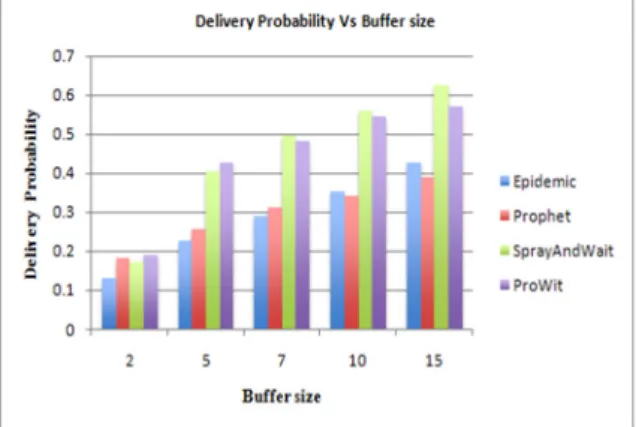
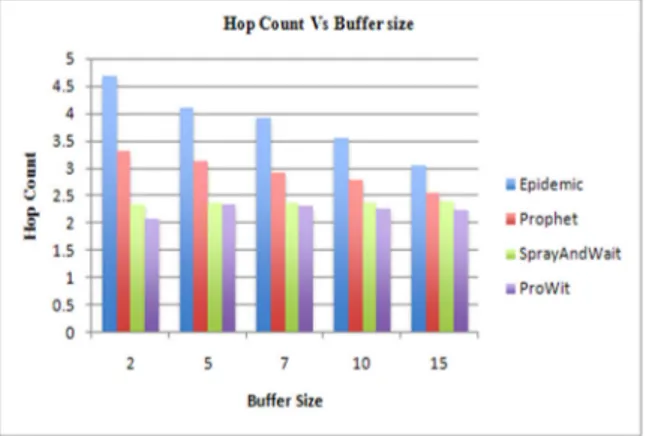
Fig.2 shows the relation between the buffer size and delivery probability. It can be observed from Fig.2 that the delivery probability of packets for PRo-Wait is found to be 0.4436 which is the second highest among the four protocols plotted (Prophet = 0.2955, Spray and Wait = 0.4522 and 0.2855 is for Epidemic). Fig.3 shows the relation between buffer size and mean overhead ratio. It is found that the mean average overhead ratio for the proposed protocol is 8.703 which is the least among the four protocols plotted (Spray and Wait = 11.65, Prophet = 52.136, Epidemic = 78.021). Fig.4 depicts the relation between buffer size and hop count. It can be observed from Fig.4 that the mean value of hop count in PRoWait is 2.245, which is lower than other three protocols (Prophet = 2.93, Spray and Wait = 2.35 and 3.86 is for Epidemic).
Figure 3: Comparison graph between Buffer size and Aver-age Latency.
Fig.5 illustrates the relation between TTL and de-livery probability of the four protocols. It is observed that the mean delivery probability of packets for PRo-Wait is 0.7492 which is the clear highest among the four protocols plotted (Spray and Wait = 0.6536, Prophet = 0.7115, and 0.5332 is for Epidemic). Due to this, the number of packets successfully delivered is quite high in PRoWait. Fig.6 is depicts the relation between TTL and overhead ratio. It has been observed that the mean overhead ratio for PRoWait is 14.05, which is the lowest among the four protocol plotted (Prophet = 45.42, Spray and Wait = 23.07 Sec, Epi-demic = 181.133). Further, the ProWait performance is 61.57% better than the Epidemic, 68.25% better than Spray and Wait and Prophet, respectively in terms of mean overhead ratio.
Figure 4: Comparison graph between Buffer size and Hop count.
Figure 5: Comparison graph between TTL and Delivery Probability.
Figure 6: Comparison graph between TTL and Average La-tency.
Fig.7. shows the relation between TTL and hop count. It is found that the mean value of hop count in PRoWait is 2.07 which is again the lowest when compared to the other three protocols (Spray and Wait = 2.28, Prophet = 3.222 and 4.88 is for Epidemic).
5
CONCLUSION
In this paper, a new routing protocol named as PRoWait is designed to overcome some of the shortcomings of the existing protocols in Oppnet. As the area of routing in Oppnets is still under research and much work is to be done in different aspects, the main focus in this work is mainly to increase the packet delivery ratio and lower delay and hop count. The PRoWait is designed to overcome some of the shortcomings of the existing protocols in Oppnet. Through simulation analysis the performance of PRoWait is evaluated and compared with Epidemic, Spray and Wait, and Prophet protocols in terms of delivery probability, overhead ratio, and average hop count performance metrics. It has been observed that PRoWait outperforms these protocols on the basis of aforementioned performance metrics.
In future, efforts will be focused on increasing the packet delivery ratio by adding some more parameters and functions to the PRoWait scheme. Performance of PRoWait on different mobility models will also be explored in the future.
REFERENCES
Elizabeth M. Royer and Chai-Keong Toh, 1999, “A review of current routing protocols for ad hoc wireless net-works”, IEEE Personal Communication Magazine, vol. 6, no. 2, pp. 46-55.
C.-K. Toh, 2002, “Ad Hoc Mobile Wireless Networks: Pro-tocols and Systems”, Prentice Hall PTR, Englewood Cliffs, NJ.
L. Pelusi, A. Passarella, and M. Conti, 2006, “Opportunistic networking: data forwarding in disconnected mobile ad hoc networks”, IEEE Communications Magazine, vol. 44, Issue 11, pp. 134-141.
C.-M. Huang, K.-C. Lan, C.-Z, and Tsai, 2008, “A survey of opportunistic networks”, in proceedings of the 22nd
Intl. Conference on Advanced Information Networking and Applications- workshops, 2008 (AINAW 2008), Okinawa, Japan, pp. 1672-1677.
S. K. Dhurandher, Deepak Kr. Sharma, I. Woungang, and H.C. Chao, 2011, “Performance Evaluation of Various Routing Protocols in Opportunistic Networks”, in Pro-ceedings of IEEE GLOBECOM Workshop 2011, Hou-ston, Texas, USA , pp. 1067-1071.
A. Keranen, 2008, “Opportunistic Network Environment Simulator”, Special Assignment Report, Helsinki Uni-versity of Technology, Dept. of Communications and Networking.
A. Vahdat, and D. Becker, 2000, “Epidemic routing for par-tially connected ad hoc networks”, Technical Report CS-2000-06, Dept. of Computer Science, Duke Univer-sity, Durham, NC.
T. Spyropoulos, K. Psounis and C. S. Raghavendra, 2005, “Spray and Wait: An Efficient Routing Scheme for In-termittently Connected Mobile Networks”, in proceed-ings of SIGCOMM Workshop on Delay-Tolerant Net-working, Philadelphia, USA, pp. 252-259.
A. Lindgren, A. Doria, and O. Schelen, 2003, “Probabilistic routing in intermittently connected networks”, ACM SIGMOBILE, Mobile Computing and Communica-tions Review, vol. 7, Issue 3, pp. 19–20.
S. K. Dhurandher, Deepak Kr. Sharma, I. Woungang , and S. Bhati, 2013, “HBPR: History Based Prediction for Rout-ing in Infrastructure-less Opportunistic Networks”, in Proceedings of 27th IEEE International Conference on
Advanced Information Networking and Applications (AINA-2013), Barcelona, Spain, pp. 931-936.
S. K. Dhurandher, Deepak Kr. Sharma, I. Woungang, A. Saini, 2014, “Efficient Routing based on Past Infor-mation to Predict the Future Location for Message Pass-ing in Infrastructure-less Opportunistic Networks”, in the Special Issue Support Technology and Architecture for Networked and Distributed Systems, Journal of Su-percomputing, Springer, DOI: 10.1007/s11227-014-1243-5, Online, June 28, 2014 (Impact Factor: 0.917). S. K. Dhurandher, Deepak Kr. Sharma, I. Woungang, R.
Gupta, S. Garg, 2014, “GAER: Genetic Algorithm based Energy-efficient Routing Protocol for Infrastructure-less Opportunistic Networks”, Journal of Supercomputing, Springer, DOI: 10.1007/s11227-014-1195-9, Online, May 3, 2014 (Impact Factor: 0.917).