I am submitting herewith a dissertation written by Ronald Gene Smith, II entitled “The Impact of secondary Mathematics Methods Courses on Preservice Secondary Teachers’ Beliefs about the Learning and Teaching of Mathematics.” I have examined the final electronic copy of this dissertation for form and content and recommend that it be accepted in partial fulfillment of the requirements for the degree of Doctor of Philosophy, with a major in Education.
Dr. Vena Long, Major Professor
We have read this dissertation and recommend its acceptance:
JoAnn Cady
Chuck Collins
P. Mark Taylor
Accepted for the Council:
Carolyn R. Hodges
Vice Provost and Dean of the Graduate School
The Impact of Secondary Mathematics Methods Courses on Preservice Secondary Teachers’ Beliefs about the Learning and Teaching of Mathematics
A Dissertation Presented for the Doctor of Philosophy
Degree
The University of Tennessee, Knoxville
ii
iii
Acknowledgements
The completion of this educational journey has been made possible due to the support, encouragement and example of many along the way. There is not sufficient space available on this page to express my gratitude toward the vast numbers who have helped me complete this endeavor, but I do wish to acknowledge a few.
I would like to thank the entire ACCLAIM team. Dr. Vena Long, Dr. Bill Bush, Dr. Robert Mayes, Dr. Carl Lee, Dr. Mike Mays, and others have put so much into making this dream come true for me, and I will forever be indebted to them for this opportunity. The support and encouragement of the entire cohort has been a huge blessing to me throughout this program.
Dr. P. Mark Taylor has been unwavering in his confidence in my ability to complete this research. I appreciate all of his encouragement throughout the entire process. I would also like to express my deepest appreciation for Dr. Long. She put in countless hours to make all of this possible and was there to push me when needed it. In addition, I would like to thank Dr. Chuck Collins and Dr. JoAnn Cady for their time, suggestions and support throughout the entire process.
iv Abstract
The Comprehensive Framework for Teacher Knowledge provides a model that describes an approach to the secondary mathematics methods course, as described by Robert Ronau and P. Mark Taylor. The model includes the orientation of preservice teachers toward mathematics and the teaching of mathematics, which includes the beliefs of the preservice teachers. The first questions deal with identifying the methods used in the methods course to address beliefs. The second set of questions deal with the effects of the methods course on the beliefs that preservice teachers hold on the learning and teaching of mathematics.
The study included 16 different universities in the United States. The students completed the Mathematics Beliefs Instrument (MBI) before and after the course. The data used for
analyses included the MBI, course syllabi and interviews with instructors and course textbooks. Qualitative analysis was conducted on the syllabi and interviews to assist in creating a rubric to score the syllabi, interviews and textbooks. Correlation and linear regression analysis was used along with the Wilcoxon signed-ranks test for the statistical analysis.
v
Table of Contents
Chapter 1: Background of the Study ... 1
Introduction ... 1
Reform Teaching ... 2
Mathematics Methods Course Framework ... 4
Statement of the Problem ... 6
Research Questions ... 6
Significance... 7
Limitations and Delimitations ... 8
Definitions of Terms ... 8
Chapter 2: Literature Review ... 11
Introduction ... 11
Beliefs ... 11
Definitions of Beliefs from Research ... 12
Descriptions of Beliefs ... 13
Nature of Beliefs ... 14
Source of Authority of Beliefs ... 15
Categorizing Beliefs... 16
Consistency of Beliefs ... 20
Definition of Beliefs ... 20
Beliefs and Knowledge ... 22
Types of Knowledge ... 25
Influences of Beliefs on Practice ... 26
Inconsistencies between Beliefs and Practice ... 28
Changing Preservice Teachers’ Beliefs ... 30
Role of the Teacher Educator ... 34
Apprenticeship of Observation ... 35
Problem Areas ... 36
Secondary Methods Courses ... 39
Current Research on Mathematics Methods Courses ... 39
Research on Secondary Methods Courses ... 39
Stakeholders in Methods Courses ... 41
Secondary Mathematics Methods Course Content ... 41
Creation of Reflective Practitioners ... 44
History of Mathematics Methods Courses ... 46
Reform Attempts to Teaching Mathematics ... 48
Summary ... 50
Chapter 3: Methodology ... 53
Qualitative Study ... 53
Participants ... 53
Instrumentation ... 55
Data Analysis ... 55
Quantitative Study ... 56
Participants ... 57
vi
Procedures ... 59
Sample Description ... 61
Chapter 4: Findings ... 65
Class Data ... 65
Developing Reform Oriented Beliefs ... 72
Dilemmas that Lead to Change ... 74
Methods that Stimulate Teachers to Use Reform Practices ... 81
Degree of Incorporation of CFTK ... 82
Changes in Preservice Teachers Beliefs ... 86
Degree of CFTK and Student Beliefs ... 86
Change in Preservice Teachers’ Beliefs. ... 89
Chapter 5: Conclusions ... 95
Summary of the Study ... 95
Findings... 96
Discussion and Recommendations ... 99
Recommendation to Methods Course Instructors ... 99
Recommendation to Methods Course Researchers ... 100
Recommendations for Institutions ... 100
Conclusion ... 101
Limitations ... 102
Recommendations for Further Research ... 105
References ... 107
Appendices ... 123
Appendix A ... 124
Appendix B ... 128
vii List of Tables
Table 1: Comparison of Beliefs about the Nature, Teaching and Learning of Mathematics.. 19
Table 2: Size of Universities... 62
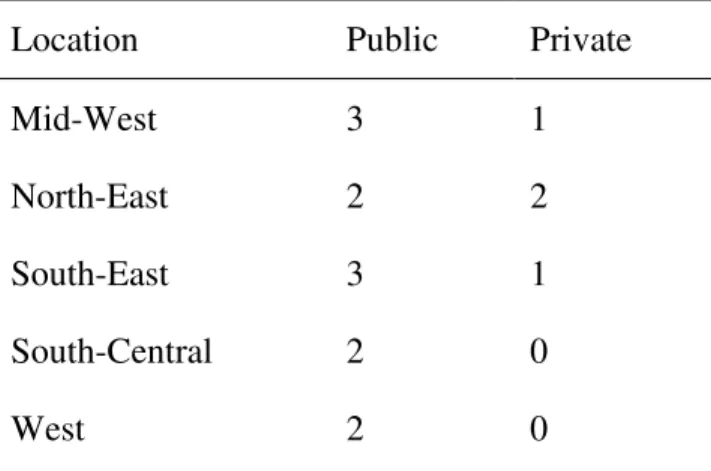
Table 3: School Locations and Public vs. Private... 62
Table 4: Degree of Research vs. Public or Private Institution... 62
Table 5: Doctorate Degree Held... 63
Table 6: Themes Found in Syllabi... 66
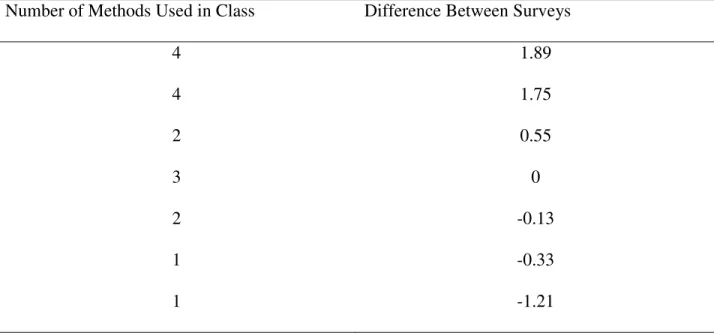
Table 7: Methods Used to Challenge Preservice Teachers vs. Survey Differences for Section A of the MBI... 79
Table 8: Methods Used to Challenge Preservice Teachers vs. Survey Differences for Section B of the MBI... 80
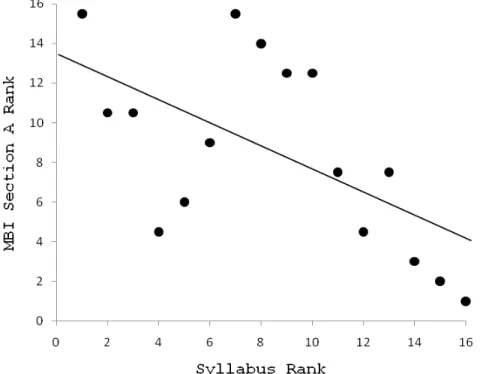
Table 9: Summary of Linear Regression for Variable Predicting Differences in Pre and Post Section A MBI Scores... 81
Table 10: Rubric Analyses Results for Data Sources... 82
Table 11: Designation for Aspects of CFTK ... 84
Table 12: Distribution of CFTK Aspects in Syllabi and Interviews... 84
Table 13: Summary of Linear Regression for Variables Predicting Changes in Preservice Teachers’ Beliefs on Section A of MBI... 88
Table 14: Descriptive Statistics for Mean MBI Scores... 91
viii List of Figures
1
Chapter 1: Background of the Study Introduction
Mathematics education in the United States has seen numerous developments over the past 100 years. These changes have been precipitated by groups such as the National Council of Teachers of Mathematics (NCTM), Association of Mathematics Teacher Educators, and the National Science Foundation. In their efforts to reform mathematics education, the NCTM published a list of goals for students to learn during their kindergarten through twelfth grade years of schooling in 1989 (National Council of Teachers of Mathematics, 1989). These goals became known as the standards for mathematics education and were modified in 2000 (National Council of Teachers of Mathematics, 2000). The purpose of these standards for mathematics education is to provide teachers with the frameworks upon which to reform their mathematics teaching.
The reforms addressed in the NCTM documents require a change in the fundamental beliefs about how students learn mathematics. Beliefs about how students learn and understand mathematics are “undoubtedly a driving force behind the nature of a teacher’s instructional practice” (Artzt & Armour-Thomas, 2002, p. 23). These beliefs act as filters that regulate what a teacher believes and does in the classroom (Ambrose, Clement, Philipp, & Chauvot, 2004; Thompson, 1992) Beliefs can also be seen to act as lenses through which a teacher views
2
student. Once a preservice teacher’s beliefs have been questioned, then the future teacher is ready to consider various approaches to teaching and learning that construct or at least significantly revise their beliefs.
In order for reform to occur, teachers need to learn not only the standards contained in the NCTM documents, but teachers also need to learn how to incorporate a new approach to learning mathematics that is encouraged by these standards. The standards incorporate a learning style that aligns very closely to the constructivist philosophy of learning. An obvious opportunity for learning this approach to teaching mathematics is during the preparation phase in a university setting, especially in the mathematics methods course. Current reformers in education are calling for the faculty in teacher education programs to implement and model instructional strategies that are consistent with the constructivist theory of learning (Shapson & Smith, 1999), the underlying theory of learning espoused in the NCTM standards. Secondary teachers typically major in mathematics and then prepare for a teaching career. In an ideal educational experience, preservice teachers would experience content courses that reflected best practices of teaching. For many preservice teachers, the reality is that a reform-oriented learning experience does not occur until the methods course (Goubeaud & Yan, 2004). The methods course is one course that many future secondary mathematics teachers take in preparation for their future careers. This course would appear to be a prime location for integrating the reform ideas and challenging the current belief systems of preservice teachers. If done properly, the methods course could provide a perfect segue into a reform-oriented career of teaching mathematics.
Reform Teaching
The idea of teaching in a reform manner requires that one knows the tenets of
3
students’ knowledge is a key component of a constructivist approach to teaching (Draper, 2002). Draper also stated that constructivism involves the learner and the teacher working together to solve problems. A constructivist teacher will create a learning environment that enables the student to be in charge of her own learning (Andrew, 2007). Constructivist teachers ensure that their classrooms are characterized by students who are engaged (Driscoll, 2000). Andrew (2007) identified nine traits that he labeled as the “nine components of constructivist instruction”. These nine traits are (a) teaching to help students “develop, reflect on, evaluate, and modify” their personal conceptual frameworks; (b) creating a classroom environment that enables students to be in charge of their own learning; (c) negotiating possible solutions to problems; (d) attempting to identify each student’s conceptual framework; (d) providing opportunities for students to engage in activities; (e) encouraging and supporting interactions between students; (f) agitating “weak mathematical constructs” of students through designed activities; (g) “structure learning tasks within relevant, realistic environments”; and (h) reveal multiple solutions and approaches to problems. Andrew is not alone in identifying characteristics that can be used to indicate a constructivist approach to teaching. Lubienski, Camburn and Shelly (2004) identified nine “instruction-related factors” (p. 26) that could help identify a teacher’s instructional preferences in regards to reform-oriented methods.
Draper (2002) stated that
“With the newest wave of reform, some mathematics educators have called for teachers to move away from teaching by telling (the school mathematics tradition) and move toward the constructivist teaching paradigm.” (p. 520)
4
educators in the higher educational institution cannot be expected to provide models of constructivist teaching because teacher educators are more likely than other higher education faculty to use student-centered instructional techniques according to Goubeaud and Yan (2004).
Mathematics Methods Course Framework
The purpose and structure of a mathematics methods course is generally in the hands of the teacher educator preparing the course. No general guidelines or frameworks for all
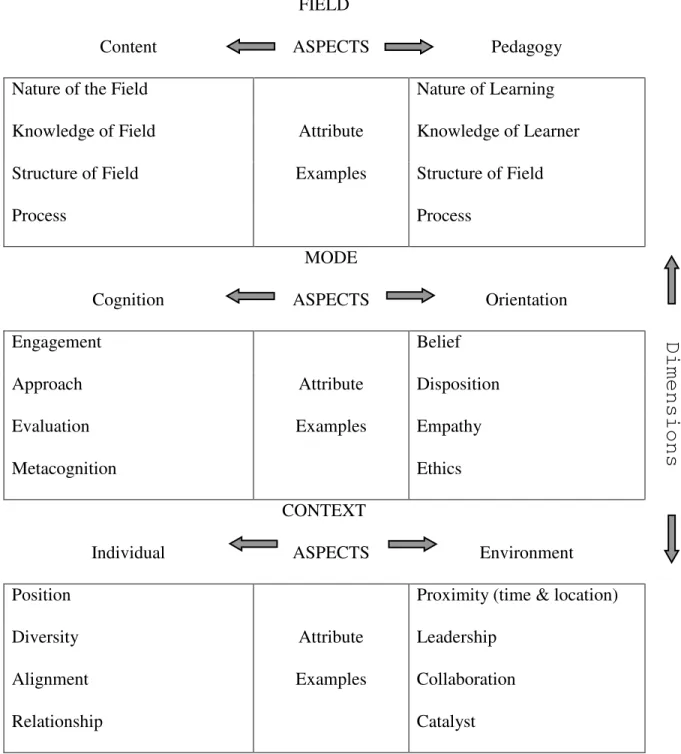
mathematics methods courses exist. One proposed framework for mathematics methods courses has been offered by Ronau and Taylor (2008). This model is referred to as the Comprehensive Framework for Teacher Knowledge (CFTK). The framework can be seen in Figure 1 below. The framework provides for a core consisting of teacher practice, student achievement and pedagogical content knowledge, as suggested by Shulman (1986). From this core, extend three main dimensions. These dimensions can be thought of as the knowledge of the “what”, “how” and “where” of learning. Each dimension is then broken down into two aspects. The “what”, referred to as the field dimension, is broken down into both the subject matter knowledge and the pedagogical knowledge necessary for the particular field, in this case mathematics. The “how”, referred to as the mode dimension, represents how cognition and orientation, or thinking and feeling, impact teaching and learning. The “where”, referred to as the context dimension, refers to the local context in terms of a micro-scale, the individual, and a macro-scale, the
5 FIELD
Content ASPECTS Pedagogy
Nature of the Field
Attribute
Nature of Learning
Knowledge of Field Knowledge of Learner
Structure of Field Examples Structure of Field
Process Process
MODE
Cognition ASPECTS Orientation
Engagement
Attribute
Belief
Approach Disposition
Evaluation Examples Empathy
Metacognition Ethics
CONTEXT
Individual ASPECTS Environment
Position
Attribute
Proximity (time & location)
Diversity Leadership
Alignment Examples Collaboration
Relationship Catalyst
Figure 1: Summary of Comprehensive Framework for Teacher Knowledge
occupies the same level as the aspect itself. Each of the aspects is dependent upon the other aspects, thus showing a symbiotic relationship amongst the aspects.
6
Statement of the Problem
The literature on secondary mathematics methods courses is very limited. There are studies that have examined individual courses, instructors or institutions (Buehl, Alexander & Murphy, 2002; Fernandez, 2005; Geddis & Wood, 1997; Kinach, 2002a; Kinach, 2002b; Manouchehri & Enderson, 2003; Quinn, 1997). Some studies have examined the effect of an individual course on the students in that course (Geddis & Wood, 1997). There have been few, if any studies of what is being taught in the secondary mathematics methods courses across
multiple institutions of higher learning. Ball (1988) points out that little is known about what students will learn or encounter in our education classes. If future mathematics teachers are going to learn about reform-oriented teaching, then the community of mathematics educators needs to know how common this type of teaching is across multiple schools.
Due to the lack of research about the content of the secondary mathematics methods courses, there exists a dearth of information about how the content of methods courses impacts the beliefs of preservice secondary teachers. Research about activities or methods that lead to changes in the fundamental beliefs about how students learn and understand mathematics promises to be very valuable to teacher educators.
Research Questions
This study will address the following research questions:
1. What characteristics of the methods courses challenge traditional beliefs and encourage the development of beliefs aligned with reform teaching practice?
7
b. Which of the identified methods stimulate preservice teachers to incorporate reform teaching practices into their teaching?
c. To what degree do the methods courses incorporate the multilevel model of teacher knowledge as posited by the Comprehensive Framework for Teacher Knowledge proposed by Ronau and Taylor (2008)?
2. In what way are the beliefs about the learning and teaching of mathematics held by preservice teachers changed, if any change occurs?
a. Are the beliefs of preservice teachers changed to demonstrate more alignment with a reform-oriented view of teaching mathematics?
b. Does the degree of incorporating a multilevel model of teacher knowledge correlate positively with the subsequent alignment of preservice teacher’s beliefs with a reform-oriented view of teaching mathematics?
Significance
In the mathematics education community, much effort is being expended on promoting and encouraging teachers to incorporate standards-based reform. Teachers are encouraged to do this at workshops, professional development, national conferences, etc. An ideal time to start teachers on the path toward reform teaching is during their education and training period prior to their immersion in the existing culture that is inundated with traditional ideas, beliefs, methods and curriculum. Smith (2007) pointed out that
8
Currently there has been little research to suggest that this reform effort is being practiced at our colleges and universities in the preparation of secondary preservice teachers. Another problem is that there is little research on preservice secondary teachers’ beliefs about the learning and teaching of mathematics. In order to study the practices that occur in secondary mathematics methods courses and the accompanying beliefs of secondary preservice teachers, research must be conducted in these areas. To shed light on this situation, I will examine the efforts of
secondary mathematics teacher educators and the change in beliefs of the preservice secondary teachers in regard to the learning and teaching of mathematics. Once research is conducted in this area, then future research can begin to identify additional methods of addressing the beliefs of preservice secondary mathematics teachers.
Limitations and Delimitations
This study is dependent upon the cooperation of the professors who teach the secondary mathematics methods courses at colleges and universities. In order to determine what is being taught and the manner in which the class is taught I will survey teacher educators as to their beliefs about and practices in teaching the mathematics methods courses. I will compare the approaches being used to a list of factors that are characteristic of reform-oriented teaching such as those offered by Andrew (2007) and Lubienski et al. (2004). In order to provide triangulation of the analysis, I will also call on randomly selected professors, selected from the surveys used for analysis. These calls will be for the purpose of comparing the survey with the actual course delivery and content.
Definitions of Terms
In order to determine if standards-based reform instruction is being used in the
9
For the purpose of this study, standards-based refers to mathematics instruction that is based on the standards that were introduced by the National Council of Teachers of Mathematics in 1989 and updated in 2000. Reform refers to changing the traditional approach to mathematics and mathematics teaching (Cady, Meier, & Lubinski, 2006; Cooney, 2003), although Cooney does point out that “In the United States, reform in mathematics education is best represented by the Principles and Standards for School Mathematics and its three predecessors” (p. 1). In this paper, reform and reform-oriented will both refer to teaching that addresses the ideas and standards set forth in the NCTM documents, primarily in the Principles and Standards of School Mathematics (National Council of Teachers of Mathematics, 2000).
For the purpose of this study, secondary mathematics methods courses will refer to classes offered at universities and colleges that are designed to instruct preservice teachers on how to teach mathematics to students in grades nine through twelve. The secondary mathematics methods course normally includes topics in content, pedagogy, pedagogical content knowledge and clinical experiences. In order for a college to be considered, that college or university needs to offer a program that results in the certification of teachers for teaching secondary
mathematics.
10
11
Chapter 2: Literature Review Introduction
The purpose of this chapter is to provide relevant information that is available in the existing literature. The chapter will begin with a discussion of the beliefs and the importance of beliefs to teaching. This discussion will be followed by a reason for addressing beliefs in the secondary mathematics methods courses. Finally, there will be a discussion about the secondary mathematics methods course. Initially, in order to develop the need for addressing beliefs in the secondary methods course, the need to examine teachers’ beliefs will be addressed first.
Beliefs
12 Definitions of Beliefs from Research
The exact meaning of the term “beliefs” is not easy to derive from the available research. Beliefs are defined in terms of their relationships to other concepts. For example, Pajares (1993) defines beliefs as the attitudes and values that a teacher has about the teaching profession, students and the entire educational process. Other researchers view beliefs and attitudes as being different concepts (Philipp, 2007). One example that describes the differences between beliefs and attitudes claims that beliefs, attitudes and emotions lie on a continuum where beliefs require the least emotional attachment and emotions require the most emotional attachment (Owens, Perry, Conroy, Geoghegan, & Howe, 1998). The continuum of beliefs, attitudes and emotions also exhibits an increasing amount of cognitive basis, with emotions needing little cognitive basis to be held and beliefs requiring a greater degree of cognitive basis. Still other researchers suggest that a teacher’s beliefs affect the teacher’s attitudes and orientations (Grossman, Wilson, & Shulman, 1993). A teacher’s orientations affect everything they do in a classroom, including lessons, goals, assignments and assessments. Teacher’s attitudes include how they feel about their subject and their teaching (Ernest, 1989; Quinn, 1997).In all of these descriptions, there exists a relationship between beliefs, attitudes, emotions and orientations. The nature of these relationships is the reason these concepts are all tied together in one aspect of the Comprehensive Framework for Teacher Knowledge model by Taylor and Ronau (2008).
13
is “conative” (p. 41) in nature, which relates to actions that stem from a belief. Yet, many of these definitions fail to provide clear definitions of beliefs.
The definitions of beliefs that are provided in much of the available research do not provide enough information to develop a definition of beliefs that is suitable for this study. In order to develop a definition of beliefs, existing definitions are not adequate in and of themselves to provide a definition. In order to expand upon the idea of a belief, the descriptions of beliefs can be used to gain an idea of what is meant by the term “beliefs”.
Descriptions of Beliefs
14 Nature of Beliefs
Due to the idea that deeply held beliefs actually become a part of a teacher, these beliefs help define who that teacher is. Therefore, determining how firmly entrenched a belief is to the teacher and how the teacher came to accept a particular belief (Cooney, et al., 1998) is important to the study of the nature of beliefs. Some beliefs, referred to as central (Philipp, 2007;
Thompson, 1992), are deeply ingrained in a teacher and become central to one’s being and who the teacher is (Pratt, 1998).
Not all beliefs are held so firmly in one’s mind. Some beliefs, referred to as peripheral, are less firmly held than central beliefs. Beliefs can be maintained in a teacher’s mind at varying levels of conviction (Thompson, 1992). Some beliefs are formed without any evidence or direct reason. Beliefs formed in this manner are referred to as nonevidential beliefs (Cooney, et al., 1998; Merry, 2005). When beliefs are formed nonevidentially, then the holder of the beliefs has a dilemma over how to evaluate or judge which beliefs are of most importance or of greater value (Thompson, 1992).
Belief formation can also depend on the context in which that belief was created and the context to which the belief is connected in a belief system (Beswick, 2005). Beswick reports that “context is thus relevant to both the development and the enactment of teachers’ beliefs” (p. 41). She states that there is a relationship between a teacher’s beliefs and that teacher’s perception of the classroom environment. Beswick is not alone in her assessment of the effect of context on the enactment of beliefs (Ajzen & Fishbein, 1980).
15 Source of Authority of Beliefs
The study of teachers’ beliefs must consider how a teacher views the source of authority for knowledge. The reason that the source of authority must be examined is that how a teacher views the source of knowledge gives insight into the teacher’s intellectual and cognitive
development. Cady et al. (2006) find the preservice teacher’s source of authority as being critical to the teacher changing their beliefs and practice to accept reform-oriented teaching. Many students entering college view knowledge as being something to be received from an expert (Baxter Magolda, 1992), in the case of teacher education this expert would be the teacher educator. This source of authority is referred to as voices (Belenky, Clinchy, Goldberger, & Tarule, 1986; Cady, et al., 2006; Cady & Rearden, 2007).
The idea of voices refers to whose voice the teacher is listening when gaining knowledge. Teachers can hold an absolute view of knowledge where they listen to the voices of experts and hold a right/wrong view of knowledge, which is similar to Perry’s position 1 of basic duality (Perry, 1999). As teachers develop intellectually, they begin to listen to the voice of others, which Baxter Magolda (1999) sees as a level of development where teachers coconstruct their knowledge with the help of others. As the preservice teachers progress in their intellectual development, they reach the level where they begin to look at knowledge more critically. The teachers begin to create their own knowledge based on the contexts and their own experiences (Baxter Magolda, 1992; Cady & Rearden, 2007). This is referred to as listening to one’s own voice (Belenky, et al., 1986) and is viewed as an internal locus of authority (Cady & Rearden, 2007; Perry, 1999).
16
King (2004) state that teachers reach cognitive maturity when their epistemological views include an internal locus of authority where they develop their own belief system through the processes of construction, evaluation and interpretation. In order to change a teacher’s beliefs and practice, the teacher educator must find methods of moving the preservice teacher from an external locus of authority to an internal locus of authority in order to affect sustained changes. These changes may not be present in a teacher’s first year in the classroom, as Cady, Meier and Lubinski (2006) found. But, if the proper groundwork is laid, then teachers can build on this foundation and become teachers who practice reform methods in their classrooms much as Cady et al. found.
In order to develop a working definition of beliefs, consideration must be given to how beliefs are categorized. Categorizing beliefs is not only an academic pursuit, conducted for the purpose of classifying a teacher’s beliefs, but categorizing is a process that occurs in the mind of every teacher. Now that beliefs have been described, the interaction between beliefs must be considered. This interaction can be understood through the manner in which beliefs are categorized and the degree of interaction between various categories of beliefs.
Categorizing Beliefs
Beliefs are frequently categorized into primary or primitive beliefs and derivative beliefs (Breiteig, Grevholm, & Kislenko, 2005; Chapman, 2002; Green, 1971; Johnson, 2004;
17
beliefs are about one’s self and one’s own identity. These primitive beliefs act as axioms to form axiomatic systems upon which other beliefs are then created and combined to form belief
structures, which were defined in chapter one.
Beliefs do not function independently (Breiteig, et al. 2005; Green, 1971), but instead form belief structures and systems, which are a conglomeration of beliefs. As was stated in chapter one, the ideas of a belief structure and a belief system are simply ways to describe how an individual arranges her/his beliefs into clusters, which tend to be dynamic structures that change due to the experiences of the individual (Thompson, 1992). Cooney, Shealy and Arvold (1998) and Breiteig et al. identified three characteristics of belief systems. They found that belief systems have a quasilogical relationship between the incorporated beliefs. They also found that beliefs are related based on their order, such as centrally held beliefs or peripherally held beliefs. Additionally, they suggest that clusters, or belief structures, of beliefs tend to be isolated from other clusters. This isolation can lead to apparent contradictions in belief systems. These systems of beliefs are important to the level of attachment that one feels to a belief. If a belief is added to a belief system very quickly, then that belief is much harder for a person to change (Pajares, 1992). These beliefs then are used to make decisions about future information that is processed. Cooney et al. (1998) point out that belief systems are the basis for what people believe, and as such are important to understand when trying to challenge preservice teachers’ beliefs.
18
one views as appropriate. Calderhead identifies these types of teaching as including transmission of facts and knowledge, guided learning, social contexts or teaching mathematics as a social construct, or even treating mathematics as a purely academic subject with no connections to other disciplines. Beliefs about content are very important in that these beliefs strongly influence what is taught by a teacher and what type of delivery is best for that material (Calderhead, 1996; Grossman, Wilson, & Shulman, 1993; Philipp, 2007). Calderhead includes a teacher’s beliefs about what it means to really know a subject in the category of subject, or content, beliefs.
Beswick (2007) identified nine beliefs that she grouped into three main categories. The three main categories are the nature of mathematics, mathematics learning, and the role of the teacher. Beswick’s three categories are in agreement with other researchers (Raymond, 1997; Swan, 2006). Beswick (2005) included Table 1 below to explain her categories of beliefs. Beswick used research from both Ernest (1989) and Van Zoest et al. (1994) to construct her table. The columns represent continua as you progress from the top to the bottom of each column. The rows represent three ideas that are theoretically similar to each other. The actual impact of any individual column continues to be undetermined. Raymond (1997), as a result of her research, suggests that the nature of mathematics has stronger associations to a teacher’s actual practice than the more pedagogical beliefs, but the results were inconclusive.
19
Table 1: Comparison of Beliefs about the Nature, Teaching and Learning of Mathematics
Beliefs about the nature
of mathematics (Ernest, 1989)
Beliefs about mathematics teaching
(Van Zoest et al., 1994)
Beliefs about mathematics learning (Ernest,
1989)
Instrumentalist Content-focused with an emphasis on
performance
Skill mastery, passive reception of
knowledge
Platonist Content-focused with an emphasis on
understanding
Active construction of understanding
20
community. Procedural beliefs include what Pratt (1998) refers to as tactical knowledge and strategic beliefs. Pratt identifies tactical knowledge as the knowledge of the proper time and manner to adjust one’s teaching actions to accommodate for a change in the circumstances in the environment. Pratt refers to strategic beliefs as knowing why the adjustments are needed.
Beliefs are categorized by researchers in order to examine various beliefs. Individuals categorize beliefs in order to make sense of the world around them. The act of categorizing creates consistency amidst many beliefs that at times do not appear consistent with each other. Consistency of Beliefs
Teachers, as other people, have a need to see themselves as consistent beings. This need for consistency is not unique to teachers. The need for consistency creates problems for all people who hold beliefs that are inconsistent. One example of contradictory beliefs is that a person may believe that all people should be free, but the same person holds the belief that criminals should go to prison (Rokeach, 1960). Rokeach states that in order for a person to deal with this discontinuity in beliefs, the person must isolate the beliefs in question from other beliefs that might be contradictory. This isolation is not limited to individual beliefs, but can apply to entire belief structures (Cooney, Shealy, & Arvold, 1998; Green, 1971; Rokeach, 1960). This isolation can occur when beliefs, belief structures or belief systems, are developed without the benefit of comparison to other beliefs. This isolation of beliefs and belief structures causes apparent inconsistencies in teachers’ beliefs and practices. In order to advance the study of beliefs beyond the basic idea of what beliefs are considered to resemble, a definition of beliefs is imperative.
Definition of Beliefs
21
very similar, and almost indiscernible, to knowledge (Calderhead, 1996). Other researchers consider beliefs and knowledge separately. The separation between beliefs and knowledge is apparent in research looking at domain specific beliefs regarding knowledge in a particular content area (Buehl, Alexander, & Murphy, 2002; Muis, Bendixen, & Haerle, 2006). Others see beliefs as based on affective evidence and personal experiences (Borko, et al., 1992; Grossman, Wilson, & Shulman, 1993; Pajares, 1992/ Thompson, 1992). The meaning assigned to the term “beliefs” varies depending on the research and researcher. Op’t Eynde, De Corte and Vershaffel (2002) propose a definition for beliefs that states
Students’ mathematics-related beliefs are the implicitly or explicitly held subjective conceptions students hold to be true, that influence their mathematical learning and problem solving. (p.16)
This definition will be modified slightly for this study. For the purpose of this study the definition of mathematics-related beliefs includes the implicitly or explicitly held subjective conceptions preservice teachers hold to be true that influence their own personal mathematical learning and the preservice teachers’ views on the mathematical learning of others. A
qualification of the definition is important since the manner in which these beliefs are formed, or the degree to which they are formed is not implied by the term belief in this study.
22 Beliefs and Knowledge
The relationship between knowledge and beliefs is stated frequently in the research. Knowledge and beliefs are considered determining factors for reform teaching to occur (Borko, Mayfield, Marion, Flexer, & Cumbo, 1997; Borko & Putnam, 1996; Frykholm, 2005; Staub & Stern, 2002) and for what happens in the classroom (Borko, 1997; Mizell & Cates, 2004; Peressini, Borko, Romagnano, Knuth, & Willis, 2004). Ernest (1989) claims that theoretical knowledge is composed of content knowledge combined with beliefs and attitudes about mathematics. Knowledge and beliefs both must be addressed for meaningful change to occur. Meaningful change can occur when teachers have the knowledge necessary to implement the change supported by the beliefs to sustain the change throughout the difficult periods (Borko, et al., 1997) and the period of time referred to as the “Learning Dip” (Barkley, 2005, p. 44) where the learning drops a little at first due to the use of new pedagogical approaches, but then the learning increases and exceeds the initial level.
23
Some researchers do consider beliefs and knowledge as separate from each other
(Calderhead, 1996; Pajares, 1992). Other researchers continue to try to separate knowledge from beliefs. Some researchers suggest four features that can be used to distinguish beliefs from knowledge (Calderhead, 1996; Nespor, 1987; Pajares, 1992). The first of these features is existential presumption, which is truth that one holds as deeply personal. Existential
presumptions represent reality to an individual. These beliefs are considered unchangeable. They are beliefs that just exist. The second feature is alternativity. Alternativity refers to an individual creating an alternative environment, though the environment may not exist in reality, but the created environment does represent the ideal environment to that individual. The third feature of beliefs is affective and evaluative loading. Affective and evaluative loading refers to the idea that beliefs are based more on affective bases than knowledge, which tends to have a more objective base (Grossman, Wilson, & Shulman, 1993). The evaluative aspect of this feature refers to the idea that many beliefs are based on judgments and evaluations of individuals or situations. The fourth feature of beliefs is episodic structure. Episodic structure refers to how beliefs are stored in memory. This feature suggests that beliefs are stored as episodes or situations that occurred in the past and continue to be used as a basis for a particular belief. Another view on differentiating between beliefs and knowledge is put forth by Beswick. Beswick (2007) takes the view that beliefs are “distinguishable from knowledge only in terms of the degree of consensus they attract as a result of the quality and quantity of evidence upon which they are based and their power to make sense of the world” (P. 96). Her view combines the features of the previous method.
24
2007). If there is no absolute truth, then separating beliefs from knowledge based on the degree of truth does not have any basis. Philipp suggests that an idea is a belief if the holder of that idea can accept someone holding a different or opposing view of the same general idea. If the holder of the idea cannot accept any opposing views of that idea, then for that individual that is no longer a belief but becomes knowledge. Another view is that beliefs that are justified become knowledge (Breiteig, et al., 2005). In these definitions there are no requirements for the existence of any universal truth that can make any one belief more factual than another. This lack of
precise definitions has resulted in situations where concepts that were once thought to be beliefs are now believed to be knowledge and what was once considered to be knowledge is now considered belief (Thompson, 1992).
Some researchers continue to try to separate beliefs from knowledge. In an effort to study beliefs by themselves, Raymond (1997) tries to separate knowledge and beliefs in her research. She concludes that knowledge, beliefs and practice contain links that cannot be separated. These researchers have all recognized that knowledge and beliefs are woven together, which agrees with the Comprehensive Framework for Teacher Knowledge model suggested by Ronau and Taylor (2008). Their model suggests that all aspects are connected in some fashion and therefore cannot be taught in isolation.
25 Types of Knowledge
Knowledge is broken down into domains much like beliefs were broken down earlier in this chapter. Some researchers suggest that there are three main domains of knowledge for mathematics education. These three domains are mathematics content, pedagogy specific to mathematics, and the professional identity of the mathematics educator (Borko, Peressini, et al., 2000; Peressini, et al., 2004). Other researchers have suggested a different breakdown of
knowledge, which consists of content knowledge, general pedagogical knowledge, and pedagogical content knowledge (Borko & Putnam, 1996; Shulman, 1986). Shulman (1986) proposes that content knowledge has three categories. These three categories are the subject matter knowledge of a particular content area, knowledge about curricular interests of a particular content area, and the pedagogical content knowledge that is unique to a particular content area. This does not represent the final breakdown of knowledge, as Grossman, Wilson and Shulman (1993) further dissect pedagogical content knowledge into four areas. These four areas include teachers’ overarching conceptions as to why they teach a subject, knowledge about how students understand and misunderstand topics within a subject area, knowledge about the various types of curriculum associated with a content area, and knowledge about various teaching strategies for various topics in a particular content area. Ball, Lubienski and Mewborn (2001) include another division, which they refer to as mathematical knowledge for teaching. This category includes knowledge about mathematics that is essential for teaching mathematics effectively. This would include ideas such as possessing knowledge about mathematics that is essential for the proper sequencing of mathematical topics.
26
addressed is the importance of how a teacher’s beliefs influence a teacher and how that teacher executes her/his teaching activities.
Influences of Beliefs on Practice
Beliefs influence how a teacher responds in a given situation (Ambrose, et al., 2004) due to the manner in which the beliefs are derived. Some researchers view the source of beliefs to be events and experiences that have occurred in a person’s past (Calderhead, 1996; Nespor, 1987; Pajares, 1992; Thompson, 1992). Events that occur and leave a vivid memory tend to be used as the seeds of future beliefs and belief systems. This poses problems for teacher educators in that all future teachers have years of experiences that shape not only their view of teaching but also their views of what it means to be a teacher. Lortie (1975) labeled this phenomenon as the “Apprenticeship of Observation”. Beliefs derived in this manner do not require objective
evidence to entrench them firmly in the holders mind (Grossman, et al., 1993). As was discussed earlier in this chapter, these types of beliefs are known as nonevidential because they fail to be based upon evidence. These beliefs do not require facts or other sources of external validity in order to convince the holder that the belief is valuable. A belief does not need to be held by others, nor does a belief require a consensus in order to be considered valuable (Nespor, 1987; Pajares, 1992; Thompson, 1992). Since a belief can exist without regard to its validity, a belief can be very challenging to identify and change (Borko & Putnam, 1996). Although these beliefs may be challenging to change, the potential rewards exist because these beliefs can have a dramatic influence on how a teacher practices her/his trade (Chapman, 2002).
27
Calderhead, 1996; Grossman, et al., 1993; McMullen, et al., 2006; Pajares, 1992; Richardson, 1996; Wilkins & Brand, 2004). For example, teachers’ epistemic beliefs influence what teachers choose to teach from their content and how they choose to teach the content (Grossman, et al., 1993). A teacher’s beliefs have a strong effect over her/his perceptions and judgments, which results in behavior that is seen in the classroom (Pajares, 1993). Borko and Putnam make their stance very clear in saying “teachers’ knowledge and beliefs – about teaching, about subject matter, about learners – are major determinants of what they do in the classroom” (Borko & Putnam, 1996, p. 675). In the relationship between beliefs and reform teaching practices, Wilkins (2002) agrees that beliefs have a positive effect on a teacher’s classroom practices, but also states that content knowledge has a negative effect on teachers’ beliefs and practices.
The reason for the apparent paradox on increased content knowledge having a negative effect on beliefs comes from a study conducted by Nathan and Koedinger (2002a) and a study by Nathan and Petrosino (2003). Both of these studies look at what the researchers have labeled an “expert blind spot”. This blind spot is similar to the blind spot on the retina of an eye where one’s brain cannot see a spot but fills in the image by blending the surrounding image to complete the spot. Similarly, when a teacher has a high degree of content knowledge, then the teacher tends to have trouble seeing where students will struggle and tend to fill in the missing part of that learning picture with the expertise from the teacher’s particular content area. This practice tends to give the teacher an image of learning that follows very closely to the principles of the discipline being taught.
28
teachers must make many instructional decisions every day. These instructional decisions are guided by procedural knowledge, which is influenced very heavily by a teacher’s beliefs (Pajares, 1992). Not only are a teacher’s decisions influenced by the teacher’s beliefs, but the actual approach that a teacher implements in the teaching of mathematics is highly dependent upon that teacher’s beliefs (Thompson, 1992). Ernest (1989) states that the model of
mathematics teaching that a teacher adopts is the primary determinant of how that teacher will teach mathematics. He also states that the model that is adopted is strongly influenced by the teacher’s conception of the nature of mathematics, which is part of every teacher’s belief system. Not only the model of teaching, but the actual learning tasks and assessments that are selected by the teacher are influenced by the teacher’s belief system (Nathan & Koedinger, 2000b; Staub & Stern, 2002).
The relationship between beliefs and practice is not always clear due to inconsistencies that exist between what teachers claim to believe and their actual teaching practices. Therefore, a necessary area to examine is why inconsistencies occur between a teacher’s beliefs and practices. Inconsistencies between Beliefs and Practice
29
systems, when there may actually be no inconsistency. For example, a teacher may possess reform-oriented belief in science, but fail to hold the same belief in the area of mathematics. If researchers fail to take the context into consideration, then apparent inconsistencies may arise in the results of the research. These contexts may also be more social in nature (Ernest, 1989; Swan, 2006; Thompson, 1992). Social contexts could include parents’, colleagues’,
administrators’, or students’ expectations.
Another source of inconsistencies comes from the teachers themselves. Some teachers have an idealized vision of what type of teacher they want to become. If they lack the necessary skills and knowledge that are required to fulfill this vision, then the teachers may find themselves holding a belief that they are incapable of fulfilling (Thompson, 1992). Teachers also find
themselves in a dilemma when they feel they must choose between coverage and reform practices of teaching (Swan, 2006). Swan discusses the idea of coverage to be challenging and controversial to teachers.
Ernest (1989) suggests that another potential source of inconsistencies between beliefs and practice is the amount of metacognition that a teacher practices. If teachers fail to examine their practices, then they may develop practices that do not achieve the type of practice which is consistent with their beliefs. Increasing the level of metacognition in preservice teachers is very important in the methods course since examining one’s own practices and metacognition are critical elements in becoming reform-oriented teachers who implement constructivist ideas (Cooney, et al., 1998; Thompson, 1992).
30
material for a state test causes teachers to feel pressure to repress their reform practices in exchange for the faster transmission style of teaching (Swan, 2006).
Thompson (1992) identifies three scenarios that describe how teachers respond to inconsistencies when they exist between a teacher’s beliefs and practice. The first possibility is that no real inconsistency exists, only a perceived difference. The second possible situation is that teachers learn to live with differences between their beliefs and their actual practice. The final possible situation is where teachers actually change their beliefs and reorder their belief structures in order to eliminate the inconsistency.
In an effort to encourage students to approach the teaching of mathematics from a reform perspective, then the teacher educators must create inconsistencies between the preservice teachers’ prior beliefs and the beliefs that are being formed in the methods course. When these inconsistencies occur, change can begin to occur in the preservice teachers’ beliefs and practices. Changing Preservice Teachers’ Beliefs
31
changing prior to beliefs, changes in both areas occur more simultaneously and work together to bring about changes in both beliefs and practice (Borko, 1997; Cobb, Wood, & Yackel,1990; Fennema, et al., 1996; Franke, Fennema, & Carpenter, 1997; Philipp, 2007). The change in beliefs cannot occur in isolation from changes in knowledge or from changes in practice (Franke, et al., 1997). In this model, the exact order is not important because both beliefs and practices are changing together. This model suggests that the order of change is not what is important, but instead what is important is that educators focus on both beliefs and practices (Borko, Davinroy, Bliem, & Cumbo, 2000; Borko & Putnam, 1996).
Regardless of the order, researchers do tend to agree that changing the beliefs or practice of a teacher is difficult (Ball, 1988; Calderhead, 1996; Frykholm, 2005; Pajares, 1993; Simon & Schifter, 1991). Pajares (1993) states that:
The process of belief change is difficult and threatening for insiders, for they have made commitments to prior beliefs and see little reason to adjust them. Accommodating new information and adjusting existing beliefs under these familiar circumstances can be nearly impossible. (p. 46).
32
Changing beliefs and practices may be difficult, but this task must be addressed. For professional development providers, this task is incorporated during the professional
development sessions. For teacher educators, this task must be embedded in the teacher education program. One obvious course to address changes in preservice teachers’ beliefs and practices in mathematics education would be the mathematics methods course. Preservice teachers’ existing beliefs and knowledge play a role in shaping what the preservice teachers will learn and how they will learn during their teacher education program (Borko & Putnam, 1996). The preservice teachers’ existing epistemological beliefs affect how the preservice teacher views teaching and learning situations (Yadav & Koehler, 2007). Existing beliefs act as a filter, through which new learning is screened (Borko, 1997; Cady, et al., 2006; Frykholm, 2005; Pajares, 1993). Therefore, teacher education programs, and methods courses in particular, must provide opportunities for preservice teachers to examine and challenge their beliefs (Grossman, et al., 1993). This will only happen if opportunities to challenge and change their beliefs are presented to the preservice teachers (Lappan & Theule-Lubienski, 1994).
The issue of exactly how to change the beliefs of preservice teachers continues to be examined by researchers. Teachers’ beliefs are often deeply embedded in the teachers’ mind, practice and being. Therefore, changing these beliefs is challenging. In order to facilitate a change in beliefs, teacher educators must find ways to challenge the primitive beliefs that
33
the best way to create a change in beliefs is to introduce information that the preservice teacher can see as an anomaly. Once an anomaly is observed, then the educator must provide opportunity for the preservice teacher to reconcile the new information into an existing belief system. This will produce an inconsistency in the preservice teacher, which will provide opportunity to allow the preservice teacher to attempt to regain consistency by reducing the inconsistencies that have been created in their belief system. When the inconsistencies are identified, then the educator must ensure that the preservice teacher sees the process of assimilating the new information with the old beliefs as being unsuccessful in order to create the need for a change to an existing, or creation of a new, belief or belief system.
The entire process of creating a dilemma can be achieved by encouraging preservice teachers to act in a manner that is inconsistent with their beliefs about teaching (Pajares, 1993). Another method that can create a dilemma is by using the findings of significant experts,
including the teacher educator, that contradict the preservice teachers’ beliefs. Teacher educators have a very critical role in the process of challenging the beliefs of preservice teachers. Teacher educators must recognize the importance of their being able to identify the beliefs of preservice teachers in order to adequately challenge those beliefs (Hollingsworth, 1989). Not only do teacher educators need to identify the beliefs of the preservice teachers, but the teacher educator must enable the preservice teachers to identify their own beliefs before any change can begin to occur (Freeman, 1991).
34
Pajares, 1993). Kinach (2002b) recognizes that this must occur in the methods course, but acknowledges that the identification and subsequent challenging of existing beliefs and belief systems in order to promote epistemological changes toward reform teaching, will be a difficult task. Once the beliefs are identified, then the teacher educator must challenge the preservice teacher’s beliefs in a manner that is contextually based (Geddis & Wood, 1997; Wilson & Cooney, 2002) in order to provide additional motivation for the need to change a belief. The needs to challenge preservice teachers’ beliefs and to create dilemmas that will result in changed beliefs provide a challenging task for teacher educators. This is a task that can, and must, be addressed by the teacher educator in the methods course.
Role of the Teacher Educator
The role of the teacher educator is critical in the mathematics methods course. The teacher educator must make a conscious effort to address both knowledge and beliefs. Both knowledge and beliefs must be considered as targets of change and as filters of change (Borko, et al., 1997). In order to act as a catalyst in the process of changing the beliefs of preservice
teachers, the teacher educator must create dilemmas that create inconsistencies in the belief systems of preservice teachers that will produce change. Not only does the teacher educator need to create dilemmas, but the educator must also model the reform teaching that is being
35
results of mathematics methods courses will continue to have only sporadic success, at best, in creating reform-minded mathematics teachers (Cooney, et al., 1998).
Researchers of mathematics education are finding that the mathematics methods course can have benefits in regard to teachers’ attitudes about mathematics (Quinn, 1997; Robinson & Adkins, 2002; Wilkins, 2002). The degree to which the attitudes of secondary teachers are impacted by the methods course is not conclusive, as Quinn (1997) found that secondary
teachers’ attitudes do not change as a result of the methods course. The improvement of attitudes toward mathematics was not the only emotional consequence of the methods courses. Preservice teachers experience a high level of anxiety about mathematics (Cady & Rearden, 2007).
Fortunately, the level of anxiety felt by preservice teachers about mathematics can be positively influenced by the methods course (Conrad & Tracy, 1992; Sloan, Vinson, Haynes, & Gresham, 1997; Tooke & Lindstrom, 1998). The level of anxiety is seen to decrease when preservice teachers participate in a methods course. With reduced levels of anxiety, the preservice teachers are better prepared to address their beliefs.
Therefore the role of the teacher educator is to begin the process of shaping the
preservice teachers’ attitudes and feelings about mathematics. The preservice teachers must also observe reform-oriented teaching from the teacher educators. This is critically vital due to the exposure of many preservice teachers to traditional teaching methods from very early in their formative years of education.
Apprenticeship of Observation
36
suggests that preservice teachers have experienced over 2,000 hours of teaching before they take their first teaching class. These hours of observation provide future teachers with many examples of presentation that are frequently not in line with the reform ideology. Lortie (1975) refers to the plethora of teaching experiences that preservice teachers have observed as the “apprenticeship of observation” (p. 61). This “apprenticeship of observation” is rather unique to teaching because few other professions provide children with the amount of exposure to the profession prior to entering formal training at the university level (Pajares, 1993). Therefore, candidates in other fields find fewer inconsistencies between their beliefs based on previous observations and the beliefs of those who educate them in preparation for their careers. The beliefs that are formed through this “apprenticeship of observation” form challenges for teacher educators to overcome in the methods courses. These challenges go beyond the methods course or even the teacher education program. The traditional methods of teaching mathematics are found in the very profession of teaching itself. Therefore, any effort to change preservice teachers must be an effort to make changes far beyond the methods classroom.
Problem Areas
Wilson and Ball (1996) are recommending that a reform movement in mathematics education must change the nature of the teaching of mathematics at its very roots. These changes are going to be challenging due to the immense amount of tradition that must be overcome in the field of mathematics education (Wilson & Ball). Another very challenging problem for
preservice teachers to overcome is the development of an expert blind spot (Nathan & Petrosino, 2003).
Professional inertia. Taylor (2002) refers to the phenomena of tradition that must be
37
in colleges of education and is reinforced as soon as they enter a school to begin their teaching career. The preservice teacher has been exposed to this tradition since their earliest educational experiences. One area that exemplifies the concept of professional inertia is in how a
mathematician deals with accepted statements. Mathematicians tend to accept statements that have been proven and are generally accepted by the mathematical community. This tendency must be addressed by mathematics educators in order to encourage teachers to unpack these generally accepted statements in order for students to justify the statements themselves (Ball, 1990). Since many secondary mathematics preservice teachers major in mathematics, they are being taught to be mathematicians. Borko, Eisenhart, Brown, Underhill, Jones, and Agard (1992) found that most university level mathematics content courses do not stress meaningful learning of mathematics until the third year of study. The upper level mathematics courses that do stress more conceptual understanding do so at such a high level of rigorous proof and abstract
reasoning that the conceptualizing aspect is not apparent. In fact Borko et al. (1992) found that preservice teachers found the methods course to have the most direct impact on their teaching.
Peressini, Borko, Romagnano, Knuth and Willis (2004) suggest that knowledge and beliefs cannot be isolated from the situation in which they are embedded, or the context in which they were learned or developed. This indicates that if teachers are left to develop their beliefs once they are in a teaching position, then their beliefs will be very influenced by their
38
Expert blind spot. Nathan and Petrosino (2003) describe how many content area teachers
tend to take the structure of their content area and apply that to the learning of their subject. This is especially easy in mathematics, where structure and order are very much a part of the content. Many current teachers already use this structure as the foundation of their teaching. It is
important to work with preservice teachers on how to include reform-oriented teaching principles in the teaching of mathematics that incorporate standards based practices prior to their first teaching position. Some researchers are attempting to incorporate reform-oriented content courses into the elementary education program (Hart, 2002), but for many programs the content courses do not offer reform-oriented approaches to the teaching and learning of mathematics. Since preservice teachers are not seeing reform teaching in the content courses, then where will they see a reform-oriented approach to teaching? The mathematics methods course is the most likely source for this type of experience for many preservice teachers.
39
Secondary Methods Courses
Current Research on Mathematics Methods Courses
Researchers are finding that mathematics methods courses are effective in changing preservice teachers’ beliefs (Benbow, 1993; Shaw, Dvorak, & Bates, 2007; Timmerman, 2004; Wilkins & Brand, 2004). Not only are the preservice teachers’ beliefs changing, but the attitudes toward mathematics are changing as well (Robinson & Adkins, 2002). Research indicates that preservice teachers’ beliefs change to a more constructivist view when the methods course takes on a more reform-oriented approach (Cady, et al., 2006), but when the methods class remains traditional in nature, then the beliefs are not shown to change. In methods courses that adopt a reform approach, the beliefs and attitudes of the preservice teachers are becoming more closely aligned with reform views of teaching mathematics. These changes include a change in viewing mathematics teaching as requiring a right or wrong answer approach. The preservice teachers also are seeing mathematics as being less rule-oriented (Benbow, 1993). These studies examined elementary preservice teachers. Quinn (1997) reports that elementary teachers’ attitudes improve toward mathematics as a result of a methods course, but he also states that the attitudes of
secondary teachers do not show improvement. He does suggest that this could be due to the fact that secondary preservice teachers already have favorable attitudes toward mathematics, which results in their attitudes not improving as a result of a methods course. The research on
secondary methods courses can provide insight into secondary preservice teachers, the teacher educators and the methods courses.
Research on Secondary Methods Courses
40
Floden, & Ferrini-Mundy, 2001; Wilson & Ball, 1996). Cooney (2003) points out that “there is a dearth of research about preservice secondary teachers’ knowledge of mathematics” (p. 3). Although there is little research on secondary methods courses in mathematics, research is critical in this area. One reason that research on the secondary methods course is critical is because of the preservice teachers’ exposure to traditional teaching methods. Ball, et al. (2001) believe that university courses are frequently insufficient to overcome the traditional experiences that have been “washed in” (p. 437) to the preservice teachers’ minds though their years of schooling. So the question remains as to what is known about secondary methods courses.
Monk (1994) found that courses in content had less effect on student achievement and pupil performance than courses in mathematics pedagogy, which agrees with other researchers on the effect of additional content knowledge (Mizell & Cates, 2004; Nathan & Koedinger, 2000a; Nathan & Petrosino, 2003). Monk’s conclusions indicate the importance of methods courses that include pedagogy, especially content specific pedagogical methods. The importance of the need to include specific pedagogical methods for future mathematics teachers has
41 Stakeholders in Methods Courses
The content that is required in a secondary mathematics methods course is influenced by many stakeholders. These influences include, but are not limited to, the preservice teachers, mathematics education faculty, mathematics faculty, local school districts (who will serve as cooperating schools during the supervised teaching experience and who will be hiring the teachers), students who will be impacted by the new teachers, state boards of education, certifying agencies, National Council of Teachers of Mathematics, and the Mathematical Association of America. All of these groups have an idea of what is important to include in the methods course. Due to these varied and sometimes conflicting ideas, the content that should be included in a secondary mathematics methods course is not clearly defined. Attempts to identify the content necessary for a methods course and the entire course of study for preservice teachers have been attempted. An examination of these attempts will help understand the current status of the methods course.
Secondary Mathematics Methods Course Content
An early attempt to establish the mathematics necessary for secondary school teachers is recommended by a subcommittee of American commissioners to the International Commission on the Teaching of Mathematics in 1911 (NCTM 1970, pp. 311-312). This committee
recommends a methods course that contains both observation and student teaching.
42
processes of mathematics” (p. 191). The commission also makes recommendations as to what mathematics courses should be included in the preparation of secondary mathematics teachers. A course in the history of mathematics is recommended as one of the most vital for all future teachers of mathematics (p. 197). The commission does believe that a course in the history of mathematics must be a very exciting class and not one that is “dry and sterile” (p. 197).
More recently, the Mathematical Association of America provides some input through The Conference Board of the Mathematical Sciences (2001), who published a document that delineates their idea of the important topics to include in a secondary mathematics teacher program. This report includes the mathematics content that should be included in programs that prepare mathematics teachers. The report did not define the pedagogical preparation that the preservice teachers would need in order to be adequately prepared for teaching, but the report contains suggestions that could easily be incorporated into a methods course for secondary mathematics teachers.
43
imagined as being good teaching consists of transmission (Bramald, et al., 1995; Cooney, 1999; Pratt, 1998). The beliefs that preservice teachers bring into the teacher education program acts as a lens that can influence what and how the teachers learn during their university experience (Borko, et al., 1992; Borko, Listen, & Whitcomb, 2007; Peressini, et al., 2004). In order to facilitate a change in the beliefs of preservice teachers, teacher educators need to find ways to challenge the existing belief structures and systems of the preservice teachers. In today’s climate of moral relativism, many educators are not comfortable in challenging students’ beliefs. Teacher educators must realize that the goal is not to create an army of teachers who all hold the same beliefs as the teacher educator, but instead the goal is to challenge belief systems that have been in place for many years (Pajares, 1993).
44
to reform-oriented mathematics in the methods course. The need to create opportunities to change beliefs must be coupled with opportunities to examine their existing beliefs. The process of examining their beliefs and reflecting on activities that occur in the coursework must be intentional for the purpose of creating reflective practitioners.
Creation of Reflective Practitioners
One important ingredient which is necessary in the process of changing preservice teachers’ beliefs is reflection. Teachers will not change their beliefs if they do not examine those beliefs, and reflect on the beliefs in light of experiences that challenge their current belief
systems (Grossman, et al., 1993; Pajares, 1993; Wilson & Cooney, 2002). Reflection is not a natural process that preservice teachers bring into a teacher preparation program. Instead, reflection is a skill that must be developed and taught (Shulman, 1988). Cooper’s study shows that preservice teachers who spend additional time in the university setting and less time in a classroom setting tend to have better reflection skills than their counterparts who spend more time in classroom settings (Cooper, 1996). Cooper’s results also indicate that the students who reflect were more likely to implement reform methods in their classrooms. This finding is in contrast to the views of student teachers who believe that they receive better preparation during their time in actual classrooms (Geddis & Roberts, 1996; Geddis & Wood, 1997). In fact, research indicates that the ability to reflect can assist new teachers in resisting the professional inertia that exists in schools and tends to pull teachers away from using reform-oriented methods in their teaching (Pajares, 1993). Pajares states that it is this “emphasis on reflection that marks a difference between education and training” (p. 47) in the preparation of new teachers.