“GROW ALL YOU CAN, AND SAVE ALL YOU GROW”:
INNOVATION AND TRADITION AT THE PRINCE EDWARD COUNTY COMMUNITY CANNERY
Hannah Janine Evans
A thesis submitted to the faculty at the University of North Carolina at Chapel Hill in partial fulfilment of the requirements for the degree of Master of Arts in the Department of American
Studies (folklore).
Chapel Hill 2020
Approved by: Bernard L. Herman
Wesley Hogan
Glenn Hinson
ABSTRACT
Hannah Janine Evans: “Grow All You Can, and Save All You Grow”: Innovation and Tradition at The Prince Edward County Community Cannery
(Under the direction of Bernard L. Herman)
ACKNOWLEDGEMENTS
I am deeply grateful to many people for their help in bringing this thesis to life, the first being Patty Gulick, manager at the Prince Edward County Community Cannery. From my initial phone call with Patty in early June of 2019, she demonstrated an eagerness to help, and took every step possible to make canning and networking seem less intimidating. I am thankful to have her as a consultant, mentor and friend. Operations at the cannery and the completion of this thesis could not be accomplished without Rodney Scott. To the rest of the community at the Prince Edward County Cannery, thank you for welcoming me in. I sincerely cherish the wisdom and relationships that I gained over the past canning season, and I look forward to working side-by-side with you all, up to my elbows in blanched tomatoes, as soon as I can. I am also indebted to Allie Hill and the entire Virginia Food Works staff and board for introducing me to life at the Cannery as a dual-use-facility. I owe a special thank you to Yvonne and Jesse Cunningham for allowing me to help produce a batch of Nona’s Italian Cucina pasta sauce. I am incredibly appreciative of Bret Peaden, librarian at Hampden-Sydney College in Farmville, Virginia, for his assistance in finding key archival material relating to the earliest canneries in the county.
Hinson. I thank him for his willingness to serve on my thesis committee, but more so for the exposure to experiences that have completely changed my understanding of ethnography and academic scholarship, particularly through the Descendants Project. Wesley Hogan has served as an inspiration for leadership in documentary and oral history projects, and I am indebted to her for always asking me hard and challenging questions that improve my writing, and for reminding me of the worthwhile nature of this work.
I recognize that this thesis could never have been completed without the faithful cheerleading of my family and friends. Between trips from Charlottesville to Chapel Hill for classes, and Charlottesville to Farmville for research, I estimate that I have spent upwards of 550 hours driving nearly 30,000 miles in the past two years. I simply could not have taken on an endeavor of this magnitude without the support of my in-laws, Debbie and Kurt Elward and Lloyd and Betsy Evans, and my parents, Cydney and Lewis Collier. I am especially grateful to Lloyd and Betsy for providing me with an abundance of produce to can throughout the summer, and for sharing their love of gardening with me. Mom and Dad, thank you for always teaching me that studying the humanities is a worthy pursuit. Dad, I will never be able to thank you
TABLE OF CONTENTS
LIST OF FIGURES ... viii
INTRODUCTION ... 1
“Grow All You Can, and Save All You Grow” ... 1
The New Prince Edward County Cannery ... 11
Methodology ... 14
CHAPTER 1: PLACE... 26
CHAPTER 2: SPACE ... 49
Home Canning: Ms. Lena’s Tomato Soup ... 49
Commercial Canning: A day with Nona’s Italian Cucina ... 68
CHAPTER 3: CONVERSATIONS ... 77
Virginia Food Works: ... 77
Conclusion: ... 80
EPILOGUE ... 85
LIST OF FIGURES
Figure 1.1: Stationary School-Community Canneries, 1945 ... 3
Figure 1.2: Original Farmville High School Cannery, 1943 ... 10
Figure 1.3: Prince Edward County Cannery, 1975 ... 13
Figure 1.4: Prince Edward County Cannery Staff, 1975 ... 13
Figures 1.5-1.6: Tim Napier making Brunswick stew (views 1 & 2) ... 25
Figures 1.7-1.8: Layne Family canning Brunswick stew (views 1 & 2) ... 25
Figure 2.1: Prince Edward County Cannery, exterior view ... 28
Figure 2.2: Prince Edward County Cannery, exterior sign ... 28
Figures 2.3: Washer/dryer and scale ... 31
Figures 2.4: Cannery hallway, featuring hooks for aprons and gloves ... 31
Figures 2.5: Cannery manager, Patty Gulick ... 34
Figures 2.6: Patty’s office ... 34
Figure 2.7: Lena’s recipes ... 35
Figures 2.8-2.10: Patty’s magnet collection, and two views of Patty’s office... 35
Figure 2.11: Tipple-compartment sanitizing sink ... 38
Figures 2.12-2.13: Northwestern interior wall of cannery ... 38
Figure 2.14: Corn cutting machine ... 40
Figure 2.18: Steam Kettles along the northeastern wall of the cannery ... 43
Figures 2.19: Back door, storage rack and cooking paddles... 43
Figure 2.20: Pulper/Finisher machine ... 43
Figure 2.21: Wide view of canning floor from northeastern corner ... 47
Figures 2.22: Seamer machine and five-gallon bucket shelf ... 47
Figure 2.23: Tin can storage ... 47
Figure 2.24: Retorts and water troughs ... 48
Figure 2.25: Retorts and water troughs (view 2) ... 48
Figures 3.1: Lutz family garden and raised beds ... 55
Figures 3.2: Produce gifted to me by the Lutz family ... 55
Figure 3.3: Flowers from Cullen Produce Auction ... 59
Figures 3.4-3.5: Ed Smith canning with his crew ... 66
Figure 3.6: Yvonne Cunningham at the Charlottesville City Market, courtesy of Bob Patterson and Street Photography Magazine ... 72
Figure 3.7: Kathleen (Kat) Gregory, during a cannery open-house demonstration... 72
Figure 3.8: Jesse Cunningham cutting basil courtesy of Bob Patterson and Street Photography Magazine ... 72
Figure 3.9: Finish cans before labeling, Nona’s Italian Cucina, courtesy of Bob Patterson and Street Photography Magazine ... 76
Figure 3.10: Yvonne Cunningham posing with finished jars of sauce, courtesy of Nona’s Facebook page ... 76
INTRODUCTION
“Grow All You Can, and Save All You Grow”
On April 9, 1943, the Farmville Herald ran a brief three-paragraph blurb on its front cover, posing the question to readers, “Do You Want [a] Canning Center?” In the adjacent column, the question was accompanied by another headline, “Victory Garden Classes Begin Monday; Plan Canning Centers.” Prince Edward and its surrounding counties were eager to gauge public interest in implementing a large-scale canning program. The article continued, “Plans have not yet been completed as the demand has not been determined, but such a center may be conducted at Farmville High School kitchen through the use of government loaned equipment.” Over the following three weeks, excitement for the new canneries swept through central Virginia with twenty-four citizens enrolling in the newly established canning and gardening classes by April 16, and a whopping 243 enrollees by April 30, prompting six new classes at locations across Prince Edward, Cumberland and Buckingham counties.1
By May of 1943, officials from the Federal Department of Agriculture selected Farmville, Virginia in Prince Edward County as one of three primary locations for a canning center to open in the state. Hoyt Turner, canning specialist at the University of Georgia, designed the facility in the basement of Farmville High School. The cannery opened on Wednesday, June 16, 1943, with a capacity to process 2,00 cans per day, and quickly became a “model for other
state plants,” including six other facilities that opened in quick succession in central Virginia.2 The original facility contained, “a large boiler, retort and equipment for preparing and processing meats, vegetables and fruits” and was run by local home economics teachers, Miss Evelyn Simpson and Mrs. Betty Hammond.3 The cannery functioned as a collaboration between the government, school board, teachers, agricultural extension agents and local citizens, all working to support the war production efforts.
Canning centers began as spaces of collaboration for both white and black Americans in the 1910s, with the earliest facilities arising organically from a community driven need to share the economic burden of purchasing equipment and expending labor. The demand for community spaces to preserve food accelerated through the Great Depression in the 1930s, eventually coming to peak national awareness during the World War II era in conjunction with the federal rationing program.4 In her book, Eating for Victory, Amy Bentley writes, “In 1943, the peak year for home front food production, 20 million households, constituting three fifths of the
population, produced more than 40 percent of vegetables Americans consumed. In addition, 4.1 billion jars of food were preserved at home and community canning centers.”5 For black
Americans, community canning centers developed as spaces that enabled the celebration of rural black identity, thriving on grassroots community cooperation and resource sharing.6 Although
2 Herbert Clarence Bradshaw, History of Prince Edward County, Virginia, from Its Earliest Settlements through Its
Establishment in 1754 to Its Bicentennial Year. 574; “Canning Unit Here Inspected As Model for Other State Plants.” TheFarmville Herald, June 25, 1943.
3 “Canning Unit Here Inspected As Model for Other State Plants.” TheFarmville Herald, June 25, 1943.
4 Debra Ann Reid. "Locations of Black Identity: Community Canning Centers in Texas, 1915-1935." Research and Review Series7 (2000): 4.
5 Amy Bentley, Eating for Victory: Food Rationing and the Politics of Domesticity (Urbana: University of Illinois Press, 1988), 114.
extension agents helped to implement canning programs in black communities throughout the South, white community canneries received greater priority and more extensive attention for community integration as evidenced by the implementation of canneries in school facilities.
In February of 1946, the Agricultural Education Magazine released a map of the 3,142-known school-based canning centers throughout the country, accompanied by an article about “Improving the Program of Instruction in School-Community Canneries.”7 These canneries were likely housed in local white schools, like the facility at Farmville High School. While less
collective information exists about the presence of entirely black community canneries, this map of school-canneries developed in 1945 frames our understanding of the historical implications of race in communal canning spaces. The Agricultural Education Magazine map, indicating spaces that were primarily white-centric, matches up very closely with maps of the American Black Belt from the same era. This raises many questions about canning centers and interpretations of the spaces that surrounded the canneries. Who were the community members allowed in these canneries and who was largely excluded from these spaces? What was the population
distribution in towns that housed canneries, and were the majority of citizens able to access these facilities? What implications does the development of canneries in white spaces of education and privilege still hold for clients in these spaces today?
The phenomenon of community canning that took hold during the Great Depression and World War II continued to thrive through the 1950s into the 1960s, even with the advent of industrial foods. From their inception, community canning centers prospered through innovation and tradition. These dual pillars emerged from the ingenuity needed to pool resources in times of economic depression, and a desire to eat locally grown produce. The present-day Prince Edward
County Community Cannery opened in 1975, incorporating innovation and tradition into its operation in new and evolving ways. The new facility shares its home canning practice with the same physical space as a small-scale commercial operation, led by the nonprofit Virginia Food Works. Entry-level food entrepreneurs utilize the commercial canning program as a way to market and manufacture their family or cultural recipes, while home canners produce their respective family recipes for personal consumption. The symbiotic relationship between tradition and innovation, between home and commercial canning, allows the Prince Edward County Community Cannery to succeed despite the narrative of canneries as a disappearing cultural phenomenon.
The government encouraged citizens to work together in communal spaces to benefit local economies during a time of national turmoil. Coming together around a specific, tangible cause created incentive for communities to bond and strengthen their commitment to each other and to local food practices as a way to benefit the broader nation.8 In a document titled,
“Community Canning Centers,” produced by the United States Department of Agriculture in 1944 and intended to help strategic planning for and implementation of canneries throughout the country, the very first section addressed “getting the community organized.”9 The pamphlet read, “Community canning centers will not just happen…. Successful canning centers usually are the result of group action spurred on by some individual who sees the need for providing facilities for preserving food and has the energy to do something about it.” Often, the responsibility for community organization fell to local white women.
8 Bentley, Eating for Victory: Food Rationing and the Politics of Domesticity, 115.
The USDA pamphlet continued, “It doesn’t matter who this [organizer] is—an energetic homemaker, a home demonstration agent, a businessman growing his first garden, a teacher of vocational agriculture or home economics, a civic leader.” The only pronoun used in this excerpt refers to a local businessman growing his first garden, although historical evidence proves that the bulk of labor performed in these canning facilities was led by white women. The
implementation of the Farmville High School Cannery followed the historical pattern of
gendered labor. Credit for the introduction of the facility often went to white men, including “M. G. Via, the vocational agriculture instructor, who was instrumental in securing the unit for Farmville,”10 and Hoyt Turner, the University of Georgia canning expert. Mr. Via would later go on to become head of the community canning program in Prince Edward County, serving in a supervisory position. However, the boots-on-the-ground work was almost entirely performed by women.
In April, the Farmville Herald reported, “Mrs. B. W. Putney, chairman of the garden committee of the OCD, has several garden spots on the list which are offered free to those who wish to raise a victory garden. Mrs. W. M. Mayton has offered an acre of land on Longwood Avenue. ‘It is very important that those planting victory gardens enroll now in the victory garden class,’ Mrs. Putney said. ‘The federal government is offering facilities for canning and
dehydrating surpluses and providing pressure cooker and instructors and the fuel for operating a canning center. It is an opportunity the town people can well afford to accept, as few have facilities for canning.”11 Mrs. Putney was quoted several times over the summer of 1943,
10 “Victory Garden Classes Begin Monday; Plan Canning Centers.” TheFarmville Herald, April 9, 1943.
collecting surveys from local community members and urging those interested in furthering the County’s canning efforts to attend the requisite instructional courses.
By June of 1943, women made up the entire staff of the community canning program, with the exception of Mr. Via. Miss Lula Walker, a “well-known teacher and nutritionist” led the initial courses in canning production and processing.12 Her instruction sparked many local home economics teachers to step up and run the canning facilities throughout the county. “Miss Frances Lindsay, home economics instructor, is supervising the work at Green Bay, Rice and Worsham. Miss Evelyn Simpson, home economics instructor, is supervising the work at
Farmville, Darlington Heights and Prospect. Miss Betty Hammond is instructor at the Farmville unit. Instructors at other units are Mrs. B. W. Allen, Worsham; Miss Myrtle Bradshaw, Rice; Miss Sibyl Brisentine, Prospect; Mrs. J.T. Baker, Darlington Heights.”13 Along with the staff responsible for the canning centers operations, women in the community accomplished the entirety of the day-to-day processing work.
Shortly after the Farmville center opened in June of 1943, the Herald ran a front-page feature article announcing, “Canning Unit Here Inspected As Model for Other State Plants.” This article gave one of the most vivid depictions of life at the cannery:
The plant which has a capacity of 2,000 cans of food daily, is designed for progressive production. At the entrance is a lobby where baskets, wraps and other things may be deposited while the housewife carries on her work. The produce is washed and prepared on spacious tables, sinks and drainboards at the entrance to a lighted and well-ventilated room. It then goes into the three retorts, or the four pressure cookers, and when finished is canned, and the cans placed in an adjoining room where there is ample shelf space. Next to the storage room is the refrigeration room. The walls of the rooms are painted, and the concrete floors are kept clean. The plant as a whole is very inviting. The unit was established to afford the people of Farmville and vicinity ample facilities for the canning of food for next winter. The slogan is “Grow all you can and save all your
12 Ibid.
grow.” Housewives are not limited to their own products for canning, but may buy elsewhere and bring the products for canning. The instructors who have had adequate training and experience with the equipment and with canning methods, will instruct the housewives in the art of canning. The plant makes it possible for canning large quantities of one product at a time, thus serving a great number of patrons.14
The Herald article emphasized the gendered expectations of canning centers. Amy Bentley addresses this issue from a larger societal perspective, writing, “food preservation remained exclusively in the domain of women. There was never a question in either society’s or the
government’s view that canning was a woman’s job; it was simply one more duty in her ‘kitchen front.’”15
While canneries gave white women the opportunity to subvert domestic narratives by asserting power and leadership, they were often the site of continued segregation and
discrimination against black patrons. In mid-June, 1943, the Farmville Herald revealed the first inkling of this ongoing racial divide, emphasizing the presence of the cannery as a
white-dominated sphere. “Facilities at the center are available to all people in this section. It will be open Friday and Monday at 10:00 o’clock for White people and a permanent schedule will be announced next week, with time allotted to both White and Colored people of the section.”16 One week later, the Herald released the official schedule for the six canning centers in Prince Edward County. The Farmville unit publicized the following schedule: “white people, Monday, Tuesday, Wednesday, 8:30am to 1pm: Friday 8:30am to 10am: Tuesday, 1pm to 6pm, by appointment; colored, Thursday, 8:30am to 1pm.”17 White patrons were allotted twenty hours per week to work, while African-American patrons were only offered four and a half hours per week.
14 “Canning Unit Here Inspected As Model for Other State Plants.” TheFarmville Herald, June 25, 1943.
15 Bentley, Eating for Victory: Food Rationing and the Politics of Domesticity, 115.
16 “Farmville Canning Center Opens To Save Surplus Food.” TheFarmville Herald, June 18, 1943.
Less than a decade later, Farmville High School became the epicenter for racial disparity in Prince Edward County. Farmville High School was built in 1938 and equipped with the new canning center, as well as amenities like a gymnasium, machine shop and infirmary that provided white students in the community access to a top-tier educational experience.18 In 1939, the first stand-alone high school for black students was established six blocks down the road from Farmville High School, the Robert Russa Moton High School. The differences in
accommodations between the two facilities were striking, spurring students at Moton High School to stage a walk out in April of 1951, demanding better conditions for Black students.19 The strike prompted NAACP intervention, and led to the federal court case, Davis, et al. v. County School Board of Prince Edward County, Virginia, which, in 1952, became one of the five cases included in landmark Brown v. Board of Education lawsuit.20 Prince Edward County, like many counties throughout the American South, is still facing ramifications from years of racial injustice, and specifically, from a five year period where publicly funded schools remained closed rather than bend to federal desegregation law.
Despite the racial turmoil in the decades between 1940 and 1960, the original cannery at Farmville high school continued to flourish, suggesting a high demand in Prince Edward County for a canning facility to remain a central community gathering place. By the end of summer in 1943, the Farmville High School center had produced, “15,186 cans of vegetables since its opening on June 10 and 268 families have used its facilities… This is about the highest record for any of the community canneries in Virginia, which have been established under the
18 Kristen Green. Something Must Be Done about Prince Edward County: a Family, a Virginia Town, a Civil Rights Battle. New York: Harper Perennial, 2016. 49.
19 Ibid., 46
sponsorship of the US Department of Agriculture and the agricultural teachers…Prince Edward is also the leading county in Virginia in usage of the canneries, with a total of 31,630 cans and 686 families.”21 By the 1970s, the desire for community canning centers was still prevalent in the County.
The New Prince Edward County Cannery
Although the original models of school canneries continued to function into the 1970s, between 1973 and 1975, six school canneries closed in Prince Edward and the surrounding counties. The Farmville Herald was quick to report that despite the closures, “the amount of food processed in Virginia school canneries has nearly doubled in the same period,” indicating a sustained interest in canning, and perhaps, simply a need for new, more modern facilities.22
A history-rich location was chosen as the site for the new Prince Edward County Cannery, established in the fall of 1975. Situated in the Worsham neighborhood, one minute’s walk southwest on Abilene Road from the beloved community market, Granny B’s, the new cannery site, “was selected for its central location easily accessible to all county residents.”23 The new cannery was erected just six miles from downtown Farmville, an area which is flanked by the Moton Museum (where Moton High School once stood), the old Farmville High School and Longwood University. Hampden-Sydney, the oldest all male college in America, and its
protected lush green and red brick campus, resides just half a mile from the new cannery, along with the area’s oldest Black Baptist Church, Mercy Seat Baptist. The white paneled building and
21 “268 Families Use Canning Center At High School.” TheFarmville Herald, September 3, 1943.
22 “Cannery Workshop To Be Held.” TheFarmville Herald, June 18, 1975.
red tin roof of Mercy Seat is a geographical landmark in the community, not only for Black congregants, but also for those looking for the new Prince Edward County Cannery. Mercy Seat Baptist Church is located at the corner of College Road, which followed northwest leads to Hampden-Sydney, and followed southwest leads to Abilene Road. Granny B’s Market, “a county spot frequented by local residents as well as Hampden-Sydney College and Longwood
University students for its home style chicken,” flanks Abilene Road heading southwest.24 Before becoming the beloved Granny B’s, the building was home to Mercy Seat Elementary School for African-American students in the County. The Prince Edward County Community Cannery resides one tenth of a mile past Granny B’s.
The new, state-of-the-art facility opened on November 10, 1975, in time for processing butchered meat from the fall hunting season:
The $90,000 building including lot cost, is located on Route 665 in the Worsham, Hampden-Sydney area just south of the Mercy Seat Baptist Church…The brick exterior, concrete interior structure is a multipurpose building, the main section of which is the 80 by 32-foot cannery, with ventilated roofing and special lighting over each work area. The building, with ample graveled parking, also contains a lounge for patrons to wait or rest, a cannery manager’s office, restrooms, boiler room and large storage room.
Equipment: Included in the equipment are such new items as a bean huller and corn cutter to separate kernels and cob. There are six kettles varying in capacity from 30 to 60 gallons; four 300-quart retorts for the steam purification process; steam blanchers to facilitate vegetable and fruit skin removal; pulper and finisher for mixture and juices preparation; rod and real washer; cooling vats with automatic visual temperature
recorders, line exhauster to remove bacterial air bubbles and sealers to finish the canning process. A meat saw and grinder complete the equipment.
Mrs. Linda Wilson Campbell, of prospect, a 1974 Longwood College graduate in home economics, is the county employed cannery manager. In preparation for her work, she
Figure 1.3: Photograph of Prince Edward County Community Cannery and manager, Linda Wilson Campbell, before grand opening in 1975, from, “Cannery Opens Monday, Five-Day Week Planned.” TheFarmville Herald, November 5, 1975.
attended a regional instructional school for cannery operators this past spring. A second cannery employee is Jasper L. Hendricks, also of Prospect, who serves as maintenance supervisor.25
During its 44th season of operation, in the summer of 2019, I visited the Prince Edward County Cannery for the first time, determined to learn why this cannery, unlike so many others, was still operational. Folklorists have long struggled with questions of disappearing culture, and, like canners, act on a desire for preservation. Over the summer I worked to store up both vegetables and stories, spending early mornings up to my elbows in ripe tomatoes, and afternoons waiting for cans to cool while eating fried chicken on picnic tables at Granny B’s. While working and eating I was always listening, absorbing stories.
Methodology
My thesis is driven by a set of ideas represented in several core works, addressing
historical approaches to canning research, and speaking to methodology. In her article, “Canning Tomatoes, Growing ‘Better and More Perfect Women’: The Girls’ Tomato Club Movement,” Elizabeth Engelhardt addressed the gendered nature of canning propagated throughout the American South in the early twentieth century. Engelhardt wrote, “In contrast to the earliest tomato club messages of empowerment and radical social change, the movement changed over the century to be more traditional in its vision of home, family, gender and economics…The Tomato Club Reports at the North Carolina Division of Archives, however, suggest there was much more to the initial tomato club movement than ribbons and tradition.” Engelhardt then argued that the earliest tomato canning clubs were built around women’s empowerment and
innovation, an approach I considered when researching the earliest women who ran the canneries in Prince Edward County.
Danielle Elise Christensen offered another possible lens through which to view the gendered history of canning in her article, “Simple Necessity?: Agency and Aesthetics in
Southern Home Canning. Like Engelhardt, Christensen focused on canning practices in the early to mid-twentieth century. Christensen incorporated discussions of the modern millennial canning movement as well as examples of rural canning practices at home, in canning clubs and at
agricultural competitions. Christensen referenced an article on twenty-first century canning written by Chuck Reece in the Bitter Southerner:
[Creamed Corn & The Truth] emphasized that people in the city might want to can ‘because it’s cool’ or in order to reconnect with tradition, while assuming that rural canners preserve food ‘out of necessity,’ either as an inherited habit (something simply ‘in their family tradition’) or because ‘they can’t afford not to.’ In fact, home bottling in the rural South has never been purely about necessity; carefully arranged displays at agricultural fairs over the past two centuries should be enough to dispel the notion of a strictly utilitarian folk unconcerned with options or artistry.26
She then argued that, “archival work suggests that reducing past rural domestic practice to duty or deprivation alone ignores the agency and aesthetic sophistication of people already
marginalized by gender, region, race, and other contributors to socioeconomic status.”27
Engelhardt and Christensen’s writing introduced the dichotomies of tradition and innovation, and agency and necessity. The lines between these ideas are not always clear, and I explore them in my consideration of the Prince Edward County canneries.
26 Danielle Elise Christensen, “Simply Necessity?: Agency and Aesthetics in Southern Home Canning.” Southern Cultures, vol. 21 no. 1, 2015, pp. 18.
Several works on folklore methodology impacted my approach to fieldwork. Folklorist Martha King, writing for Southern Cultures in her article, “Compelled to Listen: The Making of an Ethnographer,” offered her own experiences as a child that shaped her into a young
ethnographer. In King’s earliest memories, she was a young girl watching her grandfather baptize congregants at church, and she recalled, “I started to catalog people, crossing them through networks with imaginary strings tied to the thumbtacks of my mind.”28 I came back to this illustration often throughout the summer, as I tried to unwind the story of the cannery
coming from multiple vantage points. King’s writing offered another essential food metaphor for consideration. She recounted advice given to her by her grandmother, “Don’t wait to write out your life in order as it came. There’s a reason people make a pie before putting a chicken in the oven.”29 In a parallel manner, there is a reason I chose to start my journey at the cannery, encountering the everyday people who enliven the space, instead of starting my research in the archives. As King described it, ethnography is about uncovering “out-of-order” memories, or in this case, approaching a historical community’s narrative out-of-order.
Throughout the summer I also found myself coming back time and time again to Ann K. Ferrell’s interpretation of reflexive fieldwork in her article, “It’s Really Hard to Tell the True Story of Tobacco: Stigma, Tellability and Reflexive Scholarship.” This article resonated with me not only because of the agricultural connection between her work and my own (many of the regular canners came from or still worked on tobacco farms), but also because of her
consideration of “nonconventional data.” Ferrell summarizes her research this way: “In
describing how I came to locate the tellable, I suggest increasing reflexivity in our scholarship by
28 Martha King, “Compelled to Listen: The Making of an Ethnographer.” Southern Cultures 22, no. 1 (2016): 10–14.
expanding our ideas about what counts as data. Nonconventional data—specifically, interactions with outsiders to this tradition—led me to examine what had become the tellable narratives about tobacco farming. Meanwhile, farmers taught me that what was most important to them had become untellable.”30 Her approach became more significant to me this summer because much of my data came from what I would consider to be “nonconventional” or “nonformal” sources.
I have come to the realization that methodology bends to circumstance, and not the other way around. Because of the unique circumstances of conducting fieldwork in a cannery, I chose to take a truly participant observer role. This approach allowed me to build trust within the community by learning and partaking in the canning process in order to uncover the “untellable” narratives. Thankfully, my father-in-law, Lloyd, is an avid gardener and produced enough produce throughout the summer to keep me eagerly engaged. Coming to the cannery with fresh green beans that I had helped pick was always a way to get a foot in the door. As I grew more comfortable, I would show up many mornings empty handed, ready to help anyone who needed an extra hand processing. Still, I am incredibly grateful to have had Lloyd’s vegetables to make me feel legitimate in the space early on in the fieldwork process. Fortunately, canning lends itself to quickly becoming a participant in a community space.
The practice of conducting ethnography has become deeply linked to the process of conducting oral histories or formal interviews. Given the nature of the canning process, these interviews did not develop the way I originally envisioned. First and foremost, the Prince Edward County Cannery is only open three days a week, and most canners only come on
sporadic schedules, whether that be frequently at the beginning of summer and then tapering off, or coming once every two weeks with larger loads. It took me a a month to meet many of the
regulars who would become integral to my understanding of life at the cannery. It took even longer to earn a place of trust. Given a summer (and into the fall, until the cannery slowed down in the off-season and then closed for the year) as a timeline for researching a thesis project, learning to build community relationships took a good portion of that time.
The actual practice of working at the cannery provided an excellent space for community building to take place, and many stories were told in the process of snapping green beans or coring apples. However, these spaces are absolutely not conducive to recording devices.
Especially during the summer, with half a dozen fans on high speed and high-pitched rattling and squealing from the steam kettles, the cannery can be deafening at times. Having my hands
constantly working also meant that taking notes during the process was difficult. I quickly decided to abandon my formal looking black moleskin journal and trade it for a paring knife. In response, I immediately found that I engaged in more thoughtful conversations when I was in the thick of hard work with my consultants rather than trying to observe them and record their every word. At the end of each day, I spent my hour and a half drive home from the cannery talking through everything that had happened during the day into a voice recorder on my phone. I would relay conversations from the day, the produce we put up, what everyone was wearing and what we ate for lunch to the best of my abilities as I drove the winding roads back to Charlottesville, often getting stuck going thirty miles an hour behind a tractor or a horse and buggy.
Here is one excerpt from a morning in late July. As I drove home, I recounted helping cannery regular, Tim Napier, with a batch of Brunswick stew:
“It’s been a late, long day. It’s 2:33pm, it’s 90 degrees, and it’s July 31. It’s a
and just getting started on my drive home. It is much later than I thought I would be going home
today…
Tim was there, and he was working on Brunswick stew. We had been talking about him
doing Brunswick stew so I kind of fell in with him pretty easily. They already had the butter
beans and meat and such going and they were working on potatoes.
I was thinking that I heard the familiar rumble of the tiny kettle, and that made me smile
because it has its own distinct rattling sound. Then I realized that didn’t make any sense that I
would hear the rattling all the way from the back hallway, and I thought, maybe it’s the pipes?
Instead, it was actually the potato peeler, which I noticed when I walked in where Tim’s
two workers (whose names I don’t remember, but they are the two Mexican men who usually
work with Tim) were stationed, but I didn’t realize it. It’s a big tumbler basically, that you put
your potatoes in and that gets the skins off of them by just knocking them back and forth on a
really sharp sandpaper surface, and tumbling them around. Then the potatoes come out and
they’re clean, and they wash them.
Then they were using the big chopper. It’s a metal grid that you put a potato on and push
down on it. They had to cut the potatoes in halves or thirds in order to get to a good size to use
the chopper so they wouldn’t come out like a long and skinny French fry. I asked Tim if he
needed help because he was working with the chopper. I would get in and cut potatoes to the
right size, then he could just chop and go one after another instead of having to pause
in-between each chop in order to cut.
It was just one of those mornings where I feel like every time someone needed a hand at
the cannery someone just jumped in and ‘did the thing’ and then went back to whatever they
My fieldwork followed older precedents of early ethnographers who relied much more on their own observations than on community interviews. I found myself struggling with how to best authenticate my consultants’ voices without explicitly having their voices recorded. Looking to Ferrell as a model helped to validate my ethnographic approach, and helped to keep me honest about questioning how my own memory might affect the way that I remembered a conversation later that I was not able to record verbatim.
I also considered the approaches of both Martha King and Elaine Lawless in my work, and the ways that they respectively grappled with ethnographic authority. In “Documenting Traditions and the Ethnographic Double Bind,” King presented a model of true collaboration, giving ultimate control to her consultants in the final production of a documentary that was directly circulated in their community. In “‘I was Afraid Someone like You… an Outsider… Would Misunderstand’: Negotiating Interpretive Differences between Ethnographers and Subjects,” Lawless grappled with the tension between giving interpretive rights to her
consultants, while still desiring to maintain her own analyses and conclusions as a scholar. By considering these models, I discovered the importance of working closely with my consultants to get their feedback about the work I produce, and taking into consideration their opinions on my representations of the cannery.
Ferrell emphasized that the way that we tell individual narratives is heavily influenced by what the public or cultural norms deem to be “acceptable” or “tellable”.”31 In Prince Edward County, I found this to be especially true. I was very interested in probing more into narratives of race as they surrounded the cannery, but I was more often than not redirected to see how the cannery today functions as a space of inclusion. It is not to say that those narratives and the pain
of the county’s racial history don’t exist, but rather that they are still deemed “untellable” to a degree. Instead of taking on the role of investigative journalist, interested in uncovering one specific narrative about the cannery, I listened to the narratives that were being told. Still, I took note of things left unsaid.
My own positionality as a white, middle class, educated woman, walking into a rural community rife with racial history, greatly influenced what was “left unsaid,” in my own
research. While recounting the day working with Tim on Brunswick stew, I was initially tempted to leave out my own verbal side-note about his two workers being Mexican men whose names I don’t remember, because I was embarrassed that I hadn’t taken notes to be able to refer to them by name. I met these men and other Latinx workers who frequented the cannery several times throughout the summer, but my limited Spanish vocabulary made it difficult to get to know their stories outside of what Tim and other white cannery patrons shared with me. In fact, most of the discussion of race in this entire thesis is centered on historical narratives of white and black experiences in the American South, and I recognize that not expanding the conversation into the experiences of other racial communities is a gap in the narrative.
One of the most glaring silences in my entire account of the Prince Edward County Cannery is the absence of Rodney Scott’s voice. Rodney is an essential presence in the cannery. He is Patty’s partner in facility operations, typically in charge of running the retorts and other machinery in the cannery, as well as any other job that presents itself throughout a canning day. Early on in my visits to the cannery, Patty commented to me that Rodney does not feel
might involve even just his hands (Rodney often runs the can-seaming machine, a process that I wanted to document) I made sure to explicitly ask his permission before taking out my phone. From the time I first walked into the cannery I was deeply intrigued by Rodney’s personal story and incredible work ethic, but I let my knowledge of his desire for privacy prevent me from ever asking the questions that I wanted answers to. I believe that this was an important part of
building trust between us, but it also led to the intentional silencing of his voice.
Patty and I had conversations about Rodney and his presence as a black man in the cannery, but I never heard Rodney’s own opinions about his role. There have only been two instances where I’ve heard stories about Rodney as they relate to race. On one occasion, a local community group came in to the cannery to prepare stew for an annual fundraiser, reserving the cannery on an off day in order to bring their entire organization in at once. Patty recounted the event to me, emphasizing that the group of white men and women did not thank Rodney once for his help, and then left their equipment and tools a complete mess with the expectation that
Rodney would clean up behind them. The next fall when they asked to reserve the facility for the same fundraiser, Rodney specifically asked to not work that day.
Coming from an entirely different perspective, there were certain black families that came into the cannery on a regular basis who clearly felt more comfortable working exclusively with Rodney. These patrons would ask for his help managing an uncooperative piece of
own desires for comfort and wanting people to like me quite clear, and I would be remis not to mention this in my discussion of my own reflexivity. Even among white patrons, I was often 25 years the junior to groups of white men having discussions at the cannery, and sometimes found that positionality intimidating. It was equally as difficult to broach the subject of race with black patrons as it was with white patrons, nervous of the answers I might receive and wanting to maintain a place of security that I had established in the community. It has been a crucial process for me to reflect on the way that power dynamics in race, class, gender and education levels framed the development of my relationships this summer, and many times dictated what kinds of information I was able to uncover and to consider what stories were likely left partially or
completely untold.
One of the primary narratives that did emerge throughout the summer was a story about survival, and a general concern for the future of the cannery. In 2011, Virginia Cooperative Extension agent, Donna Meade, produced a report stating, “The Commonwealth of Virginia currently has thirteen remaining seasonally operating community canneries located in ten counties, most of which are centered in the rural central and southwest portion of the state.”32 In her choice of wording, “currently has thirteen remaining,” Meade emphasized the disappearing nature of these canneries. The report went on to outline information about the canneries
including “feasibility trends and potential future of these near icons from the past.”33 Meade’s language echoes many early folklorists, intent on capturing traditions with the broader
implications being that they were dying out and would be one day gone forever. In all honesty it is hard not to take this approach, when by the end of the summer of 2019, only eight of these
32 Donna Meade, “Virginia’s Community Canneries.” Virginia Tech, 2011.
canneries remained in operation. Nevertheless, I found myself constantly wanting to fight the “folklorist preserving dying culture” trope in my own work.
It is hard to spend time in the Prince Edward County Cannery without realizing that disappearing culture is a very real fear. Many of the cannery’s regular patrons are over the age of fifty. I was told repeatedly how refreshing it was to have a young person so interested in cannery life, and the current cannery manager, Patty Gulick, and I spoke frequently about ways to market the cannery to a demographic of young families. One example of a young family that has been utilizing the cannery is tied closely to their parents’ roots in the community. The Layne family has been going to canneries in Prince Edward County for generations, since the patriarch’s mother used to run a cannery in Darlington Heights, twenty-five minutes from Farmville. Mr. Jay Layne and his wife now frequent the Prince Edward Cannery, and his son and daughter-in-law have just recently started to become invested in the canning process after realizing how much financial sense it makes to feed their four children under the age of ten. This is exactly the market that Patty is most interesting in addressing.
To many of the home canners at the Prince Edward Cannery, it may very well seem that the practice is dwindling. When the facility opened in 1975 it maintained a five day a week schedule for home use clients. That dropped to three days a week in 2010. The difference, however, is not simply that the demand for a five-day work schedule wasn’t there, but that the cannery now shares use with a non-profit commercial entity that operates three-days a week during peak canning season, and full time during the off season between January-June. This symbiotic relationship between the home and commercial canning branches of the Prince
Figures 1.5-1.6: Tim Napier stirs Brunswick Stew in the sixty-gallon kettle. Photos by Hannah J. Evans.
CHAPTER 1: PLACE
In distinguishing between historical context and present-day functionality, I am mindful that my first step is to render the cannery as an object, or constellation of objects. I see it as imperative to describe the cannery as a physical, material place, through which I am better able to make sense of it as an enlivened space. Because the story of the Prince Edward County Community Cannery is so complex, beginning with a detailed description allowed me preserve the space in detail as it was laid out in the summer of 2019, and to discover possible points of entry into the narrative by highlighting facets of the cannery that stood out as most important in my mind. Tackling this section became my first undertaking in writing the larger thesis. In order to accomplish this task, I turned to examples of narrative descriptions of historic landmarks in the National Register of Historic Places as models of thick descriptions of place, and emulated that style here.
Today, the Prince Edward County Community Cannery faces northwest onto a gravel and dirt parking lot off of Abilene Road in Farmville, Virginia. The one-story building, speckled with sun bleached white and red bricks, is relatively unassuming. It is approximately one hundred-feet long by thirty-feet wide. Along the front elevation of the building are two entrances, internally marking the beginning and end of the main caning floor. A white wooden door sits at the
the cannery. These two grey doors have a ramp in front and serve as a loading dock to wheel produce in and cans out of the facility.
Wooden posts, spaced every ten feet with thick rope looped between them, separate the parking lot from the cannery and ensure that cars don’t park too close. An old wooden picnic table lives between the roped off lot and the brick exterior of the building, to the left of the double grey doors. It is typically too hot to enjoy sitting outside for long during canning days in the August heat of summer, but occasionally the picnic table offers relief from the high
temperatures and loudness that build inside the facility. It is used as a place for patrons to grab a quick cigarette while they wait on their cans to be pressure sealed inside. A large blue dumpster sits catty-corner to the northeast door. More than once, a local community member has dumped their trash into the cannery dumpster and left the door open, inviting racoons and other critters in to feast on the scraps from the cannery. The manager has since placed a large white sign on the dumpster urging patrons to “CLOSE THE DUMPSTER,” to prevent similar encounters with local wildlife.
Figure 2.1: The Prince Edward County Community Cannery exterior view. Courtesy of the Virginia Food Works website. https://virginiafoodworks.org/facility-and-equipment/
double doors, a small three-foot by two-foot white sign reads “Prince Edward County
CANNERY. No Produce after 10:00. Open at 7:00.” From the road, you can barely make out the word “CANNERY,” let alone discern any more information about the facility. On days that the cannery is open for home use, the facility manager, Patty Gulick, usually sticks a bright yellow yard sign in front of the parking lot closest to the road indicating, “CANNERY OPEN 7:30-10am.” These signs are deceiving about the length of a canning day. Although no new produce is accepted after 10am, patrons are typically working in the facility still processing food or waiting for cans to cool from the retort until at least 1:30pm, and until after 4pm on the busiest of days. The main double doors open directly into a spacious industrial kitchen. The majority of the facility extends into one large room. The ceiling is lined with open rafters and rows of rectangular florescent lights, evoking an industrial scale operation. Towards the southwest side of the building, a white, double stacked washer and dryer and a small grey metal cabinet full of linens share a corner. Towels of various colors and sizes drape over a wooden clothes-drying rack set up next to the washing machine, before being folded and stacked neatly on top of the cabinet. Although the cannery has a dryer, it was never hooked up due to lack of proper piping and exhaust. It remains attached to the washing machine, a permanently dysfunctional feature of the canning floor.
elementary school class that came to tour the cannery standing on the scale, proving its high tolerance for weight. Behind the scale and washer/dryer, a wall partitions the cannery.
The main canning floor is approximately eighty-feet long by thirty-feet wide, and the back half of the building is roughly thirty-by-thirty feet. The main open area is separated by a wall that bisects the building from northwest to southeast, with a small hallway leading to the rear of the facility. A handwashing station containing a sink with an inconsistently functioning foot pedal, a paper towel dispenser and a silver trashcan adorns the portion of the wall next to the large scale. In front of the hand washing station, still towards the northwestern side of the
building, a brown four-foot by two-foot table displays pamphlets containing information about the cannery. These pamphlets include recipes, rules and regulations. This table is also where the hair nets, beard nets and gloves are stored.
The informational table is the last landmark before reaching the break for the hallway along the back wall of the cannery. An old meat grinder that rarely gets used resides on the other side of the hallway opening, still in the main facility, along the southeastern side of the wall. The meat grinder backs up to a single door, leading into a ten by ten-foot storage room filled with cardboard boxes for canners to carry their finished cans home in. A door inside this storage room opens to a small boiler closet, housing the main heat source for the facility.
The hallway connects to the southwestern side of the facility. Four doors line the hallway on either side. On the right, the doors are slightly more spaced out and reveal the two offices. The furthest southwest office belongs to Kathleen Gregory, the commercial canning manager, and is almost always closed.
Figures 2.3: Washer/dryer, scale and linen storage in the cannery. Photo by Hannah J. Evans.
white desk calendar, business cards, mugs full of writing utensils, and Patty’s computer (the only place to get internet in the building). A four-foot by two-foot brown desk faces the doorway, displaying a white desk calendar, business cards, mugs full of writing utensils, and Patty’s computer (the only place to get internet in the building). Three chairs with chestnut brown frames invite canners to come in and rest during breaks. The chair directly in front of the desk is yellow, with a green chair to the right of the entryway and its matching green counterpart under the window and AC unit.
A white refrigerator flanks the yellow chair, typically stocked with sample products, and always with bottles of water. Next to the refrigerator a small wooden cart contains a random assortment of cans and glass bottles. In between the two green chairs on the northeastern wall of the room spans a short taupe filing cabinet topped with a microwave, and a tall grey metal cabinet six feet wide by six feet tall. This cabinet displays Patty’s prized magnet collection. Family and patrons of the cannery always bring her back magnets from their travels, and her collection includes magnets from as close as Washington D.C. and as far as the United Kingdom. The magnets have always felt symbolic to me. Patty took over as the home canning manager after the beloved Ms. Lena served for nearly 40 years in the role. For Patty, this magnet collection not only serves as a way to make the space authentically hers, but as a constant reminder that she is loved and accepted as an essential part of the community.
above her desk. The certifications are hung next to a time clock where Rodney and Patty have an old-fashioned punch card reader, complete with paper cards that always look like they are faded yellow from age, to record their hours for the county to pay them.
Other decorations in the room include a large “Homegrown Virginia” banner along the southeastern wall above the wooden cart with odds and ends and a framed two-by-two-foot puzzle of canned goods in glass jars that is displayed on the hutch on the northwestern wall. My favorite two decorations are near the green armchair on the northeastern wall, hanging over the microwave. The first is a framed and yellowing newspaper tribute from a 2015 issue of the
Farmville Herald to Ms. Lena, Patty’s predecessor, titled “Preserving Memories, Huddleston Seals Career”. The second is the Longwood University softball schedule. Patty’s niece played for the Longwood softball team for all four of her college years, and she remains an avid fan.
Figures 2.5: Cannery manager, Patty Gulick. Photo by Hannah J. Evans
Figure 2.7: Ms. Lena’s recipes pinned to a corkboard outside of the cannery offices. Photo by Hannah J. Evans.
are made of the same heat resistant material, and become essential when scooping from the large kettles. Patty guards her personal pair of gloves tucked in a desk drawer in her office because many of the ones in the hallway have holes in them. She also keeps her personal paring knife in a mug on the hutch, so that she doesn’t have to use the knives on the cannery floor, many of which are dulled with overuse.
Continuing down the hallway to the southwestern portion of the building, the facility extends into a thirty-by-fifteen-foot room. The hallway floor slopes to facilitate drainage, and is covered by thick black kitchen mats to help counter the slipperiness of the wet concrete floor. The back of the facility is dedicated to storage. Along the southeastern part of the back room is a double garage door to facilitate loading product into the storage room. Massive pallets holding thousands of tin cans line the southwestern wall of the facility. These range from pint to quart to gallon sizes, and cost patrons $0.40, $0.48 and $1.25 per can respectively. A thirty percent upcharge is enforced for clients who do not live in Prince Edward or the surrounding counties, which also contribute to the yearly budget for facility funding. The northwestern wall of the back room is taken up with an industrial walk in freezer and refrigerator. Shelves hold extra salt and sugar, as well as stockpiled cleaning supplies.
run throughout the building allow for water to be sprayed virtually everywhere without making surfaces slippery. Because food waste clogs floor drains, the cannery strongly encourages patrons to dispose of waste in trashcans located throughout the room.
The first row of equipment runs directly along the front northwestern wall of the building. To the left of the double grey doors is a five-foot-tall potato peeler. The machine consists of a round opening on top where potatoes are poured in, and then run through a sandpaper-like metal shield. The potatoes grate on the shield while being rinsed with water, before being spit out into a bucket waiting for the clean, peeled potatoes at the bottom.
A double sink inhabits the space between the potato peeler and the first window on the northwestern wall of the building. A sixty-gallon trashcan lives beneath the window, and a three-compartment sink extends adjacent along the wall. At the beginning of each canning day, the first compartment of the triple-sink gets filled with clean fresh water for rinsing, the second with soapy water for washing, and the third with bleach diluted in water for sanitizing. This is the main cleaning station in the facility and every kitchen implement that can be removed and washed by hand gets run through the three-compartment sink to be properly cleaned. A ledge next to the “rinse” sink holds soap, bleach, scrub pads and squeegees, and a stainless-steel table next to the “sanitizing” sink serves as a place to put utensils while they dry off. Above the double and triple sinks hang two magnetic knife blocks that runs two feet along the wall, where a variety of preparation knives are stored for easy access. Like Patty, canners frequently choose to bring their own knives for prep work, because cutting with the dulled facility knives can be incredibly daunting.
Figure 2.11: Tipple-compartment sanitizing sink. Photo by Hannah J. Evans.
small handled pots line the shelves. The small handled pots are not used for cooking, but rather as ladles. Likewise, the top shelf is home to 5-gallon stock pots that see little cooking.
Occasionally, if the large bowls are dirty one of these stock pots serves as a substitute. Continuing to the southwest side of the building, along the front wall there is another smaller double sink, usually used for rinsing vegetables and fruit, followed by a metal rack containing replacement parts for many of the cannery’s large straining devices, as well as several large apple corers that allow preparation of a bushel of apples in minutes. A single sink that is most often used for hand washing or quick rinsing things, instead of heavy-duty cleaning, rests next to the storage shelf.
Figure 2.14: Corn cutting machine. Photo by Hannah J. Evans.
In the southwestern corner of the building a creaky white single door nearly always stands open on canning days. A broken screen keeps bugs (mostly) outside while allowing the faintest breeze of air to circulate into the cannery. A hose dangles coiled on the wall next to the door for easy access to spray down equipment and the floor, as well as to fill up the kettles along the back wall. A white corded telephone is mounted between the hose and the door. The location of the phone creates easy access to step outside to hear a patron calling and inquiring about wait times in the cannery, even on the loudest of days.
Behind the door, another large metal tiered rack is covered with utensils—large slotted spoons and spatulas, measuring cups and spoons, spoons for tasting, along with ladles and
funnels for pouring. The shelf holds dish soap and thick steel wool pads for scrubbing the kettles. A fire extinguisher hangs on the wall between the door and shelf, with another sixty-gallon trashcan beneath it. Diagonal to this shelf, along the southwestern wall of the building, a mounted rack contains what at first glance look like large metal and plastic rowing oars. These paddles are the most utilized item for cooking at such a large scale, in the massive kettles that protrude to their right. Metal grilles that get placed in the bottom of the kettles to keep food from clogging up the duct work are also suspended from this rack.
chambers, reminiscent of the churn of an oncoming train. There is a release valve that alleviates the pressure by emitting water out the back side of the kettle and into the floor drain.
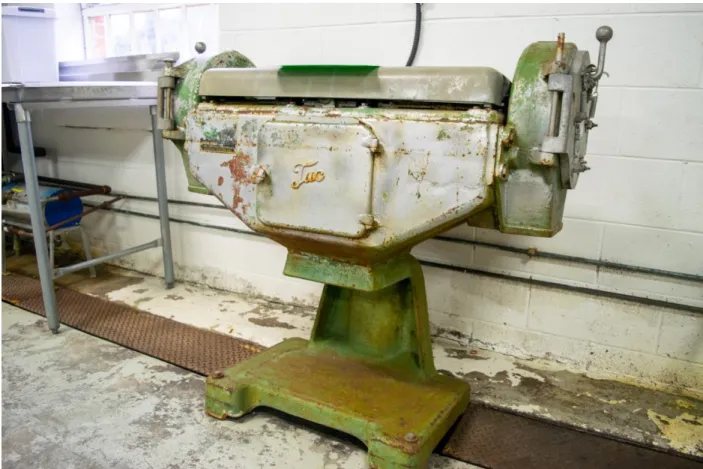
Two windows span the wall behind the kettles, one covered entirely by a large fan that blows outward to help ventilate the steam from cooking, and the second which remains cracked open. A pulper-finisher machine completes the back wall. A juicer, this machine processes cooked tomatoes (getting rid of the skins and seeds, to create silky-smooth tomato soup) and apples for applesauce. The juicer is kept close to the kettles to reduce spillage when produce is moved from one to the other. A hose located along the southeastern wall in the back corner makes it easier to spray down the pulper machine and kettles for cleaning.
The middle two corridors of the cannery are mostly made up of long stainless-steel workbenches for prepping food. Two benches, about two-feet wide by eight-feet long, run from southwest to northwest directly in front of the kettles. There are usually one or two mismatched stools at these benches, but they are rarely used except in the occasional moment of downtime. One of the stools is plain wood with a circular top; a second stool has a brown cushion, rendering it slightly more comfortable. A third stool, usually reserved for more elderly clients, is furnished with a green cushion, and sits lower to the ground. It possesses the additional amenity of a metal back that provides some comfort and relief from standing.
Figure 2.18: Steam kettles along northeastern wall of cannery. Photo by Hannah J. Evans.
Figures 2.19: Back door, storage rack and cooking paddles. Photo by Hannah J. Evans.
Figure 2.20: Pulper/Finisher machine. Photo by Hannah J. Evans.
cracks the skins for peeling and processing. This middle row is finished off with two large stainless-steel benches, again roughly two-feet by eight-feet long, for preparation and processing work.
The next line of equipment in the cannery that lies closest to the southeastern wall of the facility begins with a stainless steel work table near the kettles. Moving back towards the northeastern half of the facility is another tiered metal shelving unit. This unit holds white five-gallon buckets that often get filled up during the cooking process with whatever is coming in and out of the kettles. The shelf also holds all of the lids for the tin cans, and a jar of Sharpies to write on the cans before they go into the pressure cookers. Typically, a can is marked with a patron’s caning identification number, the year, and the type of produce, i.e., “corn, “TS” for tomato soup, or “SS” for spaghetti sauce. Three seamer machines stand to the right of the metal rack.
Service. Hoyt Turner, one of the key developers in the original Farmville High School cannery, would later work for the UGA Agriculture Extension program in the 1940s.
Like the adjacent middle section, the row containing the seamers also ends with two long workbenches, one stainless steel and one with a plastic white cutting board surface. The first two tables in both middle passages, closest to the northeastern half of the facility and the double door entranceway, are usually used for storing personal items like bags and snacks. A thick yellow line on the floor divides the entryway of the facility from the actual prep floor. No open food or drink is allowed beyond the yellow line.
The final and perhaps most important element in the entire canning operation are two four-foot-tall retorts, or large pressure cookers, located along the southeastern wall, followed by two three-foot high by six-foot long black cooling troughs. Both retorts are a deep, oxidized red. Above the retorts, a mechanical pulley system is mounted through the ceiling rafters. The pulley system features a substantial black chain with an iron hook at the end. The hook is used to help maneuver metal buckets made of perforated metal between the retorts and the cooling tubs. After the cans have been filled and seamed, they are loaded into the metal buckets and lowered by pulley system into the retorts, where they are cooked for the appropriate amount of time. On the wall behind the retorts, a processing chart lists all of the proper cook times for any given type of product. The buckets are then transferred to the water baths until the cans are cool enough to handle. In the final step in the process, the canner removes cans from the cool water bath and hand dries each with a dish towel from the stash by the double doors. This ensures that the cans don’t develop rust over time.
Figure 2.21: Wide view of canning floor from Northeastern corner. Photo by Hannah J. Evans.
Figures 2.22: Seamer machine and shelf with five-gallon buckets. Photo by Hannah J. Evans.
Figure 2.24: Retorts and water troughs (view 1). Photo by Hannah J. Evans.
CHAPTER 2: SPACE
Home Canning: Ms. Lena’s Tomato Soup
The cannery as a physical object is enlivened by the work and conversations that move throughout the space. While it is a building with a physical location on the map, it is also an experience beginning with the primary function of canning, and expanding into the dialogue and relationships that transcend the physical boundaries of space. As I write about the enlivened nature of this place, I find myself experiencing a tension between my historical voice, and my ethnographic voice, and my creative nonfiction voice. I have explored various ways of
conveying the story of the Prince Edward County Cannery in my “Introduction” and “Place” sections. The story that I want to tell here emerged as something of a memoir in a distinctly creative nonfiction voice, reiterating to me the importance of anecdotal storytelling as an essential methodology for shaping a full ethnographic and documentary narrative.
By embracing this style of writing, I see my place in this narrative as central, reflecting the summer and fall that I spent in Farmville becoming an active participant and member of the community. As my own engagement with the community became deeper and richer, I found myself increasingly engaging the creative nonfiction voice. I am aware and carefully conscious of the reflexive nature of this kind of storytelling, placing myself as a main actor in a story which I entered less than one year ago. By inserting myself into the story as a participant and narrator, I inherently take some of the power away from my consultant community. I am constantly
experience without neglecting the voices of my consultants who shape life at the cannery and have for many years.
Whenever you spend time conducting any kind of ethnographic research, you quickly find out that there are “kin-keepers” in every community, people who hold a special kind of knowledge that you are constantly being pointed towards to find out the truth about a place. From the moment I began spending time at the cannery, it became readily apparent that “Ms. Lena” Huddleston was one of these community elders. Patty Gulick, the cannery manager, spent the first several weeks of the summer trying to help me track down Ms. Lena, who was at that time living in an assisted living facility in Richmond, to sit down with her and conduct an oral history interview. Unfortunately, due to her failing health, I was unable to meet Ms. Lena. Not meeting Ms. Lena may not have been the worst thing, though, because it reminded me that folklorists too often chase the past when we should be chasing the present. The extent of Ms. Lena’s legacy has become something poetic and ungraspable to me, but at the same time it has been concretely shaped by the present voices of those who knew her well and were able to speak to the way that she influenced the life of the cannery.