Enhanced terminal room disinfection and acquisition and
infection caused by multidrug-resistant organisms and
Clostridium diffi
cile
(the Benefi ts of Enhanced Terminal Room
Disinfection study): a cluster-randomised, multicentre,
crossover study
Deverick J Anderson, Luke F Chen, David J Weber, Rebekah W Moehring, Sarah S Lewis, Patricia F Triplett, Michael Blocker, Paul Becherer, J Conrad Schwab, Lauren P Knelson, Yuliya Lokhnygina, William A Rutala, Hajime Kanamori, Maria F Gergen, Daniel J Sexton; for the CDC Prevention Epicenters Program
Summary
Background Patients admitted to hospital can acquire multidrug-resistant organisms and Clostridium diffi cile from inadequately disinfected environmental surfaces. We determined the eff ect of three enhanced strategies for terminal room disinfection (disinfection of a room between occupying patients) on acquisition and infection due to meticillin-resistant Staphylococcus aureus, vancomycin-meticillin-resistant enterococci, C diffi cile, and multidrug-meticillin-resistant Acinetobacter.
Methods We did a pragmatic, cluster-randomised, crossover trial at nine hospitals in the southeastern USA. Rooms from which a patient with infection or colonisation with a target organism was discharged were terminally disinfected with one of four strategies: reference (quaternary ammonium disinfectant except for C diffi cile, for which bleach was used); UV (quaternary ammonium disinfectant and disinfecting ultraviolet [UV-C] light except for C diffi cile, for which bleach and UV-C were used); bleach; and bleach and UV-C. The next patient admitted to the targeted room was considered exposed. Every strategy was used at each hospital in four consecutive 7-month periods. We randomly assigned the sequence of strategies for each hospital (1:1:1:1). The primary outcomes were the incidence of infection or colonisation withall target organisms among exposed patients and the incidence of C diffi cile infection among exposed patients in the intention-to-treat population. This trial is registered with ClinicalTrials.gov, NCT01579370.
Findings 31 226 patients were exposed; 21 395 (69%) met all inclusion criteria, including 4916 in the reference group, 5178 in the UV group, 5438 in the bleach group, and 5863 in the bleach and UV group. 115 patients had the primary outcome during 22 426 exposure days in the reference group (51·3 per 10 000 exposure days). The incidence of target organisms among exposed patients was signifi cantly lower after adding UV to standard cleaning strategies (n=76; 33·9 cases per 10 000 exposure days; relative risk [RR] 0·70, 95% CI 0·50–0·98; p=0·036). The primary outcome was not statistically lower with bleach (n=101; 41·6 cases per 10 000 exposure days; RR 0·85, 95% CI 0·69–1·04; p=0·116), or bleach and UV (n=131; 45·6 cases per 10 000 exposure days; RR 0·91, 95% CI 0·76–1·09; p=0·303) among exposed patients. Similarly, the incidence of C diffi cile infection among exposed patients was not changed after adding UV to cleaning with bleach (n=38 vs 36; 30·4 cases vs 31·6 cases per 10 000 exposure days; RR 1·0, 95% CI 0·57–1·75; p=0·997).
Interpretation A contaminated health-care environment is an important source for acquisition of pathogens; enhanced terminal room disinfection decreases this risk.
Funding US Centers for Disease Control and Prevention.
Introduction
Multidrug-resistant organisms and Clostridium diffi cile are common causes of health-care-associated infections that lead to adverse patient outcomes.1 The hospital
environ ment may be an important source for trans-mission of these organisms. First, hospitals are con-taminated with clinically important multidrug-resistant organisms and C diffi cile.2 Meticillin-resistant
Staphyl-ococcus aureus (MRSA), vancomycin-resistant enterococci (VRE), and Acinetobacter spp can survive on inanimate surfaces for days, and C diffi cile can survive for months.3
Second, only 50% of surfaces in hospital rooms are suffi ciently cleaned between patient stays.4 As a result,
patients admitted to rooms previously occupied by patients with multidrug-resistant organisms and C diffi cile are at an increased risk of subsequent infection or colonisation with these organisms.5 Finally, the
contaminated environment is an important source of health-care personnel hand contamination.6–8
Terminal room disinfection (disinfection of a room between occupying patients) can be enhanced by using a chemical disinfectant with sporicidal activity or by use of
Lancet 2017; 389: 805–14
Published Online
January 16, 2017 http://dx.doi.org/10.1016/ S0140-6736(16)31588-4
SeeComment page 765
Duke Infection Control Outreach Network, Division of Infectious Diseases (D J Anderson MD, L F Chen MBBS, S S Lewis MD, L P Knelson MSPH, Prof D J Sexton MD), Department of Biostatistics and Bioinformatics (Y Lokhnygina PhD),Duke University Medical Center, Durham, NC, USA; Department of Hospital Epidemiology, University of North Carolina Health Care, Chapel Hill, NC, USA (Prof D J Weber MD, P F Triplett MD, W A Rutala PhD, H Kanamori MD,
M F Gergen MT ASCP); Durham Veterans Affairs Medical Center, Durham, NC, USA (R W Moehring MD); High Point Regional Hospital, High Point, NC, USA (P F Triplett); Alamance Regional Medical Center, Burlington, NC, USA (M Blocker MD); Carolinas Medical Center, Charlotte, NC, USA (M Blocker); Rex Healthcare, Raleigh, NC, USA (P Becherer MD); and Chesapeake Regional Medical Center, Chesapeake, VA, USA (J C Schwab MD)
Correspondence to: Dr Deverick J Anderson, DUMC Box 102359, Durham, NC 27710, USA
supplemental disinfection technologies. However, to our knowledge, no multicentre randomised assessment of enhanced terminal room disinfection strategies has been done.9 We designed the Benefi ts of Enhanced Terminal
Room Disinfection study to assess the eff ects of four diff erent strategies for terminal room disinfection on acquisition of multidrug-resistant organisms and C diffi cile.
Methods
Study design and participants
We did this pragmatic, multicentre, cluster-randomised, crossover trial in nine hospitals in the USA from April, 2012, to July, 2014 (appendix). We tested one of four strategies for terminal room disinfection. Three strategies included enhanced terminal disinfection, and one included the standard terminal disinfection.
These four strategies were used in targeted rooms, defi ned as single-patient rooms from which a patient on contact precautions was discharged or transferred. In the reference group, targeted rooms were disinfected with quaternary ammonium-containing disinfectant for all rooms except those with patients with C diffi cile, in which a hypochlorite-containing disinfectant (bleach) was used. In the UV group, targeted rooms were disinfected with quaternary ammonium-containing disinfectant and a UV-C device except rooms of patients with C diffi cile, in which a bleach-containing disinfectant and UV-C device were used. In the bleach group, a bleach-containing dis-infectant was used in all targeted rooms. In the bleach and UV group, a bleach-containing disinfectant and a UV-C device were used for all targeted rooms.
Each strategy was used at every study hospital for four consecutive 7-month study periods. Each study period consisted of a 1-month wash-in period followed by a 6-month period of data collection. The sequence of
disinfection strategies was randomly selected for each hospital.
We selected study hospitals to include multiple types of hospitals (tertiary, community, Veterans Aff airs) as a convenience sample. All microbiological cultures were considered for inclusion in our outcomes. Cultures may have been representative of infection or colonisation and included surveillance cultures, if obtained by policy at the study hospital. No screening cultures were obtained specifi cally for the study.
The Duke University Health System Institutional Review Board served as the central institutional review board. We received a waiver of informed consent for this study.
Randomisation and masking
We did resource-dependent randomisation of hospitals, taking into account the number of UV devices available (nine). First, we used a random number generator to determine the order in which hospitals would be randomly assigned a disinfection strategy. Then, we used a random number generator to determine the order in which disinfection strategies were used in each hospital. We continued this process for each hospital but counted the number of machines already assigned for other hospitals in each study period. If all nine UV-C devices were already assigned for a period, subsequent hospitals could not be assigned to one of the UV strategies for that period. Ultimately, all hospitals used all four strategies in a 1:1:1:1 ratio (appendix p 9). Allocation was not masked.
Procedures
All hospitals used gown and glove precautions (ie, contact precautions) for patients known or suspected to harbour multidrug-resistant organisms or C diffi cile. Environ men tal services personnel were trained on the appropriate use of the disinfectants, cleaning Research in context
Evidence before this study
The hospital environment is contaminated with
multidrug-resistant organisms and Clostridium diffi cile and is often disinfected inadequately. As a result, patients who enter contaminated hospital rooms are at increased risk for acquisition and infection from these organisms. Enhanced disinfection strategies may decrease the risk for transmission of such bacteria through the hospital environment, but supportive evidence is limited to single centre or quasi-experimental studies. According to a systematic review by Han and colleagues, no randomised multicentre trials have been done to
determine the effi cacy of enhanced strategies.
Added value of this study
Our study is, to our knowledge, the fi rst multicentre randomised controlled trial to evaluate the eff ect of enhanced disinfection strategies on acquisition and infection due to four
target organisms (meticillin-resistant Staphylococcus aureus, vancomycin-resistant staphylococci, multidrug-resistant
Acinetobacter, and C diffi cile). Adding a UV-C device to quaternary ammonium disinfection decreased the risk of subsequent acquisition and infection by target organisms.
Our study shows the effi cacy of enhanced disinfection and
confi rms that the contaminated hospital environment is a modifi able risk factor.
Implications of all the available evidence
Multidrug-resistant organisms and C diffi cile lead to adverse patient outcomes. Novel and improved prevention strategies are needed. Prevention of the spread of these organisms will probably require a multifaceted approach, including enhanced disinfection, improved hand hygiene, and antimicrobial stewardship.
protocols, and UV-C device. The appendix provides information on standardisation of disinfection practices, implementation, and measures of protocol fi delity (appendix pp 1–2).
We did a microbiological analysis of 92 randomly selected seed rooms at two study hospitals to determine the total and average number of colony-forming units of the four target organisms that remained in the hospital room after terminal room disinfection (appendix p 4). Microbiological analyses and identifi cation were done with standard protocols.10 All hospitals used PCR-based
nucleic acid amplifi cation tests to identify C diffi cile throughout the study.
We designed this study to detect infection or colonisation with one of four target organisms: MRSA, VRE, C diffi cile, or multidrug-resistant Acinetobacter.11 A
seed room was defi ned as a room containing a patient with microbiologically proven current or history of infection or colonisation with one or more target organisms. History of infection or colonisation was defi ned as any positive culture within the 12 months before admission. The next patient admitted to the seed room was an exposed patient. Community-onset was defi ned as the isolation of a target organism within the fi rst 48 h of hospital admission. Hospital-acquired was defi ned as the isolation of a target organism after 48 h of hospital admission.
Outcomes
We had two primary outcomes: fi rst, the incidence of all target organisms among patients exposed to seed rooms, and second, the incidence of C diffi cile infection among patients exposed to seed rooms, in the intention-to-treat population. Secondary outcomes were incidence among exposed patients of MRSA, of VRE, and of multidrug-resistant Acinetobacter; incidence in the whole hospital of all target organisms, of MRSA, of VRE, of C diffi cile, and of multidrug-resistant Acinetobacter; and adverse events (rate of UV-C device failure, time on diversion, emergency room wait time, health-care worker perception of cleaning methods, and room turnover time [time between patient discharge and completion of terminal room disinfection]; appendix pp 4–5). Incidence was calculated as the number of qualifying incident cases per 10 000 exposure days. Exposure days were calculated as the number of days the exposed patient spent in the seed room. Patients excluded from the numerator were also excluded from the denominator. Adverse outcomes were assessed at the hospital-level (ie, all patients or rooms were included in the analyses unless otherwise stated).
Three additional predetermined variables were measured at each study hospital: hand hygiene compliance, room cleaning compliance, and colonisation pressure (appendix pp 10–11).12 We obtained demographic
data and comorbid conditions for all exposed patients
314 819 patients with 606 811 room stays in nine hospitals
31 226 room stays where patients were exposed
575 585 rooms not exposed including wash-in periods
7112 exposed patients in reference group
2196 excluded 1453 room stay <24 h
582 community-onset 161 history of
colonisation or infection
4916 eligible for intention-to-treat analysis
4916 eligible for per-protocol analysis
7577 exposed patients in UV group
2399 excluded 1684 room stay <24 h
561 community-onset 154 history of
colonisation or infection
5178 eligible for intention-to-treat analysis
2330 without documented use of UV machine
2848 eligible for per-protocol analysis
7893 exposed patients in bleach group
2455 excluded
1697 room stay <24 h 587 community-onset 171 history of
colonisation or infection
5438 eligible for intention-to-treat analysis
5438 eligible for per-protocol analysis
8644 exposed patients in bleach and UV group
2781 excluded
1807 room stay <24 h 745 community-onset 229 history of
colonisation or infection
5863 eligible for intention-to-treat analysis
2162 without documented use of UV machine
3701 eligible for per-protocol analysis
through administrative databases to calculate Charlson scores.13
We did two post-hoc analyses: (1) of the incidence of target organisms among exposed patients after removing the criteria requiring a minimum of 24 h in the seed room; and (2) of the incidence of target organisms due to vegetative bacteria (MRSA, VRE, and multidrug-resistant Acinetobacter; appendix p 4).
Exposed patients qualifi ed as an incident case of acquisition14 if they met the following criteria: in a seed
room for 24 h or more AND a positive clinical culture or test with one of the target organisms AND the
organism identifi ed in the clinical culture or test was the same target organism isolated from the preceding patient in the seed room AND the positive culture or test was obtained during the index admission either during exposure to the seed room OR the positive culture or test was obtained after exposure to the seed room during the index admission or readmission within 90 days of discharge from the room for MRSA, VRE, and multidrug-resistant Acinetobacter15 or within
28 days of discharge from the room for C diffi cile.16 We
excluded incident cases if they were community-onset infections or the exposed patient had a microbiologically proven history of infection or colonisation with the same target organism during the 12 months before admission.
Statistical analysis
We did power calculations based on a review of 4 years of surveillance data from study hospitals and published literature. All power calculations were done with two-sided signifi cance level of 0·05. We projected that 1·96 million patient-days of care would be provided at the nine study hospitals (after excluding the wash-in periods). For each 6-month intervention period, we projected that approximately 491 200 patient-days of care would occur (distributed across nine participating hospitals). Based on data from our pre-existing surveillance databases, we projected that 959 outcomes due to the four target organisms would occur during the baseline (or reference) 6-month period (ie, with standard terminal room disinfection and no use of UV-C), for a baseline incidence of 1·95 per 1000 patient-days. Under these assumptions, the study would have 60% power to detect a 10% decrease in incidence rate, 92% power to detect a 15% decrease, and more than 99% power to detect a 20% decrease. The power analysis was done using simulation and was based on a Poisson regression model with hospital-level incidence rate as the outcome and disinfection strategy and hospital as the covariates.
All qualifying incident cases were included in the intention-to-treat population. The per-protocol population was identical to the intention-to-treat population for the reference strategy and bleach strategy. For the two strategies involving the UV device, the per-protocol population included qualifying incident cases who entered a seed room with documented use of the UV device. For the purposes of this study, the UV device only had to be turned on, the cycle did not have to be completed. The appendix contains a more detailed discussion of the diff erences between the analysis populations (pp 2–3).
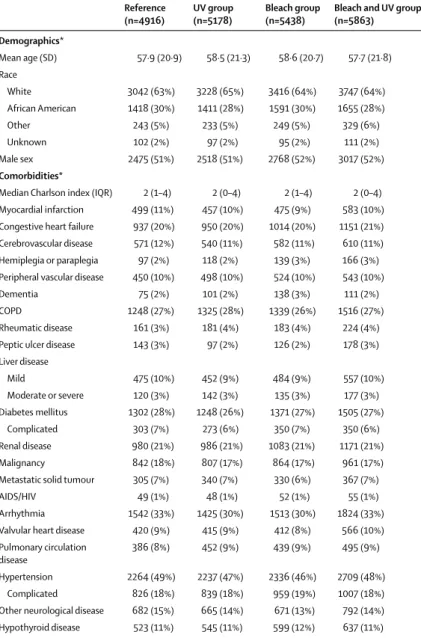
We summarised patient characteristics using per-centages for categorical variables and medians for con-tinuous variables. We analysed outcomes using intention-to-treat and per-protocol principles for out-comes among exposed patients. We analysed incidence rates using overdispersed Poisson models with Reference
(n=4916)
UV group (n=5178)
Bleach group (n=5438)
Bleach and UV group (n=5863)
Demographics*
Mean age (SD) 57·9 (20·9) 58·5 (21·3) 58·6 (20·7) 57·7 (21·8)
Race
White 3042 (63%) 3228 (65%) 3416 (64%) 3747 (64%)
African American 1418 (30%) 1411 (28%) 1591 (30%) 1655 (28%)
Other 243 (5%) 233 (5%) 249 (5%) 329 (6%)
Unknown 102 (2%) 97 (2%) 95 (2%) 111 (2%)
Male sex 2475 (51%) 2518 (51%) 2768 (52%) 3017 (52%)
Comorbidities*
Median Charlson index (IQR) 2 (1–4) 2 (0–4) 2 (1–4) 2 (0–4)
Myocardial infarction 499 (11%) 457 (10%) 475 (9%) 583 (10%)
Congestive heart failure 937 (20%) 950 (20%) 1014 (20%) 1151 (21%) Cerebrovascular disease 571 (12%) 540 (11%) 582 (11%) 610 (11%)
Hemiplegia or paraplegia 97 (2%) 118 (2%) 139 (3%) 166 (3%)
Peripheral vascular disease 450 (10%) 498 (10%) 524 (10%) 543 (10%)
Dementia 75 (2%) 101 (2%) 138 (3%) 111 (2%)
COPD 1248 (27%) 1325 (28%) 1339 (26%) 1516 (27%)
Rheumatic disease 161 (3%) 181 (4%) 183 (4%) 224 (4%)
Peptic ulcer disease 143 (3%) 97 (2%) 126 (2%) 178 (3%)
Liver disease
Mild 475 (10%) 452 (9%) 484 (9%) 557 (10%)
Moderate or severe 120 (3%) 142 (3%) 135 (3%) 177 (3%)
Diabetes mellitus 1302 (28%) 1248 (26%) 1371 (27%) 1505 (27%)
Complicated 303 (7%) 273 (6%) 350 (7%) 350 (6%)
Renal disease 980 (21%) 986 (21%) 1083 (21%) 1171 (21%)
Malignancy 842 (18%) 807 (17%) 864 (17%) 961 (17%)
Metastatic solid tumour 305 (7%) 340 (7%) 330 (6%) 367 (7%)
AIDS/HIV 49 (1%) 48 (1%) 52 (1%) 55 (1%)
Arrhythmia 1542 (33%) 1425 (30%) 1513 (30%) 1824 (33%)
Valvular heart disease 420 (9%) 415 (9%) 412 (8%) 566 (10%)
Pulmonary circulation disease
386 (8%) 452 (9%) 439 (9%) 495 (9%)
Hypertension 2264 (49%) 2237 (47%) 2336 (46%) 2709 (48%)
Complicated 826 (18%) 839 (18%) 959 (19%) 1007 (18%)
Other neurological disease 682 (15%) 665 (14%) 671 (13%) 792 (14%)
Hypothyroid disease 523 (11%) 545 (11%) 599 (12%) 637 (11%)
Data are n (%) unless stated otherwise. *The majority of patient-specifi c data were not available from one study hospital because of changes in electronic health record systems as follows: age (406 had data missing), race (428 missing), sex (407 missing), comorbidity data (1267 missing). COPD=chronic obstructive pulmonary disease.
disinfection group (reference, UV, bleach, and bleach and UV), order of the strategies within the study (whether a particular strategy was used in the fi rst, second, third, or fourth study period), and hospital as fi xed-eff ect categorical covariates. We used generalised estimating equations to account for correlation between diff erent study strategies within the same hospital. Each of the study groups was compared to the reference group except for the analysis of C diffi cile among exposed patients. Because this comparison involved the comparison of bleach vs bleach and UV-C, results from the UV group and the bleach and UV group were compared to results from the reference group and the bleach group. We used the same model construction strategy for all outcome analyses. We calculated relative risk (RR), 95% CIs, and risk reductions for each model. Statistical tests were
done at a two-sided signifi cance level of 0·05. In light of the pragmatic nature of the trial, we made no adjustments for multiple comparisons. We did all statistical analyses using SAS (version 9.4).
The study is registered on ClinicalTrials.gov (NCT01579370).
Role of the funding source
The funder served an advisory role in the development of the study protocol. All authors had full access to all data in the study and had fi nal responsibility for the decision to submit for publication.
Results
All nine hospitals participated in the study from April, 2012, to July, 2014. The appendix shows the
Reference UV group Bleach group Bleach and UV group
All target organisms
Exposed patients 4916 5178 5438 5863
Incident cases (%) 115 (2·3%) 76 (1·5%) 101 (1·9%) 131 (2·2%)
Exposure days 22 426 22 389 24 261 28 757
Rate (per 10 000 exposure-days) 51·3 33·9 41·6 45·6
Risk reduction (95% CI) Reference 17·4 (5·8 to 28·9) 9·7 (–2·7 to 22·0) 5·7 (–6·2 to 17·7)
RR (95% CI); p value Reference 0·70 (0·50 to 0·98); 0·036 0·85 (0·69 to 1·04); 0·116 0·91 (0·76 to 1·09); 0·303
Clostridium diffi cile*
Exposed patients ·· ·· 2499 2678
Incident cases (%) ·· ·· 36 (1·4%) 38 (1·4%)
Exposure days ·· ·· 11 385 12 509
Rate (per 10 000 exposure-days) ·· ·· 31·6 30·4
Risk reduction (95% CI) ·· ·· Reference 1·2 (–12·7 to 15·2)
RR (95% CI); p value ·· ·· Reference 1·0 (0·57 to 1·75); 0·997
Meticillin-resistant Staphylococcus aureus
Exposed patients 3300 3451 3631 3848
Incident cases (%) 73 (2·2%) 54 (1·6) 74 (2·0) 89 (2·3)
Exposure days 14 524 14 780 15 343 18 960
Rate (per 10 000 exposure-days) 50·3 36·5 48·2 46·9
Risk reduction (95% CI) Reference 13·8 (0·1 to 27·3) 2·1 (–13·8 to 17·8) 3·4 (–8·9 to 15·5)
RR (95% CI); p value Reference 0·78 (0·58 to 1·05); 0·104 1·00 (0·82 to 1·21); 0·967 0·97 (0·78 to 1·22); 0·819
Vancomycin-resistant enterococci
Exposed patients 1055 1206 1468 1753
Incident cases (%) 37 (3·5%) 17 (1·4%) 24 (1·6%) 37 (2·1%)
Exposure days 5838 5780 7522 9488
Rate (per 10 000 exposure-days) 63·4 29·4 31·9 39·0
Risk reduction (95% CI) Reference 34·0 (9·3 to 58·6) 31·5 (12·7 to 50·2) 24·4 (0·5 to 48·2)
RR (95% CI); p-value Reference 0·41 (0·15 to 1·13); 0·084 0·43 (0·19 to 1·00); 0·049 0·36 (0·18 to 0·70); 0·003
Multidrug-resistant Acinetobacter†
Exposed patients 31 47 28 62
Incident cases (%) 0 0 1 (3·6) 0
Exposure days 156 199 98 244
Rate (per 10 000 exposure-days) 0 0 102·4 0
RR=relative risk. *Rooms with patients known or suspected of having C diffi cile infection were terminally cleaned with bleach-containing solutions in all study disinfection strategies. †We created no models for multidrug-resistant Acinetobacter because only one outcome occurred in the nine study hospitals across all four study groups.
randomised assignment for each hospital (p 13). The average cluster size was 7807 (SD 644) patients. 31 226 patients were exposed to a seed room; 24 585 (79%) stayed in the seed room for 24 h or more, and 21 395 (69%) met all inclusion criteria (fi gure). Baseline characteristics of qualifying exposed patients were similar for all four cleaning strategies (table 1).
A total of 423 outcomes were recorded: 228 (54%) cultures represented infection and 195 (46%) represented colonisation. 115 patients had a primary outcome during 22 426 exposure days during the reference period (51·3 per 10 000 exposure days); the median incidence of target organisms in the baseline period per hospital was 37·1 per 10 000 exposure days (range 17·5–101·6). The addition of a UV-C device to the standard disinfection strategy signifi cantly decreased the incidence of target organisms to 33·9 per 10 000 exposure-days (n=76; RR 0·70, 95% CI 0·50–0·98; p=0·036; table 2; appendix
p 14). The incidence of target organisms was lower in eight of the nine study hospitals in the UV group (appendix p 15).
There was no signifi cant diff erence in the incidence of target organisms from rooms treated with bleach compared with reference (table 2). Similarly, there was no signifi cant diff erence between use of bleach and UV compared with reference (table 2). The appendix shows outcomes from individual study hospitals by intention to treat for each disinfection strategy (p 7).
The incidence of C diffi cile was not signifi cantly diff erent with or without UV-C devices (table 2). The incidence of MRSA was not signifi cantly lower in the UV group and essentially unchanged in the bleach and bleach and UV groups (table 2). The incidence of VRE was not signifi cantly lower in the UV group but was signifi cantly lower in both groups that used a bleach-containing disinfectant (table 2). The use of bleach decreased the incidence of VRE by 57% Reference group UV group Bleach group Bleach and UV group
All target organisms
Exposed patients 4916 2848 5438 3701
Incident cases (%) 115 (2·3%) 46 (1·6%) 101 (1·9%) 93 (2·5%)
Exposure days 22 426 12 299 24 261 17 354
Rate (per 10 000 exposure-days) 51·3 37·4 41·6 53·6
Risk reduction (95% CI) Reference 13·9 (–0·1 to 27·9) 9·7 (–2·7 to 22·0) –2·3 (–15·7 to 11·1)
RR (95% CI); p value Reference 0·69 (0·50 to 0·95); 0·025 0·74 (0·61 to 0·91); 0·004 1·0 (0·81 to 1·23); 1·00
Clostridium diffi cile*
Exposed patients ·· ·· 2499 1712
Incident cases (%) ·· ·· 36 (1·4%) 30 (1·8%)
Exposure days ·· ·· 11 385 8015
Rate (per 10 000 exposure-days) ·· ·· 31·6 37·4
Risk reduction (95% CI) ·· ·· Reference –5·8 (–17·1 to 5·5)
RR (95% CI); p value ·· ·· Reference 1·22 (0·68 to 2·17); 0·511
Meticillin-resistant Staphylococcus aureus
Exposed patients 3300 1872 3631 2425
Incident cases (%) 73 (2·2%) 28 (1·5%) 74 (2·0%) 63 (2·6%)
Exposure days 14 525 7934 15 343 10 681
Rate (per 10 000 exposure-days) 50·3 35·3 48·2 59·0
Risk reduction (95% CI) Reference 15·0 (–0·6 to 30·6) 2·1 (–13·8 to 17·8) –8·7 (–18·0 to 0·5)
RR (95% CI); p value Reference 0·67 (0·48 to 0·94); 0·019 0·89 (0·72 to 1·09); 0·260 1·09 (0·85 to 1·39); 0·503
Vancomycin-resistant enterococci
Exposed patients 1055 659 1468 1134
Incident cases (%) 37 (3·5%) 13 (2·0%) 24 (1·6%) 24 (2·1%)
Exposure days 5838 3265 7522 6237
Rate (per 10 000 exposure-days) 63·4 39·8 31·9 38·5
Risk reduction (95% CI) Reference 23·6 (–6·1 to 53·2) 31·5 (12·7 to 50·2) 24·9 (–0·6 to 50·4)
RR (95% CI); p value Reference 0·56 (0·21 to 1·50); 0·248 0·35 (0·16 to 0·78); 0·010 0·41 (0·22 to 0·77); 0·006
Data are unchanged for multidrug-resistant Acinetobacter baumaunii (table 2). *Rooms with patients known or suspected of having C diffi cile infection were terminally cleaned with hypochlorite-containing solutions.
compared to reference; the use of bleach and a UV-C device decreased incidence of VRE by 64% (table 2). Only one patient acquired multidrug-resistant Acinetobacter after exposure in a seed room. Thus, no comparisons or models were constructed for this organism.
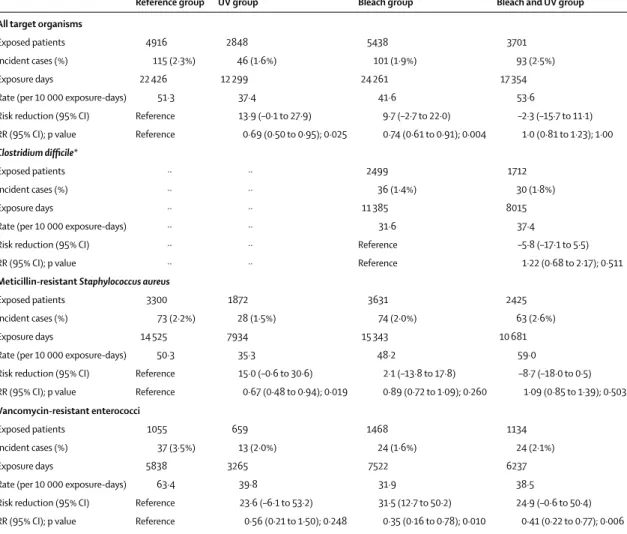
2848 (55%) of 5178 eligible rooms in the UV group and 3701 (63%) of 5863 eligible of rooms in the bleach and UV group were included in the per-protocol analyses. Eff ect estimates were generally similar in per-protocol analyses to the intention-to-treat analyses (table 3). The incidence of MRSA, however, was signifi cantly lower in the UV group compared with the reference group (table 3).
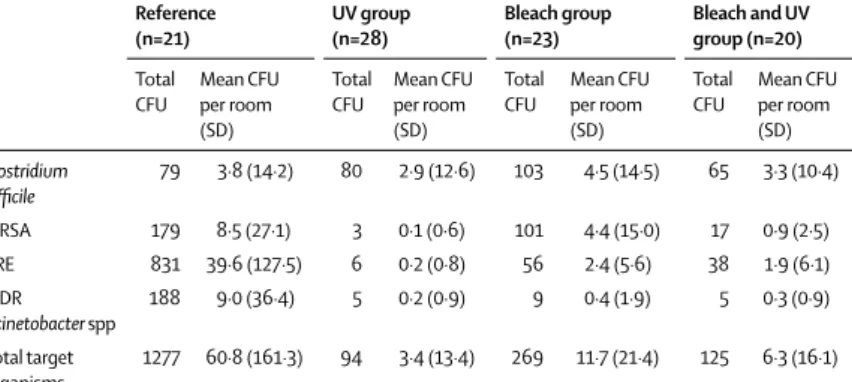
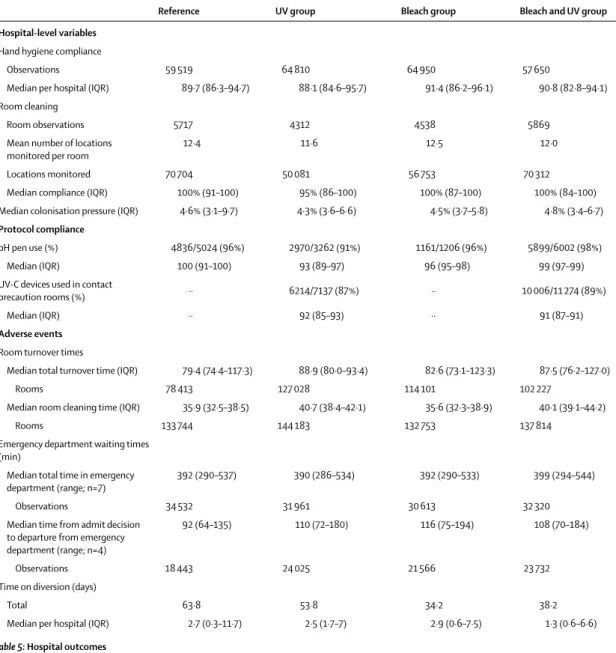
Our microbiological assessment of 92 seed rooms after terminal disinfection showed that all enhanced strategies decreased the bioburden of target organisms, but the largest decrease occurred in the UV group (table 4). Protocol compliance, hand hygiene compliance, cleaning compliance, and colonisation pressure were similar across study groups (table 5; appendix p 4).
The median room cleaning time was approximately 4 min longer in the UV and UV and bleach groups (table 5). The total wait time in the emergency department and days on diversion were unchanged across disinfection strategies. Time from admit decision to departure from the emergency department was approximately 10–20 min longer in each of the enhanced disinfection groups compared with the reference group. One hospital reported a single UV-C exposure event during the study (appendix p 5). Additional secondary analyses, including incidence in the whole hospital of all target organisms, of MRSA, of VRE, of C diffi cile, and of multidrug-resistant Acinetobacter, and health-care worker perception of cleaning methods, will be presented elsewhere.
We did two post-hoc analyses (appendix p 9). First, removing the 24-h exposure requirement for exposed patients did not change the eff ect measures. Second, after excluding patients admitted to C diffi cile seed rooms, the decrease in incidence of target vegetative multidrug-resistant organisms was strengthened in the UV group and signifi cantly lower in the bleach and UV group.
Discussion
Our large, prospective, multicentre, cluster-randomised trial is the fi rst, to our knowledge, to demonstrate a decrease in acquisition and infection with epidemio-logically important pathogens following the use of enhanced room disinfection strategies. Patients admitted to rooms previously occupied by patients harbouring a multidrug-resistant organism or C diffi cile were 10–30% less likely to acquire the same organism if the room was terminally disinfected using an enhanced strategy. The largest risk reduction occurred when a UV-C device was added to the standard disinfectant strategy. By contrast, we showed no statistically signifi cant decrease in outcomes when we used enhanced terminal disinfection with bleach or bleach and UV. Similarly, the incidence of
C diffi cile infection was not diff erent among exposed patients after adding UV to bleach disinfection.
Our results need to be interpreted in the appropriate context. First, decreases in acquisition of target organisms associated with the use of enhanced dis-infection strategies were recorded even though our reference group was also an enhanced strategy of sorts. Overall compliance with thoroughness of cleaning in the reference group was roughly 90%. By contrast, most previous studies conclude that approximately half of all hospital room surfaces are not cleaned during terminal cleaning.4 Improved cleaning compliance decreases
environmental bioburden17 and risk of acquisition,
particularly of MRSA and VRE.18,19 Second, in the
reference group, the quaternary ammonium-containing disinfectant was delivered with microfi bre cloths, which remove more bacteria than cotton and synthetic fi bre cloths.20 Third, the enhanced nature of the reference
group and lack of multidrug-resistant Acinetobacter outcomes probably led to a decrease in power. Thus, the absence of a decrease in the incidence of target organisms among exposed patients in the bleach and bleach and UV groups might have been related to type II error.
No randomised controlled trials have previously been done using a UV device or enhanced chemical dis infectant. To our knowledge, only one other randomised controlled trial has investigated an enhanced terminal room disinfection strategy. A hydrogen peroxide vapour system was evaluated over 30 months in six high-risk units in a single tertiary care centre.21 Patients in intervention units
had a 64% decrease in acquisition of multidrug-resistant organisms and C diffi cile and a 75% decrease in acquisition of VRE compared to patients in control units.
UV devices reduce the environmental bioburden of MRSA, VRE, C diffi cile, and Acinetobacter spp.10,22 Of four
published studies on the clinical eff ectiveness of UV devices, one showed a 20% decrease in hospital-acquired multidrug-resistant organisms23 and three showed
22–53% decreases in C diffi cile infection.24–26 In light of Reference
(n=21)
UV group (n=28)
Bleach group (n=23)
Bleach and UV group (n=20)
Total CFU
Mean CFU per room (SD)
Total CFU
Mean CFU per room (SD)
Total CFU
Mean CFU per room (SD)
Total CFU
Mean CFU per room (SD)
Clostridium
diffi cile
79 3·8 (14·2) 80 2·9 (12·6) 103 4·5 (14·5) 65 3·3 (10·4)
MRSA 179 8·5 (27·1) 3 0·1 (0·6) 101 4·4 (15·0) 17 0·9 (2·5)
VRE 831 39·6 (127·5) 6 0·2 (0·8) 56 2·4 (5·6) 38 1·9 (6·1)
MDR Acinetobacter spp
188 9·0 (36·4) 5 0·2 (0·9) 9 0·4 (1·9) 5 0·3 (0·9)
Total target organisms
1277 60·8 (161·3) 94 3·4 (13·4) 269 11·7 (21·4) 125 6·3 (16·1)
MRSA=meticillin-resistant Staphylococcus aureus. VRE=vancomycin-resistant enterococci. MDR=multidrug-resistant. CFU=colony-forming units.
these results, we were surprised by the lack of change in rates of C diffi cile among exposed patients. This lack of change might have been caused by the following factors. First, the reference group for our C diffi cile-specifi c outcome involved the use of bleach. As we had high (around 90%) compliance with the use of bleach, there may have been relatively few residual spores for the UV device to eliminate.17 Second, UV is less eff ective against C diffi cile
than against vegetative bacteria, especially in areas of shadow.10,22 Third, we used a single-stage cycle with the
UV-C device placed adjacent to but outside of the bathroom.27 Thus, we may not have eff ectively eliminated
C diffi cile from bathrooms. Finally, the environment might not play as large a role in C diffi cile transmission as previously suspected.28 Eyre and colleagues29 assessed
1250 cases of symptomatic C diffi cile in Oxfordshire, UK, over a 4-year period using whole genome sequencing and reported that 45% of C diffi cile cases were genetically distinct from previous cases. Although this analysis did not consider asymptomatic colonisation, only 2% of patients with related C diffi cile isolates were linked by possible environmental con tamination. Our post-hoc analysis excluding patients exposed to C diffi cile showed that the eff ect in the UV group was strengthened and the eff ect in the bleach and UV group became statistically signifi cant.
To our knowledge, no other randomised controlled trials have assessed the eff ect of using a sporicidal disinfectant on the incidence of our target organisms. Grabsch and colleagues30 recorded a 67% decrease in
acquisition of VRE and an 83% decrease in VRE
Reference UV group Bleach group Bleach and UV group
Hospital-level variables
Hand hygiene compliance
Observations 59 519 64 810 64 950 57 650
Median per hospital (IQR) 89·7 (86·3–94·7) 88·1 (84·6–95·7) 91·4 (86·2–96·1) 90·8 (82·8–94·1)
Room cleaning
Room observations 5717 4312 4538 5869
Mean number of locations monitored per room
12·4 11·6 12·5 12·0
Locations monitored 70 704 50 081 56 753 70 312
Median compliance (IQR) 100% (91–100) 95% (86–100) 100% (87–100) 100% (84–100)
Median colonisation pressure (IQR) 4·6% (3·1–9·7) 4·3% (3·6–6·6) 4·5% (3·7–5·8) 4·8% (3·4–6·7)
Protocol compliance
pH pen use (%) 4836/5024 (96%) 2970/3262 (91%) 1161/1206 (96%) 5899/6002 (98%)
Median (IQR) 100 (91–100) 93 (89–97) 96 (95–98) 99 (97–99)
UV-C devices used in contact
precaution rooms (%) ·· 6214/7137 (87%) ·· 10 006/11 274 (89%)
Median (IQR) ·· 92 (85–93) ·· 91 (87–91)
Adverse events
Room turnover times
Median total turnover time (IQR) 79·4 (74·4–117·3) 88·9 (80·0–93·4) 82·6 (73·1–123·3) 87·5 (76·2–127·0)
Rooms 78 413 127 028 114 101 102 227
Median room cleaning time (IQR) 35·9 (32·5–38·5) 40·7 (38·4–42·1) 35·6 (32·3–38·9) 40·1 (39·1–44·2)
Rooms 133 744 144 183 132 753 137 814
Emergency department waiting times (min)
Median total time in emergency department (range; n=7)
392 (290–537) 390 (286–534) 392 (290–533) 399 (294–544)
Observations 34 532 31 961 30 613 32 320
Median time from admit decision to departure from emergency department (range; n=4)
92 (64–135) 110 (72–180) 116 (75–194) 108 (70–184)
Observations 18 443 24 025 21 566 23 732
Time on diversion (days)
Total 63·8 53·8 34·2 38·2
Median per hospital (IQR) 2·7 (0·3–11·7) 2·5 (1·7–7) 2·9 (0·6–7·5) 1·3 (0·6–6·6)
bacteraemia with use of bleach. Results from the intention-to-treat analysis in our trial did not show a signifi cant decrease in the incidence of target organisms following the routine use of bleach for terminal disinfection of contact precaution rooms. Results from a prespecifi ed secondary analysis, however, validate the decrease in VRE reported by Grabsch and colleagues. Our clinical results were largely corroborated by our microbiological assessment of seed rooms after terminal disinfection; greater reductions in colony-forming units occurred in the UV group than in the bleach and UV and bleach groups.
Our study has limitations. First, we relied on clinical cultures obtained during the course of standard care, which might have introduced ascertainment bias. Clinicians might have changed their culturing practices during the course of the study. Additionally, because we did not screen seed patients with a history of infection or colonisation or all exposed patients on exit from the seed rooms, we did not capture all acquisitions, might have failed to exclude a patient with community-onset colonisation, and our denominators might have included extra exposure days. We doubt, however, that any of these scenarios aff ected our results given randomisation. Second, we did not do molecular analyses to confi rm that the organisms included in our outcomes were related to organisms in the environment, as this task was impossible given the scope of our study. Third, we did not account for multiplicity in our statistical testing given the pragmatic nature of our study; thus, the p values generated from our analyses should be interpreted with caution. Fourth, as noted above, our study had an enhanced reference group and thus decreased power. As a result, we suspect the eff ect measures in our study represent minimum eff ects of these strategies. Finally, our intervention was directed towards three multidrug-resistant organisms and C diffi cile. We suspect that enhanced terminal room disinfection strategies decrease risk of acquisition of non-multidrug-resistant organisms, such as meticillin-susceptible S aureus and vancomycin-susceptible enterococci.
Acquisition and infection with multidrug-resistant organisms and C diffi cile in health care is a complex and multi faceted process. Our study suggests that (1) the health-care environment is an important source for acquisition of multidrug-resistant organisms and C diffi cile, and (2) the risk of acquisition of these patho-gens from the environment can be modifi ed. More than a century after Semmelweis and Lister’s landmark studies, our results suggest that methods to improve disinfection can still lead to better patient outcomes.
Contributors
DJA did the literature search, prepared the fi gures, designed the study, collected, analysed, and interpreted data, wrote the Article, and approved the fi nal version. LFC, DJW, RWM, SSL, WAR, and DJS designed the study, collected and interpreted data, revised the Article, and approved the fi nal version. PFT, MB, PB, JCS, LPK, HK, and MGT collected data, revised the Article, and approved the fi nal version. YL analysed and interpreted data, revised the Article, and approved the fi nal version.
Declaration of interests
WAR and DJW have received consulting fees from Clorox. The other authors declare no competing interests.
Acknowledgments
Supported by grants from the CDC Prevention Epicenters Program (U54CK000164, to DJS), the NIH/NIAID (K23AI095357, to DJA), and the National Center for Advancing Translational Sciences, NIH (UL1TR001111). The views expressed in this Article are those of the authors and do not necessarily represent the views of the CDC or NIH. We thank Joyce Frederick for her signifi cant contributions to this study. We also thank the following for their contributions to the successful completion of this study: Alamance Regional Medical Center—Mike Gover, Ron Halleen, Jean Keck, Melba Phillips, Clea Pulliam, Cameron Satterfi eld, Ashlei Williamson, Sara Wall; Chesapeake Regional Medical Center—Cynthia Boydston, Melanie Buski, Rollyn Cartwright, Joleen Connor, Monica Fuller, Larry Hires, Allison Johnson, Amie Prado, Arnell Pugh, Billy Richmond, Barbara Shields, Monita Short, Tiff any Silmon, Scavellas Slater, Mary Summerlin, Tammy Von Moll, Elizabeth Wade; Duke Raleigh Hospital—Linda Alford, Donald Brown, Kim Catron, Connie Clark, Glenda Debord, Tammy Green, Neal Seigler, Kathryn Whitfi eld, Brittain Wood; Duke Regional Hospital— Kint Greenhouse, Mary Justesen, Cameron Satterfi eld, James Sessoms, Laura Smith, Vicki Tutor, Joy Vollers, James Walker; Duke University Hospital—Orlando Ackerson, Demario Harris, Pam Isaacs, Judith Megelich, Christopher O’Connor, Ornella Stewart, Christopher Vogelheim, Jessica Vondy; Durham Veterans Aff airs Medical Center—Ben Blount, Joel Boggan, Orlando Brown, James Bunn, Dwayne Hicks, Sara Hoff man, William Hubbell, Steve McLeod, Mike Mejia, Larry Park, Jeff rey Robinson,
Susan Wilkins, Roger Walsh, Christopher Woods; High Point Regional Hospital—Angelina Drews, Rocky Jameson, Judy Pemberton, Jennifer Pridgen, Cherrie Speagle, Barbara Tillman; Rex Healthcare— Sean Agard, Jeff rey Agricola, Joe Brown, Vicki Clark, Marty Cooney, Aku Fudzie, Zoe Gjertson, Debra Harris, Christopher Riley; University of North Carolina Health Care—Katie Crandall, Lula Daniels, Lauren DiBase, Sherie Goldbach, Kimberly Green, Kandi Herndon, Lori Osborne, Emily Pfaff , Orlando Reyes, Emily Sickbert-Bennett, Jeff Strickler, Jason Smith. We acknowledge TruD SmartUVC, Ecolab, and Clorox for their signifi cant material contributions to the study. We also thank Angelica Corporation and Shared Linen Services, each for donating microfi bre cloths to a study hospital. All of these companies provided materials for the completion of the study but played no role in the funding, design, analysis, or manuscript preparation.
References
1 Tackling drug-resistant infections globally: fi nal report and recommendations. 2016. http://amr-review.org/sites/default/ fi les/160525_Final%20paper_with%20cover.pdf (accessed June 1, 2016).
2 Dancer SJ. Importance of the environment in meticillin-resistant Staphylococcus aureus acquisition: the case for hospital cleaning. Lancet Infect Dis 2008; 8: 101–13.
3 Kramer A, Schwebke I, Kampf G. How long do nosocomial
pathogens persist on inanimate surfaces? A systematic review. BMC Infect Dis 2006; 6: 130.
4 Carling PC, Parry MM, Rupp ME, Po JL, Dick B, Von Beheren S.
Improving cleaning of the environment surrounding patients in 36 acute care hospitals. Infect Control Hosp Epidemiol 2008; 29: 1035–41.
5 Mitchell BG, Dancer SJ, Anderson M, Dehn E. Risk of organism
acquisition from prior room occupants: a systematic review and meta-analysis. J Hosp Infect 2015; 91: 211–27.
6 Guerrero DM, Nerandzic MM, Jury LA, Jinno S, Chang S,
Donskey CJ. Acquisition of spores on gloved hands after contact with the skin of patients with Clostridium diffi cile infection and with environmental surfaces in their rooms. Am J Infect Control 2012; 40: 556–58.
7 Hayden MK, Blom DW, Lyle EA, Moore CG, Weinstein RA. Risk of
8 Stiefel U, Cadnum JL, Eckstein BC, Guerrero DM, Tima MA, Donskey CJ. Contamination of hands with methicillin-resistant Staphylococcus aureus after contact with environmental surfaces and after contact with the skin of colonized patients.
Infect Control Hosp Epidemiol 2011; 32: 185–87.
9 Han JH, Sullivan N, Leas BF, Pegues DA, Kaczmarek JL,
Unscheid CA. Cleaning hospital room surfaces to prevent health care-associated infections: a technical brief. Ann Intern Med 2015; 163: 598–607.
10 Anderson DJ, Gergen MF, Smathers E, et al. Decontamination of targeted pathogens from patient rooms using an automated ultraviolet-C-emitting device. Infect Control Hosp Epidemiol 2013; 34: 466–71.
11 Magiorakos AP, Srinivasan A, Carey RB, et al. Multidrug-resistant, extensively drug-resistant and pandrug-resistant bacteria: an international expert proposal for interim standard defi nitions for acquired resistance. Clin Microbiol Infect 2012; 18: 268–81. 12 Bonten MJ, Slaughter S, Ambergen AW, et al. The role of
“colonization pressure” in the spread of vancomycin-resistant enterococci: an important infection control variable. JAMA Intern Med 1998; 158: 1127–32.
13 Deyo RA, Cherkin DC, Ciol MA. Adapting a clinical comorbidity index for use with ICD-9-CM administrative databases. J Clin Epidemiol 1992; 45: 613–19.
14 Huang SS, Rifas-Shiman SL, Warren DK, et al. Improving methicillin-resistant Staphylococcus aureus surveillance and reporting in intensive care units. J Infect Dis 2007; 195: 330–38. 15 Avery TR, Kleinman KP, Klompas M, Aschengrau A, Huang SS.
Inclusion of 30-day postdischarge detection triples the incidence of hospital-onset methicillin-resistant Staphylococcus aureus. Infect Control Hosp Epidemiol 2012; 33: 114–21.
16 McDonald LC, Coignard B, Dubberke E, Song X, Horan T, Kutty PK. Recommendations for surveillance of Clostridium diffi cile-associated disease. Infect Control Hosp Epidemiol 2007; 28: 140–45.
17 Eckstein BC, Adams DA, Eckstein EC, et al. Reduction of Clostridium diffi cile and vancomycin-resistant Enterococcus contamination of environmental surfaces after an intervention to improve cleaning methods. BMC Infect Dis 2007; 7: 61. 18 Datta R, Platt R, Yokoe DS, Huang SS. Environmental cleaning
intervention and risk of acquiring multidrug-resistant organisms from prior room occupants. JAMA Intern Med 2011; 171: 491–94. 19 Hayden MK, Bonten MJ, Blom DW, Lyle EA, van de Vijver DA, Weinstein RA. Reduction in acquisition of vancomycin-resistant enterococcus after enforcement of routine environmental cleaning measures. Clin Infect Dis 2006; 42: 1552–60.
20 Smith DL, Gillanders S, Holah JT, Gush C. Assessing the effi cacy of diff erent microfi bre cloths at removing surface micro-organisms associated with healthcare-associated infections. J Hosp Infect 2011; 78: 182–86.
21 Passaretti CL, Otter JA, Reich NG, et al. An evaluation of environmental decontamination with hydrogen peroxide vapor for reducing the risk of patient acquisition of multidrug-resistant organisms. Clin Infect Dis 2013; 56: 27–35.
22 Rutala WA, Gergen MF, Weber DJ. Room decontamination with UV radiation. Infect Control Hosp Epidemiol 2010; 31: 1025–29. 23 Haas JP, Menz J, Dusza S, Montecalvo MA. Implementation and
impact of ultraviolet environmental disinfection in an acute care setting. Am J Infect Control 2014; 42: 586–90.
24 Levin J, Riley LS, Parrish C, English D, Ahn S. The eff ect of portable pulsed xenon ultraviolet light after terminal cleaning on hospital-associated Clostridium diffi cile infection in a community hospital. Am J Infect Control 2013; 41: 746–48.
25 Miller R, Simmons S, Dale C, Stachowiak J, Stibich M. Utilization and impact of a pulsed-xenon ultraviolet room disinfection system and multidisciplinary care team on Clostridium diffi cile in a long-term acute care facility. Am J Infect Control 2015; 43: 1350–53. 26 Nagaraja A, Visintainer P, Haas JP, Menz J, Wormser GP,
Montecalvo MA. Clostridium diffi cile infections before and during use of ultraviolet disinfection. Am J Infect Control 2015; 3: 940–45. 27 Boyce JM, Havill NL, Moore BA. Terminal decontamination of
patient rooms using an automated mobile UV light unit. Infect Control Hosp Epidemiol 2011; 32: 737-42.
28 Walker AS, Eyre DW, Wyllie DH, et al. Characterisation of Clostridium diffi cile hospital ward-based transmission using extensive epidemiological data and molecular typing. PLoS Med 2012; 9: e1001172.
29 Eyre DW, Cule ML, Wilson DJ, et al. Diverse sources of C. diffi cile infection identifi ed on whole-genome sequencing. N Engl J Med 2013; 369: 1195–205.