PERFORMANCE REVIEW UNIT
Total Factor Productivity of European Air
Navigation Services Providers:
Basic Concepts and Empirical Application
Prepared by the Performance Review Unit (PRU) in
collaboration with Dr Christian Bontemps (CENA & LEEA)
Final Version
September 2005
EUROCONTROL
This Technical Note is produced by the Performance Review Unit (PRU) in collaboration with Dr. Christian Bontemps from the Centre d’Etude de la Navigation Aérienne (CENA) and the Laboratoire d’Economie et d’Econométrie de l’Aérien (LEEA). This collaboration was facilitated by the French Civil Aviation Authority, Direction de la Navigation Aérienne (DNA).
The PRU was established in 1998 to support the Performance Review Commission (PRC) in its task of helping to “ensure the effective management of the European ATM system through a strong, transparent and independent performance review and target-setting system”.
The PRU’s e-mail address is [email protected]
The PRC’s website address is http://www.eurocontrol.int/prc
NOTICE
The PRU has made every effort to ensure that the information and analysis contained in this document are as accurate and complete as possible.
Should you find any errors or inconsistencies we would be grateful if you could bring them to the PRU’s attention.
COPYRIGHT NOTICE AND DISCLAIMER
© European Organisation for the Safety of Air Navigation (EUROCONTROL) EUROCONTROL, 96, rue de la Fusée, B-1130 Brussels, Belgium
http://www.eurocontrol.int
EUROCONTROL
This document is published in the interest of the exchange of information and may be copied in whole or in part providing that the copyright notice and disclaimer are included. The information contained in this document may not be modified without prior written permission from the Performance Review Unit. The views expressed herein do not necessarily reflect the official views or policy of EUROCONTROL, which makes no warranty, either implied or express, for the information contained in this document, neither does it assume any legal liability or responsibility for the accuracy, completeness or usefulness of this information.
DOCUMENT IDENTIFICATION SHEET
DOCUMENT DESCRIPTION
Document Title
Total Factor Productivity of European Air Navigation Services Providers: Basic Concepts and Empirical Application
DOCUMENT REFERENCE EDITION: EDITION DATE:
PRU Technical Note – 01/2005 Final Version September 2005
ABSTRACT
This note presents the methodology used to measure the Total Factor Productivity (TFP) of European Air Navigation Service Providers (ANSPs). Several inputs and outputs are defined and selected for the purposes of computing multilateral output and input indexes associated with the provision of ATM/CNS. TFP scores and TFP growth rates are computed for the European system and for each ANSP using a panel of 29 ANSPs and three years (2001-2002-2003) derived from the ATM Cost-Effectiveness (ACE) data set. A sensitivity analysis of TFP scores suggests that TFP levels are fairly stable and not too sensitives to the various hypotheses considered. Finally, a regression analysis is performed to identify the impact of selected exogenous factors (e.g. airspace density, traffic variability) on TFP scores.
Keywords
EUROCONTROL Performance Review Unit – TFP methodology – input and output indexes – European Air Navigation Service Providers – ATM/CNS provision – ACE data set – TFP scores and
TFP growth rates – Gross versus Residual TFP- OLS estimation – Exogenous factors.
CONTACT: Tel: +32 2 729 3956, e-mail: Performance Review Unit, EUROCONTROL, 96 Rue de la Fusée, B-1130 Brussels, Belgium. [email protected] - http://www.eurocontrol.int/prc
DOCUMENT INFORMATION
TYPE STATUS DISTRIBUTION
Performance Review Report Draft General Public
Report commissioned by the PRC
Proposed Issue EUROCONTROL Organisation
TABLE OF CONTENTS
NOTICE... ii
COPYRIGHT NOTICE AND DISCLAIMER... ii
TABLE OF CONTENTS... iv
INDEX OF TABLES AND FIGURES... v
EXECUTIVE SUMMARY ... vi
1 INTRODUCTION ...8
2 BASIC PRODUCTIVITY MEASUREMENT CONCEPTS ...10
2.1 Index numbers theory ...10
2.1.1 Properties of index numbers...10
2.1.2 Multilateral aggregation method ...11
2.2 Gross (observed) TFP index versus “residual” TFP index ...12
3 EMPIRICAL APPLICATION TO ANS ...13
3.1 Scope of the analysis...13
3.2 Definition of ANS and its breakdown...14
3.3 Definition of outputs for ATM/CNS provision...14
3.3.1 En-route...14
3.3.2 Terminal...15
3.4 Definition of input metrics for ATM/CNS provision ...15
3.4.1 Labour ...16
3.4.2 Capital ...16
3.4.3 Other operating inputs ...18
3.5 Multilateral output and input indexes...19
4 TFP RESULTS ...25
4.1 TFP results at European system...25
4.2 TFP results at ANSP level...26
4.3 Relationship between TFP scores and output index...28
4.4 Relationship between TFP scores and financial cost-effectiveness ...29
4.5 Comparison between TFP scores and ATCO-hour productivity ...30
5 SENSITIVITY ANALYSIS OF TFP SCORES ...32
6 ANALYSIS OF DRIVERS FOR DIFFERENCES IN TFP SCORES...34
7 CONCLUSIONS ...37
8 BIBLIOGRAPHY...38
INDEX OF TABLES AND FIGURES
Table 1: Outputs and revenues for 2001-2003 ...20
Table 2: Inputs and costs for 2001-2003...21
Table 3: Multilateral output indexes (2001-2003)...22
Table 4: Multilateral input indexes (2001-2003) ...24
Table 5: Multilateral TFP indexes (2001-2003) ...26
Table 6: Relationship between TFP scores and output index...28
Table 7: Results of TFP regression...36
Table 8: Output data ...40
Table 9: Input data ...41
Figure 1: ANSPs providing information since ACE 2001 ...13
Figure 2: Multilateral CCD output index and composite flight-hours ...23
Figure 3: Multilateral input, output and TFP indexes for the European system ...25
Figure 4: Partial productivity indexes for European system ...25
Figure 5: Breakdown of TFP into output and input effects ...27
Figure 6: TFP scores versus output index ...29
Figure 7: TFP scores and financial cost-effectiveness...30
Figure 8: TFP and (partial) ATCO-hour productivity, 2003 ...31
Figure 9: Sensitivity of the base line TFP scores to changes in assumptions ...32
EXECUTIVE SUMMARY
This technical note applies standard economic and statistical tools for the measurement of Total Factor Productivity of 29 European Air Navigation Service Providers (ANSPs). Productivity is a key element of cost-effectiveness, hence the importance of accurately measuring and analysing productivity and its trend over time. Its measurement allows the identification and promotion of best practice among ANSPs and contributes to informed decisions making among stakeholders. This is particularly relevent in the context of likely technological (e.g. datalink) and organisational/institutional changes (e.g. Single European Sky) of the European ATM/CNS system.
Essentially, the TFP is a ratio that measures how effectively an ANSP converts all its input resources (labour, materials, energy, machines, etc.) into outputs/services. When several inputs are used and/or several outputs produced an aggregated measure of input and an aggregated measure of output have to be computed in order to obtain a TFP score. The aggregation procedure developed by Caves et al. (1982) is based on the Tornqvist index.
In this note, using the data available from the ATM-Cost-effectiveness (ACE) data base, two output metrics are used to characterise the services provided for en-route and terminal ANS: the number of flight-hours controlled and the number of IFR airport movements, respectively. Similarly, three input categories are identified: labour, capital, and other (operating) inputs. The labour input is broken down into two different categories: Air Traffic Controllers (ATCOs in OPS) and all the other (support) staff.
Between 2001 and 2003, the TFP index increased by some 2% at European system level. At ANSP level the TFP growth rates range from +37% to -21%. However, the period under analysis is, to some extent, atypical for the industry and more years will be needed to infer a solid trend analysis.
At ANSP level, TFP scores show a wide dispersion: there is a factor of 2.2 between the first and third quartiles of the TFP distribution. This result is comparable with the dispersion of the (partial) ATCO-hour productivity indicator presented in the ACE 2003 Benchmarking Report. In fact the correlation between the TFP score and the ATCO-hour productivity indicator is relatively high (a R² of 0.74).
The results of a sensitivity analysis suggest that the TFP scores are fairly stable and not too sensitive to the different hypotheses considered.
When interpreting the differences among TFP scores, it is important to account for exogenous factors that are beyond ANSP’s managerial control (e.g. “traffic complexity”). A regression analysis of the TFP scores on selected exogenous variables shows how these influence the observed TFP scores. However, proper econometric analysis would require accounting for specific effects relating to each ANSP. Unfortunately, for the time being the size of the sample (i.e. 29 ANSPs over three years) does not allow for such an empirical estimation. Further research area is outlined in this context.
1 INTRODUCTION
To support cost-effectiveness and productivity analysis a Specification for Information Disclosure was developed so that Air Navigation Service Providers (ANSPs) could provide the PRC with a range of economic and operational information. As of 2002, ANSPs are required to submit annual data according to the Specification for Economic Information Disclosure1 (EID) document. In parallel to the development of the Specification for
Information Disclosure, Key Performance Indicators (KPIs) for cost-effectiveness and productivity were developed in 2001 by an ad-hoc KPIs Working Group led by the PRU2. As
of 2003, a comprehensive analysis of data provided by ANSPs is produced by the PRU in a document entitled “ATM Cost-Effectiveness (ACE) Benchmarking Report”3. In these
reports, a performance framework is proposed to analyse cost-effectiveness and productivity and measures of partial productivity indicators are compared. Cost-effectiveness is analysed and broken down into productivity, employment costs and support costs. All else being equal, an improvement of productivity contributes to better cost-effectiveness, hence the importance of accurately measuring and analysing productivity and its trend over time. Indeed, the accurate measurement of productivity growth in ATM/CNS should play an important role in providing effective information to identify and promote best practice among ANSPs and in contributing to informed decisions making among stakeholders (e.g., airspace users, regulators, policy makers). This is even more crucial given the envisaged technological (e.g. datalink) and organisational/institutional changes (e.g. Single European Sky) in Europe.
As identified by the KPIs Working Group, several benchmarking tools, including Total Factor Productivity (TFP), can be developed for the purposes of comparing performance and identifying best practice. In fact the ACE data set allows for such tools to be empirically applied and open new opportunities to study the economics of ANS. The main objective of this paper is to briefly introduce standard economic and statistical tools used in applied economics for TFP measurement. This paper also presents a framework that can be applied to make TFP comparisons among ANSPs (i.e., cross-section data) and across time (i.e. time series data). As the use of such techniques is relatively new in the field of ANS, it is important to pay particular attention to the definition of ANSP inputs (resources) and outputs (products).
TFP measurement has been applied to various economic sectors, including public utilities and services. There is a rich literature on productivity measures applied to air transportation, but so far the focus has been exclusively on airlines and airports (see e.g., Oum et al. (1992), Oum et al. (1999)). A recent study has shown that the TFP in the US air transport industry increased at an average annual rate of 2% over the 1972-2001 period, almost triple the 0.7% rate for the private business sector as a whole (see Duke and Torres, 2005).
Finally, recent economic theory suggests that TFP indexes can be used for setting the X factor under price-cap regulation schemes (e.g, Bernstein and Sappington, 1999).
1 Decision No. 88 of the EUROCONTROL Commission, November 2001. For more details see
Performance Review Commission web site at www.eurocontrol.int/prc.
2 For more details see Performance Review Unit Working Paper on “Cost-effectiveness and
Productivity KPIs”, October 2001, www.eurocontrol.int/prc.
Recently, Lawrence and Diewert (2004) used the TFP methodology to compute X factors for New Zealand’s electricity distributors, where the X factor is established taking into account both the (historic) difference in TFP growth rates and difference in input prices growth rates between the regulated industry and the rest of the economy.
The structure of the paper is the following: Section 2 introduces the basic concepts of productivity measurement and explains how to construct an aggregated output index from disaggregated output metrics. Section 3 presents the input and output data required to construct productivity indexes in the specific case of ATM/CNS provision, multilateral inputs and outputs indexes are then computed. Section 4 displays TFP multilateral indexes for the European system and at ANSP level. Section 5 provides a sensitivity analysis of the TFP scores, while Section 6 provides a preliminary econometric analysis of the TFP scores. Finally, Section 7 concludes. A complete set of references is provided in the bibliography. The appendix provides an example to illustrate how the multilateral TFP index is calculated.
2 BASIC
PRODUCTIVITY
MEASUREMENT CONCEPTS
The definition and measurement of productivity have been extensively studied in both theoretic and empirical economic analysis. Essentially, Total Factor Productivity (TFP) is a ratio that measures how effective a firm/organization (or industry, country) converts all its input resources (labour, materials, energy, machines, etc.) into outputs (goods and services). This definition is quite straightforward where a firm produces one output with one input, however difficulties arise when several inputs are used and/or several outputs produced: an aggregated measure of input and an aggregated measure of output have to be computed in order to obtain a TFP index.
Not surprisingly, Partial Factor Productivity indexes (PFP), rather than a TFP index, are often used to make comparisons between firms. A PFP index is the ratio of some quantity of output by some quantity of input. An example of PFP can be found in the ACE 2003 Benchmarking Report (section 5.3.2) which displays the hourly productivity of Air Traffic Controllers (ATCOs) as the ratio of the flight-hours controlled (output) to the ATCOs-hours worked (input).
PFP indexes are usually easy to compute, understand, and interpret. They are therefore often used in economic studies. However, a PFP does not give a global view of productivity. For example, an increase in labour productivity can be outweighed by a decrease in capital productivity so that the TFP actually decreases. TFP takes into account all the inputs and outputs metrics and summarizes the comparison in an overall productivity index. Hence, this gives a more comprehensive picture of productivity. The main challenge is to calculate aggregated outputs and inputs indexes given data availability. Clearly, the outputs and inputs metrics selected impact the results of any productivity analyses. For this reason, care must be taken to select input and output measures that are sufficiently broad and applicable to the analytical questions to be addressed.
In the case of ANSPs productivity comparisons, several issues make the construction of the TFP index difficult: First, how can the different ANSPs’ input/output metrics be aggregated? Second, how can quality of service and exogenous factors be taken into account in TFP results? Each of these issues is briefly addressed in the following sections.
2.1 Index numbers theory
An index number is defined as a real number that measures changes in a set of related variables (Coelli et al. (1998)). TFP is an index number given that it enables the change in productivity to be measured over time for a given firm, and/or it enables productivity to be compared across different firms for a fixed time period.
2.1.1 Properties of index numbers
As there exist several index number formulae, Fisher (1922) proposed a number of criteria to assess the global performance of those indexes: positivity (the index is positive), continuity, proportionality (if all the quantities produced by a firm increase by the same proportion, then its output index increases by that proportion), commensurability (independence of the units of measurement of quantities), time-reversal test (if one exchanges the firm and the “reference” firm, the new index is equal to the inverse of the
previous one), mean-value test (the index is ranked between the extreme values of the partial quantity ratios), factor-reversal test (a link between quantity index, price index and value index) and transitivity (invariance of the results with respect to the “reference” firm). The Fisher Index satisfies all criteria except the last one. Similarly, the Tornqvist Index satisfies all criteria except the last two. For the other usual indexes, at least three criteria are not satisfied. This explains the extensive use of the Fisher and the Tornqvist indexes in empirical studies, even though it can be shown that all the indexes are highly correlated and, from a practical point of view, provide very similar results4.
2.1.2 Multilateral aggregation method
In the case of time-series comparisons (same ANSP observed over different time periods), the results in terms of TFP can be ranked by (natural) time order, i.e. start from a notional value (generally 100 or 1) and compute for each period t the TFP index for the ANSP at date t, the “reference” ANSP being the same ANSP at the previous time t-1. The whole series of TFP indexes can be computed with this rule (the indexes are said to be chained). In the cross-section case (several ANSPs observed at a fixed time period), there is no natural order and the choice of the sequence order can affect the results. Given that the ACE data set comprises cross-section information for 29 ANSPs over a three year period (2001, 2002 and 2003), it is important that a proper framework be developed to analyse TFP in the context of panel data. In other words, the TFP indexes should provide consistent productivity comparisons across ANSPs and across time. This can be achieved with transitive indexes. Unfortunately, no index number (even Fisher or Tornqvist) satisfy the transitivity property (see Section 2.1.1 above).
Caves et al. (1982) developed an aggregation procedure based on the Tornqvist index that enables comparisons to be made among panel data observations (time series of cross-section) by generating transitive indexes. This procedure is known as the CCD5 aggregation
method6 and the indexes arising from this procedure are “multilateral”:
i is N i i is i it N i i it t sq
q
q
q
Q
ln
~
2
1
~
ln
2
1
ln
1 1
, where:- N is the number of outputs (respectively inputs);
- Qst is the multilateral output (respectively input) index for the ANSP t with ANSP s as
base;
-
it represents the revenue share (respectively cost share) relating to output i (respectively input i) for ANSP t;-
q
it is the quantity of output i (respectively input i) relating to ANSP t;-
i represents the arithmetic mean across all ANSPs of the revenue shares (respectively cost shares) relating to output i (respectively input i), and;
4 See Diewert (1992) for a theoretical analysis. 5 Caves, Christensen, Diewert.
-
q
~
i represents the geometric mean across all ANSPs of the quantities associated to output i (respectively input i).In this formula, the comparison of two ANSPs is made by comparing each ANSP with the average ANSP. Note that revenue shares are used as weights for the aggregation of outputs, while cost shares are used for the aggregation of inputs. A drawback of this methodology is that it cannot define an index for an ANSP which displays a zero quantity in one input or output.
This paper follows the CCD methodology to compute estimates of the relative levels of TFP for the 29 ANSPs during the three year period 2001-2003.
2.2 Gross (observed) TFP index versus “residual” TFP index
There exist a number of characteristics that influence the performance measures based on observed TFP index. These include, inter alia, output and operating characteristics such as average transit time per aircraft, traffic variability, and a number of “complexity” variables such as the structure of the traffic mix and the density of the airspace. Many of these factors are largely beyond ANSPs’ managerial control, i.e. they are exogenous, and as such, the differences in these factors will need to be controlled before making any meaningful comparison of performance across different ANSPs or over time within an ANSP. Similarly, the level of quality of service associated with a given output can also affect the gross (observed) TFP index.
To overcome this problem, some researchers have suggested a “two-step” approach to adjust the gross TFP results by regressing the results over a number of variables deemed relevant to capture the effects of the “uncontrollable” factors and to adjust for the quality of service (see e.g., Caves et al. (1981), Oum and Yu (1995)). However, there is discussion among researchers on the way such ad-hoc adjustments could and should be performed. This work will be left for future research where TFP can be explicitly derived from a structural model which can be empirically estimated. As a first attempt, this paper proposes to regress the observed TFP index on a set of relevant variables in order to estimate which variable seems to empirically affect the TFP level.
3 EMPIRICAL APPLICATION TO ANS
3.1 Scope of the analysis
The data used were collected in the context of Economic Information Disclosure (EID) to the EUROCONTROL Performance Review Commission (PRC) for the years 2001, 2002 and 2003. The data were collected and validated in cooperation with the European ANSPs and comprise economic, financial and operational information. An economic analysis of the data can be found in the ACE Benchmarking Reports (see PRC web site at
www.eurocontrol.int/prc). There are large variations in geographical scope, output size, and
other market and operating characteristics among the sample ANSPs. Note that for time comparison purposes only those 29 ANSPs7 that have consistently provided information
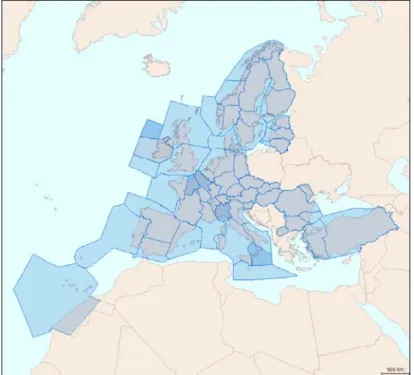
since the ACE 2001 are taken into account (see Figure 1).
Figure 1: ANSPs providing information since ACE 2001
7 Aena (Spain), ANS CR (Czech republic), ANS SE (Sweden), ATSA Bulgaria, Austro Control,
Belgocontrol (Belgium), DFS (Germany), DHMI (Turkey), DNA (France), EANS (Estonia), ENAV (Italy), Finland CAA, FYROM CAA (Macedonia), HungaroControl, IAA (Ireland), LGS (Latvia), Oro Navigacija (Lithuania), LPS (Slovak Republic), LVNL (The Netherlands), MIA/MATS (Malta), MoldATSA (Moldova), MUAC (Maastricht), NATAM/Avinor (Norway), NATS (UK), NAV Portugal (FIR Lisboa) (Portugal), NAVAIR (Denmark), ROMATSA (Romania), Skyguide (Switzerland), Slovenia CAA.
3.2 Definition of ANS and its breakdown
According to ICAO, ANS comprise Air Traffic Management, Communication, Navigation, and Surveillance (ATM/CNS), and other services such as Aeronautical Information Services (AIS), Aeronautical Meteorological Services (MET), and Search and Rescue Services (SAR) (see PRU Working Paper “Cost effectiveness and Productivity KPI’s” (2001)). Costs for the provision of ATM/CNS comprise the bulk of ANS costs (some 90%). Moreover, MET services are often provided by organisations other than ATM/CNS providers8. Besides, it
would be very difficult to obtain output metrics for the other services such as MET, AIS and SAR. Therefore, for the purposes of this paper, the analysis will only focus on ATM/CNS provision.
3.3 Definition of outputs for ATM/CNS provision
ANS cover three phases of the flight: en-route control, approach control and terminal control. There is no precise (operational) definition on where the boundaries are set for the approach control phase. In practice, the approach control phase depends on the organisation of the operational units within the different ANSPs so that it can be part of the en-route control or the terminal control.
Most European ANSPs apply two types of charges associated with ANS provision: en-route charges and terminal navigation charges (TNC). Because some discretion is used to allocate costs for the approach control phase either to en-route or to terminal, any productivity/cost-effectiveness analysis which focuses on one phase of flight (e.g. en-route) is likely to be affected by differences in allocation of costs (i.e. inputs). It is therefore useful to have a “gate-to-gate” TFP measure and to compute a global output measure that combines the service provided for the three phases of flight.
Several potential measures can be used to characterise the services provided. The fact that controlling a flight in an en-route environment is different from controlling a flight in a terminal environment requires particular attention for the selection of relevant output metrics.
3.3.1 En-route
In the en-route control environment, air traffic controllers (ATCOs) can be viewed as producing capacity to provide a “safe, efficient and orderly flow” of air traffic: from a “demand side” aircraft pass into specific en-route sectors and ATCOs ensure that aircraft are separated according to well defined criteria. From a “supply side” the ATM system provides a volume of (en-route) sector-hours which will determine the amount of capacity provided. Capacity cannot be stored and this available capacity can be used more or less extensively by aircraft depending on the traffic volume fluctuations (hour, day, week, season). Clearly, there are no obvious ways to measure capacity as it has both spatial and temporal dimensions. Having a metric which is straightforward to compute and comparable across ANSPs inevitably requires the use of proxies to estimate en-route production.
8 See Performance Review Unit “Report on Aeronautical MET Costs”, May 2004,
The number of flights or movements controlled is clearly not entirely satisfactory as an en-route output measure given that, first, it depends on the volume of airspace controlled by a given ANSP (a movement over 100 km is not the same as a movement over 1000 km), second, it does not reflect the work involved for providing the service (a movement in a highly dense part of airspace is not the same as a movement in a sparse area). Moreover, this metric depends on the organisation of the operational units (e.g. if one ANSP decides to combine two adjacent ACCs, its output measured in terms of movements will be divided by a factor of (nearly) two.
In empirical work on airline productivity micro-economists use (amongst other) the number of passenger-miles transported as a production metric. A natural translation of this measure to ATM/CNS provision is the number of kilometres controlled or flight-hours controlled. These measures are readily available and, contrary to movements, they reflect the size of the area involved (see KPI Working Paper).
The number of kilometres controlled is one of the metrics proposed for measuring the production associated with en-route ANS. Clearly, there are several ways to define the number of kilometres for a given flight: it can be the great circle distance, the distance along the flight plan or the real distance flown. However, these measures are very close to each other.
The number of flight-hours controlled is highly correlated with kilometres and easier to obtain from an empirical point of view (it is measured for each ATC operational unit described in the EUROCONTROL Central Flow Management Unit (CFMU) environment, and can be summed up without problem). This proxy will be used to characterise en-route production: it has the attractive properties of being easy to compute, transparent, measured consistently across ANSPs and additive.
3.3.2 Terminal
Controlling a flight in a terminal area consists in arranging take-off and landing sequencing. Using kilometres or flights-hours controlled would not be appropriate in the context of terminal control. The number of airport movements handled would seem a better metric to capture the terminal output. Logically, all IFR and VFR airport movements should be counted because both consume non-negligible resources. However, within EUROCONTROL Member States there is no comprehensive data set on the number of controlled VFR airport movements (see KPI Working Paper). Preliminary indications are that the number of controlled VFR airport movements is relatively marginal with respect to IFR airport movements. As a consequence, only IFR movements are considered for the terminal output metric.
3.4 Definition of input metrics for ATM/CNS provision
Inputs can be aggregated or disaggregated depending on data availability. For the purposes of this study the following three main categories of inputs are considered: labour, capital, and other (operating) inputs which comprise items such as materials, energy, purchased goods and services, etc. The economic analysis of ACE data suggests that
ATM/CNS provision is both labour and capital intensive. We detail below these three input categories.
3.4.1 Labour
Labour is one of the two usual inputs (with capital) used in basic models of firm production. In fact ATM/CNS provision is found to be a relatively labour intensive activity. On average, the cost share of labour is equal to some 56% of the total ATM/CNS provision costs. It is generally the largest cost items for ANSPs.
There are several different categories of staff associated with ATM/CNS provision9. Among
the various categories, Air Traffic Controllers (ATCOs) are the work force directly involved in the “production” process. As ATCOs are the most highly specialised and scarce resource in this process10, their average employment costs are significantly higher than for the other
staff categories.
For the purpose of this analysis, two types of labour input are considered: ATCOs in Operations on the one hand (some 30% of total staff), and all the other remaining staff, on the other hand (some 70% of total staff). The latter type can be viewed as support staff for the ATM/CNS process (assistants, engineering, administration staff, etc.).
For each labour input a quantity and a price series are required to compute a TFP index. In the ACE data, we observe both the number of full-time equivalent (FTE) ATCOs in Operations and the associated number of working hours on duty in Operations. Due to international differences in the number of hours worked per year (because of differences in local legislation, etc.), it is preferable to use the number of ATCOs working hours rather than the number of FTE ATCOs.
On the other hand, for all the other remaining staff FTEs had to be used since no data on the number of working hours is available.
3.4.2 Capital
ANSPs use capital services in the ATM/CNS production process. The costs share associated with these capital services amount to some 20% of the annual ATM/CNS provision costs. These comprise two parts: (1) depreciation and (2) an element reflecting the opportunity cost of capital.
Several types of capital services are used including: buildings, controller working positions, various ATM equipment with sophisticated Flight Data Processing (FDP) and Radar Data Processing (RDP) systems, CNS infrastructure (such as NAVAIDS, surveillance radars) etc.
9 See the Specification for Information Disclosure, Table C, which can be found on the web site at
www.eurocontrol.int/prc.
10 In fact, in the Specification for Information Disclosure different sub categories of ATCOs are
defined, including ATCOs in Operations, ATCOs on other duties, and ATCO trainees. ATCOs in Operations hold the required licence to provide ATC services. The PRU computes its (partial) productivity indicators on the basis of FTE ATCOs in Operations.
Ideally, one would observe the inventory list of all the key assets which comprise the flow11
of capital services used in the production process: the number of ATC operational units/buildings, such as ACCs12, APPs13, TWRs14, and their operating hours; the number of
controller working positions hours that have been used, operating hours of NAVAIDs (such as ILSs, VORs, DMEs) and surveillance radars, etc. Then, for each of these capital quantities an economic cost would be determined and used to aggregate the various quantities.
In empirical analysis, however, the capital input is often the most problematic to measure and assess. First, an inventory list of the key physical capital is generally not available for research purposes. What is usually available is the aggregated accounting value of the stock of physical capital, as reported in the year-end Balance Sheet statement, which sometimes includes the disclosure of a subset of key assets (typically land, building, machines, equipment, etc). Second, as opposed to labour services which are hired by an ANSP, capital services are generally bought by the ANSP and owned throughout the asset life. As a consequence, the computation of an economic cost for the capital services rendered is not straightforward given that it has to take into account the purchase price and its economic depreciation throughout the asset life. In fact, if all the assets were rented or leased, the price (annual costs) of each capital service would correspond to its rental/leasing fee. Finally, there are different ways to report accounting values of purchased assets: the Gross Book Value (GBV) at historical costs, the GBV at replacement costs, and the Net Book Value (NBV) which is the GBV value less the cumulative (accounting) depreciation. From an economic point of view it would be preferable to use the GBV at replacement (i.e. market value) costs since this measure would be less influenced by different depreciation rules15 and different positions in the investment cycle. However, only
NBV values are currently available from the ACE data.
Given these limitations, empirical TFP analysis typically uses proxies to measure the amount of capital services and their associated prices. Examples include, inter alia, the accounting value of the rolling stock and the rail length for rail studies (Australian Industry Commission, 1992), the number of buses in a urban transport study (Oben et al. (1992), the number of gates and runways for airport studies (Gillen and Lall (1999)), and a fleet quantity index for airline studies (Oum and Yu (1996)). Clearly, the choice of proxies is often determined by the availability of data.
As a consequence, for the purposes of this study it is assumed that the flow of capital services can be proxied by, on the one hand, the number of hours en-route sectors are open and, on the other hand, by the number of APPs and TWRs operational units.
The number of hours en-route sectors are open is directly related to the productive capability performed by Area Control Centres (ACCs) in the en-route environment. Each sector requires a number of controller working positions equipped with sophisticated ATM tools and software, etc. Moreover, the size of the ACC building is usually related to the number of controller working positions. By and large, the number of sector-hours is a fair
11 In most empirical work, it is assumed that the stock of capital at the end of the period, which is
more readily available, is proportional to the flow of capital used during the period.
12 Area control centers. 13 Approach control units. 14 Tower control units.
reflection of the direct physical assets used by ACCs, although it is likely that some capital assets might not necessarily be proportional to the number of sector-hours.
Similarly, the number of APP and TWR operational units managed16 by an ANSP is more
relevant in the context of the terminal output metric. The number of APPs and TWRs should correlate fairly well with the number of terminal NAVAIDS (ILS, DME, etc.) and other communication and surveillance equipment17. A limitation with the use of the TWR
operational units as proxy for the terminal capital input is that a small TWR unit opened 8 hours a day represents the same input quantity than a large TWR unit opened 20 hours a day.
Clearly, future research and further data would be required for the measurement of physical capital and its monetary value, especially in the context of terminal control. At this stage, it is important to note that since the cost share associated with capital for terminal ANS is only some 4%, the assumptions used to derive the capital input will not highly impact on the final TFP index results.
3.4.3 Other operating inputs
For pragmatic reasons, the third input considered includes a variety of heterogeneous items which comprise (non-staff) operating costs and exceptional cost items18. The costs share
associated with these other operating inputs amount to some 20% of the total ATM/CNS provision costs. Operating costs for ATM/CNS provision include purchase of goods (raw materials, energy, and non-capitalised maintenance parts, furniture, etc.), purchase of (outsourced) services19, and cost items such as, rentals, insurance, etc.
Clearly, no readable quantities are available for this “catch-all” input. The information from the ACE data set does not allow us to have a very detailed understanding of the various sub-items (e.g., telecommunications, outsourcing services, rents and insurance, parts, etc.) comprising operating costs. In fact, only a lump sum (monetary) figure is observed corresponding to the total (non-staff) operating costs.
In several empirical studies (e.g. Oum and Yu, 1996), the operating expenses are deflated by an appropriate price index to obtain a series of quantity for “other operating inputs”. The underlying assumption from this computation is that all the operating expenses are made at local prices. Therefore, similar amounts of operating costs would represent the same “quantity” if the ANSPs/countries face the same cost of living. On the contrary, for a country
16 The degree of flexibility to adapt the level of inputs may vary since some inputs tend to be fixed in
the short run. There is arguably little managerial discretion to decide which APPs and TWRs to be operated, although some discretion on the number of operating hours could be envisaged.
17 It should also be noted that some ANSPs do not own all the teminal CNS infrastructure that might
be located near an airport. This underestimates the true cost of capital related to terminal ANS.
18 Only few ANSPs report exceptional cost items. For more details see the ACE Benchmarking
Reports.
19 Some ANSPs prefer to use internal staff for the whole ATM/CNS “production” process, including
technical maintenance and R&D functions, while other ANSPs prefer to outsource some elements of the process. In the latter case, the costs associated with outsourced staff/services are included as operating costs. Clearly any PFP indicator that is measured on the internal staff only is likely to be affected by differences in outsourcing policies. On the other hand, the TFP framework has the advantage of being a global measure and, hence its results less likely to be influenced by the organisation of the production process.
whose cost of living is half the level of another country, this assumption means that it would use twice the quantity of “other operating inputs”. This assumption is appropriate when the share of “local” expenditure (such as rent, purchase of local services and goods, etc) is large and the share of expenditures in international market prices (such as specialised consulting services, insurance, energy, etc) is small. The current data availability unfortunately offers no clue on the nature of these expenditures, and it is likely to vary from one ANSP to another. Therefore for the purposes of this study, it is assumed20 that 50% of
the expenditures are made in international market prices and 50% in local prices. Note that Section 5 provides a sensitivity analysis of TFP scores and the hypothesis that 100% of the expenditures are made in local prices is considered. In future research it would be interesting to further refine this assumption and perhaps identify two types of “other operating inputs”: those that are bought at local market prices and those procured at world market prices.
3.5 Multilateral output and input indexes
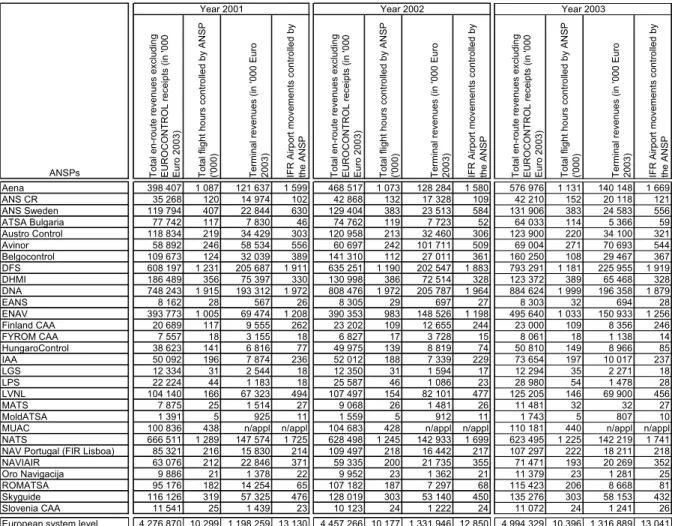
In Section 3.3 we distinguish two categories of outputs for the ATM/CNS provision: the number of flight-hours controlled and the number of IFR airport movements. Table 1 displays the outputs and the revenues derived from the EID for the years 2001-2003. For ease of comparison between ANSPs the two following adjustments have been made on revenues data:
1. En-route revenues have been reduced by an amount corresponding to EUROCONTROL costs. This will enhance the comparability since four ANSPs in the sample are not under the full-cost recovery mechanism and do not recover EUROCONTROL costs.
2. Contrary to en-route, whereby costs equal revenues by virtue of the full cost recovery regime 21, terminal ANS revenues do not necessarily match terminal ANS
costs. For example, a “loss” in terminal ANS is often recovered from a surplus arising in other activities (e.g. consultancy, etc) or from state subsidies. As a consequence, for those ANSPs22, cost rather than revenue shares are used to compute the multilateral output indexes.
20 Using the Price Level Index for GDP from EUROSTAT (the ratio of Purchasing Power Parities
(PPP) to the exchange rate for each country).
21 Except for NATS which operates under economic regulation with a price-cap incentive scheme. 22 The share of en-route and terminal ATM/CNS provision costs have been used to compute the
multilateral output indexes for Aena 2003), ATSA Bulgaria (2001), DHMI (2001-2002-2003), EANS (2001-2002-(2001-2002-2003), ENAV (2001), Finland CAA (2001-2002-(2001-2002-2003), FYROM CAA (2003), IAA (2002), LGS (2002), LPS (2001, 2002), MATS (2003), NAV Portugal (FIR Lisboa) (2001-2002), Oro Navigacija (2003) and ROMATSA (2002, 2003).
To tal en-rout e r e venue s exc ludi ng E U ROCO NTROL r e ceipts ( in '00 0 Eur o 2003) To tal fl ig ht hou rs co ntr o lled by A N S P ('000 ) Te rm inal r e venues ( in ' 000 Eu ro 2003) IFR A irpor t m o ve me nts cont ro lle d b y th e ANSP To tal en-rout e r e venue s exc ludi ng E U ROCO NTROL r e ceipts ( in '00 0 Eur o 2003) To tal fl ig ht hou rs co ntr o lled by A N S P ('000 ) Te rm inal r e venues ( in ' 000 Eu ro 2003) IFR A irpor t m o ve me nts cont ro lle d b y th e ANSP To tal en-rout e r e venue s exc ludi ng E U ROCO NTROL r e ceipts ( in '00 0 Eur o 2003) To tal fl ig ht hou rs co ntr o lled by A N S P ('000 ) Te rm inal r e venues ( in ' 000 Eu ro 2003) IFR A irpor t m o ve me nts cont ro lle d b y th e ANSP Aena 398 407 1 087 121 637 1 599 468 517 1 073 128 284 1 580 576 976 1 131 140 148 1 669 ANS CR 35 268 120 14 974 102 42 868 132 17 328 109 42 210 152 20 118 121 ANS Sweden 119 794 407 22 844 630 129 404 383 23 513 584 131 906 383 24 583 556 ATSA Bulgaria 77 742 117 7 830 46 74 762 119 7 723 52 64 033 114 5 366 59 Austro Control 118 834 219 34 429 303 120 958 213 32 460 306 123 900 220 34 100 321 Avinor 58 892 246 58 534 556 60 697 242 101 711 509 69 004 271 70 693 544 Belgocontrol 109 673 124 32 039 389 141 310 112 27 011 361 160 250 108 29 467 367 DFS 608 197 1 231 205 687 1 911 635 251 1 190 202 547 1 883 793 291 1 181 225 955 1 919 DHMI 186 489 356 75 397 330 130 998 386 72 514 328 123 372 389 65 468 328 DNA 748 243 1 915 193 312 1 972 808 476 1 972 205 787 1 964 884 624 1 999 196 358 1 879 EANS 8 162 28 567 26 8 305 29 697 27 8 303 32 694 28 ENAV 393 773 1 005 69 474 1 208 390 353 983 148 526 1 198 495 640 1 033 150 933 1 256 Finland CAA 20 689 117 9 555 262 23 202 109 12 655 244 23 000 109 8 356 246 FYROM CAA 7 557 18 3 155 18 6 827 17 3 728 15 8 061 18 1 138 14 HungaroControl 38 623 141 6 816 77 49 975 139 8 819 74 50 810 149 8 966 85 IAA 50 092 196 7 874 236 52 012 188 7 339 229 73 654 197 10 017 237 LGS 12 334 31 2 544 18 12 350 31 1 594 17 12 294 35 2 271 18 LPS 22 224 44 1 183 18 25 587 46 1 086 23 28 980 54 1 478 28 LVNL 104 140 166 67 323 494 107 497 154 82 101 477 125 205 146 69 900 456 MATS 7 875 25 1 514 27 9 068 26 1 481 26 11 481 32 32 27 MoldATSA 1 391 5 925 11 1 559 5 912 11 1 743 5 807 10
MUAC 100 836 438 n/appl n/appl 104 683 428 n/appl n/appl 110 181 440 n/appl n/appl
NATS 666 511 1 289 147 574 1 725 628 498 1 245 142 933 1 699 623 495 1 225 142 219 1 741
NAV Portugal (FIR Lisboa) 85 321 216 15 830 214 109 497 218 16 442 217 107 297 222 18 211 218
NAVIAIR 63 076 212 22 846 371 59 335 200 21 735 355 71 471 193 20 269 352
Oro Navigacija 9 886 21 1 378 22 9 952 23 1 362 21 11 379 23 1 281 25
ROMATSA 95 176 182 14 254 65 107 182 187 7 297 68 115 423 206 8 668 81
Skyguide 116 126 319 57 325 476 128 019 303 53 140 450 135 276 303 58 153 432
Slovenia CAA 11 541 25 1 439 23 10 123 24 1 222 24 11 072 24 1 241 26
European system level 4 276 870 10 299 1 198 259 13 130 4 457 266 10 177 1 331 946 12 850 4 994 329 10 396 1 316 889 13 041
ANSPs
Year 2001 Year 2002 Year 2003
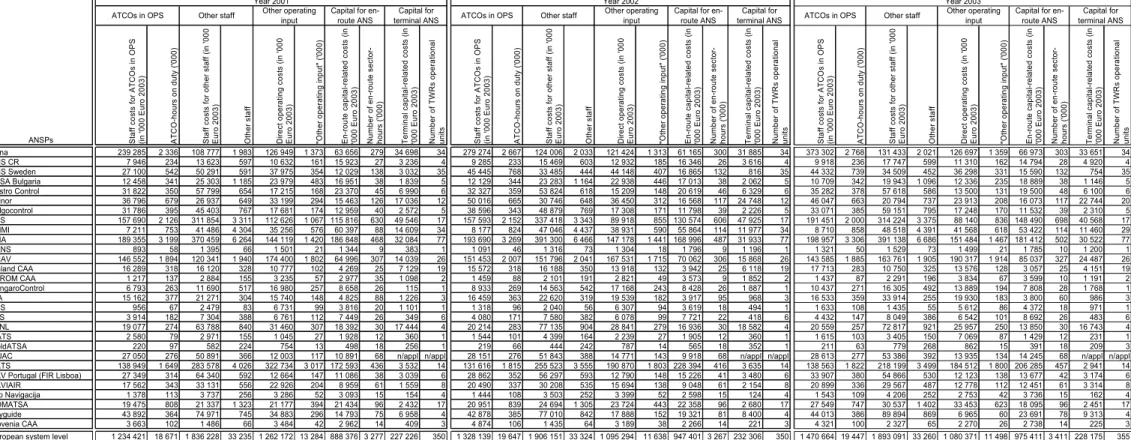
S ta ff c o sts for A T C O s in O P S (in '000 E u ro 2003) ATCO-hour s on dut y ( '000) St af f cos ts f or ot her s taf f ( in ' 000 Eur o 2 003) Ot her st af f Di re ct oper at ing c o st s ( in ' 000 Eur o 2 003) "O ther oper at ing i nput " ( '000) En-rout e c api ta l-r e la ted cos ts ( in '0 00 E u ro 2003) Num b er of en-rout e se ct or -ho ur s ( '00 0) T e rm inal capi ta l-r el a ted c o st s ( in '0 00 E u ro 2003) Num b er of T W Rs o per at ional un its S ta ff c o sts for A T C O s in O P S (in '000 E u ro 2003) ATCO-hour s on dut y ( '000) St af f cos ts f or ot her s taf f ( in ' 000 Eur o 2 003) Ot her st af f Di re ct oper at ing c o st s ( in ' 000 Eur o 2 003) "O ther oper at ing i nput " ( '000) En-rout e c api ta l-r e la ted cos ts ( in '0 00 E u ro 2003) Num b er of en-rout e se ct or -ho ur s ( '00 0) T e rm inal capi ta l-r el a ted c o st s ( in '0 00 E u ro 2003) Num b er of T W Rs o per at ional un its S ta ff c o sts for A T C O s in O P S (in '000 E u ro 2003) ATCO-hour s on dut y ( '000) St af f cos ts f or ot her s taf f ( in ' 000 Eur o 2 003) Ot her st af f Di re ct oper at ing c o st s ( in ' 000 Eur o 2 003) "O ther oper at ing i nput " ( '000) En-rout e c api ta l-r e la ted cos ts ( in '0 00 E u ro 2003) Num b er of en-rout e se ct or -ho ur s ( '00 0) T e rm inal capi ta l-r el a ted c o st s ( in '0 00 E u ro 2003) Num b er of T W Rs o per at ional un its Aena 239 285 2 336 108 777 1 983 126 949 1 373 63 656 279 34 698 34 279 274 2 667 124 006 2 033 121 424 1 313 61 165 300 31 885 34 373 302 2 768 131 433 2 021 126 697 1 359 66 973 303 33 651 34 ANS CR 7 946 234 13 623 597 10 632 161 15 923 27 3 236 4 9 285 233 15 469 603 12 932 185 16 346 26 3 616 4 9 918 236 17 747 599 11 310 162 14 794 28 4 920 4 ANS Sweden 27 100 542 50 291 591 37 975 354 12 029 138 3 032 35 45 445 768 33 485 444 44 148 407 16 865 132 816 35 44 332 739 34 509 452 36 298 331 15 590 132 754 35 ATSA Bulgaria 12 458 341 25 303 1 185 23 979 483 16 951 38 1 839 5 12 129 344 23 283 1 164 22 938 446 17 013 38 2 062 5 10 709 342 19 943 1 096 12 336 235 18 889 38 1 146 5 Austro Control 31 822 350 57 799 654 17 215 168 23 370 45 6 990 6 32 327 359 53 824 618 15 209 148 20 619 46 6 329 6 35 282 378 57 618 586 13 500 131 19 500 48 6 100 6 Avinor 36 796 679 26 937 649 33 199 294 15 463 126 17 036 12 50 016 665 30 746 648 36 450 312 16 568 117 24 748 12 46 047 663 20 794 737 23 913 208 16 073 117 22 744 20 Belgocontrol 31 786 395 45 403 767 17 681 174 12 959 40 2 572 5 38 596 343 48 879 769 17 308 171 11 798 39 2 226 5 33 071 385 59 151 795 17 248 170 11 532 39 2 310 5 DFS 157 690 2 126 311 854 3 311 112 626 1 067 115 816 630 49 546 17 157 593 2 152 337 418 3 343 89 918 855 130 574 606 47 925 17 191 451 2 000 314 224 3 375 88 140 836 148 490 698 40 568 17 DHMI 7 211 753 41 486 4 304 35 256 576 60 397 88 14 609 34 8 177 824 47 046 4 437 38 931 590 55 864 114 11 977 34 8 710 858 48 518 4 391 41 568 618 53 422 114 11 460 29 DNA 189 355 3 199 370 459 6 264 144 119 1 420 186 848 468 32 084 77 193 690 3 269 391 300 6 466 147 178 1 441 168 996 487 31 933 77 198 957 3 306 391 138 6 686 151 484 1 467 181 412 502 30 522 77 EANS 893 58 1 395 66 1 501 21 1 344 9 383 1 1 091 46 1 316 73 1 304 18 1 796 9 1 196 1 1 321 50 1 529 73 1 499 21 1 785 10 1 200 1 ENAV 146 552 1 894 120 341 1 940 174 400 1 802 64 996 307 14 039 26 151 453 2 007 151 796 2 041 167 531 1 715 70 062 306 15 868 26 143 585 1 885 163 761 1 905 190 317 1 914 85 037 327 24 487 26 Finland CAA 16 289 318 16 120 328 10 777 102 4 269 25 7 129 19 15 572 318 16 188 350 13 918 132 3 942 25 6 118 19 17 713 283 10 750 325 13 576 128 3 057 25 4 151 19 FYROM CAA 1 217 137 2 884 155 3 235 57 2 977 35 1 098 2 1 459 88 2 101 191 2 821 49 3 573 9 1 852 2 1 437 87 2 291 196 3 834 67 3 599 10 1 191 2 HungaroControl 6 793 263 11 690 517 16 980 257 8 658 26 115 1 8 933 269 14 563 542 17 168 243 8 428 26 1 887 1 10 437 271 16 305 492 13 889 194 7 808 28 1 768 1 IAA 15 162 377 21 271 304 15 740 148 4 825 88 1 226 3 16 459 363 22 620 319 19 539 182 3 917 95 968 3 16 533 359 33 914 255 19 930 183 3 800 60 986 3 LGS 956 67 2 479 83 6 731 99 3 816 20 1 101 1 1 318 96 2 040 56 6 307 94 3 619 18 494 1 1 633 108 1 435 55 5 612 86 4 372 18 971 1 LPS 3 914 182 7 304 388 6 761 112 7 449 26 349 6 4 080 171 7 580 382 6 078 99 7 721 22 418 6 4 432 147 8 049 386 6 542 101 8 692 26 483 6 LVNL 19 077 274 63 788 840 31 460 307 18 392 30 17 444 4 20 214 283 77 135 904 28 841 279 16 936 30 18 582 4 20 559 257 72 817 921 25 957 250 13 850 30 16 743 4 MATS 2 580 79 2 971 155 1 045 27 1 928 12 360 1 1 544 101 4 399 164 2 239 27 1 905 12 360 1 1 615 103 3 405 150 7 069 87 1 429 12 231 1 MoldATSA 220 97 582 224 754 13 498 18 256 1 219 66 444 242 787 14 565 18 352 1 211 63 779 268 862 15 391 18 209 3
MUAC 27 050 276 50 891 366 12 003 117 10 891 68 n/appl n/appl 28 151 276 51 843 388 14 771 143 9 918 68 n/appl n/appl 28 613 277 53 386 392 13 935 134 14 245 68 n/appl n/appl NATS 138 949 1 649 283 578 4 026 322 734 3 017 172 593 436 3 532 14 131 616 1 815 255 523 3 555 190 870 1 803 228 394 416 3 635 14 138 563 1 822 218 199 3 499 184 512 1 800 206 285 457 2 941 14 NAV Portugal (FIR Lisboa) 27 349 314 64 340 592 12 664 147 11 086 38 3 039 6 28 862 352 56 297 593 12 790 148 15 226 41 3 480 6 33 907 380 54 866 530 12 123 138 13 677 42 3 174 6 NAVIAIR 17 562 343 33 131 556 22 926 204 8 959 61 1 559 8 20 490 337 30 208 535 15 694 138 9 048 61 2 154 8 20 899 336 29 567 487 12 778 112 12 451 61 3 314 8 Oro Navigacija 1 378 113 3 737 256 3 286 52 3 093 15 154 4 1 444 108 3 503 252 3 399 52 2 598 15 124 4 1 543 109 4 206 252 2 753 42 3 736 15 162 4 ROMATSA 19 475 808 21 337 1 323 21 177 394 21 434 96 2 432 17 20 951 839 24 694 1 305 23 724 443 22 358 96 2 680 17 27 549 747 30 537 1 402 33 453 623 18 095 96 2 451 17 Skyguide 43 892 364 74 971 745 34 883 296 14 793 75 6 958 4 42 878 385 77 010 842 17 888 152 19 321 81 8 400 4 44 013 386 89 894 869 6 965 60 23 691 78 9 313 4 Slovenia CAA 3 663 102 1 486 66 3 484 42 2 962 14 409 3 4 874 106 1 435 64 3 189 38 2 266 14 221 3 4 321 100 2 327 65 2 270 26 2 738 14 225 3 European system level 1 234 421 18 671 1 836 228 33 235 1 262 172 13 284 888 376 3 277 227 226 350 1 328 139 19 647 1 906 151 33 324 1 095 294 11 638 947 401 3 267 232 306 350 1 470 664 19 447 1 893 091 33 260 1 080 371 11 498 975 411 3 411 228 175 355
Year 2003
ATCOs in OPS Other staff Other operating input Capital for en-route ANS terminal ANSCapital for Year 2002
ATCOs in OPS Other staff Other operating input Capital for en-route ANS terminal ANSCapital for
ANSPs
Year 2001
ATCOs in OPS Other staff Other operating input Capital for en-route ANS terminal ANSCapital for
Similarly the three input categories discussed in Section 3.4 and their associated costs are presented in Table 2. The labour input comprises the number of ATCOs in Operations (measured in terms of working hours) and the remaining support staff (measured in terms of FTE). The number of sector-hours and the sum APP and TWR operational units characterise the capital input (respectively for en-route and terminal ANS). Finally, the price level indexes of GDP23 are used to compute a quantity series of “other operating inputs”.
To obtain a single measure that characterises ANSPs’ outputs or inputs, the different metrics reported in Table 1 and Table 2 are aggregated using the CCD methodology (see Section 2.1.2) to obtain multilateral output and input indexes, respectively.
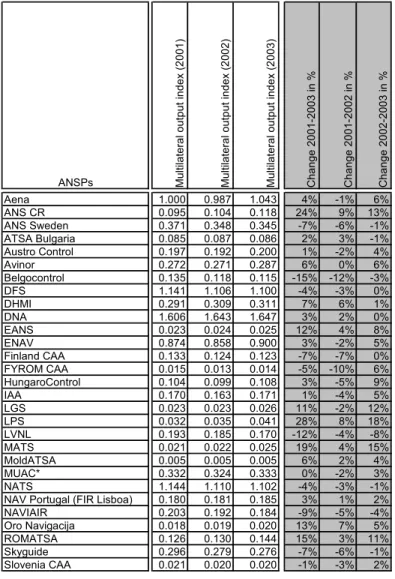
The multilateral output indexes and their growth rates between 2001 and 2003 are displayed in Table 3 below.
ANSPs Mu lti lat eral output index ( 2 001) M u lti lat eral output index ( 2 002) M u lti lat eral output index ( 2 003) C hange 2001-2003 i n % C hange 2001-2002 i n % C hange 2002-2003 i n % Aena 1.000 0.987 1.043 4% -1% 6% ANS CR 0.095 0.104 0.118 24% 9% 13% ANS Sweden 0.371 0.348 0.345 -7% -6% -1% ATSA Bulgaria 0.085 0.087 0.086 2% 3% -1% Austro Control 0.197 0.192 0.200 1% -2% 4% Avinor 0.272 0.271 0.287 6% 0% 6% Belgocontrol 0.135 0.118 0.115 -15% -12% -3% DFS 1.141 1.106 1.100 -4% -3% 0% DHMI 0.291 0.309 0.311 7% 6% 1% DNA 1.606 1.643 1.647 3% 2% 0% EANS 0.023 0.024 0.025 12% 4% 8% ENAV 0.874 0.858 0.900 3% -2% 5% Finland CAA 0.133 0.124 0.123 -7% -7% 0% FYROM CAA 0.015 0.013 0.014 -5% -10% 6% HungaroControl 0.104 0.099 0.108 3% -5% 9% IAA 0.170 0.163 0.171 1% -4% 5% LGS 0.023 0.023 0.026 11% -2% 12% LPS 0.032 0.035 0.041 28% 8% 18% LVNL 0.193 0.185 0.170 -12% -4% -8% MATS 0.021 0.022 0.025 19% 4% 15% MoldATSA 0.005 0.005 0.005 6% 2% 4% MUAC* 0.332 0.324 0.333 0% -2% 3% NATS 1.144 1.110 1.102 -4% -3% -1%
NAV Portugal (FIR Lisboa) 0.180 0.181 0.185 3% 1% 2%
NAVIAIR 0.203 0.192 0.184 -9% -5% -4%
Oro Navigacija 0.018 0.019 0.020 13% 7% 5%
ROMATSA 0.126 0.130 0.144 15% 3% 11%
Skyguide 0.296 0.279 0.276 -7% -6% -1% Slovenia CAA 0.021 0.020 0.020 -1% -3% 2%
Table 3: Multilateral output indexes (2001-2003)
Table 3 shows that that there is a wide range of output levels but also of output growth rates among ANSPs. In order to make the interpretation of the results easier, the values
displayed in Table 3 are relative to Aena 2001 (the “reference” observation with a value of 1.000). A value lower (higher) than 1.000 indicates an output lower (higher) than Aena’s 2001 output. The multilateral CCD aggregation method allows transitive comparisons across all observations (time series of cross-section). For example, Table 3 indicates that DNA’s 2003 output is some 65% greater than Aena’s 2001 output. Notice the significant differences in the output growth rate among ANSPs during the 2001-2003 period (-15% for Belgocontrol to +28% for LPS). Because of the terrorist attacks in September 2001, the Iraq war and the SARS epidemic in Spring 2003, all three years were, to some extent, atypical for the ATM industry. This also shows that, to a large extent, the level of output is exogenous for any given ANSP and that the challenge is to flexibly adjust the inputs to current and expected output levels.
As displayed in Table 1, MUAC only generates an output in the en-route environment. It is not possible to define a multilateral CCD index when one input or one output is zero. Therefore for MUAC (asterisked in Table 3) Fisher output indexes were computed since these are not affected when one output is equal to zero. It should be noted that the multilateral CCD and Fisher indexes are highly correlated (i.e. R² at 0.99 for the sample of ANSPs) and the two indexes produce very similar figures. Therefore, for the purpose of this paper these indexes can be considered as comparable.
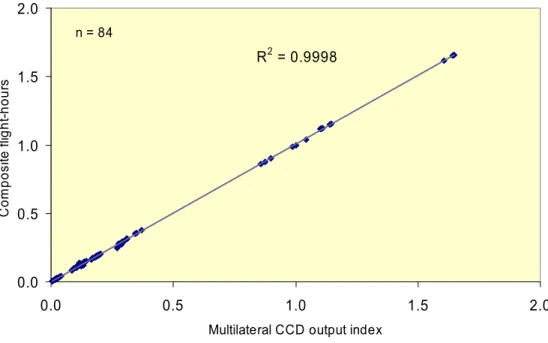
Figure 2 shows that the multilateral output index is highly correlated (R² close to 1.000) with the output index (i.e. “composite flight-hours”) used in the ACE reports, even though the formulae differ24. R2 = 0.9998 0.0 0.5 1.0 1.5 2.0 0.0 0.5 1.0 1.5 2.0
Multilateral CCD output index
C o m p os ite f lig ht -h o u rs n = 84
Figure 2: Multilateral CCD output index and composite flight-hours
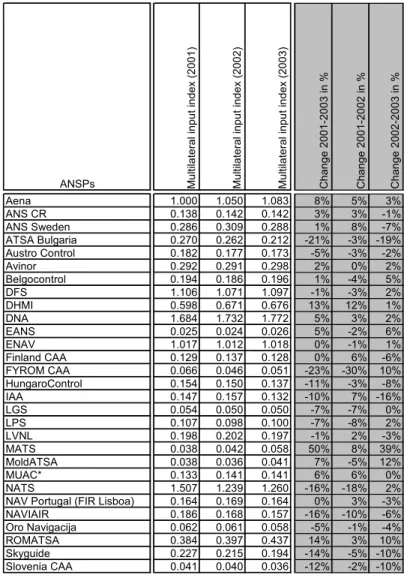
Table 4 displays the multilateral input indexes for the whole sample observations. As for the sample of output indexes, there is a wide range both in terms of input levels and input
24 The “composite flight-hours” used in the ACE data analysis are computed using a Laspeyres index
growth rates during the 2001-2003 period. However, it is likely that some changes in data reporting between 2001 and 2003 have occurred and this could potentially explain some of the largest variations observed in Table 4. It is important to underline that data accuracy is improving each year and that trends observed in the multilateral input index will reflect more and more genuine performance changes.
ANSPs Mu lti lat eral inpu t i ndex ( 2001) M u lti lat eral inpu t i ndex ( 2002) M u lti lat eral inpu t i ndex ( 2003) C hange 2001-2003 i n % C hange 2001-2002 i n % C hange 2002-2003 i n % Aena 1.000 1.050 1.083 8% 5% 3% ANS CR 0.138 0.142 0.142 3% 3% -1% ANS Sweden 0.286 0.309 0.288 1% 8% -7% ATSA Bulgaria 0.270 0.262 0.212 -21% -3% -19% Austro Control 0.182 0.177 0.173 -5% -3% -2% Avinor 0.292 0.291 0.298 2% 0% 2% Belgocontrol 0.194 0.186 0.196 1% -4% 5% DFS 1.106 1.071 1.097 -1% -3% 2% DHMI 0.598 0.671 0.676 13% 12% 1% DNA 1.684 1.732 1.772 5% 3% 2% EANS 0.025 0.024 0.026 5% -2% 6% ENAV 1.017 1.012 1.018 0% -1% 1% Finland CAA 0.129 0.137 0.128 0% 6% -6% FYROM CAA 0.066 0.046 0.051 -23% -30% 10% HungaroControl 0.154 0.150 0.137 -11% -3% -8% IAA 0.147 0.157 0.132 -10% 7% -16% LGS 0.054 0.050 0.050 -7% -7% 0% LPS 0.107 0.098 0.100 -7% -8% 2% LVNL 0.198 0.202 0.197 -1% 2% -3% MATS 0.038 0.042 0.058 50% 8% 39% MoldATSA 0.038 0.036 0.041 7% -5% 12% MUAC* 0.133 0.141 0.141 6% 6% 0% NATS 1.507 1.239 1.260 -16% -18% 2%
NAV Portugal (FIR Lisboa) 0.164 0.169 0.164 0% 3% -3% NAVIAIR 0.186 0.168 0.157 -16% -10% -6% Oro Navigacija 0.062 0.061 0.058 -5% -1% -4%
ROMATSA 0.384 0.397 0.437 14% 3% 10%
Skyguide 0.227 0.215 0.194 -14% -5% -10% Slovenia CAA 0.041 0.040 0.036 -12% -2% -10%
Table 4: Multilateral input indexes (2001-2003)
Table 4 shows that in 2003 several ANSPs used fewer inputs than in 2001. For ATSA Bulgaria, NATS, NAVIAIR, HungaroControl, Skyguide and Slovenia CAA, the decrease of the multilateral input index is mainly driven by a significant decrease of the “other operating inputs” (associated with operating costs) between 2001 and 2003. Given the somewhat exogenous nature of the output, it is particularly important for an ANSP to flexibly adjust its level of inputs.
It should be noted that the high input index increase (+50%) for MATS is the result of changes in data reporting between 2001 and 2003.
4 TFP
RESULTS
4.1 TFP results at European system
The methodology presented in Section 2.1.2 and the CCD multilateral inputs and outputs presented in Section 3.5 are used to compute the productivity of the European ANS system as a whole. The multilateral TFP index is obtained by dividing the multilateral output index by the multilateral input index. Figure 3 displays the multilateral input, output and TFP indexes for the European system.
0.98 0.99 1.00 1.01 1.02 1.03 2001 2002 2003 Output Input TFP
Figure 3: Multilateral input, output and TFP indexes for the European system Figure 3 shows that between 2001 and 2003, the TFP index increased by some 2% at European system level. It is also worth noting that although the growth of output was negative between 2001 and 200225, the TFP of the European system slightly increased
since the level of inputs has been reduced at a greater rate. Between 2002 and 2003 gains in TFP were achieved since the output index increased at a greater rate than the input index.
Figure 4 above displays on the one hand the TFP and, on the other hand, the five partial productivities computed as the output index divided by the relevant input quantity.
0.92 0.96 1.00 1.04 1.08 1.12 1.16 2001 2002 2003 TFP ATCOs in OPS PFP Other staff PFP "Other operating input" PFP En-route capital PFP Terminal capital PFP
Figure 4: Partial productivity indexes for European system
Figure 4 shows that the impact of each input on TFP varies in time. This is a key feature of TFP which allows for the relative importance of inputs to change over time. Indeed, Figure
25 2002 was a very special year for air transport due to the impact of the terrorist events of September
4 indicates that the partial productivity of the “other operating inputs” increased by some 16% between 2001 and 2003 while the partial productivity of “other staff” and terminal capital increased by less than 1%. On the other hand, the partial productivity of ATCOs in OPS and en-route capital both decreased by some 3.5%. In other words, the positive TFP growth achieved at European system level is mainly driven by a strong increase of the “other operating inputs” productivity which offsets the decrease of productivity of ATCOs in OPS and en-route capital.
4.2 TFP results at ANSP level
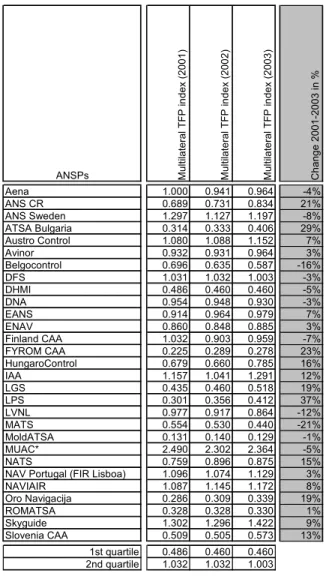
Table 5 below displays the multilateral TFP indexes for the 29 ANSPs which are computed using the multilateral CCD inputs and outputs presented in Section 3.5. The TFP indexes are normalised so that the level of Aena in 2001 is 1.000. The results show significant differences with values ranging in 2003 from 0.129 for MoldATSA to 2.364 for MUAC26. The
highest TFP figure without MUAC is Skyguide with 1.422, i.e. some 47% higher TFP than the reference value (Aena 2001).
ANSPs Multi later al TF P i n dex ( 200 1) Multi later al TF P i n dex ( 200 2) Multi later al TF P i n dex ( 200 3) Change 2001 -2003 in % Aena 1.000 0.941 0.964 -4% ANS CR 0.689 0.731 0.834 21% ANS Sweden 1.297 1.127 1.197 -8% ATSA Bulgaria 0.314 0.333 0.406 29% Austro Control 1.080 1.088 1.152 7% Avinor 0.932 0.931 0.964 3% Belgocontrol 0.696 0.635 0.587 -16% DFS 1.031 1.032 1.003 -3% DHMI 0.486 0.460 0.460 -5% DNA 0.954 0.948 0.930 -3% EANS 0.914 0.964 0.979 7% ENAV 0.860 0.848 0.885 3% Finland CAA 1.032 0.903 0.959 -7% FYROM CAA 0.225 0.289 0.278 23% HungaroControl 0.679 0.660 0.785 16% IAA 1.157 1.041 1.291 12% LGS 0.435 0.460 0.518 19% LPS 0.301 0.356 0.412 37% LVNL 0.977 0.917 0.864 -12% MATS 0.554 0.530 0.440 -21% MoldATSA 0.131 0.140 0.129 -1% MUAC* 2.490 2.302 2.364 -5% NATS 0.759 0.896 0.875 15%
NAV Portugal (FIR Lisboa) 1.096 1.074 1.129 3%
NAVIAIR 1.087 1.145 1.172 8% Oro Navigacija 0.286 0.309 0.339 19% ROMATSA 0.328 0.328 0.330 1% Skyguide 1.302 1.296 1.422 9% Slovenia CAA 0.509 0.505 0.573 13% 1st quartile 0.486 0.460 0.460 2nd quartile 1.032 1.032 1.003
Table 5: Multilateral TFP indexes (2001-2003)
Table 5 also reports the first and third quartiles of the TFP scores distribution. These two quartiles provide further insights on the dispersion of the TFP results. In 2003, there is a factor of 2.2 between the two quartiles. This result is in line with the dispersion of the (partial) ATCO-hour productivity indicator27 presented in the ACE 2003 Benchmarking
Report (see also Section 4.5 for further details).
It should be noted that those significant differences among TFP levels may be driven by exogenous factors that are beyond ANSPs’ managerial control (e.g. “traffic complexity”). An analysis of the impact of external factors on TFP scores is provided in Section 6. Therefore, although it is informative to look at relative TFP scores among ANSPs, it is more valuable to consider the TFP growth rate for a given ANSP since this is more readily comparable. Table 5 indicates that TFP growth rates range from -21% for MATS to +37% for LPS. Table 5 also suggests that TFP increased in a majority of ANSPs between 2001 and 2003. Changes in TFP can be broken into an “output effect” (i.e. the input level remaining constant) and an “input effect” (i.e. the output remaining constant). Figure 5 shows both the input and output effects between 2001 and 2003 for the 29 ANSPs. As argued earlier, the level of output is, to a large extent, not within an ANSP’s control, while the level of inputs is a managerial choice. -30% -20% -10% 0% 10% 20% 30% MA TS B e lgocont rol LVN L A N S S w eden F in lan d C A A DH MI MU AC * Ae na DFS DN A Mo ld ATS A RO M A T S A EN AV N A V P o rt ugal (F IR Li sboa) Avinor A u st ro Co n tro l EA N S N A VI AI R Sk ygui de IAA S loveni a CA A NA T S Hunga roCont rol Oro Nav igaci ja LGS AN S C R FY R O M CAA AT S A Bul gar ia LP S
Output effect Input effect
Figure 5: Breakdown of TFP into output and input effects
Between 2001 and 2003, four ANSPs achieved TFP growth rates greater than 20%: LPS (+37%), ATSA Bulgaria (+29%), FYROM CAA (+23%) and ANS CR (+21%). Figure 5 indicates that for ANS CR and LPS, the TFP increase is driven by an increase in the volume
27 In the ACE data analysis, the ATCO-hour productivity indicator is the ratio of the “composite
of output. On the other hand, ATSA Bulgaria and FYROM CAA achieved significant TFP improvement by reducing the quantity of inputs.
Notice that eleven ANSPs experienced a negative TFP growth between 2001 and 2003. For Aena (-4%) and DHMI (-5%), the TFP decrease is mainly driven by a significant increase of inputs. Similarly, the traffic downturn is the main driver of the TFP decrease for ANS Sweden, Finland CAA, LVNL and Belgocontrol.
The high TFP decrease (-21%) for MATS is driven by a large increase of input quantities (+50%, capped in Figure 5). This increase is the result of changes in data reporting between 2001 and 2003. Data accuracy has improved each year since the implementation of Information Disclosure in 2001, and is further expected to improve as greater experience is gained. Clearly, as accuracy improves, trends observed in TFP will become more and more related to genuine performance changes.
4.3 Relationship between TFP scores and output index
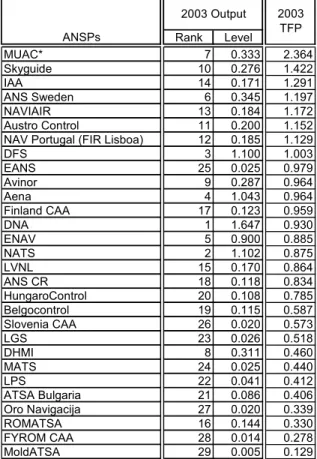
As shown in Section 3.5, there is a wide range among output levels controlled by ANSPs. In 2003, NATS, the second largest ANSP (in terms of output), had an output level that was more than 75 times greater than the second smaller ANSP, FYROM CAA. In such a context, it is important to investigate whether, and to what extent, differences in output levels are related to differences in TFP scores. Table 6 displays the 2003 output index and TFP scores for each ANSP.
Rank Level MUAC* 7 0.333 2.364 Skyguide 10 0.276 1.422 IAA 14 0.171 1.291 ANS Sweden 6 0.345 1.197 NAVIAIR 13 0.184 1.172 Austro Control 11 0.200 1.152 NAV Portugal (FIR Lisboa) 12 0.185 1.129 DFS 3 1.100 1.003 EANS 25 0.025 0.979 Avinor 9 0.287 0.964 Aena 4 1.043 0.964 Finland CAA 17 0.123 0.959 DNA 1 1.647 0.930 ENAV 5 0.900 0.885 NATS 2 1.102 0.875 LVNL 15 0.170 0.864 ANS CR 18 0.118 0.834 HungaroControl 20 0.108 0.785 Belgocontrol 19 0.115 0.587 Slovenia CAA 26 0.020 0.573 LGS 23 0.026 0.518 DHMI 8 0.311 0.460 MATS 24 0.025 0.440 LPS 22 0.041 0.412 ATSA Bulgaria 21 0.086 0.406 Oro Navigacija 27 0.020 0.339 ROMATSA 16 0.144 0.330 FYROM CAA 28 0.014 0.278 MoldATSA 29 0.005 0.129 2003 TFP ANSPs 2003 Output
Figure 6 indicates that the largest ANSPs in terms of output do not have the highest TFP. Furthermore as shown in Figure 6 below, for the five largest ANSPs (DNA, NATS, DFS, Aena and ENAV), the output level does not seem to impact the TFP scores.
0.0 0.4 0.8 1.2 1.6 0.0 0.6 1.2 1.8
Multilateral output index
M u lti la te ra l TF P index n = 84 5 largest ANSPs
Figure 6: TFP scores versus output index
However, for the other smaller ANSPs, the TFP level seems to be influenced by the level of output which could indicate that some scale effects are at play (there is also some dispersion of TFP scores for a given level of output). Clearly, further work would be needed to better characterise the relationship between output levels and TFP scores. This could be achieved by explicitly deriving a structural (e.g. production or cost) model which can be empirically estimated.
4.4 Relationship between TFP scores and financial cost-effectiveness
In the ACE reports, the PRU uses the financial cost-effectiveness KPI to assess and compare the performance of the European ANSPs. This is computed as the ratio of the (gate-to-gate)28 ATM/CNS provision costs to the composite flight-hours. This unit cost can
be further broken down into three key economic ratios: (1) ATCO-hour productivity, (2) employment costs per ATCO-hour and (3) support cost ratio. All else being equal, higher productivity and lower support cost ratios will increase cost-effectiveness, while higher employment costs per ATCO-hour contribute to lower cost-effectiveness. In other words, productivity is only one, albeit important, driver for the level of ATM/CNS provision unit costs. Nevertheless, it is interesting to see to which extent TFP scores and unit costs correlate. This is done in Figure 7.