© PBSRG 2012 Journal for the Advancement of Performance Information and Value VOL. 4 NO. 2 195
Case Study: Use of Best Value Process for Inspection and
Preventive Maintenance of Pumping Stations
Jannie Koster-Robaard
Consistender, Director and Senior Consultant Groningen, The Netherlands
The water board Velt en Vecht is a Best Value (BV) client who used the Performance Information Procurement System (PIPS) process to select professional services in 2012. The client had a procurement mission of integrity, transparency, objectivity, and non-discrimination that aligned them with the BV PIPS system. With a strategic plan of leadership instead of management and control, the water board is an example of a visionary owner that can be successful with BV PIPS. Lessons learned from the water board implementation of PIPS are that BV PIPS is a change of paradigm, even for a visionary owner. Both the owner who selects and the contractors who compete for the award must learn the new paradigm of minimized decision making, proactive planning, and risk management.
Keywords: Best Value Procurement, the Netherlands, PIPS, Water board Velt en Vecht, pumping stations, inspection and preventive maintenance
Introduction
The maintenance of sewage pumping stations and other pumping stations is a recurring service that is outsourced by the water board Velt en Vecht (herein: Velt en Vecht). In February 2012, the water board started to prepare the tender “Inspection and preventive maintenance of sewage pumping stations and other pumping stations.” Due to the high value of the contract, Velt en Vecht had to follow the European tender process.
The procurement mission of Velt en Vecht was: "Velt and Vecht is a social responsible and reliable customer, based on the core values of integrity, transparency, objectivity and non-discrimination. We focus on results, solutions for which we also use the knowledge, innovation and creativity from the market"(Velt en Vecht 2012). As a result of the purchasing mission, Velt and Vecht gave itself the objective to perform procurement procedures in a different way, making best use of the knowledge of the market. Velt en Vecht decided to make use of the principles of Best Value (BV) Performance Information Procurement System (PIPS), founded by Kashiwagi (2011), for the tender “Inspection and preventive maintenance of sewage pumping stations and other pumping stations” to experience if this would be a suitable methodology for Velt en Vecht.
Water Management in the Netherlands
Water is critical to the livelihood of people, livestock, and industry. In the Netherlands, there is not enough clean and sanitary water. Therefore, water management is necessary. In the
Netherlands, the surface water is managed by regional water authorities (water boards). Flood protection is the core task of the regional water authorities. The Netherlands is constantly
© PBSRG 2012 Journal for the Advancement of Performance Information and Value VOL. 4 NO. 2 196
threatened by both sea and rivers because the country lies below sea level. Protection against floods is literally and figuratively “a matter of life and death.” Economic interests must also be protected: behind the dikes lies € 2.000 billion of invested capital. Together, the national government and the regional water authorities are responsible for the management of water barriers. The government is in charge of the protection of the coastline and the maintenance of the dams, which close off the major sea-arms in the west. The other water barriers (dikes, dunes and quay-walls) are managed by the regional water authorities.
Regional Water Authorities
The protection of surface waters from pollution is also an important task of the regional water authorities. An important element of this task is the construction and the operation of purification works (wastewater treatment plants), which are used for the cleaning of the sewerage water of households and companies. The national government is responsible for the maintenance of the main system of the bodies of water. The regional water authorities are legally bound to manage regional and local bodies of water. For this, they operate about 360 sewage purification plants. Regional water authorities also see to the control of the quantities of surface water in a certain area on a daily basis. The management of water quantities aims at reaching and maintaining certain water levels dependent on the function of the body of water in question.
A correct supply and drainage of surface water prevents surpluses and shortages. The national government maintains the main water infrastructure. Regional water authorities are in charge of water quantities at regional and local levels (UVW 2012).
Organization of the Regional Water Authorities
A regional water authority is governed by its General Assembly, an executive committee and a chairman. The General Assembly consists of representatives of stakeholder organizations and is authorized to make all decisions that are necessary for fulfilling its tasks, such as the annual budgeting and accounting, setting water levels, performing inspections, and taxation.
The executive committee consists of a chairman and regular members (the number of which is determined by the General Assembly) and is responsible for day-to-day management and policy preparations. The chairman is charged with promoting the interests of the regional water
authority and chairs of both the General Assembly and executive committee. Like local and national governments, the members of the General Assembly are elected by the general public (UVW 2012).
Velt en Vecht
Velt en Vecht is responsible for the water management in Southeast Drenthe and Northeast Overijssel. The management area of Velt en Vecht is very diverse, there is nature, agriculture, construction, and open water. These waterways are very critical as they support (Velt en Vecht 2012):
90,000 acres
200,000 inhabitants
© PBSRG 2012 Journal for the Advancement of Performance Information and Value VOL. 4 NO. 2 197 1200 km waterways
7 wastewater treatment plants
700 sewage pumping stations, other pumping stations and water works 185 employees
The purchasing department of Velt en Vecht has been working on professionalizing the procurement for several years. It started with the adoption of a procurement mission by the General Assembly. Originally, purchases were primarily based on the lowest price. In recent years, the use of the criterion Most Economically Advantageous Tender (MEAT) has increased. The professionalization of the procurement requires a different kind of leadership of the
employees. Best Value (BV) Procurement and its philosophy behind (Information Measurement Theory and Kashiwagi Solution Model) can help Velt and Vecht to change to a new type of leadership. Therefore, with the objective to perform procurement procedures in a different way, making best use of the knowledge of the market, Velt en Vecht decided to make use of the principles of BV Procurement, the Performance Information Procurement System (PIPS), for the tender “Inspection and preventive maintenance of sewage pumping stations and other pumping stations.”
Scope of the Project
The scope of work for Velt en Vecht contained about 134 sewage pumping stations and 298 other pumping stations. Due to the different types of installations, the tender was divided into two lots, one for the sewage pumping stations (Lot 1) and one for the other pumping stations (Lot 2). Both lots are assessed separately.
For both lots the purpose of the tender was gaining insight into the state of maintenance, while any preventive maintenance and cleaning is performed. Inspection reports should form the basis for the outsourcing of the corrective maintenance. The long-term goals were:
The full functionality of the installations are guaranteed; Disturbance, failure and sewer overflows are prevented; and Control of operating costs is achieved.
Tenderers had to describe in their “offering scope,” which activities they offer, the way they will execute the activities, and how they will report to Velt en Vecht. Besides a description of the execution of the work, Velt and Vecht asked the tenderers in their “offering scope” to give a vision of effective preventive and corrective maintenance in the future and how the tenderer would lay a foundation for this with the execution of the contract.
Preparation of the Tender
For both lots, Velt and Vecht had assembled a tender team for the selection process. Both teams were trained twice. The first training took place at the start of the preparation of the tender procedure and was focused on the methodology of BV Procurement. The second training took place a few weeks after the start of the tender procedure. This training was focused specifically on the evaluation of tenders; using an exercise case.
© PBSRG 2012 Journal for the Advancement of Performance Information and Value VOL. 4 NO. 2 198
The contractors who were planning to tender also had the opportunity to attend a training session about BV procurement. This training focused on the methodology of BV Procurement and gave examples of what to do and not to do in their offers.
To define the project-goals was a difficult and time-consuming process for the tender team. The members of the tender team had different ideas on the implementation of preventive maintenance and were not used to formulate SMART fitting within the BV system (van de Rijt & van den Hoogen 2012). Therefore, it was a time-consuming process. For Velt en Vecht, this was the first European tender without giving a concept contract (definitive scope of work) in the selection phase of a tender-procedure. Velt en Vecht shared the BV point of view that the contract should be part of the Pre-Award (or clarification) phase.
The Procurement Process
The procurement process followed the “Dutch ranking method” (PSI Bouw 2007), in which all “quality” criteria are “transformed” into “fictitious” Euros. To calculate which vendor has the most economically advantageous tender, the amount of “fictitious” Euros scored on quality was deducted from the vendor’s budget (van Abeelen 2012). The quality was determined via the award criteria as: scope, Risk Assessment and Value Added (RAVA) plan, planning (schedule), and interviews.
Selection Procedure
The tender took place based on the so-called “open procedure.” Therefore, every contractor who meets the minimum requirements for financial and economic standing and technical competence was admitted to the tender procedure.
For both lots, Velt and Vecht used an adapted version of the BV Procurement methodology to fit within the European legislation for tender procedures (Kashiwagi 2011, van Leeuwen 2011). The same adaptations have been made with the procurement of rolling stock at BRU (Van Abeelen, 2012 in this issue). These adaptations differ for various reasons from the adaptation made by the Ministry of Transport in 2009 in its Fast Track Project (see Van de Rijt et al, 2011)
The award criteria (Table 1) and possible scores (Table 2) were given. Table 1
Award criteria
No. Criteria Weight
1 Scope (offering scope) 10%
2 Risk Assessment and Value Add plan (RAVA) 25%
3 Planning 5%
© PBSRG 2012 Journal for the Advancement of Performance Information and Value VOL. 4 NO. 2 199 Table 2
Possible scores
Rating Explanation % of Maximum Value Quality
10 Excellent (maximum value) 100
8 Good (significant value) 50
6 Neutral 0
4 Insufficient - 50
2 Very bad - 100
The ratings given per criteria were given the following deductions or additions (Tables 3 and 4). Lot 1 had a ceiling price of € 120.000. Lot 2 had a ceiling price of € 90.000.
Table 3
Lot 1 deductions or additions
Deduction Neutral Addition
Item Maximum deduction at 10 8 6 4 2 Value scope € 12.000 € 6.000 € 0 € 6.000 € 12.000 Value RAVA € 30.000 € 15.000 € 0 € 15.000 € 30.000 Value Planning management € 6.000 € 3.000 € 0 € 3.000 € 6.000 Value Interviews Per Key person € 36.000 € 18.000 € 18.000 € 9.000 € 0 € 0 € 18.000 € 9.000 € 36.000 € 18.000 Table 4
Lot 2 deductions or additions
Deduction Neutral Addition
Item Maximum deduction at 10 8 6 4 2 Value scope € 9.000 € 4.500 € 0 € 4.500 € 9.000 Value RAVA € 22.500 € 11.250 € 0 € 11.250 € 22.500 Value Planning management € 4.500 € 2.250 € 0 € 2.250 € 4.500 Value Interviews Per Key person € 27.000 € 13.500 € 13.500 € 6.750 € 0 € 0 € 13.500 € 6.750 € 27.000 € 13.500 The Tenders
On the day of the deadline for submission of the tenders, all tenders submitted on time. Lot 1 had seven tenders and Lot 2 had two tenders. For Lot 1, two tenders had to be declared invalid: one
© PBSRG 2012 Journal for the Advancement of Performance Information and Value VOL. 4 NO. 2 200
tenderer did not meet the minimum requirements and one tenderer had made a mistake in its offer price. According to the European tender legislation, it is not allowed to give that tenderer the opportunity to submit a new price. For Lot 2, one tender had to be declared invalid because the tenderer did not meet the minimum requirements. All valid tenders meet the requirements for the “quality documents” (Scope, RAVA and Planning) regarding formatting and length of the documents. Velt en Vecht decided to continue with the BV procedure with the remaining tenderer for Lot 2 in order to determine whether this would be the expert Velt en Vecht was looking for.
Judgment of the Tenders
The assessment of tenders took place by two independently functioning committees:
The Tender Committee consisted of two members: one of the Purchasing Department of Velt en Vecht and an external expert.
The Assessment Committee (for each Lot a different Committee) consisted of relevant expert evaluators on the different (sub) disciplines.
The Tender Committee received all parts of the tender (the price documents and the quality documents). The Committee reviewed for both Lots the tenders on completeness, the minimum requirements for financial and economic standing and technical competence, the minimum requirements for the quality documents (anonymity, number of pages, etc.), and assessed
whether the proposed prices were below the established ceiling price. After assessing the tenders, the Tender Committee stored the price documents in a safe.
The Assessment Committee only received copies of the valid quality documents of the tender. The tender prices were not disclosed to the Assessment Committee. First, the members of the Assessment Committee individually evaluated the quality documents. Then, the Assessment Committee came together in a plenary session to give the final scores in consensus and motivation for the scores. For the assessment of the quality documents, the members of the Assessment Committee had to use a series of assessment points as given in the Descriptive Document of the tender (Table 5).
© PBSRG 2012 Journal for the Advancement of Performance Information and Value VOL. 4 NO. 2 201 Table 5
Assessment points
Criterion Points of attention Assessment criterion
Scope 1. Fits the project objectives and conditions in the project description 2. Vision on the execution of the project 3. Identification of the most important
activities with regard to the execution of the project with differentiation to - Activities of tenderer
- Activities of Velt en Vecht 4. SMART description. 5. Ambition and commitment
Tenderer shows that they truly and thoroughly understand the
assignment, and that they will meet the project objectives of Velt en Vecht.
RAVA plan 1. Identification of the most important Risks and Value Adds.
2. Identification of effective measures to minimize Risks and use Value Adds.
3. SMART description.
4. Ambition and commitment
Minimize risks to contribute to the project objectives.
Maximize the value adds to contribute to the project objectives. Planning management 1. Identification of:
- Activities - Critical path - Milestones
2. Consistency with the Risk and Value Add plan
Tenderer shows with a realistic plan that the milestones are met.
Interviews 1. Comfortable with the project and consistent with the tender,
demonstrated by the given answers.
2. Fitting knowledge and experience, demonstrated by the given answers.
Key officials of the tenderer will be assessed on the understanding of the project and his or hers commitment to the project.
The scope documents of the tenderers were all sufficient. What was remarkable was that almost all tenderers submitted poor RAVA plans. Tenderers formulated mostly technical risks or the measures to minimize the risks were not effective related to the project objectives (example: risk: bad weather; measurement: appropriate clothing for the staff). The value adds of some tenderers were not realistic. Also remarkable was that some tenderers submitted bad plans: key activities were missing in the planning (so the planning did not correspond with the scope and the RAVA plan), with no milestones and critical path.
The judgement of the quality documents seemed to be more difficult than the judgement of a “traditional” tender-procedure. The members of the assessment team tended to refer to their own knowledge in their individual evaluation of the tenders (judging as an expert instead of a non-expert). The evaluators found it difficult to “Assess what you see and not what you think.” The educational plenary sessions were very valuable. In that session, it was possible to the take the subjectivity out of the judging. The entire assessment process of the quality documents took considerably more time than estimated. However, it leads to clarity and well-founded scores, potentially enabling a clearer picture of which tenderer was “top the crowd”.
© PBSRG 2012 Journal for the Advancement of Performance Information and Value VOL. 4 NO. 2 202
Interviews and Prioritization
The assessment of interviews did not start until after the final scores and motivation for each award criterion of the quality documents were adopted by consensus. For the assessment of the interviews the members of the Assessment Committee had to use the assessment points as given in the Descriptive Document of the tender (Table 5). Velt en Vecht had prescribed in the
Descriptive document that two key persons were expected at the interviews. The key persons were interviewed during half an hour.
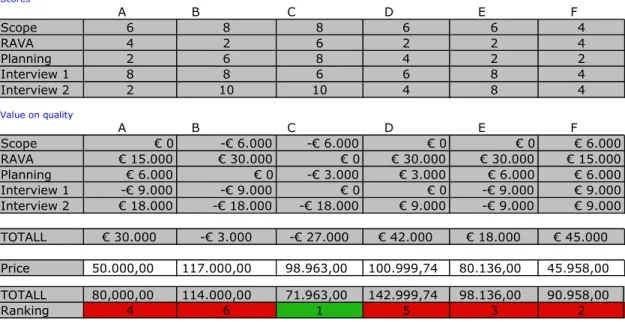
The interviews were better than the quality documents. Most of the key persons scored sufficient or even better. Thus, the interviews had a great added value and showed dominance. The final scores are given for Lot 1, revealing the potential best value vendor as vendor C (Figure 1).
Figure 1. Final scores Lot 1
The Pre-Award
Vendor C, the potential best value vendor of Lot 1, was also the remaining tenderer for Lot 2. For Lot 2, they also had a good score, and were therefore invited to enter and lead the Pre-Award phase for both lots. Already in the first Pre-Award meeting, vendor C (herein, the contractor) was very proactive. They took the lead, gave a schedule for the next meetings and proposed to make one integral plan for the execution of the assignment for both lots. In this meeting an explanation of the weekly risk report (WRR) and its use was given to the contractor. In the next week, they immediately started working with the WRR (see annex 1 for a submitted WRR). The Pre-Award phase took about four weeks. The contractor determined the duration of this phase. During this phase, they clarified their proposal (scope, financial plan, and the value adds) and made a detailed plan of the execution. They also made a risk management plan (RMP). All the risks of the other tenderers and the list of concerns of Velt en Vecht were given to the
Scores A B C D E F Scope 6 8 8 6 6 4 RAVA 4 2 6 2 2 4 Planning 2 6 8 4 2 2 Interview 1 8 8 6 6 8 4 Interview 2 2 10 10 4 8 4 Value on quality A B C D E F Scope € 0 -€ 6.000 -€ 6.000 € 0 € 0 € 6.000 RAVA € 15.000 € 30.000 € 0 € 30.000 € 30.000 € 15.000 Planning € 6.000 € 0 -€ 3.000 € 3.000 € 6.000 € 6.000 Interview 1 -€ 9.000 -€ 9.000 € 0 € 0 -€ 9.000 € 9.000 Interview 2 € 18.000 -€ 18.000 -€ 18.000 € 9.000 -€ 9.000 € 9.000 TOTALL € 30.000 -€ 3.000 -€ 27.000 € 42.000 € 18.000 € 45.000 Price 50.000,00 117.000,00 98.963,00 100.999,74 80.136,00 45.958,00 TOTALL 80,000,00 114.000,00 71.963,00 142.999,74 98.136,00 90.958,00 Ranking 4 6 1 5 3 2
© PBSRG 2012 Journal for the Advancement of Performance Information and Value VOL. 4 NO. 2 203 contractor as part of the RMP. The contractor compiled them into the RMP.
The contract for the assignment was also made by the contractor and Velt en Vecht, based on the contractor’s project plan.
Execution
During the first months of execution, Velt and Vecht was satisfied with the way the contractor was performing the contract. The inspection reports they had to submit were complete and submitted on time. After about three months there was deterioration. The maintenance was performed less accurately (e.g. oil in the pumps was not refreshed and because of that there were failures) and the inspection reports were incomplete and submitted too late. The employees of Velt en Vecht had a tendency to interfere with the execution and tell the contractor how to act. The purchase officer of Velt and Vecht asked the author to support them. First, there was a meeting with the employees of Velt en Vecht. The employees had the opinion that the problems were caused by the fact that BV procurement was used and the contractor had too much freedom. It was explained to the employees that the contractor has to take his responsibility as an expert and that they will be asked how to solve the problem at hand.
Subsequently, a meeting was held with the contractor. The contractor’s project leader and director attended the meeting. They were told about the problems in the field and the incomplete inspection reports were shown to them. They were asked if it was possible for them to make an offer for corrective maintenance based on their inspection reports. They both had to admit that their employees had not performed well. They were asked to give a solution for this. The contractor decided to inspect again all the objects where the maintenance had been carried out poorly, to do the necessary preventive maintenance, and draw up new inspection reports at their own expense.
In an evaluation meeting, the contractor’s project leader said that they had underestimated their role. Their employees were accustomed to a client who tells them what to do. They also had other projects and thought that their maintenance staff would know what to do after a few months and gave less attention to support them in their new role. As a result, they fell back into their old roles (reactive). Furthermore, the project leader and director said that they are very enthusiastic about BV because it enabled them to show what their capabilities were and held them accountable to work more efficiently because they themselves are now able to decide how to execute the contract. They have learned from the past period and now pay more attention to supporting their employees.
Evaluation of the Tender Procedure
In December, the tender-procedure was evaluated with the tender committee. Velt en Vecht evaluated the tender as successful with the following points of attention:
Two tenderers had to be declared “invalid” because they did not meet the minimum requirements. This brings the perceived risk that the contracting authority had to exclude a tenderer who might be the expert. A solution can be next time not to give minimum requirements for financial and economic standing and technical
© PBSRG 2012 Journal for the Advancement of Performance Information and Value VOL. 4 NO. 2 204
competence. The only requirements can be a copy of a relevant entry in the trade or professional register and that the grounds for exclusion as given in the European Law are not applicable. In the BV system: after judgment of the tenders it is clear who the expert is, so there is no immediate need to give minimum requirements.
Tenderer F had bad scores on the quality documents and the interviews. Nevertheless, they still ended at the second place, due to a very low price. At the next BV
procurement, Velt en Vecht will introduce “a threshold” for the interviews. If a tenderer has a negative (weighted) score on the quality documents, resulting in an addition on his price, they will not be invited for the interviews.
As evidenced by the issues in the execution phase, this was a learning process for Velt en Vecht and the contractor. The contractor should regularly consult with the
employees of Velt en Vecht and do what is necessary to help them to become comfortable in their new “BV role”.
The contractor should regularly consult with the client in order to evaluate the execution. The contractor is responsible for feedback to their employees.
Conclusion
The following conclusions can be drawn from the Velt and Vecht test of BV PIPS:
Velt and Vecht is a BV owner and is actively looking for contractors using the BV process.
The change to BV PIPS was a paradigm shift even for the visionary owner.
The selection committee still was using their experience to rate the contractors rather than allowing the contractors to differentiate themselves.
The contractors could not overcome their lack of familiarity with the PIPS system to become proactive and expressing their vision for the project.
An improvement on the BV PIPS methodology, using project capability instead of scope, would minimize the selection panel experts’ propensity for using their experience to rate the contractors.
In the execution phase of the contract, it’s important that both the employees of Velt en Vecht and the employees of the contractor are aware of their “BV role.” It’s the responsibility of the visionaries of Velt en Vecht and the contractor to support their employees in this. It’s not necessary that the employees change, it’s enough that they understand their role and fall back to their visionary as soon as there is a question or problem.
The use of BV PIPS in Velt and Vecht shows that there are BV clients who are looking for a solution. When visionary clients use BV PIPS, it shows that BV does not require the visionary professional to change the client personnel. The author suggests that organizations that will use BV do exist, and their minds do not have to be changed.
References
Kashiwagi, D. (2011). Case Study: Best Value Procurement/Performance Information
© PBSRG 2012 Journal for the Advancement of Performance Information and Value VOL. 4 NO. 2 205
and Value, 3 (1), 12-45.
PSI Bouw (2007); Gunnen op Waarde, hoe doe je dat? Rapport in het kader van het PSI Bouw- programma Gunnen op waarde (in Dutch).
Van Abeelen, A. (2012). Case Study: Contracting Rolling Stock Maintenance of Utrecht
Tramway, the Netherlands. Journal for the Advancement of Performance Information and Value, (this issue).
Van Leeuwen, M. (2011). Using Best Value PiPS Procurement in Europe, Need for
Compromise? Journal for the Advancement of Performance Information and Value, 3 (1), 56-71. Van de Rijt, J. & van den Hoogen, H. (2012). A New Sewage System with Best Value
Procurement. Journal for the Advancement of Performance Information and Value, (this issue). Rijt, J. van de, Witteveen, W., Vis, C., Santema, S. C. (2011). Best Value at the Directorate-General for Public Works and Water Management in The Netherlands: A Case Study of the Procurement of Infrastructure Projects Worth $1,200M. Journal for the Advancement of Performance Information and Value, 3 (1), 90-100.
UVW. (2012). Unie van Waterschappen. URL www.uvw.nl (visited 27 December 2012). Velt en Vecht. (2012). Velt en Vecht. URL www.veltenvecht.nl (visited 27 December 2012).