Image Segmentation Based Face Recognition
Using Enhanced SPCA-KNN Method
Mrs.J.Savitha M.Sc.,M.Phil.,
Ph.D Research Scholar,Karpagam University, Coimbatore, Tamil Nadu, India.
Dr.A.V.Senthil Kumar.,
Director, Hindustan College of Arts and Science, Coimbatore, Tamil Nadu, India.
Abstract- In this paper we tend to propose a completely unique technique for face recognition mistreatment hybrid ESPCA-KNN (SIFT-PCAKNN) approach. The projected technique consists of 3 components. The primary half is predicated on pre-processing face pictures mistreatment Graph primarily based formula and SIFT (Scale Invariant Feature Transform) descriptor. Graph primarily based topology is employed for matching two o face pictures. Within the second half Manfred Eigen values and Manfred Eigen vectors are extracted from every input face pictures. The goal is to extract the vital info from the face information, to represent it as a collection of recent orthogonal variables referred to as principal elements. Within the final half a nearest neighbour classifier is intended for classifying the face pictures supported the ESPCA-KNN formula. The formula has been tested on one hundred totally different subjects (15 pictures for every class). The experimental result shows that the projected technique incorporates a positive result on overall face recognition performance and outperforms different examined strategies.
Keywords-Image segmentation, face recognition, PCA, KNN, ESPCA-KNN.
1. INTRODUCTION
Human face detection and recognition techniques have attracted a lot of attention over the years and lots of algorithms are developed. Face recognition has several potential applications in pc vision, closed-circuit television, linguistics video analysis and automatic access management systems. the matter of automatic face recognition are often declared as follows: given a picture of a personality's face (test set or probe), compare it with pre-stored models of a collection of face pictures labelled with the person’s identity (the coaching set or reference), and report the matching result. Face segmentation is a vital step within the face recognition system as a result of majority of face classification techniques tend to solely work with labelled face pictures. Note that overall performance and responsibleness of a face recognition system depends on properly tagged face space, so correct face segmentation is one amongst the crucial tasks in face recognition system style. Purpose of the face segmentation step is to extract the realm, from given massive image that contains solely face. However, nice variability in image look attributable to cause variation, occlusion, image orientation, illuminating condition and facial features,
Generates nice difficulties in algorithms implementation [1]. Hence, the face segmentation task still remains a challenge despite of nice effort in such algorithms development. Image segmentation, in general, splits a given image into range of regions, that ar of interest. this will be performed by analysis of cross-correlation between adjacent pixels among constant feature (or descriptor) within the image. SIFT (Scale-invariant feature transform) options are well-tried to be sturdy against face look variability so they're typically applied as inputs to face segmentation algorithms [2]–[4]. The factors that notably influence the segmentation ar complicated background color, orientation and also the distance of the device from the face. The face segmentation methodology relies on pure mathematics, colour, appearance, or motion and edge data. for instance, the intensity primarily based segmentation algorithms could cause misclassification in cases wherever the intensities of the background ar larger than the intensities of the item being metameric [5], [6]. the ultimate accuracy of our hybrid ESPCA-KNN rule depends on the correctness and quality of image segmentation. The Graph primarily based segmentation rule is deployed so as to boost preciseness of the key points search and overall quality.
The planned hybrid technique, given during this article, employs a brand new feature projection - classification approach named ESPCA-KNN technique along side Graph primarily based segmentation algorithmic rule. Our hybrid technique lies together of ESPCA (SIFT-PCA) projection and KNN classification. By SPCA we tend to demonstrate that PCA is well-suited to representing key purpose patches (once they need been reworked into a canonical scale, position and orientation), which this illustration considerably improves SIFT’s matching performance. This hybrid approach combines benefits of each algorithmic rules: Scale invariant property of SIFT and decoration relation ability (towards higher reparability of data) of Principal element Analysis (PCA) algorithm, As a back-end, KNN rule is applied. This algorithmic rule is employed to classify the various face pictures.
Vector Machine) [8]. From the results, it's indicated that the planned classifier is superior to another classifier.
The definition of the paper is as follows. Section a pair of provides transient summary of the progressive in face recognition. The planned technique of face recognition is represented in finally experimental results and implementation problems area unit mentioned in Section four and it's followed by conclusion.
2. FACE RECOGNITION SYSTEM:
One of the foremost difficult issues in face recognition is the way to agitate is Associate in Nursing applicable separation of the information that has to belong to identical category. Within the face recognition task, a category represents all information of identical subject (i.e. all pictures of identical person). The goal is to implement the automatic machine-supported system that (after format and coaching on a sampling of images) acknowledges person's identity within the image that has not been incorporated into the coaching. potential approaches and steps in face recognition system area unit printed.
Input image from database
2.1 The procedure of face recognition may be divided into the subsequent steps:
First, input pictures area unit divided. As {a partial neighbourhood- an area Unitika district region locality vicinity section} of this method image options mistreatment SIFT are extracted and processed. Second, coaching of the categoryifier followed by creation of models for every class is performed. Finally, these classifications models [9] area unit won’t to recognize/classify unknown probe pictures (i.e. pictures from the take a look at set).
Situation of the face recognition method is illustrated during this figure; the gallery could be a set of famous people. The photographs won’t to take a look at the algorithms area unit known as probes. A pursuit is either a replacement image of individual within the gallery or a picture of a personal, not conferred within the gallery. To calculate performance, one wants each a gallery and probe set.
The probes square measure LED to a classification algorithmic program, and therefore the algorithmic program returns the simplest match between every probe and pictures within the gallery. The calculable identity of the probe is that the best match [10].Image segmentation (automatically partitioning a picture into regions) is a very important stage of the projected algorithmic program for face recognition.
IMAGE SEGMENTATION METHODS:
The Graph based mostly segmentation rule is deployed so as to boost exactness of the key points search and overall quality. The ultimate results of the rule square measure keen about the standard of the initial image segmentation. There square measure many techniques to live quality of image segmentation. One amongst the techniques analyses similarity of pixels within the same section, and difference if pixels over the various segments. Consequently, edges between 2 vertices ought to have low weights within the same section and high weights if the vertices square measure placed in several segments [11].The following 2 necessary problems arise if associate degree economical graph-based rule is to be designed:
Definition of live of distinction between 2 elements or segments, definition of function. The rule starts with the step wherever every section contains only 1 component. Within the next step, segments square measure iteratively incorporate by exploitation the subsequent conditions:
Diff (I1, I2≤Int (I1) +T (I1) Diff (I1, I2≤Int (I2) +T (I2)
where Diff (I1,I2) is that the distinction betweenI1 and I2 elements, Int(I1) and Int(I2) square measure internal variations of I1 and I2 elements, T(I1) and T(I2) square measure threshold
,
2.2 SIFT Descriptor
implementation uses sixteen histograms of eight bins (8 orientations), which provides a 128 dimensional descriptor. [15].
2.3Transforms of the Image Feature Space:
Goal of this step is rework image options to the shape that is additional appropriate for classification. Common rework strategies are listed within the middle column of (PCA, CCA and PCA-CCA).Principal element Analysis (PCA) [16] could be a normal technique for spatial property reduction and has been applied to a broad category of laptop vision issues, as well as feature choice, beholding and face recognition. Canonical Correlation Analysis (CCA) could be a appropriate and dominant technique which may be used for exploring the relationships among multiple dependent and freelance variables. thus a robust feature projection approach for facial pictures is projected supported canonical correlation analysis. CCA acknowledges and measures the connection between 2 sets of variables. Finally CCA finds a try of linear mixtures that has the best correlation [17]. Hybrid strategies also are common. PCA-CCA has been investigated by [17]. The PCA-CCA rule of face recognition uses as input 2nd pictures. The canonical parametric statistic between input reference image and also the take a look at pictures is calculated by the PCA-CCA rule. The principle of PCA-CCA rule.
2.4 Feature Classification:
K-Nearest Neighbour algorithmic rule (KNN) could be a methodology for classifying objects supported nearest coaching examples within the feature vector. Associate object is classed by a majority vote of its neighbours [18]. the worth of k is set supported the scale of the information used for classification. If k = 1, then the thing is just allotted to category of its nearest neighbour, larger values of k cut back the result of noise on the classification, however build boundaries between categories less completely different. Among alternative ways, SVM, neural network and theorem classifiers is also mentioned [19], [20].
3. PROPOSED METHOD
In this section we tend to gift the planned methodology for fusing 2 approaches to face recognition: SPCA illustration and KNN classification. the target of the planned methodology is to acknowledge a 2nd object containing a personality's face. For recognition purpose,
ESPCA-KNN is employed as classifier supported by the native feature. The native feature extracted from the given image is Harris-Laplace detector alongside SPCA descriptor. The native options utilized in this study have unchangingness property.
3.1 PCA – based SIFT Descriptors (SPCA)
The idea of applying PCA to image patches isn't novel [21], [22]. Our contribution lies in strictly demonstrating that PCA is well-suited to representing key purpose patches (once they need been reworked into a canonical scale, position and orientation), which this illustration considerably improves SIFT’s matching performance. SPCA descriptor is additionally supported the gradient image, the most distinction with SIFT being the any compression exploitation PCA. The uncompressed dimension of the descriptor is 3042 (39x39) that is reduced to thirty six when applying PCA [23], [24]. SPCA may be summarized within the following steps:
Pre-compute Associate in nursing eigenspace to precise the gradient pictures of native patches, given a patch, cypher its native image gradient, project the gradient image vector exploitation the eigenspace to derive a compact feature vector.
This feature vector is considerably smaller than the quality SIFT feature vector, and may be used with an equivalent matching algorithms. The geometer distance between 2 feature vectors is employed to work out whether or not the 2 vectors correspond to an equivalent key purpose in several pictures
.3.2 K-Nearest Neighbour (KNN)
So far just in case of KNN we tend to continuously set k = one we'd wish to study the impact of k on accuracy. We tend to observe that with the increasing price of k, accuracy bit by bit goes down. For instance, for k = one KNN observes ninety two accuracy. On the opposite hand, for k = ten KNN observes seventy six accuracy. Finally, Fig. four demonstrates that k = one is that the best option and therefore, during this paper, we've got used k = one for news result.
To make a prediction for a take a look at example the subsequent steps are followed:
Figure the space of take a look at vector with all coaching vectors thought-about.
Realize the k nearest vectors. Prepare the space in ascending order and opt for the nearest label. In this study KNN algorithmic rule is employed for the primary stage of classification with geometrician distance as distance live. The geometrician distance formula is shown below:
Where x and y are geometrician vectors [25].
3.3 ESPCA-KNN
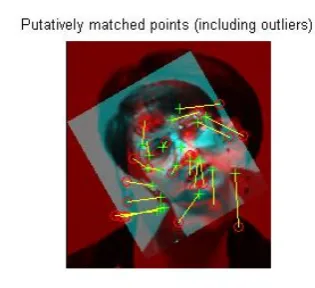
(for corner extraction Harris-Laplace corner detection methodology [26], [27] is applied).The aim of segmentation formula is to extend the reparability between skin and non-skin categories. Once the corners square measure extracted then the feature vector is made exploitation SIFT formula. The SIFT options square measure extracted from all faces within the information. Then given a brand new face image, the options extracted from that face square measure compared against the options from every face within the information. A feature is taken into account as matched with another feature once the space thereto feature is a smaller amount than a selected fraction of the space to subsequent nearest feature. This ensures that we have a tendency to scale back the amount of false matches. The face within the information with the biggest range of matching points that agrees with the spacial distributions of the key points is taken into account as nearest face and is employed for the classification of the new face. ESPCA is employed to search out the nearest neighbours of the given segmental image with all the out there coaching pictures. If a label is found then the formula equal, otherwise the ESPCA-KNN is applied to label the item [27], [28].
In our planned methodology, coaching part and testing part square measure divided into the subsequent stages:
Training phase:
a. Coaching pictures square measure hand-picked and placed within the folder.
b. Scan the coaching pictures.
c. Pre-process every image by reducing the image size to 180x200 and apply image segmentation and Harris Corner detection formula.
d. Native options (Harris-Laplace and SPCA) square measure extracted from the pre-processed image and construct.
e. The feature vector for the given image. f. Feature vector is made by the native options
of the image as row during a matrix.
g. Repeat steps a pair of to Step five for all the coaching pictures
h. The KNN methodology is trained and tuned for testing part.
Testing phase:
a. Scan the take a look at pictures.
b. KNN is applied initial. The closest neighbours square measure known exploitation the geometer distance perform.
Training information:
If the K neighbours have all a similar labels, the question is labelled and exit; otherwise, cypher try wise distances between the K neighbours and construct the space matrix.
4. EXPERIMENTAL RESULTS
The planned approach is enforced on the Pentium IV two.8 GHz. The experiments are done on face databases [29] and enforced in MATLAB surroundings. This information consists of pictures of a hundred totally
different objects with inexperienced background. Thus for each object, there ar fifteen pictures (it is 1500 pictures for the complete database). For a few subjects, pictures were taken at totally different times variable the lighting, facial features (open, closed eyes, smiling or not smiling) and facial details (glasses, no glasses). Every image has the dimensions of one hundred eighty x two hundred pixels. We’ve got created 2 comparisons on the idea of that the impact of segmentation for face recognition has been tested (see Tab. 2 and Tab. 3). In coaching section, we tend to used segmental face pictures from the information [29]. We tend to applied Graph primarily based segmentation rule for segmenting a hundred objects (therefore coaching information contains a hundred images). As check section we tend to used classic pictures from face information [29]. Next, we've got integrated this segmentation rule with the ESPCA methodology. ESPCA consists of 2 half’s: SIFT half and PCA part. As already explicit, our experimental results tried that the SIFT descriptor may be a terribly sturdy and reliable illustration for the native neighbourhood of a picture purpose (see Fig. 9). Eigen faces are calculated by mistreatment PCA rule and experiments ar performed by variable the quantity of eigenfaces employed in face house to calculate the face descriptors of the photographs [30]. Eigenfaces are computed for every face within the information and also the eigenface of the question face is compared with all faces within the information. Comparison is finished by computing euclidian distance between 2 eigenfaces mistreatment KNN. The euclidian distance between the testing image feature and also the coaching image feature is set by finding the distinction between the testing and also the coaching feature and a distance matrix is made. Nearest neighbour of the question is retrieved that has minimum distance. within the distance matrix, initial k worths are thought of and also the majority label of the k value is taken into account because the correct label of the given testing image [30], [31] some resultant face pictures from each PCA and ESPCA are shown during this figure shows 2 false positives and one correct positive retrieved mistreatment PCA and 2 correct positives retrieved and one false positive mistreatment ESPCA approach.
Computation time is counted for the whole process which has feature police investigation, matching and Recognition. A show that ESPCA is that the quickest one, SIFT is that the slowest however it finds the foremost matches.
The performance of system is measured in terms
of accuracy. The accuracy is given by, Q=M/P
Proposed ESPCA-KNN rule is more practical classification technique than the opposite Algorithms. Moreover, to speed retrieval for KNN we have a tendency to advocate to the usage of ESPCA. This rule achieved a close to real time recognition performance and high correct results.
Comparison of algorithm:
S.No Algorithm Accuracy Error rate period Time
1. KNN 95.2 0.32 0.23
2. SPCA 97.5 0.27 0.22
3. ESPCA 98.3 0.21 0.15
This table is shows the comparison of KNN, SPCA, ESPCA algorithms based on some parameters accuracy and error rate, time period.
This above chart shows the comparison bar plot of above algorithms KNN, SPCA, ESPCA and second plot for error rate calculation
5. CONCLUSION
In this paper, we've got projected a mix of Graph primarily based segmentation rule and face recognition approach supported SIFT options, PCA and KNN algorithms. For native feature, the Hessian-Laplace detector beside ESPCA descriptor is employed. The classifier wont to determine the face from the feature vector is SPCA-KNN. ESPCA is performed to spot the item. KNN classifier is applied to spot the nearest object from the trained options. Within the projected technique, the item recognition is completed with larger accuracy. The projected SPCA approach is compared with eigenfaces and tested its superiority through experiments. As associate extension, we tend to square measure investigation the employment of SIFT options and impact image segmentation for retrieval of correct face with alternative varieties of face representatives. Take a look at results gave a recognition rate of concerning ninety fifth for non-segmented info [28] and ninety eight for metameric info (700 coaching images) victimization projected ESPCA-KNN technique.
We’ve got introduced a feature extraction technique from still pictures, that are evaluated on info and our metameric info. This method has been found to be sturdy against extreme expression variation because it works expeditiously on info. We’ve got shown that the segmentation victimization ESPCA-KNN features a positive impact for face recognition and accelerates the popularity KNN technique.
Future work can embrace the method of Kernel principal element analysis to scale back the feature vector in order that high-dimensional information is handled with less complexness. Additional work got to be performed to extend the popularity proportion. In future, we tend to conjointly decide to perform experiments and also tests of more complex algorithms with aim to compare the presented approach with other existing algorithms. We are also planning to investigate reliability of the proposed method by involving larger databases of images.
Algorithms Total images
Total time
100 image time
KNN 300 7.3 4.2
spca 250 6.8 3.7
REFERENCES
[1] BELHUNMEUR, P. N., HESPANHA, J. P., KRIEGMAN, D. J.Eigenfaces vs. fisherfaces recognition using class specific linear
projection. IEEE Trans Pattern Analysis and Machine
Intelligence,1997.
[2] ZHAO, W., CHELLAPPA, R., ROSENFELD, A. Face recognition:a literature survey. ACM Computing Surveys, 2003, vol. 35,no. 4, p. 399-458.
[3] BERND, H., KOSHIZEN, T. Components for face recognition. InProceedings of the 6th International Conference on Automatic Face and Gesture Recognition. Seoul (Korea), 2004, p. 153 - 158. [4] MARCIALS, G. L., ROLI, F. Fusion of LDA and PCA for face
recognition. In Proc. of the Workshop on Machine Vision andPerception. 8th Meeting of the Italian Association of ArtificialIntelligence. Siena (Italy), 2002.
[5] JIANBO, S., MALIK, J. Normalized cuts and image segmentation.IEEE Transactions on Pattern Analysis and Machine Intelligence,2002, vol. 22, no. 8, p. 888 - 905.
[6] HE, R., ZHU, Y. A hybrid image segmentation approach based on Mean Shift and fuzzy C – means. In Asia – acific Conference onInformation Processing. [Online] 2009.
[7] YANG, W., LEI, Z., SANG, J. 2D-3D face matching using CCA method. National Laboratory of Pattern Recognition Institute of Automation. Beijing (China), 2008.
[8] CORTES, C., VAPNIK, V. Support vector networks. Machine Learning, 1995, vol. 20, p. 273-297.
[9] PARVEEN, P., THURAISINGHAM, B. Face recognition using multiple classifiers. In 18th IEEE International Conference on Tools with Artificial Intelligence (ICTAI). 2006, p. 179-186.
[10] KWAK, K. C., PEDRYEZ, W. Face recognition: A study in information fusion using fuzzy integral. Pattern Recognition Letters, 2005, vol. 26, p. 719 - 733.
[11] FELENZWALB, P. F., KLETTE, R. Efficient graph-based image segmentation. International Journal of Computer Vision, 2004,vol. 59, no. 2. [Online]
[12] DONG, L., OGUNBONA, P., LI, W., YU, G., FAN, L., ZHENG,G. A fast algorithm for color image segmentation. In FirstInternational
Conference on novative Computing. Informationand Control
(ICICIC), 2006. [Online]
[13] LOWE, D. G. Distinctive image features from scale-invariant key points. International Journal of Computer Vision, 2004,vol. 60, no. 2, p. 91-110.
[14] MIKOLAJCZYK, K., SCHMID, D. Scale and affine invariant interest point detectors. International Journal of Computer Vision,2008, vol. 60, no. 1, p. 63-86.
[15] BOLECEK, L., RICNY, V. LANINA, M. Fast method for reconstruction of 3D coordinates. In 35th International Conferenceon Telecommunications and Signal Processing (TSP), 2012, ISBN 978-1-4673-1115-1.
[16] COOLEY, W., LOHNES, W. PCA correlation. P. R. Multivariate Data Analysis. New York: John Wiley & Son. Inc.
[17] HE, Y., ZHAO, L., ZOU, C., LIPO, W., KE, C., SOON, O. Y.Face recognition based on PCA/KPCA plus CCA. In Proceedings of International Conference on Advances in Natural Computation. Heidelberg: Springer. LNCS 3611. 2005, p. 71-74.
[18] MURALIDHARAN, R., CHANDRASEKAR, C. Combining local and global feature for object recognition using SVM-KNN. In Proceedings of International Conference on Pattern Recognition. Informatics and Medical Engineering. 2012, ISBN 978-1-4673-1039-0/12.
[19] MAZANEC, J., MELISEK, M., ORAVEC, M., PAVLOVICOVA,J. Support Vector M achine, PCA and LDA in face recognition.Journal of Electrical Engineering, 2008, vol. 59, no. 4, p. 203 to209. [20] MA, Y., DING, X. Face detection based on hierarchical Support
Vector Machines. Proc. ICRP, 2002, p. 222-225.
[21] MARTINEZ, A. M., KAK, A. C. PCA versus LDA. IEEE Trans.Pattern Analysis and Machine Intelligence, 2001, vol. 23, no. 2,p. 228-233.
[22] TURK, M., PENTLAND, A. Eigenfaces for recognition. Journal of Cognitive Neuroscience, 1991, vol. 3, no. p. 71 - 86.
[23] JUAN, L., GWUN, O. A comparison of SIFT, PCA-SIFT and SURF. International Journal of Image rocessing, 2009, vol. 3,no. 4, p. 143-152.
[24] YAN, K., SUKTHANKAR, R. PCA-SIFT: A more distinctive representation for local image descriptors. In Proc. IEEE Conf.Computer Vision and Pattern Recognition (CVPR). 2004, vol. 2,p. 506-513.
[25] LI, L., ZHANG, Y., ZHAO, Y. K-nearest neighbors for automated classification of celestial objects. Science in China Series G-PhysMech Astron., 2008, vol. 51, no. 7, p. 916 - 922.
[26] KIRBY, M., SIROVICH, L. Application of the Karhunen-Loeve, procedure for the characterization of human faces. IEEE Trans.Pattern Anal. Mach. Intelligence, 1990, vol. 12, no.1, p. 103 - 107.
[27] CHENNAMMA, H. R., RANGARAJAN, L., RAO, M. S. Robust,near-duplicate image matching for digital image forensics. International,Journal of Digital Crime and Forensics, 2009, vol. 1,no. 3, 18 p.
[28] ZHOU, Y., MAYYAS, A., MOHAMMED, A. PCA based image fusion routine with application to automotive stamping split detection.Research in Nondestructive Evaluation, 2011, p. 76 - 91. [29] Essex Face Database. [Online] Cited 2012-01-17. Available
at:http://cswww.essex.ac.uk/mv/allfaces/index.html.
[30] CONDONE, C., RUIZ, A., CABELLO, E. PCA vs. Low Resolution Images in face verification. In Proceedings of the 12th International Conference on Image Analysis and Processing,2003.
[31] BACH, F. R., JORDAN, M. I. A probabilistic interpretation of canonical correlation analysis. TR 688. University of California,Berkley, 2005.