Movement and Sources of
Basement Ventilation Air and Moisture
During ASD Radon Control
Additional Analysis
May 20, 2009
Contractor Report to:
U.S. Environmental Protection Agency Indoor Environments Division
Washington, DC
Under Cooperative Agreement No. XA83146010
by Bradley Turk
Environmental Building Sciences, Inc. Las Vegas, New Mexico 87701
505-426-0723
and Jack Hughes
Southern Regional Radon Training Center Engineering Extension
217 Ramsay Hall
Auburn University, Alabama 36849-5331 800-626-2703
Contractor Report to EPA: Movement and Sources of Basement Ventilation Air and Moisture During ASD
ABSTRACT
The original study in three Pennsylvania houses found that operation of active soil
depressurization (ASD) radon control systems caused modest reductions in basement moisture levels. Additional, supplemental analysis has been conducted on the relationship between basement air and outdoor air moisture, and on the movement of airborne sources of basement air moisture under the influence of ASD systems. Results indicate that moisture levels in the air of the basement, first floor, soil, and outdoors are all strongly intercorrelated (correlation
coefficients ranging from 0.6 to 0.9), with basement and outdoor air having correlation
coefficients of approximately 0.77 and lagged responses for basement air of six to 12 hours, for all houses. Simple linear regression models found that moisture from the outdoor air directly, and indirectly from the other zones, explained approximately 70% of the overall variation in basement air moisture levels.
Examining the movement of airborne moisture sources and basement air moisture revealed that all houses experienced large variations in interzonal air flows and ventilation, and that ASD operation increased the flow of outdoor and upstairs air into the basement. ASD operation virtually eliminated the minor, pre-existing flow of air and moisture from the soil, which may be a more important source in houses with larger soil gas entry. Lower moisture levels in outdoor air in winter and the upstairs air in summer (due to dehumidification by the HAC systems) have the potential to help dry the basement or offset moisture entry from other sources. The ASD systems extracted and exhausted large quantities of moisture from the house and soil around the house, implying that the systems may cause long-term drying of the basements. For one house, direct block wall depressurization (BWD) more effectively reduced wall moisture than sub-slab ASD. Results again hint that ASD/BWD may have a much larger, beneficial impact on moisture levels and conditions for microbial growth in and around the microclimate of moisture-sensitive, finish materials applied to basement walls and floors. ASD for effective moisture control may require higher air flow and PFE than is necessary for effective radon control. Although additional ventilation from ASD operation may help IAQ, its lack of control and predictability can cause over- and under-ventilation, and may be detrimental in some cases.
Contractor Report to EPA: Movement and Sources of Basement Ventilation Air and Moisture During ASD
TABLE OF CONTENTS
Executive Summary ... Introduction ... A. Relationship Between Basement and Outdoor Air Moisture ...
A1. Background... A2. Analytical Approaches and Results ...
A2.1 Correlation
A2.2 Lag/Response Time of Selected Variables ... 2A.3 Ordinary Least Squares Regression (OLS) ... A2.4 Autoregression ... A3. Summary of Findings ...
B. Basement Moisture Sources and Movement, and ASD Moisture Considerations ... B1. Background ... B2. Description of Moisture and Air Flow Variables ...
B2.1 Air Flows ... B2.2 Absolute Humidity ... B2.3 Radon ... B2.4 Soil Gas Entry ... B2.5 Moisture Exhausted by ASD ... B3. Basement Moisture Sources and Flows ... B3.1 Relative Moisture Index ... B3.2 Air Flow into Basement ... B3.3 Drying/Wetting Potential of Convective Moisture Sources ... B3.4 Net Convective Flow of Moisture ... B3.5 Moisture Extraction by ASD Systems ... B4. Drying Mechanisms...
Contractor Report to EPA: Movement and Sources of Basement Ventilation Air and Moisture During ASD
B5. ASD System Design Issues and Considerations ... B5.1 ASD System Air Flows ... B5.2 Pressure Field Extension ... B5.3 Depressurization/Ventilation of Block Walls ... B5.4 Potential Drying Effects on Foundation and Near-Surface Materials... B5.5 Unintended Ventilation Caused by ASD Operation ... B6. Summary of Findings ...
C. Acknowledgements...
D. References ...
Appendices
Appendix A- Correlation Matrices Appendix B – Regression Results
Contractor Report to EPA: Movement and Sources of Basement Ventilation Air and Moisture During ASD ES-1 / 4
EXECUTIVE SUMMARY
An earlier, exploratory study in three Pennsylvania houses found that operation of active soil depressurization (ASD) radon control systems caused modest reductions in basement moisture levels (Turk and Hughes 2008). The reporting and analysis of data covered the theoretical framework; basic presentation of data on air movement, building air leakage, and moisture levels; and results showing that basement moisture levels were significantly reduced during non-summer periods. While extensive data was collected during the study, analysis of other, related topics was limited.
Therefore, additional analyses have been conducted on the relationship between basement air and outdoor air moisture, and on the movement of airborne sources of basement air moisture under the influence of ASD systems, and findings are reported here. This report is best
considered as a supplement to the original study report, which contains detailed descriptions of experimental procedures and is frequently referenced throughout this document. Readers are encouraged to first become familiar with the original study report.
Relationship Between Basement and Outdoor Air Moisture
Review of original data from the three Pennsylvania houses indicate that moisture in the basement air (along with first floor air and soil air below the basement slab floor) tends to
closely follow moisture changes in outdoor air. In fact, this linkage appears to dominate over the measureable, but smaller, changes in basement air moisture caused by cycling of the radon control systems. Basic statistical assessment were performed and findings include:
Five variables were identified as most likely to have an impact on basement moisture: outdoor air moisture, first floor moisture, sub-slab soil air moisture, ASD on/off operation, and heating and air conditioning (HAC) equipment operation. The review also pointed out the many inter-relationships between the variables, and comparatively high
correlations between them. Outdoor air entering the soil and the upper floors of the house likely has a strong influence on the air in those spaces, and indeed the correlation
coefficients between them and outdoor air ranged from 0.6 to 0.9. In turn, the moisture levels of the air in those zones influenced the basement air. Therefore, the outdoor air had both direct and indirect (through the other zones) effects on the basement. The correlation coefficients for basement and outdoor air are consistent for all houses at approximately 0.77 with a delayed response, or lag, of approximately six to 12 hours.
While correlation measures association between variables, least squares linear regression models were developed to examine the comparative causation of the dependent variables on basement moisture and their predictive ability. As with most regression models, the predictive ability increased as variables were added, explaining over 95% of the variation in basement air moisture when all five variables were included. However, because of the pass-through of outdoor air through the other two zones, the simplified models of one, two, and three variables (outdoor air, ASD and HAC operation) were evaluated in more detail.
Contractor Report to EPA: Movement and Sources of Basement Ventilation Air and Moisture During ASD ES-2 / 4
Regression with outdoor air moisture alone explained approximately 70% of the variation in the basement air moisture, while ASD and HAC added modest explanatory power (approximately 4%). These results were consistent for all houses and confirm that
changes in outdoor air moisture are a large determinant for changes in indoor air moisture. Remaining variability in basement moisture appears to be largely explained by other source and removal processes in the basement, soil, and upstairs. These would include occupant activities (respiration, cooking, showers, laundry and cleaning, etc.),
dehumidification by HAC equipment, storage effects, precipitation, water leaks, drying of new construction, and diffusion from the soil.
Attempts to estimate the quantities of moisture contributed or removed by outdoor air (and the other factors) produced a broad range of seasonally-dependent responses that are not easily explained. In fact, the regression models estimate that summer season contributions of outdoor air moisture were less than during non-summer periods – which is not in line with expectations and calculations of short-term air flow and moisture during the summer for several of the houses (see below). It is probable that the large cross correlations between the key variables being studied and the underlying assumptions for linear regression models may have limited the ability to fully account for the non-linear relationships between the variables and the contributions of individuals variables to basement moisture.
Autoregression models, using three variables (outdoor air, ASD and HAC operation) to account for the time series nature of the data, were very successful predictors of behavior (R2 greater than 0.995). However, the ordering of the values imposed by the temporal factor, which is not addressed at all in linear regression, makes the relationships less clear.
Basement Moisture Sources and Movement, and ASD Moisture
Considerations
As suggested in the Conceptual Model and data analysis of the original study report, ASD-induced air flows to and from outdoors, the first floor, and the soil were likely to significantly impact moisture levels in the house and basement. This additional, more detailed examination of moisture levels and air flows for the various air masses confirm that ASD, along with other factors (house structural characteristics, seasonally-variable weather and house mechanical operation, and ASD configuration and operating characteristics), can cause large changes in air flow and moisture.
It should be noted that most of the ASD operating periods were quite short, and the data frequently suggest that the full potential effect on moisture levels of a particular ASD operating mode may not have been realized by the end of an individual operating period.
It is likely that ASD remains the most cost-effective method of controlling soil gas entry, especially where entry potential is high (large effective soil-contact leakage area and high soil permeability). Since soil gas entry has the potential to inject large quantities of contaminants such as radon, landfill gases, chemical vapors, and moisture into buildings, ASD should always be considered as a control strategy.
Contractor Report to EPA: Movement and Sources of Basement Ventilation Air and Moisture During ASD ES-3 / 4
The houses experienced large variations in interzonal air flows and outdoor air infiltration, both seasonally and from house-to-house. However, by removing air from the basement through cracks and gaps in the foundation surfaces (and slightly depressurizing the basement), ASD operation generally increased outdoor air infiltration into the basement and upstairs, and the flow of upstairs air into the basement.
As expected, ASD operation appears to have had little impact on the moisture level of the air streams from the outdoors and first floor that enter the basement, although some drying of the soil air may have occurred.
Although soil gas consistently had high moisture levels, the convective flow of soil gas into these houses was generally small, and the moisture contribution to the basement air was typically less than that from other sources. Operation of the ASD systems
dramatically reduced or eliminated this moisture contribution, but that reduction had a relatively small drying effect on the basement air. This finding in these houses is contrary to common assumptions about the generally dominant role of soil gas entry reduction in basement moisture control. However, for houses with larger soil gas entry, the ASD systems‟ control of soil gas entry might be a larger potential drying influence.
Moisture levels in outdoor air exhibited very large variations, but tended to be higher in the Summer than Winter, by factors of three to five, or more. Because the ASD systems tended to increase the infiltration of outdoor air throughout the year, this incoming air has the potential to both enhance the drying of the basement when the outdoor air is drier than the basement (e.g., during the Winter) and to add significant moisture when the outdoor air is wetter (e.g., Summer).
Upstairs air was usually drier than basement air, with the central air conditioning equipment acting to dehumidify this air during the Summer. The data suggest that the ASD systems significantly increased the flow of upstairs air into the basement which often accounted for drying observed in the basement, especially during the Summer and parts of the Spring and Fall. This mechanism appears to partially or completely offset the
additional moisture added to the basement by the incoming outdoor air during warm, humid weather.
In these houses, the ASD systems extracted and exhausted large quantities of moisture, some from within the house, the balance from other sources – presumably the soil around the foundation. The amount extracted generally varied seasonally with the moisture levels in the soil and outdoor air, ranging from approximately 1.2 to 1.5 times higher in the Summer.
The ASD system in one house removed approximately five to 10 times the quantity of moisture as did a standard dehumidifier – implying that the systems may have the potential for more effective, long-term drying of the basements.
In terms of standard ASD installations, radon control effectiveness may not be a good surrogate for moisture control effectiveness. It appears that systems designed and
Contractor Report to EPA: Movement and Sources of Basement Ventilation Air and Moisture During ASD ES-4 / 4
installed for good control of radon may not be optimal for moisture reduction, since greater moisture reductions were achieved from more robust systems with higher flow and PFE than in a typical installation.
Although it is seldom necessary to install block wall depressurization (BWD) for radon control (in homes with open core block foundation walls), direct BWD was most effective at reducing moisture in the block walls of one basement, while sub-slab ASD alone had a smaller effect.
Findings suggest that ASD/BWD systems may provide more effective control of moisture in the materials and small spaces of finished walls and floors. These regions are in closer proximity to the entry locations of moisture-laden soil gas, and would likely experience larger moisture reductions (than basement air) when the systems are operated. Because many finish materials are moisture sensitive and will easily support microbial growth, reduction in their moisture content might have greater beneficial impact on moldy odors and related biocontaminants. This phenomenon was not investigated during this study. While ASD systems tend to reduce moisture by modifying interzonal flows and boosting outdoor air ventilation rates, these changes are not controlled and are difficult to predict and quantify. Although adequate ventilation is desirable and recommended by ASHRAE, ASD as a ventilation technique often misses its mark: over-ventilating with attendant energy penalties, under-ventilating, and/or causing air flow in locations that may actually be harmful. To be a more reliable ventilation approach, ASD systems would need to be carefully, designed, engineered, installed, and operated – at present, an impractical objective. Proper ventilation is more appropriately achieved with techniques other than ASD.
Contractor Report to EPA: Movement and Sources of Basement Ventilation Air and Moisture During ASD 1 / 51
INTRODUCTION
An earlier, exploratory study in three Pennsylvania houses found that operation of active soil depressurization (ASD) radon control systems caused modest reductions in basement moisture levels (Turk and Hughes 2008). The reporting and analysis of data covered the theoretical framework; basic presentation of data on air movement, building air leakage, and moisture levels; and results showing that basement moisture levels were significantly reduced during non-summer periods. While extensive data was collected during the study, analysis of other, related topics was limited.
Therefore, additional analyses have been conducted on the relationship between basement air and outdoor air moisture, and on the movement of airborne sources of basement air moisture under the influence of ASD systems, and findings are reported here. This report is best
considered as a supplement to the original study report, which contains detailed descriptions of experimental procedures and is frequently referenced throughout this document. Readers are encouraged to first become familiar with the original study report.
A. RELATIONSHIP BETWEEN BASEMENT AND OUTDOOR AIR
MOISTURE
While the original study showed that basement moisture levels could be significantly
reduced, the data also appeared to show that, regardless of operation of the radon control system, changes in basement moisture tracked most closely with outdoor air moisture. To estimate the strength of this relationship, and the relationship among other factors that could alter basement air moisture levels, further statistical assessments have been performed.
A1. BACKGROUND
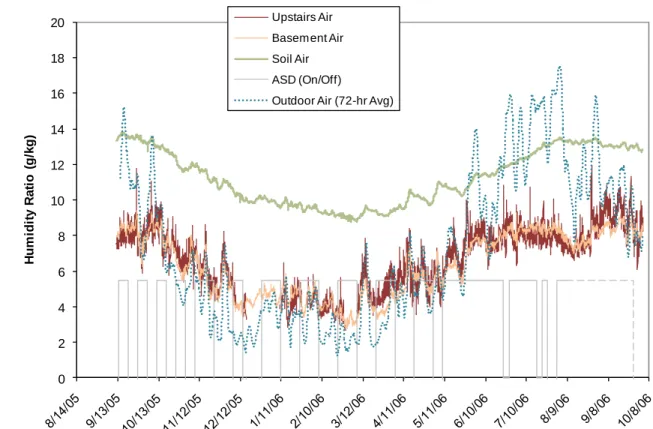
Review of the graphical data from the three Pennsylvania houses indicate that moisture in the basement air (along with first floor air and soil air below the basement slab floor) tends to
closely follow moisture changes in outdoor air (Figure 1). In fact, this linkage appears to
dominate over the measureable, but smaller, changes in basement air moisture caused by cycling of the radon control systems – active soil depressurization. Long-term, seasonal changes are due, in part, to coincident changes in the temperature of air and its subsequent ability to hold moisture. However, based on preliminary results from the study and additional analysis (Section B of this report), it is suspected that air flows between zones within the buildings, between outdoors and indoors, and between the surrounding soil and the indoors accounts for much of the moisture transport. Thus, the flows can either add or remove moisture, depending on the
comparative moisture levels in the various air masses and the direction of air flows.
While indoor moisture sources, from occupant activities (e.g., respiration, cooking, showers, laundry and cleaning, etc.), water leaks, drying of new construction moisture, and diffusion from the soil, have the potential to add large amounts of moisture to the indoors, they don‟t appear to be responsible for most of the changes in indoor moisture levels for these three houses. Figure 1 displays long-term tracking of outdoor air moisture suggesting that outdoor air is the common, underlying cause of indoor air wetting and drying, but that indoor sources and drying
Contractor Report to EPA: Movement and Sources of Basement Ventilation Air and Moisture During ASD 2 / 51
mechanisms (central air conditioning equipment) and perhaps precipitation are likely responsible for episodic changes and some observed divergence from the trend.
Figure 1. Continuously measured and moving average (outdoor) data for variables considered to be important in
contributing to moisture levels in the basement air (PA01).
A2. ANALYTICAL APPROACHES AND RESULTS
To investigate the association between basement air moisture and outdoor air moisture, a physical model of the moisture mechanisms at work in the houses could be created. However, it would require much more comprehensive measurements of moisture, temperature, and air flow and was beyond the scope of this analysis. Instead, simpler statistical assessments, associative and predictive, were applied to test the dependence of changes in basement moisture on changes in outdoor air moisture. Evaluations of relationships were made using correlation coefficients and several variations of the common least squares regression, and different independent variables. Where correlation is useful for measuring association (interdependence) between variables, regression can be used to estimate dependence of one variable on another (causation and ability to predict one from another).
0 2 4 6 8 10 12 14 16 18 20 H um idi ty R a ti o (g/ k g) Upstairs Air Basement Air Soil Air ASD (On/Off)
Contractor Report to EPA: Movement and Sources of Basement Ventilation Air and Moisture During ASD 3 / 51
A2.1 Correlation
The selection of variables was based on a combination of variables that would be
representative of the physical system in conjunction with the statistical concerns of sample size (not more than about 10% missing values) and correlations. Strong correlation between
dependent variables (such as sub-slab soil air, first floor air, and outdoor air moisture) limits the statistical meaning of a regression model framework that incorporates these variables.
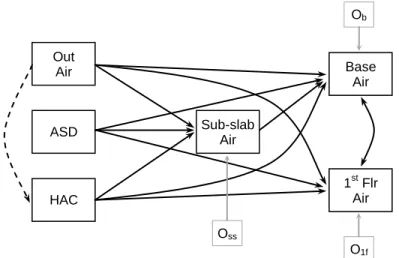
Five of the measured variables meeting these criteria were considered for the models. In Figure 2, the relationships connecting basement air with outdoor air, first floor air, sub-slab (soil) air, and operation of the ASD and heating and cooling (HAC) systems are shown. Other,
undefined, sources of moisture/removal are also indicated (Oi).
The association between these variables is measured by the correlation coefficients in Appendix A, where many are shown to be cross-correlated, reflecting the paths diagrammed on Figure 2. The correlations of the five variables to basement air moisture are summarized in Table 1. For all houses, the strongest correlations occur for first floor air, sub-slab air, and outdoor air, in that order. Since outdoor air is drawn into the first floor and sub-slab, it is likely a large contributor to the correlation, and is augmented by the other factors mentioned above. Table 1. Correlation Coefficients Associating Moisture in Basement Air with Key Dependent Variables.
Description
Basement Air
PA01 PA02 PA03
Outdoor Air 0.837 0.723 0.857
First Floor Air 0.932 0.952 0.969
Sub-slab Air 0.922 0.861 0.928 ASD On/Off 0.209 -0.246 -0.253 HAC 0.070 -0.447 0.163 Out Air ASD 1st Flr Air Base Air Sub-slab Air HAC Ob O1f Oss
Figure 2. Diagram of paths interconnecting primary sources and mechanisms that affect
moisture levels in the basement air. Other, undefined sources (removal) of moisture that may play an important role are aggregated in Oss, O1f, Ob, and may include diffusion, occupants and occupant activities, precipitation, liquid water entry, mechanical dehumidification, storage, etc.
Contractor Report to EPA: Movement and Sources of Basement Ventilation Air and Moisture During ASD 4 / 51
ASD operation is modestly correlated with basement air moisture in all houses, with the negative correlation at PA02 and PA03 being consistent with observed reductions in basement air moisture levels. Interestingly, ASD operation is positively correlated with basement air moisture at PA01 (basement moisture levels and ASD [on] increase together), although subsequent regression analysis demonstrates the expected response when summer and non-summer periods are isolated.
Operation of the HAC equipment that moves heated, cooled, and dehumidified air around the house is controlled by a thermostat on the first floor. Besides dehumidifying the house air during humid summer periods and mixing the house air, the HAC systems are capable of indirectly drawing in outdoor and soil air, due to poor supply and return balance, and injecting it into the building. The correlation coefficients imply that these effects of HAC operation are not strongly associated with basement moisture levels in PA01 and PA03. The negative correlation at PA02 indicates that the basement air moisture is reduced when the HAC system is running, likely caused by the dehumidification and/or injection of drier air into the basement.
A2.2 Lag/Response Time of Selected Variables
A simple evaluation of the delay in response of basement air moisture levels as other factors change was conducted by watching correlations as lag times were introduced into the data (Table 2). Lags applied were hourly for up to 12 hours, then daily for up to 10 days. For basement air moisture, correlated to earlier basement values, correlations are quite high for the first hour declining slowly up to 24 hours – suggesting that basement moisture does not change rapidly over short intervals.
The response of basement air moisture to changes in outdoor air moisture was generally delayed approximately six to 12 hours in all three houses. The relationship between the ASD variable and basement air moisture was more difficult to assess. In house PA01, the correlation was positive but in the other two houses it was negative. In house PA03, the interpolation of missing values did not result in reliable data so those correlations are not reported. A single correlation for PA03 is reported to indicate that the correlations followed a pattern similar to that observed in house PA02.
The correlation between basement air moisture and HAC operation ranged in strength, but was generally small and initially negative in all three houses. The lag time for maximum correlation was from one hour (PA02 and PA03) to approximately 24 hours (PA01). HAC operation could impact basement moisture levels by creating pressure differences that would alter air (and moisture) movement within the buildings, from outdoors, and from the soil.
Contractor Report to EPA: Movement and Sources of Basement Ventilation Air and Moisture During ASD 5 / 51
Table 2. Correlation Coefficients as Variables are Lagged (maximum correlation coefficients highlighted in bold italics)
Lag Time (hours)
PA01 PA02 PA03
Base Out ASD HAC Base Out ASD HAC Base Out ASD HAC
0 0.756 0.134 -0.050 0.766 -0.149 -0.205 0.747 -0.180 -0.061 1 0.998 0.759 0.133 -0.056 0.999 0.769 -0.151 -0.208 0.997 0.750 -0.066 2 0.996 0.762 0.132 -0.061 0.997 0.771 -0.152 -0.205 0.992 0.754 -0.060 3 0.994 0.765 0.132 -0.065 0.996 0.773 -0.154 -0.201 0.987 0.756 -0.051 4 0.991 0.767 0.131 -0.068 0.995 0.775 -0.155 -0.198 0.982 0.759 -0.044 5 0.989 0.769 0.131 -0.070 0.993 0.776 -0.157 -0.195 0.977 0.761 -0.035 6 0.986 0.771 0.130 -0.072 0.992 0.777 -0.158 -0.192 0.972 0.763 -0.028 7 0.983 0.771 0.130 -0.072 0.990 0.777 -0.159 -0.190 0.968 0.765 -0.021 8 0.980 0.772 0.129 -0.072 0.989 0.777 -0.160 -0.188 0.964 0.766 -0.016 9 0.978 0.772 0.129 -0.071 0.987 0.777 -0.161 -0.186 0.960 0.767 -0.010 10 0.772 0.777 0.768 11 0.771 0.777 0.769 12 0.771 0.777 0.769 24 0.940 0.755 0.131 -0.077 0.969 0.764 -0.167 -0.198 0.931 0.764 0.019 48 0.873 0.707 0.142 -0.075 0.935 0.737 -0.167 -0.191 0.873 0.738 0.049 72 0.819 0.678 0.167 -0.059 0.905 0.719 -0.150 -0.184 0.827 0.715 0.061 96 0.776 0.655 0.209 -0.042 0.875 0.697 -0.131 -0.172 0.790 0.694 0.072 120 0.253 -0.102 144 0.291 -0.064 168 0.334 -0.016 240 0.392 0.089
A2.3 Ordinary Least Squares Regression (OLS)
Multiple regression was performed by the least squares method for basement air moisture (ybase, humidity ratio, W) on dependent five variables initially: xout – the moisture in outdoor air
(humidity ratio, W, g/kg); xff – moisture in first floor air (W); xss – moisture in sub-slab soil air
(W); xasd – a discrete indicator of when the ASD system was on or off based on the
semi-continuous measurement of air flow in one of the active suction pipes (PA01 and PA02) or on system status information (PA03); and xhac – a measure of forced air heating and cooling (HAC)
system operation that ranged in value between 0 and 100 (percent on-time for each hour). The basic form of the regression model is:
where bi are the corresponding regression coefficients, and C is the regression constant.
Although there is evidence that some variables elicit a delayed response in basement air moisture (Table 2), lagged values were not incorporated into the regression models for the sake
Contractor Report to EPA: Movement and Sources of Basement Ventilation Air and Moisture During ASD 6 / 51
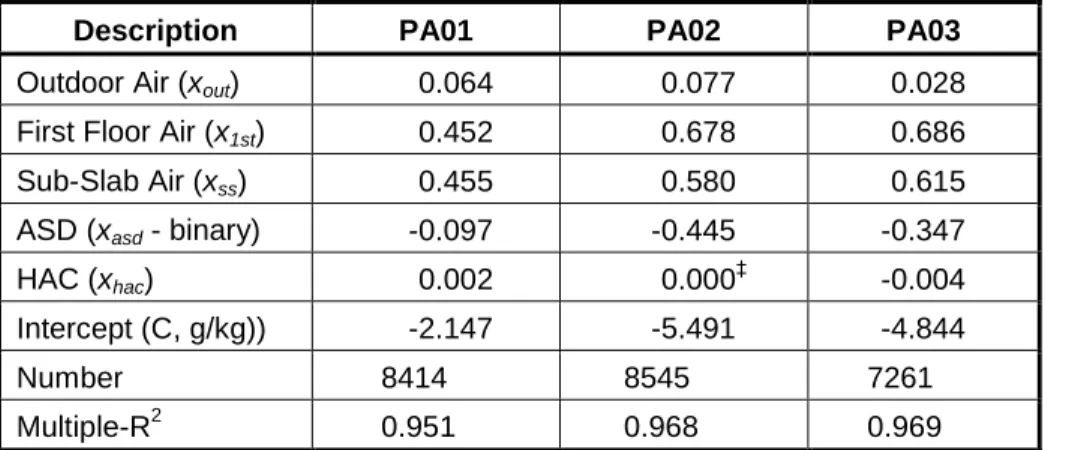
of simplification. Regression results for coefficients, intercepts, and R2 (coefficient of
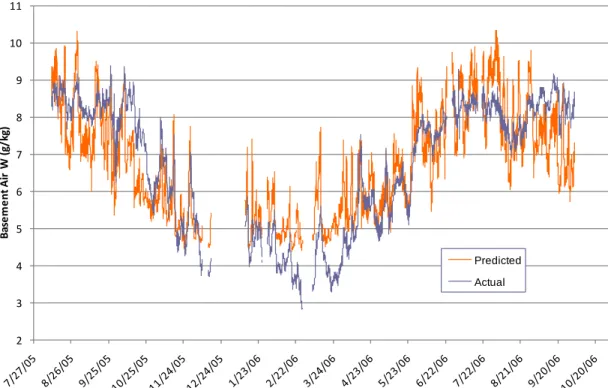
determination) are summarized in Table 3. These models successfully predict the basement air moisture, explaining over 95% of its variation in all three houses. Figure 3 graphically displays the predictive ability of the model for PA01, comparing the actual and predicted basement moisture over approximately 14 months of the study. More detailed information on the
regressions for each house, along with plots of actual and predicted basement moisture levels are included in Appendix B.
Table 3. Parameters for Ordinary Least Squares Regression with Five Dependent Variables - All Seasons.
Description PA01 PA02 PA03
Outdoor Air (xout) 0.064 0.077 0.028
First Floor Air (x1st) 0.452 0.678 0.686
Sub-Slab Air (xss) 0.455 0.580 0.615
ASD (xasd - binary) -0.097 -0.445 -0.347
HAC (xhac) 0.002 0.000 ‡ -0.004 Intercept (C, g/kg)) -2.147 -5.491 -4.844 Number 8414 8545 7261 Multiple-R2 0.951 0.968 0.969 ‡
All significant at p=.0001, except xhac at PA02 where p=0.430
Figure 3. Measured basement air humidity ratio (W) for PA01, along with predicted W using 5-variable regression
model (outdoor air, first floor air, sub-slab air, ASD operation, and HAC operation). 2 3 4 5 6 7 8 9 10 11 B as e m e nt A ir W ( g/ kg ) Predicted Actual
Contractor Report to EPA: Movement and Sources of Basement Ventilation Air and Moisture During ASD 7 / 51
The regression coefficients in Table 3 for first floor and sub-slab soil air at all houses suggest a much larger contribution to basement air than from outdoor air. The regression coefficients for ASD and HAC are more difficult to interpret because these variable have different units than basement air. However, the regression coefficients for ASD are all negative indicating that when ASD is operating, basement moisture is lowered.
Since a better understanding of the relationship between outdoor air and basement air was one of the focuses of this extended analysis, and because it was expected that outdoor air effects would also be communicated through the first floor and sub-slab soil air, additional analysis of the effects of first floor and sub-slab soil air was conducted. In Figure 4, the coefficients of determination (R2) for various combinations of dependent variables are shown. The R2 is an estimation of the explained variation in basement air moisture by each regression model. Thus, regression on outdoor air alone explains approximately 70%, 73%, and 74% of the variation in basement air moisture for PA01, PA02, and PA03, respectively. These are not estimates of the quantity of moisture contributed by outdoor air.
Figure 4. Coefficients of determination (R2) from regressions run for one (outdoor air) to five dependent variables.
First floor and sub-slab soil air were substituted for outdoor air during the regressions on three variables.
Addition of the ASD and HAC variables increase the explained variability by up to about 4%. Substituting the first floor or sub-slab air variables for outdoor air in the three-variable regressions results in larger improvements: 15% to 21%, with first floor air causing largest improvements in all houses. As mentioned earlier, a variety of other processes and activities can affect moisture levels in the first floor and sub-slab soil air, which in turn appear to have marked
0. 70 0.73 0. 74 0. 70 0. 76 0. 76 0. 70 0. 77 0. 77 0 .8 8 0 .9 4 0 .9 5 0 .8 5 0 .8 3 0.8 7 0. 90 0. 94 0.95 0. 91 0. 0.92 0.92 95 0.97 0.97 0.00 0.10 0.20 0.30 0.40 0.50 0.60 0.70 0.80 0.90 1.00
PA01 PA02 PA03
C o e ffi c ie n t o f D e te rm in a ti o n , R 2 Outdoor Air 2 Var: OA+ASD 3 Var: OA+ASD+HAC 3 Var: 1stFlr+ASD+HAC 3 Var: Soil+ASD+HAC 4 Var: OA+ASD+HAC+1stFlr 4 Var: OA+ASD+HAC+Soil All 5 Variables
Var-Contractor Report to EPA: Movement and Sources of Basement Ventilation Air and Moisture During ASD 8 / 51
impact on basement air moisture. The four- and five-variable regressions resulted in only modest additional improvements.
To isolate the effects and relationships of outdoor air moisture on basement air,
three-variable regression models containing outdoor air, and ASD and HAC operation were considered in more detail. The predicted (and observed) values from the regression for PA01 are shown in Figure 5. Inspection of Figure 5 and Figure 3 (five variable) indicates that the three-variable model deviates more from the observed values. Plots for PA02 and PA03 are similar, and the summarized regression data in Table 4 confirm these observations. The plots for other houses and more detailed regression information for the three-, two-, and single-variable models are included in Appendix B.
Figure 5. Measured basement air humidity ratio (W) for PA01, along with predicted W using 3-variable regression
model (outdoor air, ASD operation, and HAC operation – see Table 4).
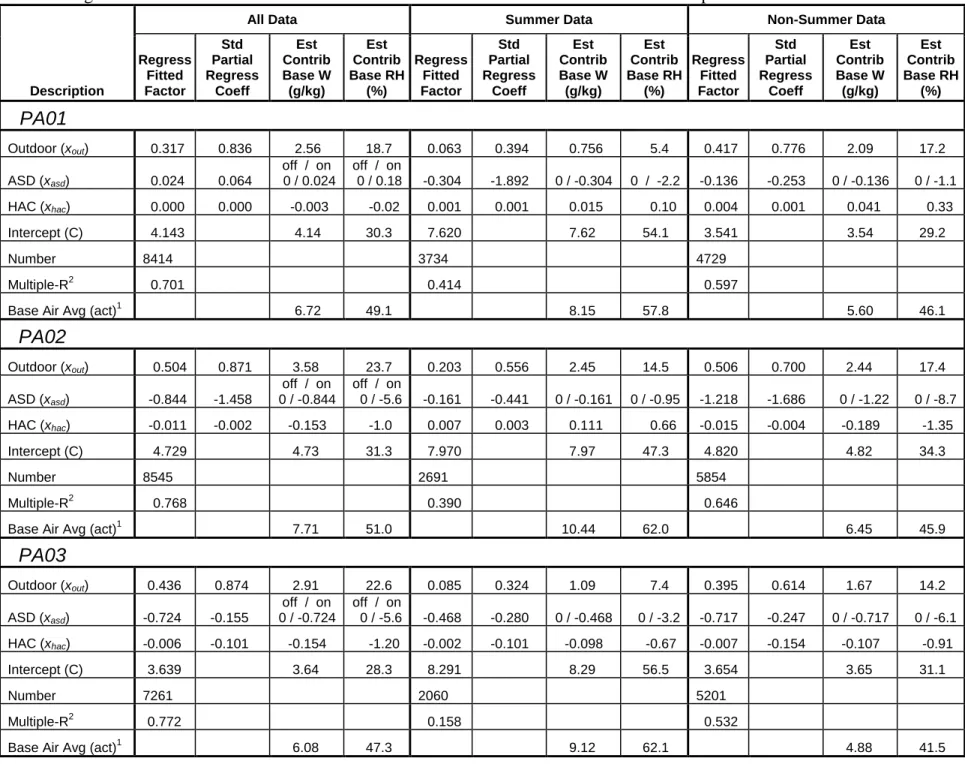
The earlier analysis and report found differences in basement moisture responses during the summer and non-summer periods, likely due to large summer increases in the outdoor air moisture load and possibly dehumidification by the central HAC system. Regressions were run separately for these two periods and for the combined periods, and the calculated regression factors are included in Table 4. While the R2 for the combined summer and non-summer (All) data range from 0.70 to 0.77 for all three houses, the R2 for separate summer and non-summer periods are much lower, possibly due to the fewer number of observed data used for the regressions.
As noted for Table 1, the correlation coefficient for basement air moisture vs. ASD at PA01 was positive, and contradicts the analyses in the earlier report showing reduced moisture during ASD operation – a similar result was found here for the ASD regression coefficient at PA01 for combined summer and non-summer (All) data. While this result is unexplained, the ASD
2 3 4 5 6 7 8 9 10 11 B as e m e nt A ir W ( g/ kg ) Predicted Actual
Contractor Report to EPA: Movement and Sources of Basement Ventilation Air and Moisture During ASD 9 / 51
regression coefficients for the separate summer and non-summer periods are negative, as expected.
Because the variables are not all in the same units of measurement, a standardized partial regression coefficient (SPRC), b′y , was calculated that gives the rate of change in standard
deviation units of y per one standard deviation unit of x, from
where sx and sy are the standard deviations of the dependent and independent variables,
respectively.
The standard partial regression coefficients effectively eliminate the differences in measurement scale so they can be compared to show the relative effects of the independent variables on basement air moisture. Because of the binary (on/off) nature of the ASD data, the comparisons of SPRC for these data may not be meaningful – in fact, showing larger impacts than outdoor air, and the comparisons are not easily explained. For HAC, the SPRC consistently shows a very tiny impact on changes in basement air moisture compared with outdoor air in PA01 and PA02, while at PA03 the HAC effect ranges from one tenth to one third that of outdoor air.
To estimate the overall contribution (or removal) of absolute moisture quantities to the basement air, the regression coefficients were multiplied by the corresponding average of measured values for each independent variable (outdoor air and HAC on-time) to yield the average moisture gain/loss (W, g/kg). For ASD, the regression coefficient was multiplied by 0 (off) and 1 (on). Results of these calculations are shown in columns 4, 8, and 12 of Table 4. Extending this to estimates of gains/loss in basement air relative humidity (RH, %), the average basement air RH was proportioned (columns 5, 9, and 13) according to the calculated humidity ratios (W). These results indicate that the outdoor air can contribute moisture, ranging in average from 0.8 to 2.6 g/kg (5 to 19% RH) at PA01, 2.4 to 3.6 g/kg (15 to 24% RH) at PA02, and 1.1 to 2.9 g/kg (7 to 23% RH) at PA03. Although it is expected that outdoor air would add more moisture to the basements during the summer periods, these estimates point to the opposite. Estimated moisture reductions with the ASD in operation are smaller than, but approximately within the range of, reductions measured during ASD cycling as reported in Turk and Hughes 2008. For these three-variable regression models, the regression constants (C) typically accounted for more than 50% of the basement moisture. The constants lump all of the other moisture effects occurring in from upstairs, sub-slab soil, and from diffusion through the foundation materials, etc. Since there are many assumptions underlying the least squares linear regression, including that the moisture responses are linear, these estimates of actual moisture gains/losses should only be considered to be crude estimates intended to show ranges of effects.
Contractor Report to EPA: Movement and Sources of Basement Ventilation Air and Moisture During ASD 10 / 41
Table 4. Regression Results and Estimated Contributions to Basement Air Moisture for Three Dependent Variables
All Data Summer Data Non-Summer Data
Description Regress Fitted Factor Std Partial Regress Coeff Est Contrib Base W (g/kg) Est Contrib Base RH (%) Regress Fitted Factor Std Partial Regress Coeff Est Contrib Base W (g/kg) Est Contrib Base RH (%) Regress Fitted Factor Std Partial Regress Coeff Est Contrib Base W (g/kg) Est Contrib Base RH (%)
PA01 Outdoor (xout) 0.317 0.836 2.56 18.7 0.063 0.394 0.756 5.4 0.417 0.776 2.09 17.2 ASD (xasd) 0.024 0.064 off / on 0 / 0.024 off / on 0 / 0.18 -0.304 -1.892 0 / -0.304 0 / -2.2 -0.136 -0.253 0 / -0.136 0 / -1.1 HAC (xhac) 0.000 0.000 -0.003 -0.02 0.001 0.001 0.015 0.10 0.004 0.001 0.041 0.33 Intercept (C) 4.143 4.14 30.3 7.620 7.62 54.1 3.541 3.54 29.2 Number 8414 3734 4729 Multiple-R2 0.701 0.414 0.597
Base Air Avg (act)1 6.72 49.1 8.15 57.8 5.60 46.1
PA02 Outdoor (xout) 0.504 0.871 3.58 23.7 0.203 0.556 2.45 14.5 0.506 0.700 2.44 17.4 ASD (xasd) -0.844 -1.458 off / on 0 / -0.844 off / on 0 / -5.6 -0.161 -0.441 0 / -0.161 0 / -0.95 -1.218 -1.686 0 / -1.22 0 / -8.7 HAC (xhac) -0.011 -0.002 -0.153 -1.0 0.007 0.003 0.111 0.66 -0.015 -0.004 -0.189 -1.35 Intercept (C) 4.729 4.73 31.3 7.970 7.97 47.3 4.820 4.82 34.3 Number 8545 2691 5854 Multiple-R2 0.768 0.390 0.646
Base Air Avg (act)1 7.71 51.0 10.44 62.0 6.45 45.9
PA03 Outdoor (xout) 0.436 0.874 2.91 22.6 0.085 0.324 1.09 7.4 0.395 0.614 1.67 14.2 ASD (xasd) -0.724 -0.155 off / on 0 / -0.724 off / on 0 / -5.6 -0.468 -0.280 0 / -0.468 0 / -3.2 -0.717 -0.247 0 / -0.717 0 / -6.1 HAC (xhac) -0.006 -0.101 -0.154 -1.20 -0.002 -0.101 -0.098 -0.67 -0.007 -0.154 -0.107 -0.91 Intercept (C) 3.639 3.64 28.3 8.291 8.29 56.5 3.654 3.65 31.1 Number 7261 2060 5201 Multiple-R2 0.772 0.158 0.532
Base Air Avg (act)1 6.08 47.3 9.12 62.1 4.88 41.5
1
Contractor Report to EPA: Movement and Sources of Basement Ventilation Air and Moisture During ASD 11 / 41
A2.4 Autoregression
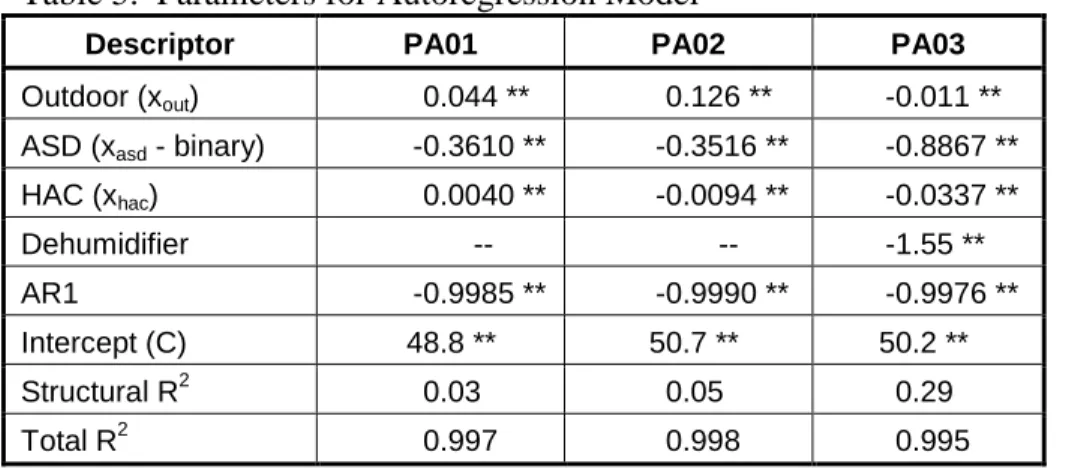
Since the majority of data being analyzed were in time series, or automatically and semi-continuously collected on one-hour intervals throughout the study, autoregression was also evaluated. In autoregression, it is presumed that the dependent variable, basement air moisture, has a „memory‟ of its preceding value – or is a function of itself and the independent variables at a previous moment of time.
The autoregressive component adds the following calculation to the structural equation (least squares):
where AR1 is the autoregression coefficient, and elag is the lagged structural residual for the
preceding period.
The autoregression model for basement air relative humidity (%RH) used the three
independent variables as in the OLS, above. In house PA03, a stand-alone dehumidifier operated at some points in time – an independent variable for dehumidifier operation was added to the autoregression for this house (xdehumid).
Data from after the start of cycling of the ASD systems was used in the analysis, while missing dependent variable data values were interpolated using an interpolation algorithm. Identifying the structure of the model itself involved a test for autocorrelation, followed by a test for the lag structure of the detected autocorrelation. Statistically significant autocorrelation was found in all three houses and a single lag was adequate to account for most of the
autocorrelation. The final autoregressive models for all three houses, incorporating a single lag are shown in Table 5.
Table 5. Parameters for Autoregression Model
Descriptor PA01 PA02 PA03
Outdoor (xout) 0.044 ** 0.126 ** -0.011 **
ASD (xasd - binary) -0.3610 ** -0.3516 ** -0.8867 **
HAC (xhac) 0.0040 ** -0.0094 ** -0.0337 ** Dehumidifier -- -- -1.55 ** AR1 -0.9985 ** -0.9990 ** -0.9976 ** Intercept (C) 48.8 ** 50.7 ** 50.2 ** Structural R2 0.03 0.05 0.29 Total R2 0.997 0.998 0.995 **p<.01
In terms of prediction, all independent variables are statistically significant in each house. The model is said to have a structural and an autoregressive component. The structural component is the usual regression model. Within the autoregressive framework, this actually doesn‟t predict well yielding low structural R2
. The variables, however, are predictive as can be seen by the OLS regressions, above.
While the autoregessive model is a very successful predictor of behavior (R2 greater than 0.995), the ordering of the values imposed by the temporal factor, which is not addressed at all in linear regression, makes the relationships less clear.
Contractor Report to EPA: Movement and Sources of Basement Ventilation Air and Moisture During ASD 12 / 41
A3. SUMMARY OF FINDINGS –
Relationship Between Basement and Outdoor Air Moisture
The extensive data collected during this project in three houses provided an opportunity to examine the relationship between moisture levels in the basement air and those in the outdoor air. Visual inspection of plotted data during the initial analysis suggested that basement air moisture tracked very closely with outdoor moisture. Over the long-term, some of this supposed tracking is due to coincident changes in air temperature, both indoors and outdoors, that enable air to hold more moisture at higher temperatures and less at lower temperatures. However, the data also show that without changes in temperature, basement air moisture levels can rise and fall in apparent response to outdoor air moisture. Following is a summary of the specific findings:
After reviewing the correlation and physical dependencies of the many variables measured during the study, five variables were identified that were of interest and likely to have an impact on basement moisture: outdoor air moisture, first floor moisture, sub-slab soil air moisture, ASD on/off operation, and HAC operation. The review also pointed out the many inter-relationships between the variables, and comparatively high correlations between them. Outdoor air entering the soil and the upper floors of the house likely has a strong influence on the air in those spaces, and indeed the correlation coefficients between them and outdoor air ranged from 0.6 to 0.9. In turn, the moisture levels of the air in those zones influenced the basement air. Therefore, the outdoor air had both direct and indirect (through the other zones) effects on the basement. The correlation coefficients for
basement and outdoor air are consistent for all houses at approximately 0.77 with a delayed response, or lag, of approximately six to 12 hours.
While correlation measures association between variables, least squares linear regression models were developed to examine the comparative causation of the dependent variables on basement moisture and their predictive ability. As with most regression models, the predictive ability increased as variables were added, explaining over 95% of the variation in basement air moisture when all five variables were included. However, because of the pass-through of outdoor air through the other two zones, the simplified models of one, two, and three variables (outdoor air, ASD and HAC operation) were evaluated in more detail.
Regression with outdoor air moisture alone explained approximately 70% of the variation in the basement air moisture, while ASD and HAC added modest explanatory power (approximately 4%). These results were consistent for all houses and confirm that
changes in outdoor air moisture are a large determinant for changes in indoor air moisture. Remaining variability in basement moisture appears to be largely explained by other source and removal processes in the basement, soil, and upstairs. These would include occupant activities (respiration, cooking, showers, laundry and cleaning, etc.),
dehumidification by HAC equipment, storage effects, precipitation, water leaks, drying of new construction, and diffusion from the soil.
Attempts to estimate the quantities of moisture contributed or removed by outdoor air (and the other factors) produced a broad range of seasonally-dependent responses that are not easily explained. In fact, the regression models estimate that summer season contributions of outdoor air moisture were less than during non-summer periods – which is not in line with expectations and calculations of short-term air flow and moisture during the summer
Contractor Report to EPA: Movement and Sources of Basement Ventilation Air and Moisture During ASD 13 / 41
for several of the houses (Section B). It is probable that the large cross correlations between the key variables being studied and the underlying assumptions for linear regression models may have limited the ability to fully account for the non-linear relationships between the variables and the contributions of individuals variables to basement moisture.
Autoregression models, using three variables (outdoor air, ASD and HAC operation) to account for the time series nature of the data, were very successful predictors of behavior (R2 greater than 0.995). However, the ordering of the values imposed by the temporal factor, which is not addressed at all in linear regression, makes the relationships less clear.
Contractor Report to EPA: Movement and Sources of Basement Ventilation Air and Moisture During ASD 14 / 41
B. BASEMENT MOISTURE SOURCES AND MOVEMENT, AND ASD
MOISTURE CONSIDERATIONS
The final report of the radon/moisture study (Turk and Hughes) included a preliminary review of air flows, moisture movement, and moisture extraction by the radon mitigation systems. To better understand moisture movement and sources in the three houses participating in the ASD radon/moisture project, a more detailed examination of moisture levels and air flows for the various air masses has been conducted. The purpose was to better understand how ASD systems might impact indoor moisture levels and the variability in factors affecting moisture entry, and to consider implications for ASD system design and operation.
B1. BACKGROUND
The Conceptual Model, presented in the final report for this study, discusses the potential effects of air flows, including ASD-induced flows, on building moisture:
In all seven possible mechanisms described above the flow paths are generally complex, mostly accidental and unintended, and the pressures driving the flows are very small (that is, less than 10 Pa) and intermittent, depending on weather conditions. It is likely that many of these mechanisms work in combination, to varying degrees, depending on many house, soil, and meteorological conditions.
The findings of this current analysis confirm that observation. Some general conclusions may be drawn from the data, and can be helpful in understanding the general effects of certain operational phenomena in these buildings. For example, the data strongly suggest that ASD operation typically increases the flow of air from the upstairs to the basement, and that there can be potential basement drying resulting from that air flow increase. However, the data even more strongly suggest that the degree of that air flow increase, and consequent moisture impacts, is heavily dependent on many factors, including house structural characteristics, seasonally-variable weather and house mechanical operation, and ASD configuration and operating
characteristics. Further, as predicted in the Conceptual Model, the data show that ASD operation influences every air flow into, out of and within a structure, and that those influences and their consequences are also highly variable from house to house and season to season. In this regard, it is well to remember that this study examined three houses in one geographic location with ASD systems configured and operated in two different modes. Different house structural and operational characteristics, climatic factors and ASD systems would probably exhibit an even wider range of variability in operating characteristics and observed effects.
B2. DESCRIPTION OF MOISTURE AND AIR FLOW VARIABLES
Much of the moisture transport in these houses was due to the bulk flow of air moving between the outdoors, indoor, and soil. Therefore, data for temperature, humidity, radon, and barometric pressure were averaged over periods when valid interzonal flow tracer measurements
Contractor Report to EPA: Movement and Sources of Basement Ventilation Air and Moisture During ASD 15 / 41
were conducted. Following are brief descriptions of the measured and calculated data applied in this analysis.
B2.1 Air Flows
Interzonal air flows between the indoors-outdoors and basement-upstairs were determined using a constant injection, multi-tracer, ventilation measurement system (see Turk and Hughes for additional details). The time periods for these measurements typically included three, three-hour periods from 2:00 – 5:00 AM plus three, three-three-hour periods from 1:00 – 4:00 PM for each season. The median of the individual results for valid test periods is presented here.
B2.2 Absolute Humidity (AH, g/m3)
Absolute humidity was calculated using standard psychrometric relationships (ASHRAE 2005) from temperature, relative humidity, and barometric pressure measurements in target air masses (Turk and Hughes 2008).
B2.3 Radon
Continuous radon monitors were used to sample air within the house (first floor and
basement) and in the subgrade material beneath the slab floors at the following locations: PA01 – E3, PA02 – C4, and PA03 – C1. Radon within block walls and at the exterior of poured walls was also nmeasured.
B2.4 Soil Gas Entry
Soil gas entry was estimated from a steady-state mass balance calculation using estimated outdoor air radon levels (0.12 to 0.3 pCi/l), averages of measured radon concentrations in the soil gas and basement, and measured basement air flows for each three-hour period.
B2.5 Moisture Exhausted by ASD
Temperature and relative humidity of the air entering the bottom of the ASD pipes was used, along with the air flow in the pipes measured by center-located pitot tube, to determine the quantity of moisture being exhausted by the ASD pipes. During cool and cold weather some of this moisture may have condensed on sections of the pipe exposed to cold temperatures and drained back into the opening through the foundation wall or slab. Thus, the amount of moisture exhausted by the ASD systems may be overestimated, although the quantity of this returned moisture may have been small compared to the total exhausted.
B3. BASEMENT MOISTURE SOURCES AND FLOWS
Data from the three study houses were developed to illustrate the relationships between the moisture characteristics of basement air and of air moving into the basement from various sources, and the quantities of those flows. Of particular interest are the changes in air flow quantities due to ASD operation and the potential basement moisture consequences of those changes. Table 6, below, summarizes much of the data relevant to the following discussions. Appendix C contains additional measured and calculated data used to develop information in Table 6.
Contractor Report to EPA: Movement and Sources of Basement Ventilation Air and Moisture During ASD 16 / 41
Table 6. Summary of Moisture, Radon, and Interzonal Flows under Different Seasons and ASD Operating Conditions
Average AH (g/m3) Radon Concentrations (pCi/L) Interzonal Flow/Ventilation
Soil Gas Entry (cfm) House # Season ASD Config Bsmt Air Upstairs Air Outdoor Air Soil Gas Outdoor Air (est) Upstairs Air Bsmt Air Soil Gas Upstairs to Bsmt Outdoor to Bsmt ASHRAE Bsmt (ACH)1 Outdoor to Upstair (ACH) ASHRAE Upstairs (ACH)1 (cfm) (ACH) (cfm) (ACH) PA01 Winter Off 5.3 5.0 3.3 12 0.3 39 60 230 11 0.06 26 0.13 0.07 0.21 0.16 10.8 On full 5.8 5.3 4.9 12 0.3 0.4 0.4 240 32 0.16 39 0.19 0.28 0.0 Spring Off 7.3 6.9 7.4 12 0.3 11 50 380 6.8 0.03 7.0 0.03 0.54 1.9 On full 7.0 7.2 9.1 13 0.3 0.4 1.3 320 2.8 0.01 16 0.08 0.21 0.1 Summer Off 9.7 9.3 17 15 0.3 21 26 930 18 0.09 10 0.05 0.14 0.4 On full 9.6 9.1 16 16 0.3 1.0 0.8 360 33 0.16 13 0.06 0.16 0.0 Fall Off 9.7 9.3 9.1 15 0.3 17 55 910 2.4 0.01 12 0.06 0.27 0.9 On mod 10 11 13 15 0.3 0.5 0.7 470 4.4 0.02 9.1 0.04 0.28 0.0 PA02 Winter Off 6.4 5.6 6.9 15 0.3 9.3 20 190 4.6 0.02 13 0.06 0.07 0.06 0.23 1.8 On full 5.2 4.7 4.2 16 0.2 0.2 0.4 140 47 0.23 38 0.19 0.17 0.1 Spring Off 6.0 5.7 6.7 13 0.3 8.4 17 340 4.3 0.02 13 0.06 0.06 0.8 On full 7.0 6.5 9.4 14 0.3 0.3 0.6 170 35 0.17 35 0.17 0.19 0.1 Summer Off 12 10 12 17 0.3 8.3 15 200 13 0.06 6.8 0.03 0.05 1.0 On full 12 10 12 17 0.3 0.3 0.5 180 36 0.18 37 0.19 0.25 0.1 Fall Off 9.3 7.3 5 17 0.3 9.9 20 320 2.4 0.01 12 0.06 0.08 0.9 On mod 8.2 6.8 3.8 16 0.1 0.1 0.6 230 19 0.09 30 0.15 0.16 0.1 PA03 Winter Off 5.0 4.3 2.4 13 0.3 2.9 8.5 220 42 0.35 24 0.20 0.07 1.0 0.20 2.1 On full 4.8 4.5 5.5 13 0.2 0.2 0.2 44 95 0.79 44 0.36 1.0 0.0 Spring Off 7.1 5.4 5.9 13 0.3 4.6 21 1400 3.7 0.03 7.3 0.06 0.56 0.1 On full 5.7 4.7 4.3 13 0.1 0.1 0.2 64 73 0.60 25 0.20 1.2 0.1 Summer Off 11 10 17 15 0.3 2.2 3.8 1100 ND 2 ND2 ND2 ND2 ND2 ND2 On full 11 9.6 17 15 0.2 0.2 0.2 80 130 1.10 38 0.32 1.0 0.0 Fall Off 8.0 6.2 8.4 15 0.3 4.5 15 940 8.2 0.07 7.0 0.06 0.71 0.2 On mod 7.2 6.1 7.8 15 0.3 0.4 0.3 92 67 0.56 8.0 0.07 1.1 0.0 1
Ventilation rate for basement and upstairs as recommended by ASHRAE Std 62.2 (2007)
2
Contractor Report to EPA: Movement and Sources of Basement Ventilation Air and Moisture During ASD 17 / 41
B.3.1 Relative Source Moisture Index
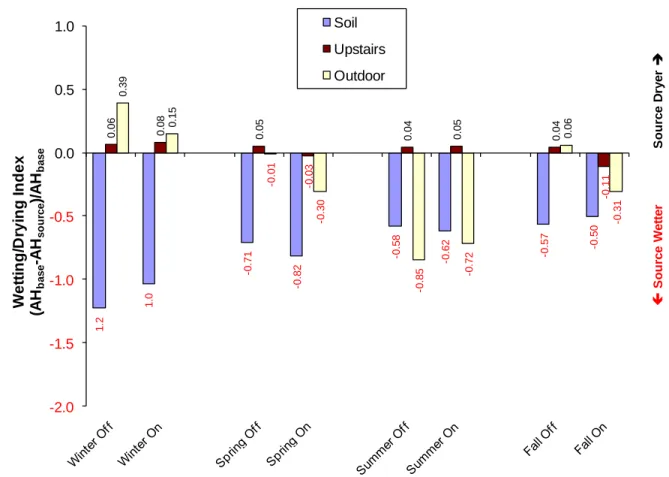
A relative moisture index was created to compare the moisture levels in the air of different zones surrounding the basement (Figures 6 to 8). The figures show the index for air from each source, which is simply the difference between the absolute humidity (AH, g/m3) of the
basement air and the AH of the source air, normalized by the AH of the basement air.
Some clear, if not necessarily consistent, moisture relationships emerge from these data: 1) soil air was always much wetter than basement air; 2) upstairs air was almost always drier than basement air, but the difference is smaller than between soil air and basement air; 3) outdoor air varied from significantly drier to significantly wetter than basement air, including some periods when it had a higher relative moisture index than soil air; 4) during Summer, and parts of Spring and Fall, upstairs is the only potentially drying air source to the basement; and 5) ASD operation appears to have relatively little impact on moisture content of the into-basement air flows, although other data indicate some very limited drying of soil gas at a few locations.
Note that during the summer tracer gas study period in PA02, the outdoor air moisture content was considerably lower than the seasonal average. Outdoor air moisture conditions during summer tracer gas studies in PA01 and PA03 were more representative of that seasonal average (see Table 6).
Figure 6. Index comparing the moisture of air in the basement of house PA01 with that of sources of air in zones
around the basement (soil, outdoors, upstairs), normalized by the basement air moisture. Values are shown for the periods during interzonal flow testing in the four seasons with the ASD system on and off. Zones with air dryer than that in the basement are represented as positive values.
1 .2 1 .0 -0 .7 1 -0 .8 2 -0 .5 8 -0 .6 2 -0 .5 7 -0 .5 0 0 .0 6 0 .0 8 0 .0 5 -0 .0 3 0 .0 4 0 .0 5 0 .0 4 -0 .1 1 0 .3 9 0 .1 5 -0 .0 1 -0 .3 0 -0 .8 5 -0.7 2 0 .0 6 -0 .3 1 -2.0 -1.5 -1.0 -0.5 0.0 0.5 1.0 W e tt in g /D ry in g I n d e x (A Hb a s e -AH s o u rc e )/ A Hb a s e Soil Upstairs Outdoor S o u rc e W e tt e r S o u rc e D ry e r
Contractor Report to EPA: Movement and Sources of Basement Ventilation Air and Moisture During ASD 18 / 41
Figure 7. Source moisture index for house PA02.
Figure 8. Source moisture index for house PA03.
1 .4 1 .2 -0 .9 3 -0 .4 0 -0 .4 3 -0 .8 0 -0 .9 8 0 .1 3 0 .0 9 0 .0 6 0 .0 8 0.16 0 .1 4 0.21 0 .1 8 -0 .0 7 0 .1 9 -0 .1 1 -0 .3 4 -0 .0 0 -0 .0 4 0 .4 5 0.5 4 -2.0 -1.5 -1.0 -0.5 0.0 0.5 1.0 W e tt in g /D ry in g I n d e x (A Hb a s e -AH s o u rc e )/ A Hb a s e Soil Upstairs Outdoor S ou rc e W e tt e r S o u rc e D ry e r -2.01 1 .5 1 .7 -0 .9 0 1 .3 -0 .4 7 -0 .4 4 -0 .8 7 1 .0 0 .1 4 0 .0 6 0 .2 4 0 .1 7 0 .0 2 0.10 0 .2 3 0 .1 5 0 .5 1 -0 .1 5 0 .1 6 0.25 -0 .6 6 -0 .6 2 -0 .0 6 -0 .0 8 -2.0 -1.5 -1.0 -0.5 0.0 0.5 1.0 W e tt in g /D ry in g I n d e x (A Hb a s e -AH s o u rc e )/ A Hb a s e Soil Upstairs Outdoor S ou rc e W e tt e r S o u rc e D ry e r
Contractor Report to EPA: Movement and Sources of Basement Ventilation Air and Moisture During ASD 19 / 41
B3.2 Air Flow Into the Basement
While the moisture content of the air entering the basement is a key factor in determining the contribution to, or removal of moisture from, the basement, the flow rates of air from these zones is also important. Figures 9 to 11 show the quantity of air flow into the basement from each source zone around the basement (soil, upstairs, and outdoors).
These plots show the extreme variability of air flows into the basements of the study houses, both seasonally and between houses. House to house differences might be inferred from the leakage characteristics of the building shells and the floor between the basement and first floor, as determined by blower door testing (see blower door test results, Turk and Hughes). However, the degree of overall air-tightness is only one of many influences on infiltration, exfiltration and in-house air flows. Other factors include weather, HAC operation and occupant activities. The net effect of these influences is not constant, as evidenced by the variance in flows between different ASD Off periods in each house. (Note: during ASD Off periods, gate valves in all suction pipes of the systems were closed.)
Of particular importance to considerations of ASD impact on basement moisture are the ASD-induced changes to these flows and the variability of those changes, even between the Winter, Spring and Summer periods when the ASD systems were configured identically in each
Figure 9. Median of up to six measurements of air flow into the basement for each test period at house PA01 from
the soil, upstairs, and outdoors during the interzonal flow test periods in the four seasons with the ASD system on and off. 11 0 .0 1 .9 0 .1 0.4 0 .0 0.9 0 .0 11 32 6 .8 2 .8 18 32 2 .4 4 .4 26 39 7 .0 15 10 13 12 9 .1 0 5 10 15 20 25 30 35 40 45 50 In to B a s e m e n t A ir F lo w ( c fm ) Soil Upstairs Outdoor
Contractor Report to EPA: Movement and Sources of Basement Ventilation Air and Moisture During ASD 20 / 41
Figure 10. Air flows into the basement of house PA02.
Figure 11. Air flows into the basement of house PA03. Missing data is indicated by ND.
1 .8 0 .1 0.8 0 .1 1.0 0 .1 0.9 0 .1 4 .6 47 4 .3 35 13 36 2 .4 19 13 38 13 35 6 .8 37 12 30 0 5 10 15 20 25 30 35 40 45 50 In to B a s e m e n t A ir F lo w ( c fm ) Soil Upstairs Outdoors 2 .1 0 .1 0 .1 ND 0.2 42 95 3 .7 73 ND 130 8 .2 67 24 43 7 .3 24 ND 38 7 .0 8.0 0 20 40 60 80 100 120 140 In to B a s e m e n t A ir F lo w ( c fm ) Soil Upstairs Outdoor 0 .0 0 .0 0 .0
Contractor Report to EPA: Movement and Sources of Basement Ventilation Air and Moisture During ASD 21 / 41
house, and total system air flow remained virtually constant. During the Fall period in each house, the ASD systems were re-configured to a single slab suction point, and the system flows were reduced to produce air flows more representative of systems commonly installed for radon control (Table 7). This configuration produced yet another variation on air flows in each house.
Despite the marked variability of these air flows, there are some discernable patterns associated with ASD operation. Upstairs to basement flow increased in every house and every season except PA01 in the Spring. It is likely that these two exceptions to the general trends are related to the occupants‟ practice of employing natural ventilation during suitable weather, i.e., Spring and Fall. Outdoor to upstairs flow was also often increased (see discussion in Section B4, below). Soil gas entry was practically eliminated in every case, although ASD Off values for this flow were typically quite small. By far the largest, less than 11 cfm, was in PA01 in Winter, before the wall/floor joint was sealed. Increase in outdoor to basement flow was indicated except in PA01 in the Fall.
B3.3 Drying/Wetting Potential of Convective Moisture Sources
By combining the previous two sets of data (relative moisture index times the air flow
quantity), a basement drying/wetting potential has been developed and presented in Figures 12 to 14 for the three houses. The potential does not imply actual drying or wettingof the air flows into the basement from the three sources.
Figure 12. The relative drying/wetting potential of into-basement air flows for house PA01. The values do not
represent actual changes in basement moisture, rather are a comparison of the potential for air from different sources to add moisture to or remove moisture from the basement.
-0 .3 7 -0 .0 0 -0 .0 4 -0.0 0 -0 .0 1 -0 .0 0 -0 .0 1 -0 .0 0 0 .0 2 0 .0 7 0 .0 1 -0 .0 0 0 .0 2 0.0 5 0 .0 0 -0 .0 1 0 .2 9 0 .1 6 -0 .0 0 -0 .1 3 -0 .2 4 -0 .2 6 0 .0 2 -0 .0 8 -0.4 -0.3 -0.2 -0.1 0.0 0.1 0.2 0.3 0.4 W e tt in g /D ry in g P o te n ti a l (m 3/m in ) Soil Upstairs Outdoor W e tt ing D ry in g
Contractor Report to EPA: Movement and Sources of Basement Ventilation Air and Moisture During ASD 22 / 41
Figure 13. The drying/wetting potential for house PA02.
Figure 14. The drying/wetting potential for house PA03
-0 .0 7 -0 .0 1 -0 .0 3 -0 .0 0 -0 .0 1 -0 .0 0 -0 .0 2 -0 .0 0 0 .0 2 0 .1 2 0 .0 1 0 .0 8 0 .0 6 0 .1 4 0 .0 1 0 .1 0 -0 .0 3 0 .2 1 -0 .0 4 -0 .3 4 -0 .0 0 -0 .0 4 0 .1 5 -0.4 -0.3 -0.2 -0.1 0.0 0.1 0.2 0.3 0.4 W e tt in g /D ry in g P o te n ti a l (m 3/m in ) Soil Upstairs Outdoor W e tt in g D ry in g 0.45 -0 .0 9 0 .0 0 -0 .0 0 -0 .0 0 ND 0.0 0 -0 .0 1 0 .0 0 0 .1 7 0 .1 6 0 .0 3 0 .3 6 ND 0 .3 9 0 .0 5 0 .2 9 0 .3 5 -0 .1 8 0 .0 3 0 .1 7 ND -0 .0 1 -0 .0 2 -0.4 -0.3 -0.2 -0.1 0.0 0.1 0.2 0.3 0.4 W e tt in g /D ry in g P o te n ti a l (m 3/m in ) Soil Upstairs Outdoor -0.67 W e tt in g D ry in g