T
ECHNICAL
March 1996R
EPORT
Source:ETSI TC-BTC Reference: DTR/BTC-01053
ICS: 35.120
Key words: PTN, PISN, mobility, PUM, supplementary service, ANF, impact
Business TeleCommunications (BTC);
Private Integrated Services Network (PISN);
Private User Mobility (PUM);
Impact of PUM on the PISN
ETSI
European Telecommunications Standards Institute
ETSI Secretariat
Postal address: F-06921 Sophia Antipolis CEDEX - FRANCE
Office address: 650 Route des Lucioles - Sophia Antipolis - Valbonne - FRANCE X.400: c=fr, a=atlas, p=etsi, s=secretariat - Internet: [email protected]
Tel.: +33 92 94 42 00 - Fax: +33 93 65 47 16
Copyright Notification: No part may be reproduced except as authorized by written permission. The copyright and the foregoing restriction extend to reproduction in all media.
Whilst every care has been taken in the preparation and publication of this document, errors in content, typographical or otherwise, may occur. If you have comments concerning its accuracy, please write to "ETSI Editing and Committee Support Dept." at the address shown on the title page.
Contents
Foreword ...7
1 Scope ...9
2 References ...9
3 Definitions and abbreviations ...10
3.1 Definitions ...10
3.2 Abbreviations ...11
4 Introduction to private user mobility...12
4.1 Overview ...12
4.2 PUM service architecture...12
4.3 Identification of PUM users ...12
4.4 Overview of PUM supplementary services and ANFs ...13
4.4.1 PUM registration handling ...13
4.4.2 PUM call handling...13
4.4.3 User's service profile transfer...13
4.4.4 Relationships between PUM supplementary services and ANFs ...13
5 Interaction with basic services...14
5.1 Provision of basic services ...14
5.2 Basic call procedures for PUM ...14
6 Interactions with supplementary services...14
6.1 General issues ...15
6.1.1 Access to services...16
6.1.2 Service options ...16
6.1.3 Transfer of supplementary service related data...16
6.1.4 Destination PINX: home PINX versus visitor PINX ...17
6.1.5 Duality between the terminal owner's service and PUM user's services...17
6.2 Specific supplementary service considerations ...17
6.2.1 Number identification services (SS-CLIP, SS-COLP, SS-CLIR)...17
6.2.1.1 Service description ...17
6.2.1.2 Interactions ...17
6.2.2 Name identification services (SS-CNIP, SS-CONP, SS-CNIR) ...17
6.2.2.1 Service description ...17
6.2.2.2 Interactions ...18
6.2.3 Call diversion services...18
6.2.3.1 Call Forward Unconditional (SS-CFU)...18
6.2.3.1.1 Service description...18
6.2.3.1.2 Interactions ...18
6.2.3.2 Call Forward on Busy (SS-CFB)...18
6.2.3.2.1 Service description...18
6.2.3.2.2 Interactions ...19
6.2.3.3 Call Forward on No Reply (SS-CFNR) ...20
6.2.3.3.1 Service description...20
6.2.3.3.2 Interactions ...20
6.2.4 Path Replacement (ANF-PR) ...20
6.2.4.1 Service description ...20
6.2.4.2 Interactions ...20
6.2.5 Call Transfer (SS-CT) ...20
6.2.5.1 Service description ...20
6.2.5.2 Interactions ...21
6.2.6 Call completion services...21
6.2.6.1 Service description ...21
6.2.6.2.1 Call Completion to a Busy Subscriber
(SS-CCBS) ... 22
6.2.6.2.2 Call Completion on No Reply (SS-CCNR)... 22
6.2.7 Call Offer (SS-CO)... 22
6.2.7.1 Service description... 22
6.2.7.2 Interactions... 22
6.2.8 Do-Not-Disturb services... 23
6.2.8.1 Do-Not-Disturb (SS-DND)... 23
6.2.8.1.1 Service description ... 23
6.2.8.1.2 Interactions... 23
6.2.8.2 Do-not-disturb Override (SS-DNDO) ... 24
6.2.8.2.1 Service description ... 24
6.2.8.2.2 Interactions... 24
6.2.9 Call intrusion (SS-CI) ... 24
6.2.9.1 Service description... 24
6.2.9.2 Interactions... 25
6.2.10 Advice Of Charge (SS-AOC) ... 25
6.2.10.1 Service description... 25
6.2.10.2 Interactions... 26
6.2.11 Recall (SS-RE) ... 26
6.2.11.1 Service description... 26
6.2.11.2 Interactions... 26
6.2.12 Call Interception (ANF-CINT)... 26
6.2.12.1 Service description... 26
6.2.12.2 Interactions... 26
6.2.13 Call Distribution to the Attendant (SS-CDA) ... 27
6.2.13.1 Service description... 27
6.2.13.2 Interactions... 27
6.2.14 Message Waiting Indication(SS-MWI)... 27
6.2.14.1 Service description... 27
6.2.14.2 Interactions... 27
6.2.15 Night Service (SS-NS) ... 27
6.2.15.1 Service description Attendant night mode (SS-NMA) ... 27
6.2.15.2 Interactions... 27
7 PUM on top of CTM ... 28
7.1 Numbering aspects ... 28
7.2 Interactions between PUM and CTM services ... 28
7.2.1 CTM Location Registration (SS CTLR) ... 28
7.2.1.1 Service description... 28
7.2.1.2 Interactions... 29
7.2.2 CTM Transfer of Service Profile (ANF-CTSP)... 29
7.2.2.1 Service description... 29
7.2.2.2 Interactions... 29
7.2.3 CTM Call Handling (ANF-CTMI/ANF-CTMO)... 29
7.2.3.1 Service description... 29
7.2.3.2 Interactions... 29
7.2.4 CTM Authentication (SS-CTAT/SS-CTAN) ... 29
7.2.4.1 Service description... 29
7.2.4.2 Interactions... 30
7.2.5 CTM Handover (ANF-CTH) ... 30
7.2.5.1 Service description... 30
7.2.5.2 Interactions... 30
8 Management service consideration ... 30
8.1 User aspects administration... 30
8.2 Routing administration... 31
8.3 Tariff and charging administration... 31
8.4 Traffic management ... 31
8.5 Management of PISN user access... 31
8.6 Restoration and recovery ... 31
8.8 Management of numbering/dialling plans ...31
8.9 Management of mobility...32
8.10 Configuration of PISN supplementary services ...32
9 Signalling considerations...32
9.1 Location registration (SS-PUMR)...33
9.2 Incoming and outgoing PUM calls (ANF-PUMI, ANF-PUMO) ...33
9.2.1 ANF-PUMI ...33
9.2.2 ANF-PUMO ...33
9.3 Supplementary service control...33
10 Numbering considerations ...33
10.1 Addressable entities...33
10.2 Number formats ...33
10.3 Alternative identifiers...34
Foreword
This ETSI Technical Report (ETR) has been produced by the Business TeleCommunications (BTC) Technical Committee of the European Telecommunications Standards Institute (ETSI).
ETRs are informative documents resulting from ETSI studies which are not appropriate for European Telecommunication Standard (ETS) or Interim European Telecommunication Standard (I-ETS) status. An ETR may be used to publish material which is either of an informative nature, relating to the use or the application of ETSs or I-ETSs, or which is immature and not yet suitable for formal adoption as an ETS or an I-ETS.
1
Scope
This ETSI Technical Report (ETR) shows the impact that the introduction of Private User Mobility (PUM) has on a Private Integrated Services Network (PISN). This ETR only deals with the support of PUM within a single PISN and covers the following aspects:
- Basic services as defined in ETS 300 171 [1];
- Supplementary services: Implementation considerations are included as well as the inter-relationships between the various PUM supplementary services;
- Network management services: Only those management services which are likely to have a significant impact on PUM are considered. Also included in this clause are the specific network management requirements for the support of PUM services.
2
References
This ETR incorporates by dated and undated reference, provisions from other publications. These references are cited at the appropriate places in the text and the publications are listed hereafter. For dated references, subsequent amendments to or revisions of any of these publications apply to this ETR only when incorporated in it by amendment or revision. For undated references the latest edition of the publication referred to applies.
[1] ETS 300 171 (1992): "Private Telecommunication Network (PTN) -Specification, functional model and information flows - Control aspects of circuit mode basic services".
[2] ETS 300 173: "Private Integrated Services Network (PISN); Specification, functional models, and information flows; Identification supplementary services". [3] ETS 300 189 (1992): "Private Telecommunication Network (PTN) - Addressing". [4] ETS 300 415 (1994): "Private Telecommunication Networks (PTN) - Terms and
Definitions".
[5] ITU-T Recommendation I.210 (1993): "Principles of telecommunication services supported by an ISDN and the means to describe them".
[6] ETS 300 256 (1992): "Private Telecommunication Networks (PTN) -Specification, functional model and information flows - Diversion supplementary services".
[7] ETS 300 365 (1992): "Private Telecommunication Networks (PTN) -Specification, functional model and information flows - Call Completion supplementary services".
[8] ETS 300 361 (1993): "Private Telecommunication Networks (PTN) -Specification, functional model and information flows - Call Offer supplementary service".
[9] ETS 300 363 (1993): "Private Telecommunication Networks (PTN) -Specification, functional model and information flows - Do Not Disturb and Do Not Disturb Override supplementary services".
[10] ETR 076 (1993): "Supplementary services and additional network features in Private Telecommunication Networks".
[11] ETR 245: "Compendium of PTN Management Services".
[12] ETR 048 (1992): "Telecommunications Management Network (TMN) -Management services prose descriptions".
[13] DE/BTC-01057: "Business TeleCommunications (BTC); Private Integrated Services Network (PISN); Service profiles of mobile users; General requirements".
NOTE: This deliverable (DE/BTC-01057) is TC approved but has not been given an ETS number yet. ETS numbers will not be allocated until the Stage 3 standard is also TC approved.
[14] ETS 300 425 (1994): "Private Telecommunication Networks (PTN) -Specification, functional model and information flows - Call Intrusion supplementary services".
[15] ECMA 211 (1994): "Private Telecommunication Networks (PTN) - Specification, functional model and information flows - Advice Of Charge supplementary services".
[16] ECMA 213 (1994): "Private Telecommunication Networks (PTN) - Specification, functional model and information flows - Recall supplementary services".
[17] ISO/IEC 11579-1 (1994): "Information Technology - Telecommunications and information exchange between systems Private Integrated Services Network -Part 1: Reference configuration for PISN exchanges (PINX)".
[18] ISO/IEC 11571 (1994): "Information Technology - Telecommunications and information exchange between systems - Numbering and Sub-addressing in Private Integrated Services Network".
[19] CCITT Recommendation E.164 (1990): "Numbering plan on ISDN era".
3
Definitions and abbreviations
3.1 Definitions
For the purposes of this ETR the following definitions apply:
Additional Network Feature (ANF): A set of functions supporting services above those required for a
basic call. The customer for these services can be any entity within the network, i.e. any entity other than a user (see ETS 300 415 [4]).
Call (BASIC Call): The instance of the use of service (see ETS 300 171 [1]).
Private Integrated Services Network (PISN): A private network providing services to a specific set of
users (different from a public network which provides services to the general public) (see ISO/IEC 11579-1 [17]).
PISN number: A number in the domain covered by a PISN Numbering Plan (see ISO/IEC 11571 [18]). Private Integrated Services Network Exchange (PINX): A PISN nodal entity which provides automatic
connection handling functions used for the provision of telecommunication services. A nodal entity consists of one or more nodes (based on ISO/IEC 11579-1 [17]).
PISN address: Formalized information used to indicate unambiguously an identifiable entity which
provides or uses telecommunication services (based on ISO/IEC 11571 [18]).
supplementary service: A service which modifies or supplements a basic telecommunication service.
Consequently, it cannot be offered to a customer as a stand alone service. It should be offered together with or in association with a basic telecommunication service. The same supplementary service may be common to a number of telecommunication services (based on ITU-T Recommendation I.210 [5]).
Private User Mobility (PUM): The capability of a PISN user to register at any PISN terminal, and so
PUM number: A number which uniquely identifies a PUM user. This is the number used by the caller to
reach the PUM user.
PUM registration: The operation performed by a PUM user to inform the PISN of the PISN address that
should be used for locating the user.
PUM user: A PISN user who has been authorised to use PUM facilities.
Home Data Base (HDB): The data base where the current location and all associated parameters of a
PUM user are stored.
Home Private Integrated Services Network Exchange (PINX): The PINX which has direct access to
the HDB for a particular PUM user.
Visitor Data Base (VDB): The database where all relevant parameters required to serve a CTM or PUM
user are stored as long as they are in an area controlled by this database.
visitor PINX: The PINX which is serving a CTM or PUM user in the visitor area.
3.2 Abbreviations
For the purposes of this ETR the following abbreviations apply: ANF Additional Network Feature
ANF-CTSP, CTSP Transfer of Service Profile Additional Network Feature ANF-PUMI, PUMI Incoming PUM call handling Additional Network Feature ANF-PUMO, PUMO Outgoing PUM call handling Additional Network Feature
CC Call Control
CCA Call Control Agent
CIPCL Call Intrusion Protection and Capability Levels CLIP Calling Live Identification Presentation
CLIR Calling/Connected Name Identification Restriction COLP COnnected Live identification Presentation
HDB Home Data Base
PIN Personal Identification Number
PINX Private Integrated Services Network Exchange PISN Private Integrated Services Network
PUM Private User Mobility SS Supplementary Service
SS-PUMR, PUMR Supplementary Service PUM registration VDB Visitor Data Base
4
Introduction to private user mobility
4.1 Overview
Private User Mobility (PUM) provides Private Integrated Services Network (PISN) users with personal mobility services that enable them to make and receive calls on the basis of a unique, personal PUM number throughout the PISN at any suitable terminal. PUM also provides the PUM user with the possibility to use other telecommunication services according to his own personal service profile. PUM should only be limited by terminal and network capabilities and the restrictions imposed by the PISN.
In a PISN supporting PUM there exists no permanent association between PUM users and terminals. Any PUM user can register on any terminal within the PISN, and it is thus possible to have multiple registrations on a given terminal. It is also possible to have no user registered on a specific terminal.
4.2 PUM service architecture
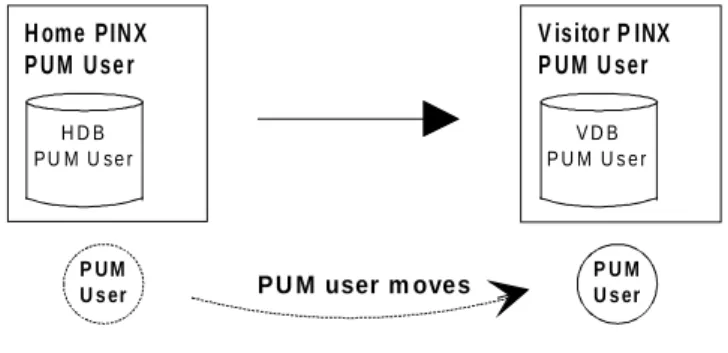
PUM services are based upon the concepts of Home Data Base (HDB) and Visitor Data Base (VDB). The HDB contains the current location and all associated parameters of the PUM user, and is accessible from the PUM user's home PINX. The VDB contains the information required for providing the PUM user with PISN services in the visitor area, and is accessible from the PUM user's visitor PINX.
Figure 1 illustrates the PUM concept in terms of home/visitor PINX/data base. It describes the state of the PISN after the PUM user has registered at the visitor PINX. The PISN has modified the PUM user's entry in the HDB which now points to the visitor PINX. Also, a VDB entry has been established which supports the PUM user's access to PISN services at the visitor PINX. The entry in the HDB should point to the VDB which has to contain the current access number (alternatively, the HDB could specify the PUM user's current access number).
V isito r P INX P U M U ser
V D B P U M U s e r
P U M U s er
H ome PIN X P U M U se r
H D B PU M U s e r
P U M U s er
P U M user m oves
Figure 1: Illustration of PUM
4.3 Identification of PUM users
Each PUM user is permanently associated with a PISN number from the number range of the PUM user's home PINX. Thus the PUM user can be made addressable through the PISN by using the PUM Supplementary Services and Additional Network Features.
To accommodate certain implementation scenarios it is possible to assign to a PUM user an identifier which is permanent but which is not a PISN number. Such a facility would be used for security reasons. This identifier is used to determine the PUM user's entry in the HDB and has a one-to-one relationship with the PISN number which is used for routing purposes.
In addition to the PUM user's identifier (PUM number or alternative identifier), a Personal Identification Number (PIN) can be used to provide an authentication of the PUM user.
4.4 Overview of PUM supplementary services and ANFs
PUM is defined in terms of several supplementary services and additional network features, which together with basic call control support the functions of PUM:
- PUM registration for incoming and outgoing calls; - PUM incoming call handling;
- PUM outgoing call handling; - Transfer of user's service profile.
4.4.1 PUM registration handling
PUM registration is a supplementary service, SS-PUMR, that updates the location information in the home and the visitor data bases if the PUM user registers at a new address or deregisters from the network.
4.4.2 PUM call handling
PUM call handling comprises two ANFs: Incoming PUM Call Handling (PUMI) for calls destined for a PUM user, and Outgoing PUM Call Handling (PUMO) for calls originated by a PUM user:
- ANF PUMI performs the actions necessary to establish a call to a PUM user's current location (also referred to as hosting address/terminal), such as redirecting the call based on information retrieved from the data bases;
- ANF PUMO assists calls made by a PUM user, by identifying the PUM user at the visited location and providing its service profile or redirecting the call to the user's home PINX for processing.
4.4.3 User's service profile transfer
In order for the PUM users to receive a consistent set of PISN services throughout the PISN, the necessary elements of the user's service profile are made available at the visitor PINX. This is achieved by means of the transfer of the mobile user's service profile, ANF-CTSP, between PINXs.
4.4.4 Relationships between PUM supplementary services and ANFs
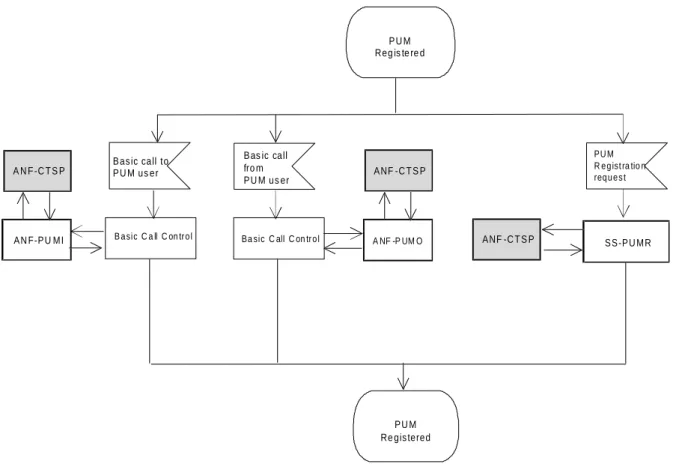
Figures 2 and 3 show possible relationships among the services listed above. Input and output signals represent stimuli as seen from the PISN. Arrows represent control flows. Shaded boxes represent optional services, i.e., the service may or may not be invoked at that point.
In the figures below "PUM idle" represents a state where the PUM user is not registered at any terminal and "PUM registered" represents the state where the PUM user is registered at a specific address.
PU M R egis tered
SS-PU MR
PU M R egis tered
PU M ID LE PU M ID LE Basic call from P U M u s e r
A N F - P U M O A N F - C T S P
Basic Call Control PU M regis tration reques t PU M ID LE SS-PU MR
A N F - C T S P
P UM d ereg istration
req u est
B as ic call to PU M us er
Bas ic call fro m PU M us er
AN F-PU MI A NF -P UM O
PU M Reg is te re d
PU M Re gis tered
SS-PU MR
PU M R eg ist ra tio n requ es t
B a sic C a ll C on tr ol
A N F -C T S P ANF -C T S P
ANF -C T S P
Ba sic C all C on tr o l
Figure 3: Relationship of PUM services (continued)
5
Interaction with basic services
5.1 Provision of basic services
For the purpose of this ETR, basic services are the telecommunication services defined in ETS 300 171 [1]:
- 64 kbit/s circuit mode bearer services for unrestricted digital information, speech, and 3,1 kHz audio;
- teleservices telephony, telefax group 4, and syntax-based videotex, based on these bearer services.
Introducing PUM in a PISN should not require the PISN to provide any other basic services.
5.2 Basic call procedures for PUM
The basic call procedures can be re-used for PUM calls without major changes if the extra functionality needed is added in the following form:
- standardised supplementary services and ANFs; - implementation specific local procedures.
This approach is a well established principle for enhancing the services offered by PISNs.
6
Interactions with supplementary services
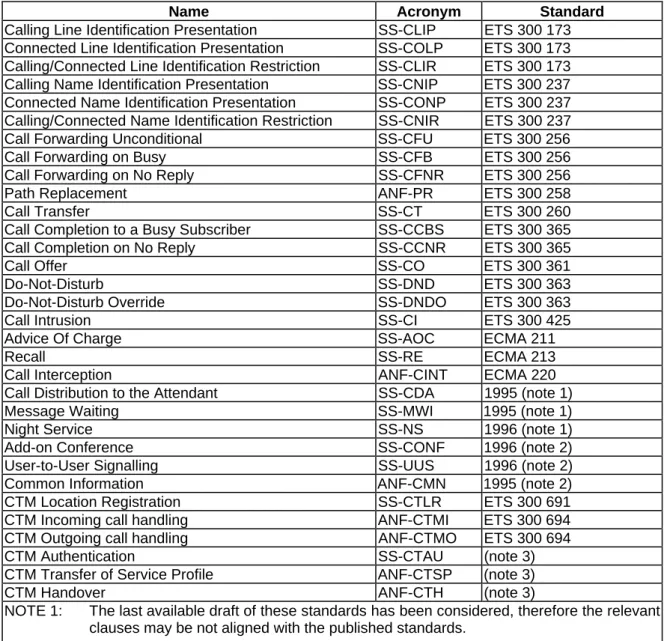
Although normative interactions with existing supplementary services are specified in the Stage 1 standards for PUM call handling and registration, this ETR considers the interaction of PUM with existing and some planned supplementary services from an implementation point of view. Table 1 shows the SSs considered by this ETR.
Table 1: Summary of status of PISN supplementary service and ANF standards (September 1995)
Name Acronym Standard
Calling Line Identification Presentation SS-CLIP ETS 300 173 Connected Line Identification Presentation SS-COLP ETS 300 173 Calling/Connected Line Identification Restriction SS-CLIR ETS 300 173 Calling Name Identification Presentation SS-CNIP ETS 300 237 Connected Name Identification Presentation SS-CONP ETS 300 237 Calling/Connected Name Identification Restriction SS-CNIR ETS 300 237 Call Forwarding Unconditional SS-CFU ETS 300 256 Call Forwarding on Busy SS-CFB ETS 300 256 Call Forwarding on No Reply SS-CFNR ETS 300 256
Path Replacement ANF-PR ETS 300 258
Call Transfer SS-CT ETS 300 260
Call Completion to a Busy Subscriber SS-CCBS ETS 300 365 Call Completion on No Reply SS-CCNR ETS 300 365
Call Offer SS-CO ETS 300 361
Do-Not-Disturb SS-DND ETS 300 363
Do-Not-Disturb Override SS-DNDO ETS 300 363
Call Intrusion SS-CI ETS 300 425
Advice Of Charge SS-AOC ECMA 211
Recall SS-RE ECMA 213
Call Interception ANF-CINT ECMA 220
Call Distribution to the Attendant SS-CDA 1995 (note 1)
Message Waiting SS-MWI 1995 (note 1)
Night Service SS-NS 1996 (note 1)
Add-on Conference SS-CONF 1996 (note 2)
User-to-User Signalling SS-UUS 1996 (note 2)
Common Information ANF-CMN 1995 (note 2)
CTM Location Registration SS-CTLR ETS 300 691 CTM Incoming call handling ANF-CTMI ETS 300 694 CTM Outgoing call handling ANF-CTMO ETS 300 694
CTM Authentication SS-CTAU (note 3)
CTM Transfer of Service Profile ANF-CTSP (note 3)
CTM Handover ANF-CTH (note 3)
NOTE 1: The last available draft of these standards has been considered, therefore the relevant clauses may be not aligned with the published standards.
NOTE 2: These services are not considered because no stable and recent draft is available. NOTE 3: Stable Stage 1 and Stage 2 standards exist and are TC approved. ETS numbers will
not be allocated until the Stage 3 standard is also TC approved.
Others SSs and ANFs are identified in ETR 076 [10]. However, some of them have been dropped from ECMA TC32 1995 work program, for the other no work will be done in the foreseeable future. Therefore, they are not considered by this ETR.
6.1 General issues
The provision of standardized supplementary services where one or more of the involved users is a PUM user can present a number of problems in implementation. This subclause of the ETR identifies some of the general issues which should be considered and then looks at certain specific services which pose particular difficulties when PUM users are involved.
6.1.1 Access to services
One of the most obvious problems likely to be encountered by PUM users as they move from one PINX to another is the difference in supplementary service access methods implemented by the various hosting terminals.
In a multi-vendor network, it is quite difficult, even with careful network planning and management, to provide unified user procedures throughout the network. Moreover, some terminals or PINXs within the network may not be available for customisation.
The rationalisation of user procedures is a difficult problem to deal with. While complying with the QSIG standards for supplementary service signalling between PINXs, each manufacturer is likely to offer access to the services in slightly different ways because:
- there are three generic methods for network access protocols (i.e., the protocol between network and terminal equipment): functional procedures, the keypad stimulus protocol and the feature key management stimulus protocol;
- even if the same generic method is used, there is still scope for differences, since in the stimulus protocol case no specific procedures are standardised for individual supplementary services, and standardised functional procedures are so far available for public ISDN terminals only and for few services.
This could cause confusion to PUM users as they try to invoke supplementary services at different points within the PISN.
Another option is to ensure that the PUM user's home PINX is always accessed to provide supplementary services. For some services this would be quite acceptable but for others, the processing and signalling overheads necessary for maintaining user status at the home PINX would be intolerable. If this option can be used to process supplementary services, it cannot be used for user interface. In fact, the PUM users have no choice than to use the user(terminal)-PINX interface of the visited PINX.
6.1.2 Service options
PISN standards specify in many cases the mandatory core of a supplementary service and optional features, which an implementation may support in addition to the basic core. A manufacturer may provide further proprietary enhancements of the supplementary service. For instance, the core of Call Forwarding Unconditional (CFU) is that all calls or all calls associated with a specific basic service are diverted to another PISN address. Standard options are the provision of notifications, interrogation procedures, etc. A manufacturer may further offer the non-standardized possibility to specify different diverted-to numbers based on certain call criteria, e.g. external vs. internal calls, while still complying with the basic core of CFU.
The consistent provision of standard and proprietary service options for PUM users faces similar difficulties as discussed in subclause 6.1.1. Invoking the supplementary service at the home PINX regardless of the PUM user's actual location again seems a good solution in some cases.
6.1.3 Transfer of supplementary service related data
Some existing supplementary services allow the served user to register data that are then used in the invocation of the service. An example is the Diverted-to user's address in the Call Diversion services. Once registered, this information should continue to be associated with the PUM user regardless of the user's movements within the PISN.
DE/BTC-01057 [13] defines the general requirements for the service profiles of mobile users. It specifies the information that the PISN maintains regarding the services and facilities that are available for the user. The service profile contains the necessary parameters for each facility and the activation status so that a mobile user's service profile can be re-created at any visitor PINX if this PINX supports the facility.
Other supplementary services rely on data stored in association with a specific service invocation, which also should "follow" the PUM user when changing hosting address. An example is the queue of outstanding call completion requests.
In these cases this may prove to be very difficult in a multi-vendor environment where such data may be stored and processed in quite different ways. There seems to be no simple solution to this problem other than imposing constraints on the use of such services by PUM users.
6.1.4 Destination PINX: home PINX versus visitor PINX
Many supplementary services require actions from the destination PINX of a call. In the PUM case it is not so obvious what should be regarded the destination PINX, since the PUM user "exists" twice in the PISN. In a logical sense it would be the home PINX as it holds the PUM user's permanent "image". From a call termination point of view it would be the visitor PINX as this is the PUM user's current physical location. The determination of which interpretation is more suitable should be made on a case-by-case basis. If the visitor PINX is chosen, the following considerations are worthy of note in almost all cases: - the service may not be available to a served PUM user at all location;
- the options subscribed to by the served PUM user may not be offered at all visitor PINXs; - the terminals may not be similar in all location;
- user procedures may differ from PINX to PINX.
6.1.5 Duality between the terminal owner's service and PUM user's services
The PISN should maintain data separately for the hosting terminal and for the PUM user. It is, for example, required that the outgoing calls by the PUM user are not charged to the hosting terminal's account, and that the PUM number to be the originator number for the PUM user's outgoing calls. In the same way, a CFU activated for a hosting terminal should not affect the PUM incoming calls.
6.2 Specific supplementary service considerations
The following subclauses deal with possible problems and other considerations to be taken into account when implementing existing PISN SSs and ANFs to be used by PUM users.
6.2.1 Number identification services (SS-CLIP, SS-COLP, SS-CLIR)
6.2.1.1 Service description
SS-CLIP is a service offered to the called user and provides that user with the calling user's number and if applicable, the calling user's sub-address.
SS-COLP is a service offered to the calling user and provides that user with the connected user's number and if applicable, the connected user's sub-address.
SS-CLIR is a service which prevents the served user's number being presented to another user.
6.2.1.2 Interactions
The PISN should consider the PUM number for the execution of all these services. When the PUM user makes an outgoing call, the PISN should present the PUM number (not the hosting terminal's number) to the called party if SS-CLIP is invoked. On the other hand, when the PUM user responds to an incoming call, the PISN should present the PUM number to the calling party if the COLP service is activated.
6.2.2 Name identification services (SS-CNIP, SS-CONP, SS-CNIR)
6.2.2.1 Service description
SS-CNIP is a service offered to the called user and provides that user with the calling user's name. SS-CONP is a service offered to the calling user and provides that user with the connected user's name. SS-CNIR is a service which prevents the served user's name being presented to another user.
6.2.2.2 Interactions
The PISN should consider the PUM user's name for the execution of all these services. When the PUM user makes an outgoing call, the PISN should present the PUM user' name (not the hosting terminal owner's name) to the called party if SS-CNIP is invoked. On the other hand, when the PUM user responds to an incoming call, the PISN should present the PUM user's name to the calling party if the CONP service is activated.
6.2.3 Call diversion services
The call diversion services already provide for remote activation and deactivation but the problems associated with varying user procedures and service options as described in subclauses 6.1.1 and 6.1.2 still apply.
It is worth considering the three Call Forwarding services separately as their requirements for operating with PUM users are different.
6.2.3.1 Call Forward Unconditional (SS-CFU)
6.2.3.1.1 Service description
Once CFU has been activated, all incoming calls to the served user or just those relating to a specific basic service, are diverted to another destination defined by a PISN number and, optionally, a subaddress, specified at the time of activation of the service. Incoming calls are diverted immediately, independently of whether the served user is busy or free. A diversion according to SS-CFU may be concatenated with one or more other diversions.
Activation and deactivation of this service can be performed by the served user (locally) or by another authorised user (remotely).
NOTE: In the context of PUM, activation and deactivation can also be performed remotely by the served user from a location other than the home location.
Diversion can be achieved by forward switching (routing onwards from the served user's PINX) or by re-routing from the originating PINX.
6.2.3.1.2 Interactions
CFU is the simplest of the three services to consider. A call arriving at the PUM user's home PINX when the PUM user has activated CFU can be detected and diverted without any attempt to reach the current visitor PINX, i.e., CFU is invoked at the home PINX.
If the activation take place after the registration, it is considered to be local and handled by the visited PINX. Since this SS is likely to be invoked at the home PINX, it is necessary to inform the home PINX. In order for this to happen, the visitor PINX can activate the CFU remotely on the home PINX.
If CFU is activated for the hosting terminal, the visitor PINX needs to recognise the incoming call for the PUM user and to overcome the CFU of the terminal in order to deliver these calls to the PUM user at the hosting terminal.
6.2.3.2 Call Forward on Busy (SS-CFB)
6.2.3.2.1 Service description
If the served user is busy and CFB has been activated, all incoming calls to the served user or just those relating to a specific basic service, are diverted to another destination defined by a PISN number, and optionally a subaddress, specified at the time of activation of the service. A diversion according to SS-CFB may be concatenated with one or more other diversions.
Activation and deactivation of this service can be performed by the served user (locally) or by another authorised user (remotely). Diversion can be achieved by forward switching or by re-routing from the originating PINX.
6.2.3.2.2 Interactions
It is almost impossible for the home PINX to be kept informed of the busy/free status of a PUM user such that CFB could be invoked prior to routing to the visitor PINX. This leaves a number of options for the provision of this service, all of which involve co-operation between the Home and the visitor PINXs:
a) CFB is always invoked at the visitor PINX. The home PINX should ensure that the Diverted-to
number and the user's options for diversion are transferred to the new visitor PINX on PUM Registration or at the time of the first incoming call to the PUM user, thus effectively deactivating CFB at the old location and activating it at the new location.
NOTE: Activation of CFB by the PUM user may be performed locally at a visitor PINX, but in order to transfer the activation to a new location later on, the home PINX should be made aware of it, e.g., by means of a procedure similar to remote CFB activation or by invoking ANF-CTSP.
Assuming that the PUM user subscribes to a standard form of CFB at the home PINX, the following variations could be encountered at visitor PINXs as the user moves within the PISN:
- PINXs offering standard CFB:
Feature activation/deactivation procedures may differ but operation of the service should be identical.
- PINXs offering a non-standard CFB:
Feature activation/deactivation procedures are more likely to differ and the operation of the service may be similar but could be enhanced or simplified compared with the standard CFB.
- PINXs offering no CFB service at all:
In this case, of course, the PUM user's calls are not redirected if the user is busy.
b) CFB is activated at the home PINX but invoked as part of the PUM service at the visitor
PINX. The home PINX maintains all of the registration data and user options relating to CFB and
passes this information to the visitor PINX with each incoming call as part of the PUMI information flows. If the PUM user is then determined to be busy, the PUMI service diverts the call from the visitor PINX to the identified Diverted-To user. The signalling and processing overheads are likely to be minimal and the PUM user can be guaranteed getting the same service at any point in the PISN.
c) Calls to busy PUM users are re-directed back to the home PINX for the invocation of CFB.
Once again, the home PINX maintains all of the registration data and user options relating to CFB but only passes an indication that CFB is available in the PUMI information flows. If the visitor PINX then determines that the PUM user is busy, it passes the call back to the home PINX where CFB can be invoked.
If the PISN is configured such that, for a call where CFB would be applicable, PUMI routes the call from the home PINX by forward switching, this method is very simple to implement. A call to a busy user would normally be rejected with an appropriate indication and this can be detected by the home PINX thereby causing CFB to be invoked. In this case there is not even a need for PUMI to inform the visitor PINX that CFB is available.
If, however, the call from the home PINX was originally routed to the visitor PINX by the re-routing method, there is no certainty the home PINX will still be involved in the call at the time that the PUM user is determined to be busy. In this case, the visitor PINX should use the PUM user's PISN address to direct the call back to the home PINX with a suitable indication that CFB is to be invoked.
d) The visitor PINX redirects a call to a busy PUM user following a dialogue with the home
PINX. As with the previous two options, the home PINX maintains all of the registration data and
user options relating to CFB. On encountering a busy PUM user, the visitor PINX requests the CFB options, Diverted-To address and other related information from the home PINX. It is then able to redirect the call itself even though control of the CFB operation remains at the home PINX.
6.2.3.3 Call Forward on No Reply (SS-CFNR)
6.2.3.3.1 Service description
If the served user fails to answer an incoming call within a predefined period and CFNR has been activated, the call will be diverted to another destination defined by a PISN number, and optionally a subaddress, specified at the time of activation of the service. This conditional diversion may apply to all calls to the served user or just those relating to a specific basic service. A diversion according to SS-CFNR may be concatenated with one or more other diversions.
Activation and deactivation of this service can be performed by the served user (locally) or by another authorised user (remotely).
Diversion can be achieved by forward switching or by re-routing from the originating PINX.
6.2.3.3.2 Interactions
SS-CFNR presents similar operational difficulties to those seen in CFB when the original called party is a PUM user.
The options considered are basically the same as those for CFB:
a) CFNR is always invoked at the visitor PINX. Same comments as for CFB;
b) CFNR is activated at the home PINX but invoked as part of the PUMI service at the visitor PINX. Same comments as for CFB;
c) Responsibility for processing unanswered PUM calls reverts to the home PINX for the invocation of CFNR after a suitable time-out. Using this method would imply that almost all calls to PUM users would need to be directed from the home PINX by forward switching and this could be seen as very wasteful of resource;
d) The visitor PINX redirects an unanswered call to a PUM user following a dialogue with the home PINX. Same comments as for CFB.
6.2.4 Path Replacement (ANF-PR)
6.2.4.1 Service description
ANF-PR permits an active call's connection through the PISN to be replaced by a new connection in order to find a more efficient route. It is applicable to basic services where a temporary discontinuity in the transfer of user information can be tolerated, for example, speech and video. If unsuccessful, repeat attempts can be made at intervals as long as the call remains active.
6.2.4.2 Interactions
No significant interactions or considerations.
6.2.5 Call Transfer (SS-CT)
6.2.5.1 Service description
SS-CT enables a PISN user who has two calls of the same basic service to connect the two other users together as a new call. One of the calls should be in the active state but the other call can be either active or alerting.
Transfer can be by means of "Join", where the two connections are simply joined together at the served user's PINX, or by re-routing. In the latter case a new connection path is established between the PINXs of the two users to be transferred and the original connection paths are released.
6.2.5.2 Interactions
There are no obvious operational difficulties involved in the use of SS-CT by PUM users. It is likely that the service would have to be executed at the visitor PINX as route optimisation procedures may have removed the home PINX from the call path by the time that SS-CT is invoked. Additionally, even if a path was to be found such that SS-CT could be invoked at the home PINX, a "transfer by join" might leave a very complex overall call path. For such a simple service (from the user's point of view) with only limited options for variation in access methods, it is probably unnecessary to implement elaborate procedures to ensure that it is always invoked at the PUM user's home PINX. However, this does not imply that careful implementation planning would not be necessary to ensure that a unified procedure is employed throughout a network.
6.2.6 Call completion services
6.2.6.1 Service description
Call Completion enables a calling user (user A), whose call to user B met a busy condition (Call Completion to Busy Subscriber, SS-CCBS) or was not answered (Call Completion on No Reply, SS-CCNR), to be informed when user B becomes available and to have the original call established. Although several options exist for the operation of this service in a PISN, it is always an end-to-end service between originating and terminating PINX. One way of operating, which is the only method used in the public ISDN, requires that a signalling connection is maintained between both PINXs until the service completes. Regardless of the method used, both end PINXs have to store information relating to the call completion request, possibly in a queue of similar requests invoked by or against that particular user. The terminating PINX has to monitor the status of user B, while the originating PINX runs a service duration timer and cancels the request upon expiry of the timer. All these tasks are implementation specific and also involve local interaction with the terminals concerned.
The network signalling protocol has to be able to convey requests for monitoring a destination, requests to cancel monitoring, and indications that the destination is no longer busy or has been used and is free again. The protocol also has to be able to support reservation of the path for the call and the completion of the call when the calling user has responded to the recall.
6.2.6.2 Interactions
This brief outline already shows the difficulties that arise if one of the users is a PUM user, in which case the end PINX (originating or terminating) would be the visitor PINX. If the PUM user changes location and the call completion service is to continue, the new visitor PINX would have to carry on the tasks that were started in an implementation dependent way at the previous location, and also interact with the terminal consistently. If a signalling connection is maintained this connection would have to be handed over (transferred) to the new visitor PINX (such a handover or transfer capability is currently not defined). A simple solution would be to cancel the call completion request if the PUM user roamed to a new visitor PINX before the CC Recall occurs (call completion could be cancelled for other reasons, too, e.g. if the called user invoked Do-Not-Disturb). This limitation might be unacceptable for PUM on top of CTM where the CT moves frequently from one Visited Area to another but in most cases it would be satisfactory. For SS-CCBS invoked by the PUM user, it is possible to execute it at the home PINX. When the called party is free, the home PINX is informed by the CCBS procedures, then the home PINX can "ring" the PUM user at the visitor PINX by using PUMI ANF. When the PUM user invoke the CCBS at the visited PINX, this PINX has to inform the home PINX by mean of ANF-CTSP.
In order to overcome the problem of cancelling a large proportion of call completion requests against very mobile users, two simple approaches can be considered:
a) Invoking call completion at the PUM user's home PINX. This turns out not to be a practical
option for two main reasons:
- it would be very difficult for the home PINX to monitor the status of a called PUM user on whom CCBS or CCNR had been invoked;
- existing call completion procedures do not provide for actions separated from the local end PINXs.
b) Transferring a call completion request or indication between visitor PINXs with each
location registration. Unless it can be guaranteed that each visitor PINX is from a single
manufacturer and of a similar mark, this, too, is an impractical approach as implementations of call completion services are likely to differ considerably between manufacturers.
6.2.6.2.1 Call Completion to a Busy Subscriber (SS-CCBS)
The options which exist for SS-CCBS are as follows:
a) accept the limitation that CCBS is cancelled when the PUM user moves to a new visited Area; b) where the PUM user is the served user, use the Call Offer service instead of CCBS;
c) where the PUM user is the served user or the called user, use the Message Waiting SS with the voice Mail-Box.
6.2.6.2.2 Call Completion on No Reply (SS-CCNR)
In order to offer some level of CCNR service to a PUM user, there are also a number of similar options that may be considered:
a) accept the limitation that CCNR is cancelled when the PUM user moves to a new Visited Area; b) where the PUM user is the served user or the called user, use the Message Waiting SS with the
voice Mail-Box.
6.2.7 Call Offer (SS-CO)
6.2.7.1 Service description
SS-CO permits a calling user to request that the call be offered to the user at the busy destination and that the called user be given the choice of accepting, rejecting or ignoring the offered call.
A PINX can offer its users one or more of four different ways of invoking SS-CO: - automatically and instantly on every call meeting busy;
- automatically after a time-out if a call met busy;
- instantly on a call meeting busy if the calling user included a CO request in the SETUP; - after consulting the calling user when meeting busy.
These different ways can be regarded as service options which the served user of SS-CO (the calling user) can subscribe to.
6.2.7.2 Interactions
There are no significant interactions between the Call Offer Supplementary Service and the PUM services regardless of whether the PUM user is the calling user or the called user. The only consideration worthy of note is that, since SS-CO can only be invoked at the visitor PINX, repeated CO requests against the same called PUM user will sometimes succeed and sometimes fail, depending on whether the current visitor PINX supports SS-CO or not.
6.2.8 Do-Not-Disturb services
6.2.8.1 Do-Not-Disturb (SS-DND)
6.2.8.1.1 Service description
SS-DND allows the served (called) user to have all calls or just those relating to a specific basic service rejected by the PISN. The calling user is given an appropriate indication.
SS-DND may be overridden by means of SS-DNDO (see subclause 6.2.8.2), if the calling user has a sufficient capability level. The served user of SS-DND may be given different levels of protection against override of SS-DND by SS-DNDO.
Activation and deactivation of this service can be performed by the served user (locally) or by another authorised user (remotely).
6.2.8.1.2 Interactions
If the calling user is a PUM user no special considerations apply other than the ones raised before about consistent service appearance, in this case with regard to the visitor PINX providing notifications and/or tones or announcements.
If the called user is a PUM user, the Do-Not-Disturb service could be invoked at either the home PINX or the visitor PINX.
a) SS-DND invoked at home PINX. In this case, the existing procedures or remote activation or
deactivation would be used, Operation of the service would be quite effective and easy to implement for the following reasons:
- once activated, no further signalling is required between home PINX and any visitor PINX, not even in the case of location changes, until the service is deactivated;
- incoming calls could be rejected at the home PINX before being routed through the network to the visitor PINX;
- the user interface and the operation of the service would be consistent as it would always run at the same PINX;
- the service would always be available to a subscribing user regardless of the capabilities of the visitor PINX.
b) SS-DND invoked at the visitor PINX. Assuming that the service is available at the visitor PINX,
activation or deactivation is a local procedure. However, network signalling is usually still required in order to make the home PINX aware of the activation/deactivation; either DND remote procedures or ANF-CTSP could be used for that purpose. Operation of the service in this way has the following drawbacks:
- with every location change, SS-DND will have to be activated again at the new visitor PINX, e.g. as part of the location update procedures;
- calls to the PUM user would have to be routed as far as the visitor PINX before being rejected as a result of SS-DND;
- as with all services, the user interface might not be consistent between PINXs; - a visitor PINX may not support SS-DND;
- support of subscription options, e.g., override protection levels (DNDPL), may not be compatible. The SS-DND standard requires only that DNDPL 0 and 3 shall be supported. A PUM user assigned a protection level of 1 or 2 at the home PINX may have to accept a different level of protection at a visitor PINX which supports only the mandatory values.
6.2.8.2 Do-not-disturb Override (SS-DNDO)
6.2.8.2.1 Service description
SS-DNDO enables a served (calling) user to override the Do-not-disturb condition and cause the call to continue as if DND had not been encountered. Various levels of override capability can be given to served users allowing the override of different levels of protection associated with users of SS-DND.
A PINX can offer its users one or more of three different ways of invoking DNDO: - automatically on a call meeting Do-Not-Disturb at the called user;
- instantly if the calling user included a DNDO request in the SETUP;
- after consulting the calling user when a call met Do-Not-Disturb at the called user.
These different ways can be regarded as service options which the served users of DNDO can subscribe to.
For the actual operation of DNDO the PINX can implement the service with or without the path retention method. In the first case the call is retained after meeting Do-Not-Disturb and used for the invocation of DNDO, in the second case it is released, with the DNDO invocation using a new call.
6.2.8.2.2 Interactions
Invocation of DNDO by a calling PUM user is similar to invoking SS-CO. Therefore the considerations of subclause 6.2.7 apply here accordingly.
In the case that DNDO is invoked on a PUM user having DND active, the service ought to operate at the same PINX as SS-DND (see subclause 6.2.8.1):
- if this is the home PINX and DNDO is allowed (i.e. the PUM user's DND protection level is lower than the DNDO capability level of the calling user) the call should be routed to the visitor PINX as if DND were not active. Using the path retention method in that case means that the path is retained only between the Originating PINX and the home PINX; if the path is also to be retained for SS-CO or SS-CI, the appropriate request should be included in the SETUP to the visitor PINX after DNDO has been invoked successfully;
- if DND operates at the visitor PINX, DNDO does not seem to cause any additional complications.
6.2.9 Call intrusion (SS-CI)
6.2.9.1 Service description
SS-CI permits a calling user to request immediate connection to a busy destination. This may involve joining the new call in conference with the existing call or, alternatively, may cause the existing call to be placed on hold. The original call is restored on withdrawal of the served user.
Once intrusion has occurred, the calling user may, optionally, have the authority to request that the unwanted user is released from the call.
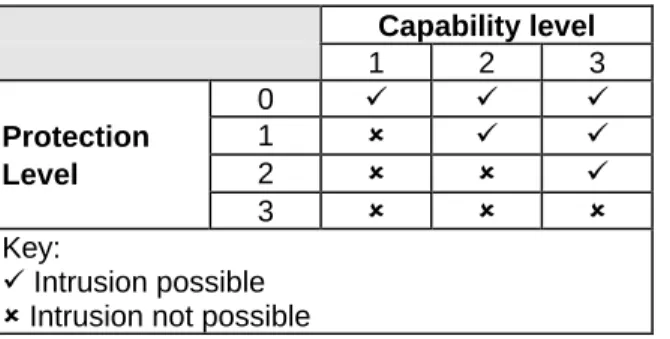
Served users can be given different intrusion capability levels and other users may be given protection against their calls being intruded upon. Different levels of intrusion protection can protect against different levels of authority to intrude as indicated in table 2.
Table 2: Relationship between Call Intrusion Protection and Capability Levels (CIPCL) Capability level
1 2 3
0 ü ü ü
Protection 1 û ü ü
Level 2 û û ü
3 û û û
Key:
ü Intrusion possible
û Intrusion not possible
The network can offer the served (calling) user either of two different ways to invoke Call Intrusion; immediately with the call setup or after consultation when the call meets busy.
6.2.9.2 Interactions
There are no significant interactions between the Call Intrusion Supplementary Service and the PUM services regardless of whether the PUM user is intruding or being intruded upon. As SS-CI can only be invoked at the visitor PINX for a PUM user, it is worth noting the following important considerations: - the service may not be available to a calling PUM user at all locations;
- the options subscribed to by the calling PUM user (e.g., immediate invocation on busy) may not be offered at all visitor PINXs;
- the procedures for manual invocation by the calling PUM user may differ from PINX to PINX; - a visitor PINX may not support the particular capability level (CICL) the calling user has at his home
PINX;
- at any visited PINX which supports SS-CI the PUM user should be provided with an intrusion protection level (CIPL) at least as high as the user subscribes to at the home PINX;
- if the PUM user is the unwanted party in an intrusion attempt and the visitor PINX does not support SS-CI, the PUM user would have no protection against intrusion. In this case the protection level could be provided from the home PINX, acting as the unwanted-user-PINX of SS-CI. However, with the existing SS-CI procedures this is only possible if the home PINX is on the call path of the unwanted call, which cannot be assumed to be generally the case;
- support of subscription options, e.g., override protection levels (CIPCL), may not be compatible. The SS-CI standard requires only that CIPCL levels 0 and 3 shall be supported. A PUM user assigned a protection level of 1 or 2 at the home PINX may have to accept a different level of protection at a visitor PINX which supports only the mandatory values.
6.2.10 Advice Of Charge (SS-AOC)
6.2.10.1 Service description
SS-AOC allows the served user to receive information concerning charges for a call. Three versions of the service provide information on:
a) charging rates at call establishment time and changes to the charging rates during a call; b) cumulative charge information automatically or on request during a call;
c) final charge information when the call is released.
The main interest in this service is the provision of information on charges incurred in the public network on a call-by-call basis.
6.2.10.2 Interactions
When the PUM user registers on a PINX in another country, the language to be used to present the information to the user may need to be changed. It could be possible to indicate in the service profile the preferred language to be used for the PUM user.
No significant interactions or considerations.
6.2.11 Recall (SS-RE)
6.2.11.1 Service description
SS-RE is used to redirect a transferred call back to the served user if the call is unanswered within a predetermined period.
In this service the following notation is used:
- User A: The served user of both SS-RE and SS-CT;
- User B: The user having a call with User A in active state prior to transfer; - User C: The transferred-to user, being alerted or busy.
6.2.11.2 Interactions
There are no significant interactions to be considered when User B or User C in the Recall supplementary service are PUM users.
SS-RE allows two options for processing a recall to the transferring user.
- The first option is to send a new SETUP message from User B to the served user (User A) to effect the recall. If this method is used, there would be no interactions to be considered when User A is also a PUM user. The recall SETUP message would be directed towards the home PINX and would be processed as a normal incoming call regardless of the PUM user's present location;
- The second option is to signal to User A from the local PINX if User C fails to respond. In most cases, the Recall timers will be 30s or less and it would, therefore, be unlikely that User A would move to a new location area in this time. If, however, this were to occur, it would be reasonable to allow the Recall to fail or to invoke some other implementation specific exceptional procedure.
6.2.12 Call Interception (ANF-CINT)
6.2.12.1 Service description
ANF-CINT is particularly applicable to attendants. Certain types of call which encounter certain condition in the PISN are diverted to a designated user. The purpose of this is to provide further assistance to the calling user. The type of call to which the service applies are defined by the basic service(s) and the source of the call (e.g., intra-PISN, incoming calls from a public network). The particular failure conditions that lead to the invocation of this ANF are network and implementation dependent but examples include: - destination number unobtainable;
- no reply; - call rejection.
Diversion can be achieved by forward switching from the PINX that detects the failure condition or by re-routing from the originating PINX.
6.2.12.2 Interactions
No significant interactions or considerations.
NOTE: It would be very useful to have "PUM user is not registered" added to the list of interception causes in the SS-CINT standards.
6.2.13 Call Distribution to the Attendant (SS-CDA)
NOTE: The definition of this service is not yet stable so this clause should be considered as speculative.
6.2.13.1 Service description
SS-CDA provides for calls to attendants to be distributed between selected attendants and provides for the handling of calls when all eligible attendants are busy. A queue may be handled by a number of attendants (common queue) or by a single attendant (specific queue). Attendants can be linked together in Attendant Groups where each member of the group has equal responsibility for the calls queuing for the group.
Each call to an attendant is allocated to an appropriate call queue and, when one or more eligible attendants are available, presented to either a specific attendant or to a group of attendants.
There is no constraint on the geographical location of the members of an attendant group.
The relationship of "queues to attendant groups" and "attendant groups to attendants" can be as follows:
a) Limited Attendant Grouping: Each attendant is a member of only one attendant group but each
common queue can be serviced by one or more attendant groups;
b) Limited Queue Association: An attendant may be a member of more than one attendant group
but each queue is associated with only one attendant group.
6.2.13.2 Interactions
No significant interactions or considerations.
6.2.14 Message Waiting Indication(SS-MWI)
6.2.14.1 Service description
SS-MWI enables the message centre to send a message waiting indication when messages are available for the served user and also enables this message waiting indication to be cancelled when no more messages are available for the served user.
6.2.14.2 Interactions
Message waiting indications are sent to the home PINX by the message centre. It is expected that this information will be included in the service profile of the PUM user. So the PUM user may be informed about the waiting message at the new location by transferring this information with the service profile using SS-CTSP. However, this information may not be presented to the user if the hosting terminal does not have the capability to do it.
6.2.15 Night Service (SS-NS)
NOTE: The definition of this service is not yet stable so this clause should be considered as speculative.
6.2.15.1 Service description Attendant night mode (SS-NMA)
SS-NS enables a user designated as an Attendant to indicate to the PISN that he or she is either available or not available for handling attendant calls. When not available (Night Mode), calls can be redirected to an alternative answering position. This service provides an equivalent to "Log-on" and "Log-off" procedures.
6.2.15.2 Interactions
Night Service is a direct derivative of SS-CFU and, therefore, the same considerations described in subclause 6.2.3 apply when a PUM user is acting as the attendant.
7
PUM on top of CTM
In a PISN which supports both Cordless Terminal Mobility (CTM) and PUM, interactions arise between the two types of mobility. This is a consequence of the requirement that PUM users should be allowed to register also on Cordless Terminals (CTs).
7.1 Numbering aspects
In order to enable PUM users to register on cordless terminals and to use the same procedures as on wired terminals, the CTs need to be assigned an identifier. A PISN number or an alternative identifier can be used according to the CTM architecture.
A problem may arise when the owner of the CT is also a PUM user; in this case the PISN needs to identify the CT as well as the PUM user. Two options are possible:
a) use of a PISN number to identify the CT and another different PISN number to identify the PUM user. In this case, the PISN independently tracks the CT using the CTM procedures, and updates the PUM registration using the PUM procedures. There is no special relationship between the PUM user and the CT even if he is the owner of the terminal;
b) use of the same PISN number can be used to identify the PUM user and the CT. This option could be useful in some cases in order to make an efficient use of the PISN numbers. The PISN should distinguish between two entities with the same PISN number which is possible technically but unusual for the existing PISNs. Some of the problems that can arise are listed below:
1) as long as the user is registered on his terminal, he can be served using the CTM procedures;
2) when the user registers elsewhere as a PUM user and leaves his CT, the PISN needs to make a decision whether the PUM user (at his new hosting terminal) or the CT will receive an incoming call for that PISN number. The following scheme describes a possible scenario: - incoming calls for that PISN number can be handled as PUM calls, this is a local
decision for the home PINX;
- outgoing calls from the hosting address can be handled by PUMO;
- CTM location registration for the CT can be handled by the SS-CTLR. Either the CT is not authorized to register at all so all registration request will be rejected by the home PINX or it can be registered with a limited service profile, i.e., outgoing calls from the CT can be limited to internal and emergency calls;
- calling the CT is not possible; in this case, because it will be difficult for the PISN to distinguish between calls that should be delivered to CT and those that should be delivered to the PUM user;
- if another PUM user registers at this CT, the PUMI for this user will deliver the calls to the CT;
- in order for the owner of the CT to be able to re-use the CT he has to invoke the SS-PUMR on his CT when he comes back.
7.2 Interactions between PUM and CTM services
7.2.1 CTM Location Registration (SS CTLR)
7.2.1.1 Service description
SS-CTLR makes the location of a CTM user known to the PISN. By updating location information in the PISN, incoming calls can be routed to a CTM user, and the CTM user can access the PISN services from the current location area. CTLR also enables a CTM user to inform the PISN that the current location area is no longer to be used to make and receive calls.
7.2.1.2 Interactions
The initial PUM registration on a CT can be achieved using the same procedures as for the PUM registration on a wired terminal, as the CTM home PINX is not involved. In this case, the CTM visitor PINX becomes also the PUM visitor PINX. Therefore, it maintains the PUM user's registration information as well as the CTM user's registration information.
This situation can be maintained as long as the CT stays at the initial location area. However, when the CT changes the location area, the PUM user's registration needs to be moved automatically to the new location area of the CT.
Upon arrival in the new location area, the usual CTM location registration procedures are initiated first. Then, the old visitor PINX initiates the re-registration procedure via the CTM home PINX. The CTM home PINX routes the PUM registration request to the new visitor PINX. Then the usual PUM registration procedures are performed.
The following two considerations are worthy of note:
a) if the CTM home PINX does not support PUM facilities, it will reject the PUM re-registration request from the old visitor PINX. In this case, the old visitor PINX should initiate the de-registration of the PUM users in order to return the PISN to a consistent state;
b) if the new visitor PINX does not support PUM facilities, it will reject the PUM re-registration request from the old visitor PINX received via the CTM home PINX. In this case, the old visitor PINX should initiate the de-registration of the PUM users in order return the PISN to a consistent state.
7.2.2 CTM Transfer of Service Profile (ANF-CTSP)
7.2.2.1 Service description
The Transfer of Service Profile ANF enables a mobile (CTM or PUM) user's service profile to be transferred to the visitor PINX and possibly to update the service profile at the home PINX.
7.2.2.2 Interactions
ANF-CTSP can be invoked by PUM SS and ANF. There is no obvious difficulties in the use of ANF-CTSP for PUM.
7.2.3 CTM Call Handling (ANF-CTMI/ANF-CTMO)
7.2.3.1 Service description
ANF-CTMI enables calls to be directed to a CTM user within the PISN.
ANF-CTMO enables the PISN to process CTM user's outgoing calls and supplementary services invocation.
7.2.3.2 Interactions
No significant interactions or considerations.
7.2.4 CTM Authentication (SS-CTAT/SS-CTAN)
7.2.4.1 Service description
SS-CTAT enables the PISN, as a security measure, to validate the identity provided by the CTM user. SS-CTAN enables the CTM user, as a security measure, to validate the identity of the PISN prior to accepting certain instruction from it.
7.2.4.2 Interactions
No significant interactions or considerations.
7.2.5 CTM Handover (ANF-CTH)
7.2.5.1 Service description
ANF-CTH enables a CTM user involved in a established call to continue with the call while moving between overlapping location areas within the same visited area.
7.2.5.2 Interactions
When a PUM user is registered on a CT, the PUM calls as well as the CTM calls can be affected by an invocation of ANF-CTH. In most cases this operation does not cause any special problems because it is a "radio operation" which can be achieved independently of whether the involved call is a CTM or a PUM call. However, if the CT moves from one Fixed Part to another, it may be necessary to update the PUM user's record in the Visitor Data Base to reflect the new access address of the CT.
8
Management service consideration
A number of services providing management functions within a PISN have been identified in ETR 245 [11] and ETR 048 [12]. The descriptions of these services are brief and no detailed standards have been published. This clause of the ETR, therefore, considers in very general terms only a selection of management services where the impact of PUM might be significant.
The considered management services are: - User aspects administration;
- Routing administration;
- Tariff and charging administration; - Traffic management;
- Management of PISN user access; - Restoration and recovery;
- Management of PISN network services; - Management of dialling/numbering plans; - Management of mobility;
- Configuration of PISN supplementary services.
These services are considered individually in the following subclauses.
8.1 User aspects administration
The purpose of this management service is to allocate and administer telecommunications services (basic and supplementary services) to PISN users. Considerations related to PUM are:
- the ability to provide a flexible allocation of basic services between a PUM user's visited terminal and a home terminal. As an example, voice may be allocated to the visited terminal while Fax is allocated to the home Fax terminal;
- the ability to declare a PUM user as a valid PISN user by creating a new entry in the appropriate HDB;
- "Black listing"; i.e., the maintaining of a list of PUM users to whom no service whatsoever is to be provided;
- the ability to limit, for some PUM users, the provision of mobility service to certain visitor PINXs (a subset of the full range of visitor PINXs);