PROMOTING POSITIVE MALE GENDER SOCIALIZATION AMONG MIGRANT MALE YOUTH LIVING IN KAKUMA REFUGEE CAMP, KENYA: APPLYING APPRECIATIVE INQUIRY TO GENDER-BASED VIOLENCE
PREVENTION EFFORTS
Mary Whitney Fry
A dissertation submitted to the faculty at the University of North Carolina at Chapel Hill in partial fulfillment of the requirements for the degree of Doctor of Public Health in the Department of Health
Policy and Management in the Gillings School of Global Public Health.
Chapel Hill 2016
Approved by:
iii
ABSTRACT
Mary Whitney Fry: Promoting Positive Male Gender Socialization among Migrant Male Youth Living in Kakuma Refugee Camp, Kenya: Applying Appreciative Inquiry to Gender-Based
Violence Prevention Efforts
(Under the direction of Stephanie B. Wheeler)
Detrimental gender norms that influence male perpetrated gender-based violence
against women are enhanced in times of forced migration and refugee resettlement. 1 While a variety of factors in these contexts contribute to male adoption of harmful notions of
masculinity and subsequent controlling and violent behaviors towards women, a variety of
protective factors may exist to counteract this tendency and reduce gender-based violence
perpetration. 2 This research sought to understand how social and structural factors in Kakuma Refugee Camp in Kenya could be leveraged to promote positive male gender socialization
among refugee youth.
This study employed a two-phased qualitative data collection approach to best explore
these factors among predominantly South Sudanese migrant male youth living in Kakuma
Refugee Camp. The Appreciative Inquiry leadership theory served as the base conceptual
framework for the study methodology.
Key findings from this study were categorized into four core themes: 1) Kakuma
structures that promote positive male gender socialization and positive male/female
interactions, 2) male gender socialization among refugees in Kakuma and what factors affect
iv
how this “real man” should relate with women in the community, and 4) recommendations for
promoting positive male gender socialization in order to avert GBV perpetration behaviors.
The study’s results suggest a change model to promote positive male gender
socialization that averts GBV perpetration behaviors among male youth in Kakuma. Specifically,
the plan for change elevates men as leaders in order to facilitate change amid complexity by
building on the constructs of freedom, information, culture, and relationships to influence male
v
ACKNOWLEDGEMENTS
This dissertation is the culmination of a three-year journey through the University of
North Carolina’s Executive Doctoral Program in Health Leadership. A number of individuals
have supported me with wisdom and encouragement along the way.
I’d like to first express my gratitude to the members of my dissertation committee for
their guidance and expertise. Stephanie Wheeler, my dissertation chair, shared in my passion
for the study’s topic and offered a unique perspective on research in my study’s location due to
her own experience living and working in the region. Stephanie provided invaluable counsel to
my work and thoughtful leadership of the dissertation process. Asheley Skinner provided
insight in adolescent health and best approaches to the application of literature to the study.
Bryan Weiner advised greatly on the study’s design from his expertise of qualitative research
methods. Mary Kincaid contributed thoughtfully to the study’s gender-specific content, offering
insight from her own research and practice in the sector. Claire Campbell supported the study’s
application of Appreciative Inquiry through her experience and skill in applying strengths-based
methodologies to community-focused research and insider-driven change models. I’m grateful
to each of these individuals for their encouragement and overwhelming support.
Secondly, I’d like to thank the leadership of IsraAID for its on-the-ground facilitation of
my research in Kakuma. Naama Gorodischer sat with me for hours in the early days of this
study’s design, brainstorming about GBV prevention and how best to engage men in this effort.
vi
Theran’s leadership during this study facilitated meetings with camp authorities for necessary
research approvals and paved the way for engaging with study participants. Julie Krause
organized all personal and research-related logistics for my time in Kakuma. I couldn’t have
conducted this research without the dedicated support of IsraAID.
Third, I’m grateful to the Appreciative Inquiry practitioner community for its support
throughout this study, as well as during my personal journey of embracing appreciative living.
Wendy Sarratt was my initial inspiration of applying AI to my doctoral research, having
previously traveled this road in her own DrPH dissertation. Susan Wood further solidified my
thinking about the relevancy and applicability of AI in this study, and she introduced me to tools
and practitioners who could further support my research. In the spirit of AI, I’m overwhelmed
with gratitude to this community for embracing me and so generously giving of time, insight,
and encouragement.
Fourth, I’d like to thank the faculty of the Department of Health Policy and Management
in the Gillings School of Global Public Health at UNC and the Don Holzworth family for awarding
me the Charles A. Veatch Endowed Scholarship in Health Leadership. I appreciate the financial
support this award offered for this research, as well as the faculty’s confidence in my future as
a global health leader.
Fifth, I am indebted to friends and family for standing by me in this process. I consider it
an honor to have walked this DrPH road with other members of Cohort 9, an incredible group
of leaders in global health who are certainly up to something! I am grateful for their collective
positivity, immense wisdom, and unwavering friendship. I am also eternally grateful for my
vii
Their relentless encouragement and love has been a pillar of support as I carry out my life’s
ambitions and professional pursuits.
Finally, I appreciate the time and honesty provided by this study’s participants, both
agency leaders and male youth residents of Kakuma Refugee Camp. Words cannot express the
efforts exerted by agencies that work tirelessly to affect change in Kakuma; their dedication is
unyielding. And to the young men of Kakuma who are brave, creative, respectful, powerful,
viii
TABLE OF CONTENTS
LIST OF TABLES ... xi
LIST OF FIGURES ... xiii
LIST OF ABBREVIATIONS ... xiv
CHAPTER 1: INTRODUCTION ... 1
Statement of the Issue ... 1
Purpose Statement ... 3
CHAPTER 2: REVIEW OF THE LITERATURE ... 7
Background ... 7
Methodology for Literature Review ... 11
Article Inclusion Criteria ... 12
Search Terms ... 13
Study Selection... 15
Results ... 17
Description of Included Publications ... 17
Results of Included Publications ... 18
Discussion ... 32
Limitations in the Review Process ... 33
Considerations for Future Research ... 34
CHAPTER 3: RESEARCH METHODS ... 36
Specific Aims ... 36
ix
Background ... 38
Study Population ... 40
Conceptual Framework ... 41
Study Design ... 44
Study Participant Recruitment ... 45
Consent and Confidentiality ... 48
Data Collection ... 49
Data Analysis Procedures ... 53
Ethical Considerations ... 56
Psychosocial Risk ... 56
Statement of Non-Affiliation ... 57
Ethical Approvals ... 57
CHAPTER 4: RESULTS... 58
Population ... 58
Study Results and Discussion ... 61
I. Kakuma structures that promote positive male gender socialization and positive male/female interactions ... 62
II. Male gender socialization among refugees in Kakuma ... 68
III. The real man ... 72
IV. Promoting positive male gender socialization that averts GBV perpetration behaviors ... 77
Conclusion ... 85
CHAPTER 5: PLAN FOR CHANGE ... 88
Introduction ... 88
x
Change Amid Complexity: Self-Organizing Systems ... 91
The Plan for Change ... 94
Freedom ... 97
Information ... 99
Culture ... 101
Relationship ... 103
Conclusion: Male Gender Identity ... 105
CHAPTER 6: DISCUSSION ... 108
Impact of the Study on Public Health ... 108
Study Limitations ... 109
Further Research ... 112
Final Thoughts ... 113
APPENDIX 1: AIM 1 CONSENT FORM ... 115
APPENDIX 2: AIM 1 KEY INFORMANT INTERVIEW GUIDE ... 118
APPENDIX 3: AIM 1 KEY INFORMANT INTERVIEW AGENDA ... 122
APPENDIX 4: AIM 2 VERBAL CONSENT FORM ... 123
APPENDIX 5: AIM 2 FOCUS GROUP DISCUSSION GUIDE ... 126
APPENDIX 6: AIM 2 FOCUS GROUP DISCUSSION AGENDA ... 130
APPENDIX 7: DATA ANALYSIS CODEBOOK ... 131
APPENDIX 8: IMAGES OF DRAWINGS AND LISTS FROM AIM 2 FOCUS GROUP DISCUSSIONS ... 136
xi
LIST OF TABLES
Table 1.1. Definitions of key terms ... 6
Table 2.1. Search Terms 1: Male gender socialization and GBV in sub-Saharan Africa ... 13
Table 2.2. Search Terms 2: Male gender socialization and GBV among refugees in sub-Saharan Africa ... 14
Table 2.3. Quality and characteristics of papers included in the literature review 20
Table 2.4. Variables of gender socialization among male youth in sub-Saharan Africa, as pertaining to gender-based violence ... 26
Table 2.5. Variables of forced migration among male youth in sub-Saharan Africa in the male socialization/gender-based violence continuum ... 30
Table 4.1. Description of Aim 1 participants ... 59
Table 4.2. Description of Aim 2 participants ... 61
Table 4.3. Kakuma structures that promote positive male gender socialization ... 63
Table 4.4. Kakuma structures that promote positive male/female interactions ... 65
Table 4.5. Gender socialization constructs for male refugees living in Kakuma ... 69
Table 4.6. Constructs of the real man ... 73
Table 4.7. Constructs of the real man with women ... 75
Table 4.8. Aim 1: Agency recommendations for promoting positive male gender socialization to avert GBV perpetration behaviors... 78
Table 4.9. Aim 2: Hopes and dreams for young men and young men in their interactions with women (as documented and verbalized in small groups within the larger FGD) ... 82
Table 4.10. Aim 2: Male youth recommendations for promoting positive male gender socialization to avert GBV perpetration behaviors... 84
xii
xiii
LIST OF FIGURES
xiv
LIST OF ABBREVIATIONS
GBV: gender-based violence
STI: sexually transmitted infection
UNHCR: United Nations High Commission for Refugees NGO: Non-governmental organization
AI: Appreciative Inquiry FGD: Focus group discussion
HIV/AIDS: Human immunodeficiency virus/Acquired immunodeficiency syndrome SSA: Sub-Saharan Africa
SES: Socioeconomic status
PEER: Participatory ethnographic evaluation and research DRC: Democratic Republic of the Congo
CI: Confidence Interval
WHO: World Health Organization
DOAT: Directory of Open Access Journals MFC: Men for Change
RCT: Random control trial CTS: conflict tactics scale UN: United Nations
SGBV: Sexual and gender-based violence GoK: Government of Kenya
KI: Key informant
JRS: Jesuit Refugee Services
xv
AMREF: African Medical and Research Foundation
NACOSTI: National Centre for Science, Technology, and Innovation UNC-CH: University of North Carolina at Chapel Hill
1
CHAPTER 1:INTRODUCTION
Statement of the Issue
Gender-based violence (GBV) is progressively becoming recognized as a global public
health problem. Women survivors of GBV face increased morbidity through physical injuries,
sexually transmitted infections (STIs), reproductive health problems, and psychological trauma. 1-4 Vulnerability to GBV increases amid complex humanitarian emergencies, forced migration,
and resettlement due to the absence of protection, gender or ethnic discrimination, economic
disparity, and limited rights for women. 1,3-5 Increased GBV perpetration behaviors among men in these settings influence cyclical patterns of acceptable gender norms—among men and
women—and societal violence, shaping behaviors among new generations of males.
Specifically, social and structural contexts of forced migration and refugee camp resettlement
contribute to this gender norm development cycle, challenging notions of manhood that may
lead to unhealthy male socialization and ultimately higher GBV incidence perpetrated against
women.
In sub-Saharan Africa, manhood is achieved when one is both provider and protector,
yet this is often challenged in emergency contexts. Within these contexts, many men are
unable to work in refugee settings, and families rely on the United Nations High Commissioner
for Refugees (UNHCR) or nongovernmental organizations (NGOs) for their provision of needs.
Men must relinquish ambitions, and many find it difficult to adapt to their host country’s
2
fleeing danger and becoming a refugee is seen as a weakness. 6 The literature links this unhealthy socialization to what is termed “hegemonic masculinity,” a behavioral disposition
among males to overcompensate for weakness through dominance and control, 7-10 and hegemonic masculinity often leads to GBV perpetration. 11-14
Male refugee youth are at risk of adopting hegemonic masculinity behaviors. The
literature reveals themes of male socialization and the common crisis of masculinities—both in
a general sub-Saharan context as well as amid forced migration—that contribute to hegemonic
masculinity and GBV incidence. In fact, forced migration tends to enhance pre-existing gender
inequalities and power imbalances among male youth, further increasing GBV incidence. 14 To best support this knowledge base, research is needed to provide insight into positive structural
and contextual factors that lead to healthy notions of masculinity among male refugee youth,
specifically noting factors that could reduce male perpetration of GBV.
As a recipient of thousands of refugees from surrounding nations—including over
46,500 from South Sudan since December 15, 2013 15—Kenya offers a prime location for further study in this regard. Kakuma Refugee Camp in Northern Kenya, established in 1992, hosts over
170,000 refugees from over nine nations and 20 ethnic groups. 13 Whereas most refugee camps hold majority populations of women and children, Kakuma hosts a majority population of male
youth. 13 This male refugee youth population presents an exceptional case to explore gender socialization among forced migrants, including structural and contextual factors that protect
against GBV perpetuation. While risk factors exist among this population that could contribute
to hegemonic masculinity development, a variety of protective factors from such a community
3
involvement in an institution such as school or church, and the attainment of support from
other social networks. 16
Purpose Statement
My long-term goal for the study was to contribute to efforts that reduce GBV incidence
and subsequent health burdens by promoting healthy masculinity development among
refugees through innovative agency- and youth-directed change. The overall objective of this
research was to explore possibilities for positive change among social, organizational, and
leadership structures that affect masculinity development among refugee male youth. The
following research questions guided the process of achieving the above objective: How can social and structural factors in Kakuma Refugee Camp in Kenya be enhanced to promote positive male gender socialization among refugee youth?
• Sub-question 1: What positive elements exist for male refugee youth in Kakuma that
promote healthy masculinity development and potentially protect against GBV
perpetration behaviors?
• Sub-question 2: What do agencies and male youth envision for the positive collective
future of male youth in Kakuma?
• Sub-question 3: How can these positive drivers be realized and replicated to affect
change in refugee male youth behaviors, ultimately reducing GBV perpetration
incidence?
The rationale for the research was that GBV prevention requires reduced male perpetration of
GBV. Prior to expecting such behavior change, we must first address factors contributing to
4
The above research questions were addressed using the Appreciative Inquiry (AI)
leadership theory for promoting positive change. The AI methodology approaches
organizational or community-level transformation by valuing the past and present to effectively
embrace the future, and the above research questions follow the logic of the AI approach
through appreciating, envisioning, constructing, and sustaining positive change. 17 This theoretical approach is embodied in the following aims by which the above questions were
explored through a qualitative research methods design:
• Aim 1: Explore organizational leadership potential in promoting healthy male
development in Kakuma.The research team conducted key informant (KI) interviews with 3 lead agency representatives with GBV programming focus in Kakuma. These
interviews accomplished the following: 1) assessed current GBV prevention efforts
working with male youth in Kakuma, 2) engaged participants in the Appreciative Inquiry
(AI) approach detailed in Chapter III: Methods, and 3) garnered support for conducting similar discussions with male refugee youth. Participants received an introduction to AI
and discussed the positive core elements that promoted healthy masculinity
development and reduced GBV incidence in Kakuma. A draft KI interview guide for Aim
1 can be found in Appendix 2, and data analyzed from Aim 1 contributed to the plan for
change (see Chapter 5). An interview team, including myself, conducted the KI
interviews in English, as the working language among agency staff working in Kakuma
was English. Participants were recruited in partnership with UNHCR and the study’s lead
5
• Aim 2: Explore youth leadership potential in promoting healthy male development in
Kakuma.Four FGDs, including one group of 4 and one group of 8 male youth refugees ages 18-35 facilitated on two different occasions, followed the FGD guide in Appendix 5.
The FGD adhered to AI methodology, displayed in the conceptual model in Chapter III: Methods, and achieved the following: 1) discovered positive factors existing both within traditional cultural settings and in Kakuma to promote healthy male development and
GBV prevention, 2) imagined and designed a positive future for male youth that builds
on existing strengths to prevent GBV, and 3) developed a plan for change and a means
to transfer this change to communities, programs, and policies. A facilitation team,
including myself, conducted the FGDs in English. Due to universal education offered in
the camp, English proficiency was commonly grasped after the first year of living in
Kakuma. Aim 2 participants were recruited from IsraAID’s students engaged in the
organization’s mentorship training program, South Sudanese and Sudanese men who
mentor South Sudanese adolescents who arrived in Kakuma following the December 15,
2013 influx of refugees.
As refugees in sub-Saharan Africa continue to migrate from conflict zones to refugee
camp settings, GBV prevention research focusing on refugee male youth remains paramount.
This study sought to address this research gap by exploring a root attribute to GBV perpetration
by males, specifically male gender socialization and how masculinity development affects male
behaviors with women. Results from this study uncover current GBV prevention efforts in
Kakuma that engage men, agency- and male-perceived notions of positively socialized men,
6
women, and recommendations for promoting positive male gender socialization and positive
male/female relationships. These recommendations, and the data at large, contributed to a
proposed plan for positive change in Kakuma, specifically, and in complex environments, more
broadly. Five key themes emerged as influencers in promoting positive change in this complex
environment: freedom, information, culture, relationships, and identity. Understanding the
interconnected nature of these constructs and how male gender identity is influenced amid
complexity can inform both research and practice in GBV prevention efforts.
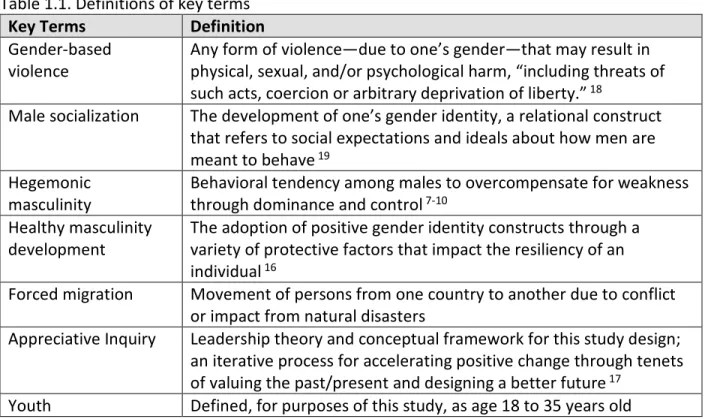
Table 1.1. Definitions of key terms
Key Terms Definition
Gender-based violence
Any form of violence—due to one’s gender—that may result in physical, sexual, and/or psychological harm, “including threats of such acts, coercion or arbitrary deprivation of liberty.” 18
Male socialization The development of one’s gender identity, a relational construct that refers to social expectations and ideals about how men are meant to behave 19
Hegemonic masculinity
Behavioral tendency among males to overcompensate for weakness through dominance and control 7-10
Healthy masculinity development
The adoption of positive gender identity constructs through a variety of protective factors that impact the resiliency of an individual 16
Forced migration Movement of persons from one country to another due to conflict or impact from natural disasters
Appreciative Inquiry Leadership theory and conceptual framework for this study design; an iterative process for accelerating positive change through tenets of valuing the past/present and designing a better future 17
7
CHAPTER 2:REVIEW OF THE LITERATURE
Background
The global public health community is progressively recognizing gender-based violence
(GBV) as a significant issue affecting the health of women. GBV is defined as any form of
violence due to one’s gender, which may include physical, sexual, and/or psychological violence
such as deprivation or neglect 20,21. Women survivors of GBV face increased morbidity through physical injuries, sexually transmitted infections (STIs), reproductive health problems, and
psychological trauma 1-4. In sub-Saharan Africa, physical assault against women by intimate partners ranges from 24% in Zambia to 31% in Nigeria 22, and all forms of intimate partner violence reach heights of 46% and 48% prevalence in Kenya and Zambia, respectively 23. Among adolescent girls 12-19 years of age in Mbarara, Uganda, the sixth largest urban center in the
Eastern African nation, 23% reported sexual coercion, or an unwillingness to engage in sexual
intercourse, upon first sexual experience 24. A variety of social, cultural, and contextual factors influence these rates in sub-Saharan Africa; increased understanding of these dynamics may
contribute positively to GBV prevention efforts.
Gendered stereotypes and perceptions of GBV in low-income settings appear to
perpetuate the above statistics, as sexual relationships are heavily influenced by gender norms
within societies 25. Violence against women in such settings is often condoned 7, and the acceptability of such violence alone is arguably among the greatest determinants of GBV in
8
intimate partner instance, such that 80% of women respondents in a nationally representative
survey in Zambia and 66% of women respondents in Kenya defend a man’s use of violence
against her because of an erroneous act committed, as per societal expectation 22. Among men, justification of GBV among intimate female partners varies from 8% acceptability in Madagascar
to 63% in Kenya 26. The impact of such gender norms may include the continued perpetration and increased incidence of GBV in societies where such acts are condoned.
Indeed, social and structural contexts greatly influence norms affecting GBV, are
deserving of attention. Gender identity is the relational construct that refers to social
expectations and ideas about how men and women are meant to behave 27. Gender, not sex, has greater influence over one’s behavior and perceived power in relationships 7. Culture, religion, and other aspects of society determine these precepts, and differences in the male and
female genders are rooted in power inequalities, traditionally resulting in male domination and
female subordination 7,27. The socialization of gender recognizes that both men and women acquire a set of learned behaviors based on social expectations of gender identities. Uthman
and colleagues researched attitudes associated with GBV in sub-Saharan Africa and based their
work on the social learning theory 26. This theory states that individuals adopt behaviors as observed in role model’s actions. Pertinent to gender socialization in sub-Saharan Africa, norms
in patriarchal societies are learned and passed down to the next generation to reinforce
potentially harmful ideals of masculinity that are rooted in the control of women and exhibition
of power 19,26.
This aspect of male dominance is often referred to as hegemonic masculinity, a
9
insecurity 7-10. Research states that hegemonic masculine behavior can be adopted if traditional aspects of masculinity are threatened or if one is unable to achieve culturally perceived notions
of gendered success 10,28. Men of this gender identity who engage in violent sexual behavior may be influenced by “low self-esteem and poor social skills,” desiring to cover up their
weakness through power 28. Men who take on this identity transition from insecurity to
control, thereafter judging their success and the success of other men by physical strength and
heterosexual conquest 7,9. The position of hegemony among men becomes an accepted ideal in society whereby men exercise their power in sexual relationships, often engaging in violent and
controlling behaviors against women. Social control and power imbalances, as exemplified by
hegemonic masculinity, cultivate societal norms that justify GBV and therefore encourage male
violent behavior among women 29.
Specific vulnerability constructs related to violence, oppression, and migration may
further increase a man’s tendency to adopt hegemonic masculine behaviors and act out in
sexual violence 30. The literature reveals an increased psychosocial burden on those who experience trauma, forced displacement, separation from family, loss of basic necessities, and
threats to aspirations 31, and research also highlights that female vulnerability to GBV increases amid complex humanitarian emergencies, forced migration, and resettlement due to the
absence of protection, gender or ethnic discrimination, economic disparity, and limited access
to rights 1,3-5. These burdens associated with forced migration affect millions in sub-Saharan Africa who have fled their nations of origin and become refugees. As of 2009, 17 sub-Saharan
10
Forced migration and resettlement also influence masculine gender role stress,
specifically the added struggle of male refugees to manifest traditional notions of masculinity,
thereby contributing to unhealthy coping and socialization patterns 34. Traditional gender norms place men in the role of provider and protector; however, refugee males have not only
fled their livelihoods and ambitions upon fleeing conflict, but they have also had to rely on
agencies for provision of needs. Most host countries prohibit refugees from gaining
employment, as they lack citizenship in their new homeland. This inability to work—along with
a variety of other factors associated with forced migration—arguably challenges one’s
manhood. The very nature of fleeing danger is seen as weakness 6. The stress of challenged masculinities can lead to hegemonic masculinity behaviors and a number of detrimental
outcomes, including interpersonal violence and aggressive sexual behaviors towards women 30,34.
In light of the above-mentioned masculinity development patterns and the perpetration
of GBV, I undertook a systematic literature review to identify factors linking gender socialization
among male youth in sub-Saharan Africa with violent sexual behaviors and GBV incidence. This
review is structured in two parts: 1) male gender socialization to present a foundational model
of gender norm development in the region, and 2) male gender socialization among refugees in
sub-Saharan Africa to understand how forced migration contributes to this construct.
A review of male socialization in sub-Saharan Africa is critical to preventing GBV. A great
deal of research and intervention has targeted female empowerment and GBV survivor
response; however, significant potential exists in research and subsequent policy development
11
that contribute to gender socialization among males and the ensuing behavior patterns among
them can help facilitate “gender transformative” GBV prevention, a process that seeks to alter
gender norms and foster increased gender equity 7. Additionally, increased male involvement in GBV prevention strategies promotes positive male development and increases social
pressure against GBV. When given the opportunity, men have been known to reconsider their
hegemonic masculinity, altering behaviors to adopt a less harmful gender identity that
contributes to improved health outcomes among both males and females 9.
Methodology for Literature Review
A review of articles was conducted following the standard systematic review
methodology to understand the relationship between gender socialization in sub-Saharan
Africa (independent variable) and gender-based violence (dependent variable), and also to
examine the role of forced migration due to conflict (independent variable) in the context of
GBV. I used Web of Science, PubMed, CINAHL, Global Health, and Scopus in initial searches to
identify interventions, evaluations, and other systematic reviews of the subject under study.
Among these search engines, only Web of Science produced results matching inclusion criteria.
English articles in the Web of Science database were searched on a number of occasions
between January 31, 2014 and February 1, 2016. Next, I contacted key experts in the field to
provide information on international organizations and renowned researchers who have
distinguished themselves in GBV prevention efforts through male-targeted interventions, as
well as experts in the field of forced migration research. I then pulled additional publications
and grey literature from these sources for review—including reports, research, and essays—
12
were examined to further highlight articles of relevance. The following section outlines the
methodology I used for the review process, including eligibility criteria, sources, search terms,
and study selection.
Article Inclusion Criteria
Characteristics of articles included in the review can be summarized by study design,
population of focus, type of intervention, and outcome measure.
The following study designs were included in the review: peer-reviewed original
research, systematic reviews, and performance evaluations. Grey literature was also included,
such as education manuals, collections of case studies, advocacy briefs, and expert papers.
Study populations of inclusion were limited to youth and adolescents (i.e. defined
differently per country, but approximately between 13 and 35 years of age) in sub-Saharan
Africa. Articles focusing on populations above 35 years and in countries outside of sub-Saharan
Africa were excluded from review. Exceptions included studies that comprised—and separately
aggregated—the target age range in the population under study. I also included in the review
global research that presented data on sub-Saharan Africa.
Intervention types included those studies focusing on male gender socialization, male
involvement in GBV prevention, and forced migration as associated with GBV. Only articles
discussing forced migration, refugee populations, or post-conflict were included; wartime
violence and its affects on masculinity development and GBV were excluded if not also
addressing migration. The review included HIV-specific studies that focused on gender and
13
male socialization without association to GBV were excluded; likewise, HIV-focused studies
focusing on association to GBV without insight into male socialization were excluded.
Two outcome measures were included in the review: 1) sexual, physical, and/or
emotional GBV among women, as perpetrated by males, and 2) GBV prevention.
Search Terms
The first set of search terms that I used for this systematic review represents
terminology searches for part one of the research question, namely how gender socialization in
sub-Saharan Africa contributes to violent sexual behavior among male youth. Multiple searches
were conducted in Web of Science to promote a comprehensive collection of publications,
following these search terms (see Table 2.1): “Youth OR adolescent OR young adult” AND “Male
OR masculinity OR man OR men” AND “Gender-based violence OR violent sexual behavior OR
intimate partner violence” AND “Determinant* OR social* factor OR social*” AND “Kenya OR
east* Africa OR sub-Saharan Africa.”
Table 2.1. Search Terms 1: Male gender socialization and GBV in sub-Saharan Africa Population Youth OR adolescent OR young adult
AND
Population Male OR masculinity OR man OR men
AND
Issue Gender-based violence OR violent sexual behavior OR intimate partner violence
AND
Cause Determinant* OR social* factor OR social*
AND
Location Kenya OR east* Africa OR sub-Saharan Africa
Search Terms 2 represents search terms for part two of the literature review: forced
migration and male gender socialization as contributing to GBV. The above-mentioned
14
for inclusion. I intentionally did not include this secondary search element of forced migration
in the first search terms in order to gain initial context about male socialization and GBV in the
sub-Saharan Africa prior to understanding how forced migration adds to this complexity.
Nonetheless, Search Terms 1 did surface one article that addressed forced migration, and it was
included in the review for part two, as well.
The following represents search terms used for the second part of the literature review
(see also Table 2.2): “Youth OR adolescent OR young adult” AND “Refugee OR refugees OR
“forced migration” OR post-conflict” AND “Masculinity OR masculine OR gender identity OR
socialization OR gender norm OR manhood” AND “Gender-based violence OR violent sexual
behavior OR sexual violence OR rape” AND “Kenya OR sub-Saharan Africa OR east* Africa.”
Table 2.2. Search Terms 2: Male gender socialization and GBV among refugees in sub-Saharan Africa
Population Youth OR adolescent OR young adult
AND
Context Refugee OR refugees OR “forced migration” OR post-conflict
AND
Issue Masculinity OR masculine OR gender identity OR socialization OR gender norm OR manhood
AND
Outcome Gender-based violence OR violent sexual behavior OR sexual violence OR rape
AND
Location Kenya OR sub-Saharan Africa OR east* Africa
In addition to the provision of recommended references by key experts in the field, of
which two were included in the review, I also reviewed the following organizational websites
for institutional resources and publications as per the counsel of key experts:
• Instituto Promundo:
15
• Sonke Gender Justice:
http://www.genderjustice.org.za/resources/cat_view/43-journal-articles-book-chapters.html
• Engender Health: http://www.engenderhealth.org/pubs/gender/index.php
• Raising Voices: http://raisingvoices.org/resources/#reports-articles-essays
Additional references were pulled from selected articles.
Study Selection
Following the strategic searches and added articles from other sources, I screened
article abstracts and removed duplicates. I then reviewed full text articles for eligibility and
searched relevant references for additional full text review. All articles screened for inclusion by
abstract, full text, snowball, and other sources were documented in an Excel spreadsheet,
noting the following details: author, date of publication, title, design, population, outcomes,
and eligibility criteria. Figure 2.1 below displays the article selection process for parts one and
16 Figure 2.1. Study selection process
Potential articles identified through Web of Science
(n = 186)
Potential articles identified through other sources
(n = 24)
Articles screened per abstract (n = 76)
Articles after duplicates removed (n = 73)
Full text articles assessed for eligibility (n = 73)
Additional full articles pulled and assessed from references (snowball)
(n = 24)
Full text articles excluded (n = 61)
Full text articles excluded (n = 17)
ID
E
N
T
IF
IC
A
T
IO
N
S
C
R
E
E
N
IN
G
E
LI
G
IB
IL
IT
Y
IN
C
LU
D
E
D
17
Results
A total of 19 papers, from 210 articles initially identified, were included in this
systematic review. Among these papers, 13 were studies of observational, cross-sectional, and
descriptive designs with one study including a thorough systematic review. The remaining
papers included one systematic review, one education manual, one collection of case studies,
one advocacy brief, and two expert papers.
Description of Included Publications
The papers under review consisted of research design studies, programmatic reviews,
and expert reports. Table 2.3 details the quality and characteristics of papers included in this
systematic review. The majority of studies were observational, cross-sectional, and descriptive
studies that assessed the attitudes and experiences of male—and sometimes female—youth in
sub-Saharan Africa around male gender socialization as it relates to GBV, and in a few instances,
the relationship between forced migration and GBV.
The remaining articles were systematic reviews (1) 23, an education manual (1) 35, a collection of case studies (1) 36, an advocacy brief (1) 14, and expert papers (2) 13,37, all of which met inclusion criteria. The systematic review focused on Africa more generally, but all but one
of the 12 studies reviewed in that article were within sub-Saharan Africa. The education manual
targeted men of all ages in a global context, addressing issues of young men and GBV, including
reference on many occasions to gender norms as related to sub-Saharan African nations. The
collection of case studies also addressed both men and boys throughout Africa; however, data
was presented in reference to age, and specific sub-Saharan African cases were highlighted:
18
of two expert papers were global in focus, with clear reference to nations in sub-Saharan Africa.
Finally, the last expert paper addresses peace education in refugee camps in Kenya and
Uganda, while highlighting contextual factors of forced migration and male socialization that
impact GBV incidence.
Results of Included Publications
Two main interlocking themes emerged from the 19 included articles, namely male
socialization and the role of forced migration in the socialization/GBV continuum. Table 2.4
details this first theme and presents 20 variables from this correlation, many of which
reoccurred in a number of articles. Specifically, men in sub-Saharan Africa tend to face social
pressure from parents and their community to be sexually active at a young age, hold multiple
partners 8,11,28,38-40, and display manhood by initiating dominance and control over the opposite sex 8,11,14,25,39-42. Hegemonic masculinity as a social construct was examined in many studies and found to be positively associated with GBV. In four reviewed studies, a crisis of masculinities is
noted to manifest itself into an overcompensation of this insecurity through sexual conquest,
contributing toward sexual violence 6,11-14,28,41,42. Other social factors among males—such as the role of parenting 35,43, religion 6,25,44, communication 40,43, and cultural nuances of language and behavior 25,42—were commonly associated with GBV.
Among the included 19 articles in the review, six produced aspects relevant to the
second theme under study: forced migration as affecting the male socialization and GBV
continuum. While forced migration from conflict does not directly lead to increased GBV
incidence through negative socialization experiences for young men, the literature reveals that
19
distress and displacement 14. The context of post-conflict environments, including refugee camps, can encourage and sustain GBV through the strain on masculinities, further detailed in
Table 2.5. Specifically, men’s inability to work and the lack of financial independence 6,11-13, along with other frustrations of diminished aspirations and hopelessness 6,11, are key factors that challenge male notions of masculinity. One’s inability to protect self and/or family 12-14,37, in addition to the fear and defeat that is associated with forced migration 6, can directly reduce a male’s sense of worth and pride 6,11-13. Such threats to one’s masculinity due to forced
migration and resettlement can lead male youth to behave in acts of violence towards women
in an effort to reclaim lost dominance, power, and control 11,12. In contrast, the literature also highlights cohorts of young men who choose an alternate form of masculinity from the
traditional hegemony that is often described amid threats to manhood; positive notions of
masculinity are known to be adopted amid the trauma and loss associated with refugee status.
Men exhibiting this “benign masculinity” gain endurance and hope from certain protective
2
0
Table 2.3. Quality and characteristics of papers included in the literature review
STUDY, YEAR DESIGN
TARGET POPULATION
& SAMPLE SIZE LOCATION DATA COLLECTION PROCESS DATA ANALYSIS PROCESS LIMITATIONS & BIASES
Atwood, 2011
Observational, descriptive, cross-sectional
6th and 7th graders between 13 and 19 years from one school, n=36 (boys and girls)
Monrovia, Liberia
Five focus group discussions, 4 same-gender and 1 mixed-same-gender, randomly assigned
Audiotaped and transcribed FGDs, qualitative research coding approach, themes prioritized
Not generalizable (one school in one city); Sample size low; unknown nationality or age of FGD moderators
Barker, 2005 Systematic literature review plus observational, cross-sectional, descriptive study
Young men in sub-Saharan African nations, and programs operating within these nations. Botswana (n=4), Nigeria (n=20), Uganda (n=16), South Africa (n=18) Botswana, Nigeria, Uganda, South Africa
Reviewed literature on men and masculinities, conflict and HIV/AIDS in SSA; consulted with partners; conducted 50 key informant interviews with staff working with young men; conducted 23 FGDs; conducted 4 in-depth interviews with young men showing compelling
gender-equitable attitudes. Not described
Unknown data analysis methodology
Hampshire, 2011
Observational, descriptive, cross-sectional
Youth aged 9-17 (boys and girls), selected settlements of relatively poor SES, n=959 Eastern Cape Province, South Africa
Child Mobility Project as platform for data collection. Phase 1: 30 youth trained to collect mobility data to inform phase 2. Phase 2: 394 interviews by adult interviewers. Phase 3: survey questionnaire administered to 959 youth. Administrators were black South Africans, not necessarily from
communities of interview. Not described
2
1
STUDY, YEAR DESIGN
TARGET POPULATION
& SAMPLE SIZE LOCATION DATA COLLECTION PROCESS DATA ANALYSIS PROCESS LIMITATIONS & BIASES
Heslop, 2013
Observational, descriptive, cross-sectional
Youth aged 16-29, n=30 (12 male, 18 female) Chipata District, Eastern Province, Zambia
Adapted "Participatory Ethnographic Evaluation and Research" (PEER) method. Trained youth interviewers, selected peers, unrandomized and uncontrolled. Targeted youth were interviewed 4 times, once per theme. Usually same sex interviewers and interviewees. Authors interviewed the youth interviewers after 2 days to gather data; one author took notes. Interviewed community key informants.
Feedback workshop (including interviewers, authors, and host program staff) following all
interviews. Peer researchers (youth interviewers) and authors conducted their own analysis (unknown method) of main findings, challenges, and
recommendations
Unknown of data documentation method by the interviewers; possible recall bias after 2 days from the interview on behalf of the interviewers. Data analysis method not reliable or valid (unknown method beyond discussion). Jaji, 2009 Observational, descriptive, cross-sectional
Refugee men from Burundi, DRC, Rwanda, Uganda, and South Africa, living in Kenya. Ages 21-35 years (n=29)
Kangemi, Nairobi Kenya
Ten men agreed to individual interviews with 19 engaging in FGDs. FGDs were in three groups, with either six or seven participants in
each. Not described
Findings not generalizable to all refugees in Nairobi due to the diverse countries of origin, some men were married while some were single, some had jobs while others did not, various education levels, and diverse religions. Unknown data analysis methodology.
Jewkes, 2006
Observational, descriptive, cross-sectional
Rural men in Stepping Stones program from 70 villages. Ages 15-26 years (n=1370)
Rural Eastern Cape Province, South Africa
Most participants recruited from schools. Structured questionnaire administered in face-to-face interview, in Xhosa by young male interviewers. IPV measured by WHO's 2000 instrument that captures data on perpetration. Stratified two-staged survey with participants clustered within villages.
First, analysis of descriptive variables on rape. Then continuous variables summarized by calculating means (95% CI). Binary and categorical variables summarized by percentages (95% CI). Use of STATA 8.0 and GLMM (where required) via PQL checks using Genstat v6.
2
2
STUDY, YEAR DESIGN
TARGET POPULATION
& SAMPLE SIZE LOCATION DATA COLLECTION PROCESS DATA ANALYSIS PROCESS LIMITATIONS & BIASES
Kaufman, 2012 Policy brief Men and boys.
Conflict and post-conflict settings. Global
Unspecified. The purpose of this policy brief is to discuss 1) the context of sexual violence in both war and peace; 2) the varied roles of men and boys carry out in conflict and post-conflict; and 3) outline policy and programmatic proposals
that engage men. Not described
Selection bias, in terms of cases documented. Unknown data analysis methodology
Lary, 2004
Observational, descriptive, cross-sectional
Youth recruited from venues (sports grounds,
marketplaces, bus depots, and bars), aged 16-24, both male (n=40) and female (n=20)
Dar es Salaam, Tanzania
Semi-structured interviews. Iterative approach, allowing for question refining throughout the study. PI and technical advisors reviewed incoming data for new thematic direction and provided feedback to data collection team. Venues from one of 12 wards were mapped, participants screened for inclusion criteria. Interviews tape recorded, transcribed into Kiswahili text, translated into English.
Data exhaustively reviewed for main themes, coded for retrieval and analysis using NUD*IST program. Matrices of three main emergent themes to best condense, organize, and analyze data.
Cross-sectional disallows temporal relationship. Not generalizable (limited to men and women who associated at public venues).
Lwambo, 2011
Observational, descriptive, cross-sectional
Men and women in urban, semi-urban, and rural settings (n=231)
North Kivu (Eastern), DRC
Field research in two cycles. Three semi-structured questionnaires developed: one for male FGDs, one for female FGDs, and one for in-depth interviews with men. Single male focus group participants chosen for in-depth interviews. Participants could express in French, Swahili, and local languages.
Interviews were digitally recorded and later transcribed. During second cycle, participants were given opportunity to discuss results.
2
3
STUDY, YEAR DESIGN
TARGET POPULATION
& SAMPLE SIZE LOCATION DATA COLLECTION PROCESS DATA ANALYSIS PROCESS LIMITATIONS & BIASES
Maganja, 2007
Observational, descriptive, cross-sectional
Male urban youth ages 16-24 from one ward (administrative unit) with population 73,978. Recruited from venues (e.g. soccer fields, movie/video rooms, bars). n=60 (interviews) and n=between 70 and 168 (FGDs)
Dar es Salaam, Tanzania
In-depth interviews and FGDs. Local interviewers were trained in the qualitative instrument used. Recruitment occurred in venues mapped for key concentration of youth least likely to generating income and most likely to engage in HIV risk behaviors. Gender-specific interviews (40 men, 20 women). 14 FGDs (10 with men, 4 with women). Youth participating in interviews were not eligible to participate in FGD.
Interviews and FGDs were in Kiswahili, audiotaped, transcribed, and translated into English. Data were reviewed for themes. Codes developed, data coded, and matrices constructed to condense and organize the data to facilitate cross-case analysis.
Not generalizable due to small sample size; not generalizable to rural environments, for these youth were urban. Strength: triangulation of data from interviews and FGDs to support findings. Peacock, 2012 Expert paper prepared for UN Women Expert Group
Meeting Men and boys. Global
Review of data from IMAGES survey, WHO multi-country study (2005), and other expert authors. Methodology
unspecified. Not described
Unknown data collection and analysis processes. Difficult to generalize globally as various locations are used in research.
Peterson, 2005
Observational, descriptive, cross-sectional (ethnographic)
Youth ages 13-16. Volunteer,
convenience sample from one community school in semi-rural Zulu tribal area of 10,000 population. FGDs: 5 male FGs, 5 female FGs (8-10 in each). Interviews: n=5 girls, n=5 boys.
KwaZulu-Natal Province, South Africa
Young black South African psychologists were trained and conducted FGDs and interviews (gender-specific). Field notes were also taken for body language and other contextual factors.
FGDs and interviews were taped, translated, and transcribed. Nvivo (software) was used for data coding management. Sexual violence data analyzed using Glaser's constant comparative technique.
Not generalizable due to one specific location/community under study Promundo, 2008 Programmatic Tool for Education/ Training
Boys, young men, and
men (all ages) Global
Data drawn from literature review process and expressed in the
manual's introduction Not described
2
4
STUDY, YEAR DESIGN
TARGET POPULATION
& SAMPLE SIZE LOCATION DATA COLLECTION PROCESS DATA ANALYSIS PROCESS LIMITATIONS & BIASES
Roman, 2013
Systematic literature review
Literature focusing on families and
adolescents (articles
of inclusion n=7) Africa
Comprehensive search conducted in May 2012 for previous 10 years, using databases such as Ebscohost (Medline, CINAHL, PsyArticles), Directory of Open Access Journals (DOAJ), Project Muse and BioMed Central and also specific journals Lancet, and JSTOR. Two reviewers independently evaluated the methodological quality of the studies reviewed.
Methodological quality scores were given to each article prior to inclusion.
Studies didn't review implications of youth exposure to IPV; possible limitation. Sommers, 2001 Expert paper prepared for UNHCR workshop on refugee education in developing countries
Refugee youth (ages 12-30 years) populations
Kenya and Uganda
Review of literature on peace education concepts and programs, pertaining to refugee youth and violent youth. Followed by field research in Kenya and Uganda. Interviews with UNHCR officials in Geneva, as well as peace education
experts will also be incorporated. Not described
Unknown data collection and analysis processes. Difficult to generalize as various locations are used in research with various nationalities of refugees and camp policies.
Stern, 2009
Collection of
Case Studies Men and boys Africa
Unspecified. The purpose of the case study collection is to showcase some of the innovative programs and policies taking place across the African continent, working with men and boys on issues related to gender, HIV, health, development and social
justice. Not described
Selection bias, in terms of cases documented. Unknown data analysis methodology
Walker, 2005
Observational, descriptive, cross-sectional
Young men ages 22-35 involved in Men for Change (MFC, an NGO) programming (n=17). Also, counseling staff at MFC (n=5)
Alexandra Township, South Africa
Author (white female) and research assistant (black male) conducted formal interviews with men in MFC living in Alexandra. Informal discussions with men who previously worked for MFC. Interviews with
MFC clinical counseling staff. Interviews transcribed.
2
5
STUDY, YEAR DESIGN
TARGET POPULATION
& SAMPLE SIZE LOCATION DATA COLLECTION PROCESS DATA ANALYSIS PROCESS LIMITATIONS & BIASES
Wood, 2007
Observational, descriptive, cross-sectional (ethnographic)
Young men (out-of-school) and women in one township, ages 14-25. Interviews female n=46, males n=30. Former Transkei region in Eastern Cape, South Africa
Participant observation for 18 months. Data collection taken by young, white female alongside young, local, male (1) and female (1) research assistants. In-depth semi-structured interviews. Participants recruited directly through networks, from observation, or from
snowballing. Interviews conducted in language of choice.
Interviews transcribed and translated. Observational field diary and interview notes were coded thematically using Atlas software.
Limited population and therefore not
generalizable. Selection bias may have occurred due to the relationships that were possibly created following the 18 months of observation. Wubs, 2009 Observational, descriptive, cross-sectional Students (in relationships) in school-based health education program in three sites (schools selected n=80). Student ages 10-18. Cape Town n=3796, Mankweng n=2616, Dar es Salaam n=567 (total n=6979) Mankweng and Cape Town, South Africa; Dar es Salaam, Tanzania
Use of baseline data from a RCT taking place. Self-administered questionnaire of 115 items covering sexuality and reproductive health. Pre-tested questionnaire and adjusted appropriately.
Statistical analysis from baseline data only. Conflict Tactics Scale (CTS) instrument used to assess assaults by intimate partners. Analyses conducted with SPSS (v14.0). Statistical analysis cross-tabulation and logistic regression models for cluster effects. Final models included only explanatory variables that were significant (p<=.05).
2
6
Table 2.4. Variables of gender socialization among male youth in sub-Saharan Africa, as pertaining to gender-based violence (part 1 of 2)
Variables of male gender socialization associated with GBV
Gender norms and identity shaped by upbringin g Father figures don't engage with their sons on issues of reproductio n and fertility Male role models in question (exposur e to GBV, self or others, as child, no role model at all) Growing up with neither biological parent associated with lower risk of perpetratio n Social pressure (parents and/or community ) to be sexually active and/or have multiple partners Rites of passage as socializatio n factor (sexual experience as initiation into manhood) Boys/men are seen as strong, brave, risk-taking, aggressive , etc. Gender socialization influenced by social context, urbanization , politics, and poor social institutions Hegemonic masculinity as male gender identity (power, status, control, dominance ) Male sociali-zation amid violenc e Studies
Atwood, 2011 x x
Barker, 2005 x x x x x x x
Hampshire,
2011 x x
Heslop, 2013 x x
Jaji, 2009 x x x
Jewkes, 2006 x
Lary, 2004 x
Lwambo, 2011 x x x x
Maganja, 2007 x x
Peterson, 2005 x x x
Walker, 2005 x x x x
Wood, 2007 x
Wubs, 2009
Reviews
Roman, 2013 x
2
7
Promundo, 2008 x x x x x
Collection of Case Studies
Stern, 2009 x x x x x
Policy Brief
Kaufman, 2012 x x x x
Expert Papers
Peacock, 2012 x x
2
8
Table 2.4. Variables of gender socialization among male youth in sub-Saharan Africa, as pertaining to gender-based violence (part 2 of 2)
Variables of male gender socialization associated with GBV
Violence justified to control and discipline female in relationship Some young men believe violence is not justified Crisis of masculinities (traditional masculinities threatened, men over-compensate through sexual conquest) Justification for sexual abuse (men unable to control sexual desires; female obligation to control this Gender inequality and poverty lead to sex for exchange Poor communication skills associated with high risk of perpetration Cultural nuances of behavior and desire (e.g. no means yes) Various understan-ding by males of the meaning of "forced sex" Religion as justification of male dominance Religion as protective factor against violence Studies
Atwood, 2011 x
Barker, 2005 x
Hampshire 2011 x
Heslop, 2013 x x
Jaji, 2009 x x x
Jewkes, 2006 x
Lary, 2004 x x x
Lwambo, 2011 x x
Maganja, 2007
Peterson, 2005 x x x
Walker, 2005 x x
Wood, 2007 x x x x
Wubs, 2009 x
Reviews
Roman, 2013
Education Material
Promundo, 2008 x
2
9
Stern, 2009
Policy Brief
Kaufman, 2012 x
Expert Papers
Peacock, 2012
30
Table 2.5. Variables of forced migration among male youth in sub-Saharan Africa in the male socialization/gender-based violence continuum
Variables of forced migration affecting male socialization and GBV
Barker, 2005 Jaji, 2009 Kaufman, 2012 Lwambo, 2011 Peacock, 2012 Sommers, 2001
Men who witness or experience violence are more likely to report using violence
against women x x x
Men who have been displaced are more likely to report physical violence against
women x
Weakened ties to land: men fear that others will take their land and they'll
have nowhere to return x
Sense of idleness and little hope for future; loss of pre-migration goals and
aspirations x x
Employment is a requisite to being publicly recognized as a man; unemployment leads to loss of social
status and low self-esteem x x x x
Refugees often rely on assistance from outside agencies, directly going against the masculine notion of financial
independence x
Inability to provide and protect loved
ones is seen as failure in manhood x x x x
Because male youth are not economically capable of marrying, they use sexual
violence against women x x
Refugee women prefer local (from host population) men who can meet her
needs, over refugee men who cannot x
Frustration and stress is high among refugee males; often men manifest this frustration and loss of manhood through
sexual violence x x x x
With violence and migration comes a loss of manhood, and men feel the need to
recover this lost masculinity x x
Women's increased agency, often promoted by international influences in refugee camps, can be seen as
counteracting traditional notions of manhood, leading to increased violence
by men x x
Flight or migration is seen as feminine and a sign of weakness, through fear and
defeat x
Young men who migrate face challenges in their new countries, often seen as
31 Variables of forced migration affecting
male socialization and GBV
Barker, 2005
Jaji, 2009
Kaufman, 2012
Lwambo, 2011
Peacock, 2012
Sommers, 2001
conform to new notions of masculinity
Education as a protective factor for refugee young men against violence and in promotion of achieving manhood and
headship x x
Religion as a protective factor for refugee young men against hegemonic masculine
attitudes and behaviors x x
Men who are engaged in community development as agents of change form
positive masculine attitudes x x x
Some refugee youth adopt a positive or benign masculinity, which contrasts other dominant and potentially violent masculinities (i.e. hegemonic masculinity)
32
Discussion
This literature review presents data from 19 studies, reviews, programmatic evaluations,
training tools, case study collections, advocacy briefs, and expert papers, highlighting key
findings for application in the field of GBV prevention. I have understood two main themes
from the literature: 1) male socialization in GBV behavior and 2) the role of forced migration in
the socialization/GBV continuum. Firstly, young men in sub-Saharan Africa face social pressure
to exhibit gender dominance and control over young females of the same age group. This
hegemonic masculinity mentality manifests into one’s gender identity, affecting behaviors that
often result in GBV. Secondly, male refugee youth encounter a number of challenges in
migration and resettlement that threaten masculinity and influence behaviors. Although
positive behaviors may emerge, such traumatic and life-altering experiences often result in an
overcompensation of control and power that contributes to GBV perpetration.
My original question sought to interpret how gender socialization in sub-Saharan Africa
contributes to GBV perpetration behaviors among male youth, and what role forced migration
plays in the gender socialization/GBV continuum. Much was uncovered in the above-mentioned
research to address gender socialization among men in sub-Saharan Africa, specific to its
association with GBV. The literature reveals aspects of culture, language, parenting and role
modeling, religion, and context of violence that shape a young man’s perspective regarding the
opposite sex and gender relations, as well as sexual desires and dominance. This understanding
is foundational to uncovering the effects of forced migration on the same process. Although
minimal research exists in this regard, the literature routinely cites exposure to violence,
33
the stress of adjusting to host community norms as paramount to shaping one’s masculinity
and potentially threatening manhood. As recognized in part one of this review, hegemonic
masculine tendencies surface when traditional gender norms are at risk, creating an
environment whereby sexual violence is both prevalent and justified.
Limitations in the Review Process
Limitations exist in the body of research included in this systematic review. The majority
of articles (10 out of 19) were conducted in a very specific setting with small subsets of
populations 6,8,12,28,38-42,44. In addition, many included studies selected participants based on convenience or volunteerism, rather than randomization. This may present selection biases to
those particular studies, and therefore also to this systematic review. As such, these studies are
not generalizable to the larger sub-Saharan African community. In addition, the majority of
included research (13 out of 19 included studies) employed a cross-sectional, descriptive study
design, disabling a temporal relationship assessment between gender socialization and GBV, or
forced migration and male socialization with GBV, due to point-in-time data collection
methodology 6,8,11,12,25,28,38-44. Additionally, although a variety of other databases beyond Web of Science were explored in the process, they had minimal quality results. Also relating to the
search process and inclusion of articles, the grey literature included in the review was limited to
data that was known through key expert recommendation and to which I had access. Indeed,
additional grey literature exists and demands review, but these sources were unknown for
purposes of inclusion. Lastly, I faced difficulty in the study selection process, namely that male
socialization was addressed in many additional studies; however, despite the fact that male