Clinical Infectious Diseases
M A J O R A R T I C L E
A Randomized Study Evaluating Oral Fusidic Acid
(CEM-102) in Combination With Oral Rifampin Compared With
Standard-of-Care Antibiotics for Treatment of Prosthetic
Joint Infections: A Newly Identi
fi
ed Drug
–
Drug
Interaction
Richard Pushkin,1Maria D. Iglesias-Ussel,1,2Kara Keedy,1Chris MacLauchlin,1Diane R. Mould,3Richard Berkowitz,4Stephan Kreuzer,5Rabih Darouiche,6 David Oldach,1and Prabha Fernandes1
1
Cempra Inc, and2
University of North Carolina, Chapel Hill;3
Projections Research Inc, Phoenixville, Pennsylvania;4
Phoenix Clinical Research, Tamarac, Florida;5
Memorial Bone and Joint Clinic and University of Texas Health Science Center at Houston, and6
Departments of Medicine, Surgery, and Physical Medicine and Rehabilitation, Michael E. DeBakey Veterans Affairs Medical Center and Baylor College of Medicine, Houston, Texas
Background. Fusidic acid (FA) has been used for decades for bone infection, including prosthetic joint infection (PJI), often in combination with rifampin (RIF). An FA/RIF pharmacokinetic interaction has not previously been described.
Methods. In a phase 2 open-label randomized study, we evaluated oral FA/RIF vs standard-of-care (SOC) intravenous antibi-otics for treatment of hip or knee PJI. Outcome assessment occurred at reimplantation (week 12) for subjects with 2-stage exchange, and after 3 or 6 months of treatment for subjects with hip or knee debride and retain strategies, respectively.
Results. Fourteen subjects were randomized 1:1 to FA/RIF or SOC. Pharmacokinetic profiles were obtained for 6 subjects randomized to FA/RIF. FA concentrations were lower than anticipated in all subjects during thefirst week of therapy, and at weeks 4 and 6, blood levels continued to decline. By week 6, FA exposures were 40%–45% lower than expected.
Conclusions. The sponsor elected to terminate this study due to a clearly illustrated drug–drug interaction between FA and RIF, which lowered FA levels to a degree that could influence subject outcomes. Optimization of FA exposure if used in combination with RIF should be a topic of future research.
Clinical Trials Registration. NCT01756924.
Keywords. prosthetic joint infection; arthroplasty; fusidic acid; rifampin.
Joint replacement surgery has become increasingly common, and as the population ages, the burden of prosthetic joint infec-tion (PJI) is projected to increase. CEM-102 (sodium fusidate, fusidic acid), hereafter referred to as FA, is the only marketed member of a novel class of natural product antibiotic, the fusi-danes, initially identified fromFusidium coccineumin 1960 [1]. Fusidic acid binds with the ribosomal translocase, elongation factor G (EF-G), preventing the dissociation of the EF-G-DP complex from the ribosome, inhibiting protein synthesis and bacterial growth [2–4]. Oral and topical FA have been used in various countries in Western Europe for >4 decades to treat staphylococcal infections.
FA has potent in vitro activity against gram-positive aerobic or-ganisms. Antimicrobial activity against staphylococci recovered
from US subjects with blood, bone and joint, respiratory tract, and skin infections as part of a surveillance study conducted in 2014 showed that FA inhibited 99.8% of 1804Staphylococcus aureusisolates (and 100.0% of 848 methicillin-resistantS. aureus [MRSA] isolates) at a minimum inhibitory concentration (MIC)≤1 µg/mL (minimum inhibitory concentration for which 90% of isolates inhibited [MIC90] = 0.12 µg/mL for both) [5]. The majority of coagulase-negative staphylococci were similarly susceptible (MIC90= 0.25 µg/mL). Among other gram-positive bacteria, FA has activity against enterococci (MIC90= 4 mg/L) [6],Corynebacteriumspecies (MIC≤0.12 µg/mL) [7], Micro-coccus luteus(MIC≤0.5 µg/mL) [7],Streptococcus pyogenes (MIC90= 8 µg/mL) [6], andPropionibacteriumspecies
(MIC90-= 1 µg/mL) [8].
Rifampin (RIF) has emerged as a valuable antibiotic in the treatment of PJIs, due to its unique activity in the setting of bac-terial biofilms. In a landmark study, Zimmerli and colleagues [9] demonstrated the role of RIF in the effective treatment of PJI when used in combination with initial intravenous therapy and follow-on oral antibiotic therapy. However, RIF cannot be used as monotherapy due to the high rate of resistance emergence Received 13 June 2016; accepted 14 September 2016; published online 28 September 2016.
Correspondence: R. Pushkin, Cempra, Inc, 6320 Quadrangle Dr, Ste 360, Chapel Hill, NC 27517 ([email protected]).
Clinical Infectious Diseases®
2016;63(12):1599–604
© The Author 2016. Published by Oxford University Press for the Infectious Diseases Society of America. All rights reserved. For permissions, e-mail [email protected]. DOI: 10.1093/cid/ciw665
when used alone [10]. FA has also demonstrated activity against S. aureusbiofilms in vitro, both as a single agent and in combi-nation with daptomycin, vancomycin, or linezolid [11].
The combination of FA and RIF to treat PJIs has demonstrat-ed efficacy and safety [12,13], at doses similar to those used in this study. To date, however, there have been no pharmacoki-netic (PK) reports of FA and RIF given in combination, either from a healthy volunteer drug–drug interaction (DDI) study or from patients receiving combination therapy. The purpose of this phase 2 trial was to assess the safety, tolerability, efficacy, and PK of oral FA and RIF when used in combination com-pared with intravenous standard-of-care (SOC) antibiotic ther-apy, for the treatment of hip or knee PJI or spacer infection.
METHODS
Study Design
This was a phase 2, open-label, multicenter, randomized study to evaluate oral FA plus RIF compared to SOC antibiotics for the treatment of PJI (hip or knee) or spacer infections, in sub-jects managed by 2-stage surgical exchange or debridement and retention (DAR) strategies. One hundred subjects were to be enrolled with the goal of randomizing 50 subjects (25 subjects per treatment arm). PK blood sampling was performed for subjects randomized to FA/RIF.
A randomized discontinuation study design allowing assess-ment of FA/RIF tolerability prior to randomization was utilized (Supplementary Figure 1). Enrolled subjects received loading doses of FA and RIF in addition to intravenous SOC antibiotic therapy initiated at the time of explant surgery or DAR. Subjects meeting criteria for randomization (FA/RIF tolerability and positive microbiological assessment) were randomized 1:1 to either the FA/RIF or SOC arm.
Intraoperative cultures were obtained at the time of debride-ment or explant surgery and at the time of prosthesis reimplan-tation. Treatment continued for 6 weeks in subjects managed by 2-stage surgical exchange, and 3 or 6 months for hip or knee DAR, respectively. Clinical outcome was assessed on the day of reimplantation surgery (around week 12) for subjects managed with 2-stage exchange and, for subjects with hip or knee infection managed with DAR, at the end of scheduled treatment, which was 3 or 6 months, respectively.
Study Population
Adults≥18 years of age with prosthetic knee or hip joint or spacer infection, with recent or planned surgery (2-stage ex-change or DAR surgery), and suitable for oral antibiotic therapy were enrolled. For randomization, all isolated gram-positive or-ganisms must have been susceptible to FA, and all staphylococ-cal isolates must have also demonstrated susceptibility to RIF. Isolation of gram-negative bacteria or fungi was exclusionary.
Antibacterial Treatment
All subjects had received SOC intravenous antibiotics at the time of randomization. Subjects were randomized 1:1 to either
oral FA plus RIF or SOC intravenous antibiotics, in accordance with the Infectious Diseases Society of America clinical practice guidelines for PJI [14] and local standard practice. FA was administered orally as 2 loading doses of 1500 mg 12 hours apart on day 1, followed by 900 mg twice daily thereafter. The FA maintenance dose was later lowered to 900 mg in the morn-ing and 600 mg in the evenmorn-ing or vice versa (1500 mg total daily dose) to improve tolerability, and temporary FA dose reduction to 600 mg twice daily in response to poor tolerability was per-mitted. RIF was administered orally as 450 mg twice daily. Dose reduction to 300 mg twice daily for subjects weighing <80 kg, with estimated creatinine clearance of 30–50 mL/minute, with poor tolerability, or at the investigator’s discretion, was permit-ted. Treatment continued for 6 weeks in subjects managed by 2-stage surgical exchange, and 3 or 6 months for hip or knee DAR, respectively. Chronic suppressive therapy was allowed thereafter.
Pharmacokinetic Evaluations
Plasma for FA/RIF PK was collected on 3 days: approximately day 7, and at weeks 4 and 6. Samples were drawn prior to dosing, at 1, 2, and 4 hours postdose and 6–8 hours postdose. Plasma concentrations of FA and of RIF and its metabolite, 25-desacetyl rifampin, were determined using sensitive and selective, validated liquid chromatography–tandem mass spec-trometry (LC-MS/MS) methods. Assays were performed by Microconstants, Inc (San Diego, California). Where feasible, plasma concentration-time data were analyzed by noncompart-mental analysis using Phoenix/WinNonlin version 6.3 (Phar-Sight Corporation, Mountain View, California).
Clinical Response
The primary outcome (clinical success, clinical failure, or inde-terminate status) was determined by the investigator at the test-of-cure (TOC) visit. Clinical success was defined as no evidence of infection, by cultures obtained at prosthesis reimplantation, arthrocentesis, arthroscopy, or arthrotomy, in a subject whose antibiotic therapy was not changed (other than dose adjust-ments). The TOC assessment occurred at reimplantation (around week 12) for subjects with a 2-stage exchange, and after 3 or 6 months of treatment for subjects with a hip or knee DAR, respectively.
RESULTS
Demographics and Subject Disposition
A total of 41 subjects were enrolled between April 2013 and April 2014. Twelve subjects were enrolled but not dosed (did not meet protocol criteria for study drug dosing); 15 subjects were enrolled, dosed, but not randomized; and 14 subjects were enrolled, dosed, and randomized (7 to FA/RIF and 7 to SOC) (Supplementary Figure 2). Baseline characteristics for the 14 enrolled, dosed, and randomized subjects (safety– intent-to-treat population) are presented in Table1.
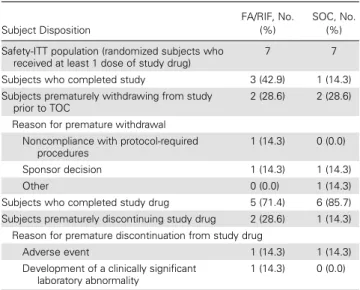
Four randomized subjects (n = 2 [28.6%] from each arm) prematurely withdrew from the study before TOC (Table 2), 2 subjects on the SOC arm due to early termination of the study by the sponsor. One subject (n = 1 [14.3%]) randomized to SOC prematurely discontinued SOC study drug due to an adverse event (AE) (vancomycin-associated fever), and 1 sub-ject (n = 1 [14.3%]) randomized to FA/RIF prematurely discon-tinued study drug due to AEs of nausea and diarrhea.
Efficacy Results
Due to early study closure, the availability of efficacy data are limited. Of 7 subjects enrolled in each treatment arm, therapy was considered successful at the TOC visit in 4 subjects in each arm (Table1). However, 2 of the FA/RIF subjects were cul-ture negative at enrollment (therapy was considered successful for 1), and 2 of the SOC subjects did not reach TOC due to early study closure; therefore,final determination of their outcome is not possible, even though they might have ultimately been successes.
Of particular interest, 1 subject in the FA/RIF group with MRSA (subject 114-06) demonstrated microbiological treatment failure. For that subject, the MRSA strain isolated at the initial explant surgery was susceptible to both FA (MIC = 0.12 µg/mL) and RIF (MIC = 0.25 µg/mL). On the day of reimplantation surgery (day 105), a MRSA strain resistant to RIF (MIC = 8 µg/mL) was recovered from 2 tissue biopsies, but the isolates remained susceptible to FA (MIC = 0.06 µg/mL). This microbiological failure was potentially related to depressed FA levels due to a DDI (described below), resulting in essential-ly RIF monotherapy. This subject (114-06) had the lowest FA plasma concentrations of all the subjects at week 1 (taking 1800 mg FA total daily dose) and at week 4 (taking 1500 mg FA total daily dose) (Figure1).
Safety Results
Similar to efficacy, due to early study closure, the safety database is limited. Gastrointestinal disorders of mild or moderate Table 1. Baseline Characteristics for Safety-Intent-to-Treat Population and Outcome
Subject
ID Age, y Sex
Site of PJI Infection
Surgical Procedure
Baseline Inclusionary Pathogen
Baseline FA/RIF MIC, µg/mL
Randomized
Therapy Outcome Reason for Failure
103-01 62 M Hip 2-stage exchange MSSA 0.12/0.03 FA/RIF Success
103-02 64 M Hip DAR MRSA 0.12/0.015 FA/RIF Failure AE; switched to new
antibiotic
108-07 75 M Knee 2-stage exchange Culture negative NA FA/RIF Failure Persistent inflammation 111-01 66 F Knee 2-stage exchange Staphylococcus
epidermidis
0.25/0.015 FA/RIF Success
112-04 64 F Knee 2-stage exchange No inclusionary pathogens
NA FA/RIF Success
114-03 86 F Knee 2-stage exchange MSSA 0.12/0.015 FA/RIF Success
114-06 72 M Knee 2-stage exchange MRSA 0.12/0.25 FA/RIF Failure Infection recurrence (MRSA resistant to RIF)
103-03 45 M Hip & spacer DAR & spacer replacement
MRSA . . . SOC Indeterminate Insufficient data; study discontinued 104-08 62 M Knee 2-stage exchange S. epidermidis . . . SOC Success
108-04 65 M Knee 2-stage exchange S. epidermidis . . . SOC Failure AE; switched to new antibiotic 108-06 83 M Knee 2-stage exchange Group B streptococci . . . SOC Success
108-08 64 F Hip 2-stage exchange Culture negative . . . SOC Indeterminate Insufficient data; study discontinued 114-05 61 M Knee 2-stage exchange S. epidermidis . . . SOC Success
114-07 77 F Hip & spacer 2-stage exchange MSSA . . . SOC Success
Abbreviations: AE, adverse event; DAR, debridement and retention; FA, fusidic acid; MIC, minimum inhibitory concentration; MRSA, methicillin-resistantStaphylococcus aureus; MSSA, methicillin-susceptibleStaphylococcus aureus; NA, not applicable; PJI, prosthetic joint infection; RIF, rifampin; SOC, standard of care.
Table 2. Subject Disposition for Safety–Intent-to-Treat Population
Subject Disposition
FA/RIF, No. (%)
SOC, No. (%) Safety-ITT population (randomized subjects who
received at least 1 dose of study drug)
7 7
Subjects who completed study 3 (42.9) 1 (14.3) Subjects prematurely withdrawing from study
prior to TOC
2 (28.6) 2 (28.6)
Reason for premature withdrawal Noncompliance with protocol-required
procedures
1 (14.3) 0 (0.0)
Sponsor decision 1 (14.3) 1 (14.3)
Other 0 (0.0) 1 (14.3)
Subjects who completed study drug 5 (71.4) 6 (85.7) Subjects prematurely discontinuing study drug 2 (28.6) 1 (14.3)
Reason for premature discontinuation from study drug
Adverse event 1 (14.3) 1 (14.3)
Development of a clinically significant laboratory abnormality
1 (14.3) 0 (0.0)
Abbreviations: FA, fusidic acid; ITT, intent to treat; RIF, rifampin; SOC, standard of care; TOC, test of cure.
intensity were reported most frequently by both treatment groups, the most common being nausea and diarrhea.
Pharmacokinetic Results
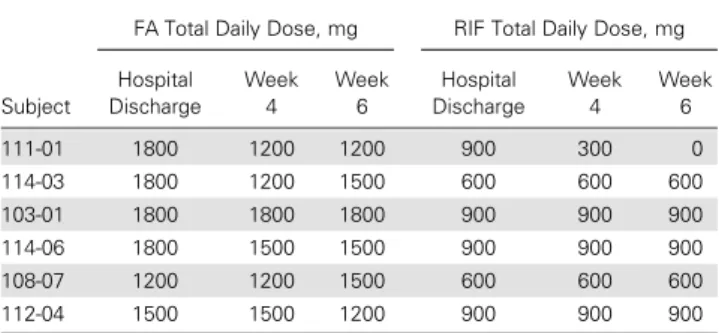
Pharmacokinetic data for 6 of 7 FA/RIF-treated subjects were obtained and a summary of the dosing prior to each PK day is shown in Table3. Concentration-time data were analyzed using noncompartmental approaches as implemented in WinNonLin Phoenix (Certara). Because FA dose reductions to 600 mg twice daily were permitted, PK parameters were
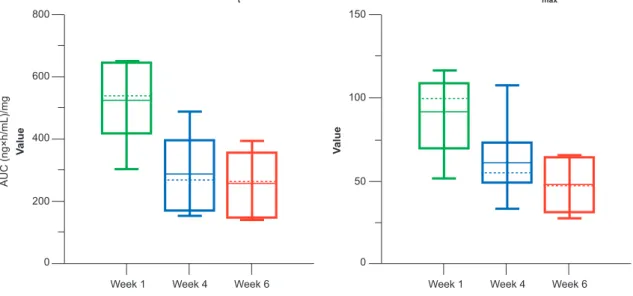
dose-normalized using the subject’s dose the week prior to the PK assessment, and dose-normalized parameters were used to determine the change in exposure from week 1 at weeks 4 and 6. The mean FA (dose normalized) percentage decrease in area under the concentration-time curve (AUC) was 43% at week 4 and 45% at week 6 (Figure2). One subject (subject 111-01) did not receive RIF after week 4, so week 6 data were excluded from PK analysis of a potential DDI.
The mean RIF maximum plasma concentration (Cmax) on week 4 was approximately 34% lower than week 1, while the week 6 Cmaxwas approximately 42% lower than week 1. The mean RIF AUC on week 4 was approximately 45% lower than week 1, while the week 6 AUC was approximately 47% lower than week 1 (not shown).
Based on a prior phase 1 PK study with FA (using a loading dose of 1650 mg twice daily and maintenance dose of 825 mg twice daily), the expected steady-state trough concentrations were 200 µg/mL [15]. As shown in Figure1, FA concentrations were lower than anticipated in all subjects during thefirst week of therapy and, at weeks 4 and 6, FA blood levels continued to decline. By week 6, FA exposures were 40%–45% lower than previously observed exposures with similar dosing regimens, suggesting a substantial DDI in which RIF lowers FA concentrations.
Fusidic
Acid Plasma Concentration (μg/mL)
0 1 2 3 4 5 6 0 1 2 3 4 5 6 0 1 2 3 4 5 6 0 1 2 3 4 5 6
200
180
100 140 160
120
80
60
40
20
0
Hospital Discharge Day 5
Hospital Discharge Day 7
Week 4 Week 6
Hours Post-AM Dose
111–01
114–03
112–04
103–01
114–06
108–07 Expected trough concentration (200 μg/mL) for loading dose 1650 mg twice daily and maintenance dose 825 mg (1650 mg total daily dose), based on previous Phase 1 PK study
Figure 1. By subject (hours post-AMdose) fusidic acid plasma concentrations. Subject 111-01 discontinued rifampin at week 4 due to intolerance. Actual plasma
concen-trations are plotted. Abbreviation: PK, pharmacokinetic.
Table 3. Summary of Study Drug Administration in Subjects Randomized to Fusidic Acid/Rifampin
Subject
FA Total Daily Dose, mg RIF Total Daily Dose, mg
Hospital Discharge
Week 4
Week 6
Hospital Discharge
Week 4
Week 6
111-01 1800 1200 1200 900 300 0
114-03 1800 1200 1500 600 600 600
103-01 1800 1800 1800 900 900 900
114-06 1800 1500 1500 900 900 900
108-07 1200 1200 1500 600 600 600
112-04 1500 1500 1200 900 900 900
Abbreviations: FA, fusidic acid; RIF, rifampin.
The observation of a DDI is clearly illustrated in the FA plas-ma concentrations of subject 111-01 (Figure1). At the time of hospital discharge on day 5, this subject had an FA Cmaxof 95.6 µg/mL and AUC(0–t) of 581 µg × h/mL, having received FA 1800 mg total daily dose (TDD) and RIF 900 mg TDD. Follow-ing hospital discharge, a dose adjustment to FA 1200 mg TDD and RIF 300 mg TDD was made to manage gastrointestinal in-tolerance. At week 4, the FA Cmaxand AUC(0–t)had decreased substantially, to 64.6 µg/mL and 292 µg × h/mL, respectively. At this visit, RIF was discontinued due to elevated bilirubin and the subject continued on FA monotherapy. By week 6, when the subject was only taking FA 1200 mg TDD, the FA plasma con-centration levels markedly increased, to a Cmaxand AUC(0–t)of 117 µg/mL and 658 µg × h/mL, respectively. This Cmaxwas more consistent with steady-state plasma concentrations ob-served with a similar dosing regimen in the phase 1 PK study [15]. Antimicrobial therapy was successful in this subject.
DISCUSSION
When coadministered with RIF, a decline in FA plasma levels occurred by day 5–7 and worsened through weeks 4 and 6. These levels were lower than the expected steady-state trough concentrations based on phase 1 PK data. The likely mechanis-tic explanation for the interaction is induction of cytochrome P450 3A4 (CYP3A4) by RIF. As FA is metabolized primarily by CYP3A4, coadministration results in more rapid metabolism of FA. Not illustrated in this article, as it has been well described in the literature, a decline in RIF plasma levels over time was also observed in our study, and is likely due to autoinduction of metabolism [16]. Although the interaction between FA and
RIF may seem predictable, clinical practice over the past decade has supported use of this antibiotic combination [12,13,17].
When coadministered, a reduction in FA exposure creates an opportunity for rapid emergence of RIF resistance and subse-quent treatment failure. This may have occurred in 1 subject as-signed to the FA/RIF group; MRSA initially recovered during explant surgery was susceptible to both FA and RIF. On day 105 at reimplantation surgery, MRSA, now resistant to RIF with an MIC of 8 µg/mL (however, still susceptible to FA), was again recovered. This single case mirrors the experience of Drancourt [13], in which FA/RIF was as effective as ofl oxa-cin/RIF; however, treatment failures were typically associated with emergent staphylococcal RIF resistance, but not FA resis-tance. Treatment guidelines for PJI include the recommenda-tion for RIF along with a second antibiotic [14]. Specifically, the practice of using RIF plus FA is supported by data from 1 randomized controlled trial [13] and 2 retrospective studies [12, 18]. However, it should be noted that aggressive surgical de-bridement and intravenous antibiotics to reduce the bacterial burden prior to long-term oral antibiotic therapy likely contrib-uted to the high clinical success rate (90%) observed in the Aboltins study [12]; and the importance of these interventions should not be understated. Furthermore, as discussed in this ar-ticle, the combination of FA with RIF presents PK challenges.
To summarize, the sponsor elected to terminate this study due to a clearly illustrated DDI between FA and RIF, which low-ered FA levels to a degree that could influence subject outcomes. The combination of FA and RIF has been used for the treatment of PJI in many parts of the world for decades; however, based on these PK data, optimization of FA exposure if used in combina-tion with RIF should be a topic of future research.
Week 1 Week 4 Week 6
AUC (ng×h/mL)/mg
V
a
lue
Parameter=DN AUCt Parameter=DN Cmax
800
600
400
200
0
150
100
50
0
Week 1 Week 4 Week 6
V
a
lue
Figure 2. Box-and-whisker plot of dose-normalized (DN) area under the concentration-time curve from time zero to last measurable concentration-time point (AUCt) and
maximum plasma concentration (Cmax) of fusidic acid, by week. Outliers of the distributions are not shown. Subject 111-01 at week 6 was not included in this analysis because
this subject did not receive rifampin after week 4, and data do not contribute to the evaluation of the drug–drug interaction.
Supplementary Data
Supplementary materialsare available athttp://cid.oxfordjournals.org.
Consisting of data provided by the author to benefit the reader, the posted
materials are not copyedited and are the sole responsibility of the author, so questions or comments should be addressed to the author.
Notes
Acknowledgments. The authors thank Evan Martens and Barbara Bales, Cempra employees, for their manuscript assistance.
Financial support. This work was supported by Cempra, Inc.
Potential conflicts of interest. R. P., K. K., C. M., D. O., and P. F. are employees of Cempra Inc. M. D. I.-U. is a former employee of Cempra Inc. D. R. M. is a paid consultant for Cempra Inc. R. D. and R. B. have re-ceived research grants from Cempra Inc. S. K. has rere-ceived royalties from Corin and Stryker, and stock options from Innovative Technologies. All
au-thors have submitted the ICMJE Form for Disclosure of Potential Conflicts
of Interest. Conflicts that the editors consider relevant to the content of the
manuscript have been disclosed.
References
1. Godtfredsen WO, Jahnsen S, Lorck H, Roholt K, Tybring L. Fusidic acid: a new antibiotic. Nature1962; 193:987.
2. Tanaka N, Kinoshita T, Masukawa H. Mechanism of protein synthesis inhibition by fusidic acid and related antibiotics. Biochem Biophys Res Commun1968; 30:278–83. 3. Bodley JW, Zieve FJ, Lin L, Zieve ST. Formation of the ribosome-G factor-GDP complex in the presence of fusidic acid. Biochem Biophys Res Commun1969; 37:437–43.
4. Cox G, Thompson GS, Jenkins HT, et al. Ribosome clearance by FusB-type pro-teins mediates resistance to the antibiotic fusidic acid. Proc Natl Acad Sci U S A
2012; 109:2102–7.
5. Farrell DJ, Mendes RE, Castanheira M, Jones RN. Activity of fusidic acid tested against staphylococci isolated from patients in U.S. medical centers in 2014. Anti-microb Agents Chemother2016; 60:3827–31.
6. Jones RN, Mendes RE, Sader HS, Castanheira M. In vitro antimicrobialfindings for fusidic acid tested against contemporary (2008-2009) gram-positive organisms collected in the United States. Clin Infect Dis2011; 52(suppl 7):S477–86.
7. Biedenbach DJ, Rhomberg PR, Mendes RE, Jones RN. Spectrum of activity, mu-tation rates, synergistic interactions, and the effects of pH and serum proteins for fusidic acid (CEM-102). Diagn Microbiol Infect Dis2010; 66:301–7.
8. Hardy DJ, Vicino D, Keedy K, Fernandes P. Susceptibility ofPropionibacterium acnesto fusidic acid. In: 54th Interscience Conference on Antimicrobial Agents and Chemotherapy, Washington, DC, 5–9 September 2014:D-867.
9. Zimmerli W, Widmer AF, Blatter M, Frei R, Ochsner PE. Role of rifampin for treatment of orthopedic implant-related staphylococcal infections: a randomized controlled trial. Foreign-Body Infection (FBI) Study Group. JAMA1998; 279:1537–41.
10. Zimmerli W, Trampuz A, Ochsner PE. Prosthetic-joint infections. N Engl J Med
2004; 351:1645–54.
11. Siala W, Rodriguez-Villalobos H, Fernandes P, Tulkens PM, Van Bambeke F. Ac-tivity of fusidic acid (FUS) alone or in combination with daptomycin (DAP), van-comycin (VAN), or linezolid (LZD) in an in vitro model ofStaphylococcusaureus biofilm. In: 25th European Congress of Clinical Microbiology and Infectious Dis-eases, Copenhagen, Denmark, 25–28 April 2015:EV0056.
12. Aboltins CA, Page MA, Buising KL, et al. Treatment of staphylococcal prosthetic joint infections with debridement, prosthesis retention and oral rifampicin and fu-sidic acid. Clin Microbiol Infect2007; 13:586–91.
13. Drancourt M, Stein A, Argenson JN, Roiron R, Groulier P, Raoult D. Oral treat-ment ofStaphylococcusspp. infected orthopaedic implants with fusidic acid or ofloxacin in combination with rifampicin. J Antimicrob Chemother1997; 39:235–40.
14. Osmon DR, Berbari EF, Berendt AR, et al. Diagnosis and management of prosthet-ic joint infection: clinprosthet-ical practprosthet-ice guidelines by the Infectious Diseases Society of America. Clin Infect Dis2013; 56:e1–25.
15. Still JG, Clark K, Degenhardt TP, Scott D, Fernandes P, Gutierrez MJ. Pharmaco-kinetics and safety of single, multiple, and loading doses of fusidic acid in healthy subjects. Clin Infect Dis2011; 52(suppl 7):S504–12.
16. Acocella G. Clinical pharmacokinetics of rifampicin. Clin Pharmacokinet1978; 3:108–27.
17. Ferry T, Uckay I, Vaudaux P, et al. Risk factors for treatment failure in orthopedic device-related methicillin-resistantStaphylococcus aureusinfection. Eur J Clin Microbiol2010; 29:171–80.
18. Peel TN, Buising KL, Dowsey MM, et al. Outcome of debridement and retention in prosthetic joint infections by methicillin-resistant staphylococci, with special reference to rifampin and fusidic acid combination therapy. Antimicrob Agents Chemother2013; 57:350–5.