SIMULATIVE ANALYSIS OF OSNR
AND RECEIVED ELECTRIC RF POWER
OF A ROF SYSTEM HAVING
VARIABLE FIBER LENGTH, USING
DIFFERENT MODULATION
TECHNIQUES AND OPTICAL
AMPLIFIERS
KARANBIR SINGH1, *
Faculty, Amritsar College of Engg. & Technology, Amritsar-Jalandhar G.T Road, Punjab-143001, India
SANGEETA MONGA2
Faculty, AIET, faridkot, Punjab, India
Abstract:
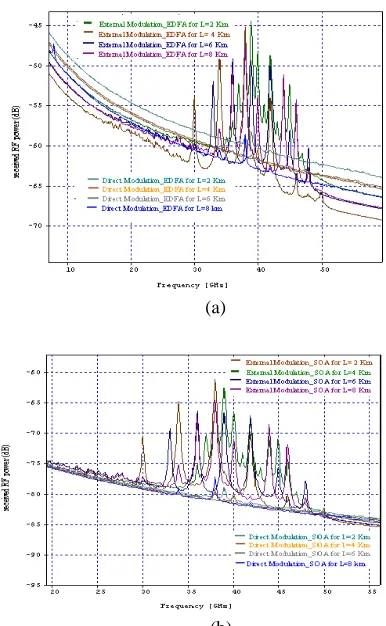
In this paper, we analyzed OSNR and received electric RF power of a RoF communication system having variable fiber length, using direct and external modulation techniques and different optical amplifiers. In this work, we have compared and measured the OSNR and received optical power of the RoF system for different modulation techniques, i.e. direct and external modulation. Further, we also compared the received electric RF power for variable fiber lengths for direct and external modulation using different optical amplifiers, i.e. EDFA and SOA. We observe an increase of –11 dB (approx.) in the received RF power for External modulation compared to direct modulation with EDFA.
Keywords: MZM; EDFA; SOA; External modulation.
1. Introduction
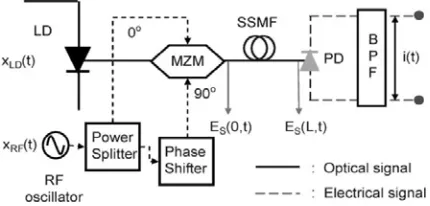
Fig. 1. Architecture of a RoF system
generate the photocurrent at a BS that is simple and compact. The photocurrent goes through a band pass filter (BPF) and an amplifier to be launched into a wireless channel in the BS. The wireless channel makes signals vulnerable to amplitude and phase distortion. A UT amplifies and filters the received signal to detect the transmitted RF signal. Finally, the data are extracted through RF demodulation. In this paper, we will deal with an optical link from the CO to the BS. Fig. 1 describes the optical link of our interest in detail. Using an MZM and a phase shifter generates an OSSB signal. An RF signal from an oscillator is split by a power splitter and a 90ºphase shifter. The LD with an MZM optically modulates this RF signal. The optically modulated signal is transmitted to the PD and the photocurrent corresponding to the transmitted RF signal is extracted by the BPF.
2. Simulation Setup
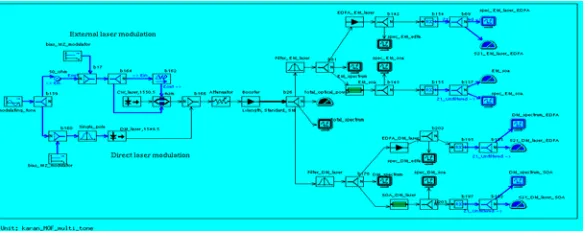
The simulation set-up for single tone radio-over-fiber system employing direct modulation and external modulation is shown in fig.2. The single tone Rf signal with frequency varying from 1 to 10 GHz is modulated either by using external modulation technique over a continuous wave (CW) laser at 1550.5 nm biased at 4 a.u of laser line width 10MHz with a CW power of 10mW or by using direct modulation technique over an LD at 1549.5 nm of a modulation index of 0.04 biased at 0.07 a.u. The quantum efficiency and responsivity of PIN diode, acting as photo detector, is fixed at 0.7199 and 0.9A/W respectively. The offset voltage corresponding to the zero phase retardation in absence of any electric field on both electrodes of MZM modulator is set at 0V. The optical signal is modelled to propagate with an attenuator. Propagation is modelled with an attenuator since RoF systems are usually employed over short distances. The transmitter and receiver section are separated by an optical fiber having variable length varying from 2 to 20 Km. The other simulation parameters of different components used in designing the RoF system using OPTSIMTM simulator are listed in Table 1.
Fig. 2. Simulation set-up to calculate OSNR and received electric Rf power for a single-tone RoF system employing DM and EM
Table 1. Simulation Parameters
Parameter
Value Fiber loss
Fiber dispersion (D) Fiber nonlinearity Fiber core effective area Fiber average beat length EDFA’s gain
EDFA’s noise figure
SOA’s line enhancement factor SOA’s confinement factor SOA’s bias current SOA’s saturation power Dark current PIN diode Quantum noise PIN diode Reference frequency PIN diode
0.2 dB/km 16 ps/nm/km 1.267 80m2 5m 16 dB 4.5 dB 3 0.35 100mA 9.15mW 0 nA Off 1550nm
3. Results and Discussion
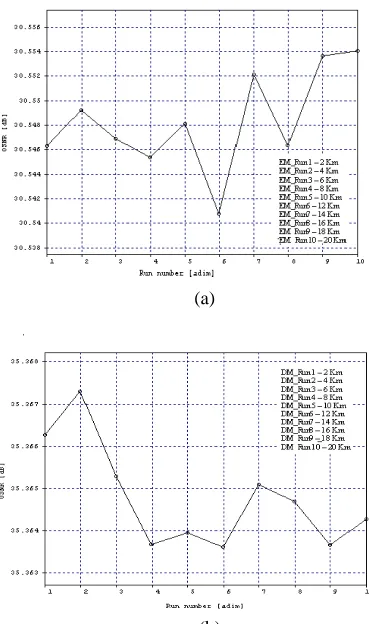
(a)
(b)
Fig. 3. Simulated value of OSNR at the receiver end (a). OSNR vs fiber length using EM (b). OSNR vs fiber length using DM
i.e. EDFA and SOA as shown in Fig. 4(a, b, c and d). We observe that the Rf power received for External modulation (EM) and Direct modulation (DM) using EDFA are –44.532 dB (apprx.) and -56.431 dB (approx) for fiber length (L) = 2 Km. Similarly, the received Rf power for EM and DM using SOA are -61.971 dB and – 77.121 dB for length (L) = 2 Km, respectively.
(b)
(c)
(d)
Fig.4. Simulated value of Received electric Rf power vs frequency (GHz) (a). Direct modulation (DM) vs External modulation (EM) for EDFA (b). Direct modulation (DM) vs external modulation (EM) for SOA (c). EDFA VS SOA for direct modulation (DM) (d). EDFA vs SOA for (EM)
(a)
(b)
Fig. 5. Received electric Rf power for variable length (a) External modulation (EM) vs direct modulation (DM) for EDFA (b) External modulation (EM) vs direct modulation (DM) for SOA.
4. Conclusion
From the results, we have concluded that an improvement at BS, in received RF power of a single-tone RF channel transmitted over an optical link of variable length in a single-tone RoF system is achieved by using DEMZM modulator with EDFA amplifier as compared to direct-modulated RoF system using EDFA. It is investigated that an improvement of –11 dB (approx.) in received Rf power is observed by using EDFA with External and direct modulation. It is also investigated that better OSNR can be obtained from a directly modulated single-tone RoF system in comparison to externally modulated single-tone RoF system.
REFERENCES
[1] A.Bahrami, T. Kanesan, Z. Ghassemlooy, A. Abd El Aziz and S. Rajabhandari, " Performance Evaluation of Radio-over-Fibre (RoF) System Using Mach-Zehnder Modulator (MZM) and On-Off Keying (OOK) Modulation Schemes," Lightwave Technology, Journal of, vol. 23, pp. 4093-4100, 2005.
[2] C. Tae-Sik, Y. Changho, S. Jong-In, and K. Kiseon, "Analysis of CNR penalty of radio-over-fiber systems including the effects of phase noise from laser and RF oscillator," Lightwave Technology, Journal of, vol. 23, pp. 4093-4100, 2005.
[3] J. R. Barry and E. A. Lee, “Performance of coherent optical receivers,” Proc. Inst. Elect. Eng., vol. 78, no. 8, pp. 1369–1394, Aug. 1990.
[4] Y. J. Wen, “Power level optimization of 40 Gb/s DWDM systems with hybrid Raman/EDFA amplification,” in Proc. Conf. Optical Internet/Australian Conf. Optical Fibre Technology (COIN/ACOFT), Melbourne, Australia, Jul. 2003, pp. 309–312.
[5] Vishal Sharma, Amarpal Singh and Ajay K. Sharma, “Simulative investigation of the impact of EDFA and SOA over BER of a single-tone RoF system,” Science-Direct, Optik 121, pp. 1280–1284, 2010.