The Relevance of Computational Techniques for Literary
Interpretations on a Micro-Level
Name: Lisette Grimmius
Supervisor: Dr. P.A.F. Verhaar
Second Reader: Prof. Dr. A.H. van der Weel
Date: 26-7-2018
2
Table of Contents
1. Introduction
42. Computational Methods as an Aid for the Interpretation of Single Works of Fiction
62.1. Computational Methods and Micro-Studies
2.1.1. Type-Token Ratio
2.1.2. Keywords and Frequently Used Words
2.1.3. Dispersion
2.1.4. Collocates
2.1.5. Sentiment Analysis
2.1.6. Topic Modelling
2.2. Potential Goals and Uses
7 8 8 11 15 16 18 19
3. Siddhartha – An Introduction to the Case Study
213.1. Siddhartha. Eine indische Dichtung- Origins, Reception and Govinda’s Role
3.2. Siddhartha’s Developments
3.3. Govinda’s Developments
3.4. Govinda’s Role in Siddhartha’s Life
3.4.1. Govinda as a Sidekick
3.4.2. Govinda as Siddhartha’s Opposite
3.4.3. Govinda as a Part of Siddhartha’s
3.4.3.1. Govinda and Siddhartha as one ‘Self’
3.4.3.2. Influences on Siddhartha
3.4.3.2.1. The Bhagavad Gita
3.4.3.2.2. Hesse’s Philosophy
3.5. A Note on Siddhartha as a Case Study
21 22 23 24 24 24 28 28 29 29 30 31
4. Case Study: Hermann Hesse’s Siddhartha
334.1. File Modifications
4.2. Methods
4.3. Case Study: Siddhartha’s Developments and Govinda’s Role
4.3.1. Theme Development
4.3.1.1. Defining the Themes
4.3.1.2. Theme Dispersion
4.3.1.3. Most Frequently Used Words
4.3.1.3.1. Frequent Words
3 4.3.1.3.2. Developments and Discrepancies
4.3.2. Character Development
4.3.2.1. Siddhartha’s Developments
4.3.2.1.1. Frequently Used Words
4.3.2.1.2. Frequently Used Words per Time Frame
4.3.2.1.3. Theme Dispersion in Siddhartha’s Speech
4.3.2.1.4. Sentiment Analysis
4.3.2.2. Govinda’s Developments
4.3.3. Govinda’s Role in Siddhartha
4.3.3.1. Words per Time Frame
4.3.3.2. Word Comparison Tests
4.3.3.2.1. Character Specific Words
4.3.3.2.2. Time Frame Specific Words
4.3.3.3. Themes
4.3.3.4. Sentiment Analysis
4.4. Results 47 48 48 48 50 52 54 60 63 64 65 65 66 67 70 72
5. Critical Review
765.1. Value and Relevance
5.2. Caveats
5.2.1. Representations and Context
5.2.1.1. The Need for Explanations
5.2.1.2. Dependence on the Source Text
5.2.2. Inaccuracies
5.2.3. Issues with Text Length
5.3. Conclusion 76 81 81 81 82 83 83 84
Bibliography
864
1. Introduction
Computational methods are used more and more often nowadays as an aid in literary research. They
have proven to be useful when exploring and comparing large corpora of texts, and can help scholars
to make connections or to find differences between texts within such corpora. It is not difficult to see
why computational methods can be helpful when analysing literary periods or genres: not only do
they allow scholars to work faster; they also allow for incorporating more texts in research projects –
numbers of texts that would take us a lifetime to read or quantities which cannot realistically be read
within the span of a human lifetime.
What we see less often is a use of these methods on a level. In this study, the
micro-level will be defined as the micro-level which confines itself to a single text. The term ‘text’ is admittedly
rather broad. For instance, both a brief sonnet and a 700-page novel may be viewed as a single text.
The micro-level comprises texts which human beings can read via the close reading method. In the
case of brief poems, readers can typically represent all the relevant aspects of these texts within
their memory. The same may arguably be claimed about a lengthy novel, although this may clearly
demand considerably more efforts. The crucial difference between the micro-level and the
macro-level, however, is that a full close reading is only possible in the former case. The macro-level is the
unit at which a full close reading ceases to be possible. Computational literary research at the
micro-level is, by extension, a method which can enrich the information produced during earlier close
reading sessions with new information. Its value lies in what it adds to the close reading of the source
text. The value of a macro-study on the other hand, is that it enables scholars to research a collection
of texts that could not realistically be read using a close reading. The beauty of using computational
methods at the macro-level is that they enable something – a survey of a large number of texts – that
would not be possible otherwise. In the case of a macro-study a distant reading might lead to the
decision to close read specific texts within a corpus that were proven by the use of computational
methods to be exceptional values of this corpus.
The observation that computational analyses at the micro-level supplement earlier close
reading sessions poses the question what these analyses can add precisely. Single texts can easily be
read in one, or in a limited number of sittings, so why would we need a computer to help us interpret
them? Surely we can do so ourselves. Adding to that, using so-called distant reading obviously
distances us from a text, which seems unnecessary for a text we can simply read ourselves. However,
this process of distancing ourselves from a text is not an inherently bad effect of using computational
methods. Rather, taking a step back to either take a look at the whole, or to focus on tiny details, can
5 and similarities within the text that we might not have seen before and that can be extremely useful
in an interpretation of a work. These details may consequently enrich our original interpretation. This
thesis is by no means meant to advocate replacing our traditional interpretational processes with
computational methods. Instead, it will be argued that digital methods form a valuable addition to
our human reading process, as was suggested with the definition of micro-studies as described
above.
To find out to what extent computational methods can be of use when coming to
interpretations of a single work of fiction, the question that will be asked in this thesis is as follows:
What is the relevance of computational methods for the interpretation of a single work of fiction?
This question will be explored over the course of this thesis both on a theoretical as well as on a
practical level, in the form of a case study of Hermann Hesse’s novel Siddhartha.
Firstly, chapter 2 will give an overview of various computational methods as used in previous
projects on a micro-scale that have been conducted over the years. This overview will both create an
idea of the possibilities these methods offer when analysing a text, and serve as a basis for the case
study that will be conducted in chapter 4, as the discussed methods will be applied in said study.
Following this overview of methods, chapter 3 is a more contextual introduction to the case
study. This case study will not simply focus on Hesse’s novel, but has the aim to investigate to what
extent computational methods can be used to support an interpretation, to work alongside our
traditional approaches of interpreting works of fiction, and to come to conclusions that exist of
arguments built up out of both traditional and computational approaches. The research question
that will be discussed in the case study will therefore be identical to the question I have investigated
for an earlier project, which consisted of a traditional analysis of the novel. The question that will be
asked is as follows: What is the role of the secondary character Govinda in Siddhartha’s
developments? Chapter 3 will explain my points as made in my earlier project, establishing a solid
base to depart from in chapter 4.
The case study in chapter 4 will focus on exploring my original research question using
computational methods. The chapter will be broken up into sections about theme development,
character development and a section that focuses entirely on the relationship between secondary
character Govinda and Siddhartha, using amongst others dispersion plots, most frequently used
words plots and sentiment analyses. This chapter will also compare my new results as found through
the case study to my original interpretation of Siddhartha, adding the newly found information to it.
Lastly, in chapter 5 a critical review will be drawn up of the use of computational methods on
a micro-scale. The chapter concludes with a reflection on the overall value of computational methods
6
2. Computational Analysis as an Aid for the Interpretation of Single Works of
Fiction
The aim of this chapter is to bring to light the way in which computational methods can enrich
traditional analyses of single works of fiction. This will be done with two reasons in mind. A first aim
is to show the value of computational methods when it comes to keeping literary discussions going.
Secondly, the chapter will serve as a basis for chapter 4, in which I will endeavour to analyse
Hermann Hesse’s 1922 novel Siddhartha with the aid of the techniques mentioned in this chapter.
The chapter will explore various computational methods that can be used for literary analysis on a
micro-level. This will be achieved with the help of examples of research projects that have been
carried out in recent decades in the field of literary analysis. Furthermore, this chapter will venture
into what goals such projects may or may not help scholars to achieve, and how they may contribute
to literary discussions. Keeping in mind the fact that the case study in chapter 4 revolves around a
single novel, the term ‘micro-study’ will be used in this paper to describe studies of single literary
works.
As was mentioned in the introduction of this thesis, computational analyses are often carried
out on a macro-level rather than on a micro-level. Using such methods when studying large corpora
can of course be quite beneficial because of the speed. A computer takes but a fraction of the time
we would need to read large numbers of texts, and – when using computational methods – one can
base research on a number of texts that one would not even be able to read in his or her entire
lifetime. Therefore, computational methods do not merely enable us to work faster; a great benefit is
that research projects can now cover huge corpora and as such go beyond the stories that are
considered ‘most important’, to also include lesser known works. As Franco Moretti writes, ‘[close
reading] necessarily depends on an extremely small canon. You invest so much time in individual
texts only if you think few of them really matter.’1 Moretti coined the term ‘distant reading’ for the
process of feeding a corpus of texts into a computer and letting the computer work with it. In his
work he has shown that computational methods can help scholars and literary historians both
uncover and focus on small details in order to gain a better understanding of entire literary periods
or genres. In short, he uses the computer to ‘[step] back to get a view of the whole’, and sees
not-reading as a condition for knowledge:2
1 F. Moretti, Distant Reading (London etc.: Verso, 2013), p. 48.
2 Moretti, Distant Reading, p. 48-49; F. Moretti, Graphs, Maps and Trees: abstract models for a literary history
7 A canon of two hundred novels sounds very large for nineteenth-century Britain
[…] but is still less than one percent of the novels that were actually published:
twenty-thousand, thirty, no one really knows – and close reading won’t help here,
a novel a day every day of the year would take a century or so. And it’s not even a
matter of time, but of method: a field this large cannot be understood by stitching
together separate bits of knowledge about individual cases, because it isn’t a sum
of individual cases: it’s a collective system, that should be grasped as such, as a
whole. [Graphs] are one way to begin doing this. […] A more rational literary
history. That’s the idea.3
From Moretti’s work alone it is clear to see why implementing computational analysis can be
extremely useful. The methods do not just save time, or allow researchers to use a greater number of
texts in their projects; they also make it possible to make (new) connections between texts, or, as
Peter Verhaar writes in his thesis Affordances and Limitations of Algorithmic Criticism, ‘they may
reveal, for instance, that a specific cluster of texts has exceptional values for a given metric, [or] that
texts which were traditionally considered exceptional appear to be completely ordinary when viewed
statistically’.4
However, would computational methods also yield such useful results and allow for
discoveries if we were to analyse not entire literary periods or genres but a single text? Would it be
equally useful to perform a distant reading of a text that one could easily read in a sitting or two?
These questions will be explored in section 2.1.
2.1. Computational Methods and Micro-Studies
This section discusses a number of computational techniques by explaining how they have been
applied in earlier studies. This will be done in order to create an overview of the possible
computational methods suitable for micro-studies, and their uses. The methods listed will be used in
the case study in chapter 4. The techniques that will be discussed here were chosen for how similar
their approaches are to the methods I intend to use in my case study, allowing me to base parts of
said study on them.
3 Moretti, Graphs, Maps and Trees, p. 4.
8 2.1.1. Type-Token Ratio
The type-token ratio, or TTR, can be generated when one divides the number of unique words in a
text (types) by the total number of words in a text (tokens).5 The higher the resulting number, the
higher the lexical variation in a text. In Literature in the Digital Age. An Introduction Adam Hammond
shows how the TTR can be used to model stylistic devices. He uses the technique as an aid to add
depth to the characterisation of Stephen Dedalus, the principal character of James Joyce’s The
Portrait of the Artist as a Young Man. The consensus is that as Dedalus matures, the author’s style
changes to mirror this: ‘In the section detailing Stephen’s earliest childhood, the narrative voice is
that of a child; in the section recounting his hyper-intellectual student days, the voice is that of a
hyper-intellectual student.’6 Hammond puts to the test whether this stylistic change of the narrator is
reflected in a growing lexical diversity. In order to do this, he calculates the type-token ratio for every
chapter of the book, which results in the table below. As can be seen, the type-token ratio increases
with each chapter, with the exception of chapter 3. Hammond concludes that the increasing
numbers (or: the increasing lexical diversity) mean that as Dedalus matures, this is indeed mirrored in
the way he speaks.7 To understand this decline in chapter 3 however, it would be necessary to do a
close reading of this part of the text to bring the data into perspective.
Figure 1. The TTR of A Portrait of the Artist as Young Man per chapter.8
2.1.2. Keywords and Frequently Used Words
Keyword analysis can form a productive way of finding important terms or of finding details about
literary characters. The term ‘keyword’, which is rather broad, will be used in this context to indicate
5 A. Hammond, Literature in the Digital Age. An Introduction (Cambridge: Cambridge University Press,
2016), p. 94.
6 Hammond, Literature in the Digital Age, p. 96. 7 Ibid.
8 Reprinted from A. Hammond, Literature in the Digital Age. An Introduction (Cambridge: Cambridge University
9 words that occur relatively often in sections of a text in comparison to a corpus that either consists of
the entire text itself, a reference corpus or of a larger body of texts.
A good example of the possibilities of keyword analysis appears in the article ‘Keywords and
Characterization: An Analysis of Six Characters in Romeo and Juliet’ by Jonathan Culpeper. In it,
Jonathan Culpeper uses keyword analysis to find details about the characters in Shakespeare’s
Romeo and Juliet. He defines keywords as ‘words whose frequencies differ significantly from their
frequencies in a norm.’9 He finds these words by comparing the words in the play to a larger
reference corpus, meaning that they are different from simply counting raw word frequencies. In this
case, Culpeper uses the entire play as a reference corpus, and compares the words spoken by each
character against said corpus.10 Using the programme WordSmith he calculates whether or not these
words by each character differ from the norm of the reference corpus. His criteria for the minimum
frequency for a word to qualify as a keyword in his project is a value of 5.11 This yields a list of both
positive and negative keywords, positive keywords being the words that appear unusually often and
negative keywords being the words that appear infrequently, compared to the reference corpus.12
Using this method, Culpeper generates a list with the top keywords for six characters in the play,
from which it appears that Romeo’s top three keywords are ‘beauty’, ‘love’ and ‘blessed’, which
matches the expectations that most readers have of him. Words like ‘dear’, ‘star’ and ‘fair’, Culpeper
adds, fit his ‘love talk’.13 Juliet’s top three consists of ‘if’, ‘be’ and ‘or’, capturing, writes Culpeper, her
grammatical style. After returning to the text, Culpeper concludes that her keywords reveal Juliet’s
anxiety throughout the play (‘If he be married / Our grave is like to be our wedding-bed’; ‘If they do
see thee, they will murder thee’).14 Other examples that support the notion that she is mostly quite
anxious are her keywords ‘or’ (‘Is thy news good, or bad?’) and ‘yet’ (‘I fear it is: and yet, methinks, it
should not’).15 From this we see that her keywords reflect the fact that Juliet does indeed use a lot of
words that articulate her anxieties.
Despite the fact that there are clear differences in the (types of) keywords that Romeo and
Juliet use, this method on its own does not lead to surprising new observations. The data may be
used to support hypotheses, which can be quite valuable in itself, but does not make for surprising
results on its own in this particular case.
9 J. Culpeper, ‘Keywords and Characterization: An Analysis of Six Characters in Romeo and Juliet’ in
Hoover, D.L., Culpeper, J. and O’Halloran, K., Digital Literary Studies. Corpus Approaches to Poetry, Prose, and
Drama (New York and London: Routledge, 2014), p. 35-63, p. 11.
10 Culpeper, ‘Keywords and Characterization’, p. 15. 11 Ibid.
10 According to Culpeper, Romeo’s egocentric nature is highlighted in the pronouns he uses
most frequently: ‘mine’, ‘me’ and ‘thine’. Culpeper attributes this to him ‘[having] a[n] external
consciousness of his role as a lover and of the effect of circumstances upon him.’16 Once more he
returns to the text to put his findings into context. From this, he concludes that Romeo’s wording is
consistent with the idea of him having an egocentric nature (‘O, wilt thou leave me so unsatisfied?’,
‘Thy beauty hath made me effeminate’, ‘Give me thy hand’, ‘One writ with me in sour misfortune’s
book’).17 Interestingly enough Culpeper’s analysis of Juliet’s dispersion plot and list of key pronouns
lists very different results, showing how different Romeo and Juliet are. When it comes to the
pronouns she uses, rather than Romeo’s ‘mine’, ‘me’ and ‘thine’, she favours ‘I’, ‘my’ and ‘thou’.
Culpeper concludes that this is consistent with the idea that Juliet spends much time expressing her
worries (‘But if thou meanest not well’; ‘I would have thee gone’).18 This argumentation seems a tad
speculative, as the most frequently used pronouns of both protagonists are quite similar, but
Culpeper is able to draw different conclusions from both pronoun uses by putting them into context.
This shows how important it is to keep returning to the text.
A method similar to Culpeper’s keyword analysis is used by Stephen Ramsay for his study of
Virginia Woolf’s The Waves. The Waves consists of six monologues by six friends that very much have
the same stylistic voice. This poses a problem: ‘Are Woolf’s individuated characters to be understood
as six sides of an individual consciousness, or are we meant to read against the fiction of unity that
Woolf has created by having each of these modalities assume the same stylistic voice?’19 In order to
begin solving this problem and to find out character details Ramsay uses a computer to transform
Woolf’s novel into lists of tokens – each list representing the words spoken by one of the six
characters, ordered from the most distinctive term to the least distinctive term.20 In order to
distinguish these outlying terms from the norm, he uses the term frequency-inverse document
frequency formula (tf-idf), a formula that measures the importance of terms in a text.21 Thus, like
Culpeper Ramsay compares the words of each character to a larger reference corpus, which, in this
case, is The Waves in its entirety.
Ramsay uses the formula for the characterisation of Louis, the only Australian character in
the story, who seems remarkably interested in Egypt and the Nile. According to Ramsay the formula
16 Ibid., p.p. 26-27. 17 Ibid., p. 26. 18 Ibid.
19 S. Ramsay, Reading Machines: Towards an Algorithmic Criticism (Urbana etc.: University of Illinois
Press, 2011), p. 10.
20 Ibid., p. 11.
21 The precise formula as used by Ramsay is as follows: 𝑡𝑓 − 𝑖𝑑𝑓 = 1 + 𝑡𝑓 ∙ log( 𝑛
𝑑𝑓), tf being the number of
11 confirms this interest (figure 2), and that it is distinctive for Louis. Adding to this, ‘accent’ appears to
be a distinctive term for Louis as well, which is fitting as the character, being the only Australian out
of the six friends, is ‘very conscious of his accent and nationality’.22
Figure 2. Term Importance of Louis' Words23
Ramsay follows the same approach to determine the distinctive words of the other characters, and
compares the words that the men and women in The Waves have in common, resulting in the finding
of distinctive words for each character and gender.
Both techniques mentioned above clearly help confirm what was already suspected about
the characters in question. On their own they do not yield polished, conclusive or surprising results.
Instead, they are quite valuable as data that supports hypotheses about literary works, and when
combined with other techniques. This means their value mostly lies in a combination of close reading
and distant reading.
2.1.3. Dispersion
It can be useful for the interpretation of single texts to see how particular words are used across a
text. In their monograph Hermeneutica. Computer-Assisted Interpretation in the Humanities Geoffrey
Rockwell and Stéfan Sinclair carry out a computer-assisted analysis of David Hume’s Dialogues
Concerning Natural Religion, in which they follow the theme ‘scepticism’ across the entire text.
They ask themselves, like many a scholar has done, what Hume meant to convey in Dialogues. The
story features a convinced sceptic, Philo, who does not believe in God, but then turns around
22 Ibid., p. 12.
12 completely in the final chapter to acknowledge the existence of God after all. This is interpreted by
many scholars as Hume simply attempting to hide his scepticism to play safe.24 Rockwell and Sinclair
establish, by means of a word count for each character that Philo – having the most lines out of all of
them by far – stands as a model for the author (which may be viewed as an unfounded way of
establishing this).25 So what does Hume mean to say when Philo changes his mind about his own
ideals?
Rockwell and Sinclair take a closer look at the dialogue and zoom in on it with the aid of
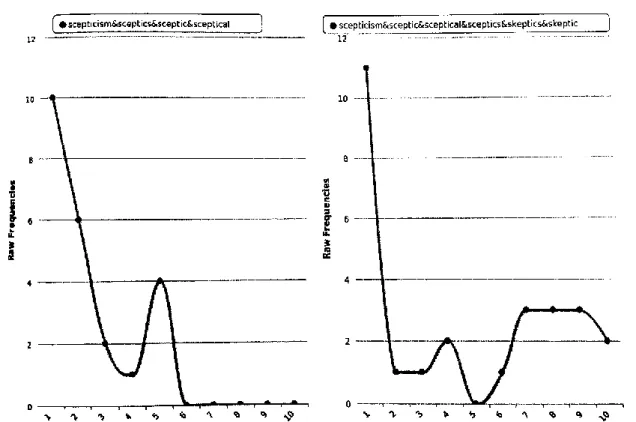
computational methods. Following variations of the term ‘scepticism’ across the story, they soon find
out that it is not Philo, but Cleanthes, the theist of the story, who uses words like ‘sceptic’ and
‘scepticism’ most often. The conclusion they draw from this is that it is Cleanthes and not Philo who
is fascinated by scepticism.26
Figure 3. The number of sceptical words used by Cleanthes (left) and Philo. The graphs, write Rockwell and Sinclair, do not
represent the distribution of the words across the book, as the words by both characters had to be extracted from the
original as a separate text.27
24 Rockwell and Sinclair, Hermeneutica, p. 175. 25 Ibid.
26 Ibid., p. 176.
13 However, Cleanthes’ use of the term suddenly drops drastically, as can be seen from the graph in
figure 3. From here, Philo takes over. Rockwell and Sinclair take this to mean the following:
Philo plays with [the theme scepticism] in the second half. Cleanthes continually
mentions scepticism in the early parts of the Dialogues as a way of belittling what
Philo has to say; Philo models it in how he argues.28
They accept both Cleanthes belittling scepticism and Philo modelling it as facts and describe that
both these factors call for further investigation. Although they do not explicitly mention it, this
interpretation has to stem from their knowledge of the original text and them returning to it to find
an explanation for the phenomenon in the graph. This is problematic in this case, as the fact that
they do not mention every step in the process gives their argumentation a somewhat speculative
turn. This flaw in the argumentation underscores the notion that it is of vital importance to be crystal
clear when using computational methods in an argumentation. Adding to this, this also shows a
limitation of this particular method, as the graph in figure 3 does not explain in what context Philo
and Cleanthes use their words, and in what context Philo takes over. As it is not clear whether they
use their words in a positive or negative light, it is always necessary to turn back to the text, which is
not necessarily a good or a bad thing, but simply proves the importance of a combination of close
reading and distant reading.
Thus, counts of how often terms are used, as well as by whom they are used across a story
and of course their prior, close reading of the text, help Rockwell and Sinclair bring to light both
Cleanthes’ fascination with scepticism, as well as a turning point in the story, where Cleanthes does
no longer speak about the theme and Philo starts doing so. This shows an instance of how an
interesting phenomenon is brought to light as a result of computational methods, which can in turn
be further investigated by a close reading.
A final interesting aspect of this particular project is a scatter plot that Rockwell and Sinclair
use to show how words and chapters correspond. It shows, for example, that chapter 0 (the
introduction), 1 and 12 use similar vocabulary. The visualisation shows how the matter of scepticism
is raised at the beginning of Dialogues and then is brought up again at the end.29
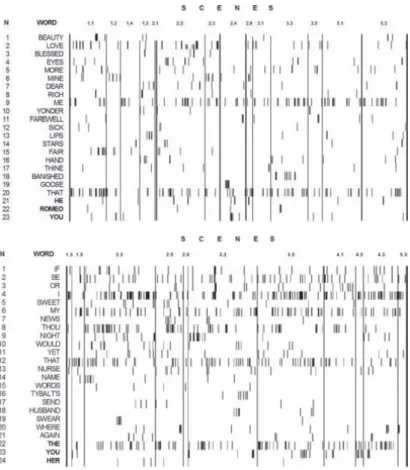
Another instance in which dispersion is relevant is in Culpeper’s project concerning Romeo
and Juliet. Culpeper makes use of the plot in figure 4, which shows the top keywords for Romeo and
Juliet and how they are divided across the play, for a more in-depth keyword analysis.
14 Figure 4. Dispersion plots for Romeo (above) and Juliet30
Across the entire play Romeo often uses keywords that reveal his concern with the physical.31
Returning to the text with this information in mind, Culpeper is able to narrow this statement, as he
concludes that Romeo ‘often reflects on aspects of his own body’, which Culpeper claims to hint at
Romeo having an egocentric nature.32 On its own, this conclusion is rather speculative, but combined
with the keyword analysis in the previous section, it makes for an interesting case. In the end
Culpeper has not only made visible aspects of Romeo and Juliet’s personalities, but in doing so he has
also highlighted the differences between the two characters. A side note of course is that the data
used by Culpeper could support various theses. This shows the importance of combining a distant
reading with a close reading in a micro-study, in the sense that Culpeper backs up and explains his
data with the help of his interpretation of the text. Another scholar might interpret the play
differently after a close reading of it, and may explain Culpeper’s data differently as a result.
30 Reprinted from Culpeper, ‘Keywords and Characterization’, p. 21; 23. 31 Culpeper, ‘Keywords and Characterization’, p. 21.
15 Nevertheless, his technique proves how valuable graphs can be when exploring characterisation,
prompting hypotheses and serving as evidence for them at the same time.
2.1.4. Collocates
A fourth technique that may lead to further insight in a text is the use of collocates, words that
appear in close proximity to the term that one follows across a text.33 Turning back to Rockwell and
Sinclair’s analysis of Dialogues, they explore the way the theme ‘scepticism’ is introduced and use the
Words in Context function of Voyant to work through the concordance entries34, which can be
viewed not as a distant reading, but as doing a more focussed close reading on a text as made
possible by the results of the distant reading they applied. This close reading of the entries helps
them discover that Philo does not speak about scepticism due to a challenge Cleanthes poses, in
which he argues that it is impossible for Philo to be sceptical of everything constantly. Philo has to be
constantly sceptical, or he will be inconsistent and appear to ‘only play scepticism as artifice during
conversation.’35 Rockwell and Sinclair conclude: ’Philo is being put on notice that how he ends the
dialogue matters. This foreshadowing sheds new light on Philo’s final position on scepticism.’36
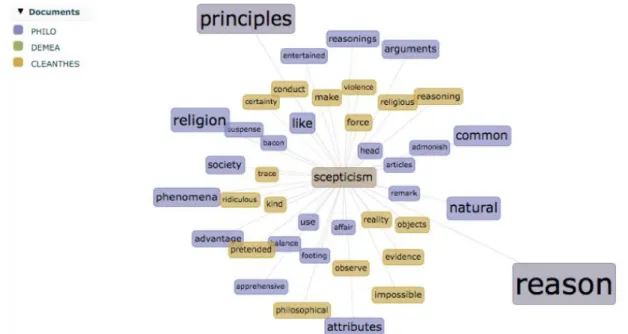
The cluster in figure 5, which again shows Cleanthes’ disdain for Philo’s scepticism, is the
result of them using the Collocate tool in the programme Voyant. They conclude:
The cluster shows some unexpected terms Cleanthes uses in the context of
‘scepticism’, along them ‘violence’, ‘conduct’, ‘ridiculous’ and ‘pretended’. For
Cleanthes scepticism is a ‘violence’ that people impress on their ‘conduct’. […]
Exploring collocates reinforced and clarified for us the disdain that Cleanthes has
for Philo’s scepticism as a way of life.37
33 Rockwell and Sinclair, Hermeneutica, pp. 180-181. 34 Ibid., pp. 177-179.
16 Figure 5. Cluster with collocates for 'scepticism'38
2.1.5. Sentiment Analysis
The methods as described in the previous sections all point to turning points in stories or define
characters’ characteristics and make them comparable. This can be very useful, especially in the light
of my case study, which deals with characters that I previously interpreted as being opposite parts of
one whole.39 However, these methods do not explain what it means that words are dispersed the
way they are (i.e. why particular words suddenly cease to be used, or suddenly pop up) and what it
means if words collocate. One always needs to turn back to the text to draw conclusions about the
findings, and to attribute them to the characters’ roles in a story. This can lead to speculative results,
as became clear from the previous sections. As was mentioned, dispersion plots and keyword
analyses alone will not tell us whether or not the words were used in a positive or negative light.
They give us a list of results that can be of much use to confirm a thesis that already exists, but rely
very heavily on a researcher turning back to the text and interpreting the results of computational
analysis from there.
In that light, rather than solely creating lists and graphs that show the collocation and
dispersion of frequently used words or keywords, it may also be very useful to do a sentiment
analysis, i.e. to incorporate techniques that identify with the help of a word list negative as well as
positive words within a text. An example of a project related to sentiment analysis can be found in
the study of so-called emotional arcs in literature by Andrew Reagan et al. in 2016, following up on a
theory formulated in 1995 by Kurt Vonnegut of emotional arcs, in which the author argues that
17 ‘there is no reason why the simple shapes of stories can’t be fed into computers’. He found, for
example, that the shapes of Cinderella and the origin story of Christianity in the Old Testament were
remarkably alike.40 Reagan et al. later wrote an article about emotional arcs and found that there are
six shapes that are most common in the narrative of stories. They stress that there is a distinction
between the plot of a story and its emotional arc:
While the plot captures the mechanics of a narrative and the structure encodes
their delivery, [we examine] the emotional arc that is invoked through the words
used. The emotional arc does not give us direct information about the plot or
intended meaning of the story, but rather exists as a part of the whole narrative
(e.g. an emotional arc showing a fall in sentiment throughout a story may arise
from very different plot and structure combinations).41
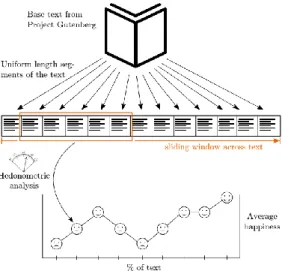
They create emotional arcs by performing a sentiment analysis by 10.000 word windows per story42,
resulting in graphs similar to the template in figure 6. Consequently, they derive six emotional arcs
from a collection of 1.327 books from Project Gutenberg: ‘rags to riches’ (rise), ‘tragedy’, or ‘riches to
rags’ (fall), ‘man in a hole’ rise), ‘Icarus’ (rise-fall), ‘Cinderella’ (rise-fall-rise) and ‘Oedipus’
(fall-rise-fall).43
Figure 6. Example of an Emotional Arc.44
40 Reagan, A.J., L. Mitchell, D. Kiley, C.M. Danforth and P.S. Dodds, ‘The emotional arcs of stories are
dominated by six basic shapes’, EPJ Data Science (2016), Volume 5, Issue 31, p. 1.
18 Turning back to a text is of course still required in this case as well, as knowledge of the corpus
provides one with the full picture, but defining the emotional arc of a story can supply scholars with
the overall mood of a narrative and how it changes over time.
2.1.6. Topic Modelling
Topic modelling is a technique that, among other applications, is suitable for analysing themes in
works of fiction. This is a method where an algorithm automatically identifies words that cluster
together and are to be found in multiple places in multiple texts.45 In his work Macroanalysis
Matthew Jockers uses the LDA algorithm in MALLET, which describes topic modelling as follows:‘A
‘topic’ consists of clusters of words that frequently occur together. Using contextual clues, topic
models can connect words with similar meanings and distinguish between uses of words with
multiple meanings.’ The computer does not know what themes it is looking for and the resulting lists
of topics are not presented as labelled lists, but as sets of words that ‘are “ranked” or “weighted”
according to their probabilities of appearing together in a given topic’, instead. ‘The ease with which
these resulting word clusters can be readily identified as topics or themes is referred to as topic
‘coherence’ or topic interpretability’, writes Jockers.46
The lists of ‘topics’ are then of course interpreted and labelled by the researchers
themselves. Not only that, the desired number of topics needs to be set by hand as well, which
Jockers points out is a somewhat arbitrary manner.47 Topics are often not easily interpretable either,
which makes this technique susceptible to some guesswork and making it, like the other techniques
that have already been reviewed, very heavily dependent on a researcher’s interpretation.
Although projects involving topic modelling are often concerned with multiple texts, the
technique can be fruitful in the case of a single novel as well, which is also shown in Jockers’
monograph. He generates a topic model of Moby Dick in order to be able to compare it to a larger
corpus that it is part of. Jockers describes topic modelling as treating each document as a ‘bag of
words’, meaning one novel is counted as one large bag. As, argues Jockers, novels do not consist of
just a few themes, but have smaller and more fleeting themes as well, it is necessary for a successful
topic model to divide a novel into chunks to capture even the transient themes. Jockers uses the
technique on Moby Dick, in order to find its themes.48 He then proceeds to compare the themes in
Moby Dick to the larger corpus that it is a part of, which means that the technique in this case gives
45 Hammond, Literature in the Digital Age, p. 116, M.L. Jockers, Macroanalysis. Digital Methods & Literary
History (Urbana, Chicago, Springfield: University of Illinois Press), p. 132.
19 him the opportunity to see which themes feature more heavily in Moby Dick than in the rest of the
corpus.
2.2. Potential Goals and Uses
The previous section of this chapter showed various examples of how computational methods can be
applied to support literary interpretations. This section concentrates on the potential goals scholars
can achieve using such methods. The goals listed here can all be derived from section 2.1. and will be
incorporated in chapter 4. This list is by no means meant to be exhaustive.
From the examples in the previous section we can derive that it is possible to achieve an
array of goals via a combination of computational methods and close reading. Computational
techniques, although they will not present us with answers and interpretations on a silver platter, do
help us (further) define and interpret elements of a narrative, such as characterisation, themes,
dialogues and the progression of said narrative.
Characterisation
It has become clear that computational methods, when used on a micro-scale, can be quite useful for
character analyses. So far, we have seen these methods being used as evidence for character
development in Hammond’s experiment with A Portrait of the Artist as a Young Man and it having
highlighted differences between characters and put forward the terms distinctive to them in
Culpeper’s keyword analysis and Ramsay’s analysis of The Waves. Lastly, we have seen them help
uncover tiny details suitable for character analysis. They can reveal, for instance, that the pronouns
that are used most frequently by a particular character can reflect important aspects of their
personality.
Themes
Section 2.1. has shown that it is possible to track a theme across a text, to see how it progresses in
terms of whether or not the words connected to it appear more or less often. Also, it is possible to
see in what light it is brought up, i.e. by finding the words that it collocates with. Like Rockwell and
Sinclair write in Hermeneutica:
Software cannot summarize a theme the way a human would. However, it can
identify the word that would mark the theme and then track the interactions
through the text.49
20 Topic modelling can also be a useful tool to find themes within a story, but its use is often more
fruitful in the case of large corpora rather than novels and novellas. However, even in the case of a
single novel the practice is useful to cluster words that are connected to a particular theme.
Dialogue
The research project conducted by Rockwell and Sinclair uses computational methods to find the
drama in dialogue, and to make visualisations of how said dialogue progresses. Culpeper showed
how both lexical and grammatical details about characters can be derived from dialogue.
Narrative
Apart from following a theme or tracking keywords across a text, the work by Reagan et al. shows
how useful sentiment analysis of texts can be when dividing these texts into time frames (of 10.000
words, in their case) and mapping out the emotional progression of their narrative.
In conclusion, a list of methods and goals can be drawn up as a result of the previous sections in the
table below. Whilst the various technologies can be applied to an array of different ends than the
ones mentioned, the table below is based solely on the methods and goals that emerged from this
chapter.
Techniques and Methods Goals
Type-Token Ratio Characterisation
Keywords Characterisation
Dispersion Plots Characterisation, following a theme/word
across a text
Concordances Theme/word connotations
Clustering Theme/word connotations
Sentiment Analysis Emotional progression of a narrative
In the previous chapter a ‘micro-study’ was defined as a study where digital methods supply
additional information to a close reading, which means that a micro-study consists of a combination
of close reading and distant reading. The fact that micro-studies are made up out of this combination
has also emerged from this chapter. In order to further explore the value of these methods if we
expect them to supply us with data that forms an addition to an existing interpretation as brought
about by a close reading, the techniques discussed in this chapter will be utilised in the case study of
21
3. Siddhartha – An Introduction to the Case Study
This chapter will function as an introduction to the case study of Hermann Hesse’s Siddhartha in
chapter 4.50 It will focus on the following question: What is Govinda’s role in the developments of the
protagonist in Hermann Hesse’s Siddhartha? In an earlier project I concluded that Govinda can be
interpreted as a part of Siddhartha’s, which is the interpretation that will be used in the case study as
well. The focus in this chapter will lie on the turning points in Siddhartha’s life, as these are the points
in the book that are of great importance for his personal growth, and Govinda is present for each of
them.
3.1. Siddhartha. Eine indische Dichtung – Origins, Reception and Govinda’s Role
Siddhartha is a 1922 novel by Swiss author Hermann Hesse. The novel tells the story of Siddhartha, a
young Brahman51 who lives in India at about 500 BCE, and his journey to enlightenment. The story is
characterised by Siddhartha’s rejection of religious dogma and teachings (die Lehre52) and the
importance of unconditional love.53 Important themes, apart from die Lehre and love, are the
concept of time as well as Siddhartha’s ‘Suche’. The novel is the result of Hesse’s preoccupation with
Indian spirituality, as well as an attempt to find something that can be believed in by all people,
regardless of their origins and differences.54 It came forth entirely out of the experiences of World
War I, which resulted in the need for moral stability; people wanted to be able to believe in
something again.55 Siddhartha is part of the body of Hesse’s works that is concerned with
self-reflection, and Hesse himself described it as an attempt to write down his own beliefs in book form.56
Hesse, having grown up in a protestant family, was heavily influenced later in life by Indian religions,
50 The case study will be based upon an earlier research project I did on the subject for my bachelor thesis, and
will take the conclusions that were drawn and the questions that were asked in said thesis as a departing point. This chapter will therefore summarise the findings of said thesis.
51 A cast consisting of priests and religious teachers. K.M. Sen, Hinduism (Great Britain: Penguin, 1963), p. 28. 52 The term die Lehre will be used in this thesis rather than ‘teachings’ or ‘dogma’, after the term used in
Siddhartha.
53 Hesse himself writes about this in his essay Mein Glaube: ‘Das mein »Siddhartha« nicht die Erkenntnis, sondern die Liebe obenan stellt, daß er das Dogma ablehnt und das Erlebnis der Einheit zum Mittelpunkt macht, mag man al sein Zurückneigen zum Christentum, ja als einen warhaft protestantischen Zug empfinden. H. Hesse, Mein Glaube (Frankfurt am Main: Suhrkamp, 1971), p. 61.
54 M. Limberg, Hermann Hesse. Suhrkamp Basisbiographie (Frankfurt am Main: Suhrkamp, 2005), p. 101. 55 V. Michels, ‚Zur Einführung: Die Entstehung des Siddhartha‘ in Michels, V. (ed.) Materialien zu
Hermann Hesses »Siddhartha«. Zweiter Band. Texte über Siddhartha (Frankfurt am Main: Suhrkamp, 1976), pp.
7-25, p. 25.; Limberg, Hermann Hesse, p. 51.
22 having read The Upanishads, The Bhagavad Gita and Buddha’s teachings.57 Siddhartha received a
positive reception and gained most of its popularity in the United States, after the Vietnam War.58
The novel has been widely analysed and interpreted since its release in 1922. However, few
interpretations have focused on the role of Siddhartha’s best friend, Govinda. The rest of this chapter
will summarise the findings of my project as mentioned above.
3.2. Siddhartha’s Developments
Siddhartha goes through various stages on his journey towards enlightenment. Initially, he is
someone who lives his life according to a Lehre, practicing meditation to escape from his Ich, this
being his only goal. After joining the Samanas, a group of wandering ascetics, he realises that die
Lehre will never lead him to salvation. This idea is reinforced by his meeting with Buddha, the
enlightened one, with whom he speaks of the ongoing cycle of life, which is how Buddha presents
the world. Siddhartha recognises that this timeless cycle is invaded by something alien, namely
Buddha’s Lehre in itself.
Thus follows the second stage in Siddhartha’s developments: His earthly life, in which he
learns die Liebeskunst (the art of love) from the famous courtesan Kamala, and turns into a rich,
gambling and drinking merchant. This life causes him to have trouble thinking clearly, turning him
into a Kindermensch (childlike person), which is how he begrudgingly thinks of his fellow citizens.
Siddhartha at his point is quite stuck in the cycle of rebirth, Sansara, as a result of his way of living.59
He flees from his current life and falls asleep in the forest.60 When he wakes up, he feels like a new
person with a new perspective on the world. He has lost his skills: thinking, fasting and waiting. Like a
child, he has to start all over again.
57 Hesse, Mein Glaube, p. 59.
58 Michels, ‘Die Entstehung des Siddhartha’, p.25.
59 Sansara (or Samsara) is the cycle of rebirth, in which the soul strives to free itself ‘from the bonds of its own
past deeds (karma) in an ‘endless series of births and deaths’. It is understood in Buddhism that escaping from this cycle is the highest state one can achieve and that sins like desire, pleasure and power amongst other things will keep one stuck in this cycle of rebirth. R. E. Buswell and D. S. Lopez, The Princeton Dictionary of
Buddhism (Princeton: Princeton University Press, 2014), p.757; The Editors of Encyclopaedia Britannica,
‘Samsara’, Encyclopaedia Britannica, 7 April 2016, n.pag.
<https://www.britannica.com/topic/samsara> (13 April 2018), Gold, A.G., V. Narayanan et al., 'Karma samsara and moksha', Encyclopaedia Britannica, 7 February 2018,
< https://www.britannica.com/topic/Hinduism/Karma-samsara-and-moksha#ref50462> (13 April 2018); Audi, R., The Cambridge Dictionary of Philosophy (Cambridge: Cambridge University Press, 1995), p.
105.
60 This act of falling asleep is interpreted as a rebirth by Vridghahiri Ganeshan, which corresponds with the fact
23 This is where the third stage in his life starts. This stage is symbolised by Siddhartha’s time as
a ferryman living by the river. Whereas the timeless cycle of life already appeared to be of
importance during his conversation with Buddha, it is during his life by the river that Siddhartha
starts to actually understand what exactly that entails, with the help of the river itself, which
symbolises this ongoing cycle. This understanding of the universe as one endless, timeless cycle
brings him closer to his final enlightenment. However, a final test is put to him in the guise of him
meeting, but then having to part with the son he finds out he had with Kamala. This loss turns him
into a true Kindermensch, which finally helps him love and understand the woes and motivations of
those around him. This is when he learns to love unconditionally. Finally, the river then shows him
and helps him fully realise that all is one:
Oft schon hatte er all dies gehört, diese vielen Stimmen im Fluß, heute klang es
neu. Schon konnte er die vielen Stimmen nicht mehr unterscheiden, […], alles
war eins, alles war ineinander verwoben und verknüpft, tausendfach
verschlungen. Und alles zusammen, alle Stimmen, alle Ziele, alles Sehnen, alle
Leiden, alle Lust, alles Gute und Böse, alles zusammen war die Welt.61
Consequently, he reaches his final state of enlightenment.
3.3. Govinda’s Developments
Govinda is a textbook secondary character in the sense that he does not go through any personal
growth throughout the story. From the start, he is fascinated with his friend and realises that
Siddhartha is not just an average Brahman:
Er liebte alles, was Siddhartha tat und sagte, und am meisten liebte er seinen
Geist, seine hohen, feurigen Gedanken, seinen glühenden Willen, seine hohe
Berufung. Govinda wusste, dieser wird kein gemeiner Brahmane werden, kein
fauler Opferbeamter, kein habgieriger Händler mit Zaubersprüchen […], und auch
kein gutes, dummes Schaf in der Herde der vielen.62
24 Govinda’s life revolves around die Lehre. He believes firmly that that is what will help him find
enlightenment. Together with Siddhartha he joins the Samanas, and goes on to join Buddha’s
community. Both times he is shocked when Siddhartha rejects their teachings. Whilst Siddhartha
goes into a new phase in life as he travels to the city, Govinda stays right where he is, being as
focussed on die Lehre as he has ever been. He never stops searching.
It is only at the very end of the story that Govinda too, reaches enlightenment, which
Siddhartha helps him find by proving to him the importance of love; up until then, Govinda –
following Buddhist teachings – was not allowed to love.
3.4. Govinda’s Role in Siddhartha’s Life
3.4.1. Govinda as a Sidekick
According to Ron Buchanan, author of the article ‘“Side by Side”: The role of the Sidekick’, the
sidekick functions as a substitute for the reader, and provides the reader with new information.63
Govinda, despite his passive role in the story, does exactly that. Throughout the story he is in the
habit of asking Siddhartha question after question whenever they meet. These questions challenge
Siddhartha to reflect on his own thought processes, as well as to attempt to put these thoughts into
words. Govinda fulfils both roles as described by Buchanan simply by asking his questions. He allows
readers a look inside Siddhartha’s brain by asking questions that he hopes will help him understand
his friend’s thoughts. Incidentally, these are also questions that make Siddhartha reflect.
The sidekick, writes Buchanan, is also the character that is trusted by the principal character,
as well as the one who accompanies the principal character on his or her journey.64 Govinda might
not be present for the bigger part of Siddhartha’s journey, as the two friends part ways quite early
on, but the next section will show that Govinda does accompany him in the sense that he is present
during the turning points in Siddhartha’s life. After all, Govinda’s role as an audience is not his only
role, nor is it his most important one.
3.4.2. Govinda as Siddhartha’s Opposite
As Govinda can be interpreted as Siddhartha’s sidekick, one would expect him to have a supporting
role. However, he does not support Siddhartha in the traditional sense. His ability to offer support is
enabled by the fact that he and Siddhartha are very different characters. The differences between
the two friends are of vital importance to Hesse’s story and they are obvious from the very start,
63 R. Buchanan, ‘“Side by Side”: The Role of the Sidekick’, in Studies in Popular Culture, Volume 26, Issue 1, pp.
15-26, pp. 15-17.
25 where Govinda is portrayed as a devout Brahman, whereas Siddhartha is unhappy and unsatisfied
with his life and religion.
At the turning points in Siddhartha’s life, their differences are what makes Siddhartha reflect
on his life, and his meetings with Govinda thus enable him to move forward. The first time this
happens the pair have already joined the Samanas. Siddhartha has not ceased to be unsatisfied. He
argues that knowledge has no enemy quite as terrible as wanting to know, as learning. These words
frighten the devout Govinda, who still means to fashion his religious life after the teachings of others.
This is one of the points in the story where he attempts to understand Siddhartha by asking him
questions:
»Mögest du, Siddhartha, deinen Freund doch nicht mit solchen Reden beängstigen!
Wahrlich, Angst erwecken deine Worte in meinem Herzen. Und denke doch nur: wo
bliebe die Heiligkeit der Gebete, wo bliebe die Ehrwürdigkeit des
Brahmanenstandes, wo die Heiligkeit der Samanas, wenn es so wäre, wie du sagst,
wenn es kein Lernen gäbe?! Was, o Siddhartha, was würde dann aus alledem
werden, was auf Erden heilig, was wertvoll, was ehrwürdig ist?«
Und Govinda murmelte einen Vers vor sich hin, einen Vers aus einer Upanishad:
»Wer nachsinnend, geläuterten Geistes, in Atman sich versenkt, Unaussprechlich
durch Worte ist seines Herzens Seligkeit.«65
Govinda’s words have an ironic aftertaste: Despite the fact that the quotation from the Upanishads
proves that Versenkung cannot be put into words, Govinda is set in his attempt to find his
Versenkung in die Lehre; in words. Not only do Govinda’s words stress how different he is from
Siddhartha; he also causes Siddhartha – who is full of doubt after realising that teachings and words
will not bring him closer to enlightenment – to become even more desperate. Siddhartha has already
realised that the teachings and rituals of the Samanas will not bring him closer to enlightenment, to
the Self, at this point. He has started to mistrust die Lehre, but Govinda’s words make him
desperately wonder what, then, is left. The realisation that teachings will not lead him to
enlightenment is, as was mentioned earlier, a turning point in Siddhartha’s life. During this turning
point, Govinda might not have gained a better understanding of Siddhartha’s thoughts, and the
conversation might not have gone in his preferred direction, but he has influenced Siddhartha
nonetheless.
26 Their difference when it comes to religious teachings is once again stressed when Govinda
and Siddhartha part ways, respectively to join Buddha’s community and to leave for the city. From
now on, as Govinda remains set in his ways and Siddhartha experiences many different ways of
living, the differences between the friends will grow even bigger.
A second instance in which Govinda, as Siddhartha’s opposite, influences his friend, is when
the pair meet again after Siddhartha’s time in the city. Govinda, having been under the impression
that he had been watching over a complete stranger, comes up with another stream of questions as
soon as he realises with whom he is faced: ‘Was bist du jetzt, wo gehst du hin, hast du deiner
Reichtum verloren?’ His meeting with Govinda leaves Siddhartha, who has woken from his sleep as if
he were reborn, smiling and feeling full of love. This is an important theme that is introduced here.
Up until now, Siddhartha has not loved, let alone loved unconditionally: When he was with the
Samanas, he lived a life that forbade him to love and made him bitter. In the city life was but a game
to him, and he looked down upon his fellow citizens. After meeting Govinda, Siddhartha reflects:
Er liebte [Govinda] noch immer, diesen Treuen, diesen Ängstlichen. Und wie hätte
er, in diesem Augenblick, in dieser herrlichen Stunde nach seinem wunderbaren
Schlafe, durchdrungen von Om, irgend jemand und irgend etwas nicht lieben
sollen! [Er war] voll froher Liebe zu allem, was er sah. Und eben daran, so schien
es ihm jetzt, war er vorher so sehr krank gewesen, dass er nichts und niemand
hatte lieben können.66
This means that Siddhartha’s meeting with Govinda has made clear to him what he was missing in his
previous life. He finds in his sleep and in the meeting with his old friend a state of bliss, and ends up
feeling full of love. Unconditional love is of utmost importance in Hinduism. In the introduction to
The Bhagavad Gita love is described by Juan Mascaró as ‘rising above the vast harmonies’ of
incarnation, prayer and the revelation of God in all things in creation’.67 Additionally, it was Hesse
himself who described that in Siddhartha not knowledge but love is what is most important.68
Govinda however, is on a path where he is not allowed to love, still being a part of Buddha’s
community. This in turn makes them into even bigger opposites.
During their final meeting Siddhartha has reached enlightenment, whereas Govinda is still
actively searching for it and has yet to make philosophical progress. Siddhartha, since their previous
27 meeting, has fully felt and understood the unity of the world; the cycle of life. Overall, the friends
have become polar opposites: Govinda still holds onto the idea that die Lehre is what is most
important, whereas Siddhartha left that idea behind a long time ago. Secondly, Govinda is not
allowed to love whereas Siddhartha now loves unconditionally. Lastly, Siddhartha is aware of the
ongoing cycle of life, whereas Govinda still thinks in time frames.
Siddhartha having found peace means that there is no room left for Govinda to
(inadvertently) influence him, nor is there a use for that. Yet, the last chapter of the story carries
Govinda’s name, implying that there is still an important part for him to play. Like we are used from
him, Govinda asks another string of questions and explains to Siddhartha that he has never stopped
searching, reflecting on a last, nonetheless important theme and difference between the two: that of
searching for enlightenment. Siddhartha has realised that one should not actively search for what
one desires:
»Wenn jemand sucht […], dann geschieht es leicht, daß sein Auge nur noch das
Ding sieht, das er sucht, dass er nichts zu finden, nichts in sich einzulassen vermag,
weil er nur immer an das Gesuchte denkt, weil er ein Ziel hat, weil er vom Ziel
besessen ist. Suchen heißt: ein Ziel haben. Finden aber heißt: frei sein, offen
stehen, kein Ziel haben.«69
Clearly, it is not Siddhartha who needs a little help at this point. It is Govinda who does. Proving his
opinion that words and teachings do not lead to enlightenment, Siddhartha tries and fails to explain
that words do not suffice and that wisdom cannot be taught. As words are indeed insufficient,
Govinda of course does not understand. Siddhartha then attempts to show him the way without
words and asks his friend to kiss him on the forehead. When Govinda does, he – who is on a path
where love is forbidden still – is filled with love and understanding, proving once again the
importance of love in Siddhartha.
Govinda’s role as an opposite has evoked in Siddhartha thoughts that helped him on his way,
but in the end, the tables seem to have turned, which makes one wonder if there is more to their
roles as opposites. This is why their coming together at turning points in Siddhartha’s life should be
explained further.
28 3.4.3. Govinda as a Part of Siddhartha’s
This section will further explore Govinda’s role as Siddhartha’s opposite, and how it contributes to
my interpretation that Govinda is a part of Siddhartha’s. It will do so firstly with the aid of a
comparison of my theory to that of one of the only other interpretations of Govinda, by Deba
Patnaik. Secondly, it will take into account Hesse’s influences for Siddhartha, which reinforce the
interpretation of the two friends as being two parts of one Self.
3.4.3.1. Govinda and Siddhartha as one ‘Self’
It has already become clear that the differences between the two friends have a purpose in the story.
Deba Patnaik too, author of the article ‘Govinda’, argues that the differences between the two
friends are not serendipitous, and that they were very consciously created by Hesse. His article is
concerned with Govinda’s role in Siddhartha. Patnaik describes Govinda not as being a part of
Siddhartha’s – which is what I will be arguing he is – but as a ‘second I’, representing the physical
dimensions of human life, which Siddhartha should go through and, in turn, leave behind.70 This take
on Govinda explains why Siddhartha feels as if he leaves his life up until then behind when he says his
goodbyes to Govinda before they part ways for the first time. Judging from Patnaik’s interpretation
after all, Siddhartha does not just part with his previous life, but with part of himself as well: the part
of himself that believed that enlightenment could be achieved through die Lehre. Patnaik goes on to
argue that Govinda represents the philosophy that Siddhartha should unlearn; Govinda is the earthly
‘second I’ that Siddhartha should leave behind to find peace.71 However, this theory does not quite
hold up. It is indeed clear that Govinda symbolises the earthly life, which will be further discussed in
the next section. However, Govinda does not in fact seem to symbolise the life that Siddhartha
should leave behind. To start with, if this were the case, it seems odd that the pair would come
together time and again during important times in Siddhartha’s life and that, at the very end of the
story, Govinda finds peace, too.
What is more, Siddhartha left life as symbolised by Govinda – life by the example of a Lehre –
behind as he was leaving the Samanas. As Govinda does not go through any developments at all,
Siddhartha cannot keep leaving behind lifestyles as symbolised by Govinda each time they meet
again; he already did so as he parted with the conviction that Lehre would bring him peace. This is
another reason why Patnaik’s interpretation of Govinda as a ‘second I’ that should be left behind by
Siddhartha does not hold up.
70 D.P. Patnaik, ‘Govinda’ in Michels, V. (ed.) Materialien zu Hermann Hesses »Siddhartha«. Zweiter Band. Texte
über Siddhartha (Frankfurt am Main: Suhrkamp, 1976), pp. 184-194, pp. 190; 193.
29 In conclusion of this section, rather than interpreting Govinda as a ‘second I’ that Siddhartha
should shed, it is more plausible to interpret him as a part of Siddhartha’s Self instead. As was
mentioned, when saying goodbye to Govinda early on in the story, Siddhartha is described as leaving
behind a part of himself, this part being interpretable as being Govinda. Thus, from early on it is
hinted that Govinda is an actual part of Siddhartha’s. As was discussed in the previous section, the
various meetings with that part of himself bring Siddhartha to self-reflect, which allows him to better
define himself. This does not just ensure that Siddhartha can reach enlightenment; it also ensures
that he can help the other part of himself to reach enlightenment, so that in the end the two parts
come together again.
3.4.3.2. Influences on Siddhartha
It has now become clear why I interpreted Govinda as a part of Siddhartha’s, rather than as Patnaik’s
‘second I’. This interpretation can be further supported when looking at various influences for the
novel, like the Bhagavad Gita and psychoanalyst C.G. Jung’s theories.
3.4.3.2.1. The Bhagavad Gita
The Bhagavad Gita is a part of the Mahabharata, one of the two main Indian epics, and tells the story
of the warrior and prince Arjuna and the god Krishna. The two characters are in the midst of a
battleground when Arjuna asks Krishna for help. Krishna advises him and helps him to see the
universe as one, like Siddhartha does for Govinda at the end of the story. The two characters are very
similar to Govinda and Siddhartha in various ways. In his article ‘Hesse’s Siddhartha and The
Bhagavad Gita’ Eugene Timpe even explains that the Bhagavad Gita can be interpreted as a dialogue
between the earthly and divine parts of one person72, which matches my interpretation as Govinda
as the earthly part of Siddhartha’s.
A second striking similarity to the ‘Gita’ has to do with Govinda and Siddhartha both reaching
enlightenment in the end, which I interpreted as both parts coming together again. Bikhu Parekh
writes about the Bhagavad Gita, in his article ‘Friendship in Classical Indian Thought’, that the
friendship at the heart of the ‘Gita’ is the highest form of friendship, and argues that Arjuna and
Krishna need each other to become complete, describing their situation as a ‘total identification’.73
This reminds very strongly of Govinda and Siddhartha coming together in the end.
72 E. Timpe, ‘Hesse’s Siddhartha and the Bhagavad Gita’, Comparative Literature (1970), Volume 22, Issue 4, pp.
346-357, p. 350.
73 B. Parekh, ‘Friendship in Classical Indian Thought’, India International Centre Quarterly (2008),