An Investigation of Circular RNAs on a Genome-Wide Scale
William R. Jeck
A dissertation submitted to the faculty of the University of North Carolina at Chapel Hill in partial fulfillment of the requirements for the degree of Doctor of
Philosophy in the Department of Genetics (Curriculum in Genetics and Molecular Biology)
Chapel Hill 2013
Approved by,
Abstract
WILLIAM JECK: An Investigation of Circular RNAs on a Genome-Wide Scale (Under the direction of Dr. Norman Sharpless, M.D.)
Acknowledgements
Table of Contents
List of Figures... vi
List of Tables ... vii
List of Abbreviations ... viii
Chapter ... 10
I. Introduction: circular RNAs are functional noncoding RNAs ... 10
A. Initial reports of ecircRNA ... 12
B. Genome wide studies of endogenous circular RNA ... 14
C. Validation assays for endogenous ecircRNAs ... 17
D. Properties of ecircRNAs ... 21
E. Function of ecircRNAs ... 25
F. Summary ... 29
II. Meta-analysis of GWAS and age-associated diseases ... 35
A. Introduction ... 35
B. Methods and results ... 37
C. Discussion ... 42
III. Circular RNAs are abundant, conserved, and associated with Alu repeats ... 48
A. Introduction ... 48
B. Results ... 49
C. Discussion ... 65
A. Production mechanisms. ... 93
B. CDR1as linearity... 94
C. Disagreement between informatic studies ... 95
D. Other ecircRNA functions ... 96
E. Conclusions ... 98
References ... 100
List of Figures
Figure
1: Timeline of major discoveries in ecircRNA ... 31
2: Biochemical and informatic approaches to the identification of ecircRNAs ... 32
3: Products of splicing events and molecular techniques for their discernment. ... 33
4: ecircRNA formation mechanisms. ... 34
5: The genetic landscape of human disease.. ... 45
6: The INK4/ARF locus is a genomic hotspot for age-associated disease susceptibility ... 46
7: CircleSeq experimental approach. ... 81
8: CircleSeq enriches for backsplice junctions. ... 82
9: CircleSeq identifies previously identified species of circular RNA. ... 83
10: Circular RNA validation. ... 84
11: Lariat species also identified by circleSeq. ... 85
12: Circularization is conserved between paralogs and in mice ... 86
13: Circular RNAs are not associated with ribosomes and are susceptible to siRNA Knockdown. ... 87
14: Novel ecircRNAs are highly stable and cytoplasmic. ... 88
15: Backsplices are flanked by paired Alu elements and long introns. ... 89
List of Tables
Table
List of Abbreviations
ecircRNA exonic circular RNA siRNA small interfering RNA
miRNA microRNA
rRNA ribosomal RNA tRNA transfer RNA ncRNA noncoding RNA
EST expressed sequence tag
GWAS genome-wide association studies CGAS candidate gene association studies
ANRIL antisense noncoding RNA in the INK4 locus
CDR1as cerebellar degeneration-related protein 1 antisense T1DM type 1 diabetes mellitus
T2DM type 2 diabetes mellitus CAD coronary artery disease
RPKM reads per kilobase per million mapping SRPBM spliced reads per billion mapping
SD splice donor
Chapter
I. Introduction: Circular RNAs are functional noncoding RNAs
Despite the tenants of the central dogma, that ‘DNA makes RNA makes protein’, the majority of cellular RNA is not translated. These noncoding RNAs are a rich class of endogenous transcripts with diverse forms and cellular roles. The bulk of cellular noncoding RNAs are in the form of ribosomal RNA (rRNA) and transfer RNA (tRNA), but other noncoding transcripts also mediate core cellular functions. These include splicing (small nuclear RNA), expression regulation (microRNA), telomere maintenance (TERC), chromosome scale structure and expression (XIST), as well as local chromatin state and expression (e.g. HOTAIR).
It is not surprising that, until recently, these highly abundant products were only sparsely reported. Most molecular techniques require either amplification or fragmentation of RNA to permit cloning, both of which destroy circularity. Lacking polyadenylation, ecircRNAs are less likely to be detected by methods dependent on these features, such as rapid amplification of cDNA ends (RACE). High throughput methods, such as RNA-seq, have also depended on isolation of polyadenylated fractions to exclude abundant rRNA and tRNA molecules. Circular RNAs, unlike miRNAs, are not easily fractioned from other gene products.
Also complicating previous characterization, splices leading to the formation of ecircRNAs have been lumped with varieties of trans-splicing. Trans -splicing similarly generates non-colinear splice junctions, with canonical exons appearing in an order different from their genomic sequence. Trans-splices between two transcripts from the same gene can produce non-colinear sequences similar to those found in ecircRNA.
A. Initial Reports of ecircRNA
The first hint of endogenously produced ecircRNAs emerged several decades ago in explorations of the DCC transcript in human cells (Nigro et al., 1991). This work described exons appearing in transcripts out of their normal sequence in the gene, with upstream exons usually located 5’ in the gene now ‘shuffled’ downstream to what should be 3’ exons (See timeline, Figure 1). Despite the non-canonical ordering, the exons were included in their entirety and appeared to use the usual splice donor/acceptor sites. Referred to as ‘exon shuffling’ (distinct from the evolutionary process described by Gilbert (Gilbert, 1978)), the rearranged products were less abundant than the linear product, non-polyadenylated, predominantly cytoplasmic, and expressed in both human and rat tissues.
The authors speculated that such a product might emerge from intra-molecular (cis) splicing, which would result in an ecircRNA. The splice seen going backwards relative to the genomic sequence, which we call a “backsplice,” could also result in a linear product if it occurred in trans, though this idea was not explored. The authors speculated that a backsplice could be promoted by the presence of complementary sequences in the introns adjacent to the involved exons, though the authors did not observe such sequences.
to identification of a likely ecircRNA. Circular products of the ETS-1 locus were also non-polyadenylated and used the canonical splice sites. The authors proved the backsplice site’s sequence by RNase protection assay, thus eliminating the possibility of PCR artifact. Additionally, they provided evidence that the backsplice containing RNA was isolated in a few, low-molecular-weight RNA fractions, and therefore unlikely to be a product of trans-splicing (see section C, below).
Examinations of the mammalian sex determining gene, SRY, also revealed abundant, conserved, and unquestionably ecircRNA production from the SRY locus in three mouse species (Capel et al., 1993). RNase protection assays revealed that 90% of SRY transcripts contained a backsplice, both in SRY overexpressing epithelial cells and murine testis. Furthermore, RNase H cleavage assay (described below) offered commanding evidence of circularity. SRY gene sequence was notable for possessing complementary sequences near to the putative splice donor and splice acceptor hypothesized by Nigro et al. to bring these sites together (Nigro et al., 1991).
B. Genome wide studies of endogenous circular RNA
Genome wide explorations of ecircRNA offer methods to characterize its common features and to identify key ecircRNAs involved in critical biological functions. Genome wide identification of ecircRNAs in multiple tissues and species has provided recent insights into their abundance, conservation, and function.
Initial genome-wide analysis of backsplicing used expressed sequence tag (EST) databases (Dixon, Eperon, Hall, & Samani, 2005). This study was inspired by reports of abundant exon repetition products in some genes (Caudevilla et al., 1998; Frantz et al., 1999; Rigatti, 2004). Species in this study were not expected to be circular, as EST sequencing uses 3’ and 5’ features in mRNA isolation not present in ecircRNAs. However some backsplices, trans-backsplices formed from intermolecular splicing between two transcripts of the same gene, can generate linear products with repeated exons that contain backsplice junction sequences. EST analysis revealed 170 instances of presumably trans -backspliced RNA, with one gene, CTBP2, demonstrating the same backsplice in murine and human ESTs.
High throughput sequencing later offered a new, much more powerful platform for the discovery of backsplice sequences in cDNA libraries. Deep sequencing of polyadenylated mRNA extended this work, and identified 205 distinct transcripts involving a backsplice (Al-Balool et al., 2011). Validation studies showed that these transcripts were often abundant (>90% of total gene products), tissue specific, and polyadenylated. These results emphasize the fact that trans-backsplicing is a common event for many genes.
Identification of circular RNAs required improved methods for sequencing non-polyadenylated species. This was made possible by rRNA depletion strategies, such as RiboZero or RiboMinus. Searching such libraries revealed thousands of transcripts with apparent backsplice sequence in multiple cell lines and tissues (Salzman, Gawad, Wang, Lacayo, & Brown, 2012). Validation assays revealed these transcripts to be, in many cases, non-polyadenylated and abundant. Many were also RNase R exonuclease resistant, a feature of circular and lariat RNAs (Hitoshi Suzuki et al., 2006). Analysis of murine RNA with the same rRNA depletion technique likewise revealed thousands of backsplicing transcripts.
developmentally specific. Validation assays showed that many—but not all— species discovered by this method were RNase R resistant and highly stable. The remaining species were likely products of trans-backsplicing, which cannot be distinguished by this technique.
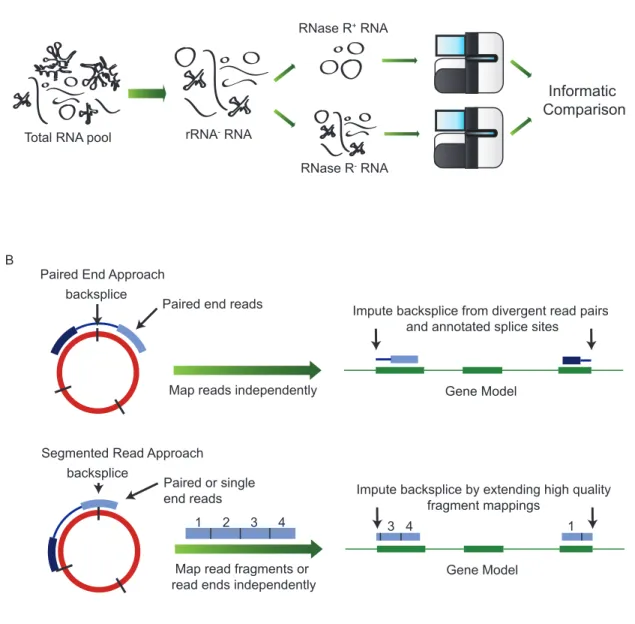
A more definitive approach for the genome wide identification of ecircRNA was first described in Archaea (Danan, Schwartz, Edelheit, & Sorek, 2012) and in mammals (Jeck et al., 2012b). Both techniques compare RNA-seq libraries prepared from RNase R treated RNA to untreated RNA (Figure 2A). Identification of backsplices that were more abundant in the RNase R treated libraries offers substantial evidence of ecircRNA, as was demonstrated by validation assays in both studies.
While studies in Archaea revealed circular RNA production primarily in noncoding transcripts (75%) (Danan et al., 2012), human and murine ecircRNAs were in predominantly coding genes (Jeck et al., 2012b). Comparison of human and murine ecircRNAs by this technique revealed a set of conserved ecircRNAs with orthologous backsplice junction pairs, along with additional genomic features discussed below.
The above studies used high throughput sequencing reads traversing the backsplice to identify ecircRNA. The details of these techniques have important implications for the varieties of ecircRNA that are detectable.
implemented with existing alignment algorithms, it uses gene annotations to impute the location of the backsplice.
Other studies have identified backsplice sequence directly (Danan et al., 2012; Jeck et al., 2012b; Memczak et al., 2013). The genomes of Archaea, being dramatically smaller, required only 40 bp single end reads, while mapping to mammalian genomes used 100bp reads in both cases. Backsplices were identified by uniquely tailored pipelines (Danan et al., 2012; Memczak et al., 2013) or using the MapSplice (K. Wang et al., 2010) algorithm. All of these approaches use unique, anchoring mappings of subsequences to identify reads composed of two discontiguous genomic sequences mapping across a backsplice (Figure 2B). Such approaches are less dependent on prior sequence annotations, which may not be applicable to ecircRNAs.
C. Validation assays for endogenous ecircRNAs
ecircRNA validation, the techniques discussed may be applicable to novel ecircRNA isolation and discovery methods.
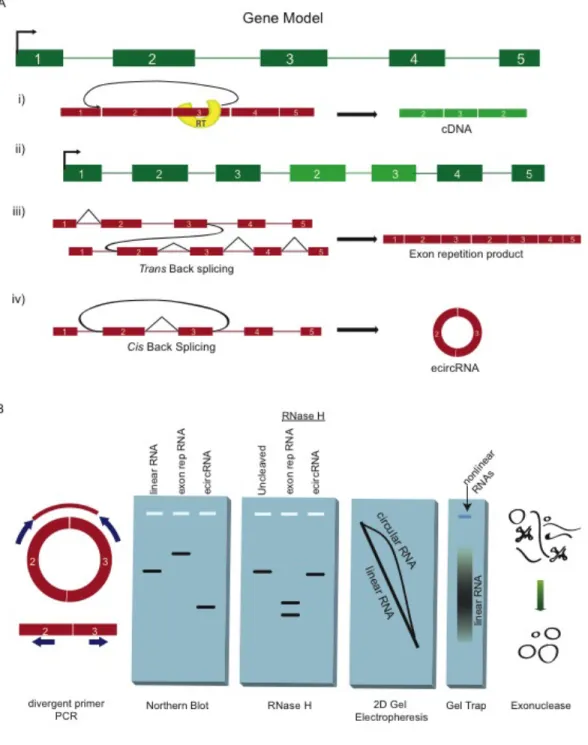
The primary problem in ecircRNA discovery is reverse transcriptase template switching, which can confound the analysis of all rare splicing products (McManus, Duff, Eipper-Mains, & Graveley, 2010). Apparent backsplice sequences in RACE clones or in deep sequencing results should ideally be present in multiple EST traces or sequencing reads. The most conclusive validating approach is RNase protection of the junction sequences (Cocquerelle et al., 1992). Less conclusive are amplification reactions with ‘divergent’ PCR primers (Figure 3B). Production of the expected bands of the right sequence reduces the likelihood of template switching.
Proof of non-polyadenylation—demonstrated by RNA fractionation or, less ideally, by oligo-dT priming—offers further evidence of circularity. Non-polyadenylation, demonstrated in the first report of ecircRNA in DCC (Nigro et al., 1991) and those since, is an obvious consequence of a molecule lacking a 3’ end. Polyadenylated sequences containing an apparent backsplice have been observed, but presumably arise from trans-splicing or segmental duplication events (Frantz et al., 1999). Non-polyadenylation is not limited to ecircRNA molecules, though, and includes abundant coding transcripts such as histone mRNAs (Marzluff, Wagner, & Duronio, 2008).
somewhat more slowly than linear RNA, and this effect increases with increased gel crosslinking (Tabak et al., 1988) (Figure 3B).
A far more elegant and conclusive assay uses either weak hydrolysis or targeted RNase H degradation followed by northern assay under denaturing conditions. If RNase H is used, the two degradation products of a collection of identical linear RNAs will also be identical, appearing as distinct bands. If alkali hydrolysis is used, degraded linear RNAs will be of random sizes, forming a smear. Circular RNAs, uniquely, will form a single band after RNase H degradation or after a single nick as in weak alkali hydrolysis.
Additional approaches also offer strong evidence of circularity. The first is 2D gel electrophoresis. This technique separates ecircRNA from linear by its slower migration through highly crosslinked polyacrylamide gels (Tabak et al., 1988). Initial migration through a moderately crosslinked polyacrylamide gel, followed by a second migration through highly crosslinked gel, leaves ecircRNAs on a distinct, off-diagonal arc (Figure 3B). This technique was used extensively in demonstrating in vitro circularization of RNAs in mammalian extracts (Pasman, Been, & Garcia-Blanco, 1996). This technique has not, to our knowledge, been used to probe for in vivo production of ecircRNA.
gel and permitted to crosslink before current is applied. Non-migrating fractions are enriched for ecircRNA, which is bound within the crosslinking matrix.
Two simple enzymatic methods are also applicable to proving circularity. The simplest—treatment with the RNase R exonuclease—degrades linear RNA and structured RNAs through a 3’à5’ exonuclease activity while leaving ecircRNA intact (Hitoshi Suzuki et al., 2006). Similarly, tobacco acid phosphatase (TAP) and terminator exonuclease treatment degrades RNA through 5’à3’ exonuclease activity (Hansen et al., 2013). In both cases, quantification of RNA before and after treatment should reveal enrichment of circular relative to linear species.
Finally, ecircRNAs can, in rare cases, be identified by electron micrograph (Kos, Dijkema, Arnberg, van der Meide, & Schellekens, 1986). This technique is not perfect, however. Early reports of ecircRNA matching yeast mitochondrial DNA sequences (Arnberg, van Ommen, Grivell, Van Bruggen, & Borst, 1980) were later shown to be lariats (van der Veen et al., 1986).
2008) (see Chapter III). This identifying signature should be noticeable in RT-PCR sequences.
D. Properties of ecircRNAs
Studies of circular RNA have identified a number of shared features. EcircRNA is extraordinarily stable (Cocquerelle et al., 1993), with many species having a half life of over 48 hours (Jeck et al., 2012b). Circular RNA is not, however, generally stable in serum, with a half-life of < 15s (Umekage, Uehara, Fujita, Suzuki, & Kikuchi, 2012), presumably due to RNase A endonuclease mediated degradation that also affects siRNAs (Haupenthal, Baehr, Kiermayer, Zeuzem, & Piiper, 2006). Intracellular stability is likely due to ecircRNA resistance to exonucleases (Cocquerelle et al., 1993). Studies of ecircRNA localization have all found cytoplasmic localization (Cocquerelle et al., 1993; Dubin, Kazmi, & Ostrer, 1995; Hansen et al., 2011; Jeck et al., 2012b; X. F. Li & Lytton, 1999; Memczak et al., 2013; Nigro et al., 1991), though the process of export remains obscure, and it is possible that circular RNA escapes from the nucleus during mitosis.
ecircRNA are discarded. It is possible to adjust this estimate by including all annotated exons between backsplice sites to generate an estimate of ecircRNA length. With this correction performed, we estimate ecircRNA comprises 0.8% of non-ribosomal RNAs, though this is likely an overestimate. Quantification by other methods, such as 2D gel electrophoresis or gel trap, may yield better estimates of ecircRNA abundance, but have yet to be reported.
Multiple mechanisms have been described to form circular RNAs generally (Figure 4). Prokaryotic mechanisms include unusual splicing of group I introns with weak 5’ splice site motifs (Price, Engberg, & Cech, 1987) or with permutation of intron-exon junctions (Puttaraju & Been, 1992) (Figure 4A). Unusual splicing reactions may also form RNA circles from group II introns in some cases (Murray et al., 2001), though this has not been demonstrated to be a general phenomenon. Further in vitro work has used T4 DNA ligases to join free 5’ and 3’ ends, aided by a complementary DNA oligo ‘bridge’ (C. Y. Chen & Sarnow, 1995) (Figure 4B). None of these mechanisms are likely to be the driving mechanism for the production of ecircRNA in vivo, as group I and group II intron autocatalytic splicing differs substantially from nuclear mRNA splicing in mammals (Cech, 1990).
al., 1993) (Figure 4C). The second, ‘lariat intermediate’ mechanism, results from internal splicing within lariats produced from exon skipping (Zaphiropoulos, 1996) (Figure 4D).
Evidence for these mechanisms is sparse. Some exon skipping events have been found that are consistent with circular RNAs derived from the same gene (Jeck et al., 2012b; Salzman et al., 2012; Zaphiropoulos, 1996). However genome wide ecircRNA discovery studies have failed to find skipping events for all, or even most ecircRNAs (Jeck et al., 2012b; Salzman et al., 2012). It is possible, though, that linear exon skipping products may be not be observed due to their instability and are still transiently formed in the production of ecircRNA. More important are example ecircRNAs where no exons flank the circularized product, such as in SRY and CDR1as (Capel et al., 1993; Hansen et al., 2011). The presence of cryptic exons are possible, but unlikely explanations for these products.
Several shared genomic features have been described that appear to promote ecircRNA formation. Introns flanking sites involved in a backsplice tend to be longer than introns generally, and, in cases where single exons are circularized, these exons are also longer (Jeck et al., 2012b; Salzman et al., 2012). Complementary sequences flanking backsplice sites, first shown to be necessary for SRY circularization (Dubin et al., 1995), and later shown to be enriched in backsplices in ESTs (Dixon et al., 2007), appear to be involved in ecircRNA formation generally as well (Jeck et al., 2012b). In particular, paired Alu repeats in inverted orientations upstream and downstream of backsplice sites appear to promote human ecircRNA formation (Jeck et al., 2012b). Notably, studies able to identify sequences not arising from annotated exons nonetheless found ecircRNAs commonly use at least one annotated splice site (Jeck et al., 2012b; Memczak et al., 2013). EcircRNA that have been described always involve a GT/AG pair of canonical splice sites, though this may be an artifact of discovery methods.
Supporting this role for ecircRNAs genome wide, discovery efforts found enrichment for miRNA binding sites generally among ecircRNAs (Memczak et al., 2013).
Two recent studies have demonstrated substantial conservation of ecircRNA expression in mammals (Jeck et al., 2012b; Memczak et al., 2013). EcircRNAs frequently overlapped in the same gene, but also commonly shared precisely orthologous backsplice sites. EcircRNAs are also present in Caenorhabditis elegans. Circular RNA discovery in Archaea found that several circular RNAs were conserved between highly divergent species, including in the ribozyme RNase P (Danan et al., 2012). Conservation of ecircRNA is further suggestive of a functional role for many of these transcripts. Also consistent with a regulatory role, ecircRNAs were differentially expressed in both human hematpoetic lineages and C. elegans developmental stages (Memczak et al., 2013).
E. Function of ecircRNAs
Convincing evidence has demonstrated functional roles for ecircRNAs in mammals. In addition to their abundance, recent studies have shown that ecircRNAs act as miRNA ‘sponges’ and limit miRNA binding to their coding targets. Others have proposed that ecircRNA regulates gene translation by removing critical coding exons.
CDR1as which was also densely bound by AGO proteins by PAR-CLIP assay. In vivo assays found coexpression of miR-7 and CDR1as in the mouse brain (though miR-7 was also expressed in other tissues), and one study showed colocalization and association of CDR1as and miR-7 using in-vitro microscopy and co-immunoprecipitation experiments, respectively (Hansen et al., 2013). Knockdown of CDR1as or overexpression of miR-671, previously shown to cleave CDR1as (Hansen et al., 2011), produced decreases in known miR-7 target gene expression. CDR1as overexpression, by contrast, attenuated the knockdown of miR-7 targets. These results demonstrate CDR1as activity as a sponge for AGO bound miR-7.
In vivo evidence in zebrafish offer convincing evidence that CDR1as sponging of miR-7 is critical for brain development. Overexpression of an ecircRNA producing CDR1as construct in zebrafish generated significant reductions in midbrain size (Memczak et al., 2013). The absence of a CDR1 ortholog in this organism neatly removes the potential for CDR1as effects on its coding antisense partner, and isolates likely mechanisms of action to sponge activity. In keeping with cell-based assays, CDR1as overexpression mimicked the phenotype of miR-7 directed morpholinos. These results demonstrate that ecircRNAs can be functional regulators of development.
not yet been shown to have a developmental phenotype, both examples point to a general role for ecircRNAs in modulating miRNA activity.
Other studies have shown differential ecircRNA production in loci with substantial disease association. Haplotypes in the INK4/ARF locus have been associated with a surprisingly large number of diseases (Jeck, Siebold, & Sharpless, 2012a). Large resequencing studies of 281 individuals have revealed no common mutations in genic regions likely to explain observed associations (A. D. Johnson et al., 2013). However risk associated haplotypes do show differential expression of locus genes, including circular RNAs produced by the ANRIL noncoding RNA (Burd et al., 2010). The surprising finding that these circular RNAs may form the dominant transcripts from the locus offers further suggestive evidence that this circular RNA may be an essential determinant of disease (Jeck et al., 2012b). Though no mechanism has been conclusively demonstrated, it has been proposed that ANRIL and perhaps cANRIL transcripts associate with the polycomb group repressor complexes to silence locus transcription (Burd et al., 2010; Kotake et al., 2010).
phenotype. As these models lack a potentially critical 5’ UTR exon, the mechanism of this effect cannot be conclusively attributed to ecircRNA formation. However, the authors propose that formation of the ecircRNA acts as an ‘mRNA trap’ by sequestering the translation start site.
The mRNA trap effect of cis-backsplicing could be a common genome wide mechanism for gene activation. EcircRNAs in the HIPK3 locus have been found to similarly include the first exon, and appear to be more abundant than linear products (Jeck et al., 2012b). Similarly SRY transcripts, in addition to a potential miR sponge activity, are more abundant than linear SRY transcripts (Capel et al., 1993). In both cases the ecircRNA is not ribosome bound, and likely represents a translationally inactive gene product. It is relevant to human disease that many products of backsplicing are known to exist in the dystrophin gene (Surono et al., 1999), and one study has suggested that ecircRNA formation may lead to functionally inactive transcripts in individuals with certain deletion mutations (Gualandi, 2003). These results suggest that backsplicing’s effects on transcript levels merit further study.
the gene (Van Eylen, Kamagate, & Herchuelz, 2001). Demonstration of translation from an endogenous ecircRNA remains elusive.
Finally, circular RNAs have been identified as viral genomes. In mammals, this property is unique to the Hepatitis δ virus (Kos et al., 1986), a circular RNA virus dependent upon coinfection with Hepatitis B. The class of plant pathogens known as viroids also possess circular RNA genomes and represent the first reported example of covalently closed circular RNA observed in nature (H. L. Sanger, 1976).
These exogenous circular RNAs have shared properties with intriguing implications for ecircRNAs. Hepatitis δ replicates through rolling circle amplification of its genomic and anti-genomic RNA, followed by cleavage into subunits by ribozymal sequences (Wu et al., 1989). How these fragments are ligated into circles is not fully understood, though endogenous DNA ligases have been proposed to play a role (Carl E Reid, 2000). Though these processes are likely pathological, transcription from an endogenous ecircRNA could have similar rolling circle amplification effects, were it to occur.
F. Summary
Figure 1: Timeline of major discoveries in ecircRNA. Major discoveries in mammalian circular RNA production and related species.
1990
2000
2010
‘Scrambled exons’ in DCC ETS-1 Circular RNA
SRY Circular RNA
Circular RNAs are translatable
Circularization as product of exon skipping Inverted repeats necessary for SRY circularization Circularization in nuclear extracts
Fmn cirularization as an ‘mRNA trap’
Abundant circular RNAs in rRNA depleted sequencing Distinction of exon repetition and
ecircRNA by sequencing assay Circular RNAs act as miRNA ‘sponges’ Exon repetition in EST sequences
ecircRNA targeting by miRNA Trans-splicing leads to exon repetition
Figure 2: Biochemical and informatic approaches to the identification of ecircRNAs. (A) Experimental procedure for identifying ecircRNA from total RNA by ribosome depletion followed by exonuclease enrichment. (B) Informatic approaches to identify splice junctions using paired end (top) or long single read data (bottom).
Total RNA pool rRNA- RNA
RNase R- RNA
RNase R+ RNA
Informatic Comparison A
B
Paired End Approach backsplice
Paired end reads
Map reads independently Gene Model
Impute backsplice from divergent read pairs and annotated splice sites
Segmented Read Approach backsplice
Paired or single end reads
Map read fragments or
read ends independently Gene Model
Impute backsplice by extending high quality fragment mappings
Figure 4: ecircRNA formation mechanisms. (A) Formation by permuted Group I introns (Puttaraju & Been, 1992), (B) T4 DNA ligase (C. Y. Chen & Sarnow, 1995), (C) direct backsplicing (Cocquerelle et al., 1993), (D) exon skipping (Zaphiropoulos, 1997), (E) and overexpression vector employed for
A
5’ Region Group I intron
Fragment 3’ Region
Group I intron Fragment GTP G OH OH OH B P P T4 DNA Ligase C D E DNA Oligo 5’ Phosphorylated Transcript
5’ branch point attacks 3’ splice donor
3’ splice donor attacks 5’ splice acceptor
Chapter
II. Meta-analysis of GWAS and age-associated diseases1
A. Introduction
A central tenet of gerontology is that common pathogenic mechanisms cause age-related phenotypes in disparate organs and tissues. For example, telomere dysfunction in the liver, bone marrow, and lung has been linked to age-associated, tissue-specific diseases such as cirrhosis, aplastic anemia, and pulmonary fibrosis, respectively (Armanios, 2012). Several broad pathways have been suggested as candidate global modifiers of human aging including sirtuins, insulin/IGF-1, ROS metabolism, inflammation, and cellular senescence. A prediction of the notion that common pathogenic pathways contribute to aging of distinct tissues is that there should be genes whose expression modulates these pathways, and heterogeneous expression of such genes within a population should be associated with multiple, seemingly distinct tissue-specific diseases.
High-density single nucleotide polymorphism (SNP) arrays have provided population geneticists a high throughput method for identifying polymorphisms associated with the onset of complex phenotypes (e.g., physiological traits and/or markers, congenital abnormalities, and disease susceptibility/resistances). Large
1 This chapter is adapted from recent publication in Aging Cell in October of 2012, and is
scale, population-based studies that utilize SNP arrays to gain insights into gene(s) that may promote/cause a complex phenotype consist of Candidate Gene Association Studies (CGAS) and Genome-Wide Association Studies (GWAS). The key difference between these two epidemiological study methods is that CGAS take a hypothesis-driven approach, whereas GWAS are performed in a non-biased manner (see review (Jorgensen et al., 2009) for more detailed discussion of advantages/disadvantages of these methodologies). Moreover, modern pedigree studies (linkage analyses) can be performed using SNP arrays to perform genome-wide searches to identify variants associated with complex diseases, such as Alzheimer’s disease (Züchner et al., 2008), but variants identified from such efforts may be limited to small numbers of actual cases (i.e., individual families).
whether there are ‘hotspot’ loci associated with multiple disease susceptibility/resistance phenotypes. Toward that end, we filtered this NHGRI data set to only include studies that focused on clinically relevant human diseases. To better visualize chromosomal loci and candidate genes associated with multiple, distinct human diseases, especially age-associated diseases, we summed the frequency of disease-associated SNPs in 200 kb bins spanning the whole genome. While clearly ‘age-related disease’ is not the same thing as ‘aging’, we elected to focus this analysis on disease susceptibility given the tractability of many well-delineated diseases to GWAS, as opposed to the mixed results obtained for less discrete endpoints (e.g., longevity, frailty, etc.). We believe this approach is still of interest to gerontologists given that freedom from disease (wellness) is an essential determinant of healthspan.
B. Methods and Results
non-disease traits, congenital deformities, and medical conditions of limited morbidity (e.g., restless leg syndrome). In rare instances (n = 14) where disease versus non-disease classification of a GWAS was not obvious, classification was performed with blinding to GWAS results (see Table S1 and Table S2 for included and excluded ‘diseases’). The inclusion/exclusion of these borderline conditions did not affect the analysis’ conclusions. The filtered GWAS data set consisted of 372 studies that identified 1775 SNPs associated with susceptibility/resistance to 105 unique human diseases. The total number of patients from these 372 studies totaled more than 2.3 million individuals from diverse ethnic backgrounds.
studies focused on identifying SNPs associated with disease categories. Distinguishing disease subtypes (i.e., IBD) had minimal impact on our findings, and only shifted one locus, 17q12, above the significance threshold. The number of unique disease associations per bin was then graphed versus chromosomal location in a ‘Manhattan plot’ (Figure 5), and a 10 000 iteration permutation analysis was performed on the mapped SNPs to estimate statistical significance.
This analysis revealed substantial heterogeneity in the human genome with regard to disease susceptibility. The majority of bins (13,900 of 15,157; 92%) did not contain any disease-associated SNPs. In contrast, only ten bins (2 Mb or 0.06% of the genome) showed statistically significant enrichment (P < 0.05) for disease association, with two strong ‘peaks’ (P < 0.0001) of multi-disease association. The largest peak spanned four neighboring bins (800 kb) that contain the gene-rich MHC locus on chromosome 6p21 (Figure 1). SNPs in this bin were linked to 24 unique diseases, most of which were autoimmune in nature (e.g., asthma, inflammatory bowel disease, lupus, Hodgkins Disease, Table 1), and not classical disease of aging. This finding confirms the well-established pathogenic role of MHC polymorphisms in the development of diverse autoimmune diseases (Fernando et al., 2008; International MHC and Autoimmunity Genetics Network et al., 2009). Therefore, while the association of the MHC locus with autoimmune diseases is not surprising, this finding serves as a positive control for the analysis.
which are age-associated: cancers (e.g., breast, glioblastoma), type 2 diabetes mellitus (T2DM), glaucoma and several atherosclerotic diseases (e.g., stroke, aortic aneurysm, myocardial infarction) (Table 1). It is worth noting the considerable size of these two peaks: the 6p21 and 9p21.3 disease susceptibility hotspots represent 0.03% of the genome, but combined were associated with nearly a third (34 of 105) of the unique diseases analyzed by GWAS.
associated with autoimmune diseases (e.g., T1DM, asthma, IBD, Hodgkins disease) and were not as strongly linked to age-associated diseases as the two bins associated with senescence (i.e., cancers, atherosclerosis, T2DM, glaucoma, pulmonary fibrosis).
C. Discussion
Although the finding that all loci associated with broad disease resistance appeared related to effects on immunity or senescence, there are limitations to this analysis. First, cis-regulatory elements can act over a large genomic scale (e.g., several Mb’s); for example, 9p21.3 variants have been suggested to influence expression both of the nearby tumor suppressor proteins of the INK4a/ARF locus and IFNa-21, a more distant (approximately 1 Mb) regulator of inflammation (Harismendy et al., 2011; Y. Liu et al., 2009). Likewise, another gene in the 5p15.33 bin, CLPTM1L, has also been postulated to contribute to cancer progression(McKay et al., 2008). Therefore, the true causal variant located near GWAS-identified SNPs may influence expression of one or more local transcripts, some or all of which may not be located in the same bin. Moreover, an ascertainment bias exists in that certain well-demarcated disease states (e.g., autoimmune diseases) appear more tractable to GWAS than less clinically distinct entities (e.g., community acquired pneumonia). Therefore, not all morbid conditions of aging are tractable to GWAS.
greatly in their total contribution to human morbidity. Additionally, this analysis does not account for SNP prevalence or scale of their effect. Future work could incorporate these factors to estimate the multi-disease population attributable risk associated with certain SNP genotypes. As a result of these limitations, this analysis may overestimate the importance of the MHC locus, which is strongly associated with several rare diseases. By contrast, it may underestimate the relevance of the 9p21.3 bin, which is associated with common, highly morbid diseases (Table 1).
sarcopenia (Baker et al., 2011; H. Chen et al., 2011; Krishnamurthy et al., 2006; C.-L. Kuo et al., 2011; Y. Liu et al., 2011).
Figure 6: The INK4/ARF Locus is a Genomic Hotspot for Age-Associated Disease Susceptibility. The primary transcripts within the human INK4/ARFlocus including the long non-coding RNA, ANRIL, are depicted relative to chromosome 9. Disease susceptibility SNPs identified by GWAS that mapped to the INK4/ARF locus are represented by color-coded circles above the genomic ruler. Susceptibility SNPs displayed below the ruler were identified by non-GWAS such as genome-wide pedigree studies. Each color represents a specific human disease that is described in the SNP color key. Clusters of susceptibility SNPs associated with a specific disease are marked by large color-coded ovals. ASVD = Atherosclerotic vascular diseases and T2DM = Type 2 Diabetes Mellitus
Late Onset Alzheimer’s
Cup Glau ma
Can r
Fr evity
CA rysm
Type Diabetes
metr sis
ASVD T2 DM
Cancer Alzheimer’s Disease
190 Kb p16INK4a
p14ARF p15INK4b
ANRIL
GWAS SNPs
Candidate SNPs
Disease Associa on
Regions
INK4/ARF
Transcripts
Key:
9p21.3 Chromosome 9
21,950K 21,960K 21,970K 21,980K 21,990K 22,000K 22,010K 22,020K 22,03 0K
Chromosome
Region
# Unique
Diseases/Bin
Candidate
Gene(s)
Associated Disease Susceptibilities
1p31.3 5 IL23R Immune: IBDA (x2)B, Behcet’s disease,
Psoriasis, Anklyosing spondylitis
2p16.1 5 REL Immune: IBD, RAC, Psoriasis, Celiac
Disease, Hodgkin’s Lymphoma
5p15.33 5 TERT Senescence: Cancers (x5), Idiopathic
pulmonary fibrosis
6p21 26 across
four bins
MHC,
NOTCH4
Immune: Arthritis (x4), IBD (x2), Cancer
(x5), Lupus, MSD, Scleroderma, Celiac
disease, T1DME, Asthma, Primary
biliary cirrhosis, Psoriasis
7q32.1 5 IRF5,
TNPO3
Immune: SLEF, IBD, RA, Primary biliary
cirrhosis, Scleroderma
9p21.3 10 p15INK4b,
p16INK4a,
p14ARF,
ANRIL
Senescence: MIG, stroke, T2DMH,
Glaucoma, Aortic aneurysm, Intracranial
aneurysm, Cancers (x3), Endometriosis
17q12 5 IKZF3,
GSDMA,
GSDMB
Immune: IBD (x2), Asthma, RA, T1DM
AInflammatory Bowel Syndrome. BNumbers in parenthesis represent unique number of
specific diseases within that disease family. CRheumatoid Arthritis. DMultiple sclerosis, EType 1 Diabetes mellitus. FSystemic Lupus Erythematosus. GMyocardial Infarction, HType 2 Diabetes mellitus.
Chapter
III. Circular RNAs are abundant, conserved, and associated with Alu repeats2
A. Introduction
endogenous circular RNA transcripts.
Recently, our group discovered a circular RNA species, circular ANRIL or “cANRIL,” whose expression is associated with that of products of the human INK4a/ARF locus and is correlated with the risk of human atherosclerosis (Burd et al., 2010). Production of cANRIL in humans is associated with common single nucleotide polymorphisms (SNPs) predicted to affect cANRIL splicing, suggesting the possibility that cANRIL production influences Polycomb group (PcG)-mediated repression of the INK4a/ARF locus to influence atherosclerosis risk (Burd et al., 2010). This observation led us to perform an unbiased assessment of circular RNA species in mammalian cells. Toward that end, we developed a genome-wide RNA exonuclease enrichment strategy. RNase R degrades linear RNAs through its exonuclease activity while leaving circular RNAs unaffected (Hitoshi Suzuki et al., 2006). This method was first optimized to enrich a known, low-copy RNA circle (cANRIL) and then coupled with long-read, high-throughput sequencing to find potential circles in human fibroblast RNA. The resulting sequencing data were mapped to the genome using bioinformatic tools to identify out-of-order exon arrangements in an unbiased manner (MapSplice) (Wang et al. 2010). These exonic circular RNAs (ecircRNAs) were analyzed by bioinformatic and molecular tools and demonstrated to be abundant, stable, conserved, nonrandom, and potentially functional as competing endogenous RNAs.
B. Results
To identify exonic circular RNAs on a genomic scale, we developed an enrichment strategy for use in mammalian cells that we have termed “CircleSeq” (Figure 7A). While a bioinformatic approach to RNA circle identification has recently been described (Salzman et al., 2012), we reasoned that a biochemical enrichment of nonlinear RNAs might allow for the detection of more rare and diverse circular RNA forms. Toward that end, total RNA was isolated from an immortalized human fibroblast cell line (Hs68), depleted of ribosomal RNA (RiboMinus) and then treated with RNase R, an RNA exonuclease that degrades linear RNAs with short 3′ tails regardless of secondary structure but does not degrade circular species (Hitoshi Suzuki et al., 2006). This method was optimized to allow for >10-fold enrichment of cANRIL in cDNA prepared from RNase R-treated vs. untreated samples. Upon confirmation of enrichment of this rare circular species, we next performed high-throughput sequencing of such samples on an Illumina HiSeq yielding ∼300 million 100-bp reads per sample, which were aligned to the human genome using a de novo splice mapping algorithm, MapSplice (K. Wang et al., 2010). This algorithm segments reads and uses mappings of these segments to find spliced mappings as well as fusions. The algorithm gives preference to continuous mappings, then spliced mappings, and finally fusion mappings that include non-colinear splicing, long range splicing, or interchromosomal splicing (Figure 7B).
Coverage plots of untreated and RNase R-treated sequencing results were normalized to allow comparisons between conditions (expressed as reads per kilobase mapped [RPKM]; see Materials and Methods). The scales (noted at right in Figure 7C) may differ in subsequent plots to permit visualization of key features. We compiled the list of all fusion splice junctions where splice donor and acceptor occur within 2 Mb but in the non-colinear ordering. We term these junctions “backsplices.” Counts of reads mapping across an identified backsplice in untreated samples, normalized by read length and number of reads mapping (spliced reads per billion mapping [SRPBM]; see Materials and Methods), are also shown to permit quantitative comparisons between backsplices. Treatment with RNase R was expected to result in decreased coverage of linear products, enrichment of reads from exons included in circular products, and in increased reads mapping as backsplice junctions in exonuclease-treated samples, all of which are diagrammed in Figure 7C. Normalized counts of reads mapping across backsplices were compiled for all conditions and replicates and compared to identify backsplices that were enriched by exonuclease exposure.
Enrichment of circular RNAs by CircleSeq:
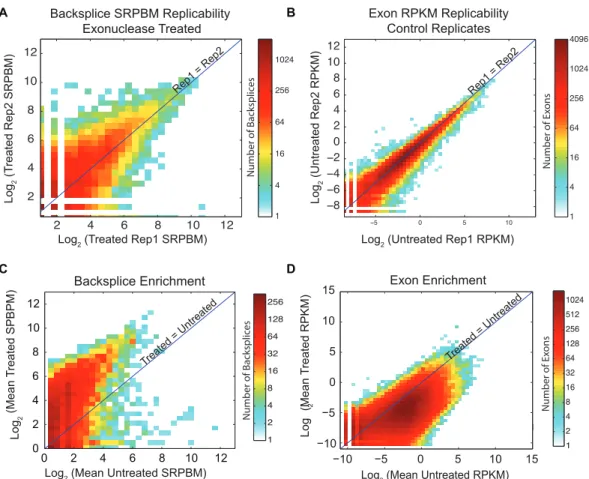
with RNase R, as would be expected of exons contained within linear RNA species (Figure 8D). These data show that CircleSeq reproducibly identifies backsplice-containing transcripts. Such backsplices are significantly enriched by RNase R digestion, contrasting with linear transcripts, which are depleted by RNase R.
Using this method, we identified >100,000 unique backsplice events throughout the genome. Of these, 25,166 were present in both RNase R-treated biological replicates and were also enriched by RNase R treatment as compared with mock treatment. While backsplice species generally were significantly enriched by RNase R treatment, we noted that 31% of backsplice species observed in untreated controls were not enriched by RNase R (Figure 8C). These species likely represent mapping artifacts or nonsequential exons harbored in linear products, resulting from either RNA trans-splicing or cleavage of ecircRNAs.
Circular RNAs contain predominantly exonic sequence:
expected. Intervening intronic sequence, however, was almost never enriched by RNase R digestion, suggesting introns are spliced from most circular forms. We were not able to detect other known circular species (e.g., SRY and DCC), due to low expression of these genes in Hs68 cells. We also observed many single exon ecircRNAs, that is, where the donor site splices to the acceptor of the same exon (e.g., KIAA0182) (Figure 9E,F). This method appears very sensitive; the 25,166 replicated backsplice events detected by CircleSeq included the large majority (1025 of 1319) of putative circles identified through a previously described bioinformatic approach (Salzman et al., 2012). This high degree of concordance is even more noteworthy given that the two methods examined ncRNA expression in different cell types (T cells vs. fibroblasts). These data demonstrate that backsplice-containing transcripts identified by this method are diverse, generally RNase R-resistant, and include most previously described circular RNAs.
on ecircRNAs, we sought to identify exonic, circular species while excluding lariats (see below) and linear trans-splices or cleaved backspliced RNAs.
Of the 25,166 unique backsplicing events that were reproducibly enriched by RNase R digestion and appeared in both biological replicates, most of these backsplices were only found in RNase R-treated samples and were not observed in the absence of exonuclease digestion. We suspect that many of these events represent rare ecircRNAs arising from pervasive background levels of RNA circularization, which may result from an occasional error in splicing (Hsu & Hertel, 2009). Others transcripts, in contrast, demonstrated coverage of backsplices and their associated circularized exons >10-fold higher than that of the canonical linear transcript from the same gene, even in control sequencing runs (KIAA0182) (Figure 9E,F). To focus on more abundant ecircRNAs with greater potential biological relevance, we chose three stringency cutoffs (LOW, MEDIUM, HIGH), selecting backsplicing events based upon their abundance and reproducible presence in both untreated and treated samples (Table 1; Supplemental Table S1). In all cases, we required backsplices to be observed and enriched in both RNase R-treated biological replicates. We placed varying minimum coverage requirements of backsplices in the control samples, with the LOW stringency set requiring a single backsplice read in the control data and HIGH stringency requiring coverage on a par with splices in a moderately expressed gene. Bioinformatic analyses gave similar results with regard to various features (see below) regardless of which transcript list was used.
backspliced products to forward spliced products at steady state by comparing the abundance of backsplice-spanning reads to reads spanning traditionally spliced junctions. The relative rate of backsplicing over forward splicing for these sites varied enormously, from <0.1% to >3200%, with no forward splicing products observed in some cases. The relative backsplicing rates for each circular RNA are shown in Supplemental Table S1. This analysis suggests that the formation of circular RNAs is considerable; e.g., using the LOW stringency list, 14.4% of genes expressed in human fibroblasts produced circular RNA species, suggesting at least one in eight human genes produces abundant circular as well as linear transcripts.
Circular RNA validation:
10C). To further exclude the possibility that these transcripts were the results of trans-spliced products, we employed a “virtual Northern” approach (Hurowitz & Brown, 2003), which identifies the size of transcripts by fractionating on a denaturing agarose gel, followed by qPCR. Backsplice-containing transcripts appeared in faster migrating fractions as compared to the associated full-length linear transcripts (Figure 10D), as would be predicted of circular RNA species composed of only a subset of exons. Trans-spliced products, in contrast, would be expected to be longer than full-length, as they contain repeated exons. Together, these data suggest that the vast majority of novel RNA transcripts comprising the LOW stringency list (1) contain backsplices, (2) are enriched by RNase R treatment, (3) are not polyadenylated, and (4) are of smaller size than linear mRNAs emanating from the same locus. These characteristics are consistent with circular RNAs, demonstrating that CircleSeq identifies ecircRNAs resulting from cis rather than trans-splicing.
Lariat detection and branch point mapping:
(Hitoshi Suzuki et al., 2006). Lariats however, could be distinguished from ecircRNAs in that lariats exhibited RNase enrichment in the absence of observed backsplice reads.
Despite the lack of backsplice reads, lariat 2′–5′ linkages were evidenced in our data by a different kind of read, which we term branch point reads. Using the abundant, stable lariat observed in GAPDH, we analyzed reads from RNase R-treated samples for 30 nt of sequence at the 5′ end of the intron, including the splice donor. We identified 24 such reads in one replicate alone, which were mapped to the human genome using the BLAT tool in the UCSC Genome Browser. Of these 24 reads, nine included sequence consistent with reverse transcription across a branch point (Figure 11A). These sequences included an untemplated T base previously described to occur with reverse transcription by Superscript II across branch points (Gao et al., 2008). One read of the nine did not include this T, and instead included an “AG” sequence at this location. We also observed that the base coverage of lariats markedly decreased close to the sites of 2′–5′ linkages (Figure 11B), as would be predicted by the known inefficient traversal 2′–5′ junctions by reverse transcriptase (Lorsch, Bartel, & Szostak, 1995). Lariat sequences also demonstrated an ablation of coverage 3′
Conservation of abundant circularized transcripts:
conservation of specific backsplicing events between humans and rodents. Representative ecircRNAs are untranslated but can be targeted by
siRNA:
Given their high expression, conservation, and the presence of an open reading frame, we sought to explore whether some circular RNAs might be translated in vivo. Engineered circular RNAs have previously been shown to have coding potential (C. Y. Chen & Sarnow, 1995). To explore translation of endogenous transcripts, we isolated unbound, monosome-bound, and polysome-bound fractions by sucrose gradient centrifugation and assayed the relative quantity of both linear and circular products by RT-PCR (Figure 13A–C). To increase the chances of detecting translated circular species, we assayed ecircRNAs that contain a translation start site. Linear products were significantly enriched in the ribosome-bound fraction for the genes assayed: HIPK3, KIAA0182, and MYO9B (Figure 13B). Circular products, in contrast, were abundant in the unbound fractions but not detected in the bound fractions, indicating that these AUG-containing ecircRNAs are not translated (Figure 13C).
circularized exon shared by both linear and circular species. A nonspecific control siRNA sequence was also employed. As expected, siRNA directed against the linear species induced knockdown of the linear transcript only, without affecting expression of the circular species (Figure 13D,E). Knockdown using siRNA targeted to exonic sequence shared in both the linear and circular species induced effective knockdown of both transcripts. It was even possible to design an siRNA to the backsplice junction of ZFY that specifically targeted the circular, but not linear, transcript. These results demonstrate that ecircRNAs can be targeted by RNA interference.
ecircRNAs are predominantly cytoplasmic and highly stable:
We next investigated ecircRNA stability and localization in vivo. Toward that end, Hs68 cells were treated with actinomycin D, an inhibitor of transcription, and total RNA was harvested at indicated time points. While highly stable RNAs such as 18S and p16INK4a exhibited very long transcript half-lives (>48 h) as
al., 2012) and suggest that ecircRNAs either undergo nuclear export or are released to the cytoplasm during mitosis, where they enjoy extraordinary stability, likely as a result of resistance to debranching enzymes and RNA exonucleases.
Bioinformatic analyses of ecircRNAs:
Having explored properties of ecircRNAs in vivo, we attempted to bioinformatically identify shared genomic features that might further elucidate function or mechanism of formation. DAVID analysis (Huang da et al. 2009) revealed an enrichment of protein kinases and related proteins among the set of genes producing ecircRNAs (Table 2), as compared to the set of expressed genes in the sample (see Materials and Methods). Although protein kinase transcripts as a whole were more likely to exhibit abundant circularization, no specific subfamily of kinase was particularly associated with ecircRNA production. Therefore, RNA circles are produced throughout the genome but are not randomly distributed among genes and may be disproportionately associated with kinase expression.
HIGH stringency transcript list was analyzed, the intronic flanks adjacent to circularized exons were approximately twofold more likely to contain an Alu repeat than non-circularized exons (P < 10−11) (Figure 15B,C). This preference to contain flanking Alu repeats was noted for both single exon as well as multiple exon ecircRNAs (data not shown). Furthermore, when Alu polarity was considered, we found that pairs of Alu elements taken from introns flanking circularized exons were significantly more likely to be complementary (in inverted orientation) than non-complementary. This held for all choices of transcript list or size of the flanking intronic window (Figure 15D). For example, using a 500-bp window, 20% of introns flanking ecircRNAs contained complementary Alu pairs vs. 8% with non-complementary pairs (P < 10−10). Circularized exons were sixfold
more likely to contain complementary Alus than control, non-circularized exons. While a role for inverted repeats on RNA circularization had been suggested in vitro (Dubin et al. 1995), these data confirm and extend this relationship at the genome-wide scale.
In addition to the presence of Alu repeats in flanking introns, we also noted distinct characteristics of exon and intron length related to ecircRNA production. Consistent with findings at HIPK2/3 (Figure 12A,B,E) and KIAA0182 (Fig. 3E), the upstream and downstream introns flanking circularized exons tended to be large—on average more than approximately threefold longer than introns flanking control exons (P < 10−15) (Figure 15E), regardless of choice of
analysis of single exon ecircRNAs, we noted that circularized exons were approximately threefold longer than expressed exons overall, at an average length of 690 nt (P < 10−15) (data not shown). In aggregate, these results suggest that the genomic structure of long exons flanked by long introns harboring inverted repeat elements facilitates RNA circularization.
C. Discussion
Here, we have shown that nonlariat circular RNAs emanate from >14% of transcribed genes in fibroblasts, comprising a highly abundant but unappreciated class of (presumably) noncoding RNA. We find that nearly all circular RNAs are comprised of exonic sequences, containing one or more exons, and always featuring a single non-colinear fusion of exons otherwise joined by canonical splicing. Salient features of our method allowing for unbiased identification of circular species are the use of ribosome depletion (RiboMinus), RNA exonuclease enrichment, cDNA synthesis using random primers rather than oligo dT, long (100-bp) reads with high coverage (>300 million reads per sample), use of MapSplice for de novo junction detection, and methodological optimization on a known circle (cANRIL). To consider a species circular, we required that it contain a backsplice and exhibit RNase R enrichment. These criteria discriminated circles from linear, trans-spliced species (which would possess a backsplice but not enrichment) as well as lariats (enrichment in the absence of a backsplice sequence but with branch junction reads). Use of this approach to identify circular transcripts in other cell types and species is an area of active ongoing investigation, as is applying exonuclease sequencing to the problem of branch point mapping.
were made from polyadenylated RNA, and RNA exonuclease resistance was not established. High-throughput sequencing of non-polyadenylated RNA identified enrichment of lone exons within some genes (Yang et al., 2011), a finding that is likely explained by abundant circular RNA containing these exons. This work also made note of the apparent stability of some lariat sequences, as we also have observed. A recent high-throughput sequencing analysis in Archaea employed RNase enrichment to identify circular RNA forms (Danan et al., 2012), establishing that the production of RNA circles is evolutionarily ancient. Most recently, Brown and colleagues reported the identification of >1000 transcription products favoring circularization (Salzman et al., 2012). In this report, the authors relied on paired-end reads of high-throughput sequencing data to find probable circles and showed that some of these species exhibited RNase R resistance. Our study expands on this result by assessing RNase R sensitivity and, therefore, circularity on the genome-wide scale. We identify >100,000 circular RNA species within RNase R-treated samples that are beyond the limit of detection in untreated samples. These studies, in concert with the present work, establish that RNA circles are highly abundant, evolutionarily old, and can be tractably identified using high-throughput sequencing strategies.
Alternatively, ecircRNA could also be formed by alternative, 5′ to 3′ splicing of nascent transcripts (Figure 16, Model 2). In this model, alternative splicing to a circular molecule is favored presumably because of intronic motifs bordering the circularized exon(s), which may interact to bring the two exons (or the ends of the same exon) close together. Key differences between these models are (1) the order of splicing events (i.e., which splice donor [SD] attacks first, of the circularized or non-circularized exon), (2) the need for a splice acceptor (SA) site 3′ from the circularized exons, and (3) the obligate production of an associated linear transcript containing the predicted exon-skipped fusion (e.g., exon 1–4 in Model 1). We believe the identification of long flanking introns and increased complementary Alu repeats about circularized exons is consistent with either model. Both features have been shown to influence exon-skipping (Fox-Walsh et al., 2005; A. Ganguly, Dunbar, Chen, Godmilow, & Ganguly, 2003), but hybridization of complementary Alus in long flanking introns would also favor the production of secondary structures in pre-mRNAs needed to drive the initiating 5′
to 3′ splicing event characteristic of Model 2.
represent a novel form of “alternative” splicing. Because our results show that ecircRNAs are significantly more stable than the associated linear mRNAs (Figure 14B,C), we were not able to rely on transcript abundance to estimate the ratio of circular to linear transcripts produced from these genes per transcriptional event. Nevertheless, our observations suggest that a significant fraction of pre-mRNA transcripts created by traversal of RNA polymerase through exon 2 of HIPK2/3 or exon 3 of KIAA0182 (Figure 9E) undergo “alternative” splicing to circularize rather than canonical splicing to produce the canonical linear transcript. As circularization of HIPK2/3 appears to preclude production of the usual protein-encoding transcript (as it would lack the ATG and significant N-terminal sequence) and is conserved between humans and rodents, this form of “alternative splicing” could regulate expression of genes like HIPK2/3. Observation of high homology between 69 murine circular RNAs and their human counterparts suggests that this may be a conserved mechanism of regulation in these genes. Application of exonuclease enrichment to a more diverse spectrum of organisms could further clarify the conservation and function of processes leading to circular RNAs.
with Ago2's RNA endonuclease “slicer” activity (J. Liu et al., 2004; Meister et al., 2004). We also show that siRNAs which target sequence in both the linear and circular transcripts of a given gene are able to induce knockdown of both species. As ecircRNAs are, in some cases, abundant, highly stable, and harbor miRNA binding sites, we expect these species could attenuate endogenous miRNA-mediated transcriptional repression through target mimicry. Additionally, ecircRNAs could sequester RNA-binding proteins, as we have suggested may be a function for cANRIL with respect to PcG proteins (Burd et al., 2010). We believe this is a particularly tantalizing prospect given the prior association of RNA splicing with PcG-mediated silencing(Isono, Mizutani-Koseki, Komori, Schmidt-Zachmann, & Koseki, 2005).
Lastly, although it appears many circular forms are not protein encoding (Figure 13A–C), it is not clear that all RNA circles are noncoding. Protein encoding RNA circles are well-established as viroids (e.g., the Hepatitis Δ agent) and have been synthesized experimentally to undergo translation in human cells (C. Y. Chen & Sarnow, 1995). It is also worth remarking in this regard that many circular RNAs contain a start codon and sometimes even the canonical AUG of the associated linear transcript (e.g., HIPK2/3). Whether endogenous circular RNAs are translated is an area of active ongoing study.
expressed than the associated, canonical mRNA. Circularization of transcribed exons is conserved between human and mice, is correlated with the presence of inverted repeats within long flanking introns, and may result from exon-skipping via a lariat structure or direct circularization driven by intronic pairing. In aggregate, these findings suggest that ecircRNAs are not the product of mere accidents of splicing but instead may regulate gene expression by affecting translation, RNAi, or through sequestration of RNA binding proteins.
D: Materials and Methods
Cell culture: Telomerized Hs68 human fibroblasts cells were obtained from G. Peters and grown as previously described (Brookes et al., 2002). Human T lymphocytes (Jurkat E6-1) were cultured in RPMI 1640 containing 10% fetal bovine serum. Cells were grown at 37°C and 3% CO2 and subcultured
reaction was allowed to proceed at 40°C for 1 h.
Library preparation and sequencing: After RNase R digestion, libraries were prepared using the TruSeq library preparation protocol (Illumina) using a modified protocol. Elute Fragment Prime buffer was added immediately to the exonuclease treatment reaction, which then proceeded with reverse transcription and second-strand synthesis per the TruSeq protocol. Before end-repair, however, we pooled fragmented, reverse transcribed cDNA from the same replicate and treatment condition. These were then prepared by the TruSeq protocol. Sequencing was performed on an Illumina HiSeq instrument with 100-bp paired end reads. Sequencing data will be publicly available pending completed submission to the Short Read Archive.