THE POLITICS OF HEALTH REFORM IN LATIN AMERICA: AGENDA SETTING AND DECISION MAKING IN CHILE AND PERU
Zoila Ponce de León Seijas
A thesis submitted to the faculty of the University of North Carolina at Chapel Hill in partial fulfillment of the requirements for the degree of Master of Arts in the Department of Political
Science
Chapel Hill 2014
Approved by:
Evelyne Huber
Frank R. Baumgartner
ii © 2014
iii ABSTRACT
Zoila Ponce de León Seijas: The Politics of Health Reform in Latin America: Agenda Setting and Decision Making in Chile and Peru
(Under the direction of Evelyne Huber)
iv
ACKNOWLEDGEMENTS
v
TABLE OF CONTENTS
Introduction ... 1
I. Health Sector Reform: AUGE and AUS ... 2
II. Parliamentary Institutions ... 8
III. Political Parties and Policymaking ... 9
VI. Agenda Setting... 13
V. Policy Dimensions and Debate ... 18
i. Media Coverage and Congressional Debates in Chile ... 22
ii. Debate and Policy Choice in Chile ... 25
iii. Debate and Policy Choice in Peru ... 33
VI. Implementation ... 40
Conclusions ... 43
1 Introduction
Scholars studying the development of social policy in Latin America have focused on countries such as Chile, Uruguay (Huber et al. 2010, Pribble and Huber 2011, Pribble 2013), and Costa Rica (Clark 2004). In these countries, political parties of the left, who promoted health reforms, aimed at the universalization of the distribution of health services to their populations. However, there is a pending research agenda in the study of universal health reform in countries without strong left-wing parties and in which parties of the center-right have led the reform, such as Peru, Colombia, or Mexico.
In Latin America, we have seen the disappearance of many programmatic political parties and the development of weakly and non-programmatic ones (Levitsky 2001, Mainwaring and Zoco 2007, Kitschelt et al. 2010). According to Kitschelt et al. (2010), Chile and Uruguay are the only remaining countries that have strongly programmatic political parties, whereas parties in Bolivia, Colombia, and Peru qualify as weakly programmatic. Surprisingly, this phenomenon has been overlooked in terms of policy decision making.
2
deliberative process. Finally, the presence of programmatic political parties in Chile is found to lead to a policy with clear definitions and viable objectives, which had important implications for its further implementation and ultimately generated equity in the health system. Conversely, weakly programmatic parties led to a poorly specified policy in terms of which and what number of diseases would be covered, which negatively impacted its implementation and had limited effects on the unequal health system in Peru.
The first section of the paper explains the state of the healthcare systems in Peru and Chile before the introduction of the reforms and describes the core of the proposals in each country and the parties and coalitions that originally crafted them. A second short section develops a comparison of congressional procedures in each country. The third section develops the theory about the programmatic nature of political parties and its impact on policymaking. The next two sections develop an empirical analysis of the processes of agenda setting, debate, and choice in these countries. An analysis of media coverage for the Chilean case1 and
congressional debates from both Chile and Peru is carried out. A final section looks at the implications of the policy decision making process on the implementation of the reforms.
I. Health Sector Reform: AUGE and AUS
Chile and Peru each have two different health care subsystems: a private one that depends on the financial resources of those who use it, and a public one that is dependent on state resources. In Chile, the private sector became more important for the provision of health care services and insurance during Augusto Pinochet’s government in the 1980s. In Peru, during Alberto
3
Fujimori’s government, a law was enacted in 1997 allowing private networks of health clinics and hospitals to compete with the public health system. In both cases, the introduction of the private sector as a key actor in health care occurred as part of a main shift towards neoliberal policies encouraged by International Financial Institutions (IFIs).
Like many Latin American countries, some of the main problems Chile and Peru suffered in the public health sector are precarious infrastructure, shortage of human resources and
technology that causes long waiting lists, low salaries for professionals which encourages them to move to the private sector, access problems, and low quality of services. On the other side, the discretionary power the private sector enjoyed led to a constant increase in care plans’ prices, unstable and often confusing rules, and discrimination against people with high risk or potentially higher costs like women, and the elderly.
Before the introduction of the private sector, the Chilean health sector consisted of three institutions: the Ministry of Health, the National Health Service (SNS), and the white collar workers’ fund, Servicio Médico Nacional para Empleados (SERMENA). While SNS provided
health care for the entire population (mainly covering blue-collar workers and the poor) and was financed in part by the state; the SERMENA covered white-collar workers and was financed by employees (Dávila 2005). The major consequence of this scenario was a great level of
segmentation within the Chilean health care sector.
4
majority of the population resorted to the public health system, depending on the network of medical posts and hospitals run by the ministry (Ewig 2004).
A commonality present between the reforms in which Pinochet and Fujimori engaged respectively is that social policy was not a main priority. Health was subordinated to fighting poverty and pushing economic growth. In both countries, the governments allowed and
encouraged the participation of the private sector in the provision of health care services. Private sector providers in Chile and Peru emerged without many regulations, constituting a powerful group that has shaped health sector reform in both countries.
Health care reform under Pinochet’s government began in 1979. The National Health
Service and SERMENA were combined into the National Health Fund (FONASA) to collect and distribute public health care funds. Moreover, the military regime created the Instituciones de Salud Previsional (ISAPRES) in 1981, which could offer alternative private insurance and
services for workers, thus competing with the public sector. Workers were able to choose between allocating their compulsory contributions to FONASA or to ISAPRES (Pribble 2013). These institutions were free to decide the services they offered, and the deseases they covered. In general, income levels and the probability of disease determined the access to health care in Chile. Thus, FONASA tended to group people with low income and with higher medical risk, while ISAPRES attracted people with higher income and lower health risk (Titelman 1999). Further, this model enabled the private sector to influence the design and implementation of governmental policies (Dávila 2005).
5
determined whether reforms were possible at all through loan agreements, and they set them within neoliberal principles2. The introduction of private sector competition into social security health care was achieved through Health Provider Entities (EPSs). A law enacted in 1997 allowed these private networks of health clinics and hospitals to offer health care insurance and provision to workers who were previously covered by the national health insurance. Thus, the role of the state as a health service provider was reduced, allowing private health care companies to compete with it. However, private providers only provided primary and secondary care. More complex and hence expensive care has always been reserved for the state system (Ewig 2004).
In 2001, the Peruvian government created the Comprehensive Health Insurance (Seguro Integral de Salud, SIS), integrating two previous state insurance programs: the Free School
Health Insurance and the Maternity Child Insurance. In 2005, SIS expanded its coverage to the rest of the population that were in a condition of poverty and extreme poverty.3
The public sectors in Peru and Chile were in charge of the provision of health care and insurance for the majority of their citizens, and especially incurred most of the risk of the system. However, these sectors’ financial resources, based on state transfers and share contributions, were not enough to cover their enormous demand.
Since the return to democracy, in 1990 in Chile and in 2000 in Peru, a reform of the health sector has always been a preeminent issue on the public agenda due to the fragmentation of the system (public and private) and the lack of resources. However, it was not until Ricardo Lagos’ government in Chile and Alan García’s term in Peru that a move towards universalism
2 Mainly IDB, also the World Bank, USAID, and DFID.
3 SIS is completely subsidized for the very poor (quintiles 1 and 2) and semi-subsidized for those with limited
6
got onto the political agenda and passed a vote in Congress: the Chilean Universal Access with Explicit Guarantees (Acceso Universal con Garantías Explícitas, AUGE) and the Peruvian Universal Health Insurance (Aseguramiento Universal en Salud, AUS).
The AUGE Plan, as it was called, proposed a set of benefits and guarantees for the coverage of 56 diseases within a specific timetable. Chileans would have the same access to health care in this number of diseases, regardless of the provider sector. The creation of a Solidarity Fund was part of the policy proposal, which was meant to be a mechanism of redistribution of the costs of AUGE across affiliates of the public and private sectors. Also, a Maternity Fund intended to cover maternity leave that would be financed by members of the public and private sector.
AUS was intended to establish a regulatory support that ensured the right of every Peruvian to health care. It proposed the funding of an Essential Plan for Health Insurance (Plan Esencial de Aseguramiento en Salud, PEAS), a set of benefits and guarantees of health services
that all citizens would have access to for a prioritized list of diseases, under the public and private sector. Thus, it would ensure quality and timely services for all diseases and conditions defined in this plan, but the bill did not specify how many or which diseases it would cover.
Although the bills look to generate a very similar reform of their respective health care systems, to provide universal access under equitable standards of quality and attention, the proposals, the policy decision making process that they went through, and the final policy choices made were very different.
7
opposition to Pinochet’s dictatorship. The coalition was formed by the Christian Democratic Party (PDC), the Party for Democracy (PPD), the Socialist Party (PS), and the Radical Social Democratic Party (PRSD). These parties rely on programmatic linkages to gain support from their electorate (Pribble 2013, Kitschelt et al. 2010). The coalition was in government during four consecutive periods, with the Christian Democrats Patricio Aylwin (1990-94) and Eduardo Frei (1994-2000), the founder of PPD Ricardo Lagos (2000-06), and the Socialist Michelle Bachelet (2006-2010).
AUGE was a key part of the proposals made during Lagos’ presidential campaign. (Dávila 2005), as his government program To Growth with Equality (Para Crecer con Igualdad) shows –coming third after economic growth and education. The document details that a true reform would need the establishment of timely and quality services that all Chileans would be entitled to. The program also promises the creation of a Solidarity Fund (Fondo Solidario) that would consist of state transfers and citizens’ contributions. Early in his term, Lagos established the Comisión para la Reforma, an inter-ministerial commission in charge of the study and proposal of the health system reform. In May 2002, Lagos officially announced the AUGE law proposal during his annual speech, and the bill was sent to Congress.
8
on charismatic candidates and not on programmatic commitments (Levitsky and Way 2003, Tanaka 2005).
President García established a multi-sector commission in February 2008, chaired by the Ministry of Health and with the participation of the Ministry of Defense, the Home Office, and ESSALUD. The commission was in charge of elaborating the AUS bill, and a plan of
implementation for the Essential Plan for Health Insurance (PEAS). The García administration sent the AUS proposal to Congress in December 2008. According to García, AUS would put an end to discrimination and exclusion in the country since it would ensure that every Peruvian, no matter their income, had access to quality care.
II. Parliamentary Institutions
Key institutional differences between the Chilean and Peruvian legislature are important to take into account. The first one is that the Chilean Congress is composed by the Chamber of Deputies and the Senate, whereas the Peruvian Congress is unicameral.
In Chile, the policy decision process has different stages. First, a bill is discussed and voted on by the permanent committees in the Chamber of Deputies, which can make
amendments to the bill. Then, it proceeds to a first floor debate and voting called General Discussion (Discusión General). Once approved, the bill has a second floor debate but this time each individual article of the bill that was amended is voted on, a process called Specific
Discussion (Discussion Particular). In a fourth stage, the bill is sent to the permanent
9
Discussion this time at the Senate, followed by a Specific Discussion. Finally, the bill the Senate approved goes back to floor debate at the Chamber of Deputies for a final vote.
In Peru, policy proposals go through two stages. First, the bills are assigned to permanent legislative committees, in which they get discussed, amended, and put to vote by the committee members. The approved bills are then debated and put to vote on the floor.
This central institutional difference played an important role in the policymaking process of health reform in Chile and Peru. Institutional procedures, in relationship with other important factors such as the programmatic nature of political parties, were important in determining the length of time that AUGE and AUS were discussed respectively, as well as the depth of the discussions that the bills went through.
III. Political Parties and Policymaking
Political parties play key roles in forming governments, organizing the work of the legislature, and articulating and aggregating citizens’ interests and preferences (Sartori 1976, Aldrich 1995, Mainwaring and Scully 1995). Scholars find that the location of political parties in the left-right spectrum is pertinent to the allocation of attention towards certain issues and thus for public spending (Castles 1982; Blais et al. 1996). Following this argument, left-wing parties are expected to be more inclined to pay attention to and spend on the development of the welfare state and the generation of equality than right-wing parties. Along these lines, we could expect to find universal expansion of social benefits being promoted by governments of the left.
10
and Costa Rica (Clark 2004). In these countries, political parties of the left promoted health reform, aiming at the universalization of the distribution of health services to their populations. However, there is a pending research agenda in the study of universal health reform in countries without strong left-wing parties and in which parties of the center-right have led the reform. Such are the cases of Peru, Colombia, or Mexico. Ideology is an important variable to explain the impact of political parties on policy choice. However, we should not overlook the interaction of this variable with the programmatic nature of political parties, the effect of party discipline, and the role of party leadership.
A political party is programmatic when it organizes itself, seeks to attract votes, and has links to citizens on the basis of a set of policies that define the party; whereas weakly
programmatic parties, even when still using programmatic appeals, are mainly based on other types of appeals, such as charismatic attraction and clientelistic exchanges (Kitschelt et al. 2010).
11
The presence of programmatic political parties has two main effects on the policymaking process: (1) at the party level and (2) at the party system level. First, members of programmatic parties legislate on policy proposals along the ideological guidelines that define their party. When party members, including the top leaders, have the role of policy proposer, they follow the programmatic commitments of the party. Therefore, the bills introduced and the debate that follows goes along with the party program. If the party has the role of opposition to a particular policy, the members will play this role also under the programmatic guidelines of the party. In both scenarios, there is a programmatic party pressure enforcing this dynamic. Second, a party system composed by different programmatic parties propels a more deliberative process since each party has clearly set commitments to its program and hence advocates for them.
On the contrary, when political parties are weakly programmatic, their loose ideological commitments translate into loosely defined policy proposals. A weakly programmatic opposition party’s members may contend a certain policy appealing to different arguments that do not necessarily align with their party program. At the party system level, the absence or low levels of programmatic competition discourages the development of an exhaustive deliberative process. Moreover, the role played by the leadership of the party gains more leverage in the context of weakly programmatic parties, serving many times as a replacement of programmatic
commitments.
Regarding policy choices, programmatic parties push for policies that have clear definitions and viable objectives, thus clearly defining its further implementation. On the contrary, weakly programmatic parties lead to poorly specified policies with unclear objectives that hinder their own implementation. These policies mainly seek to gain popularity for
12
are formulated to and extend better heath to significant numbers of people, are favored by the presence of programmatic parties of the left and center-left.
Consistent majorities and disciplined parties promote governmental decisiveness (Cox and McCubbins 2001). The ability of the party elite to enforce discipline within their party’s ranks in the legislature has an important effect on their success in advancing their legislative agendas (IDB 2006). Party discipline is usually associated with other partisan attributes such as institutionalization and the programmatic nature of political parties. However, we can find influential leaders generating voting unity (Morgenstern 2004) not only within programmatic parties, but also weakly or non-programmatic ones. The party discipline variable interacts with the programmatic nature of political parties to define the process of debate and final policy outputs.
The presence of discipline within a party develops in a different way and has distinct consequences if the parties are programmatic in comparison to weakly programmatic. In both cases, party leaders can enforce obedience during the policy decision making process. However, when the party is programmatic this obedience occurs under a set of guidelines and commitments that the party members share, based on their party platform. Therefore, legislators support elite agendas (for instance, presidential agendas) as long as they are in line with their shared
13
IV. Agenda Setting
For Jones and Baumgartner (2005), the policy decision making process can be laid out in
different stages. First, there is a process of agenda setting during which recognition of a problem occurs. Following Kingdon (2010), a particular idea becomes prominent and the “policy
window” opens for those issues that have succeeded in gaining attention from politicians. Second, theproblem definition occurs, determining how an issue will be understood or defined by the different attributes that are incorporated into its discussion. Third, the different policy proposals that were generated are debated by participants inside and outside of the government. In Kingdon’s words, solutions are coupled with problems. Finally, a policy choice is made. Each
of these stages is determinative of the final policy outcome and is prone to manipulation and strategic behavior (Jones and Baumgartner 2005). The processes of decision making of AUGE and AUS are compared over these four stages.
The processes of decision making of these two cases share a central commonality: the dominant role of the presidents as agenda-setters. Presidents are often preeminent actors of the agenda setting process since they are at the center of public attention and have important
resources such as party leadership and media coverage (IDB 2006, Kingdon 2010). The cases of AUGE and AUS show us this key feature of policymaking. Nevertheless, the kinds of party leadership established by Lagos and García are divergent; hence their effects over the policy decision making process are different.
Enhancing equality in the provision of health was a clear priority for the Chilean
14
discusses health reform as one of its major points –after economic growth and education-,
emphasizing the need for timely and quality services for all Chileans. The program also promises the creation of a Solidarity Fund that would consist of state transfers and citizens’ contributions. Lagos was elected in March 2000. Early on in his term, the president established the Comisión para la Reforma, an inter-ministerial commission in charge of the study and proposal of reform to the health system.
The argument that Lagos used to introduce the issue of health reform to the political agenda was a key strategic move. With a majority in Congress, his leftist Concertación faced a strong coalition of center-right and right political parties in the opposition: Alianza por Chile, formed by Independent Democratic Union (UDI) and National Renewal (RN). Based on extensive interviews with members of both government and opposition, Pribble (2013) shows that the great financial pressure on the public sector, which gained importance at the end of the 1990s, was highlighted by Lagos and his coalition in order to convince the opposition of the need for a reform. In 2002, the inter-ministerial commission proposed a reform of the segmented health care system introducing the AUGE law proposal. In May of this year, Lagos officially announced the AUGE plan during his annual speech and the bill was sent to the Chamber of Deputies.
15
President Lagos, as the leader of a coalition formed by programmatic parties such as the Socialist Party (PS), the Christian Democrats (PDC), and the Party for Democracy (PPD) took the opportunity to introduce a programmatically defined policy proposal backed up by the coalition in government, Concertación. Thus, the Chilean president exercised his leadership, pushing for an institutional reform in alignment with his partisan values.
In Peru, between December 2006 and January 2007, six bills referring to universal health care were sent to Congress. First, a bill developed by the left-wing parliamentary group
Nationalist-Union for Peru4, proposing the universalization of the whole system of social security that included three subsystems for pensions, health, and occupational hazards. Then, a bill by the right-wing party National Unity (Unidad Nacional) proposed the creation of a system of universal health insurance. Third,a bill developed by APRA, President García’s center-right party, at the initiative of Congressman Luis Wilson, proposing the creation of an Essential
Package for Health Insurance (PEAS). This package established the health services that all health insurance institutions, public and private, were bound to fulfill. Two more bills from the
Nationalist Party followed: one by Congresswoman Sucari that repeated bill number one, and a bill by Congressman Escudero that incorporated the creation of a Solidarity Fund, which would integrate private and public sector funds. Finally, APRA introduced a second bill, again at the initiative of Congressman Wilson, which articulated his original proposal for the creation of PEAS with the creation of a system of universal health insurance originally proposed by National Unity.
4 This coalition between the Nationalist Party (Partido Nacionalista) and Union for Peru (Unión por el Perú)
16
The bills were assigned to both the Health Committee and the Social Security Committee in Congress. The Social Security Committee5 held two hearings in June and July of 2007 and then required the issue to be debated on the floor. The debate about universal health insurance never reached the floor at this time.
It was not until February 2008 that the issue came back to the political agenda when President García established a commission chaired by the Ministry of Health in charge of proposing the necessary mechanisms that would allow the implementation of the Universal Health Insurance (AUS). The Health Committee in Congress held nine hearings between September and December 2008. The committee voted on and approved unanimously a bill that essentially referred to the last bill developed by APRA the year before. This bill was sent to floor debate. Exactly one week after this, President García sent the AUS bill to Congress. This was almost an exact copy of the bill issued by the Health Committee. This bill was not assigned to any committee in Congress but was attached to the Health Committee bill, disregarding the normal procedure, and sent directly to floor debate, which took place in March 2009.
The presence of six different bills was not enough to take the issue of universal health insurance to floor debate two years before, but the role of two party leaders was decisive later on: APRA’s Luis Wilson, President of the Health Committee in Congress, and APRA’s leader and then President of Peru, Alan García. Both bills presented by APRA prior to the debate were presented at the initiative of Wilson and with the support of other members of the party. It is surprising that a center-right party like APRA decided to promote a policy proposal to provide universal access to health services. However, the proposal is poorly specified in terms of which
17
diseases PEAS would include and how the policy would be funded. According to information provided by an APRA member who was part of the Health Committee during that period
(Personal Interview), Wilson takes his proposal to García right before the President sent the AUS bill to Congress. That could allegedly explain why both proposals look nearly identical.
Moreover, when asked about where García’s interest for AUS came from, the APRA member replied: “The president does not know [the topic], but he knows that it is ‘political’…If it is announced: ‘starting from tomorrow everybody will have access to free health services’, then
everyone says ‘bravo, applauses, this is my President!’”
The incentives to carry out health reform in the cases of Lagos in Chile and García in Peru might somehow seem similar. In both cases, problems of lack of resources and access to health services were perceived to be urgent. Nevertheless, whereas President Lagos took the opportunity to introduce a programmatically defined policy proposal backed by the coalition in government, Concertación; in Peru, a strong leader of a weakly programmatic party saw an opportunity to get a boost in popularity and promoted a loosely defined bill.
The role of the president proves to be very important for the agenda setting process of the two health reform policies analyzed in this paper, but for different reasons. In Chile, President Lagos was responsible for the introduction of AUGE for debate in Congress, through a
18
V. Policy Dimensions and Debate
Political parties and politicians as individuals have an important type of power: the power to limit the scope of the political process for certain issues of their interest (Bachrach and Baratz 1962), but also specific parts of the issue to be discussed. When analyzing the process of agenda setting, a key factor needs to be taken into account: the development of policy images.
Baumgartner and Jones (2009) explain how the competition among different interpretations of policy issues is essential to the understanding of both stability and change within the political agenda. A particular issue can be viewed from different perspectives and hence different definitions are constructed and promoted (Chong and Druckman 2007). Therefore, different frames may be used by the multitude of actors discussing a certain issue, emphasizing particular ideas. Moreover, highlighting a particular subset of aspects of an issue may have an important effect on people’s opinions since these opinions will be focused on those emphasized aspects of the issue (Druckman 2001).
When an issue is being debated, in Congress or informally among politicians, research shows that the frames used by media to cover the issue can often lead politicians to adopt the same frames used by the media outlets (Rogers and Dearing 1994, Edwards and Wood 1999). Another body of research focuses on media following frames used by politicians (Entman 2004; Fridkin & Kenney 2005).
In order to assess how similar or different the frames used by media and congressmen during the floor debate of AUGE in Chile6 were, I conducted a systematic assessment of media
6 Data is not available for the Peruvian case. No single major newspaper keeps online archives of their articles. The
19
coverage. Further, I analyzed congressional debates from both Chile and Peru, looking at how different frames were used across countries and within countries by the different political parties.
First, I did a search for “garantías explícitas” (explicit guarantees) at the online archives of the Chilean Newspaper El Mercurio7 for the period of time between the beginning of the debate (May 2002) until the approval of the proposal (August 2004). The search gave a total of 78 articles, of which 60 were related to AUGE8. After reading each story, I developed a list of key dimensions under which the media discussed AUGE: funding, health needs, the role of the private sector, redistribution and equity, government management, and growth. Then, I traced
the attention given to these attributes by the media articles by counting the number of paragraphs that used each particular frame and recording whether the frame was used in favor (pro) or against (anti) AUGE.
Second, I traced the use of the same frames in the floor debates from the Chilean Chamber of Deputies and Senate. I carefully read the transcriptions from the five debates that took place in the Parliament9. I recorded the number of paragraphs referring to each attribute of the discussion. The growth frame did not appear as important, but two new frames, coverage and consensus, were identified. Table 1 shows the arguments from each frame used to discuss
AUGE.
7
El Mercurio is the only main newspaper in the country that provides free access to its online archives.
8 Some of them were discussing health reforms in other countries, mainly in the United States.
9 Two debates in the Chamber of Deputies (December of 2002, and January of 2003), two in the Senate (May and
20 Table 1
Frames used to discuss AUGE in Chile
Frame Pro-AUGE arguments Anti-AUGE arguments
Funding10 Fair to raise taxes to tobacco, alcoholic drinks, and diesel.
Resources should come from an increase in Value Added Tax
Fair to use a portion of private insurance premiums
Not enough resources.
Resources should not come from an increase in taxes.
Resources should not come from private insurance premiums
Health Needs Can solve long waiting lists
Can solve the problem of access to services Can improve the quality of attention
Can make services less expensive Health is a right
None
Role of the Private Sector
Private sector only cares about its own profit Private sector needs to be regulated due to high costs and discrimination by sex and age
Private sector provides better services than public sector
People should be able to choose between the private and public sectors
Redistribution & Equity
There should exist solidarity between rich and poor, between private and public sector Risk should be shared
Poor people should receive the same quality of services as wealthier people
People who can afford attention in the private sector do not need to be responsible for those who cannot Solidarity Fund is unconstitutional
Management Can make government’s management of resources more efficient
Can solve problems of bureaucratic administration
Government is not able to manage resources efficiently
Reform will not solve the problem of lack of resources (technology, hospitals, physicians)
Public sector will not be ready for the increase in demand
Growth None Reform goes against pro-growth agenda
Rise in taxes is detrimental for economic growth
Against free competition of health services markets
10 A separate bill discussed the funding of AUGE, together with the funding of other social reforms promoted by the
21 Coverage Covering 56 diseases is great progress
Coverage will not affect attention to diseases that are not considered under the 56 selected Prioritization is needed due to scarce resources
Covering 56 diseases is not enough, more should be covered
Attention to diseases that are not included will be affected
Consensus Reform brings all parties together All parties participated in the debate
Reform without political consensus would fail
Consensus is not possible since right-wing parties are allied with the private sector
Right-wing parties forced Concertación to abandon the Solidarity Fund
Third, in order to compare the debates from Chile and Peru, I traced the attention to same set of frames for the two floor debates that were held in the Peruvian Congress. In addition to the frames mentioned earlier, two more dimensions were important during the discussion of AUS in Peru: social security reform, and single fund. Table 2 shows the arguments used for the
discussion of AUS.
Table 2
Frames used to discuss AUS in Peru
Frame Pro-AUS arguments Anti-AUS arguments
Funding Funds will come from state taxes
Responsibility of the Executive to determine the budget
Need to know where the funding will come from
AUS needs permanent and sustainable funding
Health Needs Can solve the problem of out of pocket expenses
Can solve the problem of access to services Can improve the quality of attention
Health is a right
22
Privatization None AUS has a privatizing role since it will
bring more business to the private sector
Poverty & Equity
Poor people are the most affected by the current system
Poor people should receive the same quality of services as wealthier people
None
Management Can make government’s management of resources more efficient
Can solve problems of bureaucratic administration
AUS will not solve the problem of fragmentation
Government is not able to manage resources efficiently
AUS will not solve the problem of lack of resources (technology, hospitals, physicians, medicines)
Coverage PEAS will be determined by the adequate epidemiologic studies
Coverage of other diseases will not be affected
Prioritization is needed due to scarce resources
Coverage will not be enough Attention to diseases that are not included will be affected
Social Security Reform
Does not make sense to mix pensions, health, and occupational hazards
Unconstitutional since pension funds are intangible
AUS is not enough: the universalization of the whole system of social security (pensions, health, and occupational hazards) is needed
Consensus Reform brings all parties together There was no consensus on AUS
Social Security Committee was excluded Not enough time to debate
i. Media Coverage and Congressional Debates in Chile
23
coalition in government, Concertación, were more active than opposition members, and when AUGE got to the floor there was already some agreement between Concertación and the opposition in terms of the need for the reform.
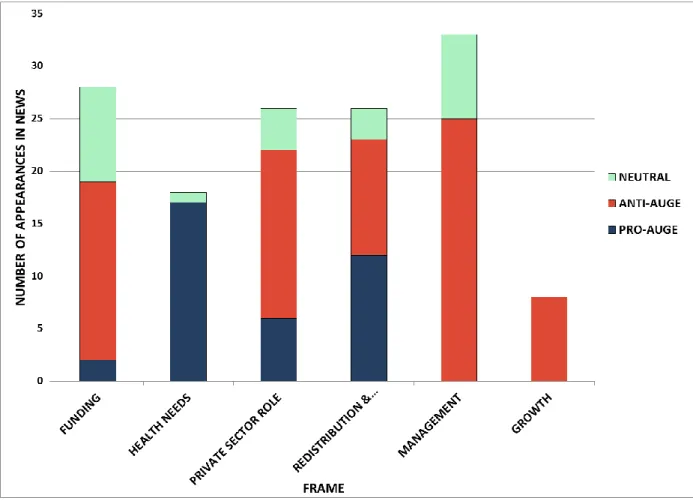
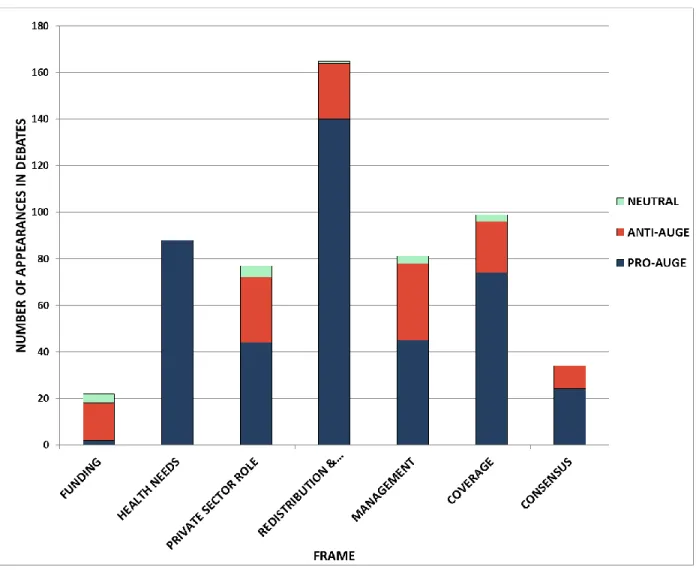
Second, the distribution of frames in news stories has a more even spread, whereas the floor debates emphasize those frames related to the proposed benefits of AUGE (health benefits, redistribution and equity, and coverage) the most.
Finally, whereas the most prominent frames that media used to cover the proposal was management, redistribution and equity was the most prominent frame used by legislators. News
stories made an emphasis on the inability of government to efficiently manage public resources. According to several stories, a clear sign of inefficiency was the scarcity of technology,
hospitals, and physicians in the public health sector, which in turn would make the
24
25
Figure 2: Number of paragraphs in floor debates for each frame that were coded pro, anti, or neutral
ii. Debate and Policy Choice in Chile
26
and PRSD introduced the change. There was agreement that funds from the public sector should not be transferred to the private one since it was the source of inequity due to risk discrimination.
On the floor, the bill was discussed and approved with 89 votes in favor and the abstention of Congresswoman Lily Pérez from National Renewal (RN), one of the right-wing parties that composed the opposition coalition, Alianza por Chile. In January 2003 a second floor debate took place, Specific Discussion, where each individual article of the bill was discussed and voted on. The right-wing parties Independent Democratic Union (UDI) and National Renewal (RN) voted against 11 articles of the bill. Most of them referred to the creation of the Solidarity Fund and the Maternity Fund, which would cover maternity leave with resources from members of the public and private sector. However, with the votes of the members of the
incumbent Concertación all the articles were approved, which meant that the funds were maintained.
AUGE was sent to discussion in the Senate committees. However, the Concertación government asked the Health Committee to eliminate the articles regarding the Maternity Fund. Osvaldo Artaza, Minister of Health during the time, stated during the first hearing that: “with the goal of generating broader political agreements, which can make the reform viable… the articles
that referred to the Maternity Fund were eliminated”.
27
resort to the public sector because their costs would be lower than if affiliated to a private sector entity. In that context, the government decided that the Solidarity Fund should be removed from the proposal since there was no agreement over it with the right parties and their support was important in order to pass the floor vote in the Senate11.
During floor debate, Senator Mariano Ruiz-Esquide (PDC), President of the Health Committee, explained that through the political agreement reached between Alianza and Concertación Senators it was decided to eliminate the Solidarity Fund and substitute it for a universal premium (prima universal) that would be taken from the current premiums of affiliates to the public and private sectors, with the exception of groups A and B from FONASA12. The Senate approved the reformed AUGE in General Discussion with 42 votes in favor and one vote against from Senator Nelson Ávila (PPD), who argued that the Solidarity Fund was the core of the project.
AUGE returned to the floor at the Chamber of Deputies in August of 2004 to be discussed and voted on the amendments made by the Senate. The elimination of the Solidarity Fund was approved with 75 votes in favor, 8 against, and 26 abstentions. The abstentions came from PS, PPD, and PRSD, whereas the votes against came from PPD members, and two PDC members (Cornejo and Saffirio). According to Pribble (2013), such layout can be explained since many legislators were convinced that, although equity-enhancing, the fund was not an essential financial pillar of the reform. Nevertheless, several Concertación members showed their
11 The Senate was composed by 38 members: 20 from Concertación, of which 13 were from PDC, 5 from PS, and 2
from PPD), and 16 from Alianza, with 9 UDI members and 7 RN members. Moreover, there were 2 independents (Matthei and Arancibia) that usually leaned with Alianza.
12 FONASA would cover the total value of their universal premiums for poor people and people with an monthly
28
discontent with the elimination of the Fund. On the other side, members of Alianza manifested their dissatisfaction with the fact that groups A and B from FONASA would have their universal premiums completely covered.
We can observe these opposing dynamics through the systematic analysis of floor debates carried out for this paper. As mentioned in the previous section, redistribution and equity was the most prominent frame used by legislators. Nevertheless, as Figure 2 shows, within this frame, both arguments pro- and anti-AUGE were used. The partition came from the left-right division within Congress. Figures 3 and 4 show the distribution of frames used by the incumbent, Concertación, and the opposition, Alianza.
Whereas the redistribution and equity frame was always used as an argument in favor of the reform by members of the left-wing coalition, this frame was mainly used as an argument against AUGE by Alianza.Along with their programmatic alignments, several legislators from UDI and RN argued that people who can afford attention in the private sector do not need to be responsible for those who cannot afford to do so. Also, that the creation of the Solidarity Fund was unconstitutional since it was an assault against private property. It is important to notice that the majority of the pro-AUGE arguments on redistribution and equity from Alianza (12 out of 14) are from the three last debates when the Solidarity Fund and the Maternity Funds were already eliminated. Then, these legislators emphasized that AUGE was going to put an end to the inequality of services between poor and rich since everyone would be guaranteed the coverage of the 56 selected diseases.
29
mismanagement of resources in the public health sector, where the scarcity of technology, hospitals, and physicians is a clear sign of the inability to allocate resources properly. In general, the right-wing parties argued that AUGE ran the risk of being a failure since the government was incapable. However, it is important to point out that the members of the opposition were not the only ones addressing the management problem in the government. Concertación also uses the frame, but in this case in favor of the reform. The coalition in government acknowledges the problem and the need for a better handling of resources. Turning it to their side, they argue that the reform will solve the problem.
Finally, the role of the private sector is clearly a source of tension between Concertación and Alianza. Left-wing legislators argue that the private ISAPRES only care about their own profit leaving aside the health of Chileans, and that they need to be regulated due to the
30
31
Figure 4: Number of paragraphs in floor debates for each frame used by Alianza members
The process of decision making that AUGE went through reflects the impact of the presence of programmatic political parties. First, at the party level, we can observe that the members of Concertación backed President Lagos’ agenda to enact AUGE as it was in line with their shared ideological commitments to provide universal access to quality health services. Moreover, they legislated along the ideological guidelines that defined the coalition,
32
mechanisms and defended the private sector’s interests. As Pribble (2013) suggests, the commitments of the right, especially UDI, were strengthened when the interest of the private sector were at stake.
Previous studies (Dávila 2005, Pribble 2013) have emphasized the lack of discipline of some Concertación members, especially from PDC, since they opposed the creation of the Solidarity Fund, or in any case, did not vote against the modification to eliminate it. However, the analysis of hearings and floor debates does not show that trend. First of all, Senators Boeninger and Ruiz Esquide from PDC and Viera Gallo from PS voted in favor of the articles that referred to the fund in the Health Committee13. Moreover, it can be argued that if some Deputies voted in favor of the modification or abstained, it was because the government (President Lagos and the Minister of Health) had already decided to remove the fund from the proposal since it caused great conflict with the opposition parties. The coalition in government was looking to pass a reform with broad consensus. Speeches made by Concertación members during the debates, including the Ministry of Health (PDC), show that they were looking to get Alianza on board and make it clear that the reform was being approved by –and thus would be the responsibility of- both coalitions.
Second, at the party system level, both opposition and government followed their programmatic guidelines, which propelled an intense deliberative process since the parties promoted and pushed for the consideration of their commitments. Conflict was high, and
together with the different stages that a policy has to go through in Chile’s bicameral legislature, the debate went for a total of two years.
33
The final policy choice was not entirely what the left wanted since the redistribution mechanisms of the original proposal were rejected; neither was the policy completely what the right wanted because a universal premium was still going to be taken from the contribution of ISAPRES’ affiliates. However, AUGE had clear definitions and viable objectives which, as will
be discussed later, had important implications for its further implementation.
iii. Debate and Policy Choice in Peru
In December 2008, the Health Committee in Congress voted on and unanimously approved a bill that essentially referred to the bill developed by APRA the year before, which proposed a
regulatory framework of universal health insurance (AUS). The bill included the Essential Plan for Health Insurance (PEAS), a set of benefits and guarantees of health services that all citizens would have access to for a prioritized list of diseases, under the public and private sector. The votes in favor came from 4 APRA members, including the President of the Committee (Luis Wilson), 2 members of the right-wing party National Solidarity (Solidaridad Nacional), a legislator from Fujimorista Party14, and an independent legislator15. The three members of the left-wing Nationalist Party were not present, neither was the member of the left-wing Union for Peru (UPP)16.
Exactly a week after, President García sent a bill to Congress, which was almost an exact copy of the bill issued by the Health Committee. This bill was not assigned to any committee in Congress but was attached to the Health Committee bill and sent directly to floor debate. During
14
A personalistic party created around the figure of ex-President and dictator Alberto Fujimori.
15 Margarita Sucari was elected as a member of Partido Nacionalista and then became independent.
16 The Nationalist Sumire and UPP’s Escudero had official permission to be absent due to travel and health
34
floor debate, Nationalist Congressman Víctor Mayorga (President of the Social Security
Committee) shows his disapproval for this violation of congressional regulations. The President of the Health Committee, Luis Wilson (APRA), responds to this complaint arguing that the Executive sent this very similar proposal to make it clear that they supported AUS. Therefore, it made sense to attach the executive bill to the one approved by the committee.
In March of 2009, AUS is discussed on the floor. The bill was approved with 62 votes in favor, 21 against, and 1 abstention. The votes in favor came from the center-right APRA, the right-wing parties National Unity, National Solidarity, and the Fujimorista Party, the left-wing party Union for Peru (UPP), and 5 independent congressmen. The votes against AUS came from the Nationalist Party, and 3 congressmen from center parties17. Congressman Juan D. Perry (National Solidarity) abstained.
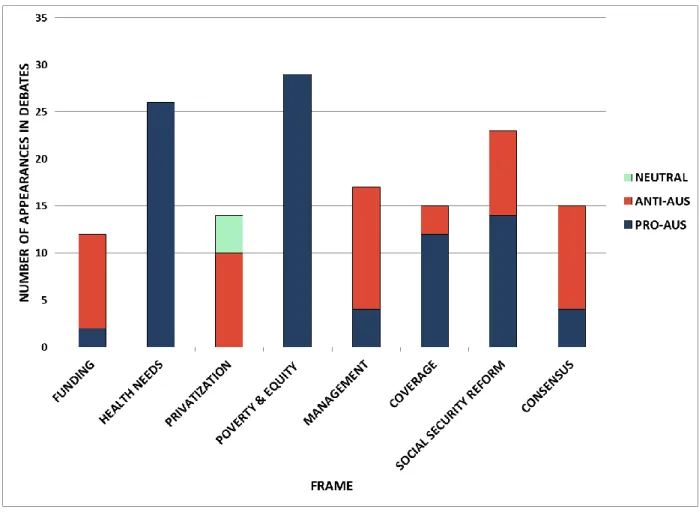
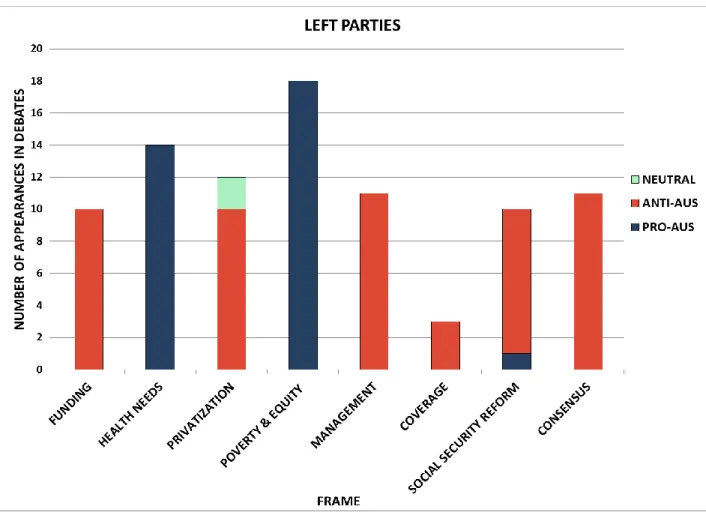
A systematic analysis of the floor debates in the Peruvian Congress show the main dynamics between parties. In the first place, in contrast to the debate in Chile, there was no debate about redistribution, neither between the rich and the poor nor between those with low and high risks. Nevertheless, as Figure 5 shows, poverty and equity was the most prominent frame in the debates. There was consensus across parties about the need for universal health insurance in order to give access to quality health services to poor people. AUS established that the coverage would be completely free for the poor and extreme poor.
17 Yonhy Lescano and Víctor A. García Belaúnde from Popular Action (Acción Popular) and Carlos Bruce from
35
Figure 5: Number of paragraphs in floor debates for each frame that were coded pro, anti, or neutral
36
private sector. Although this argument was emphasized a lot, especially by members of the Nationalist Party, none of them developed the logic behind it. Moreover, it was argued that the reform would not address the core problem of lack of resources, such as hospitals, physicians, and medicines, as well as the governmental inefficiency to manage public resources.
37
38
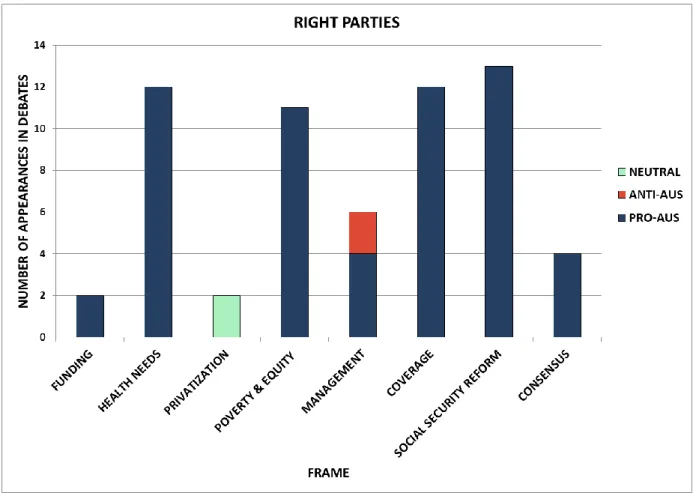
Figure 7: Number of paragraphs in floor debates for each frame used by left-wing party members
39
not an exception and its 24 members (the biggest group in Congress) voted in favor. APRA members followed García’s direction even if that meant the support for a very shallow bill.
The opposition parties, UPP and the Nationalist Party failed to contend the policy
proposal in a clear manner. They accused AUS of intending to privatize the health system but did not explain how. Also, one of their main arguments against AUS was that a broader reform that would include pensions and occupational hazards was better, which did not really oppose the proposal per se. Unexpectedly, when the proposal was voted on at the floor, UPP stepped to the side and decided to support AUS and vote in favor.
The low levels of programmatic competition present in the Peruvian Congress
discouraged the development of an exhaustive debate. APRA was interested in the approval of a reform that was poorly defined, the left-wing parties were not able to provide clear arguments against the bill, and the other right-wing parties were nearly absent during the debates. Other than APRA members, only one legislator from National Solidarity, a member of the Health Committee, was active in the debate. We could argue that the right-wing parties did not
participate because they perceived that the passage of the bill did not represent a concern since it was not going to make any major change, but a possible source of popularity.
40
VI. Implementation
The process of policy decision making of the health reform proposals in Chile and Peru had important implications for the implementation of the reforms in each country. Two main aspects are central to the comparison of the consequences of the presence of strongly programmatic parties versus weakly programmatic parties and their final policy choice.
First, both reforms considered a prioritized list of diseases that would be covered for timely and quality services. In the case of Chile, AUGE established that it would be 56 illnesses that according to the studies developed by the Ministry of Health were responsible for the majority of health problems of the population. In Peru, AUS did not establish a number but stated that the Ministry of Health would be in charge of determining which diseases the Essential Plan for Health Insurance (PEAS) would cover after the approval of the law. Moreover, both the Chilean and Peruvian proposals for universal coverage established that the list would be
evaluated every two years in order to progressively include more diseases that, according to epidemiological studies, were a priority to cover.
In Chile, AUGE has been implemented and is enforced at every public and private facility. As the norm established, the diseases covered by AUGE are considered every two years. According to Pribble, this “provides the Chilean state with an effective tool for responding to changes in the epidemiological profile of the country, thus ensuring that guarantees respond to the health care needs of citizens” (2013: 56)
41
from the Ministry of Health and the National Institute of Health (Instituto Nacional de Salud), PEAS is an excess, offering more than the system is able to provide (Personal Interview). Moreover, a current executive at the Ministry of Health stated that the García Administration rushed to approve a list of prioritized diseases and the respective services, which both the public and private sector were bound to fulfill, that “does not match reality” (Personal Interview)18
. According to both executives, now it would be politically costly for the current Minister to reduce the plan. As the Executive Director of one of the hospitals run by the Ministry of Health confirmed, PEAS is simply not enforced (Personal Interview). Further, the list, contrary to what the AUS law says, has not been revised since 2009.
Second, Chile and Peru shared a central commonality at the time that their reforms were introduced: the precariousness of their public health system, which the majority of citizens used, in terms of lack of infrastructure and human resources that caused long waiting lists. The few who could afford to resort to the private sector had to keep up with the high costs of services and discrimination due to gender and age. Both AUGE and AUS were looking to reach equity in the health system, to get over the segmentation of the system and ensure quality of health services for all their citizens regardless of their incomes.
In Chile, the reform has guaranteed timely and quality services for, as of today, 80 different diseases19, in the public FONASA and the private ISAPRES. Therefore, great progress has been made in terms of generating equity of coverage and services across systems (Pribble
18 In a personal interview, an APRA member stated that “there was no time to do it properly… he [García] was
leaving office.”
42
2013). The long waiting lists and high costs in the private sector were alleviated for, as of today, 80 diseases included in the plan.
In Peru, although the public and private sectors are legally required to comply with PEAS, as previously discussed, there is no enforcement. Currently, both public and private facilities provide the guarantees specified by PEAS as their resources allow them to do so. The main problem in the public sector is that, although AUS established that the poor and extreme poor would not pay for health services, the issue of out of pocket expenses remains. The Executive Director of one of the hospitals run by the Ministry of Health explained that people still needs to pay for medicines since the drugstores in the public health facilities often do not have them (Personal Interview). Moreover, the problem of lack of infrastructure and physicians persist, causing long waiting lists, which continues to force people –who can afford it- to resort to the private sector although most struggle to afford their high costs.
In a personal interview, an APRA member who manifested his concern about the poor implementation of AUS expressed: “how do you launch universal insurance without having the elements to implement them?” When asked whether that was not the responsibility of the whole
party since it was them who promoted and passed the law, he said: “No, the law is good… the problem was in the planning and implementation of it.”(Personal Interview)
43
As of today, whereas AUGE has had important effects on the quality of services Chileans have in the public and private sectors; in Peru, the segmented system persists, causing serious problems of quality in the services provided and inequality between the poor and the wealthier citizens. The final policy output in each of the countries this paper analyzed had different impacts from the level of technical development of the reform.
Conclusions
Research on the development of universal health policy in Latin American countries has focused on countries with strong political parties of the left who were the leaders of reforms that aimed at the universalization of the distribution of health services to their populations, such as Chile, Uruguay, and Costa Rica. Moreover, the political parties in these countries show strong programmatic commitments to their party programs. Nevertheless, there is a pending research agenda in the study of universal health reform in countries without strongly programmatic left-wing parties, and in which parties of the center-right have led the reform, such as Peru,
Colombia, and Mexico.
44
This paper compared the cases of Chile and Peru. Both countries enacted reforms, in 2004 and 2009 respectively, that looked to overcome inequity in the health system caused due to the segmentation between public and private sector, and ensure quality health services for all their citizens. Nonetheless, the process of policymaking that AUGE in Chile and AUS in Peru went through and their final policy choices were very different.
In Chile, there was a strong coalition involved in the reform, with President Ricardo Lagos at its head.Formed by center and left-wing parties, Concertación promoted a reform that was in line with their programmatic commitments. A systematic analysis of the floor debates shows that its members legislated along the ideological guidelines that defined the coalition, emphasizing the need for redistribution and equity in the health system, as well as pointing out the responsibility of the private sector for the existing inequity. Conversely, in Peru, the weakly programmatic center-right party in government, APRA, and its leader Alan García, promoted a poorly defined bill. President García did not have any programmatic commitment to universal health care, but saw an opportunity to increase his own popularity.
45
privatize the health system but did not explain how. Further, when the proposal was voted on, UPP voted in favor. The low levels of programmatic competition present in the Peruvian Congress discouraged the development of an exhaustive debate.
The final policy passed in Chile had clear definitions and viable objectives which had important implications for its further implementation, and ultimately had great effects on the generation of equity regarding access to and quality of health services. In Peru, Congress approved a policy that did not specify which and what number of diseases would be covered neither how it would be funded over time. As of today, the effects of AUS in the unequal health system in Peru have been limited. The process of implementation of a policy is not isolated from the debates and decisions that lead to it.
The programmatic nature of parties has an impact on both the process of policymaking and the final policy choices. When it comes to health policy, good policy outputs, which are formulated to and extend better heath to significant numbers of people, are favored by the presence of programmatic parties of the left and center-left.
46
47
REFERENCES
Aldrich, John. 1995. Why parties? Chicago: Chicago University Press.
Bachrach, Peter, and Morton S. Baratz. 1962. Two Faces of Power. American Political Science Review 56 (4): 947-952.
Baumgartner, Frank R., and Bryan D. Jones. 2009. Agendas and Instability in American Politics. Chicago: University of Chicago Press.
Blais, André, Donald Blake, and Stéphane Dion, S. 1996. Do parties make a difference? A Reappraisal. American Political Science Review 40 (2): 514-520.
Castles, Francis G. 1982. The Impact of Parties: Politics and Policies in Democratic Capitalist States. London: Sage Publications.
Chong, Dennis, and James N. Druckman. 2007. Framing Theory. Annual Review of Political Science 10 (June): 103–26.
Clark, Mary A. 2004. “Reinforcing a Public System: Health Sector Reform in Costa Rica.” In Robert R. Kaufman and Joan M. Nelson, eds. Crucial Needs, Weak Incentives: Social Sector Reform, Democratization, and Globalization in Latin America. Baltimore: Woodrow Wilson Center and the Johns Hopkins University Press.
Cox, Gary W., and Mathew D. McCubbins. 2001. The Institutional Determinants of Economic Policy Outcomes. In Stephan Haggard and Mathew D. McCubbins, eds. Presidents, Parliaments, and Policy. New York: Cambridge University Press.
Dávila, Mireya. 2005. "Health Reform in Contemporary Chile: Does Politics Matter?" M.A. Thesis, University of North Carolina at Chapel Hill.
Druckman, James N. 2001. On the Limits of Framing Effects: Who Can Frame? Journal of Politics 63 (4): 1041–66.
Edwards III, George C., and B. Dan Wood. 1999. The President, Congress and the Media. American Political Science Review 93 (June): 327–44.
Entman, Robert M. 2004. Projects of Power: Framing News, Public Opinion, and U.S. Foreign Policy. Chicago: University Chicago Press.
Entman, Robert M. 2007. Framing Bias: Media in the Distribution of Power. Journal of Communication 57 (March): 163–73.
48
Democratization, and Globalization in Latin America. Baltimore: Woodrow Wilson Center and the Johns Hopkins University Press.
Fridkin, Kim L., and Patrick J. Kenney. 2005. “Campaign frames: Can candidates influence media coverage?” In Karen Callaghan and Frauke Schnell, eds. Framing American Politics. Pittsburgh: University of Pittsburgh Press.
Huber, Evelyne, Jennifer Pribble, and John Stephens. 2010. “The Chilean Left in Power:
Achievements, Failures, and Omissions.” In Weyland, Kurt, Raúl L. Madrid, and Wendy Hunter, eds. Leftists Governments in Latin America. New York: Cambridge University Press.
Jones, Bryan D. and Frank Baumgartner. 2005. The Politics of Attention: How Governments Prioritizes Problems. Chicago: University of Chicago Press.
Kingdon, John. 2010. Agendas, Alternatives, and Public Policies. Longman Classics of Political Science.
Kitschelt, Herbert et al. 2010. Latin American Party Systems. Cambridge: Cambridge University Press.
Lagos, Ricardo. 1999. Programa de Gobierno Para Crecer con Igualdad. Santiago de Chile: Impresos Universitaria S.A.
Levitsky, Steven, and Lucan Way. 2010. Competitive Authoritarianism. Cambridge: Cambridge University Press.
Mainwaring, Scott, and Timothy R. Scully. 1995. Building Democratic Institutions: Party Systems in Latin America. Stanford: Stanford University Press.
Mainwaring, Scott, and Edurne Zoco. 2007. Secuencias políticas y estabilización de la
competencia partidista: volatilidad electoral en viejas y nuevas democracias. América Latina Hoy 46 (August), 147-171.
Morgenstern, Scott. 2004. Patterns of Legislative Politics. Roll-call voting in Latin America and the United States. New York: Cambridge University Press.
Pribble, Jennifer. 2013. Welfare and Party Politics in Latin America. New York: Cambridge University Press.
Pribble, Jennifer, and Evelyne Huber. 2011. “Social Policy and Redistribution: Chile and Uruguay”. In Steven Levitsky and Kenneth M. Roberts, eds, The Resurgence of the Latin American Left. Baltimore: Johns Hopkins University Press.
49
Sartori, Giovanni. 1976. Parties and Party Systems: A Framework for Analysis. New York: Cambridge University Press.
Tanaka, Martín. 2005. “Peru 1980-2000: Chronicle of a Death Foretold? Determinism, Political Decisions, and Open Outcomes”. In Frances Hagopian and Scott P. Mainwaring, eds. The Third Wave of Democratization in Latin America: Advances and Setbacks. Cambridge: Cambridge University Press.