DIVERSITY IN EXECUTIVE HEALTHCARE LEADERSHIP: DOES IT MATTER? PERSPECTIVES AND IMPLICATIONS FOR ACCESS TO CARE BY PEOPLE OF
COLOR
Reginald A. Silver, MBA
A dissertation submitted to the faculty of the University of North Carolina at Chapel Hill in partial fulfillment of the requirements for the degree of Doctor of Public Health (DrPH) in
the Department of Health Policy and Management in the School of Public Health.
Chapel Hill 2013
Approved by:
Ned Brooks, DrPH
Sandra Greene, DrPH
Suzanne Havala Hobbs, DrPH
Michel Landry, BScPT, PhD
(c) 2013
Abstract
REGINALD A. SILVER: Diversity in Executive Healthcare Leadership: Does it Matter? Perspectives and Implications for Access to Care by People of Color
(Under the direction of Ned Brooks, DrPH)
One third of the U. S. population belongs to an ethnic group other than non-Hispanic
White and that population is growing increasingly diverse. People of color are increasingly
accessing healthcare services, yet they represent less than one percent of healthcare
leadership.
The primary purpose of this study is to address two key research questions:
1. What are the opinions and perceptions of White healthcare executives and executives of color regarding the race of healthcare executives and how it may affect access to care for people of color?
2. To what extent do White healthcare executives and healthcare executives of color vary in their opinions about how to improve access to healthcare for people of color?
This research is based on qualitative data obtained from interviews of key informants
who are healthcare leaders in North Carolina and South Carolina. Informants were selected
using a convenience sampling strategy. They were asked about their perspectives on the
representation of people of color in executive healthcare leadership; what prevents people of
color from obtaining senior leadership roles in greater numbers; and how the absence of
people of color in senior leadership roles impacts access to healthcare services for people of
There was acknowledgement from informants that people of color are
underrepresented in the most senior level healthcare leadership roles. Informants perceived
that racial diversity on the executive leadership team can have a positive influence on access
to healthcare by people of color. Informants believe that the race of healthcare executives
can impact access to care by people of color. There is a prevailing perception among
informants that the best way to improve access for people of color is through increased
cultural competency.
There is congruity between elements highlighted in existing literature and responses
from key informants about racial diversity, cultural competency, and the impact that diversity
in executive healthcare leadership can have on access to healthcare by people of color. A
number of strategies are presented to promote diversity in executive healthcare leadership as
Dedication
To Alvin and Glendora for putting me on the path
To Felicia for walking this path with me
To Alan for continuing to shine a light on the path
Acknowledgements
There are times when instead of finding the work we are searching for, the work that
we are meant to do finds us. A better understanding of the phenomena associated with
diversity in executive healthcare leadership has become nearly as much a personal pursuit for
me as it has been an academic pursuit. As an engineering undergrad, I thought my
dissertation would have something to do with an operational issue like emergency
department overcrowding. Instead of studying management issues, this path has led me to
writing a dissertation on a leadership topic that is an important issue of our time and, as
indicated by the review of existing literature on the subject, an issue that is still understudied.
I am thankful for having had the opportunity to be accepted into a program which has
provided me with the tools to better understand my evolution as a healthcare executive over
the past sixteen years. The moments of success and the moments of frustration are much
better understood now looking back retrospectively with the knowledge that I’ve gained from
this journey. A better understanding of self, leads to a better understanding of the world
around you.
I extend gratitude to my dissertation committee chair, Dr. Ned Brooks for his insight,
guidance, and support to the study of a topic that has been controversial and understudied. I
would also like to give a heartfelt “thank you” to the other members of my dissertation
Thomas Ricketts. I thank each of you for the support that you have given to me and to this
work.
This work would have not been possible without the never-ending support of my
family. I thank each of you for your support and encouragement during the long days and
short nights. This research study is as much yours as it is mine. You were the inspiration and
I was simply the scribe.
I would like to thank the key informants who gave me time out of their busy
schedules to answer the interview questions written for this study. Without their participation
and candor, this research project would not have been possible.
Table of Contents
...
List of Figures x
...
List of Abbreviations xii
...
Chapter 1: Background 1
...
Research Questions 5
...
Objectives 6
...
Chapter 2: Literature Review 7
...
Cultural Competency 16
...
The Middle Management Plateau 23
...
The Importance of Mentoring 24
...
Synthesis 25
...
Conceptual Framework: Diversity and Cultural Competence 27
...
Limitations of the Literature Review 30
...
Significance of the Issue 31
...
Implications for Future Research 33
...
Timeliness of the Issue 35
...
Chapter 3: Methods 39
...
Project Timeline 50
...
Chapter 4: Results 51
... The Impact of the Level of Diversity on Access to Care (Research Question 1) 56
...
... Perspectives on Solving Healthcare Disparities (Research Question 2) 63
...
Key Informant Career Paths 68
...
Current Role Attainment 70
...
Professional Societies and Civic Groups 74
...
Mentoring 75
...
Views on the Selection Process 76
...
Healthcare Executive of Color Representation 77
...
Career Attainment Barriers 79
...
Chapter 5: Discussion 90
...
Chapter 6: Implementation Plan 96
...
Recommendations 101
...
Appendix 1: First Medline Search Results 118
...
Appendix 2: Second Medline Search Results 119
...
Appendix 3: EBSCO Business Health Search Results 121
... Appendix 4: Introductory Email to Potential Key Informants 122
...
Appendix 5: Telephone Script to Obtain Verbal Consent 123
... Appendix 6: Key Informant Interview Questions for Healthcare Executives 125
...
List of Figures
Figure 1. - Population Distribution Estimates by Race... 1
... Figure 2. - Illustration of Literature Review Methodology 8 Figure 3. - Summary of Articles With Highest Relevance...16
Figure 4. - Dreachslin's Five Step Process for Organizational Transformation...19
Figure 5. - Summary of Betancourt's Constructs...26
Figure 6. - Conceptual Model: Diversity and Cultural Competence ...28
Figure 7. - Comparison of Uninsured Rates Among Major Racial Groups...32
Figure 8. - Flow Diagram for Data Collection Methodology ...39
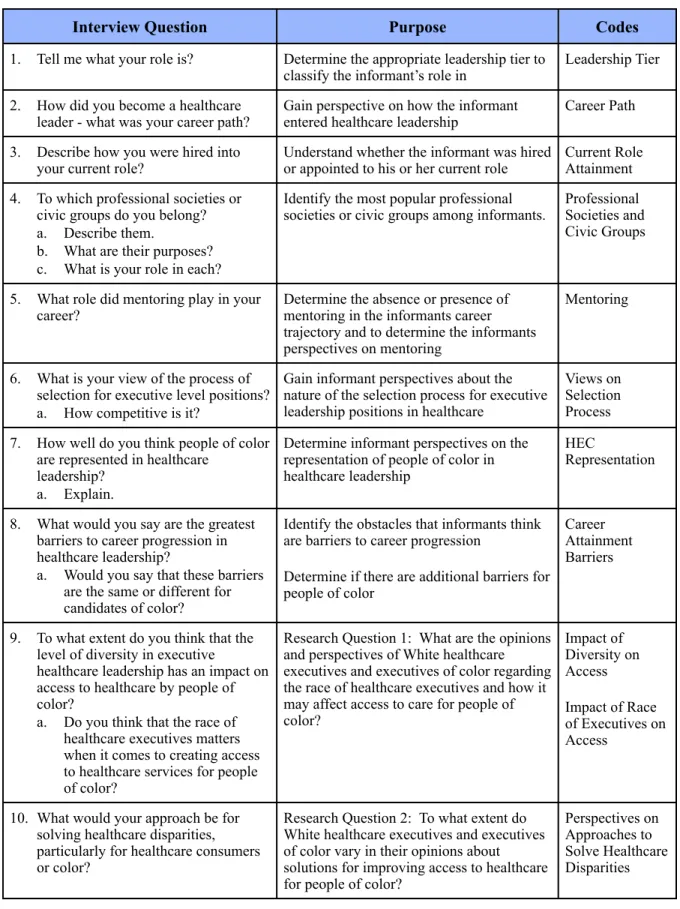
Figure 9. - Interview Question Design and Codes...46
Figure 10. - Code Browser Matrix...48
Figure 11. - Key Informant Classifications...49
Figure 12. - Project Timeline ...50
Figure 13. - Details of Non-Respondents ...52
Figure 14. - Key Informant Descriptive Data ...54
Figure 15. - Solutions to Solving Disparities by Key Informant Subgroup ...66
Figure 16. - Points of Entry into Healthcare Leadership ...69
Figure 17. - Code Theory Model of Healthcare Executive Career Progression ...71
Figure 18. - Code Co-Occurrence Model for Unofficial Networks...72
Figure 19. - Code Relations Diagram for Unoffical Networks...73
Figure 20. - Summary of Bias vs. Competition Responses in Selection Process ...77
List of Figures Continued
Figure 22. - Aggregate Code-Subcode-Segments Model for Career Attainment Barriers ...84
Figure 23. - WHE Code-Subcode-Segments Model for Career Attainment Barriers...85
Figure 24. - HEC Code-Subcode-Segments Model for Career Attainment Barriers...86
Figure 25. - Conceptual Model of Tactics to Impact Access through Diversity...97
Figure 26. - Recommendations to Improve Diversity and Cultural Competency ...102
Figure 27. - Kotter's Eight Step Model for Transformation...104
...
List of Abbreviations
ACHE American College of Healthcare Executives
AHEC Area Health Education Center
CEO Chief Executive Officer
CIO Chief Information Officer
CMO Chief Medical Officer
COO Chief Operating Officer
DrPH Doctor of Public Health
HEC Healthcare Executive of Color
IFD Institute for Diversity in Health Management
IOM Institute of Medicine
IRB Institutional Review Board
MPH Master of Public Health
NAHSE National Association of Health Services Executives
NCHCAP North Carolina Health Careers Access Program
OMH Office of Minority Health
Chapter 1: Background
The American population is growing increasingly diverse. The U. S. Census Bureau
has reported that approximately twenty eight percent of the U. S. population belongs to an
ethnic group other than non-Hispanic White [1].
Between 2000 and 2010, the fastest growth occurred in the Asian population (43.3%)
and the Hispanic population (43.0%). The growth rate for Native Hawaiian and other Pacific
Islanders was the third highest (35.4%). There was an eighteen percent increase in the
American Indian and Alaskan Native population. The population increase among African
Americans was approximately twelve percent. The lowest percent change in population
occurred among Whites (5.7%). It is expected that this population shift will continue [2, 3].
The percentage distribution of the major racial groups is expected to follow these trends for
the next forty years (Figure 1).
Figure 1. - Population Distribution Estimates by Race Racial Group Percentage of
Population in 2000 Population in 2010Percentage of Projected Percentage of Population in 2050 White
Hispanic
Black or African American Asian
American Indian and Alaska Native
Native Hawaiian and Other Pacific Islander
75.10% 72.40% 74.00%
12.50% 16.30% 30.20%
12.30% 12.60% 13.00%
3.60% 4.80% 7.80%
0.90% 0.90% 1.20%
0.10% 0.20% 0.30%
It is estimated that by 2050, the White population will make up a smaller percentage
of the population than it does today. There will be explosive growth among Hispanics and
other people of color.
There are two dynamic features of this population shift. The American population is
growing larger and it is becoming increasingly diverse at the same time. However, this trend
does not hold true in the administrative suites and boardrooms of healthcare organizations
across America [4]. There has not been an equally dramatic increase in racial diversity
within executive healthcare leadership roles. While the population continues to change, the
racial composition of the leadership teams of governing bodies and policy-making entities
remains predominantly male and predominantly White. This is true at almost every layer of
the leadership strata. Executives of color are underrepresented in the c-level positions such
as chief executive officer (CEO), chief operating officer (COO), chief information officer
(CIO), and chief medical officer (CMO). Executives of color are also underrepresented in
other healthcare executive leadership positions such as vice presidents, directors, and
managers [5].
Although Asians, African Americans, and Hispanics comprise almost 30% of the
population, they comprise less than 1% of the healthcare executive roles in the country [4].
A 2006 survey by Witt/Kieffer, a healthcare executive search firm, and Ohio State
University’s School of Public Health revealed that of 844 health system CEOs, 84% were
male and 96% were White [6]. There is also divergence between the diversity of healthcare
executives and healthcare consumers as it relates to gender. The majority of healthcare
pointed out that 75% of all healthcare purchasing decisions at the consumer level are made
by women [7].
One of the premises of this research study is that the phenomenon of a high rate of
increasing diversity in the American population and a slower rate of increasing diversity in
executive healthcare leadership provides an opportunity to assess whether current healthcare
leadership composition matches the needs of communities around the country. Specifically,
do White healthcare executives view access to healthcare the same way as people of color?
For the purposes of this study, the terms ‘people of color’ or ‘executives of color’ will be
used to represent racial groups that have historically been viewed as minorities in the United
States. Racial groups represented by these descriptors include African Americans, Native
Americans, Asians, and all other racial groups that do not identify as being White.
The literature suggests that healthcare disparities exist between both racial and ethnic
subgroups even when controlling for insurance status, income, age and severity of medical
condition [8]. Could the underrepresentation of people of color in leadership roles within
healthcare be a contributing factor to the existence of healthcare disparities? This question is
based on a stream of thought that has emerged as it relates to the impact that the lack of
diversity in healthcare provider roles has had on the propagation of healthcare disparities. In
a briefing based on the US Institute of Medicine’s seminal report entitled “Unequal
Treatment”, Nelson, et al. describe the negative effects that healthcare provider prejudice and
bias can have on some patients1. In another report, Schulman, et al. demonstrated how
physicians were less likely to recommend cardiac catheterizations for African American
female patients who presented with identical symptoms as African American males, White
males, and White females [9]. The study by Schulman, et al. suggests that a lack of diversity
in healthcare provider roles can negatively impact the care that people of color receive by
way of provider bias or prejudice. Similarly, a lack of diversity in executive healthcare
leadership may be negatively impacting the care that people of color receive. This could be
manifested in the kinds of policy being written as it relates to access to care across ethnic
groups. The lack of diversity in executive healthcare leadership may also be contributing to
the slow rate at which progressive healthcare reform policies for improving access to
healthcare are being adopted. Healthcare leaders are a part of a representational community2 that can influence which interests are emphasized and put forward on a public platform [10].
The purpose of this study was to determine if there are differences between how
White executives and executives of color view healthcare access. If differences of
perspective exist between executives of color and White healthcare executives, then a case
may be built for increasing diversity in executive healthcare leadership because a better
understanding of the differences in perspective of White executives and executives of color
might help to better match healthcare policy with the needs of a population that is growing
increasingly diverse. Attempts at synchronization between policy and needs might result in
an accumulation of knowledge that can be applied to solving issues of healthcare disparities
and access.
Research Questions
This research study explored questions that speak to the rapidly increasing diversity
of the population and the disparate rate at which diversity in the executive suites of
healthcare organizations across the country has occurred. These questions are intended to
add to the body of knowledge concerning racial diversity in executive healthcare leadership
and how it may impact access to care for people of color. These questions may also lead to a
better understanding of the policy making process that governs access to healthcare for
people of color and how it is influenced by the homogeneity of decision-making groups.
These questions may help to explain why sustainable healthcare reform to improve access to
healthcare has been slow in arriving. One premise is that the rate of innovation has been
hindered because there has been little representation of people of color within the
decision-making bodies in healthcare. This might well explain why people of color continue to be
disproportionately uninsured as compared to their White counterparts [11].
The two guiding research questions in this study were:
1. What are the opinions and perceptions of White healthcare executives and executives of color regarding the race of healthcare executives and how it may affect access to care for people of color?
2. To what extent do White healthcare executives and healthcare executives of color vary in their opinions about solutions for improving access to healthcare for people of color?
Should this study reveal that White healthcare executives and executives of color vary
in their opinions about whether the race of healthcare executives matters in access to care by
people of color, there may be the possibility that policies and practices have been misaligned
finding would also prompt a deeper look into why White healthcare executives and
executives of color hold their respective opinions.
An equally important point is whether White executives and executives of color vary
in their opinions about solutions that would improve access to healthcare for people of color.
If it is determined that White executives and executives of color have very different views
about how to improve access to healthcare for people of color, findings from this study may
illustrate how some solutions for solving access issues may be missed if there is not a
convergence of ideas and perspectives between the two subgroups.
Objectives
The objectives of this study were to:
1. Determine if views about healthcare access for people of color differ based on a person’s ethnicity and position as a healthcare leader
2. Create awareness of the absence of diversity in healthcare leadership roles by collecting demographic data from a convenience sample of healthcare leaders in a geographically bounded region of the United States
3. Inform researchers, practitioners, and policymakers about the impact that diversity in executive leadership may have on access to healthcare
Chapter 2: Literature Review
Current literature on diversity in executive healthcare leadership roles is scarce.
Much of the literature that is available is limited to the publications of professional societies
such as the American College of Healthcare Executives (ACHE), the Institute for Diversity in
Health Management (IFD) or the National Association of Health Services Executives
(NAHSE) [12].
Other sources include healthcare trade journals that may or may not be peer reviewed.
One can find a number of articles or white papers authored by journalists or consultants on
the Internet. The scarcity of peer-reviewed literature on the subject illustrates the need for
further research into the impact that a lack of diversity in executive healthcare leadership
roles can have on access to care. Because of the scarcity of literature on diversity in
executive healthcare leadership, literature about diversity in the healthcare workforce must
often serve as a proxy. Parallels can be drawn from literature that illustrates how the
mismatch between population diversity and healthcare workforce diversity has been
demonstrated to impede the access to appropriate care by people of color.
The review of literature on the topic of diversity in executive healthcare leadership
Figure 2. - Illustration of Literature Review Methodology
The first source of literature utilized was a combination of PubMed and Google
Scholar. Search strings were used via Google Scholar as a means to rapidly search for
relevant publication titles. When identified, these titles were located using PubMed and
downloaded. The second and third sources of literature were Web of Science and a formal
literature review conducted by a librarian from the Charlotte Area Health Education Center
(AHEC).
Illustrating the scarcity of available literature on the subject, the search string
“diversity in executive healthcare leadership” returned only 12 entries on PubMed. Of these
12 entries, five were substantially relevant to diversity in executive healthcare leadership.
Multiple combinations of keywords and phrases were also used in an attempt to identify
existing literature. As is typical within this genre of literature, there is a tendency toward
focusing on the effects of diversity from the perspective of nursing or nursing leadership.
Although these articles were excluded from this research project, the articles do present
thematic constructs that are explored within this research project. The excluded literature
delves into the underrepresentation of people of color in the overall healthcare workforce, the
The inclusion criteria for this study limited articles to those that focused on diversity
as a descriptor for a person’s racial or ethnic group or gender (male or female). PubMed
articles that met the criteria for inclusion were reviewed to determine common themes.
When the search string “diversity in executive healthcare leadership” was used on
Google Scholar, a total of 35,400 results were returned. The high number of results returned
is misleading because the search engine behind Google Scholar focuses on each word in the
search string individually. Google scholar also focuses on open term searches which can
influence the results that are returned. This produces results for ‘diversity’, ‘executive’,
‘healthcare’ and ‘leadership’. Google Scholar offers the option to search the most recent
articles written. When this option is selected, the number of results returned is 16,300. Even
though this significantly reduces the number of results to review, finding articles specifically
about diversity in executive healthcare leadership is cumbersome. Articles that are retrieved
have to be assessed for duplication and degree of relevance.
The search process on Google Scholar is a direct contrast to the same algorithm one
would use on PubMed. PubMed will return a minimal number of results while Google
Scholar will return an overwhelming number of results. The search process becomes a
matter of using several permutations of the search string “diversity in executive healthcare
leadership”. Results are returned highlighting the key words ‘diversity’, ‘executive’,
‘healthcare’, and ‘leadership’. There are very few results returned that tie all four keywords
together. Results returned cover a broad spectrum of disciplines beyond the scope of
healthcare and beyond the scope of diversity and executive leadership as defined in this
Filtering the results for articles that have a high degree of relevance requires the
identification of central themes that are related to the topic of diversity in executive
leadership in healthcare. These themes are instrumental in not only categorizing available
literature, but as they emerged from this research study, they became a methodology by
which additional literature could be searched for and obtained. This type of relational search
yielded three major themes that serve as the lens through which the absence of diversity in
executive healthcare leadership roles could be viewed. The three major themes that will be
developed in subsequent sections of this dissertation are cultural competency, the middle
management plateau, and the importance of mentoring.
The third and final source of literature on diversity in executive healthcare leadership
was a formal literature review conducted by a librarian on staff at the Charlotte AHEC. The
librarian provided two searches in the Medline database and one search in the EBSCO
Business Health database. In each search, the key words “diversity in healthcare leadership”
were used. The librarian indicated that using additional search terms would have severely
limited the search results from both databases.
The initial librarian-assisted Medline search was limited to case reports and reviews
that spanned the time period from 1995 to 2011. There were 18 results found. Of these 18
results, only two entries bore relevance to the topic of diversity in executive healthcare
leadership (Appendix 1). The two relevant studies from this collection of literature were
authored by Dreachslin [13] and Motwani [14]. Dreachslin focuses on factors that affect the
level of career attainment by women and people with diverse racial or ethnic identities within
how to better attract and manage more diverse talent during a time when it was thought that
the genesis of a demographic shift in the workforce was taking place.
The second librarian-assisted Medline search spanned the time period from 2007 to
2011. The narrowed time parameter yielded 37 results. Of these 37 articles, 18 were
included in the review and analysis of literature (Appendix 2). From these 18 articles that
were considered for inclusion, three of them had already been cited previously in this
literature review. It is noteworthy that only in the last five years has there been a significant
increase in the amount of literature available on diversity in executive healthcare leadership.
The literature reviewed from this time period reinforces the major themes of cultural
competency, the middle management plateau, and the importance of mentoring. Klein adds
an additional level of significance to the impact that diversity can have on leadership. Her
study points out that discrimination in the workplace still exists. To improve this, there is a
need to understand both surface-level diversity (e.g., gender, race, ethnicity), and deep-level
diversity (e.g., personality, attitudes, and values). Klein argues that surface level diversity
may affect leadership opportunities, but deep-level diversity characteristics are the proper
gauge for measuring leadership effectiveness [15]. While the Klein article focuses more on
deep-level diversity, the brief acknowledgement that surface-level diversity could actually
play a part in the selection process for leadership opportunities supports one of the central
theories of this study. The current lack of diversity in executive healthcare leadership may be
at least in part attributable to hiring decision-makers selecting those that they are most
familiar with either through established relationships or through participation in social
There is a general sense from the literature that pursuing diversity within the ranks of
healthcare leadership teams is the right thing to do. This is countered, however, by the fact
that relatively few hospital CEO’s engage in any active planning process designed to improve
diversity and diversity management [16]. In order for this to change, organizational leaders,
including senior leaders must be fully invested in supporting diversity initiatives [16-19].
Developing a diverse and a culturally competent workforce should be an extension of
the human resource recruiting function. When individuals who possess linguistic diversity
are present in leadership positions, there is a significantly greater likelihood that they will
recruit others who speak a language other than English, have leadership teams comprised of
racially/ethnically diverse members, and there will be a close alignment with organizations
that provide support to diverse groups of people [20]. The literature suggests that there is an
implied link between linguistic competence and cultural competency. Services rendered to
ethnically diverse groups might be improved by building components of linguistic and
cultural competence into the curricula of healthcare management academic programs [21].
There is still a pervasive perception that there is a lack of diversity in executive
healthcare leadership roles because there is a lack of candidates of color from which to
recruit. In reality, people of color are being trained and developed but they are not
transitioning to leadership opportunities at the same rate as their White male counterparts.
The few candidates of color that do make the transition to leadership often do not stay [22].
This outmigration of talent may be partially explained by a lack of fully understanding the
impact that leaders have on teams. There is emerging support from the literature to suggest
that group diversity has on turnover. This is facilitated through the quality of the
relationships that leaders develop with group members [23].
An additional factor that may explain the underrepresentation of people of color in
executive healthcare leadership roles is applicable to leadership roles even beyond the scope
of just healthcare. The decision-makers who determine the selection of candidates remain
predominantly male and White. They may think differently about members of groups that
have traditionally had limited access to leadership roles, often viewing their ability to lead as
inferior. This would apply to women and members of minority groups based on race and
ethnicity [24]. There is a natural tendency for hiring decision-makers to gravitate
toward candidates that are most similar to themselves. Even when women and people of
color are successful in obtaining executive leadership roles, their accomplishments are often
devalued by the appraisers of their performance [25]. Both the non-selection of people of
color and the devaluation of their contributions could be explained by unconscious attitudes
toward racial and ethnic minorities, their leadership behavior, and the appraisals of their
abilities to function in leadership roles [26].
Executive healthcare leadership positions are no different from other executive
leadership positions in that they have been viewed and evaluated based on the contributions
of White men who have predominantly held these positions of leadership. Chin and
Sanchez-Hucles refer to this as the “great man” theory of leadership [27]. Perceptions about
what successful leadership is have historically been based on stereotypes associated with
White males. People of color and women who attempt take on leadership roles are often
As more attention has been called upon the underrepresentation of people of color in
executive healthcare leadership roles, there has been an emergence of models and methods to
understand the barriers that people of color face in obtaining executive leadership roles.
There is also a growing body of knowledge that looks at the effect that absence of people of
color in leadership roles may be having on the access to healthcare by people of color.
Initiatives such as the Institute for Diversity in Health Management’s certificate program for
diversity management in healthcare may be one way in which the representation of people of
color in leadership roles may be increased [28]. Certificate programs and other diversity
training opportunities made available to White executives and executives of color may
provide a rich learning exchange from which leaders and organizations can increase their
level of cultural competence.
The drivers that influence career attainment by people of color in the healthcare
setting are comprised of social influences and human capital aspects. The social influences
are comprised of widely shared attitudes, socioeconomic disparities and sociopolitical
context. The human capital aspects include education and experience. Social factors are
thought to be the more prevalent root cause as to why there is a career attainment barrier
between women and people of color as compared to their White male counterparts [29].
The EBSCO Business Health database search yielded six new results when the same
search terms were used (Appendix 3). Of these, two were relevant to the topic of diversity in
executive healthcare leadership. From these studies, an article written by Armada and
Hubbard reinforces three key points that were previously identified in this review of
this changing patient population are growing increasingly complex. Healthcare institutions
will be challenged with providing culturally competent care in much the same way that
Betancourt described organizational cultural competence, systemic cultural competence, and
clinical cultural competence [18].
The other relevant work identified from the EBSCO search was produced by Olsen
and presents an interview by an African American chief operating officer of Clarian Health.
The article presents chief operating officer’s account of having dealt with racial
discrimination while carrying out the duties of his executive healthcare leadership role. From
these accounts, Olsen goes on to provide advice to organizations on how to combat this type
of discrimination and promote diversity in leadership [30].
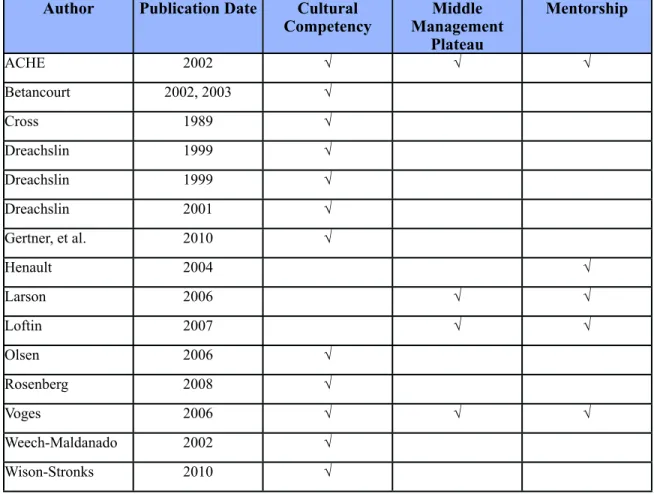
The three major themes that emerged from the review of literature are cultural
competency, the middle management plateau, and the importance of mentorship (Figure3).
Figure 3. - Summary of Articles With Highest Relevance Author Publication Date Cultural
Competency Management Middle Plateau
Mentorship
ACHE 2002 √ √ √
Betancourt 2002, 2003 √
Cross 1989 √
Dreachslin 1999 √
Dreachslin 1999 √
Dreachslin 2001 √
Gertner, et al. 2010 √
Henault 2004 √
Larson 2006 √ √
Loftin 2007 √ √
Olsen 2006 √
Rosenberg 2008 √
Voges 2006 √ √ √
Weech-Maldanado 2002 √
Wison-Stronks 2010 √
These themes were developed by reviewing each work and noting areas of
commonality. The state of existing literature appears to be focused to a higher degree on
cultural competency.
Cultural Competency
The Office of Minority Health (OMH) defines cultural competency as an ability to
assimilate linguistic, attitudinal, behavioral, and customary constructs across a number of
different cultures in such a way that the healthcare provider can function effectively in
meeting the needs of the healthcare consumer regardless of his or her ethnic background
[31]. The OMH definition is borrowed from what is considered to be the earliest and most
Georgetown University’s Childhood Development Center. Cross defines cultural
competence as a set of congruent behaviors, attitudes, and policies that come together in a
system, agency, or among professionals that enables that system, agency, or professionals to
work effectively in cross-cultural situations [32]. Olsen, et al. distill Cross’ definition of
cultural competence into simply the ability to work effectively across cultures [33].
One of the contemporary thought leaders on diversity in healthcare management and
cultural competency is Dreachslin. Dreachslin asserts that healthcare providers and
organizations are culturally competent when they can illustrate a high degree of knowledge
about other cultures and when they exhibit a high proficiency in communicating across
intercultural lines [34].
Weech-Maldanado, et al. suggest that healthcare providers are obligated to respond to
the demographic shifts in both the healthcare workforce and the patient population by
becoming culturally competent. By illustrating diversity management principles, healthcare
providers can improve employee and patient satisfaction while concurrently improving
intercultural communication and organizational performance. Weech-Maldanado, et al. also
assert that healthcare providers should become culturally competent as a means to improve
racial and ethnic disparities in access to care and healthcare outcomes [35].
Weech-Maldanado, et al. were only able to identify three prior studies on the subject when they
published their article on racial/ethnic diversity and cultural competency in 2002.
The relationship between cultural competency and diversity in executive healthcare
leadership is important because, as Betancourt suggests, a lack of diversity in healthcare
is a connection between cultural competence, quality improvement, and the elimination of
racial/ethnic disparities in care [36]. Taking Betancourt’s suggestion one step further, a high
degree of cultural competence vis-à-vis a high degree of diversity in executive healthcare
leadership roles may translate into improved outcomes such as improved access to healthcare
by people of color.
Conversely, Betancourt warns that a failure by healthcare providers to understand the
need for cultural competency could have a deleterious effect on people of color. Trust in the
healthcare system and in healthcare providers is already low among people of color,
particularly African Americans [37]. A low trust factor coupled with a low degree of cultural
competency on the part of the healthcare system and healthcare providers means that there
are serious barriers that prevent access to care for people of color.
Early on in the literature review, Dreachslin emerged as an authority on cultural
competency. As the literature review continued to develop, there were two important works
by Dreachslin that were found. In 1999, Dreachslin, et al. conducted a study on
communication patterns and group composition. The goal of that study was to determine the
effects that group diversity can have on communication patterns that in turn could have an
effect on patient-centered care teams. Dreachslin suggests that workforce demographics in
major metropolitan areas are strongly associated between roles in the patient care team and
race [38]. Dreachslin noted that African Americans were more likely to perceive that race is
a key component in communication breakdowns within patient care teams. Dreachslin also
noted that Whites more frequently perceived race as a non-issue in the breakdown of
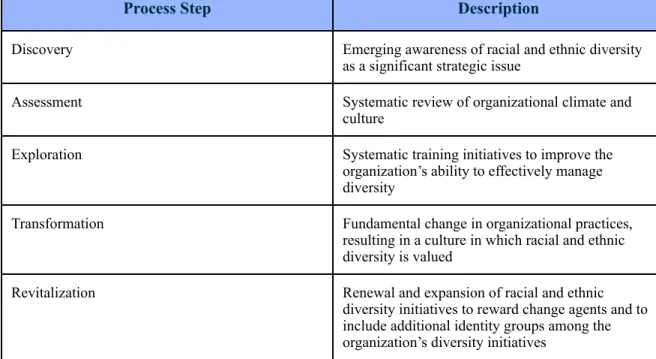
In a second study conducted in 1999, Dreachslin outlined a five step process by
which healthcare organizations could reposition themselves in their market space through
diversity leadership. The steps in Dreachslin’s model are Discovery, Assessment,
Exploration, Transformation, and Revitalization (Figure 4).
Figure 4. - Dreachslin’s Five Step Process for Organizational Transformation
Process Step Description
Discovery Emerging awareness of racial and ethnic diversity as a significant strategic issue
Assessment Systematic review of organizational climate and culture
Exploration Systematic training initiatives to improve the organization’s ability to effectively manage diversity
Transformation Fundamental change in organizational practices, resulting in a culture in which racial and ethnic diversity is valued
Revitalization Renewal and expansion of racial and ethnic diversity initiatives to reward change agents and to include additional identity groups among the organization’s diversity initiatives
In addition to developing a model that could be used as a differentiation strategy or
competitive advantage, Dreachslin informs the research community that cultural differences
that affect both the decisions that guide healthcare consumption and patient satisfaction are
strongly associated with race and ethnicity [39].
Gertner, et al. conducted a research study that complements Dreacshlin’s five-step
model. Gertner, et al. published a study that memorializes the transformative journey
undertaken by LeHigh Valley Health Network as a response to several macro-level
demographics and regulatory requirements to quality improvement initiatives and
requirements for accreditation programs. The health system held a strategic planning retreat
in which healthcare executives, physicians, other clinical staff, former patients and
community members participated. In this session, patients indicated that they felt their
cultural background, religious beliefs, and preferences for medical care were ignored or
dismissed during the provision of healthcare services [40]. Gertner identifies this event as
the spark that created the transformation that took place within the health system. The health
system leadership enacted a series of cultural awareness projects based on a strategic plan
that was developed as a direct result of the planning retreat.
Using Web of Science identified a commentary written by Rosenberg in 2008 that had
been missed early on in the literature review. The focus of Rosenberg’s commentary was the
lack of diversity in behavioral health leadership roles and how it impacted behavioral health
services, particularly for people of color [41]. Two points from Rosenberg are relevant to
this research study, 1) the population of behavioral health patients in the United States is
growing increasingly diverse and 2) this increase of diversity is not seen in behavioral health
leadership roles. These two points reflect two major premises of this current research study
in exploring how these two phenomena are occurring in the larger healthcare space outside of
behavioral health.
Rosenberg points out that there is disparity between how Whites and people of color
view the representation of people of color in behavioral health leadership roles. Rosenberg
cites the same 2006 Witt/Kieffer study that was cited by Vogues and referenced earlier in this
that people of color were well represented on healthcare management teams disagreed. A
significantly smaller percentage of White respondents disagreed. 59% of White respondents
disagreed with the statement that people of color are well represented on healthcare
management teams [42]. This finding suggests that there are differences between how
Whites and people of color view the representation of people of color in healthcare
leadership roles.
Other key findings from the Witt/Kieffer survey include perceptions between White
respondents and people of color regarding the availability of opportunities for diversity
leaders, reasons for committing to diversity recruiting, barriers to diversity recruitment,
retention, and leadership development. The responses from White respondents and people of
color remain considerably different when evaluated against these other criteria. White survey
participants responded more often with favorable perceptions about improvement in
opportunities for diversity leaders, the availability of diversity leadership positions and the
availability of diversity leadership positions within their own institutions. People of color
responded with consistently less favorable outlooks on each of these components of the
survey.
Divergent responses between White respondents and people of color occur
throughout the survey. A higher percentage of White respondents believed that diversity
recruiting is a means by which organizational goals can be met, 63% agreed versus the 47%
of people of color who agreed. Seventy percent of White respondents agreed with the notion
that organizations undertake recruiting of diverse candidates because cultural differences
they agreed. People of color were more likely to believe that barriers to diversity recruiting
include lack of commitment, organizational resistance, and individual resistance to placing
diversity candidates. White respondents were more likely to suggest that barriers to diversity
recruitment include lack of diversity candidates to promote from within, lack of access to
diversity candidates and, to a lesser degree, lack of commitment by top management.
Interestingly, the one facet of the study where responses from White respondents and
people of color converged has to do with how diversity recruiting can be improved. 81% of
White respondents and 80% of people of color who responded indicated that one way to
improve diversity recruiting is through mentoring. Recall that the importance of mentoring
was one of the three key themes that were developed in part one of this literature review.
The Witt/Kieffer study assessed the motivation behind why organizations undertake
diversity recruiting. A later study conducted by Wilson-Stronks, et al. raised the question of
what motivates hospitals to embrace cultural competence. This research question was
positioned from the perspective of CEOs. The CEOs from 60 hospitals across the United
States were interviewed. According to the results of these interviews, the main reason cited
as to why hospitals embrace cultural competence is that doing so was instrumental in
achieving the organizations’ missions or strategic plans [43]. Other, but less frequent,
motivating factors for embracing cultural competence included meeting patient needs, laws,
regulations, and to satisfy the requirements of external funding sources. The realization of
perceived tangential benefits such as improved quality of care, increased market share, cost
The Middle Management Plateau
In 2004, people of color comprised approximately 30% of the total number of
graduates from healthcare management masters programs [12]. While this might seem like a
significant increase in the number of potential candidates of color for executive roles, there
has not been a significant increase in the number of candidates of color who have obtained
roles above middle management. Voges notes that a number of employees of color with
seven to twelve years of experience are unable to get past the level of director. Because so
many employees of color become frustrated with not being able to transition from middle
management into a senior executive role, a number of them decide to change jobs or leave
healthcare altogether [6]. This might be one explanation why an increase in graduates of
color has not translated into an increase in executives of color.
One of the seminal works on the career level achievements by people of color is a
joint study that was conducted by ACHE and NAHSE in 1992. The purpose of the joint
study was to illustrate the inequity of career attainment between African American healthcare
executives and their White counterparts. The study was also developed with the intent of
identifying factors that contribute to disparate career attainment between the two subgroups.
As indicated in other studies, fewer African Americans held CEO positions or positions
reporting directly to the CEO. Additionally, African American executives were compensated
13% less than their White counterparts, their job satisfaction was reportedly lower than that
of their White counterparts, and African American executives tended to express less
satisfaction with fringe benefits, job security, and respect from their peers [44]. These
findings were noted even when levels of formal education between African American and
The study was replicated in 1997 and it was expanded to include Hispanic and Asian
healthcare executives. The 1997 study showed little improvement in career attainment for
people of color.
An additional factor that respondents suggested as an explanation as to why so many
people of color never make it beyond the middle management is because senior executives
perceive that if they promote a person of color, they assume a greater degree of risk than if
they promote a White candidate [44].
The Importance of Mentoring
Almost all of the literature reviewed in this research study highlights the importance
of mentoring as it relates to progression from the middle management plateau into a more
senior-level executive level role. There are two distinct ways in which mentoring is
referenced in the literature. When mentoring is present, it is referenced as a facilitating
mechanism that supports career progression. In situations where mentoring is not present, it
is referenced as a root cause as to why many people of color are not able to obtain executive
healthcare leadership roles. This dual reference is helpful in emphasizing how important
mentoring is in aiding healthcare organizations increase cultural competence.
Mentoring is often mentioned in conjunction with succession planning. Succession
planning appears to be poorly established among healthcare organizations. It appears to be
comprised of informal social networks and the historical “good old boy network”, suggesting
that career attainment is more predicated upon who a candidate knows instead of the
credentials and experience that a candidate may have. This may be partially explained, as
described by one respondent in the ACHE/NAHSE study, due to the differences in social
noted that White professionals seem to have an advantage when it comes to social networks
because they socialize where White executives socialize. The respondent noted that, by the
same reasoning, minority professionals are disadvantaged because they are less likely to
socialize in the places where White executives socialize. This creates a need for minority
professionals to have to work harder to obtain the visibility needed to garner increased
responsibilities [44].
Synthesis
The literature found during the literature search can be considered as a body of
complimentary works. These works introduce to the research community the phenomenon of
a population growing increasingly diverse while executive healthcare leadership roles are
not. The importance of mentoring surfaces as a critical component in removing barriers that
may be preventing people of color from attaining executive level positions. Conceptual
frameworks of workforce diversity and cultural competency emerge in a way that
organizations might become empowered to assess where they are at present state in relation
to both diversity and cultural competence. These additional studies bolster the linkage
between diversity and cultural competence. They also position both diversity and cultural
competency as constructs for healthcare organizations to meet the challenges of a changing
world and political landscape.
Of the three central themes that were identified in the literature review, cultural
competency appears to be the most widely studied. Based on the articles reviewed, cultural
competency appears to be inversely related to the middle management plateau, meaning
where there is a middle management plateau, there are low levels of cultural competency.
is present. In essence, a healthcare organization with a high degree of cultural competence
tends to have structured programs and processes to eliminate the middle management plateau
as the default level of maximum career attainment for executives of color. Such
organizations have formal mentoring programs for professionals of color to assume executive
leadership roles either by direct promotion or by promotion as a result of succession. These
things alone, however, are not enough to effectively position cultural competence as a
framework from which to improve access to healthcare for people of color.
In order to understand cultural competence as a framework to improve access to
healthcare by people of color, one must acknowledge that a lack of diversity or low degree of
cultural competence may create policies, procedures, and systems that are poorly designed to
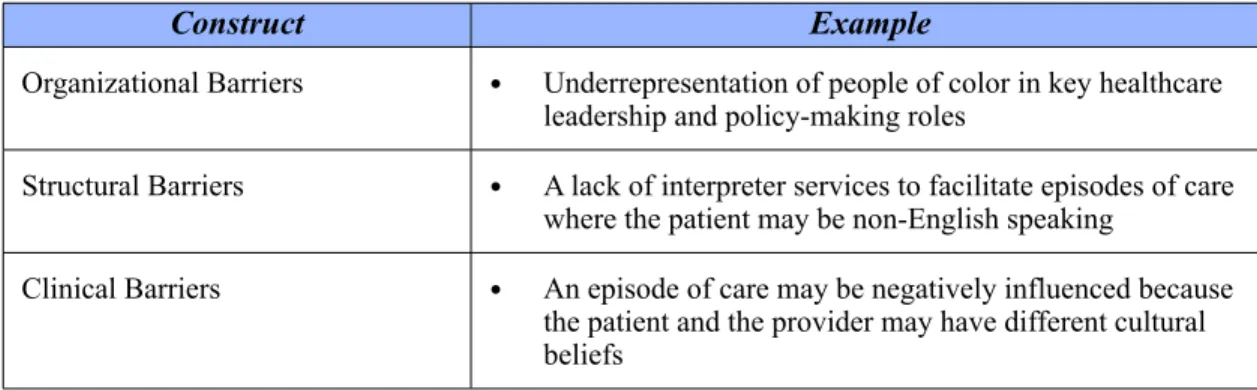
serve a diverse patient population [45]. The 2003 study conducted by Betancourt, et al. noted
that there are organizational, structural, and clinical barriers to healthcare that contribute to
inequalities of health outcomes among racial and ethnic groups. These barriers can also be
thought of as constructs that exist when there is a lack of diversity in both executive
healthcare leadership roles and the healthcare workforce in general (Figure 5).
Figure 5. - Summary of Betancourt’s Constructs
Construct Example
Organizational Barriers • Underrepresentation of people of color in key healthcare leadership and policy-making roles
Structural Barriers • A lack of interpreter services to facilitate episodes of care where the patient may be non-English speaking
These constructs have special relevance to this research study because they illustrate
the barriers to healthcare access that a person of color is likely to encounter with an
organization that has a low degree of cultural competence. Betancourt’s notion that these
barriers to healthcare exist because of an underrepresentation of people of color in key
healthcare leadership roles is a central premise to this research study.
Conceptual Framework: Diversity and Cultural Competence
Organizations that provide healthcare services can be viewed as having varying
degrees of cultural competency and diversity in executive healthcare leadership. For
conceptual purposes, these two dimensions were plotted together on a graph in which the
level of diversity in executive healthcare leadership is represented on the x axis and the level
of the organizational cultural competency is plotted on the y axis (Figure 6). The model can
then be subdivided into four quadrants each representing high and low degrees of diversity
Figure 6. - Conceptual Model: Diversity and Cultural Competence
High High
Quadrant 1:
Low degree of diversity/High degree of cultural competency
Key Elements
•The leadership team is not diverse •The organization has invested heavily in training and development for its leaders and workforce
Quadrant 2:
High degree of diversity/High degree of cultural competency
Key Elements
•The leadership team is diverse
•The organization has invested heavily in cultural competency training for its leaders and workforce
•The organization promotes a learning culture and emphasizes cultural competency with patients, leaders, staff, and the
community
Quadrant 4:
High degree of diversity/Low degree of cultural competency
Key Elements
•The leadership team is diverse
•The organization has not invested time and energy into cultural competency training Quadrant 3:
Low degree of diversity/Low degree of cultural competency Betancourt’s Constructs •Structural Barriers •Organizational Barriers •Clinical Barriers Low
Diversity in Executive Healthcare
Cul tura l Com pe te nc y
Organizations that can be classified in Quadrant 1 of the model exhibit a low degree
of diversity and high degree of cultural competency. The conceptual model recognizes that
cultural competency and diversity are two different constructs. It is possible, however
unlikely, for an organization to have little diversity in its leadership and workforce but it may
invest heavily in diversity training in an attempt to become more culturally competent. A
competency. Any gains achieved in this way are not sustainable because they are most likely
the result of short-term training programs.
The literature reviewed on cultural competency suggests that obtaining sustained
cultural competence is an evolutionary process that can only be supported by ensuring that
the organization’s workforce is diverse and the cultural norms of its constituents are
engrained in the management of the organization. In the healthcare setting, an example of
this would be a community hospital with a diverse board of directors, a diverse senior
executive team along with diverse management teams and staff. It is highly probable that an
organization of this type would use community-based focus groups as part of its strategic
development process. Organizations of this type are more likely to be found in Quadrant 2 of
the conceptual model.
Quadrant 2 represents organizations that have a high degree of diversity and a high
degree of culturally competency. These organizations focus heavily on developing a learning
culture that embraces diversity. This would be evident by a diverse workforce throughout
each echelon of the organization. This would also be evident by the absence or at least the
minimal presence of the constructs that Betancourt defined. Quadrant 2 is the optimal
position for organizations that are serious about diversity in the executive leadership ranks
and cultural competency.
Betancourt’s constructs would be located in Quadrant 3 of the model. This is where
organizations that have a low degree of diversity and a low degree of cultural competency
would be classified. Organizations classified in this quadrant of the conceptual model tend to
homogenous workforce at the middle management, and staff levels. Organizational,
structural, and clinical barriers are extremely prevalent for people of color when their
healthcare needs take them to an organization that can be classified in Quadrant 3.
Quadrant 4 of the model represents organizations that have a high degree of diversity
and a low degree of cultural competency. This would be representative of an organization
with a diverse workforce but little investment in developing cultural competency. It is highly
probable that Quadrant 4 organizations experience internal friction because group diversity is
not managed in a concerted and conscientious manner. Cultural norms are more likely to
override corporate objectives and strategy. This means that simply diversifying the executive
leadership of a healthcare organization is not enough. Time, energy, and resources must go
into helping to manage the idiosyncrasies that are inherent among different social and ethnic
groups.
Limitations of the Literature Review
The existing literature on how diversity of top management teams affects the policy
making process is inconclusive and remains an area for continued research. Arguments can
be made from both vantage points of pro-diversity and pro-homogeneity. The arguments and
counterarguments will only be resolved when there is a definitive study that firmly
establishes the concept that a diverse team or organization outperforms a homogenous team
or organization.
The search strings used in this literature review may have missed relevant works
about diversity in executive healthcare leadership. While several permutations of the
variables “diversity”, “executive”, “healthcare”, and “leadership” were used, it is possible
cultural competence. Works that may have offered relevant content but were published under
the heading of social science, organizational development, conflict management, or some
other topic were most likely missed during this literature search.
This literature review is primarily limited by the number of readily available studies
on diversity in executive healthcare leadership. There is not a singular repository for
published findings that articulate the impact that diversity in executive healthcare leadership
can have on access to care.
An additional compounding factor is that relevant literature may have been missed in
instances where the literature was not indexed properly from earlier years.
Significance of the Issue
The beliefs that healthcare executives hold regarding access to health care shape
healthcare policy and ultimately determine many consumers’ level of access to healthcare. In
order to improve access to healthcare, it is necessary for change agents to understand this
relationship. This research study points to differences in how White healthcare executives
and executives of color view access to care. In doing so, an important building block for
future research and change is laid. Bridging the gap between people’s views regarding
access to healthcare could be one of the missing links in sustainable healthcare reform.
Understanding the dynamics of diversity in executive healthcare leadership is an
integral component of improving access to healthcare for a growing population that is
becoming increasingly diverse and becoming simultaneously stratified as insured,
under-insured, and uninsured.
A better understanding of these dynamics has the potential to improve access to
number of the uninsured population are people of color, change agents are going to have to
develop higher degrees of cultural competency. Uninsured rates among people who identify
as Black, Asian, or Hispanic, tend to be higher than those of their White counterparts (Figure
7).
Figure 7. - Comparison of Uninsured Rates Among Major Racial Groups Racial
Group
Percent Uninsured in
2010
Percent Uninsured in
2011 White
Black Asian Hispanic
15.30% 14.90%
20.80% 19.50%
18.40% 16.80%
30.70% 30.10%
Source: US Census Bureau. Income, Poverty, and Health Insurance Coverage in the United States: 2011
The plight of the uninsured illustrates the magnitude of the opportunity to improve
access to healthcare. Millions of people are subject to health statuses that may be directly
related to their socioeconomic status. A person of color is likely to wrestle with the
challenges of accessing healthcare within a healthcare delivery system where the cost of an
episode of care could mean deciding between getting needed treatment and paying other
bills. The healthcare provider is more likely to be insensitive to the patient’s cultural norms
or belief systems. Furthermore, the policies governing a person of color’s ability to access
healthcare are more likely to be written by someone far removed from his or her own social
circles. All of this lends special significance to the need to understand how a lack of
diversity in executive healthcare leadership can translate into policy that does not meet the
In its 2003 report on the future of the public’s health, the Institute of Medicine (IOM)
identified an underrepresentation of people of color in the public health workforce [47]. The
report stated that the severity of this underrepresentation of people of color in the healthcare
workforce has negatively affected access to care for people of color. It negatively affects the
quality of care they receive when they access healthcare services. It negatively affects the
level of confidence and trust that people of color have in the healthcare delivery system.
This finding gives further support to the theme developed from Betancourt’s work
that the underrepresentation of people of color in the delivery portion of the healthcare
continuum creates barriers for people of color in the access portion of the healthcare
continuum.
Studying diversity in executive healthcare leadership will also add to the existing
body of research that is currently available. Since Cross, et al. penned the term “cultural
competence” in 1989, there has been little research on the effects that a lack of diversity can
have on people’s views about access to healthcare.
Implications for Future Research
Future research could be conducted to determine what the optimal degrees of
diversity and cultural competency for an organization might be. An analysis of diversity and
cultural competency optimization, however, is beyond the scope of this research study. It is
mentioned here as a placeholder for future research and as an acknowledgement of the
counter position that an increase in diversity may lead to an increase in conflict among
groups.
The effects of diversity on group performance have been studied by other researchers.
diverse groups perform as well as homogenous groups and may ultimately outperform them
[48]. Other studies have shown that homogenous groups perform better than diverse groups
because they do not have the inherent conflict that diverse groups have [49]. This position is
predicated upon the lack of needing to manage opinions, beliefs, and other facets of diversity
that may differ within the group.
On the surface, this stream of thought might suggest that the rate of innovation among
homogenous groups is actually faster than that of diverse groups because barriers such as
language, cultural norms and beliefs are not present. This stream of thought is problematic
for two reasons. First, the material that is most readily available on the subject is somewhat
dated with a number of the studies having been done in the late 1990’s. Secondly, these
studies do not clearly refute that diversity has a positive impact on group performance. A
good example of this is the study done by Knight, et al. in 1999. The study found that
diversity within top management teams had negative effects on strategic consensus. In the
same study, Knight, et al. acknowledged that individual members of top management teams
might not perceive group processes in the same way due to differences in their individual
experiences [50]. This actually supports the earlier point that increasing diversity to improve
team performance is not enough; it must be fostered and managed. Cohen, et al. support the
notion that this theme of improving diversity to improve team performance is especially
relevant to the healthcare sector. They suggest that an increase in the number of minority
health professionals in management and policy-making roles will help ensure that decisions
about resource allocation and program design will be better fitted for a society that is