Associations between Mental Health, Racial Discrimination, & Racial Identity on mHealth for African Americans
Honors Thesis
Abstract
Relationships between Racial Identity, Discrimination, and African-American mental mHealth Apps
Although mental health illness does not discriminate against any demographic group, studies have shown that there are groups that make up a disproportionate level of those affected (Ward, Wiltshire, Detry & Brown, 2013). Each year, an estimated 58 million Americans
experience a mental health illness (Ward, Wiltshire, Detry & Brown, 2013). African Americans are among the most disproportionately affected accounting for 18.7 percent of those with mental health disorders in the United States, despite only making up 12 percent of the population (Ward, Wiltshire, Detry & Brown, 2013). Many factors contribute to the increased risks and prevalence of mental health illness within the African Americans community, including disparities in seeking and receiving care, the quality of care received, and race relations (Ward, Wiltshire, Detry & Brown, 2013).
Despite the increased prevalence of disparities pertaining to African American mental health, there is little research regarding if, and how, a mental mobile health (mHealth)
application could address the need for treatment within the African American community. This study examined (1) African American mental health attitudes, (2) perceptions and beliefs surrounding mental health applications, including culturally adapted mental mHealth apps, and (3) the role of racial identity and discrimination on perceptions and beliefs of mental mHealth applications.
The African American Experience
Hyperactivity Disorder, Suicide, and Posttraumatic Stress Disorder (NAMI, n.d.). Prior research suggests that African Americans experience lower levels of well-being and heightened levels of psychological distress (Williams, Yu, Jackson, & Anderson, 1997). Researchers also have found links between increased risks of developing mental health disorders and life situations that a majority of African Americans experience (Williams & Williams-Morris, 2000). Some of the most studied life experiences include low socioeconomic status, educational attainment, and race relations. However, few studies have looked at how to mediate the effects of low SES,
educational attainment, and race relations on mental health and if a mobile app could be effective in this regard.
Several structural factors have hindered the economic advancement of African Americans within the United States. The most relevant factor that affected African American wealth and health profiles is slavery. At that point in time, slaves were not considered human, and this mindset persevered despite the abolishment of slavery in 1865 with the 13th amendment. After the abolishment of slavery, sharecropping, Jim Crow laws, post World War II policies such as the GI bill, and subsequent residential segregation through redlining and white flight continued to affect the wealth distribution in America, leaving African Americans at the bottom of the SES stratification.
The inability for African Americans to develop wealth began with the GI Bill after WWII. The GI Bill aimed at helping WWII veterans adjust to civilian life by providing low cost mortgages, low-interest loans, and financial support (Herbold, 1994; Pantin, 2018). However, these support systems were not offered or easily attained by African American veterans. In New York and New Jersey alone, less than 100 of the 67,000 mortgages provided by the GI Bill were taken out by non-Whites (Pantin, 2018). The inability to purchase homes affected the African American community and prevented them from developing wealth for future generations. A study conducted in New Zealand demonstrated that belonging to the lowest wealth quintile was correlated with higher psychological distress (Carter, Blakely, Collings, Gunasekara, &
Richardson, 2009). Not surprisingly, the wealth gap currently experienced by African Americans continues to affect their mental health status to this day.
Educational Attainment. Educational attainment is a specific component of SES
non-Hispanic white and 23.3% are Black (US Census Bureau, 2018). Although most Americans face the burden of the educational attainment gap, the burden is more pronounced in African
Americans and other ethnic minority communities. In general, increased educational attainment contributes to better mental health outcomes, thus serving as a mental health protective factor (Hudson, 2005). Other researchers have also found that the lower the level of SES, the higher the risk for developing a mental illness (Hudson, 2005). Due to the historical structural barriers such as the inability to develop wealth, African Americans are even more disadvantaged than the general population when attempting to increase their education levels and SES. However, further research in this area has indicated that this protective factor may not be true for African
Americans, especially African American men (Assari, 2018). African Americans do not experience the protective effects that higher levels of educational attainment and SES provide (Assari, 2018). Increased educational attainment for African Americans increases the number of discriminatory experiences, reducing a large amount of the protection SES and education
attainment offers their white counterparts (Assari, 2018). Without this protection, African
Americans who attain higher SES statuses are at a higher risk of battling mental health concerns. Race Relations. Other important factors to consider are both historical and current day race relations in the United States. African Americans have experienced racial discrimination since the slave trade that brought their ancestors to the United States. For racial and ethnic minorities, instances of racism, discrimination, and internal bias perpetuated by their white peers are daily occurrences that contribute to their health status (Soto, Dawson-Andoh, & Belue, 2011). Between the ages of 18-24, 50% of Latinos and 87% of African Americans report
their internal biases (Villanueva, 2018). Explicit discrimination differs in that the perpetrator openly discriminates against minorities, is aware of their beliefs and actions, and acts on them (Bastos, Faerstein, Celeste, & Barros, 2012). Current research studies focus on the effects of discrimination on health and well-being. Findings have varied in intensity and included both physical and mental manifestations on health (Soto, Dawson-Andoh, & Belue, 2011). The main effects that researchers found were heightened levels of psychological distress, anxiety,
depressive symptoms and low levels of happiness and life satisfaction (Williams & Williams-Morris, 2000). Given these concerns, a mHealth intervention might provide opportunities to address mental health concerns for African Americans.
Trends and Barriers in Seeking and/or Receiving Care.
Trends in Receiving Care. In addition to social factors which influence vulnerability to mental health difficulty, there are clear differences between African Americans and their white peers with respect to receiving mental health care. According to a published American
Psychological Association article, there is a trend in African Americans lacking treatment despite their increased rates and risks of developing a mental illness (American Psychological
Association, n.d.). A study found that less than half (45%) of African Americans with diagnosed depression received treatment or therapy of any kind, despite the rate of African American women meeting qualifications for diagnosis at twice the rate of other groups (Williams, et al., 2007).
Cultural Mistrust. African Americans’ skepticism of seeking mental health services can be demonstrated by their reluctance to seek health services in general. One important factor that inspired mistrust in medical professionals was the Tuskegee study, which intentionally harmed African Americans and hid the availability of a cure for syphilis. However, intentional harm is no longer the main reason for mistrust within African American communities. Many African Americans have heard or experienced first hand the cultural biases held by medical
professionals. Health care professionals’ lack of cultural training leads to misdiagnosis, poor quality treatment, and differential treatment than that of their White counterparts (Villanueva, 2018).
An example of diagnostic bias is found in Schizophrenia diagnosis of African Americans (Baker & Bell, 1999). Researchers have suggested that African Americans who are hyper-vigilant, or suffer from other mental illnesses receive incorrect diagnosis and subsequently are treated for paranoid schizophrenia (Baker & Bell, 1999). Increased racial discrimination leads to hyper-vigilance or hyper-awareness of race interactions and is often mistaken as paranoia by those not in racially discriminated groups (Baker & Bell, 1999). These misdiagnoses can lead to incorrect treatment. There have also been studies that find differential treatment between African Americans and their White counterparts. In one example, a white female therapist ignored racial tensions and diagnosed an African American boy with conduct disorder (Laszloffy & Hardy, 2000). This African American boy believed his teacher had racially mistreated him and the anger he felt is what led to his poor behavior in school (Laszloffy & Hardy, 2000). The group of
with conduct disorder, while a white counterpart who was acting in similar ways was passed off as just being a boy (Laszloffy & Hardy, 2000). Similar differential treatment may account for the rise of ADHD diagnosis in racial and ethnic minorities (Coker, Elliott, Toomey, et al., 2016). The heightened need of African Americans in the mental health sector paired with low access, poor treatment and representation present a significant public health concern.
Lack of Access. There is a need among African Americans for better and more accessible care. African Americans are more likely to experience chronic mental illnesses, high levels of disability, low rates of outpatient services and high rates of inpatient services, all while having low access and poorer quality of care compared to whites (Ward, Wiltshire, Detry & Brown, 2013). Part of the reason for a higher level of chronic mental illness is that African Americans delay seeking or receiving treatment. As noted earlier, African Americans disproportionately make up the lowest SES quartiles and have low levels of education attainment. This means they are less likely to have access to jobs that offer insurance that cover mental health services. The inability to pay for and locate providers is a barrier to seeking and receiving care. Also, there is a shortage of African American mental health providers who would decrease diagnostic bias and better understand individuals’ particular situations stemming from racial factors. People may feel more comfortable with providers who look like them, so representation matters. Lack of access to care leads to more chronic and life long conditions facing African Americans. Their inability to receive quality care when they first start to show symptoms can lead to further complications and the deterioration of mental health. A mHealth app could potentially help address these concerns
Mobile Health Apps
Mobile mental health applications may be able to prevent complications and the deterioration of mental health in the African American community. Approximately 90 % of adult Americans own a mobile phone (Anderson, 2016). This presents tremendous potential for a mobile health app reaching a wider audience than therapy currently does. In reaching a wider audience, an app can reduce the trend of African Americans delaying seeking and receiving treatment for fear of stigmatization and inability to afford care. Apps have been evaluated as a cost-effective method to provide health care in areas outside of the mental health arena
(Iribarren, Cato, Falzon, & Stone, 2017). There are apps used for monitoring Diabetes, insomnia, and anxiety among others that have gained public attention and showed promise (Shah & Garg, 2015). Demonstrating the positive effects an app may have on mental health symptoms, a study on the Few Touch application found that the use of the Few Touch over 6 months improved participant motivational effects when battling symptoms related to their illness (Arsand, Tatara, Ostengen, & Hartvigsen, 2010).
Current Study
Due to the potential that mobile apps present, it is important to understand the perceptions surrounding mental health treatment and mobile health applications within the
Method Participants
The sample consisted of 38 self-identified African American young adults recruited at a southeastern, public, and predominately white university. There were 38 participants, 9 of which were male. Participants had to own a mobile phone, and be between the ages (M = 20.70, SD =
2.57) of 18 to 35 to be eligible for the study. The study sample reported their mothers education level, which is reflective of socioeconomic status (SES), and the mean maternal educational
attainment was between an associate’s degree and a bachelors degree (M = 4.59, SD = 1.74). The mean self-reported family SES between the working and middle class (M = 2.87, SD = .864). Materials
Participants used desktop computers, recorders, and laptops for various phases of the study. Participants needed access to a phone and downloaded apps. The moderators had a
printed version of the semi-structured interview protocol and a clipboard. Note takers had clipboards and pieces of paper.
Procedure
ID number, and four measures. The survey took approximately 30 minutes to complete. Once all participants completed the survey and got their compensation, participants created a circle to begin the focus group portion of the study (not discussed in this study).
Measures
Demographic Information. There was a section dedicated to collection of demographic information including gender, date of birth, age, race, ethnicity, highest parental education level which served as an indicator for SES, whether participants owned a smartphone, and how often
they used mobile applications.
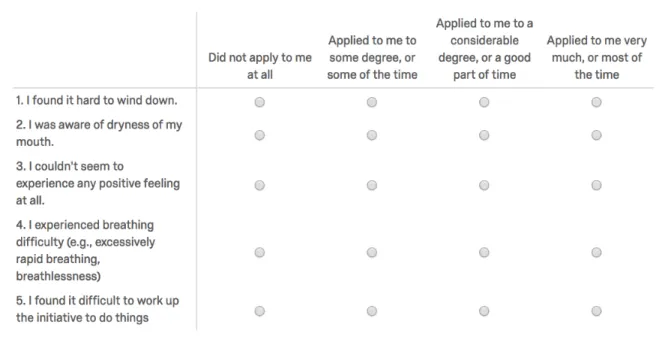
Depression, Anxiety, and Stress. The Depression Anxiety Stress Scales (DASS-21; Lovibond and Lovibond, 1995) has 21 questions that assesses self-reported states of depression,
anxiety, and stress (alpha = .913). This scale includes questions such as “I found it hard to wind down” rated on a scale from 0- Did not apply to me at all to 3- applied to me very much or most
of the time, with higher scores corresponding to more severe levels of depression, anxiety, or
stress.
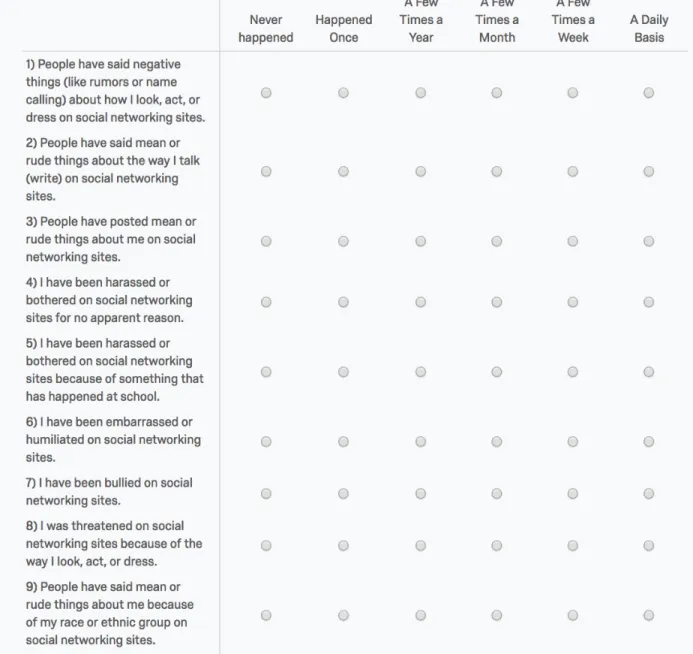
Online Interactions. A 15 question (alpha = .85) modified version of the Online
Victimization Scale (OVS; Tynes, 2010) was used to assess online victimization categorized into general victimization, individual racial discrimination, and vicarious online racial discrimination
all rated on a scale from 1- Never happened to 6 – A Daily Basis (Tynes, 2010). The original scale included 6 more questions in the category of sexual victimization (Tynes, 2010). The general victimization category included questions such as “I have been bullied on social
networking sites” (Tynes, 2010). The individual racial discrimination category includes
questions such as “I was threatened on social networking sites because of the way I look, act, or
jokes about people of my race or ethnic group on social networking sites” and “People have said things that were untrue about people in my race or ethnic group on social networking sites
(Tynes, 2010).
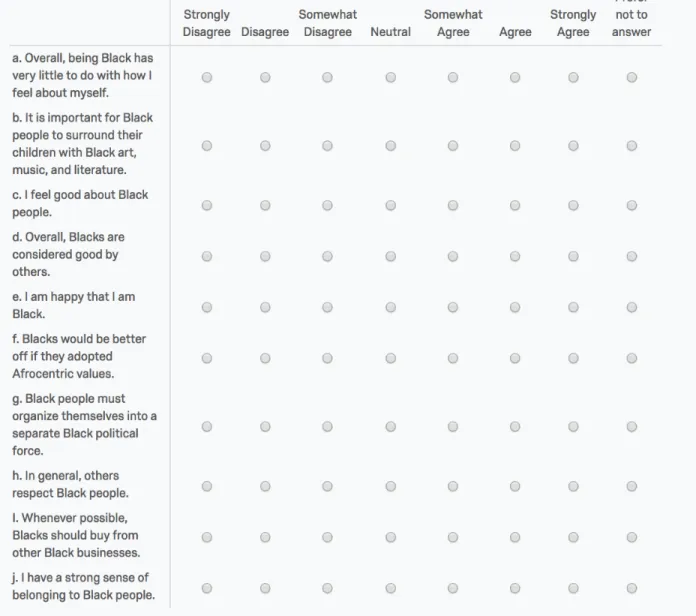
Racial Identity. The Multidimensional Inventory of Black Identity scale (MIBI-S; Martin, Wout, Nguyen, Sellers and Gonzales, 2010) was developed as a way to assess the
ideologies, beliefs, and attitudes of Blacks in relation to the Multidimensional Model of Racial Identity (MMRI). The 27 question MIBI scale (alpha = .83) is composed of a centrality scale
(alpha = .45), two racial regard subscales including both private (alpha = .69) and public (alpha = .79) regard, and four racial ideology subscales including nationalist (alpha = .43), oppressed minority (alpha = .47), assimilationist (alpha = .66), and humanist (alpha = .32) beliefs (Sellers et
al., 1998). A sample question of the centrality scale is “Overall, being Black has very little to do with how I feel about myself.” A sample question for the private regard subscale included “I feel
good about Black people” (Sellers, 1997). The public regard subscale has questions such as “Overall, Blacks are considered good by others” (Sellers, 1997). For ideology subscales, an example of an assimilationist ideology question was “Blacks should strive to be full members of
the American political system” (Sellers, 1997). In the oppressed minority subscale, a sample questions included “The racism Blacks have experienced is similar to that of other minority
groups.” A sample item from the nationalist subscale question included “Blacks would be better off if they adopted Afrocentric values” (Sellers, 1997). For the humanist subscale, questions included “Blacks should have the choice to marry interracially” (Sellers, 1997). All these
questions were answered on a scale from 1- Strongly Disagree to 7 – Strongly Agree.
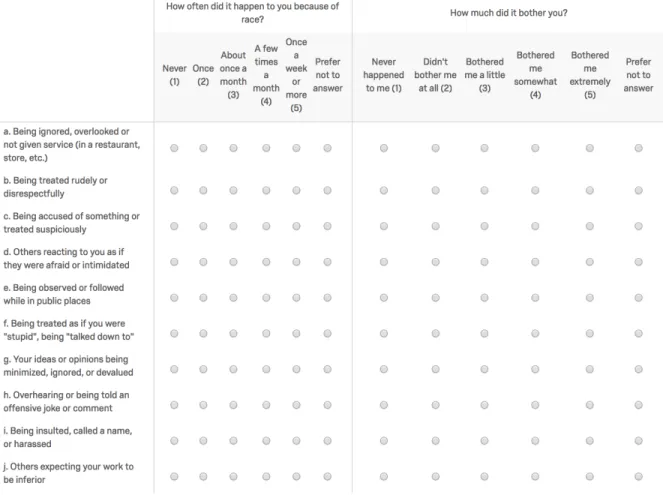
.96). This self-report scale assesses participants’ experiences with racial discrimination over a segment of time and has construct validity that indicated daily life experiences were related to
psychological symptoms, trauma symptoms, and perceived stress (Harrell, 1994). This study assesses racial discrimination over the past 6 months with questions focusing on how people feel about racial microaggressions and how often they happened to them. Questions (e.g., “Others
expecting your work to be inferior”) are rated on how often the experience happened from 1 -Never to 5 - Once a week or more as well as how much it bothered them from 1 - -Never
happened to me to 5 - Bothered me extremely.
Mobile Applications. We created a 13 question measure that consisted of a subscale concerning African American mental health treatment attitudes and two subscales regarding
attitudes toward mobile mental health treatment. Sample African American mental health attitude questions include “My mental health is a priority to me” and “I am concerned about
equal access to mental health treatment in my community.” Questions regarding the
appropriateness of m-health applications include “It is important to offer mental health services through a mobile-health app” and “Using a mobile-health app for mental health services, instead
of seeking in-person, is acceptable.” Questions regarding the appropriateness of culturally adapted mental mHealth include “It is important to make a mobile mental health app available
specifically for African Americans” and “I would use a mobile mental health app geared towards African Americans.” These scales were rated on a scale from 1- Strongly Agree to 7 – Strongly Disagree (reverse coded). As a whole, the measure had a Chronbach’s alpha of .98.
Results
SD = 4.02). We ran two-tailed correlations with all study variables (Table 1). There were several
intracorrelations among mental health variables. For example, higher levels of stress were associated with higher levels of depressive symptoms (r(37) = .638, p < .001) and anxiety (r(37) = .736, p < .001). Online racial discrimination frequency was correlated with (offline) racial discrimination frequency and bother. For example, individual online racial discrimination was significantly correlated with both racial discrimination frequency (r(37) = .384, p = .017) and bother (r(37) = .494, p = .002), while vicarious online discrimination was significantly correlated with racial discrimination bother (r(37) = .504, p = .001), but not frequency (r(37) = .266, p = .107). Finally, online discrimination was associated with self-reported mental health. Individual online racial discrimination also was correlated with anxiety and perceived stress, but not
depressive symptoms. Vicarious online discrimination was correlated with stress (r(37) = .372, p = .022), but not anxiety ( r(37) = .275, p > .05) or depression ( r(37) = .301, p > .05).
Associations between Mental Health, Perceptions of MH treatment, and mHealth My first question was whether individuals’ mental health symptoms were related to mental health treatment attitudes and perceptions of mobile mental health applications and their appropriateness. Contrary to my expectations, no significant correlations were found.
Stress. Stress was not correlated with attitudes of mental health treatment (r (37) =.214, p =.197), general mHealth appropriateness (r (37) =.065 p =.696), or attitudes regarding the
appropriateness of culturally-adapted mHealth interventions for African Americans (r (37) =.138, p =.407).
=.431).
Depression. There was no correlation between depression and attitudes of mental health treatment (r (37) = .241, p =.145), endorsement of mHealth appropriateness (r (37) = .076, p =.652), or endorsement of culturally adapted mHealth treatment for African Americans (r (37) = .028, p =.869).
Associations between Online Discrimination and Perceptions of Mental Health/mHealth My second question was whether the frequency of racial discrimination was related to perceptions of mental health and the suitability of mental health apps, in general, and culturally adapted mHealth interventions, in particular. There were no significant correlations with individual online discrimination experiences, but there were significant correlations between vicarious online discrimination experiences and mental health treatment and culturally adapted mobile health treatment attitudes.
Individual Discrimination. There were no significant correlations between reported individual online racial discrimination and attitudes towards mental health treatment (r (37) = .325, p = .046), mobile health appropriateness (r (37) = -.058, p = .729), or appropriateness of culturally adapted mobile health for African Americans (r (37) = -.015, p = .930).
Racial identity, mental health attitudes, and mHealth
Last, I examined the correlations between racial identity and perceptions of mental and mobile health treatments. I hypothesized that those with higher race centrality would have more positive perceptions on mobile mental health apps, but also examined associations between other dimensions of racial identity and these outcomes.
Centrality. Centrality had no significant correlations with attitudes of mental health treatment (r (37) = .231, p > 0.05), mHealth appropriateness (r (37) = .081, p > .05), or the appropriateness of culturally adapted mHealth for African Americans (r (37) = .282, p > .05).
Regard. There was a positive correlation between private regard and attitudes on mental health treatment (r (37) = .330, p = 0.043) and mHealth appropriateness (r (37) = .357, p =.028), but not culturally adapted mHealth for African Americans (r (37) = .298, p > 0.05). There were no significant associations between public regard and attitudes towards mental health treatment (r (37) = -.130, p > 0.05), mHealth appropriateness (r (37) = -.002, p > 0.05), and culturally adapted mHealth for African Americans (r (37) = -.102, p > 0.05).
Ideology. Nationalist ideology was significantly correlated with attitudes regarding mental health treatment (r (37) = .470, p = 0.003), mHealth appropriateness (r (37) = .325, p = 0.046), and culturally adapted mHealth for African Americans (r (37) = .355, p = 0.029).
Assimilationist ideology was not significantly correlated with attitudes mental health treatment (r (37) = .236, p >0.05) or mHealth appropriateness (r (37) = .174, p > .05), but it was correlated with attitudes regarding culturally adapted mHealth for African Americans (r (37) = .408, p = 0.011).
Discussion
symptoms and perceptions of mental health treatment and mobile mental health apps. I predicted that the higher the reported mental health symptoms, the more positive perceptions of mental health treatment and mobile mental health apps would be (Sheikh & Furnham, 2000). My hypothesis was not supported by the data. I made this hypothesis because of a prior study that found participants who attributed their distress to cultural reasons had mental health treatment seeking behaviors in Asians (Sheikh & Furnham, 2000). There are studies assessing the efficacy of mobile mental health applications and the belief that if people were battling with mental health symptoms, then they would be willing and interested in pulling up a mobile health application to aid themselves. For example, there was a study conducted with a participant sample that only used individuals clinically diagnosed with anxiety, depression, or PTSD. This study found that over 70 percent of their sample reported interest in using apps that had cognitive behavioral therapy at its core (Lipschitz, et al., 2019). However, our data show that this might not be the case. Perhaps when experiencing mental health concerns, individuals have little to no motivation to do daily life activities, much less use a mobile application.
hypothesis because I reasoned that if you experienced more online racial discrimination, then you might not want to use a platform on a sensitive topic that could open you up for more online racial discrimination. It is unclear where mHealth and culturally adapted mHealth fits into prior literature on discrimination and treatment seeking behaviors. I hoped to extend the current literature to include mHealth in treatment seeking behaviors and begin to fill this gap in the literature.
Although I did not find any significant correlations between reported levels of individual online discrimination and perceptions of mental health treatments and mobile health applications, I did find evidence contrary to my hypothesis. There were no significant associations between vicarious online discrimination and perceptions of general mobile health appropriateness. However, I found that as the amount of vicarious discrimination reported increased, there were more positive attitudes towards seeking mental health treatment and culturally adapted mobile health applications for African Americans. This finding is interesting because vicarious online racial discrimination refers to second hand discrimination where one’s community as a whole is targeted as opposed to an individual. Vicarious discrimination also could manifest as seeing someone else in your racial group targeted. The observed correlation could be explained by first acknowledging that vicarious discrimination is an issue battled as a collective and that African Americans deal with on a frequent basis. If there is an established belief and base set of
experiences with vicarious online discrimination, then there might be positive thoughts about the potential benefits that could be experienced as a collective with an app that promotes positive messages about Blackness.
could benefit from something to help deal with these situations.
Last, I examined the associations between racial identity and perceptions regarding mental health treatment and mHealth. I hypothesized that those with higher race centrality would have more positive perceptions of mobile mental health apps. However, this was not the case. Centrality was not significant with any aspect of mental health treatment attitudes, whether it be mobile or not. Instead, we found that those with higher nationalist ideology endorsed positive attitudes regarding mental health treatment, mHealth appropriateness, and culturally adapted mobile mental health applications for African Americans. According to Sellers (1998), those who endorse nationalist ideology believe in the uniqueness of the African American experience. This also means that those who ascribe to the nationalist ideology commemorate the use of African American organizations and businesses. Given the nature of this ideology, it would make sense that participants with high nationalist ideology would want a mobile mental health app that celebrates their unique experience as African Americans.
I also found that there was a significant association between assimilationist ideology and the positive endorsement of culturally adapted mobile mental health apps for African Americans. However, there was no significant association with attitudes of mental health treatment or
general views regarding mobile health appropriateness. Sellers (1998) described assimilationist ideology as that in which the person would want to be a part of mainstream culture and
health applications (Iribarren, Cato, Falzon, & Stone, 2017).
Perhaps the most interesting finding of the study was the link between private regard and mental health perceptions. We found that those who had a higher private regard had more positive attitudes on mental health treatment and perceptions regarding mobile health
appropriateness. This goes against the stereotype that African Americans are generally unwilling to seek mental health treatment. Given the nature of correlations, we know that this also means that those with low private regard are less likely to seek treatment. This finding has implications for the future of African Americans. The finding suggests that if you are confident in your Blackness, using a mental health app would not hinder that. The findings also give us insight on how we might counteract the influence of stigma on mental health seeking behaviors.
If private regard is positively associated with mental health treatment seeking attitudes, we should ask, what does cultivating private regard in African American young adults look like? We must consider what this would look like both pre-college and while in college. If we focused on developing high private regard in African American youth, one possible approach might be through careful selection of the materials they use to learn in school (e.g., materials in which they see themselves reflected). Other approaches could be exposing youth to positive portrayals of one’s racial group in the media or socializing youth to know that there is no one way to be Black, or prove to others that you are Black. Yet another approach to promoting private regard might be addressing issues of colorism and classism within the African American community that can discredit their experiences as African Americans.
Limitations
important contributions to thinking about the factors that might influence the use of mHealth interventions. Nevertheless, my study is not without limitations. First, the data were correlational and it is impossible to untangle the direction of effects. Second, there were constraints with regard to recruiting for study participants. Participants self-selected to participate and therefore most of our sample had completed some or all of their college education training and may have had a particular interest in mobile health initiatives. This limitation could have created a
population-specific effect that prevents the generalization of results to non-college educated African Americans. Third, this study also targeted African Americans so it may not be
generalizable to other racial and ethnic minorities. Fourth, my study was conducted with a small participant sample that could have affected the power of statistics and underpowered my results. The small sample may also possibly explain the unusually low reliability estimates for some of the racial identity scales.
Moving forward, those looking to conduct similar studies should focus on recruiting a well-rounded sample of participants including community members and including some non-college educated participants to help the generalizability of results. Researchers should also try to increase the sample size despite recruitment difficulties to prevent any potential under powering of results and to help with population generalization. To further address the gap in literature pertaining to mobile mental health application, these types of studies need to be conducted with other racial and ethnic minorities as well.
Conclusion
the potential to shift our thinking about cultivating private regard as a means of bolstering mental health treatment seeking attitudes and behaviors. I had three main hypotheses that I looked at in my paper. The first was that those with higher mental health concerns relating to stress, anxiety, and depression would hold more positive beliefs regarding mental health treatment and mobile mental health applications. I did not find any relationships, which could mean that mental health symptoms have no effects on attitudes towards mental health. My next hypothesis focused on a gap in the literature regarding the relationship between mHealth and online racial discrimination, which is understudied in the literature. My study provides evidence contrary to what I expected. In this study, African Americans who experienced vicarious online discrimination endorsed the acceptability of culturally adapted mental mHealth applications for African Americans and endorsed more positive beliefs regarding mental health treatment. My last hypothesis dealt with racial identity and its relation to perceptions of mental health treatment and mHealth apps. I did not find the results I anticipated regarding centrality, but I found an important connection
between private regard and attitudes on mental health treatment and mental mhealth applications. This finding can allow us to begin to explore how private regard may be used to promote mental health seeking behaviors and address long standing racial disparities in the use of mental health treatments to mitigate psychological distress.
Acknowledgements
References
African American Mental Health. (n.d.). Retrieved April 30, 2018, from
https://www.nami.org/Find-Support/Diverse-Communities/African-American-Mental-Health
Anderson, M. (2016, November 17). U.S. Technology Device Ownership 2015. Retrieved from http://www.pewinternet.org/2015/10/29/technology-device-ownership-2015/
Anderson, Mahogany S. (2018) "Barriers to the Utilization of Mental Health Services on College Campuses by African-American Students," McNair Scholars Research Journal: Vol. 11 : Iss. 1 , Article 3. Available at: https://commons.emich.edu/mcnair/vol11/iss1/3
Arsand, E., Tatara, N., Ostengen, G., & Hartvigsen, G. (2010). Mobile Phone-Based Self-Management Tools for Type 2 Diabetes: The Few Touch Application. Journal of
Diabetes Science and Technology, 4(2), 328-336. doi:10.1177/193229681000400213
Assari, S. (2018). Educational Attainment Better Protects African American Women than
African American Men Against Depressive Symptoms and Psychological Distress. Brain
Sciences, 8(10), 182. doi:10.3390/brainsci8100182
Baker, F. M., & Bell, C. C. (1999). Issues in the Psychiatric Treatment of African Americans. Psychiatric Services, 50(3), 362-368. doi:10.1176/ps.50.3.362 Basic Statistics. (n.d.). Retrieved from https://talkpoverty.org/basics/
Boulton, M. (2007). How the G.I. Bill Failed African-American Vietnam War Veterans. The
Journal of Blacks in Higher Education, (58 Winter), 57-61. Retrieved from
Carter, K. N., Blakely, T., Collings, S., Gunasekara, F. I., & Richardson, K. (2009). What is the association between wealth and mental health? Journal of Epidemiology & Community
Health, 63(3), 221-226. doi:10.1136/jech.2008.079483
Coker, T. R., Elliott, M. N., Toomey, S. L., Schwebel, D. C., Cuccaro, P., Emery, S. T., . . . Schuster, M. A. (2016). Racial and Ethnic Disparities in ADHD Diagnosis and Treatment. Pediatrics,138(3). doi:10.1542/peds.2016-0407
Conner, K. O., Copeland, V. C., Grote, N. K., Koeske, G., Rosen, D., Reynolds, C. F., & Brown, C. (2010). Mental Health Treatment Seeking Among Older Adults With Depression: The Impact of Stigma and Race. The American Journal of Geriatric Psychiatry, 18(6), 531-543. doi:10.1097/jgp.0b013e3181cc0366
Corrigan, P. (2004). How stigma interferes with mental health care. American
Psychologist, 59(7), 614-625. doi:10.1037/0003-066x.59.7.614
Costello, E. J., Compton, S. N., Keeler, G., & Angold, A. (2003). Relationships Between Poverty and Psychopathology. Jama, 290(15), 2023. doi:10.1001/jama.290.15.2023
Haynes, T. F., Cheney, A. M., Sullivan, J. G., Bryant, K., Curran, G. M., Olson, M., . . . Reaves, C. (2017). Addressing Mental Health Needs: Perspectives of African Americans Living in the Rural South. Psychiatric Services, 68(6), 573-578. doi:10.1176/appi.ps.201600208 Herbold, H. (1994). Never a Level Playing Field: Blacks and the GI Bill. The Journal of Blacks
in Higher Education, (6), 104-108. doi:10.2307/2962479
Hudson, C. G. (2005). Socioeconomic Status and Mental Illness: Tests of the Social Causation and Selection Hypotheses. American Journal of Orthopsychiatry, 75(1), 3-18.
Iribarren, S. J., Cato, K., Falzon, L., & Stone, P. W. (2017). What is the economic evidence for mHealth? A systematic review of economic evaluations of mHealth solutions. Plos
One, 12(2). doi:10.1371/journal.pone.0170581
Laszloffy, T. A., & Hardy, K. V. (2000). Uncommon Strategies for a Common Problem: Addressing Racism in Family Therapy. Family Process, 39(1), 35-50.
doi:10.1111/j.1545-5300.2000.39106.x
Lipschitz, J., Miller, C. J., Hogan, T. P., Burdick, K. E., Lippin-Foster, R., Simon, S. R., & Burgess, J. (2019). Adoption of Mobile Apps for Depression and Anxiety: Cross-Sectional Survey Study on Patient Interest and Barriers to Engagement. JMIR Mental
Health, 6(1). doi:10.2196/11334
Martin, P. P., Wout, D., Nguyen, H., Sellers, R. M., & Gonzalez, R. (2010). Investigating the psychometric properties of the Multidimensional Inventory of Black Identity in two samples: The development of the MIBI-S. Unpublished manuscript.
Mclaughlin, K. A., Costello, E. J., Leblanc, W., Sampson, N. A., & Kessler, R. C. (2012). Socioeconomic Status and Adolescent Mental Disorders. American Journal of Public
Health, 102(9), 1742-1750. doi:10.2105/ajph.2011.300477
Mclean, C., Campbell, C., & Cornish, F. (2003). African-Caribbean interactions with mental health services in the UK: Experiences and expectations of exclusion as (re)productive of health inequalities. Social Science & Medicine, 56(3), 657-669. doi:10.1016/s0277-9536(02)00063-1
Pantin, L. E. (2018). The Wealth Gap and the Racial Disparities in the Startup Ecosystem. Saint
https://www.slu.edu/law/law-journal/pdfs/issues-archive/v62-no2/lynnise_phillips_pantin_article.pdf
Roach R. (2007, July 12). From combat to campus: GI Bill gave a generation of African Americans an opportunity to pursue the American dream – Servicemen's Readjustment Act of 1944 – Special Report: The Integrated Military – 50 Years – Cover Story. Diverse
Issues in Higher Education, 26-29. Retrieved from
https://diverseeducation.com/article/8298/
Sellers, R. M., Smith, M. A., Shelton, J. N., Rowley, S. A., & Chavous, T. M. (1998).
Multidimensional Model of Racial Identity: A Reconceptualization of African American Racial Identity. Personality and Social Psychology Review, 2(1), 18-39.
doi:10.1207/s15327957pspr0201_2
Shah, V. N., & Garg, S. K. (2015). Managing diabetes in the digital age. Clinical Diabetes and
Endocrinology, 1(1). doi:10.1186/s40842-015-0016-2
Soto, J. A., Dawson-Andoh, N. A., & Belue, R. (2011). The relationship between perceived discrimination and Generalized Anxiety Disorder among African Americans, Afro Caribbeans, and non-Hispanic Whites. Journal of Anxiety Disorders, 25(2), 258-265. doi:10.1016/j.janxdis.2010.09.011
US Census Bureau. (2018, January 19). Highest Educational Levels Reached by Adults in the U.S. Since 1940. Retrieved from
https://www.census.gov/newsroom/press-releases/2017/cb17-51.html
Vogt, D. S., King, D. W., & King, L. A. (2004). Focus Groups in Psychological Assessment: Enhancing Content Validity by Consulting Members of the Target
Ward, E. C., Wiltshire, J. C., Detry, M. A., & Brown, R. L. (2013). African American Men and Women’s Attitude Toward Mental Illness, Perceptions of Stigma, and Preferred Coping Behaviors. Nursing Research, 62(3), 185-194. doi:10.1097/nnr.0b013e31827bf533 Williams, D. R., & Williams-Morris, R. (2000). Racism and Mental Health: The African
American experience. Ethnicity & Health, 5(3-4), 243-268. doi:10.1080/713667453
Williams, D. R., González, H. M., Neighbors, H., Nesse, R., Abelson, J. M., Sweetman, J., &
Jackson, J. S. (2007). Prevalence and Distribution of Major Depressive Disorder in African Americans, Caribbean Blacks, and Non-Hispanic Whites Results From the National Survey of American Life. Arch Gen Psychiatry, 64(No. 3), 268-382. doi:doi:10.1001/archpsyc.64.3.305
Williams, D. R., Yu, Y., Jackson, J. S., & Anderson, N. B. (1997). Racial Differences in Physical and Mental Health. Journal of Health Psychology,2(3), 335-351.
Table
Table 1.
Correlation Matrix.
1 2 3 4 5 6 7 8 9 10 11 12 13 14 15 16 17
1. Depression - 2. Stress .638** - 3. Anxiety .539** .736** - 4.
Individual_ORD 0.299 .414
** .331* -
5. Vicarious_ORD
0.301 .372* 0.275 .569** -
6. Centrality -0.049 0.127 0.178 0.000 -0.061 - 7. Nationalist 0.123 .346* 0.227 0.311 0.285 0.273 - 8. Private 0.060 0.038 0.088 -0.036 -0.113 0.244 0.054 - 9. Public 0.069 -0.047 -0.045 0.043 -0.157 -0.073 -0.108 0.252 - 10. Humanist 0.073 0.087 0.072 0.086 0.043 -0.046 -.491** -0.050 -0.033 - 11. Oppressed -0.035 -0.005 0.022 -0.015 -0.090 0.015 0.015 -0.198 0.219 -0.039 - 12. Assimilation 0.126 0.122 -0.054 -0.253 0.038 0.205 0.045 -0.183 0.058 0.284 0.189 -
13. RD
Frequency 0.146 .424
** .461** .384* 0.266 0.057 0.021 -0.175 -0.095 0.284 0.127 -0.173 - 14. RDBother 0.250 .453** .508** .494** .504** 0.058 0.170 -0.185 -0.224 0.081 0.072 -0.248 .816** - 15. Attitudes
MH Treat 0.241 0.214 0.210 0.015 .325
* 0.231 .470** .330* -0.130 -0.278 -0.109 0.236 -0.083 0.036 -
16. mHealth
Appropriateness 0.076 0.065 0.200 -0.058 0.166 0.081 .325
* .357* -0.002 -0.157 -0.146 0.174 -0.041 -0.014 .769** -
17. mHealth for African Americans
0.028 0.138 0.132 -0.015 .346* 0.282 .355* 0.298 -0.102 -0.106 -0.035 .408* -0.170 -0.092 .761** .732** -
**. Correlation is significant at the 0.01 level (2-tailed). *. Correlation is significant at the 0.05 level (2-tailed).
Figures
Appendix A Focus Interview Guide
SUPPLIES: (for refreshments: drinks and snacks, napkins, cups, paper plates, serving containers); list of participants; tents or name tags and markers; consent forms (2 per
participant); demographic questionnaires; paper and pens for participants and moderators; sound recording equipment; $25 payments; receipts; focus group script for moderator and assistant moderator.
1. Informed consent, check to see if participants have mHealth apps, assign participant ID number and name badge, distribute online survey and money (~10 to 15 minutes).
2. Introduction: Thank you for joining us today. The purpose of this focus group is to explore how African Americans talk about mental health and treatments, and what they would want from a mobile phone application that targets mental health for African Americans. Can you say your name and ID number before we begin for the recording?
3. Perceptions of Mental Health and Mental Health Treatments a. What is your perception/interpretation of mental health:
1. What does it mean to have good/positive mental health? Negative/bad mental health?
2. Do you think mental health is different for African Americans versus White Americans? What about African Americans versus other racial/ethnic minority groups?
3. What are the expectations, pressures, advantages and
disadvantages of being African American that can contribute to your state of mental health?
b. How do you currently talk about mental health?
1. Do you think African Americans talk about mental health differently?
2. Do you talk about mental health with your friends? Family? c. How can we help ourselves and each other promote positive mental health and
increased understanding of mental health issues?
1. What activities do you engage in that promote positive mental health?
d. Is there sufficient support for friends and family members of those affected by (severe) mental health issues?
e. FOR THIS NEXT QUESTION, YOU DO NOT HAVE TO SHARE ANYTHING CONFIDENTIAL OR PERSONAL: When searching for
1. What barriers/obstacles get in the way of finding help for mental health symptoms?
4. Racial Identity and Coping with Race-Related Stress a. What do you know about racial identity?
i. We describe racial identity as the significance of race in your life. In other words, what does it mean to be an African American, and what are your beliefs about how African Americans should act.
b. How does what you think about what it means to be a member of your racial group affect your mental health?
c. How has your racial identity beliefs changed since you were a kid? Since you started at UNC?
d. (Follow-up questions if there is time).
i. What can make you believe race is more central to how you see yourself? Less?
ii. What can make you feel good about being black? Less?
iii. Do you think others in society feel positively towards African Americans? What types of things would change this?
iv. Do you think African Americans should try to find commonalities with mainstream American culture? What are examples of this?
v. Do you think African Americans have similar experiences with other oppressed minority groups? How?
vi. Do you think African Americans should try to get along with all people regardless of racial/ethnic background, or in other words, do you think people should not view others based on race, gender, etc.?
vii. Do you think African Americans should emphasize the uniqueness of the black experience with little input from other groups (i.e., it’s important to me to join all black organizations)?
e. How have you dealt with experiences of racial discrimination?
i. Could you describe your feelings when you or SOMEONE YOU KNOW received unfair treatment because of your/their race?
ii. Have you/them experienced these things during face to face interactions, online (via social media), or both?
iii. Have these experiences of discrimination been related to mental health symptoms for you or someone you know?
5. Mental Health App for African Americans
a. If there was an app that promoted mental health in African Americans, what kinds of features should it have?
2. Would you want to share progress and/or resources on your social media networks (i.e., Facebook, Twitter)?
3. Would you want the app to be connected to other apps? What about social media networks?
b. Would you use the app to cope with negative mental health symptoms? Would you use the app alone or would you want to use it in combination with face-to-face therapy?
c. What kinds of things would you want/need in it?
1. What topics would you like to see addressed (i.e., depression, suicide)?
2. What information do you need from a mobile app related mental health? (i.e., statistics, information about symptoms, access to providers)
d. Would you want resources related to racial identity in a mental health app? What would this look like?
e. Would you want resources related to coping with racial discrimination via an app? What would this look like?
f. What do you think about these features?
1. Location beacon/alert to check in on you during stressful times with connected friends on the app.
2. Bitmoji integration.
3. Ability to share resources with connected friends. 4. Ability to find service providers
5. Daily “what’s up?” feature where you put in mood, physical symptoms, thoughts, and tailored brief interventions for negative symptoms and then automatic referrals for if those interventions don’t work.
g. What would motivate you to spend time on it?
h. How should it be advertised? Where would you most likely find out about it? i. What would make it look attractive? (i.e., color schemes, etc.).
6. Evaluating Current Mental Health Apps
a. Test Run of Selected Apps (~10 minutes) REMIND PARTICIPANTS THEY CAN KEEP APPS OPEN DURING THE REST OF THE DISCUSSION. b. What would improve some of the current apps that are available?
1. CBT Coach, Stair App, Safe Space App, Mood Coach 2. Which apps did you like the most? The least? Why? 3. What features did you like and not like?
5. What would make the apps more accessible to African Americans like yourselves?
7. Any last thoughts about the apps or any other topic we discussed today?
Thank you for participating in this focus groups! Your opinions will help us to increase our understanding of how mental health is viewed in African American communities, and how we can address mental health in these communities using mobile technology! If you have not received your payment, please let me or the assistant know!
After Interview Tasks:
• Clean up study room
• Bring all supplies back to the lab
• Upload main recording and backup recording to the lab drive. • Make sure all consents have been filed