31
Integrated Forwarder and Data Selection Scheme for Security Ensured
Vehicular Communication
1
Mrs. M. Karthika,
M.Phil Scholar, Department of Computer Science
2
Mrs. N. Kowsalya, M.Sc.,M.Phil.,MCA., Assistant Professor, Department of Computer Science Vivekanandha College of Arts and Sciences for Women(Autonomous),
Elayampalayam, Tiruchengode, Tamilnadu, India [email protected]
Abstract
Vehicle communication is carried out under the Vehicular Adhoc Networks (VANET). Vehicles and Road Side Infrastructure (RSI) elements are involved to construct VANET. Spatial and speed details are used to handle the VANET data transmission process. Vehicle data relay is managed with the support of On -Board Unit (OBU).Vehicle communication is carried out in two ways vehicles and infrastructure models. Shared data and infrastructure details are transferred over the vehicles. Vehicle communication and mobility activities are discovered by the attackers. Road network and security conditions are transferred to all nodes in the VANET. Data broadcast operations are carried out with forwarder nodes. Waiting time information is used in the forwarder node selection process. Data broadcast operations are carried out using RObust and Fast Forwarding (ROFF) protocol. Waiting time and priority factors are considered in the forwarder node selection process. Vehicle location and gap between vehicles are shown in the Empty Space Distribution (ESD) bitmap. Forwarding priority is identified with the support of the ESD bitmap information.
Data broadcast and multicast operations are handled with the integration of the Robust and Fast Forwarding (ROFF) and Trajectory based MultiCast (TMC) protocols. Forwarding capacity and Message Forwarding Metrics are estimated to identify the forwarder nodes. Data security and replica node concepts are adapted to improve the system. Network communication status is predicted with reference to the trajectory details.
Index Terms : Vehicular Adhoc Networks, Data Dissemination, RObust and Fast Forwarding (ROFF) protocol, Trajectory based MultiCast (TMC) protocol and Data Replicas
1. Introduction
Information Technology and VANets technology advances toward more critical applications such as Vehicle Collision Warning Systems (CWS) and Driverless Vehicles, it is likely that a robust and highly available localization system will be required [2]. Unfortunately, GPS receivers are not the best solution in these cases, since their accuracy range from up to 20 or 30 m and since they cannot work in indoor or dense urban areas where there is no direct visibility to satellites. For these reasons and, of course, for security reasons, GPS information is likely to be combined with other localization techniques such as Dead Reckoning, Cellular Localization, and Image/Video Localization, to cite a few. This combination of localization information from different sources can be done using such Data Fusion techniques as Kalman Filter and Particle Filter.
The system analysis the localization requirements of a number of VANet applications. Several localization techniques can be used to estimate the position of a vehicle, and their advantages and disadvantages are applied to VANets. None of these techniques can achieve individually the desired localization requirements of critical VANet applications. The localization information from multiple sources can be combined to produce a single position that is more accurate and robust by using Data Fusion techniques.
2. Related Work
32
and increase coverage and there has been theoretical analysis of the capacity of such heterogeneous networks [6]. In common with these works, we too propose the integration of the cellular network with another mobile network in our context the other mobile network is a delay-tolerant network (DTN) that uses “store-carry-forward” approach for content dissemination. Also, unlike much of the prior focus on capacity improvements, our focus is primarily on maximizing content dissemination within a delay deadline while minimizing the cost of cellular access, though certainly our approach will also free up scarce cellular bandwidth.
Delay-tolerant networking (DTN) is a new network architecture that provides meaningful data service to challenged networks in which continuous network connectivity is not guaranteed, such as sparse vehicular networks when such networks are deployed at the first few years. The initial effort for tackling Delay Tolerant Networks was placed on designing reliable and efficient routing protocols under a variety of assumptions on mobility [7]. Encouraged by the above promising results, researchers have explored using opportunistic connections between vehicular nodes to implement delay-tolerant network protocols and applications in empirical testbeds. Our work on vehicular heterogeneous networks is complementary to the above studies on “pure” DTNs. In sparse DTNs, mobile node encounters are utilized for opportunistic data transfer, and thus the underlying mobility model has a great impact on their performance. The conventional Random Walk model and Random Waypoint model are normally used to evaluate DTN protocols. In order to validate our analysis in a more credible setting, we have used a real large-scale vehicular mobility trace from a large metropolitan area (Beijing) in our study.
In our study, we use differential equations to model content replication and dissemination. This is similar to [9], where differential equations are used to model the age of content updates and are found to be a good approximation for large networks. There have been several other prior studies on content dissemination and replication in vehicular networks. The authors explore the latency performance of different frequency-based replication policies in the context of vehicular networks with limited storage. CarTorrent and AdTorrent present content dissemination mechanisms to distribute files and advertisements, respectively, in vehicular networks. In
[8], the authors study how user impatience affects content dissemination. There has been some research work on cellular multicast, to improve the efficiency of cellular network utilization for multicast applications [11]. These works are primarily aimed at improving efficiency in dense settings where the demanding nodes are all or significantly localized within each cell where the multicast takes place. While these techniques can be complementary to the solution proposed in this work, further improving the utility and delay, they are not sufficient in themselves; when propagating content to vehicles city-wide, there may not be sufficient density in individual cells to benefit substantially from cellular multicast.
3. VANET Data Communication Protocols
3.1. RObust and Fast Forwarding in Vehicular Ad-Hoc Networks
In VANET data communication many broadcast schemes have been applied to meet the requirements on the timeliness and reliability of EMD. The reliability can be improved by retransmitting the original copy of the emergency message or removing interference from hidden nodes [3]. Retransmissions and control messages exchanged for the interference avoidance increase the latency of the message dissemination. Apart from reliability issues, for fast message dissemination, the vehicle farthest from a forwarder in the message dissemination direction should be designated as a next forwarder. Since the farthest vehicle can fail to successfully receive the message due to an inherently lossy wireless channel, the explicit designation of the farthest vehicle as the next forwarder may cause the multi-hop forwarding to be suspended. In most forwarding mechanisms [4], vehicles which have received the broadcast message and are farther away from the previous forwarder contend to become a new forwarder in a distributed manner. The forwarder candidate (Farthest Forwarder Candidate (FFC)) farthest from a forwarder is opportunistically selected. In particular, since retransmissions can help to increase the reliability of dissemination, each of contentions for transmission should be completed as quickly as possible in order to minimize the latency of the overall dissemination process. Note that achieving conflicting both goals simultaneously is a challenging issue [5].
33
the previous forwarder than B, A’s forwarding priority will be always higher than B’s one, regardless of the size of the empty space between A and B. ROFF allows forwarder candidates to use waiting times which are inversely proportional to the forwarding priority in order to avoid unnecessary delay caused by the large empty space [1]. In addition, ROFF finds out the minimum difference between waiting times of two adjacent vehicles required for the successful suppression. minDiff is affected by the latency in MAC and PHY layers. Based on minDiff, ROFF sophisticatedly adjusts the waiting times of forwarder candidates for guaranteeing that the waiting time difference between any two vehicles is larger than minDiff. Our main contributions are twofold. First, we highlight and analyze the collision and latency
problems which existing forwarding schemes
overlooked. Second, we propose a practical solution called ROFF in order to tackle the above-mentioned problems we indicated.
3.2. Trajectory based Multicast Communication
Trajectory based multicast (TMC) protocol exploits vehicle trajectories for more efficient multicast transmissions in sparse vehicular networks. We focus on information dissemination among public vehicles such as taxis and buses which run for the most time of a day. We have conducted empirical study based on real GPS traces from around 2,000 taxis in Shanghai, China, and find that there are on average 5.6 encounters between each pair of taxis in one day when the communication range is 200 m. In TMC, a novel message forwarding metric is proposed to characterize the capability of a vehicle to forward a given message to a group of destination nodes, which is defined as a vector of delivery potential of the message to each of the destination nodes [10]. With this metric, a vehicle can simply forward a message to a vehicle that has a higher multicast delivery gain over the vehicle itself. To compute the metric, the key challenge is to predict the chance of encounter between two vehicles based only on their trajectories without accurate timing information [12]. The salient feature of TMC is that it is a fully distributed approach in which vehicle trajectories are shared through inter-vehicle exchange and a inter-vehicle makes its message forwarding decision based on the trajectories it learns instead of relying on a central point for information management. To the best of our knowledge, this is the first work that exploits trajectory information to
perform efficient multicast in sparse vehicular networks.
4. Problem Statement
Multi hop broadcasting schemes are used to disseminate safety messages. Forwarder node manages the data transmission process in multi-hop broadcasting protocols. Forwarder node selection process is carried out with reference to the waiting time details. RObust and Fast Forwarding (ROFF) protocol solves the unnecessary delay and collusion issues in data dissemination process. A forwarder candidate is allowed to use the waiting time is inversely proportional to its forwarding priority. Empty Space Distribution (ESD) bitmap describes the distribution of empty spaces between vehicles. A forwarder candidate acquires its forwarding priority using the concept of ESD bitmap. Collisions are avoided by control the waiting time differences than the predefined lower bound. The following problems are identified from the current VANET data transmission methods.
Multicast data delivery is not supported Data security is not provided
Forwarder node selection is not optimized
Sparse vehicular network conditions are not managed
5. Integrated Forwarder and Data Selection Scheme for Vehicular Communication
The Robust and Fast Forwarding (ROFF) protocol is integrated with Trajectory based Multicast (TMC) protocol for data dissemination process. Message Forwarding Metric is applied to select the forwarder node with capability factors. Data dissemination process is improved with security features. Network connectivity information is managed with vehicle trajectory information.
The VANET data transmission scheme is adapted to handle multicast and broadcast operations. Replicas are deployed to improve the data transmission process. Data transmission process is improved with security features. The system is divided into six major modules. They are ESD Bitmap Construction, Forwarder Node Selection, Trajectory Analysis, Multicast Data Transmission, Data Dissemination Process and Security Enhancement for data delivery.
5.1. ESD Bitmap Construction
34
monitoring its local view. Update and delete operations on Neighbor Table is carried out to maintain the freshness of the local view. Space between the vehicles is represented in the Empty Space Distribution (ESD) bitmap. The ESD bitmap is constructed through two phases. A forwarder measures its distances towards each of all the PFCs using the Potential Forwarder Candidate (PFC) topology. The ESD bitmap is constructed with the distance information of the vehicles.
5.2. Forwarder Node Selection
RObust and Fast Forwarding (ROFF) protocol is used to select forwarder nodes. Each vehicle within Naive Forwarding Area (NFA) is called as a Potential Forwarder Candidate (PFC). Waiting time and collusion factors are considered in the forwarder node selection process. A PFC can be assigned as a forwarder candidate when it is allowed to participate in the new forwarder selection process. Forwarding priority is used to assign the waiting time limits for the forwarder nodes. Forwarding priority is estimated using the Empty Space Distribution (ESD) bitmaps and the location of the previous forwarder. Each forwarder candidate is assigned with different waiting time limits. The waiting time is used to initiate the data forwarding process
5.3. Trajectory Analysis
Trajectory of vehicles is identified using Global Positioning Services (GPS) enabled navigation systems. Trajectory based Multicast (TMC) exploits vehicle trajectories for efficient multicast in vehicular networks. Message forwarding metric is estimated to identify the capability of a vehicle to forward a message to destination nodes. TMC scheme uses the distributed approach for the message communication process.
5.4. Multicast Data Transmission
Message dissemination and group coordination operations are carried out under the multicast transmission. Network disconnection, sparse communication and mobility uncertainty factors are handled in the data transmission process. Trajectory information is used to make the message forwarding decisions. Message forwarding metric is also used to predict the entry of intermediate vehicle.
5.5. Data Dissemination Process
Data dissemination operations are carried out using the forwarder nodes. Empty Space Distribution (ESD) bitmap and trajectory information are used to handle the data transmission process. Replica nodes
are used to maintain the frequently transferred messages. Forwarder nodes collect the messages from the replica nodes.
5.6. Security Enhancement for data delivery
Group keys are used for the data encryption/decryption operations in the multicast data transmission process. Data security is provided with Advanced Encryption Standard (AES) algorithm. Secure Hash Algorithm (SHA) is used for the data integrity verification in VANET communication. Message forwarder nodes are verified with trust levels.
6. Experimental Analysis
The Vehicular ad-hoc network data communication system is designed to handle the data dissemination operations between the vehicles. Broadcast and multicast data transmission operations are supported by the system. The Robust and Fast Forwarding (ROFF) protocol is used to perform the broadcast operations. The Trajectory based Multicast (TMC) protocol is employed to perform group level data transmission operations. The Integrated ROFF and TMC protocol is designed to perform the broadcast and multi cast data transmission tasks. The IRT protocol is also enhanced with security and replica features. The system is tested with three performance measures.
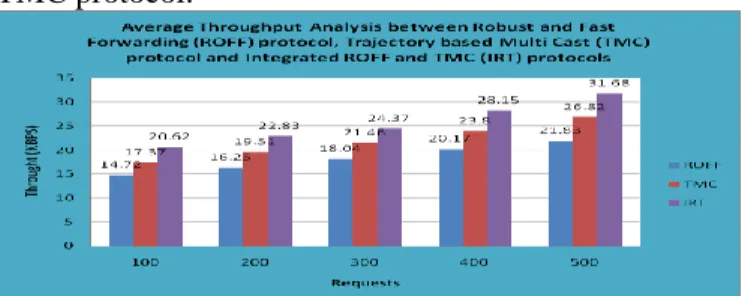
They are average throughput, delay and average traffic rate parameters. The average throughput parameter is estimated with the average data transmission rate values. Figure 6.1. shows the average throughput analysis between Robust and Fast Forwarding (ROFF) protocol, Trajectory based Multi Cast (TMC) protocol and Integrated ROFF and TMC (IRT) protocols. The TMC protocol increases the throughput 20% than the ROFF protocol. The IRT protocol increases the throughput level 15% than the TMC protocol.
Figure 6.1. Average Throughput Analysis between Robust and Fast Forwarding (ROFF) protocol, Trajectory based Multi Cast (TMC) protocol and
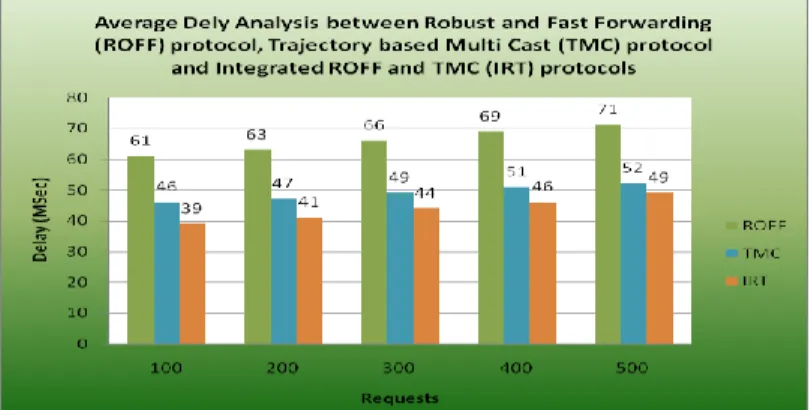
35 Figure 6.2. Average Delay Analysis between Robust
and Fast Forwarding (ROFF) protocol, Trajectory based Multi Cast (TMC) protocol and Integrated
ROFF and TMC (IRT) protocols
The data transmission delay is calculated with the difference between the requested time and delivered time values. Figure 6.2. shows the average delay analysis between Robust and Fast Forwarding (ROFF) protocol, Trajectory based Multi Cast (TMC) protocol and Integrated ROFF and TMC (IRT) protocols. The TMC protocol reduces the average delay 25% than the ROFF protocol. The IRT protocol reduces the average delay 10% than the TMC protocol. The traffic rate parameter is analyzed to measure the messages during the data transmission process. Figure 6.3. shows the average traffic rate analysis between Robust and Fast Forwarding (ROFF) protocol, Trajectory based Multi Cast (TMC) protocol and Integrated ROFF and TMC (IRT) protocols. The TMC protocol reduces the average traffic rate 20% than the ROFF protocol. The IRT protocol reduces the average traffic rate 10% than the TMC protocol. The analysis result shows that the IRT protocol produces better performance than the ROFF and TMC protocols.
Figure 6.3. Average Traffic Rate Analysis between Robust and Fast Forwarding (ROFF) protocol, Trajectory based Multi Cast (TMC) protocol and
Integrated ROFF and TMC (IRT) protocols
7. Conclusion
Vehicular Ad hoc networks (VANET) are constructed to manage communication between vehicles. Robust and Fast Forwarding (ROFF) protocol is used to handle data dissemination process. Trajectory based MultiCast (TMC) protocol is applied for multicast data delivery process. The system integrates the ROFF and TMC protocols with security features. The system supports faster and reliable data delivery scheme with security. The vehicular ad-hoc network communication system controls the collision and latency in data dissemination process. Data transmission is handled without the central information management authority. Multicast and broadcast operations are integrated in the VANET data communication process.
REFERENCES
[1] S. Panichpapiboon and W.Aattara-Atikom, “A Review of Information Dissemination Protocols For Vehicular Ad Hoc Networks,” IEEE Commun. Surveys Tuts., vol. 14, no. 3, pp. 784–798, 3rd Quarter 2012.
[2] Dedicated Short Range Comm. (DSRC) home, http://www.leearmstrong.com/dsrc/dsrchomeset.htm, 2014.
[3] J. Sahoo, P. K. Sahu and M. Gerla,
“Binary-Partition Assisted MAC-Layer Broadcast For
Emergency Message Dissemination in VANETs,” IEEE Trans. Intell. Transportation Syst., vol. 12, no. 3, pp. 757–770, Sep. 2011.
[4] R. Chen, W.-L. Jin and A. Regan, “Broadcasting Safety Information In Vehicular Networks: Issues And Approaches,” IEEE Netw., vol. 24, no. 1, pp. 20–25, Jan./Feb. 2010.
[5] D. Zhang and C. Yeo, “Enabling Efficient Wifi-Based Vehicular Content Distribution,” IEEE Trans. Parallel and Distributed Systems, vol. 24, no. 3, pp. 479-492, Mar. 2013.
[6] A. Miloslavov and M. Veeraraghavan, “Sensor Data Fusion Algorithms for Vehicular Cyber-Physical Systems,” IEEE Trans. Parallel and Distributed Systems, vol. 23, no. 9, pp. 1762-1774, Sept. 2012.
[7] Q. Yuan, I. Cardei, and J. Wu, “Predict and relay: An efficient routing in disruption-tolerant networks,” in Proc. 10th ACM Int. symp. MobiHoc, New York, NY, USA, 2009.
36
[9] A. Chaintreau and N. Ristanovic, “The age of gossip: Spatial mean field regime,” in Proc. SIGMETRICS, New York, NY, USA, 2009.
[10] W. Kim and M. Gerla, “Cognitive Multicast with Partially Overlapped Channels in Vehicular Ad Hoc Networks,” Ad Hoc Networks, vol. 11, pp. 2016-2025, 2012.
[11] H. Yomogita, Mobile GPS Accelerates Chip
Development, http://
techon.nikkeibp.co.jp/article/HONSHI/20070424/1316 05/, 2014.