COMPARATIVE STUDY REGARDING THE ADRENOCORTICOTROPIC
HORMONE (ACTH) EFFECTS ON MILK PRODUCTION
IN EWES AND SOWS
CODREANU IULIANA Faculty of Veterinary Medicine Bucharest, Splaiul Independentei, No. 105, emai : [email protected]
Key words: ACTH, milk production, sows, ewes
ABSTRACT
In this study were performed investigations about the ACTH implications in initiation and development of milk production in ewes and sows, and its relation with the milk production. In order to emphasize the impact of the ACTH on the tissues involved in lactopoiesis, we have chosen to evaluate the effects of Cortrosyn (commercial product containing Adrenocorticotropic Hormone) in these two species. Experimental investigations of ACTH were performed, through serially administration, beginning with the first day after farrowing to 2 week after farrowing. Milk production was monitored after the treatment, through the lambs and piglets weight.
After the treatment with Cortrosyn, the average weight of the lambs and piglets raised in comparison with the control group and also regarding the milk production, it was recorded a constant elevation of the main milk constitutions, especially of the lactose.
INTRODUCTION
Because an intense lactogenesis is associated with a positive maternal behavior, we considered it appropriate to study and quantify the implications of ACTH in milk production and mammary gland development, comparative in two species.
We determined indirectly the maternal behavior in lactating ewes and sows from experimental and control groups by establishing the average weight of lambs/piglets at birth and at weaning, because a higher lambs/piglets weight, reflects a higher milk production, which ultimately means better maternal behavior expressed (Acatincăi, 2003).
An indirect determining of ACTH effect of milk secretion in ewes and sows from this experiment, and while on maternal behavior was performed by following the dynamics of comparative weight and daily gain of the lambs and piglets from the two groups (McKusick et al 2001). In this context, the experimental studies from this paper try to highlight the implications of the ACTH (Cortrosyn) on the secretory function of the mammary gland in ewes and sows (Dojana, 2013).
In accordance with the general implications of ACTH in various metabolic
processes, and also the implications of this hormone in maintaining and stimulating the milk production in other species (Keller & Wood, 2008, Young et al, 2013 ), the results of this study try also to highlight the effects on the synthesis of the main milk constituents -carbohydrates, lipids and proteins.
The ewes and sows from the two experimental groups were selected so that all calved on the same day and all have the same number of births. In previous calving, the sows from the experimental group were farrowed the same number of piglets.
In both species, Cortrosyn was administered intramuscularly in dose of 1 mg, every other day, from the first day after farrowing, until day 14 of lactation (Nueleanu, 2008). On the day of birth, each lambs and piglet were weighed separately and after, was calculated the weight of each group at farrow. Lambs and piglets from the control and experimental groups were weighed on days 3, 10 and 21 after calving, calculating finally group weaning weight and the average daily gain/lamb/group and average daily gain/piglet/group (Haussmann, 2000).
Also, for this purpose have been performed investigations regarding the correlation of the main constituents of milk, after ACTH administration. The milk samples were taken at 14 days after calving.
The results were statistically processed, obtaining the average and the standard error of the average (X±Sx). For statistical signification assignment, the differences between groups were compared throughStudent Test.
RESULTS
The milk production in ewes and sows from the experimental groups was monitored (after the treatment with Cortrosyn), indirectly, through the lambs and piglets weight (Pugh, 2002, Voila 2005). After weighing all the lambs and piglets from the experimental groups and from the control groups, and by calculating the average weight at farrow and at weaning and the average daily gain/lamb and piglet, are found some changes with statistical significance (P<0.05) in some cases, which are listed below.
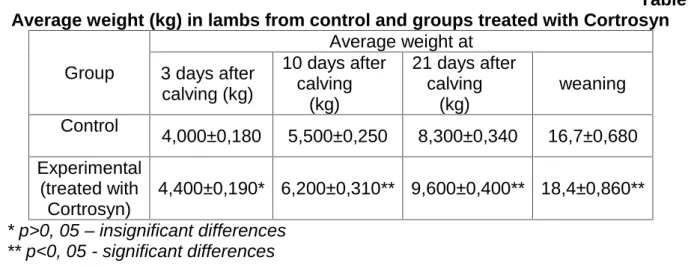
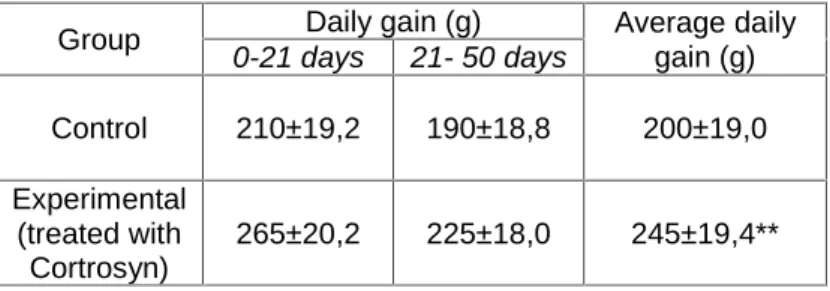
Analyzing primary data, presented in tables 1-2, shows a positive correlation between maternal behavior in sheep, milk production and administration of the ACTH hormone (in the form of commercial preparation Cortrosyn Depot).
Comparing the average weight per group at weaning and average daily gain on the entire period of lactation, we can see that in lambs from the experimental group, these parameters were significantly higher (P<0.05) compared with the control group (Haussmann, 2000).
Table 1 Average weight (kg) in lambs from control and groups treated with Cortrosyn
Group
Average weight at
3 days after calving (kg)
10 days after calving
(kg)
21 days after calving
(kg)
weaning
Control
4,000±0,180 5,500±0,250 8,300±0,340 16,7±0,680
Experimental (treated with
Cortrosyn)
4,400±0,190* 6,200±0,310** 9,600±0,400** 18,4±0,860**
Table 2 Comparative results of average daily gain of lambs from control group and
experimental group treated with Cotrosyn, during lactation period (g/day)
* p>0, 05 – insignificant differences ** p<0, 05 - significant differences
In the same time, the average weight of piglets derived from sows group treated with Cortrosyn, (6.68 kg) is also significantly higher statistically (P<0.05), compared to the control group (6,1 kg). Indirect determination of ACTH effect on the milk secretion (by following the dynamics of body weight piglets) in sows, is expressed in Figure 1.
Figure 1. The average weight in piglets from control group and experimental group at weaning
The average daily gain of piglets derived from sows treated with Cortrosyn. (Fig. 2) was 237.8 g/day, and noted a significant increase (P<0.05) compared with those from the control group (Haussmann, 2000).
190 200 210 220 230 240
205,2 237,8
G1 - control group
G2 (experimental group – treated with Cortrosyn) g
Group Daily gain (g) Average daily
gain (g)
0-21 days 21- 50 days
Control 210±19,2 190±18,8 200±19,0
Experimental (treated with
Cortrosyn)
265±20,2 225±18,0 245±19,4**
0 1 2 3 4 5 6 7
the average weight at weaning (kg)
6,1
G2 (experimental group – treated with Cortrosyn) G1 - control group 6,68
By analyzing the results obtained after the determination of the main milk constituents in ewes and sows from experimental groups, were recorded differences obviously consistent in comparison with the results obtained in other studies (Haussmann, 2000).
Thus, the ACTH effects on the synthesis of the main milk constituents (lactose, lipids, proteins), it was found that this hormone induces a marked and constant increasing of the major constituent of milk, in particular lactose (Tables 3-4).
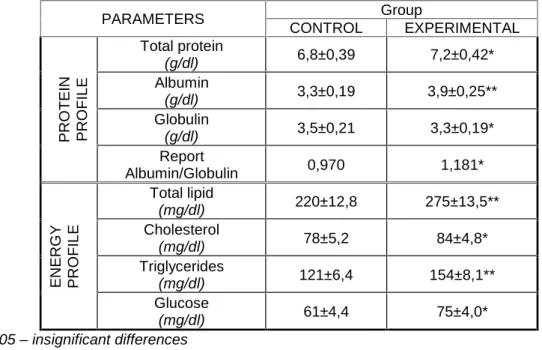
Dosing the biochemical parameters in sheep from the control and experimental groups (Table 3), revealed the existence of significant increases (P<0.05) in average values of albumin, total lipids and triglycerides in sheep from experimental group, increases which probably was reflected in milk composition of these sheep.
It can be observed a positive correlation between maternal behavior in sheep, milk production and administration of ACTH hormone (in the form of commercial preparation Cortrosyn Depot).
Also, a significant increasing (P<0.05) in milk lactose compared with values obtained in the control group (Table 4), was registered in the case of sows treated with Cortrosyn (5.64 g/100 g milk).
Table 3 Average values of protein and energy profiles in ewes from control group and
experimental group treated with Cortrosyn
PARAMETERS Group CONTROL EXPERIMENTAL P RO T E IN P RO F IL E Total protein
(g/dl) 6,8±0,39 7,2±0,42*
Albumin
(g/dl) 3,3±0,19 3,9±0,25**
Globulin
(g/dl) 3,5±0,21 3,3±0,19*
Report
Albumin/Globulin 0,970 1,181*
E NE RG Y P RO F IL E Total lipid
(mg/dl) 220±12,8 275±13,5**
Cholesterol
(mg/dl) 78±5,2 84±4,8*
Triglycerides
(mg/dl) 121±6,4 154±8,1**
Glucose
(mg/dl) 61±4,4 75±4,0*
* p>0, 05 – insignificant differences ** p<0, 05 - significant differences
Table 4 The average values of the main milk constituents in sows from the experimental and
control groups Species Specification Lactose (mg/dl) Lipids (mg/dl) Protein (g/dl) SOWS G1
(Control group) 4.74±1.2 8.20±1.6 5.72±1.4
G2
(Experimental group –
treated with
* p>0,05 – insignificant differences ** p<0, 05 - significant differences
Increasing in average values of milk lipids was recorded in the sows from the experimental groups, obtaining an average value/group of 8.88 g lipids/100 g milk (P>0.05) in comparison with the control group (8.20 g lipids/100 g milk).
CONCLUSIONS
The main purpose of this study was to investigate the ACTH effects on milk production (indirectly by establishing the weighted gain in piglets) and on milk composition in lactating ewes and sows.
The average weight at weaning and the average daily gain in lambs and piglets originate from ewes and sows treated with Cortrosyn, were significantly higher (P>0.05), compared with those from the control group.
Although administration of Cortrosyn Depot in ewes and sows has not generated clinical changes of any treated animal, we observed significant increases (P<0.05) of average values of serum biochemical parameters in ewes from experimental group (albumin, total lipids and triglycerides).
The comparative analyzing of the obtained results, reveals that the Cortrosyn treatment in sows, induced an obvious and constant increase of the main milk constituents, with statistical significance (P<0.05) in case of lactose and insignificant (P>0.05) in case of lipids and protein.
Comparing the results of treatment with ACTH (Cortrosyn) in lactating ewes and sows, it can be concluded that these administration induces an obvious increasing of the average body weight at weaning and of the daily gain, in the studied species (in lambs and piglet). Cortrosyn Depot administration in sheep and sows is a clear demonstration of the lactogenic role of the ACTH in this species.
REFERENCES
Acatincăi Stelian (2003) – Etologie – Comportamentul animalelor domestice – ed.
Eurobit, Timişoara
Dojană, N. (2013) – Tratat de fiziologia animalelor domestice si etologie, Ed. Printech,
Bucureşti
Haussmann, M , J. A. Carroll, G. D. Weesner, M. J. Daniels, R. L. Matteriand, D, C, Lay Jr. (2000) - Administration of ACTH to restrained, pregnant sows alters their pigs' hypothalamic-pituitary-adrenal (HPA) axis. J ANIM SCI. September, vol. 78 no. 9, 2399-2411.
Keller-Wood M, Wood C.E.(2008) - Regulation of maternal ACTH in ovine pregnancy:
does progesterone play a role?Am. J. Physiol. Endocrinol. Metab. Oct;295(4):E913-20.
McKusick BC, Thomas DL, Berger YM. (2001) - Effect of weaning system on
commercial milk production and lamb growth of East Friesian dairy sheep. J Dairy Sci.;84(7):1660-8.
Nueleanu Veturia-Ileana(2008) -Farmacologie veterinară, Ed. Risoprint, Cluj-Napoca.
Pugh G.(2002) -Sheep & goat medicine. Elsevier Health Sciences