255
STUDY ON FALSIFICATION AND THE TYPES OF FALSIFICATIONS
DETECTED IN THE WINES IN DOLJ COMMERCIAL NETWORK
VLADU CRISTINA EMANUELA(1), BĂDUCĂ CÂMPEANU CONSTANTIN(2)
(1) DIRECTION FOR AGRICULTURE OF DOLJ COUNTY - I.S.C.T.V., ION MAIORESCU,
NR. 4, CRAIOVA, ROMANIA (2) UNIVERSTY OF CRAIOVA FACULTY OF AGRICULTURE AND HORTICULTURE,
LIBERTY STREET, NR. 19, CRAIOVA, ROMANIA
Keywords: falsifications,nonconformities, official control
ABSTRACT
The official control of wine products is done by the speciality inspector of the State Inspection for the Technical Wine Control.
The aim of the study is to analyse: the types of nonconformities existing in the wines displayed for marketing, the number of wine samples with detected additions that are not allowed, the geographic area that they come from and the evolution of nonconformities during the studied period.
The analysis of the wines existing in the commercial network of Dolj County during the period 2006-2012 highlights nonconformities and falsifications of the wines through the dilution of the wine with water, through hiding some faults or alterations of the wine, through additions and the use of any practices that are illegal according to the current wine law.
INTRODUCTION
Frauds in wine production are as old as the wine itself, and the means used by falsifiers have an impressive variety (Nămoloşanu Ion, Antoce Arina Oana, 2005).
Most of the cases, falsifications do not harm wine’s innocuity, but it distorts its characteristics and affects consumer’s image and trust in the naturalness of the product (Bulancea Mircea, Gabriela Râpeanu, 2009).
Wine should be cherished as it is in its natural state, with the content of substances harmoniously balanced, with the perfume and raciness preserving the memory of the place and time when it was produced (Popa Aurel, 2008).
Knowledge of wine’s chemical composition in compliance with the standards admitted by wine-growing regulations is very important in order to detect the nonconformities and especially falsified, which made the object of detected additions that are not allowed.
Evaluation of wines’ naturalness is made by analysis of physical and chemical parameters in agreement with the requirements of the legal standards of these products and the information on the product’s label (Vicol Constanţa, 2011).
In order to obtain consumer’s trust, authenticity, as a component part of the quality, it should be certain and certified (Stoian Viorel, 2001, Popa A, 2012).
MATERIAL AND METHOD
The study was carried out on a number of 190 wine samples taken during the period of 2008-2012 from different economic agents carrying out wine marketing activities – bulk and bottled- in Dolj County by the wine inspectors within the State Inspection for Dolj Technical Wine Control.
256
sugar content, obtained by wine producers, natural and legal persons in Romanian vineyards.
Also, in a lower percentage, import wines or from inter-community trade intended for marketing in Dolj County.
The official control of physical, chemical and organoleptic parameters in wines sampled by I.S.C.T.V. inspectors from different economic agents who carry out wine marketing – bulk and bottled- in Dolj County was carried out in one of the five approved laboratories of the Ministry of Agriculture and Rural Development, which meet the general criteria for operation of testing laboratories established by the ISO/CEI 17025 standard, nominated in Annex 1 of Order no. 272 of December 9th, 2010.
For every wine sample taken, a laboratory test report or a test report was issued, in which their most important chemical features were stated, so as to certify the authenticity, respectively: relative density, alcohol content acquired, total acidity, volatile acidity, total dry and non-reducing extract, total and reducing sugar content, citric acid, free and total carbon dioxide, identification of synthetic coloring agents, etc.
RESULTS AND DISCUSSIONS
From 190 samples of wine taken, 89 samples were of bulk wine, approved for sale in authorised stores which sell bulk wine according to H. G 1134 since 2002 and, from 2010, The 224 art fro 2010, the rest of the 101 samples were samples of bottled wine. Concerning the proportion of samples analysed depending on the color of the wine, it was about 50%, i.e. 96 samples of white wine and 94 samples of red wine.
Table 1 Analysed samples situation according to the year of sampling and analysis,
marketing, form and sugar content
Year Samples number
From which: From which: From which:
Bulk Bottled White Red Dry
Semi-dry
Semi-
soft Soft
2006 36 23 13 19 17 15 8 12 1
2007 33 20 13 17 16 12 11 9 1
2008 14 6 8 7 7 3 5 4 2
2009 42 19 23 23 19 13 14 12 3
2010 18 3 15 11 7 5 5 8 0
2011 31 16 15 14 17 7 11 11 2
2012 16 2 14 5 11 3 8 5 0
Total 190 89 101 96 94 58 62 61 9
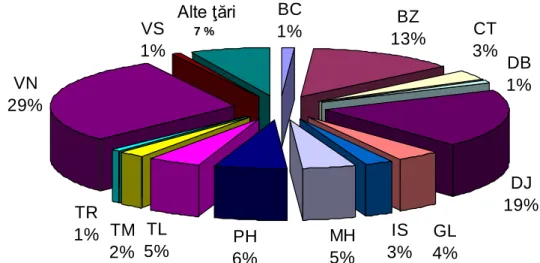
Sample distribution according to the origin reveald that most of the wine analysed samples, bulk or bottled , were produced by the economic agents of the Vrancea County-55, Dolj county-37, County-25 samples, other counties: Mehedinti, Prahova, Constanta, Galaţi, Iaşi, Bacău, being less represented.
257
Table 2 The situation of the analysed samples depending on the county or country
where they have been produced and/or imported
Year BC BZ CT DB DJ GL IS MH PH TL TM TR VN VS
Bu
lgari
a
R.
Mold
o
va
S
p
ania
Au
stria
It
ali
a
T
o
tal
n
aţio
n
al
T
o
tal
int
er
n
aţ.
T
o
tal
g
rand
2006 1 4 1 1 4 0 0 5 0 3 1 0 13 1 0 2 0 0 0 34 2 36 2007 0 2 0 0 8 0 0 1 5 0 1 0 10 0 0 3 2 1 0 27 6 33 2008 0 3 0 0 4 0 0 0 2 0 0 0 3 0 0 1 0 0 1 12 2 14 2009 1 6 0 1 14 1 2 1 1 5 0 0 9 1 0 0 0 0 0 42 0 42 2010 0 5 1 0 2 1 1 0 0 0 0 0 8 0 0 0 0 0 0 18 0 18 2011 0 2 4 0 3 1 1 2 4 0 2 2 10 0 0 0 0 0 0 31 0 31 2012 0 3 0 0 2 4 1 0 0 1 0 0 2 0 3 0 0 0 0 13 3 16 Total 2 25 6 2 37 7 5 9 12 9 4 2 55 2 3 6 2 1 1 177 13 190
BC
1% 13%BZ
IS 3% MH
5% PH
6% TL
5% VN
29%
TM 2%
Alte ţări
7 %
TR
1% GL
4%
DB 1% CT 3% VS
1%
DJ 19%
Fig 1 The situation of analysed sample distribution
Following the analysis of 190 wine samples in terms of organoleptic and physicochemical, in one of the five official control laboratories of the Ministry of Agriculture and Rural Development, there were discovered various nonconformities in a number of 71 samples, these representing a percentage of 37% of the total analyzed samples.
258
Table 3 The situation of non-compliant samples collected in 2006-2012 from commercial
network in Dolj county
Year Total collec ted From which Non conf sample s acc. to organol eptic analyse s Sampl es that not fit acc to sugar
No. of samples with detected additions that are not allowed
No. of nonconforming samples in terms of
composition Color sants additi on Sugar additi on Citic acid additi on Water addtio n Val. ext. < Val. conc alc. < Val. ac. tot. < Addti on wine hibrid Com. sampl es Non- com. sampl es
2006 36 15 21 3 2 4 1 7 2 1 - - 1
2007 33 21 12 5 2 - - 2 - 2 1 - -
2008 14 8 6 3 1 - - - 2 - -
2009 42 25 17 6 1 - 4 1 1 2 2 - -
2010 18 13 5 2 1 - - 1 - - - 1 -
2011 31 28 3 2 1 - - - -
2012 16 9 7 1 - - - 2 - 3 - 1 -
Total 190 119 71 22 8 4 5 13 3 8 5 2 1
In terms of unpermitted additions, unfortunately, wine along with many other types of food, has been the target of forger acts.
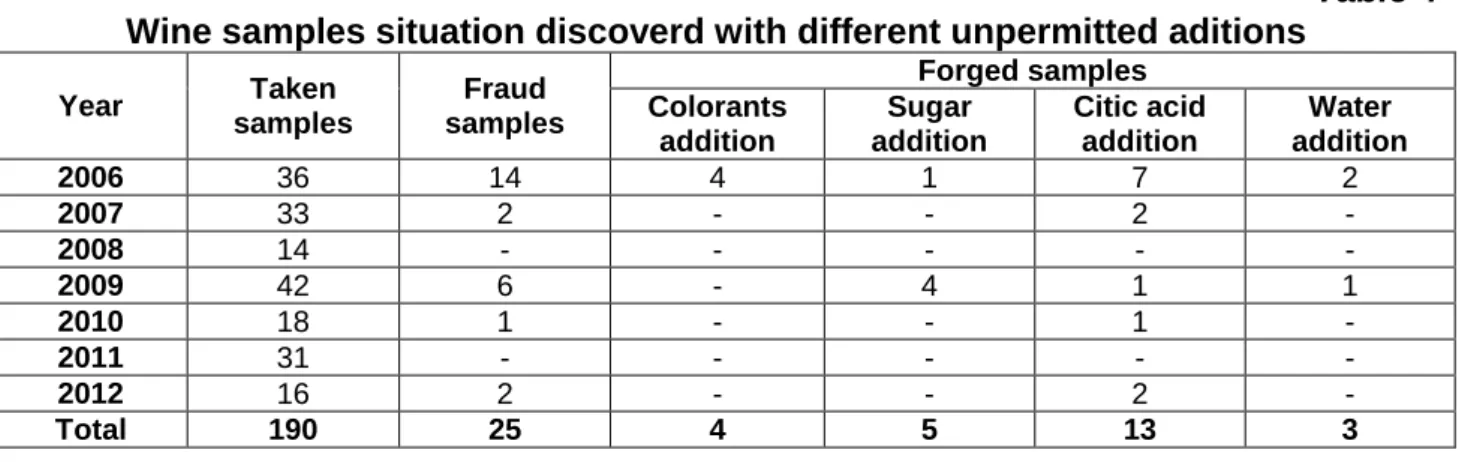
From 190 wine samples taken,the results of laboratory tests showed that 25 of them were the target of fraud. The most common practices of fraud encountered at the wines from Romania, Dolj county in general and, in particular, are: the addition of citric acid, addition of natural or synthetic sweeteners, the addition of colorants and water addition.
Table 4 Wine samples situation discoverd with different unpermitted aditions
Year Taken
samples Fraud samples Forged samples Colorants addition Sugar addition Citic acid addition Water addition
2006 36 14 4 1 7 2
2007 33 2 - - 2 -
2008 14 - - - - -
2009 42 6 - 4 1 1
2010 18 1 - - 1 -
2011 31 - - - - -
2012 16 2 - - 2 -
Total 190 25 4 5 13 3
Analising the forged wine samples according to their selling method,bulk or bottled, it was discovered that from the 25 samples, 13 samples of bulk wine and 12 samples of bottled wine were forged.
Table 5
Wine sample situations detected forged according to packing manner
Year Taken samples Forged samples From which
Bulk Bottled
2006 36 14 7 7
2007 33 2 2 -
2008 14 - - -
2009 42 6 4 2
2010 18 1 - 1
2011 31 - - -
2012 16 2 - 2
259
The study showed that the forgeries were made almost as much to white wines and red/rose wines.
Table 6 Wine sample situation detected counterfeit depending on color
Year Taken samples Forged samples From which
White wine Red/rose wine
2006 36 14 7 7
2007 33 2 1 1
2008 14 - - -
2009 42 6 4 2
2010 18 1 1
2011 31 - - -
2012 16 2 - 2
Total 190 25 13 12
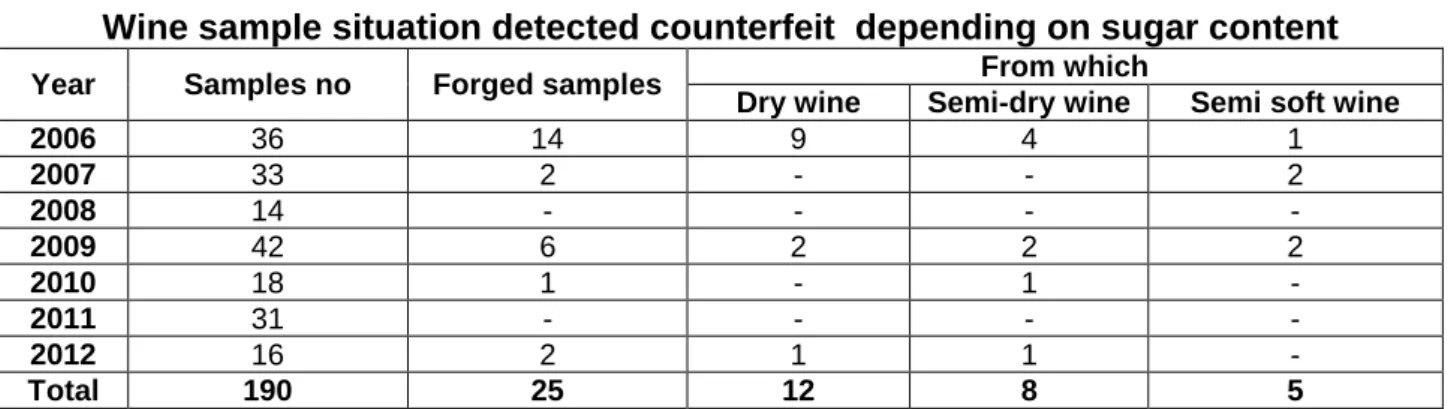
From 25 samples of counterfeit/forged wine, it was found a greater number of fraud related to the dry wines,12 samples, followed by demi-dry wine 8 samples and 5 samples of semi-soft wine.
Table 7 Wine sample situation detected counterfeit depending on sugar content
Year Samples no Forged samples From which
Dry wine Semi-dry wine Semi soft wine
2006 36 14 9 4 1
2007 33 2 - - 2
2008 14 - - - -
2009 42 6 2 2 2
2010 18 1 - 1 -
2011 31 - - - -
2012 16 2 1 1 -
Total 190 25 12 8 5
The distribution of the 25 samples of counterfeit wine, in the seven years of study, according to the origin of county of the producer or bottler, it highlights Dolj county and Vrancea county with 8 and 7 samples wine, followed very close by Tulcea , 5 samples.
Counterfeit wine samples producted and/or bottled in one county are coming from one or several manufacturers.
Table 8 Wine samples distribution detected counterfeit according to the origin county Year Taken
samples
Counterfeit samples
From which Bacău
County
Buzău County
Dolj County
Tulcea County
Vrancea County
Galaţi County
R. Moldova
2006 36 14 1 - 3 3 6 - 1
2007 33 2 - - 1 - 1 - -
2008 14 - - - -
2009 42 6 - - 4 2 - - -
2010 18 1 - - - 1 -
2011 31 - - - -
2012 16 2 - 2 - - - - -
Total 190 25 1 2 8 5 7 1 1
For all nonconformities identified by wine inspectors from State Inspection for Technical Supervision of the wine, Dolj county applied sanctions or criminal proceedings provided by the current legislation .
260
100 000 lei lei, and falsifying the wines, displaying for sale and/or selling them knowing that they are forged it is an offenceand it will be punished under the criminal code, through the drawing up of criminal cases.
CONCLUSIONS
Unhappily, wine, as almost all the products intended for commerce, was the target of actions of falsification and counterfeit.
After the analysis of the 190 wine samples from the organoleptic, physical and chemical points of view, we identified deviations from the current legal provisions with a number of 71 samples, these representing 37% of all the analysed samples.
Of the 190 wine samples 25 samples had forbidden additions, their percent being of about 13.
Among the most frequent fraudulent practices used in commercialized wines in Dolj County are: the addition of citric acid over the maximum limit – 13 samples, the addition of natural or artificial sweeteners – 5 samples, the addition of coloured substances – 4 samples and the addition of water 3 samples.
The counties with most falsified wines are: Dolj, Vrancea and Tulcea, which also have the widest areas of vineyard.
The analysis of the wines in the commercial network during the period of this study, that is 2006-2012, highlights a progressive reduction of the number of falsified wine samples, a fact due to the intense control by the wine inspectors of the State Inspection for the Technical Wine Control and to the establishment of five laboratories for the official wine control by the Ministry of Agriculture and Rural Development.
The economic agents who used fraudulent oenological practices received contravention fines, according to the wine law in effect that year or, depending on the gravity of the deed, they were punished according to art. 313 and 297 of the Penal Code. Considering that certain wine producers were detected and fined more.
BIBLIOGRAPHY
1. Bulancea Mircea, Gabriela Râpeanu, 2009 - Authentication and identification of
counterfeit foodstuffs,Didactic and Pedagogic Publishing House, R.A, Bucharest.
2. Nămoloşanu I., Antoce Arina, 2005 - Oenology Fraud control and prevention, Ceres,
Bucharest.
3. Popa Aurel, 2008 - The secret of a good wine. Contributions and refunds, ALMA
Publishing House, Craiova.
4. Popa Aurel, 2012 - The Viticulture from Oltenia between reconstruction and
development, ALMA Publishing House Craiova;
5. Stoian Viorel, 2001 - The great book of wine tasting, Artprint, Bucharest
6. Vicol Constanta 2011 - Researches on the wine authenticity and genuineness in the
wineyards from Moldova, Doctoral Thesis, Dunarea de Jos University "Galati.
* 2002, Law No. 244 of wineyard and wine in the common organisation of the market in wine of 27 April 2002, Official Gazette of Romania, part I, no. 333/20th May 2002.
* 2002, 769 decree from 28th of July 2010 approving the methodological Norms of the law on wineyard and wine. 244/02, Official Gazette of Romania, part I, no. 798/4th November 2002.
*** 2008, the Minister of Agriculture no. 224 of 7 April 2008 approving the Methodological Norms regarding the conditions of retail table bulk wine.