124
RESEARCHES ABOUT THE PHOSPHORUS REGIME FROM
AGRICULTURAL ECO-MEDIUM IMPROVED BY THE SEWAGE SLUDGE
IONESCU N.1, MUJEA G.2, MARILENA DIACONU2,
ANA IORDĂNESCU2
, IONESCU S.G.3
1Agricultural Research and Development Station PITEŞTI; 2 Wastewater Treatment Plant PITEŞTI; 3University of Agricultural Sciences and Veterinary Medicine BUCHAREST
Corresponding author: [email protected]
Key words: phosphorus, sludge, maize, wheat, soybeans
ABSTRACT
Together with other chemical elements: macronutrients and micronutrients, phosphorus (P) take active part in plant nutrition. The application of waste sludge increased P contents in both soil and plants. The study of macronutrient was done in terms
of sludge doses increased from 0-50 t.ha-1, with and without chemical fertilizers. For white
luvic-soil sensitive growth were observed with near- normal oscillations of the average concentrations of total P. Mobile forms of phosphorus have seen significant growth, with coefficient of correlation between 0.309 for maize, the wheat 2 0.152, 0.691** for soybean
and 0.923*** for wheat 4. However, phosphorus ions (H2PO4-) were specifically absorbed
by the crop: maize, winter wheat and soybeans. The correlations obtained between P concentrations in plants with sludge doses, showed increases in quite all cases: statistically ensured in maize leaves, flowering period (0.776***), insignificant for wheat 2 and soybean, except wheat 4 (-0.283), and partially decreases in maturity period (in grains), insignificant for wheat 2 and 4, significant for soybean (-0.643**), and one exception for maize with r = 0.700**.
INTRODUCTION
Together with nitrogen (N) and potassium (K), phosphorus (P) is considered as the major element in plants’ nutrition. However, P is present in soil in low amounts, that is between 0.030 and 0.240 % in the arable horizon (Hera, 1988). Besides, taking into account its tendency to react with soil components and subsequently forming relatively insoluble compounds, a certain unavailability of this element appears in case of crop plants. In the light of these reasons, P has a clear major importance in the specific nature of soil fertility. Native phosphorus from soils mainly comes from disintegration and decomposition of rocks containing apatite: Ca10(PO4)6(Fe,Cl,OH)2. P is present in the soil, finely divided, in the form of fluoride-apatite, hydroxyl-apatite or chlorine-apatite, as well as Fe- and Al-phosphates, or in combinations with clay fractions. This native P is combined with humus and organic fraction. P forms in the crop eco-environment are of organic and inorganic nature. The organic fraction is in humus and any other organic material that can be associated or not with P (Tisdale, 1975).
125
resulting in P mobile in SSol are mainly the following: de-sorption of phosphate ions labile absorbed on colloids, dissolution in Soil (of calcium salts and sescvioxydes of phosphoric acid) and diffusion (Nye, 1979). Several factors have an impact on the assimilated P although it reaches a stable equilibrium with unassimilated forms (Lindsay, 1960), affecting the normal physiological process of phosphorus absorption and translocation in plants. The most important are: pH, climate by precipitations and temperature values, fertilization system, history of plants cultivation systems. Researches indicated that for low pH values (predominant acidic environment) primary orthophosphate ion’s absorption increases: H2PO4-, a situation frequently encountered in the area of Piteşti resort. The secondary orthophosphate ion (HPO42-) is absorbed under neutral even alkaline soil reaction. In acidic soils, phosphate ions’ passing (unlike de-sorption and dissolution) may be positively influenced (Borlan, 1994) by hydrolyzed colloid reaction: Al(OH)2H2PO4 ↔ +OH-, -OH- » Al(OH)3+H2PO4-. In plants, P has three distinct stages: i) inorganic P is absorbed and combined with organic molecules or radicals, ii) primary phosphorylated compounds transfer the phosphoryl group towards other molecules by trans-phosphorylation and iii) phosphate or pyrophosphate is fractioned in intermediate phosphorylates, also by substitution of an organic radical or simply by fraction. The energy source necessary for the phosphate incorporation into organic combinations is the potential energy of oxidation- free reduction within the oxidative metabolism. The phosphate compounds of the plant have a major role in many processes: photosynthesis, carbohydrate, glycolysis, amino- acids, fats and sulphur metabolism, various biological oxidation processes. Regarding the necessity of ensuring P for plants, we also have to notice that the recovery rates of active ions SSol concentration become stringent because plants do not uniformly absorb P from the entire soil mass. Ensuring SSol, as constantly and concentrated as possible, with phosphate ions has as a purpose providing these ions to maize during the entire period of vegetation (Borlan, 1994). The present experiment with urban domestic sludge could create improved nutrition of crop plants, due to its high level in this vital MACROn - phosphorus.
MATERIALS AND METHODS
12205-126
84, P- mobile forms (PMF) of ground- PAL, both over sludge an-aerobically digested and over soil and plants. The data were statistically processed by analysis of the variant (Anova test) and with the help of correlations and regressions.
RESULTS AND DISCUSSIONS
Phosphorus contents in the cultivation environment (soil). Ground measurements performed revealed macronutrient forms both by total and by mobile forms. Total soil phosphorus values ranged from average to be considered good (table 1). Thus, in the four years PTF ranged between 0.0607 and 0.0733 %, and PMF between 35 and 92 mg.kg-1 d.w.
Table 1 The phosphorus contents from soil , total forms (%) and mobile ones (mg.kg-1 d.w.)
P / crop Maize Wheat 2
Soybean Wheat 4
Normal
PTF, % PMF, mg.kg-1
d.w. 0,0607 35 0,0733 48 0,0721 47 0,0722 92 0,030-0,240 7-228
Due to the positive effect of waste sludge introduced into the soil, phosphorus PMF has evolved highly significant positive (figure 1). Depending on the dosage used PMF evolved from 33 mg.kg-1 d.w. of control at 37 mg.kg-1 d.w. in large doses for maize, between 44-51 mg.kg-1 d.w. for wheat from second year, between 39-55 mg.kg-1 d.w. for soybeans, and between 47-137 mg.kg-1 d.w. the wheat from last year.
Influence of experimental factors on the content of P in leaves and grains. Given the favorable conditions in the cultivation soil, field plants absorbed P in the vegetative organs. Phosphorus is considered an essential micro- nutrient. P arrived in crop plants is promptly mobilized and used as such. In cases of lack or deficit of P, its content is rapidly transferred from older organs towards the active meristematic regions. Given the limits of this macronutrient: 0,1 to 0,4 %, plant analysis highlighted moderate concentrations of phosphorus. The correlations obtained between the total biomass and concentrations of P in the three plants
Figure 1. Phosphorus mobile forms (PMF) concentrations evolution from
agro-medium fertilyzed by sewage sludge
Maize
y = 0,3107x + 32,714 r = 0,309 0 10 20 30 40 50
0 5 10 15 20
Doses P , m g /k g d .w . m o b il e f o rm s Wheat,2
y = 0,4964x + 43,629 r = 0,152
0 20 40 60 80 100
0 5 10 15 20
Doses P , m g /k g d .w . m o b il e f o rm s Soyabean
y = 1,1643x + 38,019 r = 0,691** 0
20 40 60 80
0 5 10 15 20
Doses P , m g /k g d .w . m o b il e f o rm s Wheat, 4
y = 6,4536x + 40,371 r = 0,923***
0 50 100 150
0 5 10 15 20
127
Figure 2. Correlations between plant biomass and phosphorus content from leaves (PLV), flowering period
show significant increases in insurance and statistically significant only for maize (r=0.776***) (figure 2).
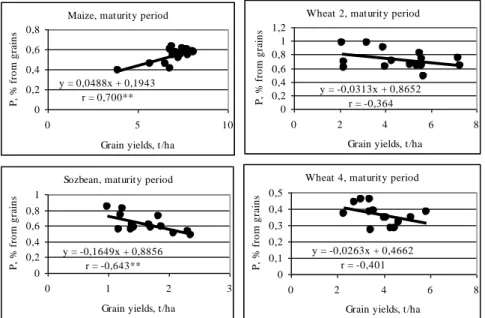
In the final phase- at maturity there was noticed that the plants have deposited P in grains. Representing one of the constitutive plants’ element, P was initially absorbed, transposed through entire plant, and contributed to a better physiology regime functioning, in the synthesis of carbohydrates, amino-acids, fats and oxidation processes, then P deposited into grains. Thus a P export phenomenon took place, from the cultivation environment into the grains. The P common ways of each crop plants are specific (figure 3).
Figure 3. Correlations between plant yields and phosphorus content from grains (PGR), maturity period
This demonstrates on one side that at maturity plants no longer need P, and their value was relatively variable compared with the grains production. With higher values of phosphorus from grain were determined in wheat 2 and soybeans, the lowest in wheat 4 and maize was intermediate.
Maize, flowering period
y = 0,0159x + 0,1272 r = 0,776*** 0 0,1 0,2 0,3 0,4 0,5
0 5 10 15 20
T otal biomass, t/ha
P , % f ro m l e a v e s
Wheat 2, flowering period
y = 0,0039x + 0,2189 r = 0,287 0
0,1 0,2 0,3 0,4
0 10 20 30
T otal biomass, t/ha
P , % f ro m l e a v e s
Soybean, flowering period
y = 0,0028x + 0,2151 r = 0,040
0 0,1 0,2 0,3 0,4
0 2 4 6
T otal biomass, t/ha
P , % f ro m l e a v e s
Wheat 4, flowering period
y = -0,0021x + 0,1572 r = -0,283 0
0,05 0,1 0,15 0,2
0 5 10 15 20
T otal biomass, t/ha
P , % f ro m l e a v e s
Maize, maturity period
y = 0,0488x + 0,1943 r = 0,700** 0
0,2 0,4 0,6 0,8
0 5 10
Grain yields, t/ha
P , % f ro m g ra in s
Wheat 2, maturity period
y = -0,0313x + 0,8652 r = -0,364 0 0,2 0,4 0,6 0,8 1 1,2
0 2 4 6 8
Grain yields, t/ha
P , % f ro m g ra in s
Sozbean, maturity period
y = -0,1649x + 0,8856 r = -0,643** 0 0,2 0,4 0,6 0,8 1
0 1 2 3
Grain yields, t/ha
P , % f ro m g ra in s
Wheat 4, maturity period
y = -0,0263x + 0,4662 r = -0,401 0 0,1 0,2 0,3 0,4 0,5
0 2 4 6 8
Grain yields, t/ha
128
CONCLUSIONS
Domestic sludge interfered in the P regime from agricultural ecosystem. Depending on doses used, with and without chemical fertilizers, P contents had increased as follows: moderate for total forms (PTF) and significant for mobile forms (PMF). Compared to the normal limit contained within 7-228 mg.kg-1 PMF, in the experiment there were obtained values between 33-137 mg.kg-1 d.w. PMF.
Having available good PMF concentrations, plants absorbed H2PO4- ions in specific quantities. Domestic sludge doses helped absorption in a direct and increasing relationship with it. Thus, in the flowering phase, plants leaves were containing in average between: 0.26-0.38 % PLV for maize, between 0.25-0.30 % PLV for wheat 2, 0.22-0.23 % PLV for soybean and between 0.14-0.13 % PLV for the wheat 4.
Phosphorus proved to be an indispensable macronutrient for plants’ life. It is relatively easily absorbed from the PMF rich soil, being trans-located in the entire plant and used in the multitude of specific bio-chemical processes. After fulfilling its specific physiological functions, P was stored into the grains, as final products of the plants raise-up and development processes. PGR content into grains was specific for the three plants and obviously at different levels compared to flowering phase. Thus, PGR oscillated between: 0.4-0.6 % in maize beans, 0.8-0.6 % in wheat 2 grains, 0.7-0.5 % in soybeans and 0.4-0.3 % last year, wheat 4 grains. These quantities represent the P export from soil fertilized with sewage sludge.
BIBLIOGRAPHY
Bertoldi M., Vallini G., Pera A. The biology of composting: a review. Waste Management & Research, 1: 157-176, 1983.
Borlan Z., Hera C., Dornescu D., Kurtinecz P., Rusu M., Buzdugan I., Tănase G. Fertilitatea şi fertilizarea solurilor (compendiu de agrochimie). [Fertility and Soils Fertilizing (Agrochemistry compendium)]. Editura Ceres, Bucureşti, 71-94; 138-155; 289-307, 1994.
Davidescu D., Davidescu V. Chimizarea agriculturii. Testarea stării de fertilitate prin plantă şi sol. [Agriculture chemistry. The testing of fertility state by plants and soil]. Editura Academiei RSR, Bucureşti, 246-253, 1972.
Davidescu D., Davidescu V. Agrochimia modernă. [Modern agro-chemistry]. Editura Academiei RSR, Bucureşti, 241-270; 306-308, 1981.
Lindsay W.L., Moreno E.C. Phosphate phase equilibrium in soils. Proceedings Soil Science Society of America (SSSA), 24(3): 177-182, 1960.
Nye P.H. Diffusion of ions and uncharged solutes in soils and clays. Advanced Agronomy, 31: 225-272, 1979.
Tisdale S.L. & Nelson W.L. Soil fertility and fertilizers. Macmillan Publishing Co., Inc., New York, USA, 66-73; 189-242, 1975.