169
RESEARCH REGARDING OXIDATION OF CLAY MINERALS
FROM SOILS OF ROMANIA
ILIE L., MIHALACHE M., GINA SCĂEȚEANU, MARIN D.I.
Keywords:soil, clay minerals, oxidation, crystallinity indices
ABSTRACT
An oxidation method with oxygenated water was used on the separated calcium saturated clay fractions and were estimated the concentrations of smectite and illite by means of X-ray diffraction patterns.
The used oxidation method with oxygenated water makes an alteration of all colloidal particles in suspension in contrast with the partial alteration in soil profile due to the structure and settling states of soil horizons.
The illite crystallinity indices are greater than those of smectite and show that illite has greater particles and higher ordering of atoms on broken surface and in lattice structure. This suggest a particle corrosion with a releasing of some structural elements and an accentuation of the illite→smectite transformation.
INTRODUCTION
The greatest part of the representative points are scattered in the graphs and show that the clay mineral content and their crystallinity are inherited from parental materials and the oxidation processes in soil. The oxygenated water change just a little the mineralogical properties.
The alteration processes of soil minerals are surface processes (Bartram S.F., 1967) which depend on the stability of each mineral (Bradley et al., 1961), their crystallinity, intensity of microbiological activity, composition and ionic strength of soil solution, the removing speed of alteration products from the surface mineral proximity, climate conditions.
In the present work were investigated in laboratory the effect of treatment with oxygenated water on the clay minerals by comparison of samples with or without treatment (Mihalache et al., 2009).
MATERIAL AND METHOD
For researcher was selected various types of soils (chernozem, phaeozem, luvisols, rendzic leptosol, vertisol, arenosol, fluvisol a.s.o.), were collected from five Romanian regions (Banat, Oltenia, Muntenia, Moldavia, Transylvania).
The clay fraction were separated by sedimentation from suspensions dispersed with natrium hydroxide at pH 9, saturated by calcium, deposited on glass plates as orientated preparates.
An alicot part with 1±0.1 Ca saturated clay in 100 cm3
suspension were treated with 1 cm3 oxygenated water and holded for 30 minutes on the boiling water bath. Then the H2O2 is removed by a leaching treatment with CaCl2 1n and deposited on glass plates.
Clay mineralogical composition was determined by X-ray diffraction on oriented samples, saturated calcium gliconate (Gâță et al., 2001; Mihalache et al., 2009).
In addition were calculated three crystallinity indices:
IA index - the inverse of the width of (001) line peak measured at its half heights;
IB index - the ratio of the heights measured from (001) peak to adjacent minimum
towards the small angles and from the peak to the background;
170
RESULTS AND DISCUSSIONS
Oxygen is the strongest oxidant in soil (Eberl et al., 1989). The agricultural technologies increase the air volume into tilled horizons and accentuate the oxidation reactions.
The oxidation of minerals is the more strong, the greater is their specific surface area. Therefore in the utilized analytical method were investigated calcium saturated clay minerals in water suspension though this reaction is remote enough from the oxidation reactions in soil profile due to particle aggregation.
The intervals of mineralogical properties have almost the same values with their limites in Romanian publications and the group of selected samples may be considered statistically representative for the soils of our country.
The greater values of illite crystalinity indices by comparison with the smectite crystalinity indices shows that the illite particles are greater size and broken surface and interne structure more ordonate than the smectite particles (White J.L., 1962).
The minerals deposited as parental material of a soil have a large extend of the concentration and of their alteration state. These high variations show however some relations between the mineral content and the particle size (IA), the external surface alteration degree (IB) and the keeping of crystalline structure (IC).
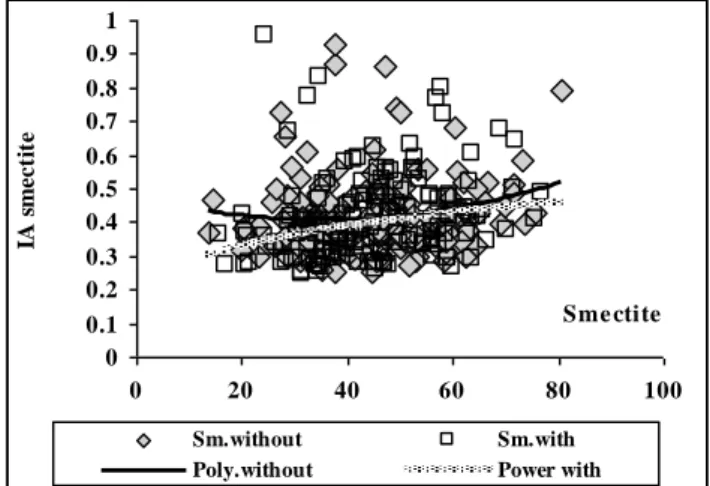
The mean size of smectite particle (IA) correlates lower with smectite content (Fig. 1) both with untreated samples (n=157, Rpoly=0.169*, Rlin=0.127, F=2.88) and higher with the treated (n=157, Rpow=0.367***, Rlin=0.229**, F=8.57). The two statistic curves tend to be superposed to the greater smectite concentration and show that oxidation reactions diminish the particle size proportional to their specific surface area namely more at small particle dimensions. It is confirmed that oxidation is a surface process which would modify the atom ordering on the broken smectite surface.
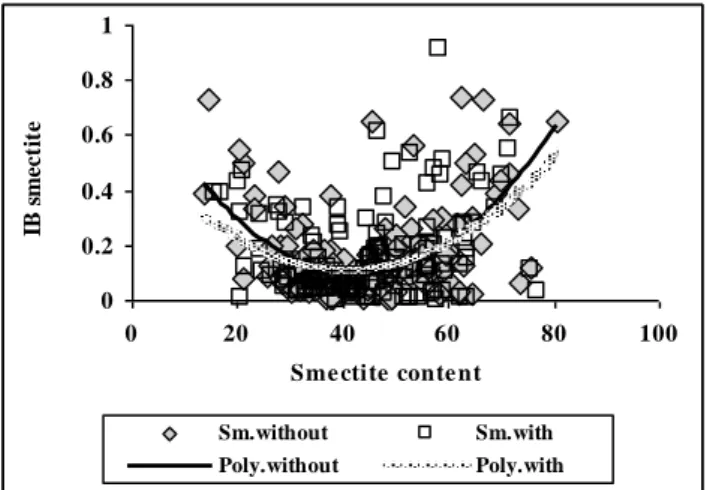
The IB smectite index correlates the best with the concentration (Fig. 2) according to a parabola at untreated (n=157, Rpoly=0.564***, Rlin=0.207*, F=6.95) and treated samples (n=157, R=0.406***, F=0.203*) which have as minim the values (41.25%; 0.18) and (36.3%; 0.14), respectively.
The representative points of the two samples series are mixed one to another and the statistical curves tend to superposed on the portion of minima. It shows that oxidation reduces the atom ordering on the broken surface especially to the more alterated particles and the little alterated.
0 0.1 0.2 0.3 0.4 0.5 0.6 0.7 0.8 0.9 1
0 20 40 60 80 100
Sme ctite
IA
s
m
e
c
ti
te
Sm.without Sm.with
Poly.without Power with
171
0 0.2 0.4 0.6 0.8 1
0 20 40 60 80 100
Sme ctite conte nt
IB
s
m
e
c
ti
te
Sm.without Sm.with
Poly.without Poly.with
Fig. 2. Smectite IB as a function of smectite content
The IA index of illite correlates with the illite quantitty of the clay fractions at untreated samples (n=157, Rpoly=0.268***, Rlin=0.238***, F=9.3) but do not to the treated samples with oxygenated water (n=157, Rexp=0.089, Rlin=0.066, F=0.6). The areals of the two series of untreated and treated samples (Fig. 3) are superposed and confirm the high alteration stability of micaceous minerals even at the colloidal size of illite (Bradley et al., 1961).
0 0.5 1 1.5 2 2.5
0 20 40 60 80 100
Illite conte nt
IA
i
ll
it
e
Illite without Illite with
Poly without Ex pon with
Fig. 3. Illite IA as a function of illite content
The representative curves are deviate one to another in the same time with the increasing of illite concentration in clay fraction. The below curve of treated samples shows that oxidation the greater reduces the particle sizes the more increases the illite concentration.
172
0 0.1 0.2 0.3 0.4 0.5 0.6 0.7 0.8 0.9
0 20 40 60 80 100
Illite conte nt in clay
IB
I
ll
it
e
Illite without Illite with
Poly without Power with
Fig. 4. Illite IB as a function of illite content
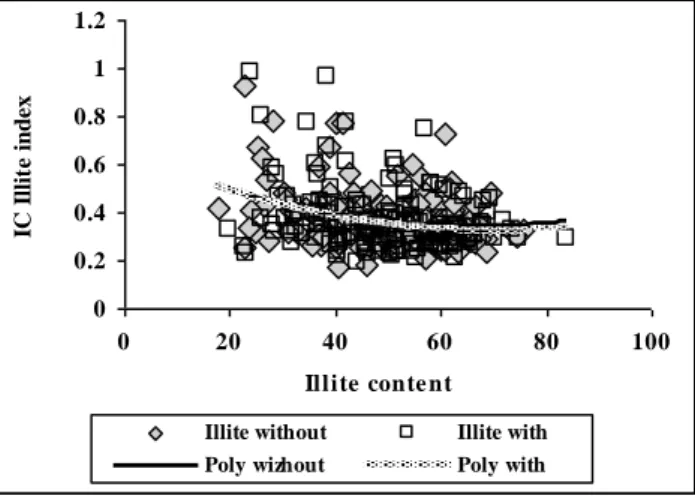
The illite IC index low correlates with the illite content (Fig. 5) at the untreated (n=157, Rpoly=0.292***, Rlin=0.274**, F=12.6) and treated samples (n=157, Rpoly=0.291***, Rlin=0.275**, F=12.7) and the correlation coefficients of two relation are almost equals. The interne ordering (IC) decrease when the illite concentration increases but the representative curves appear to be glued together and suggest a low effect of oxidation reactions independent from the illite content in clay fraction. That shows that the oxidation reactions modify a little the interne crystalline structure of illite particles.
0 0.2 0.4 0.6 0.8 1 1.2
0 20 40 60 80 100
Illite conte nt
IC
I
ll
it
e
i
n
d
e
x
Illite without Illite with
Poly wizhout Poly with
Fig. 5. Illite IC as a function of illite content
The interne structure of smectite appear to be more altered but the lack of diffraction line (002) at numerous samples do not permit an estimation of oxidation treatment effect on the interne structure of minerals.
The relations between the soil and mineralogical properties present the representative points scattered on the graph due to the mineralogical inheritance and to low modifications produced by the oxidation with oxygenated water.
This would suggest that oxidation would reduce the smectite concentration and release elements from its structure especially at smaller concentrations and greater surface area.
173
accompanied by dissolution of some structural elements and by the transformation in smectite of illite particles with smaller dimensions.
y = 0.4957x + 0.4852 R=0.498*** y = 0.5603e 0.5111x
R=0.501***
0 0.5 1 1.5 2 2.5
0 0.5 1 1.5 2 2.5
IA illite without tre atme nt
IA
i
ll
it
e
w
it
h
t
r
e
tm
e
n
t
Linear Ex pon
Fig. 6. Variation of illite IA due to oxidation
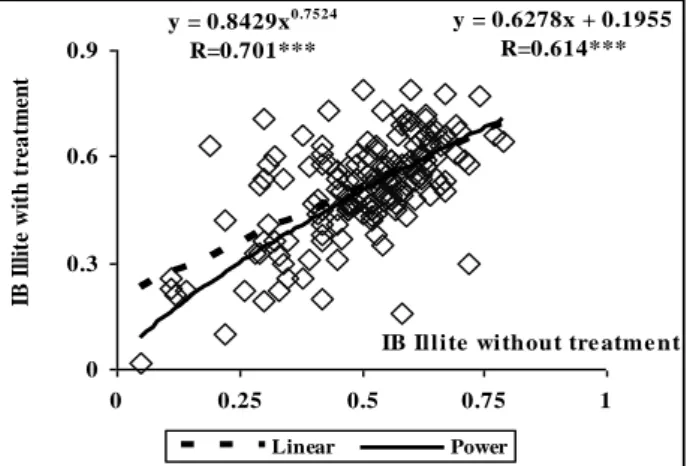
The IB illite index of treated samples high correlates with those of untreated sample (n=157, Rpow=0.701***, Rlin=0.614***, F=93.8) though the representative points are scattered on the graph (Fig. 7). The statistic curves tend to be superposed at the great values with crystalline structures little alterated. This shows that scattered points preserve an alteration level of the broken surfaces inherited from the parental material also after oxidation with oxygenated water.
y = 0.6278x + 0.1955 R=0.614*** y = 0.8429x0.7524
R=0.701***
0 0.3 0.6 0.9
0 0.25 0.5 0.75 1 IB Illite without tre atme nt
IB
I
ll
it
e
w
it
h
t
re
a
tm
en
t
Linear Power
Fig. 7. Relationship between IB indices of illite in samples with and without treatment
174
y = 0.6906x2 + 0.2486x + 0.1712 R=0.829***
y = 0.9115x + 0.0299 R=0.819***
0 0.2 0.4 0.6 0.8 1 1.2
0 0.2 0.4 0.6 0.8 1
IC Illite without tre atme nt
IC
I
ll
it
e
w
it
h
t
r
e
a
tm
e
n
t
Se rie s1 Poly. Line ar
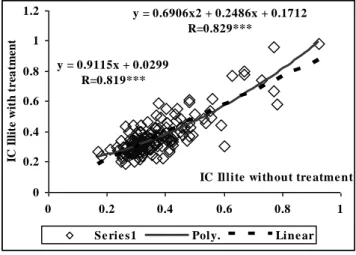
Fig. 8. Effect of treatment on the IC illite index
CONCLUSIONS
The greatest part of the representative points are scattered in the graphs and show that the clay mineral content and their crystallinity are inherited from parental materials and the oxidation processes in soil. The oxygenated water change just a little the mineralogical properties.
The relations between the crystallinity indices and the clay mineral contents show the decrease of particle size and atoms ordering on the broken surface of particles are dependent on the mineral nature and its concentration.
Smectite particle sizes (IA) diminish and those of illite particles increase due to the transformation of smaller illite particles in smectite accompanied by the dissolution of some structural elements. Under 0.40 for smectite and 0.96 for illite the treated samples have dimensions greater than the untreated ones and over these values the untreated samples have greater dimensions.
The interne ordering (IC) of smectite is smaller than of illite and frequently the smectite diffraction line (002) is absent on the X-ray diagrams. The oxidation reactions are surface reactions as shift a little the values of illite IC index and have a low influence on the crystalline structure of illite.
BIBLIOGRAPHY
1. Bartram, S.F., 1967 - Crystalline-size determination from line broadening and spotty patterns,Ed. E.F. Kaelble, Handbook of X-ray, Mac. Graw-Hill, New York.
2. Bradley, W.F., Grim, R.E., 1961 - Mica clay minerals, In The X-ray identification and crystal structures of clay minerals, Mineralogical Society, London, pp. 219-222.
3. Eberl, D.D.,Velde, B., 1989 - Beyond the Kubler index, Clay minerals, 24, pp. 571-577. 5. Gâţă, Gh., 2001 - Illite crystalinity of Romanian soils, Ştiinţa Solului, vol. XXXV, no. 1-2,
pp. 26-35.
6. Kubler, B., 1968 - Evaluation quantitative du metamorphisme par la cristalinité de illite, Bull. Centre Rech., Pau SNPA 21, pp. 385-397.
7. Mihalache, M., Gâţă, Gh., Ilie, L., Marin, D.I., Puicea, Brândușa, 2009 - Oxidation of clay minerals with oxigenated water, Scientific Papers, USAMV Bucharest, Series A, vol. LII, ISSN 1222-5339, pp. 93-98.
7. Mihalache, M., Gâţă, Gh., Ilie, L., 2008 - The parent materials of Oltenia soils, Bulletin USAMV-CN, vol. 65(1), ISSN 1843-5246, pp. 370.