http://www.jscdss.com Vol.4 No.1 February 2017: 1-6 Article history:
Accepted 16 January 2017 Published online 17 January 2017
Journal of Soft Computing and Decision
Support Systems
A Congestion-Aware Routing Algorithms Based on Traffic Priority in
Wireless Sensor Networks
Mohammad Omidvar a, Vahid Ayatollahitafti b, Mohammadreza Farahmand c,* a
Faculty of Engineering, Yazd Branch, Islamic Azad University, Yazd, Iran b Department of Computer Science, Taft Branch, Islamic Azad University, Taft, Iran c Department of Computer Science, Abarkouh Branch, Islamic Azad University, Abarkouh, Iran
* Corresponding author email address: [email protected]
Abstract
Wireless sensor network allow the network manager to measure the observed events in a short radio range and give them an appropriate response. In many applications of wireless sensor network, due to the high volume of traffic, probability of congestion and packet loss increases. Congestion in sensor networks has a direct effect on energy efficiencyand quality of service applications. Congestion may cause a buffer overflow, longer queuing time and higher packet loss. Packet loss not only reduces the reliability and quality of service application but also wastes energy. In this paper, a scheme for controlling congestion in wireless sensor network is proposed. The aim of the proposed method is to reduce congestion by considering the priority of data. In the proposed algorithm, according to the data priority, the packets will be classified. According to type of packet, traffic is redirected to control congestion in the network. Finally, the proposed algorithm is simulated and the result shows that the proposed algorithm improves the number of packet loss, energy consumption and average buffer size rather than the similar algorithm.
Keywords: Wireless Sensor Networks, Congestion Control, Traffic Prioritization, Routing.
1. Introduction
Romer and Mattern (2004) applied Wireless Sensor Networks (WSNs) for wireless networks consisting of distributed autonomous nodes to analyse physical or information of environmental such as temperature, pressure, sound, weather, and motion among others at different locations. Cerpa et al. 2001) presented a various range of sensors in civilian areas such as habitat observation. Schwiebert et al. (2001) presented for healthcare applications based on this WSNs (Kung and Vlah, 2003) and introduced object tracking for this model based on WSNs. Recently, the problem of congestion control and avoidance has been presented for attracted a lot of attention. Hence, many researchers presented the need of congestion control in WSNs. Researchers presented argue on this issue and provide numerical results, while a number of other documents like analyse and provide specific solutions on this problem (Sergiou and Vassiliou, 2013) (Sergiou, 2013) and (Antoniou and Αντωνίου, 2012). In many applications of WSNs, due to the high volume of traffic, congestion and packet loss probability increases.
Two important factors in WSNs are buffer overflow and link congestion. Buffer overflow occurs when the packet arrival rate increases more than packet service rate which occur in nodes near the sink (Sergiou, Antoniou et al., 2014). And link congestion, such as competition,
interference and bit error that this type of congestion occurs on the link.
A node in a WSN is a small embedded computing device that interfaces with sensors/actuators and communicates using short-range wireless transmitters. Such nodes work autonomously but this working to form a logical network in which data packets are routed hop-by-hop towards management nodes, generally called sinks or base stations. Sensors typically work under light load and suddenly become active in response to a detected or monitored event. In many applications, this can conclude in the generation of large, sudden, and correlated impulses of data that must be delivered to a small number of sinks without significantly disrupting the performance of the sensing application. This high generation rate of data packets is usually uncontrolled and often leads to congestion. In this state, collisions occur in the medium or in case of existence of an effective Medium Access Control (MAC) protocol, the node buffers overflow (Woo and Culler, 2001), resulting in random drops of data packets and increased delay. Dropped packets are a major handicap for these networks since they result in severe energy consumption (Wan et al. 2003). In the case that no countermeasures are taken, the power of congested nodes can be exhausted leading to the creation of routing “holes” in the network.
Mechanism of Congestion control is carried out in three sequential phases: congestion detection, notification and
counteraction. According to the challenges of WSNs and the importance of network congestion control, researchers have been done in this area. However, in the previous researches, congestion for packet priority is not efficiently controlled. In this paper, we propose a routing algorithm in which the next hop node is selected using buffer occupancy and residual energy of neighbour’s nodes. In the first phase, the proposed algorithm attempts to avoid congestion using a predefined threshold. However, if congestion occurs, it will reduce it.
The remainder of this paper is organized as follows. In Section 2, a brief review of related works on congestion control protocols in WSNs are presented. Section 3 discuss on the proposed algorithm. Section 4 shows details of the simulations and evaluates for the performance of the proposed model. Finally, the conclusion is presented in Section 5.
2. Related Work
In the explained method for congestion control, the congestion is reduced or partly controlled, but these methods, lacks of an efficient model to control the congestion effectively in a network. Sergiou, Antoniou et al. (2014) reviewed, classified, and compared algorithms, protocols, and mechanisms that deal directly with congestion control and avoidance in WSNs. Chen and Yang (2006) suggested a congestion avoidance scheme based on buffer management style, that was the behind idea of flow control hop by hop in the credit. This design, applied a specific buffer to prevent the hidden station of congestion. Wan et al. (2003) presented Congestion Detection and Avoidance algorithm (CODA) for avoidance and congestion control in WSNs. This algorithm introduces the base of the field and it is one of the most used algorithms. A Fusion scheme has been proposed for mitigating congestion control in WSNs by Hull et al. (2004). Siphon has been proposed for a source-to-sink congestion control protocol by Wan et al. (2005).
Speed removes congestion with considering direction redirecting of entrance traffic in around the hot spot (Stankovic et al., 2003). The substituting direction may not have end to end large channel capacity for the placement of precursor traffic congestion.
Hierarchical Tree Alternative Path (HTAP) has been proposed by (Sergiou, Vassiliou et al. 2013. HTAP is a scalable and distributed framework for minimizing congestion and assuring reliable data transmissions in event based on networks and it is a hop-by-hop algorithm that employs an implicit way for informing the other node of the congestion. It reduces congestion through a resource control technique. Thus, when congestion is happing, paths of alternative are created from the source to reduce, using the set of a network’s unused nodes, in order to safely transmit the observed data. The creation of alternative paths involves several nodes, which are not in the initial shortest path from the source to the sink. According to simulation results, the use of these nodes leads to a balanced energy
consumption, avoiding the creation of “holes” in the network and prolonging network lifetime.
Adaptive Rate Control (ARC) scheme has been proposed by Woo et al. in 2001. ARC cannot be used for any congestion detection or notification mechanisms. ARC uses an AIMD-like traffic control scheme to mitigate congestion, which works based on an intermediate node increases its sending rate by a constant.
A hop-by-hop node priority has been proposed by Wang et al. (2006) based on upstream congestion control protocol for WSNs. This scheme withdraw the congestion control protocols for argue in favour of providing equal fairness to each sensor node in a multi-hop WSN by attaching a weighted fairness to each sensor node.
A distributed and scalable mechanism has been proposed by Ee et al. (2004) based on Congestion Control and Fairness (CCF) for many-to-one routing in WSNs. The CCF provides congestion detection on the basis of packets service time, and congestion mitigation through traffic control.
3. Proposed Algorithm
In given to the importance of prioritizing pockets in various applications such as military and medical applications, most of the above methods do not consider priority package and packages all have the same priority. However, in our proposed algorithm packages have different priority. Also in the mentioned methods for redirecting traffic, one direction is used, that may have occurred inside the chosen route congestion. Also in this algorithm for routing and data transmission, hop by hop method is used. In hop by hop method each node according to the existing scenario selects the next hop. To determine the number of hops of each node, first, the sink sends a packet to its neighbours. Neighbours who receive this package are equal to number one. And the same procedure for each node is performed until to the end and the number of all nodes is determined.
The proposed algorithm congestion, including congestion detection mechanisms, congestion declaration and the reaction congestion, that is described in the following sections respectively.
3.1 Congestion detection mechanism
3.2 Congestion Notification Mechanism
Mechanism of congestion declaration in this algorithm is implicitly. Each node has neighbour buffer occupancy and accordingly determines whether congestion occurred within neighbouring node or not. The structure of the node is
shown in Fig. 1. The packet includes fields of the source node, that the address of source node placed in this field.
Package content as shown in Fig. 2 is stored inside the node table neighbourhood. The neighbour table includes some fields such as buffer occupancy, residual energy and the hop counts. After receiving a hello packet by each node, the node updates the neighbouring table rows.
Source node Residual energy Buffer occupancy Hop counts
Fig. 1. Hello packet structure.
Node
numbers Residual energy Buffer occupancy Hop counts
Fig. 2.Neighbouring table structure.
3.3 Congestion Control Mechanism
Appropriate response is done according to the remaining energy nodes of neighbours and residual energy of occupied buffer. First case is a state that neighbour’s node have a normal condition (means that all neighbours buffer capacity is less than the first threshold). Therefore node with the most remaining energy will be selected. The next hop of the whole package is in this node.
The second state is the case that neighbour nodes are candidate of occupied space capacity of their buffer between the first and second threshold. This is according to the said congestion mechanism detection; a state of congestion is likely and should be prevented. In this case the neighbouring node with the highest residual energy for low priority packet is selected and the neighbouring node with the lowest buffer occupancy for high priority packets is selected. In the second state, because the buffer occupancy is between the first and second threshold and this means, congestion is occurring so in this hop in addition to considering the remaining energy, we should also consider the occupied space to avoid filling buffer and change the rout packets to the less congestion rout.
The next hop shows the candidate neighbour node that their buffer occupancy is more than the second threshold. In this case, the last of a series of non-elected candidate with the highest residual energy will be selected.
3.4 Traffic Prioritization
Packet prioritization in sensitive areas such as military centres or medical care is very important because for the high-priority packets, better and optimize rout should be considered until the packets reach their destination on time and completely. For example in medical applications the packets made of different sensors and have different priorities, by sending the request, kind of disease and the priority should be identified.
In this method packets have different priority. Some have low priority and some have high priority. Each packet has a header bit as if this bit is one the packet priority is high, and if is zero it means that the priority is low.
3.5 Proposed algorithm
Congestion mitigation algorithm is described as follows. The mentioned method in algorithm is that if all neighbours candidate buffer is less than the first threshold (Thr1) (line 1),then the next hop is to a high priority packet (NHH) and low priority packet (NHL), that its last remaining energy (Eres) node is higher than other candidate node (line 2). Otherwise, if some neighbours candidate node's buffer occupancy is higher than the first threshold (line 3), then some nodes are selected that their buffer occupancy is less than the first threshold (line 4). Therefore, the next hop for the packet with low priority is the neighbour node that its remaining energy is much higher than others node (line 5). For the packet with high priority a node of neighbour’s node is selected that its buffer occupancy is lower than others neighbour's node (line 6). If buffer occupancy of all neighbouring nodes is more than the first threshold (line 7), thus, a node among the candidate neighbour's node is selected that their buffer occupancy is between the first and second threshold (Thr2) (line 8). Therefore, the next hop for the packet with low priority is the neighbour’s candidate node that the remaining energy is higher than other neighbour’s node (line 9) and for the packet with the high priority a node among the neighbours is selected that the buffer occupancy is less than others (line 10). Finally there may be a circumstances which all the neighbours buffer occupancy is more than the second threshold (line 11). In this case, next hop for packets with high priority and low priority is the non-candidate neighbour’s node that has the most remaining energy (line 12) and at the end line 13 shows the end of algorithm.
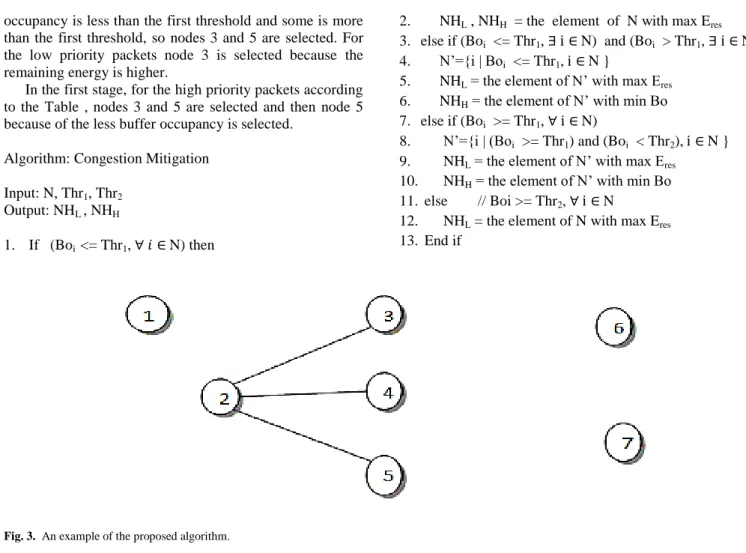
In the example of Fig. 3, we want to control congestion with the proposed mechanism. We assume the maximum buffer occupancy is 100, the first threshold 85 and the second threshold 95.
3.6 An example
occupancy is less than the first threshold and some is more than the first threshold, so nodes 3 and 5 are selected. For the low priority packets node 3 is selected because the remaining energy is higher.
In the first stage, for the high priority packets according to the Table , nodes 3 and 5 are selected and then node 5 because of the less buffer occupancy is selected.
Algorithm: Congestion Mitigation
Input: N, Thr1, Thr2 Output: NHL , NHH
1. If (Boi <= Thr1, N) then
2. NHL , NHH = the element of N with max Eres 3. else if (Boi <= Thr1, N) and (Boi > Thr1, N) 4. N’={i | Boi <= Thr1, N }
5. NHL = the element of N’ with max Eres 6. NHH = the element of N’ with min Bo 7. else if (Boi >= Thr1, N)
8. N’={i | (Boi >= Thr1) and (Boi < Thr2), N } 9. NHL = the element of N’ with max Eres
10. NHH = the element of N’ with min Bo 11. else // Boi >= Thr2, N
12. NHL = the element of N with max Eres 13. End if
Fig. 3. An example of the proposed algorithm.
4. Performance Evaluation
In this section, the performance evaluation of the proposed algorithm is provided. The proposed algorithm is compared to the HTAP. In Table 2, simulation parameters are given. The parameters of this table are used in different scenario of network.
For evaluating the proposed algorithm, various metrics taken into account that are as follow: the average buffer occupancy of nodes, packet loss, and energy consumption.
In this section the simulation results by use of charts are analysed. In all figures, the proposed algorithm is compared with HTAP algorithm, as a similar mechanism for redirecting traffic.
4.1 Average buffer occupancy
Fig. 4 shows average buffer occupancy of nodes. As it is clear in Fig. 4, average buffer space nodes in the proposed algorithm is less than HTAP. The reason of this decrement is that the proposed algorithm with considering threshold of first and second buffer, control entrance traffic into the node and try to buffer space does not exceed the second threshold.
4.2 Packet loss rate
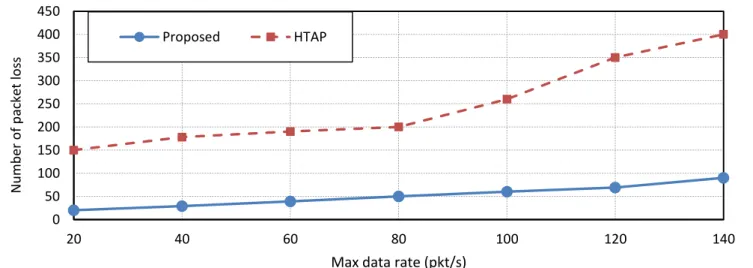
One of the important cases for packet drops is filling of buffer nodes. Fig. 5 shows the number of packet loss in the proposed algorithm rather than to HTAP algorithm. It is clear in the figure that the packet loss in the HTAP algorithm increases because of the limited selected routes, while the proposed algorithm has the lower dropped packets. The reason of this reduction is that the proposed algorithm performs the buffer management, and redirecting traffic route that causes reduction congestion in network nodes and finally reduction of removing packets.
4.3 Energy Consumption
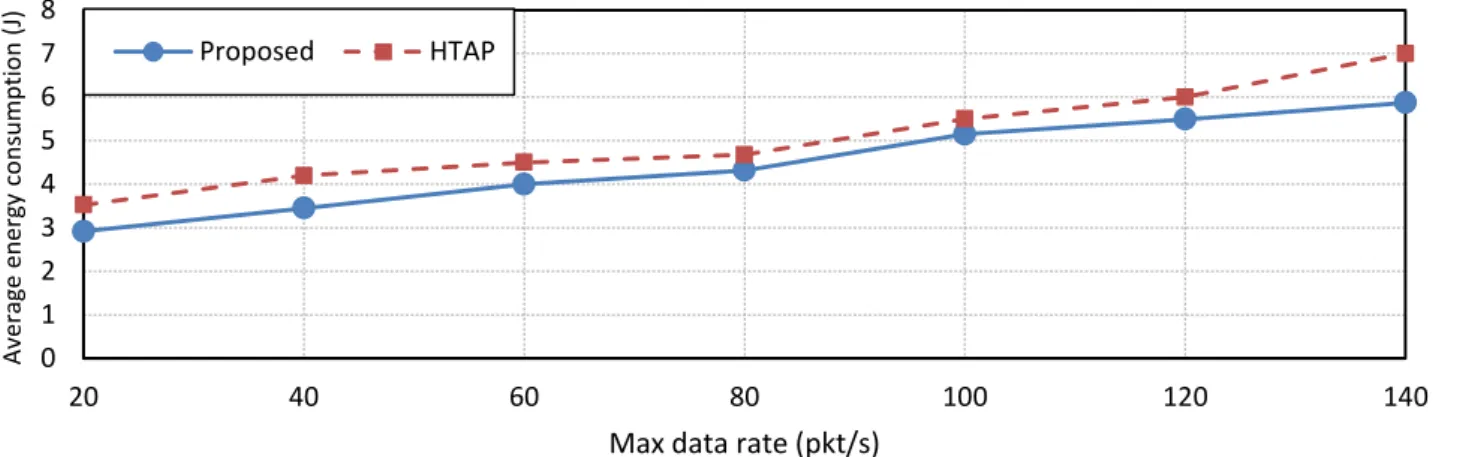
Energy problem in sensors, in most of the algorithms is considered as a challenge. Fig. 6 shows the average energy consumption of sensors.
Table 1
Neighbouring table of candidate node number 2.
Table 2
Simulation parameters.
Value
Parameters
100*100
100
10
512
250
1024
20
1000 Area(m*m)
number of node
Initial energy(Joule)
Buffer occupancy (Byte)
Max data rate (kbps)
Package size (bit)
Range of sensors(m)
Time Simulation(S)
Fig. 4. Empty average buffer occupancy during the time of the simulation.
Fig. 5. Shows Number of packet loss.
0 100 200 300 400 500 600
20 40 60 80 100 120 140
Bu
ff
er
Occu
p
an
cy
(KB)
Max data rate (pkt/s)
Proposed HTAP
0 50 100 150 200 250 300 350 400 450
20 40 60 80 100 120 140
N
u
m
b
er
o
f p
ack
et
los
s
Max data rate (pkt/s)
Proposed HTAP
Residual energy Buffer occupancy Node
1.8 1.9 1.75
80 90 70
Fig. 6. Average energy consumption.
5. Conclusion
The issue of congestion controlling in wireless sensor networks is one of the important issue. In this paper, we attempted to control congestion in wireless sensor networks by using buffer management. Also with congestion controlling, we reduce the rate of packet loss. The proposed algorithm was simulated using Matlab software. The simulation results were analysed. The obtained result showed that the proposed algorithm prevents congestion, by using buffer management and redirecting traffic and accordingly reduces the congestion.
References
Antoniou, P. C. and Π. Χ. Αντωνίου (2012). "Nature-inspired congestion control and avoidance in wireless sensor networks."
Cerpa, A., J. Elson, D. Estrin, L. Girod, M. Hamilton and J. Zhao (2001). "Habitat monitoring: Application driver for wireless communications technology." ACM SIGCOMM Computer Communication Review 31(2 supplement): 20-41.
Chen, S. and N. Yang (2006). "Congestion avoidance based on lightweight buffer management in sensor networks." Parallel and Distributed Systems, IEEE Transactions on 17(9): 934-946.
Ee, C. T. and R. Bajcsy (2004). Congestion control and fairness for many-to-one routing in sensor networks. Proceedings of the 2nd international conference on Embedded networked sensor systems, ACM.
He, T., J. A. Stankovic, C. Lu and T. Abdelzaher (2003). SPEED: A stateless protocol for real-time communication in sensor networks. Distributed Computing Systems, 2003. Proceedings. 23rd International Conference on, IEEE. Hull, B., K. Jamieson and H. Balakrishnan (2004). Mitigating
congestion in wireless sensor networks. Proceedings of the 2nd international conference on Embedded networked sensor systems, ACM.
Kung, H.-T. and D. Vlah (2003). Efficient location tracking using sensor networks. Wireless Communications and Networking, 2003. WCNC 2003. 2003 IEEE, IEEE.
Romer, K. and F. Mattern (2004). "The design space of wireless sensor networks." IEEE wireless communications 11(6): 54-61.
Schwiebert, L., S. K. Gupta and J. Weinmann (2001). Research challenges in wireless networks of biomedical sensors. Proceedings of the 7th annual international conference on Mobile computing and networking, ACM.
Sergiou, C. (2013). Performance-aware congestion control in wireless sensor networks using resource control. World of Wireless, Mobile and Multimedia Networks (WoWMoM), 2013 IEEE 14th International Symposium and Workshops on a, IEEE.
Sergiou, C., P. Antoniou and V. Vassiliou (2014). "A comprehensive survey of congestion control protocols in wireless sensor networks." Communications Surveys & Tutorials, IEEE 16(4): 1839-1859.
Sergiou, C. and V. Vassiliou (2013). "Estimating maximum traffic volume in wireless sensor networks using fluid dynamics principles." IEEE Communications Letters 17(2): 257-260. Sergiou, C., V. Vassiliou and A. Paphitis (2013). "Hierarchical
Tree Alternative Path (HTAP) algorithm for congestion control in wireless sensor networks." Ad Hoc Networks 11(1): 257-272.
Wan, C.-Y., S. B. Eisenman and A. T. Campbell (2003). CODA: congestion detection and avoidance in sensor networks. Proceedings of the 1st international conference on Embedded networked sensor systems, ACM.
Wan, C.-Y., S. B. Eisenman, A. T. Campbell and J. Crowcroft (2005). Siphon: overload traffic management using multi-radio virtual sinks in sensor networks. Proceedings of the 3rd international conference on Embedded networked sensor systems, ACM.
Wang, C., K. Sohraby, V. Lawrence, B. Li and Y. Hu (2006). Priority-based congestion control in wireless sensor networks. Sensor Networks, Ubiquitous, and Trustworthy Computing, 2006. IEEE International Conference on, IEEE.
Woo, A. and D. E. Culler (2001). A transmission control scheme for media access in sensor networks. Proceedings of the 7th annual international conference on Mobile computing and networking, ACM.
0 1 2 3 4 5 6 7 8
20 40 60 80 100 120 140
A
verage
en
erg
y
co
ns
umptio
n
(J
)
Max data rate (pkt/s)