25
EVALUATION OF SUGAR CONTENT IN STEM JUICE FROM SWEET
SORGHUM HYBRIDS GROWN IN SOUTH WEST OF ROMANIA
Babeanu Cristina1, Matei Gheorghe2Dodocioiu Ana Maria3*
1 University of Craiova, Faculty of Science, 107i CaleaBucuresti, Craiova, Romania, 2 University of Craiova, Faculty of Agriculture, 19LibertatiiStreet, Craiova, Romania,
3University of Craiova, Faculty of Horticulture, 13 A.I.Cuza Street, Craiova, Romania,
*Corresponding author e-mail: [email protected]
Keywords: sweet sorghum hybrids, juice sugar content
ABSTRACT
Sweet sorghum is one of the most important agricultural sources used for generation of biomass that can be further processed and converted relatively easily into a fuel type of bioethanol, synthesis gas, vegetable protein, feed for livestock or green manure.Sweet sorghum belongs to C4 species group whose photosynthetic efficiency is high. Due the fact that the economic importance of sweet sorghum is determined by the high content of fermentable sugar the purpose of this paper is to establish, in comparison, the juice content of a three sweet sorghum hybrids in order to select the most valuable genotype for production.For achieving this goal on the experimented hybrids was determinate the total content of soluble solids, reducing sugar content and total sugar content.
The results obtained show that the all hybrids have a high soluble solid content. Total sugar varied between 14.02% and 15.87% and from these a higher percent of 67.74% to 79.43% is represented by non-reducing sugar.The study put into the light the agronomic qualities of sweet sorghum hybrid Porumbeni 4 which proved to be the most promising hybrid with the highest sugar and biomass production.
INTRODUCTION
Sweet sorghum is a cereal which can be used as functional food, for animal feed, for fiber and source of ethanol production. Numerous researches and studies were focused on using sweet sorghum as main source of ethanol production beside sugarcane and corn (Antonopoulou et al., 2008, Mathur S. et al., 2017).
The economic importance is ensured by the high content of sugar which recommends sweet sorghum as an important source of producing bioethanol, an alternative to the fossils reserve for humanity to solve the main energetic crisis (Mathur S. et al., 2017, Matei and Duda, 2007).How to use efficient the sweet sorghum into the field of green energy represents an important topic for scientific area and the field is full of research due the features of sorghum: a plant with a high ecological plasticity which could be cultivated in different areas, easy cultivation technology and high yield potential of biomass. The sugarcontent is influenced by different kind of factors: genotype, environment, soil quality, technological measures, the way and time of harvest (Matei and Nicolescu, 2007, Rao et al., 2013, Eiland et al., 1983). The total juice components in sweet sorghum stalk consist of 23.33 % of different sugars. The main sugars include sucrose: 9.4 %, glucose: 3.4 % and fructose: 3 %(Anglani 1998).
26
The purpose of the presented paper is to evaluate the potential and the content of a three sweet sorghum hybrids in order to recommend of the most valuable hybrid for cultivation in the South West part of Romania.
MATERIALS AND METHODS
The research was carried out on the Agricultural Research Development Station Caracal, using three hybrids of sweet sorghum with different proveniences: F 135ST from Romania and Porumbeni 4 and Porumbeni 5 from Republic of Moldova.
As a soil type we experimented on chernozem, which in this area is characterized by humus content of 3 to over 4%, which means they are moderate to strong humus, with a soil reaction of neutral to acid and the pH value range from 6 to 7. The soil is microbiologically active and well supplied with nutrients. Although have a good trophic, in order to obtain higher production it is necessary to incorporate chemical fertilizers and organic products and periodically deep loosening works (Dodocioiu et al., 2012, Petrescu et al, 2008). Into the experiment we apply the specific technology for growing sweet sorghum described in previous published research papers (MateiGh., 2016).
Chemical analysis
From each variant we extract a representative number of sweet sorghum plants and using a pressing device we obtained samples for laboratory. The extracted juice was filtered with Whatman 1 filter paper and was analyzed immediately.
Total soluble solids Brix %of the extracted juice was determined using a digital refractometer (KrussOptronic DR 301-95) at 20°C;
Reducing sugars (%) were extracted in distilled water (1:50 w/V), 60 minutes at 60˚C and assayed colorimetric with 3,5dinitrosalicylic acid reagent using glucose as standard. (Paraschivu et al., 2014) Absorbance was recorded at 540 nm using a Thermo Scientific Evolution 600 UV-Vis spectrophotometer with VISION PRO software.
Non-reducing sugars were converting by hydrochloric acid hydrolysis, 15 min at
100˚C to reducing sugars. After neutralization,total sugar content(%) was assayed
colorimetric with 3,5dinitrosalicylic acidreagent at 540nm.
Non-reducing sugars(%) is the difference of total soluble sugars and reducing sugars. All determinations were performed in triplicate, and all results were calculated as mean.
RESULTS AND DISCUSSION
Related to the distribution of sugar content on hybrids stalks it can easy observed that in the figure 1 where the highest content of sugar is located in the middle area of the sweet sorghum stalks, followed by the superior part of the plant and the bottom internodes of the hybrids. The highest value, of 19.7% Brix index, was registered on Porumbeni 5 hybrid, value determined in the internodes from the middle of stalks in the milk maturity of plant development stage.
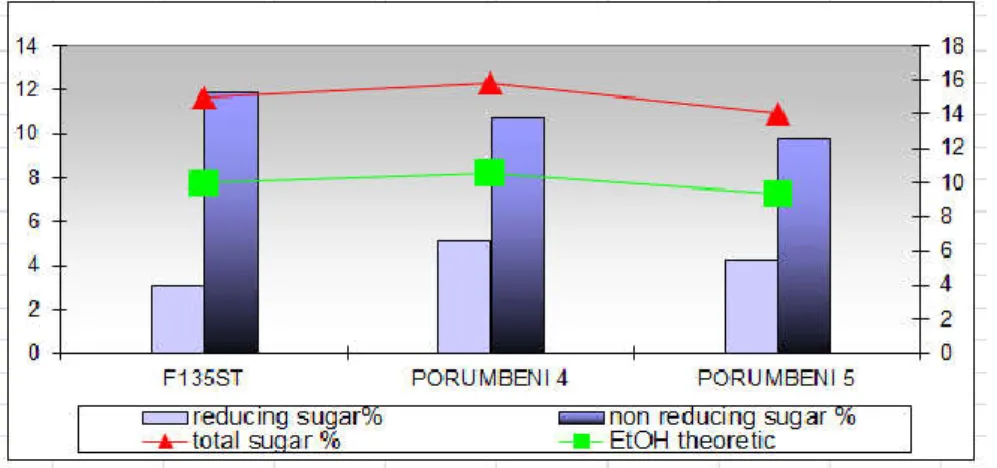
The results obtained for sugars content are presented in figure 2.
27
Figure 1 Soluble solid content (%) of the investigated sweet sorghum hybrids
Our results are similar to those reported in other research papers(Antohe, 2007, Kawahigashi et al., 2013, Eiland et al., 1983). In a research focused on the sugar components of sorghum juices, from 109 varieties using capillary electrophoresis, the results indicated that the Brix of sorghum juice was proportional to the total sugar and sucrose concentrations.
Figure 2.Reducing sugar content (%), non-reducing sugar content (%) total sugar content and theoretic ethanol yields (L/100 L juice) of the investigated sweet sorghum hybrids
Glucose concentration had a significant positive correlation with fructose concentration, but no correlation was detected between Brix and the two hexose sugars, glucose and fructose, sucrose comprised approximately 75% of the total sugar in varieties with Brix values greater than 15 (Kawahigashi et al., 2013).
For the experimented hybrids was calculated the theoretical efficiency in ethylic alcohol and the results were presented in figure 2.
28
The highest calculated ethanol yield was obtained at Porumbeni 4 hybrid (10.56 L/100 L) followed by F135ST hybrid (9.995 L/100 L) and Porumbeni 5 hybrid (9.33 L/100 L).
Figure 3 Composition of total sugar content of the investigated sweet sorghum hybrids
Previous research has shown that for the studied hybrids high values of total fresh green mass and percent of stalks related to the total green mass: F135ST-125.53 t/ha (74.1% stalks); Porumbeni 4-130.51 t/ha (81.7% stalks); Porumbeni 5- 105.44 t/ha (79.7 % stalks). (MateiGh., 2016).
All this data put into the light Porumbeni 4 hybrid as the most promising hybrid with the highest sugar content and biomass yield.
CONCLUSIONS
Taking in account the above presented data we can say that the experimented sweet sorghum hybrids has a high content of soluble solid content and total sugar content. The non-reducingsugarrepresents the main component of the total sugar on all studied hybrids.
The obtained data are supported by the scientific literature and prove that the total soluble content as Brix degree is still a useful parameter for selecting sorghum genotypes that can accumulate higher levels of total sugar and sucrose.
As a synthesis of our research we highlighted the fact that F135 ST hybrid registered the highest content of sucrose mean while the Porumbeni 4 hybrid has the highest content of the reducing sugar.
In order to recommend the experimented genotypes as quality source of biomass for ethanol, all three hybrids have the features from agronomic and biochemical point of view to be used as raw materials in the field of biofuels.
BIBLIOGRAPHY
1. Antohe I., 2007, Realizăriînameliorareasorgului la Fundulea, I.N.C.D.A. FUNDULEA, LXXV, 137-157
2. Antonopoulou G., Gavala H.N., Skiadas I.V., Angelopoulos K., Lyberatos G.,
2008. Biofuels generation from sweet sorghum: fermentative hydrogen production
and anaerobic digestion of the remaining biomass. Biores. Technol. 99, 110-119.
29
4. Billa E., Koullas D.P., Monties B., Koukios E.G., 1997. Structure and composition of sweet sorghum stalk components. Ind. Crops Products 6, 297-302.
5. Dodocioiu A.M., Mocanu R., Dobre M., 2012,The long term evolution of phosphates from the cambic chernozem at ARDS Caracal, Romania, Journal of Life Sciences 6(5), 557-563
6. Eiland B.R., Clayton J.E., Bryan W.L. 1983, Losses of fermentable sugars in sweet sorghum during storage. Trans Am SocAgricEng, 26, 1596-1600.
7. Kawahigashi H., Hasuga S., Okuizumi H., Hiradate S., Yonemaru J., 2013,
Evaluation of Brix and sugar content in stem juice from sorghum varieties, Grassland Science, 59, 11-19
8. Matei, Ghe., 2016, Study on yield features of sweet sorghum hybrids grown in South West of Romania, SGEM2016 Conference Proceedings, Book6 Vol. 1, 783-790
9. Matei, Ghe, Nicolescu M., 2007. Research regarding the dynamic accumulation of sugar to the sweet sorghum cultivated in Oltenia (Romania). Research Journal of Agricultural Science, 39 (1) 167-170
10. Matei, Gh.,Duda M.M., 2007. The percentage of participation to forming biomass yield in sweet sorghum cultivated in central Oltenia Romania, 2007, Research Journal of Agricultural Science, 39 (1) 171-174
11. Mathur S., Umakanth A.V., Tonapi V.A., Sharma R., Sharma M.K., 2017, Sweet sorghum as biofuel feedstock: recent advances and available resources, Biotechnol Biofuels 10, 146-165
12. Paraschivu M., Babeanu C., Soare R., Dinu M., Drăgoi M.,2014. Influence of late blight (Phytophthora infestans) attack on nutritional qualities of tomato, Annals of the University of Craiova - Agriculture, Montanology, Cadastre Series 44(1) 188-193
13. Petrescu E., Matei G., Rosculete C.A., 2008, Irrigation implications on the soybean crop in the pedoclimatic conditions of the Caracal Plain, Research Journal of Agricultural Science 40 (1) 161-164
14. Rao S. S., Patil J. V, Chandrasekara D., Reddy B. S. Kumar V., Srinivasa P., Gadakh S.R., 2013, Effect of Different Crushing Treatments on Sweet Sorghum Juice Extraction and Sugar Quality Traits in Different Seasons, Sugar Tech, 15(3), 311-315