68
DIVERSITY OF FUNGI IN THE ALLIUM URSINUM L COVERED SOIL
FOREST
BOROZAN AURICA BREICA, BORDEAN DESPINA MARIA, DOGARU DIANA, CRISTEA TEODOR, MADOȘĂ EMILIAN
Keywords: the diversity of fungi; forest soil; the granule method,Allium ursinum L
ABSTRACT
In the soil,ecosystem there are differences in the diversity and spatial distribution of the fungal community. Forest soil samples were harvested in the spring season from the area of influence of plants of Allium ursinum L., in the western part of the country.
The study of fungal diversity was carried out on the "soil grain method" on the sifted and ungrounded soil samples. The composition of fungal species is diverse, but there are also repetions (rehearsals) where the number of species is limited. The species present in both forest soil samples is Circinella spp, followed by Penicillium spp and Aspergillus spp, the latter being isolated only from the sifted soil sample. The low-frequency species are: Torula herbarum (species isolated from both soil samples), Chaetomium spirale (highlighted only in sampled (sifted) soil), Fusarium spp, Helminthosporium spp and Mortierella monospora, the last species isolated from the unsifted soil sample.
INTRODUCTION
Allium ursinum L. is a bulbous plant from the family Alliaceae, very common in our forests, which accumulates in a relatively short time (3 months), a rich biomass, comparable in terms of the amount of nutrients with the mature beech leaves.
Between plants, soil and microorganisms, complex interactions are created, materialized by chemical, biochemical and biological reactions (Hinsinger and colab., 2003; Richter and colab., 2007; Lambers and colab., 2009), with a positive impact on both, plants and microorganisms.
According to some authors, the plants influence the microbial community from the soil through the root secretions in their area of influence.
Jaeger and colab. (1999), say that the structure of the microbial community is influenced by both the amount and the composition of the organic matter coming from the plants.
Soil microorganisms represent an important fraction of living biomass, with values of 103-104 kg / ha in the surface layer (Fierer and colab., 2007).
Between the microbial groups that dominate the soil, because of the celular biomass, there are fungi (Ali-Shtayeh and Jamous, 2000; Rane and Gandhe, 2006).
The experimental results obtained by Ling-Ling Shi et al (2014), have shown that plant diversity in forest areas, temperatures and latitudes influence the composition of soil fungi.
Fungi play an important role in soil degradation processes and soil nutrient cycles (Bailey et al., 2002; Bue´e et al., 2009).
69
sample from which plant residues was removed (sifted soil).
In addition, for the elimination of errors, given by the high production of spores, the degree of population of the soil with particles and the identification of filamentous fungi by the "soil granule method".
The principle of the method is after Parkinson D., Balasooriya I. and Winterhalder K (1968), with the improvements made by Neonila Petre (Patent for invention OSIM nr.77633 from 1981) and Ștefanic (1991), who has made contributions by finding a way to interpret the results (Borozan et al., 2005).
According to this method, the soil samples are processed and the soil granules are deposited on agarized medium. The soil granules, 5 of them, represent the repetitions within each sample or variant.
Incubation was made at 280C, medium temperature, for 7 days. After the incubation period, the filamentous fungi were identified and at the same time the actinomycetes differentiated through microscopic observations on each soil granule.
Statistical analysis
The fungal communities were characterized in terms of diversity by calculating richness, Shannon index, and ACE (abundance-based coverage estimation) using PAST 3.06 program
RESULTS AND DISCUSSIONS
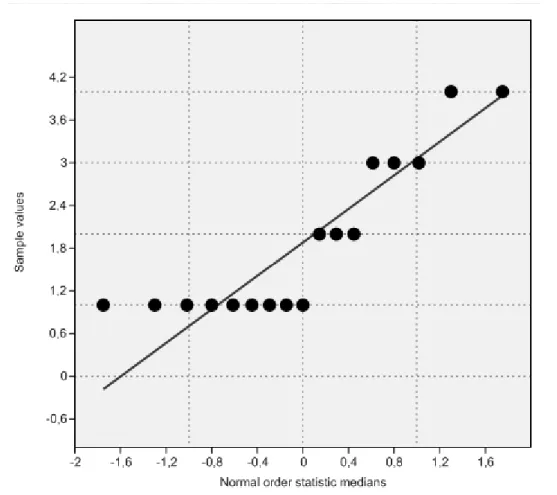
The results illustrated in Figure 1 show that the probability of the filamentous fungi species present in the two soil samples being repeated is 0.8885.
From the 2 soil samples, 10 species of filamentous fungi were isolated, to which was added unconverted mycelium in both samples, but present in a higher proportion in soil sample with vegetal residues (unsifted). Also, the actinomycetes were isolated in a large proportion, especially from the soil sample with vegetal residues (unsifted).
70
Figure 1. Description of fungus number based on abundance model
From studies conducted by Petr Baldrian and colaboratorii (2012), done on the forest soil, it appears that the fungus is numerically reduced, compared to the bacterial community, but instead there are some species of fungi that dominate numerically the bacteria.
Studies on the abundance of bacteria in samples of raw soil and unblended forest soil samples showed that there were no differences between the values cfu/g sol, after an incubation period of the bacterial isolate for 48 hours (Borozan and colab., 2013).
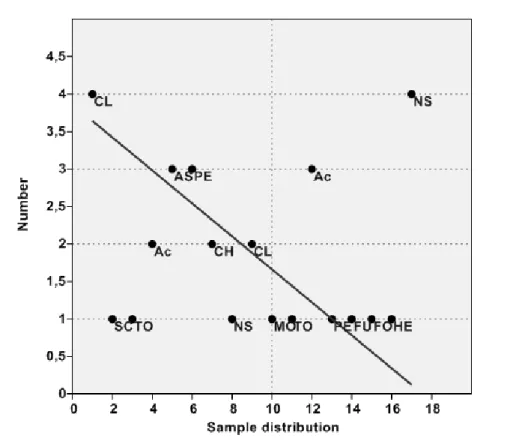
Dominant fungal species are distributed in both studied samples, but there are cases where certain species are found only in one of the soil samples (sifted and not sifted soil ), (fig. 2).
After Petr and al. (2012), fungi are spatially restricted, and are present only on certain sites.
Regarding diversity, our studies indicate a fungal dominance of 0.07813. The smallest dominance is 0.08203 and the upper one is 0.1445.
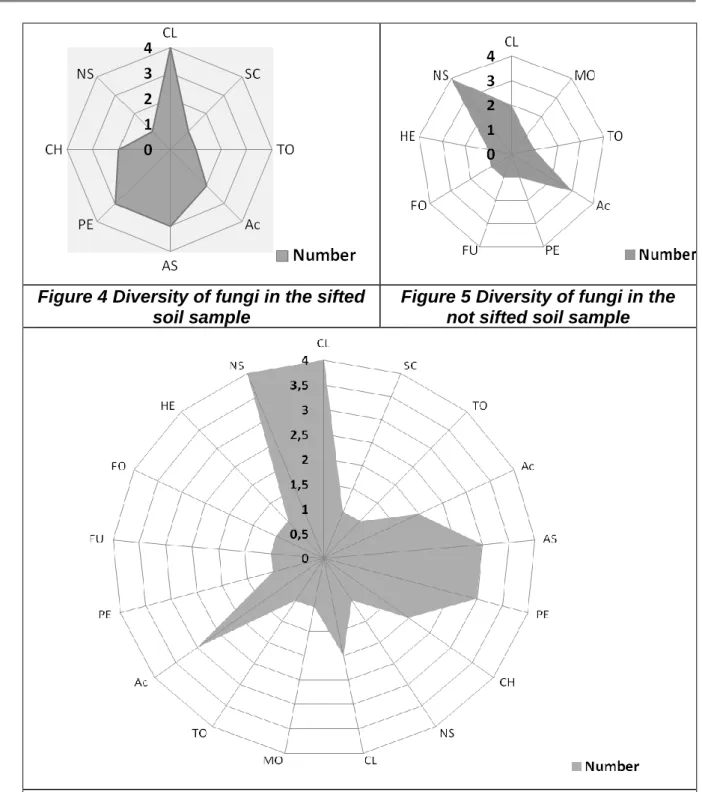
The variety of fungal species is diverse, but we also have rehearsals in which species are restricted (fig. 5). Diversity Index Shannon-H is 2.68.
71
Figure 2 Direction of the development of fungi species from soil samples
Less frequencies are the following fungal species: Torula herbarum (species isolated from both soil samples), Chaetomium spirale (highlighted only in the sifted soil sample),
Fusarium spp, Helminthosporium spp și Mortierella monospora, species present only in the unblended soil sample(fig. 4,5).
The studies made by Anderson and Domsch (1975), on the soil harvested from the deciduous forest, have shown that the largest share had imperfect fungi, follow in descending order of phycomycetes, ascomycetes and basidiomycetes. Among the types of isolated fungi (by the authors above), from the analysed soil samples were: Penicillium,
Absidia, Fusarium, Mucor, Trichoderma, Humicola, Gongronella, Candida, Cunninghamella
and Paecilomyces.
SummerellB.A. and al. (1993), isolated from soil 13 species from Fusarium as: F. oxysporum, F. solani F. moniliforme, F. proliferatum, F. beomiforme, F. chlamydosporum, F. compactum, F. equiseti, F. longipes, F. nygamai, F. scirpi, F. semitectum and F. subglutinan, from wooded areas and unspoiled forests. The authors of this study observed that fungal diversity was not influenced by the isolation techniques used, but it was affected by precipitation. The most abundant fungal species, isolated from most of soils, were F. oxysporum and F. solani.
72 Figure 4 Diversity of fungi in the sifted
soil sample
Figure 5 Diversity of fungi in the not sifted soil sample
Figure 6 The diversity of filamentous fungi in the two soil samples
Legend: CL-Circinella spp.; SC- Scopulariopsis spp; TO- Torula herbarum;Ac- Actinomycetes; AS-Aspergillus
spp; PE-Penicillium spp; CH-Chaetomium spp spirale; NS-Non-sporulated micelia; MO-Mortierella
monospora; FU-Fusarium spp; FO-Fusarium oxisporum; HE-Helminthosporium spp.
CONCLUSIONS
Our data suggest changes to the composition of the fungal community, which may be due to the plant that covers the soil, side influences of woody plants (beech), the method of analysis and the method of soil processing in the laboratory.
In our studies, these influences were evident at the level of repetitions and sample taken as a whole. Some rehearsals have been characterized by a great fungal diversity, and in others the variation palette was restricted.
73
fungi Eds, Kushawaha RKS, Guarro J, Revista Iberoamericana de Micologia, Spain, pages 51-59.
2. Anderson, J.P.E., Domsch, K.H., 1975 - Measurement of bacterial and fungal contributions to respiration of selected agricultural and forest soils, Canadian Journal of Microbiology, vol. 21, No. 3:314-322.
3. Bailey, V.L., Smith, J.L., Bolton, H., 2002 -. Fungal-to-bacterial ratios in soils investigated for enhanced C sequestration, Soil Biol Biochem, 34: 997–1007.
3. Baldrian, P., Kolarik, M., Stursova´, M., Kopecky´, J., Valaskova´, V., Vetrovsky´, T., Zifcakova´, L., Snajdr, J., Ridl, J., Vlcek, C., Voriskova´, J., 2012 - Active and total microbial communities in forest soil are largely different and highly stratified during decomposition, The I.S.M.E. Journal, 6, pages 248–258.
4. Borozan, A.B., Bordean, D.M., Boldura, O.M., Pirvulescu, L., Horablaga, M., Popescu, R., Cojocariu, L., Stefanic, Gh., 2013 - Study on the effect of Allium ursinum L. on soil bacteria evolution, XII Wellmann International Scientific Conference, Review on Agriculture and Rural Development, Scientific Journal of the University of Szeged, Faculty of Agriculture, vol. 2. (1), ISSN 2063-4803, pp.164 – 169.
5. Borozan, A.B., Ştefanic, Gh., Radu, F., 2005 - Rezultate privind frecvenţa şi calitatea
micromicetelor sub acţiunea unor substanţe fitofarmaceutice, Lucrările celui de al X-lea Simpozion de Microbiologie şi Biotehnologie, Institutul de Cercetări Biologice Iaşi, Editura Corson , ISBN 973-8225-29-9, pp. 63-77.
6. Bueѐ, M., Reich, M., Murat, C., Morin, E., Nilsson, RH., Uroz, S., Martin, F., 2009 -
Pyrosequencing analyses of forest soils reveal an unexpectedly high fungal diversity, New Phytol., 184: 449–456.
7. Fierer, N., Breitbart, M., Nulton, J., Salamon, P., Lozupone, C., Jones, R., Robeson, M., Edwards, R.A., Felts, B., Rayhawk, S., Knight, R., Rohwer, F., Jackson, R.B., 2007 - Metagenomic and small-subunit rRNA analyses reveal the genetic diversity of bacteria, archaea, fungi, and viruses in soil, Appl. Environ. Microbiol., 73: 7059–7066.
8. Griffits, B.S., Ritz, K., Ebblewhite, N., Dobson, G., 1999 - Soil microbial community structure effects of substrate loading rates, Soil Biol. Biochem., 31:145-153.
9. Hawksworth, D.L., 2001 - The magnitude of fungal diversity: the 1.5 million species estimate revisited, Mycol. Res., 105: 1422–1432.
10. Hinsinger, P., Plassard, C., Tang, C., Jaillard, B., 2003 - Origins of root-mediated pH changes in the rhizosphere and their responses to environmental constraints: a review, Plant Soil, 248, pp. 43–59.
74
12. Jaeger, C.H., Lindow, S.E., Miller, W., Clark, E., Firestone, M.K., 1999 - Mapping of sugar and amino acid availability in soil around roots with bacterial sensors of sucrose and tryptophan, Appl. Environ. Microbiol., 65:2685-2690.
13. Lambers, H., Mougel, C., Jaillard, B., Hinsinger, P., 2009 - Plant-microbe-soil interactions in the rhizosphere: an evolutionary perspective, Plant Soil, 321, pp. 83–115. 14. Lauber, C.L., Hamady, M., Knight, R., Fierer, N., 2009 - Pyrosequencing-based assessment of soil pH as a predictor of soil bacterial community structure at the Continental Scale, Appl Environ Microbiol, 75: 5111–5120.
15. Ling-Ling, Shi, Peter, E.J.W., Ferry, Slik, Xiao-Ming, Zou, Jianchu, Xu, Wen-Ting, Feng, Lu, Qiao, 2014 - Variation in forest soil fungal diversity along a latitudinal gradient, Fungal Diversity, vol. 64, Issue 1, pages 305–315.
16. McGuire, K.L., Treseder, K.K., 2010 -. Microbial communities and their relevance for ecosystem models: decomposition as a case study, Soil Biol. Biochem., 42:529–535. 17. Neonila, P., 1981- Brevet de invenţie, OSIM nr.77633.
18. Parkinson, D., Balasooriya, I., Winterhalder, K.,1968 - Rev. d'ècologie et de biologie du sol, 5,4:637-645.
19. Rane, G., Gandhe, R.V., 2006 - Seasonal distribution of soil Fungi from Forest Soils of Jalgon District, Maharashtra, Zoos print Journal, 21(9):2407-2409.
20. Richter, D.B., Oh, N.H., Fimmen, R., Jackson, J., 2007.- The rhizosphere and soil formation, In: Cardon, Z.G., Whitbeck, J.L. (Eds.), The Rhizosphere: An Ecological Perspective. Elsevier, Burlington, pp. 179–200.
21. Roesch, L.F.W., Fulthorpe, R.R., Riva, A., Casella, G., Hadwin, A.K.M., Kent, A.D., Daroub, S.H., Camargo, F.A., Farmerie, W.G., Triplett, E.W., 2007 - Pyrosequencing enumerates and contrasts soil microbial diversity, I.S.M.E. J., 1: 283–290.
22. Summerell,B..A., Rugg, C.A., Burgess, L.W., 1993 - Mycogeography of Fusarium:
survey of Fusarium species associated with forest and woodland communities in north Queensland, Australia, Mycological Research, vol. 97, Issue 8, pages 1015-1019.
23. Stefanic, Gh., 2006 - Metode de analiza a solului (biologica, enzimatica si chimica),
editia a II-a, I.C.D.A. Fundulea, XXVIII.
24. Urbanová, Michaela, Šnajdr, Jaroslav, Baldrian, Petr, 2015 - Composition of fungal and bacterial communities in forest litter and soil is largely determined by dominant trees,