Release 256 Quadro
Professional Drivers for
Windows - Version 265.90
RN-WQ26590-02v01 | November 30, 2010PRELIMINARY
TABLE OF CONTENTS
1 Introduction to Release Notes... 1
Structure of the Document ... 1
Changes in this Edition ... 1
2 Changes in the Release 256 Driver for Windows XP ... 2
Version 265.90 Highlights ... 3
What’s New in Release 256 ... 3
Limitations in this Release ... 3
Discontinued Features in this Release ... 4
Special Instructional Notes ... 5
Turning Off V-Sync to Boost Performance ... 5
NVIDIA Application Configuration Engine (ACE) ... 5
SLI Multi-OS – GPU Assignment in System Virtualization... 6
Changes in Version 265.90 ... 7
Fixed Issues–Windows XP 32-bit ... 7
Fixed Issues–Windows XP 64-bit ... 7
Open Windows XP Issues in Version 265.90 ... 8
NVIDIA Recommendations ... 8
Windows XP 32-bit Issues ... 8
Windows XP 64-bit Issues ... 9
Not NVIDIA Issues... 11
Known Product Limitations ... 13
Driver May not Work with /3GB Windows Switch When Using ECC on 32-bit
OS ... 14
Professional 3D Stereo Left-Right Buffer Swap... 14
Using HDMI/DisplayPort Audio with Displays that have a High Native
Resolution... 15
Using HDMI/DisplayPort Displays that do not Support Audio ... 15
Using HDMI/DisplayPort Audio in Dualview or Clone Mode Configurations16
GPU Runs at a High Performance Level (full clock speeds) in Multi-display
Modes ... 16
1280x1024 @ 60 Hz not Available on BenQ FP241W Monitors ... 17
Image Sharpening Control not Available with Quadro FX 4600 and Later
GPUs ... 17
More Monitors are Listed in the Windows Device Manager than are Actually
TABLE OF CONTENTS
Connected ... 17
SLI Connector Requirement on NVIDIA Quadro SLI Cards ... 17
DVD Playback Issues with Dual NVIDIA Quadro NVS Cards ... 18
PowerDVD 5.0 Does Not Display Correctly in nView Span Mode ... 18
DirectX Fails When Detaching/Reattaching Displays in Dualview Mode 18
OpenGL Viewport Scaling Problem in Horizontal Span Mode... 18
Video Playback in nView Clone and Span Modes ... 19
Monitor Ordering in the Windows Settings Page ... 20
Applying Workstation Application Profiles ... 21
No Antialiasing of 3DMark03 Image Quality Screen Captures ... 21
Windows XP/2000 Issue with Settings Tab Monitor Positioning ... 22
Antialiasing Problems With Certain Applications ... 22
Poor Quality S-Video Output on Some TVs ... 23
AGP and PCI-E Programs May Hang With AMD K7 and K8 Processors .... 23
Desktop Manager Does Not Re-Center Logon Screen ... 24
3 The Release 256 Driver for Windows XP ...25
Hardware and Software Support... 25
Supported Operating Systems... 25
Supported NVIDIA Products... 26
Supported Languages... 27
Driver Installation... 29
System Requirements ... 29
Installation Instructions... 29
Appendix A: Mode Support for Windows ...32
General Mode Support Information... 33
Default Modes Supported by GPU for Windows XP ... 34
Understanding the Mode Format ... 34
NVIDIA Quadro GPUs... 35
01
INTRODUCTION TO RELEASE NOTES
This edition of Release Notes describes the Release 256 family of Quadro Professional Drivers for Microsoft® Windows® XP. NVIDIA provides these notes to describe performance improvements and bug fixes in each documented version of the driver.
Structure of the Document
This document is organized in the following sections:
“Changes in the Release 256 Driver for Windows XP” on page 2 gives a summary of changes, and fixed and open issues in this version.
“The Release 256 Driver for Windows XP” on page 25 describes the NVIDIA products and languages supported by this driver, the system requirements, and how to install the driver.
“Mode Support for Windows” on page 32 lists the default resolutions supported by the driver.
Changes in this Edition
This edition of the Release Notes for Windows XP includes information about NVIDIA graphics driver version 265.90, and lists changes made to the driver since version 260.78.
02
CHANGES IN THE RELEASE 256 DRIVER
FOR WINDOWS XP
This chapter describes open issues for version 265.90, and resolved issues and driver enhancements for versions of the Release 256 driver up to version 265.90. The chapter contains these sections:
“Version 265.90 Highlights” on page 3 “Special Instructional Notes” on page 5 “Changes in Version 265.90” on page 7
“Open Windows XP Issues in Version 265.90” on page 8 “Not NVIDIA Issues” on page 11
Chapter 02 : CHANGESINTHE RELEASE 256 DRIVERFOR WINDOWS XP
Version 265.90 Highlights
This section provides highlights of version 265.90 of the NVIDIA Release 256 Driver. What’s New in Release 256
Limitations in this Release
Discontinued Features in this Release
What’s New in Release 256
The section summarizes the following driver changes in Release 256:
NVIDIA Control Panel Updates
General Interface
The System Information page now shows the DirectX version supported by each
GPU.
Added Multi‐GPU Visual Indicator. Stereoscopic 3D
Added 3D Vision Pro controls for use when a 3D Vision Pro hub is connected. Added stereoscopic 3D windowed‐mode support for select 3D programs, including
Google Earth.
3D Vision
Added support for 3DVisionLive.com Beta 2:
•
Supports 3D photo sharing and viewingNVIDIA Surround
Improved performance for 3‐way and 4‐way SLI configurations.
CUDA
Released the CUDA 3.2 toolkit
Added support for the NVIDIA NVS 300.
Limitations in this Release
Chapter 02 : CHANGESINTHE RELEASE 256 DRIVERFOR WINDOWS XP
This driver recognizes up to 4GB of video memory for Quadro cards under Windows XP for DirectX, OpenGL, or CUDA applications.
On Quadro cards with 6GB of video memory, only 4GB will be recognized by the driver. For cards such as the Quadro 6000 that support ECC and have 6GB of memory, enabling ECC will still provide 4GB of memory for applications to use.
Discontinued Features in this Release
NVIDIA® AutoCAD Performance driver is no longer integrated in the graphics driver.
Standalone versions or version updates can still be downloaded from the NVIDIA driver download page.
Removed the following from the NVIDIA Control Panel:
•
Views optionYou no longer need to select between Standard and Advanced views for many NVIDIA Control Panel controls.
Chapter 02 : CHANGESINTHE RELEASE 256 DRIVERFOR WINDOWS XP
Special Instructional Notes
This section clarifies instructions for successfully accomplishing the following tasks:
Turning Off V-Sync to Boost Performance
To get the best benchmark and application performance measurements, turn V‐Sync off as follows:
1
Open the NVIDIA Control Panel and make sure that Advanced Settings is selected from the control panel tool bar.2
From the Select a Task pane, under 3D Settings, click Manage 3D Settings, then click the Global Settings tab.3
From the Global presets pull‐down menu, select Base profile.4
From the Settings list box, select Vertical sync and change its value to Force off, then click Apply.5
From the Global presets pull‐down menu, select 3D App ‐ Default Global Settings (the driver’s default profile) or use the application profile that matches the application you are testing, then click Apply.Be sure to close the NVIDIA Control Panel completely —leaving it open will affect benchmark and application performance.
NVIDIA Application Configuration Engine (ACE)
This driver includes the NVIDIA Application Configuration Engine (ACE), which automatically detects the workstation application and configures the appropriate profile settings in the NVIDIA Control Panel.
See the NVIDIA Quadro Professional Drivers: NVIDIA Control Panel Quick Start Guide for
Chapter 02 : CHANGESINTHE RELEASE 256 DRIVERFOR WINDOWS XP
SLI Multi-OS – GPU Assignment in System Virtualization
On systems with two supported graphics cards installed, this driver supports a system virtualization tool’s ability to directly assign a GPU to a guest virtual machine (VM). This direct assignment allows the host and guest VM to each run on their own operating system and with their own GPU and driver. Supported Virtualization Software: Parallels Workstation Extreme
Supported Graphics Cards
Up to two different models can be used in a system, from among the following:
•
Quadro 6000•
Quadro 5000•
Quadro 4000•
Quadro 2000•
Quadro FX 5800•
Quadro FX 4800•
Quadro FX 3800 Video BIOS Requirement•
The graphics card assigned to the guest VM needs video BIOS version 62.00.39.00.00 or later.For a list of SLI Multi‐OS certified workstations, virtualization software, and OS combinations, please see http://www.nvidia.com/object/sli_multi_os.html .
Changes in Version 265.90
Changes in Version 265.90
The following sections list the important changes and the most common issues resolved since driver version 259.81.
Fixed Issues–Windows XP 32-bit
ProE WF4 OCUS benchmark memory footprint has significantly increased, causing an out‐of‐memory message.
OpenGL VBO with normal buffer hangs every 2‐3 seconds. Added “RemoteView.exe” to the application profile list
Applications using OpenSceneGraph–Application Verifier handles/TLS test fails. Presagis–using the Pregasis application profile results in a slower frame rate
compared to using the 3D App Visual Simulation profile.
Quadro FX 5800: WGL_NV_gpu_affinity extension does not work.
Quadro FX 4800: SolidEdge–the application aborts when rotating a .par file across two displays.
Quadro FX 4500 x2: Solid Edge–the application aborts while performing rotates across two monitors.
Quadro FX 1800: Catia–the application crashes with Live Human on glDrawArrays (VBO).
Fixed Issues–Windows XP 64-bit
The NVIDIA Control Panel crashes after overinstalling the driver. Changes in the application profiles has resulted in slower performance. OpenGL VBO with normal buffer hangs every 2‐3 seconds.
glGetUniformivARB returns an incorrect result.
SolidWorks eDrawings 32‐bit–Blue‐screen crash occurs when MEM_TOP_DOWN is used.
Presagis–using the Pregasis application profile results in a slower frame rate compared to using the 3D App Visual Simulation profile.
GDr–application performance drops compared to driver version 169.96. Quadro FX 5800: GLSL uniform samplers arnʹt initialized to 0 upon link.
Quadro FX 1800: CATIA– performance problem with dual monitors (de‐highlight takes too long).
Open Windows XP Issues in Version 265.90
Open Windows XP Issues in Version 265.90
As with every released driver, version 265.90 has open issues and enhancement requests associated with it. This section includes lists of issues that are either not fixed or not implemented in this version. Some problems listed may not have been thoroughly investigated and, in fact, may not be NVIDIA issues. Others may have workaround solutions.
“NVIDIA Recommendations” on page 8 “Windows XP 32‐bit Issues” on page 8 “Windows XP 64‐bit Issues” on page 9
NVIDIA Recommendations
Single display modes such as TV‐only, DFP/LCD‐only, or CRT‐only provide the best performance and quality from Windows Media Center Edition.
Dual display modes such as Dualview and nView Clone and Span modes are not recommended
when using the Windows Media Center.
If you perform a clean driver installation (no previous NVIDIA drivers installed), you must reboot your computer. If you do not reboot, the predefined application profiles will not be activated and you may experience application stability problems.
Windows XP 32-bit Issues
nView Desktop Manager: Minimized applications cannot be restored when the application taskbar icon is clicked.
You can work around this bug using either of the following methods:
•
Right‐click the application taskbar icon and then click Restore, or•
Disable all title bar buttons from the nView Desktop Manager User Interface tab. NVIDIA Control Panel‐>Workstation‐> Frame Sync: The View Status Page does not detect which is the first and which is the second display attached to the GPU. Video color‐space range for DVI‐only1 outputs is erroneously set to standard mode
(16‐235) instead of extended mode (0‐255).
A new detection feature to apply Standard CSC mode to TV outputs (including NTSC, PAL,
480i, and 576i), included DVI‐only outputs by mistake.
Note: The driver correctly applies extended mode to analog outputs, and standard mode to TV outputs (including NTSC, PAL, 480i, and 576i).
A future driver release will correct this and apply the extended‐mode color space to DVI‐only
outputs.
You can work around this issue by forcing either standard or extended mode as follows:
Open Windows XP Issues in Version 265.90
a Launch regedit and determine the current primary display card by looking in HKey_Local_Machine\Hardware\DeviceMap\Video
and note the GUID (global unique identifier assigned by Windows), which is the long string
in brackets { } at the end of the entry ʺ\device\video0ʺ.
b Look in
HKey_Local_Machine\SYSTEM\CurrentControlSet\Control\Video\{GUID}\0000
where {GUID} is the number derived from the previous step.
c Open the ʺ0000ʺ directory and create a new DWORD called VMRCCCSStatus and give it a value of
0x3 ‐ to force use of the standard YUV range of 16‐235 0x1 ‐ to force use of the extended YUV range of 0‐255
NVIDIA Control Panel: Virtual Building Explorer needs an application profile created in the NVIDIA Control Panel Global Settings.
nView Desktop Manager needs the same functionality as provided by the Hummingbird Exceed Virtual Desktop style window management.
Maxon/Cinema4D –threaded optimizations need to be enabled in the application profile.
Cinema 4D–perfoemance improvements are requested.
Quadro FX 4800: VIZRT–glVideoCaptureNV takes a few seconds to return if the input gets switched and the signals are not in sync when using the SDI pipeline.
Quadro FX 4800: VIZRT–when enabled, the unified back and depth buffer driver setting interferes with retrace counter when no G‐Sync card is connected.
Quadro FX 5800: Static VBO rendering is corrupted when starting an OpenGL screen saver, when changing the display resolution, or when changing the multi‐display configuration.
Quadro FX 5600: The SDI key signal level does not cover the entire specification range.
Quadro FX 4800: glReadPixels performance is slow.
Quadro FX 3700: SOCET GXP/SOCET Set–3D stereo effect is lost when panning or zooming.
Windows XP 64-bit Issues
Maxon/Cinema4D –threaded optimizations need to be enabled in the application profile.
Cinema 4D–perfoemance improvements are requested.
Quadro FX 4800: When multiple applications windows are swapping on V‐Sync, one of the applications stalls.
Open Windows XP Issues in Version 265.90
Quadro FX 3700/3500: ProductView Client–small updates to the front buffer are not rendered correctly.
Quadro FX 3700: SOCET GXP/SOCET Set–3D stereo effect is lost when panning or zooming.
Not NVIDIA Issues
Not NVIDIA Issues
This section lists issues that are not due to the NVIDIA driver.
AutoCAD 2009 SP2/SP3–the application crashes with recent OpenGL drivers. Linear interpolation on a 3D texture with format GL_RGBA32F_ARB produces
banding.
This is not an NVIDIA driver bug, but a normal result of the filtering methods used by the hardware.
CATIA V5R18–there are no ʺEnable OpenGL Shaderʺ options.
This is not an NVIDIA bug, but rather an issue with Windows XP SP2.
Windows Vista 64‐bit: XSI ‐ the application viewport doesnʹt refresh properly.
This is not an NVIDIA bug, but rather an issue with the application.
•
CATIAV5R18– Draft Analysis images are displayed incorrectly.This is not an NVIDIA bug, but rather an issue with the application.
CATIA V5R17/18–the text in the Tool tree is not visible.
This is a limitation in the application with some systems.
Quadro FX 1800: DDC communications does not work when using a DisplayPort‐to‐ DVI dual‐link active adapter.
This is not an NVIDIA bug, but an issue with the adapter.
Quadro FX 5600: Vega Prime 2.2–fog is not rendered properly where it intersects the terrain.
Floating point 32‐bit depth buffers are not supported on pre‐OpenGL 3.0 supported GPUs.
NVIDIA Quadro FX 570/1700: Catnap corrupts the projection matrix for the Reflect OpenGL Demo.
This is not an NVIDIA bug, but an issue with the OS–see Microsoft KB 934198.
To work around this problem, do not put the computer into standby when it is running a program that
performs intense floating‐point calculations.
SolidEdge (32‐bit)–the application cannot determine the driver version under a non‐ administrator account.
Solidworks 2009–Application profile is not shown in the NVIDIA Control Panel when SolidWorks 2009 is installed.
This is an issue with the application shortcut.
Quadro 4000/FX 4700/FX 3700: ShowCase 2011–Model “right‐click” drop‐down menu flickers when moving the mouse.
Dual Quadro FX 3700: MicroStation–when both cards are set up in Spanning mode, an application runtime error occurs.
Quadro FX 5600/1700: System crashes or hangs when running Catia application. Quadro FX 4800: SPEC UG NX4–performance degradation is seen.
The variation is within expected range.
Not NVIDIA Issues
NVIDIA recommends using OpenGL 3.0 and Quadro FX 5600 cards or later for red channel format
support.
Quadro FX 570: Solidworks 2009–lines are covered when moving parts. Quadro FX 570, FX 1700 does not operate as secondary VGA.
Quadro FX 1400: Cadence Allegro 16.0–UI performance is slow when using OpenGL. Quadro FX 3500: Large FBOs are not drawn properly when using low‐memory
graphics cards.
Quadro FX 1700: 3dsMax2011–when panning an external application window over the viewport, artifacts appear on the time line.
Quadro FX 1700: 3ds max–fuzzy black shading appears on object faces at certain camera angles and orientation.
Quadro FX 1700: CATIA 64‐bit –error reposting does not work. Quadro FX 1700: CATIA– an update binding error occurs. Quadro FX 1700: CATIA V5 R18–the application crashes.
Quadro FX 1700: Yamaha ESPRi CAD–When testing dots and line, dots disappear intermittently.
Quadro FX 3700/1700/570: The graphics cards do not work as the secondary GPUs. Quadro FX 880/380: Softimage CER–the application crashes when selecting the gizmo
of a specific scene.
Quadro Plex D2: Opticore Studio 2010–the lighting surface blinks occasionally when using SLI Mosaic mode.
Known Product Limitations
Known Product Limitations
This section describes problems that will not be fixed. Usually, the source of the problem is beyond the control of NVIDIA. Following is the list of problems and where they are discussed in this document:
“Driver May not Work with /3GB Windows Switch When Using ECC on 32‐bit OS” on page 14
“Professional 3D Stereo Left‐Right Buffer Swap” on page 14
“Using HDMI/DisplayPort Audio with Displays that have a High Native Resolution” on page 15
“Using HDMI/DisplayPort Displays that do not Support Audio” on page 15 “Using HDMI/DisplayPort Audio in Dualview or Clone Mode Configurations” on
page 16
“GPU Runs at a High Performance Level (full clock speeds) in Multi‐display Modes” on page 16
“1280x1024 @ 60 Hz not Available on BenQ FP241W Monitors” on page 17
“Image Sharpening Control not Available with Quadro FX 4600 and Later GPUs” on page 17
“More Monitors are Listed in the Windows Device Manager than are Actually Connected” on page 17
“SLI Connector Requirement on NVIDIA Quadro SLI Cards” on page 17 “DVD Playback Issues with Dual NVIDIA Quadro NVS Cards” on page 18 “PowerDVD 5.0 Does Not Display Correctly in nView Span Mode” on page 18 “DirectX Fails When Detaching/Reattaching Displays in Dualview Mode” on page 18 “OpenGL Viewport Scaling Problem in Horizontal Span Mode” on page 18
“Video Playback in nView Clone and Span Modes” on page 19 “Monitor Ordering in the Windows Settings Page” on page 20 “Applying Workstation Application Profiles” on page 21
“No Antialiasing of 3DMark03 Image Quality Screen Captures” on page 21 “Windows XP/2000 Issue with Settings Tab Monitor Positioning” on page 22 “Antialiasing Problems With Certain Applications” on page 22
“Poor Quality S‐Video Output on Some TVs” on page 23
“AGP and PCI‐E Programs May Hang With AMD K7 and K8 Processors” on page 23 “Desktop Manager Does Not Re‐Center Logon Screen” on page 24
Known Product Limitations
Driver May not Work with /3GB Windows Switch When Using
ECC on 32-bit OS
Problem
With ECC control enabled from the NVIDIA Control Panel, the driver may not start up properly if the /3BG switch was used in the Windows Boot.ini file.
This issue occurs on Windows XP 32‐bit.
Explanation and Resolution
The /3GB boot.ini startup switch grants more user virtual address space while
reducing the amount of Windows kernel virtual address space. With ECC enabled, the driverʹs memory usage may exceed the reduced, available kernel virtual address space. This out‐of‐memory condition may prevent the driver from starting normally. To resolve this issue, use Windows XP 64‐bit or avoid using the /3GB switch (may be required for some workstation applications).
Professional 3D Stereo Left-Right Buffer Swap
When displaying stereoscopic 3D, NVIDIA GPUs are capable of updating left and right eye views after each field is displayed. This is advantageous with certain types of stereoscopic 3D content–such as fast moving objects–because it allows the objects to move as smoothly as possible across the screen with fewer jumps between fields. In certain situations, however, updating the left and right views after each field may be problematic–such as when applications expect both left and right fields to be displayed as a pair. In this case, updating the left‐right pair per field may cause blurriness on the displayed image since the application‐generated fields get out of step with the displayed fields. This effect can be more noticeable on projectors that double pump the displayed frames.
In these situations, a suggested workaround is to use WGL_EXT_swap_control to set the swap interval via wglSwapIntervalEXT(2). This ensures that the left‐right views are not replaced at every field, but rather at every frame. This workaround, however, has the following caveats:
The maximum effective frame rate is limited to half of the refresh rate.
It does not guarantee that the left and right eye views are always presented in that order.
Sometimes, the fields are presented in right‐left order. This happens when the left‐ right views are updated with the next frame after presentation of the left eye view. NVIDIA is working to provide a solution in a future driver release that will provide the option for frames to be updated either per‐field or per‐frame.
Known Product Limitations
Using HDMI/DisplayPort Audio with Displays that have a High
Native Resolution
To use HDMI/DisplayPort audio with some displays that have a native resolution higher than
1920x1080, you must set the display to a lower HD resolution.
Some HDMI TVʹs have a native resolution that exceeds the maximum supported HD mode. For example, TVs with a native resolution of 1920x1200 exceed the maximum supported HD mode of 1920x1080.
Applying this native mode results in display overscan which cannot be resized using the NVIDIA Control Panel since the mode is not an HD mode.
To avoid this situation and provide a better user experience, the driver treats certain TVs– such as the Viewsonic VX2835wm and the Westinghouse LVM‐ 37w3–as a DVI monitor when applying the native mode. Because the driver does not treat the TV as an HDMI in this case, the HDMI audio is not used.
Using HDMI/DisplayPort Displays that do not Support Audio
Some HDMI/DisplayPort displays do not support audio, or have issues with current NVIDIA
graphics cards.
The NVIDIA driver attempts to identify such displays and automatically disables the audio. For example, the NVIDIA driver disables HMDI audio for all Philips HDMI TVs, as these have been identified as having issues with current NVIDIA graphics cards. There may be cases where either the driver disables audio even though there is no problem, or does not disable the audio when in fact the audio does not work. The following sections describe these situations and provides guidance for handling them.
Corrupted video and no audio
The driver has not disabled audio and the display’s audio signal is incompatible with the graphics card, causing video corruption.
With a different display connected in order to establish video, disable audio for the HDMI display using the NVIDIA Control Panel‐> Change Resolution page. From the connector list, select HDMI‐HDTV (Audio Disabled).
Known Product Limitations
Video but no audio
Check the connector list on the NVIDIA Control Panel‐>Change Resolution page.
If HDMI‐HDTV (Audio Disabled) is selected and you want to test whether your
HDMI audio does, in fact, work, then select HDMI‐HDTV (Audio Enabled) and the driver will prompt you with instructions for testing HDMI audio with the display.
If HDMI‐HDTV (Audio Enabled) is selected, then the driver has not successfully
detected that an incompatible display is connected.
Future drive versions will properly identify such displays and disable audio.
If there is no HDMI connector option in the NVIDIA Control Panel‐>Change
Resolution page, the display does not support audio and has properly reported this to the NVIDIA driver.
Using HDMI/DisplayPort Audio in Dualview or Clone Mode
Configurations
Two Audio-enabled Ports
In a multi‐display configuration where both HDMI/DisplayPort audio ports are enabled, only the primary display will provide the audio.
One Audio-enabled Port
In a multi‐display configuration where only one audio port is enabled, such as when one display is a DVI display, then the HDMI/DisplayPort display can provide the audio whether is it the primary or secondary display.
GPU Runs at a High Performance Level (full clock speeds) in
Multi-display Modes
This is a hardware limitation and not a software bug. Even when no 3D programs are running, the driver will operate the GPU at a high performance level in order to
efficiently drive multiple displays. In the case of SLI or multi‐GPU PCs, the second GPU will always operate with full clock speeds; again, in order to efficiently drive multiple displays. Today, all hardware from all GPU vendors have this limitation.
Known Product Limitations
1280x1024 @ 60 Hz not Available on BenQ FP241W Monitors
Even though the monitor EDID lists 1280x1024 @ 60 Hz, the screen turns blank when using an HDMI connection. This is an issue with the monitor and not the NVIDIA driver. Because of this issue with the monitor, the NVIDIA driver blocks the problem mode (1280x1024 @ 60 Hz) and makes it unavailable.Image Sharpening Control not Available with Quadro FX
4600 and Later GPUs
With Quadro FX 4600 and later graphics cards, the Image sharpening slider on the NVIDIA Control Panel‐> Display‐>Adjust Desktop Color Settings page is grayed out. This control is intentionally disabled because image sharpening is not supported on Quadro FX 4600 and later GPUs.
More Monitors are Listed in the Windows Device Manager
than are Actually Connected
Problem
Many monitors are listed in the Windows Device Manager hardware tree even when only a few are actually connected or enabled.
Explanation
NVIDIA chooses to expose all potential monitors even though they are not yet connected. Such an implementation makes multiple device handling easier in certain situations, such as when a user unplugs a monitor and plugs another one in at a different port.
The only impact is a cosmetic in the plug‐and‐play manager. There is no functional impact at all and the GDI is not aware of the multiple monitor listing.
SLI Connector Requirement on NVIDIA Quadro SLI Cards
The SLI connector that links two SLI cards is needed for proper SLI operation. However, the connector can be removed if you do not intend to enable SLI mode. If you remove the connector, then you must make sure that SLI mode is disabled from the NVIDIA control panel. Enabling SLI mode without the SLI connector installed will result in video
Known Product Limitations
DVD Playback Issues with Dual NVIDIA Quadro NVS Cards
With both AGP and PCI NVIDIA Quadro NVS cards installed in the system, when attempting to play DVDs in full‐screen mode on the display connected to the PCI card, the screen is blank.This is not an NVIDIA bug, but rather a problem with older point releases of PowerDVD and
WinDVD.
PowerDVD 5.0 Does Not Display Correctly in nView Span
Mode
With nView Horizontal Span mode enabled, when the PowerDVD 5.0 playback window is dragged to the second display and then stretched to fill the display, the right area of the display is corrupted.
This is not an NVIDIA bug, but a problem with PowerDVD.
DirectX Fails When Detaching/Reattaching Displays in
Dualview Mode
This problem can be duplicated as follows:
1
Enable both displays in Dualview mode.2
Detach monitor 2 and apply settings.3
Reattach monitor 2 and apply settings.DirectX runtime fails on monitor 1.
This is not an NVIDIA bug, but a limitation in the operating system where DirectX does not
enumerate the second device. DirectX can be restored to both displays by rebooting the system
OpenGL Viewport Scaling Problem in Horizontal Span Mode
With nView Horizontal Span mode enabled, when opening an OpenGL model in a viewport, the model image is scaled too large to fit in the viewport. The problem occurs with such applications as Maya 5.0 and 3D Studio MAX 4.26.This is not an NVIDIA bug, but a limitation in the application’s ability to properly maintain the
Known Product Limitations
Video Playback in nView Clone and Span Modes
Problem
With nView Clone or Span mode enabled, video playback appears on only one display under the following conditions:
•
Under nView Clone mode, when full‐screen video mirror is not used.•
Under nView Span mode, when full‐screen video mirror is not used and the video is positioned to span across both monitors. Explanation
With applications that render using the hardware overlay—such as DirectX applications—the default driver behavior is to enable the hardware overlay when nView Clone or Span mode is enabled.
Known Product Limitations
Monitor Ordering in the Windows Settings Page
Monitor Ordering on a Single GPU
Issue
The monitor order in the Display Properties Settings page is not consistently matched with the connectors on the graphics card.
Explanation
The driver does not distinguish connector positions, but instead distinguishes the display type, and consequently assigns monitor numbers according to the display type and not according to the connector.
Monitor Ordering on a Multiple GPU System
Issue
When four monitors are connected to a system with multiple PCI GPUs, such as a NVIDIA Quadro NVS 400 graphics card, and enabled in Dualview mode, many customers expect the monitor ordering in the Display Properties Settings page to conform to the following:
The monitor ordering, in fact, does not conform to this scheme.
Explanation
The monitor ordering is not controlled by the driver, but rather by the Windows OS method of enumerating PCI devices. The Windows enumeration results in the following monitor numbering:
Considerations for nView Span Modes: Outputs from the same GPUs are grouped
together in nView Span modes, resulting in the desktop spanning across monitors 1 and 3, or across 2 and 4.
Connector Position Monitor Number
Primary GPU—Output 1 1 Primary GPU—Output 2 2 Secondary GPU—Output 1 3 Secondary GPU—Output 2 4
Connector Position Monitor Number
Primary GPU—Output 1 1 Seconday GPU—Output 1 2 Primary GPU—Output 2 3 Secondary GPU—Output 2 4
Known Product Limitations
Applying Workstation Application Profiles
• Application Profiles Should be Used
The workstation application profiles are software settings used by the NVIDIA Display Drivers to provide optimum performance when using a selected application. The profile also works around known application issues and bugs.
If there is an available setting for an application, it should be used, otherwise incorrect behavior or reduced performance is likely to occur.
• Applying Application Profiles
If you make a configuration change while the application is open, you must exit and then re‐open the application for the change to take effect.
When an application is running it does not receive notification of configuration changes.
No Antialiasing of 3DMark03 Image Quality Screen Captures
Problem
After enabling antialiasing from the NVIDIA Properties page, 3DMark03 screen captures—obtained using the application’s screen capture function—might not be antialiased.
Explanation
This is not an NVIDIA bug, but rather a result of different methods used to render antialiased images.
Depending on a combination of factors, the driver may take advantage of the NVIDIA hardware’s ability to bypass the front buffer while rendering an antialiased image. In this case, the front buffer does not contain antialiased data, so if an application takes data from the front buffer—as is the case with 3DMark03’s Image Quality screen captures—then the resulting image is not antialiased.
To accommodate applications that request use of the front buffer, the NVIDIA software can provide the antialiased data in a buffer to the application. Since this negates the advantages of the NVIDIA hardware capability, this support is enabled only when antialiasing is enabled within the application, and not from the NVIDIA control panel.
In all cases when antialiasing is enabled, screen images as well as screen captures obtained
Known Product Limitations
Windows XP/2000 Issue with Settings Tab Monitor
Positioning
Problem
In the Windows Display Properties > Settings tab, the secondary monitors cannot be positioned directly above monitor #1 without snapping horizontally to a position diagonal to monitor #1.
When the Problem Occurs
The problem occurs when four monitors are connected to the graphics adapter card, but only two of them are enabled.
Cause and Workaround
This is a Microsoft—not an NVIDIA—bug, and there is no workaround to correct the positioning of the monitor icons. However, the actual positioning of the displays on the desktop can be corrected using the nView Desktop Manager window as follows: a Under the Tools tab in the Desktop Manager windows, make sure Automatically
Align Displays is checked.
b In the Settings tab, position the appropriate monitor icon above monitor #1, then click Apply.
The mouse cursor movement between monitor desktops will correspond to a vertical orientation of the monitors, even though the monitor icons in the Settings tab are diagonal to each other.
Antialiasing Problems With Certain Applications
Antialiasing in the NVIDIA Direct3D driver requires each new frame to be rendered from scratch. This requirement adversely affects applications that render only that portion of the content that has changed since the last frame. A common symptom of this problem is geometric structures that incorrectly disappear and re‐appear as the scene shifts.
Note: This will be the case even if the monitor icons are deliberately positioned diagonal to each other.
Known Product Limitations
Poor Quality S-Video Output on Some TVs
NVIDIA drivers differentiate an S‐video TV from a composite TV by searching for 75‐ Ohm loads on the chrominance and luminance lines. If the driver detects only one such load, it assumes that it has a composite TV and drives both chroma and luma onto that line. This approach allows both types of TV to display in color.
Unfortunately, some S‐video TVs do not apply the correct load to both lines, causing the driver to detect an S‐video TV as a composite. The driver, in turn, sends the lower quality signal to the S‐video TV. To work around this problem, use the Control Panel to override the Auto‐select feature. This can be done following these steps:
1
In the Settings tab of the Display Properties Control Panel, click Advanced.2
In the nView tab, click Device Settings and click Select Output Device.3
In the Device Selection tab, click the TV option.4
Change the Video output format to S‐video.AGP and PCI-E Programs May Hang With AMD K7 and K8
Processors
Issue
Microsoft® Windows® 2000 and Windows XP systems using AMD K7 and K8 processors can hang when an AGP or PCI‐E program is used.
Root Cause
There is a known problem with Microsoft® Windows® 2000 and Windows XP systems using AMD K7 and K8 CPUs that results in the Microsoft operating system allocating overlapping 4M cached pages with 4k write‐combined pages. This condition results in undefined behavior and data corruption, and is explicitly disallowed by the AMD CPU manual.
This problem can affect any device driver in the system that allocates write‐combined system memory, but is usually most easily reproduced with graphics drivers since graphics drivers generally make heavy use of write‐combined system memory for performance reasons.
Resolution
Microsoft has a knowledge base article on the issue, the text of which is unfortunately quite outdated. While the article only mentions Windows 2000, AGP, and K7, both the root cause and resolution also apply to Windows 2000 or Windows XP, AGP or PCI‐E, and AMD K7 or K8. The article can be found at http://support.microsoft.com/
?id=270715.
The issue is resolved by applying an operating system registry key as described in the referenced article that instructs the Microsoft operating system to not use the 4M pages, thus avoiding the conflict.
Known Product Limitations
The registry key is automatically applied by installation of the latest NVIDIA nForce platform driver package (including 4.57 SMBUS or later). It is imperative for the package to be installed or for the registry key to be applied before the NVIDIA graphics driver or any other device drivers are installed. The registry key takes effect only after an operating system reboot.
Desktop Manager Does Not Re-Center Logon Screen
On Windows XP multi‐display systems that are set to nView Span mode, the Windows logon screen is centered on the extended desktop. This usually causes it to be split across two displays, which users may find annoying. Although users can normally use the Desktop Manager to restrict a window’s appearance to one display, security restrictions in the operating systems prevent this in the case of the logon screen.
03
THE RELEASE 256 DRIVER FOR
WINDOWS XP
This chapter covers the following main topics: “Hardware and Software Support” on page 25 “Driver Installation” on page 29
Hardware and Software Support
Supported Operating Systems
This Release 256 driver includes drivers designed for the following Microsoft® operating systems:
Microsoft Windows® XP
•
Windows XP Professional•
Windows XP Home EditionChapter 03 : THE RELEASE 256 DRIVERFOR WINDOWS XP
Supported NVIDIA Products
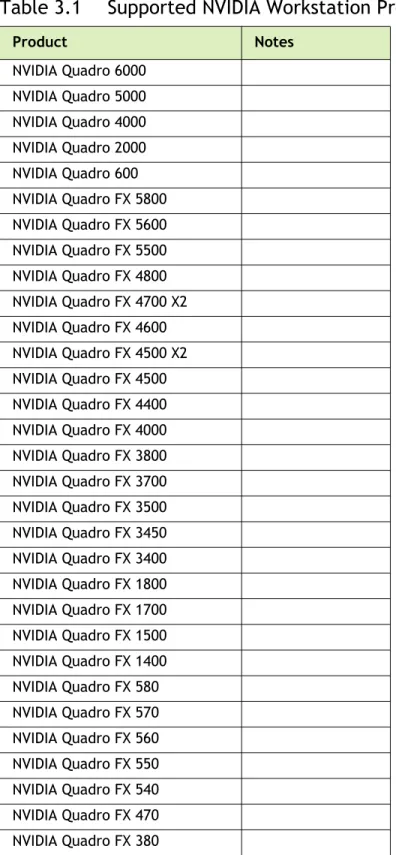
The following tables list the NVIDIA workstation products supported by this Release 256 driver.
Table 3.1
Supported NVIDIA Workstation Products
Product Notes NVIDIA Quadro 6000 NVIDIA Quadro 5000 NVIDIA Quadro 4000 NVIDIA Quadro 2000 NVIDIA Quadro 600 NVIDIA Quadro FX 5800 NVIDIA Quadro FX 5600 NVIDIA Quadro FX 5500 NVIDIA Quadro FX 4800 NVIDIA Quadro FX 4700 X2 NVIDIA Quadro FX 4600 NVIDIA Quadro FX 4500 X2 NVIDIA Quadro FX 4500 NVIDIA Quadro FX 4400 NVIDIA Quadro FX 4000 NVIDIA Quadro FX 3800 NVIDIA Quadro FX 3700 NVIDIA Quadro FX 3500 NVIDIA Quadro FX 3450 NVIDIA Quadro FX 3400 NVIDIA Quadro FX 1800 NVIDIA Quadro FX 1700 NVIDIA Quadro FX 1500 NVIDIA Quadro FX 1400 NVIDIA Quadro FX 580 NVIDIA Quadro FX 570 NVIDIA Quadro FX 560 NVIDIA Quadro FX 550 NVIDIA Quadro FX 540 NVIDIA Quadro FX 470 NVIDIA Quadro FX 380
Chapter 03 : THE RELEASE 256 DRIVERFOR WINDOWS XP
Supported Languages
The Release 256 Graphics Drivers supports the following languages in the main driver Control Panel:
NVIDIA Quadro FX 380 LP (low profile)
NVIDIA Quadro FX 370
NVIDIA Quadro FX 370 low profile NVIDIA Quadro FX 350 NVIDIA Quadro CX NVIDIA Quadro VX 200 NVIDIA NVS 300 NVIDIA Quadro NVS 450 NVIDIA Quadro NVS 440 NVIDIA Quadro NVS 420 NVIDIA Quadro NVS 295 NVIDIA Quadro NVS 290 NVIDIA Quadro NVS 285
Table 3.2
Supported NVIDIA Quadro Blade/Embedded Graphics Board
Series
Product Notes NVIDIA Quadro FX 3600M NVIDIA Quadro FX 2800M NVIDIA Quadro FX 1600M NVIDIA Quadro FX 880M NVIDIA Quadro FX 770M NVIDIA Quadro FX 560M NVIDIA Quadro FX 370M NVIDIA Quadro NVS 120MEnglish (USA) German Portuguese (Euro/
Iberian)
English (UK) Greek Russian
Arabic Hebrew Slovak
Chinese (Simplified) Hungarian Slovenian
Table 3.1
Supported NVIDIA Workstation Products (continued)
Chapter 03 : THE RELEASE 256 DRIVERFOR WINDOWS XP
Chinese (Traditional) Italian Spanish
Czech Japanese Spanish (Latin America)
Danish Korean Swedish
Dutch Norwegian Thai
Finnish Polish Turkish
Chapter 03 : THE RELEASE 256 DRIVERFOR WINDOWS XP
Driver Installation
System Requirements
The hard disk space requirement for 32 bit is minimum 120 MB for English‐only, and 172 MB for International.
The hard disk space requirement for 64 bit is minimum 140 MB for English‐only, and 186 MB for International.
Installation Instructions
Before You Begin
If NVIDIA nTune is already installed
If you have previously installed NVIDIA nTune, NVIDIA recommends that you uninstall nTune before installing this driver. After the driver install is complete, you can reinstall nTune.
If you do not have System Administrator access privileges, it is assumed that the appropriate person with System Administrator access in your organization will set up and install the NVIDIA graphics driver software on your computer.
The installation process copies all necessary files for operation into the appropriate directories.
•
The nView system files are copied to your Windows\System directory.•
nView Desktop Manager Profile files (*.tvp) are saved in the Windows\Nview directory.Depending on the version of the NVIDIA driver previously installed, profiles may also be located in the Documents and Settings\All Users\Application Data\ nView_Profiles directory.
As part of the install process, an uninstall is registered in your system.
Under Windows XP, the NVIDIA driver is installed in “Dualview mode” display. However, note that the second display is not activated by default, but must be enabled.
SLI Mosaic Mode
You must make sure SLI Mosaic mode is disabled before installing a new driver over a previously installed driver. If SLI Mosaic mode is active on your displays when you install the new driver, the driver will not install properly.
Chapter 03 : THE RELEASE 256 DRIVERFOR WINDOWS XP
Preserving Settings Before Upgrading Your Software
Before uninstalling or installing software, your can preserve your nView Desktop Manager and/or NVIDIA Display settings by using the nView Desktop Manager Profiles features.
Follow the steps below and/or refer to the NVIDIA nView Desktop Manager User’s Guide for details.
1
Open the nView Desktop Manager Profiles page (Figure 4.1).2
To preserve your current settings, you can use either the Save or the New option from the nView Desktop Manager Profiles page:•
If you want to overwrite the currently loaded profile with your changed settings, use the Save option. Notice that a warning message indicates that you are about to overwrite the selected profile.•
If you want to retain the currently loaded profile and want to save your changed settings to a new file, click the New option. Enter a name and description of the profile in the New Profile dialog box. For example, you can name this profile My Settings.3
If you are an “advanced” user and want to customize certain settings in the saved profile, click Advanced << to expand the dialog box (Figure 4.2).4
To customize the settings, you can select or clear any of the settings check boxes.5
Click Save to return to the main Profiles page.If you created a new profile, you will see the name of the newly created profile in the profiles list.
If you overwrote a current profile, the same profile name is retained in the list.
6
Now you can uninstall your current driver for a driver upgrade.7
After you restart your computer following an NVIDIA new driver install, you can easily load the saved profile from the Profiles page of nView Desktop Manager.Note: Follow the steps below and/or refer to the NVIDIA nView Desk-top Manager User’s Guide for details. Under Windows XP/2000 you must have, at least, Power User access privileges in order to create or save a profile. (Refer to Windows Help if you need an explanation of Power User access rights.)
Note: nView Desktop Manager profile (.tvp) files are saved in the Windows\nView directory. Depending on the version of the NVIDIA driver previously installed, profiles may also be saved in the Docu-ments and Settings\All Users\Application Data\ nView_Profiles direc-tory.
Chapter 03 : THE RELEASE 256 DRIVERFOR WINDOWS XP
About Using Saved Profiles in Another Computer
You can easily use any saved profile (.tvp file in the Windows\nView directory) from one computer and use it in another computer, if you want. You’ll need to copy it to the Windows\nView directory of a computer that has the NVIDIA ForceWare graphics display driver, etc. installed properly. Then this profile can be loaded from another computer from the nView Desktop Manager Profiles page just as it can from your original computer.
Installing the NVIDIA Graphics Drivers
1
Follow the instructions on the NVIDIA .com Web site driver download page to locate the appropriate driver to download, based on your hardware and operating system.2
Click the driver download link.The license agreement dialog box appears.
3
Click Accept if you accept the terms of the agreement, then either open the file or save the file to your PC and open it later.4
Open the NVIDIA driver installation .EXE file to launch the NVIDIA InstallShield Wizard.5
Follow the instructions in the NVIDIA InstallShield Wizard to complete the installation.APPENDIX A MODE SUPPORT FOR
WINDOWS
This chapter details the Windows modes supported by the Release 256 driver for NVIDIA products. It contains these sections:
“General Mode Support Information” on page 33
“Default Modes Supported by GPU for Windows XP” on page 34 “Modes Supported by TV Encoders” on page 40
Appendix A : MODE SUPPORTFOR WINDOWS
General Mode Support Information
The NVIDIA graphics driver includes a standard list of display modes that are supported by default. These modes are listed in the section “Default Modes Supported by GPU for Windows XP” on page 34.
The actual modes available depend on the capabilities of the display. In addition, the NVIDIA graphics driver has a “dynamic EDID detection” capability and will make available additional modes that are listed in the display EDID, provided the graphics hardware can support it.
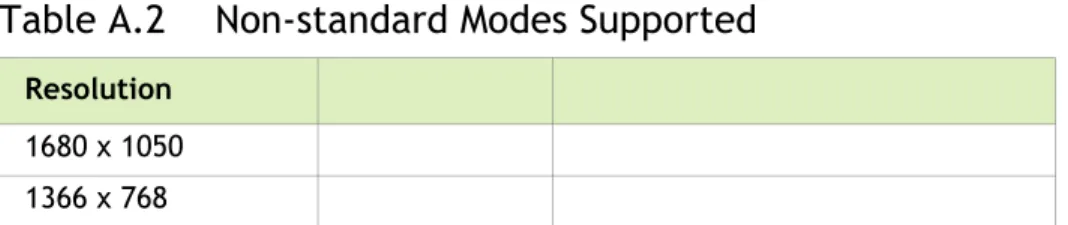
The NVIDIA graphics driver also supports the high resolutions available with the displays listed in Table A.1 as well as the non‐standard modes listed in Table A.2.
Table A.1
Modes Supported for High Resolution Displays
Display Maximum Resolution
Apple 30” Cinema HD Display (Dual link DVI)
2560x1600 @ 60 Hz
Dell WFP 3007 (Dual Link DVI) 2560x1600 @ 60 Hz
HP LP3065 dual-link DVI flat panel 2560x1600 @ 60Hz.
Table A.2
Non-standard Modes Supported
Resolution1680 x 1050 1366 x 768
Appendix A : MODE SUPPORTFOR WINDOWS
Default Modes Supported by GPU for Windows XP
This section lists the modes that are included by default in the driver INF for the following product families:
“NVIDIA Quadro GPUs” on page 35
Understanding the Mode Format
Figure A.1 gives an example of how to read the mode information presented in this section.
Figure A.1 Mode Format
Note:•
Horizontal spanning modes of 3840x1080 and above, and vertical spanning modes of 1920x2160 and above generally require at least 32 MB of video memory at 32 bpp.•
An “i” next to the refresh rate indicates an interlaced refresh rate. Resolution Example entry: 1024 x 768 32 60 70 72 75 85 100 120 140 144 150 170 200 Meaning: Resolution: 1024 x 768 Color depth: 32 bpp Refresh rates: 60 Hz, 70 Hz, 72 Hz, 75 Hz, 85 Hz, 100 Hz, 120 Hz, 140 Hz, 144 Hz, 150 Hz, 170 Hz, and 200 HzAppendix A : MODE SUPPORTFOR WINDOWS
NVIDIA Quadro GPUs
This sections lists the supported display resolutions, color depths, and refresh rates for the products listed in “Supported NVIDIA Products” on page 26.
Standard Modes
640 x 480 8 60 70 72 75 85 100 120 140 144 150 170 200 240 720 x 480 8 60 720 x 576 8 50 60 800 x 600 8 60 70 72 75 85 100 120 140 144 150 170 200 240 1024 x 768 8 60 70 72 75 85 100 120 140 144 150 170 200 240 1152 x 864 8 60 70 72 75 85 100 120 140 144 150 170 200 1280 x 720 8 60 1280 x 768 8 60 70 72 75 85 100 120 140 144 150 170 1280 x 800 8 60 70 72 75 85 100 120 140 144 150 170 1280 x 960 8 60 70 72 75 85 100 120 140 144 150 170 1280 x 1024 8 60 70 72 75 85 100 120 140 144 150 170 1360 x 768 8 60 70 72 75 85 100 120 140 144 150 170 1600 x 900 8 60 70 72 75 85 100 120 140 144 150 1600 x 1024 8 60 70 72 75 85 100 120 1600 x 1200 8 60 70 72 75 85 100 120 1680 x 1050 8 60 1920 x 1080 8 60 1920 x 1200 8 60 70 72 75 85 100 1920 x 1440 8 60 70 72 75 85 2048 x 1536 8 60 640 x 480 16 60 70 72 75 85 100 120 140 144 150 170 200 240 720 x 480 16 60 720 x 576 16 50 60 800 x 600 16 60 70 72 75 85 100 120 140 144 150 170 200 240 1024 x 768 16 60 70 72 75 85 100 120 140 144 150 170 200 240 1152 x 864 16 60 70 72 75 85 100 120 140 144 150 170 200 1280 x 720 16 60 1280 x 768 16 60 70 72 75 85 100 120 140 144 150 170 1280 x 800 16 60 70 72 75 85 100 120 140 144 150 170 1280 x 960 16 60 70 72 75 85 100 120 140 144 150 170 1280 x 1024 16 60 70 72 75 85 100 120 140 144 150 170 1360 x 768 16 60 70 72 75 85 100 120 140 144 150 170 1600 x 900 16 60 70 72 75 85 100 120 140 144 150 1600 x 1024 16 60 70 72 75 85 100 120 1600 x 1200 16 60 70 72 75 85 100 120 1680 x 1050 16 60 1920 x 1080 16 60Appendix A : MODE SUPPORTFOR WINDOWS 1920 x 1200 16 60 70 72 75 85 100 1920 x 1440 16 60 70 72 75 85 2048 x 1536 16 60 640 x 480 32 60 70 72 75 85 100 120 140 144 150 170 200 240 720 x 480 32 60 720 x 576 32 50 60 800 x 600 32 60 70 72 75 85 100 120 140 144 150 170 200 240 1024 x 768 32 60 70 72 75 85 100 120 140 144 150 170 200 240 1152 x 864 32 60 70 72 75 85 100 120 140 144 150 170 200 1280 x 720 32 60 1280 x 768 32 60 70 72 75 85 100 120 140 144 150 170 1280 x 800 32 60 70 72 75 85 100 120 140 144 150 170 1280 x 960 32 60 70 72 75 85 100 120 140 144 150 170 1280 x 1024 32 60 70 72 75 85 100 120 140 144 150 170 1360 x 768 32 60 70 72 75 85 100 120 140 144 150 170 1600 x 900 32 60 70 72 75 85 100 120 140 144 150 1600 x 1024 32 60 70 72 75 85 100 120 1600 x 1200 32 60 70 72 75 85 100 120 1680 x 1050 32 60 1920 x 1080 32 60 1920 x 1200 32 60 70 72 75 85 100 1920 x 1440 32 60 70 72 75 85 2048 x 1536 32 60
Horizontal Spanning Modes
1280 x 480 8 60 70 72 75 85 100 120 140 144 150 170 200 240 1600 x 600 8 60 70 72 75 85 100 120 140 144 150 170 200 240 2048 x 768 8 60 70 72 75 85 100 120 140 144 150 170 200 240 2304 x 864 8 60 70 72 75 85 100 120 140 144 150 170 200 2560 x 720 8 60 2560 x 768 8 60 70 72 75 85 100 120 140 144 150 170 2560 x 800 8 60 70 72 75 85 100 120 140 144 150 170 2560 x 960 8 60 70 72 75 85 100 120 140 144 150 170 2560 x 1024 8 60 70 72 75 85 100 120 140 144 150 170 2720 x 768 8 60 70 72 75 85 100 120 140 144 150 170 3200 x 900 8 60 70 72 75 85 100 120 140 144 150 3200 x 1024 8 60 70 72 75 85 100 120 3200 x 1200 8 60 70 72 75 85 100 120 3360 x 1050 8 60 3840 x 1080 8 60 3840 x 1200 8 60 70 72 75 85 100 3840 x 1440 8 60 70 72 75 85 4096 x 1536 8 60
Appendix A : MODE SUPPORTFOR WINDOWS 1280 x 480 16 60 70 72 75 85 100 120 140 144 150 170 200 240 1600 x 600 16 60 70 72 75 85 100 120 140 144 150 170 200 240 2048 x 768 16 60 70 72 75 85 100 120 140 144 150 170 200 240 2304 x 864 16 60 70 72 75 85 100 120 140 144 150 170 200 2560 x 720 16 60 2560 x 768 16 60 70 72 75 85 100 120 140 144 150 170 2560 x 800 16 60 70 72 75 85 100 120 140 144 150 170 2560 x 960 16 60 70 72 75 85 100 120 140 144 150 170 2560 x 1024 16 60 70 72 75 85 100 120 140 144 150 170 2720 x 768 16 60 70 72 75 85 100 120 140 144 150 170 3200 x 900 16 60 70 72 75 85 100 120 140 144 150 3200 x 1024 16 60 70 72 75 85 100 120 3200 x 1200 16 60 70 72 75 85 100 120 3360 x 1050 16 60 3840 x 1080 16 60 3840 x 1200 16 60 70 72 75 85 100 3840 x 1440 16 60 70 72 75 85 4096 x 1536 16 60 1280 x 480 32 60 70 72 75 85 100 120 140 144 150 170 200 240 1600 x 600 32 60 70 72 75 85 100 120 140 144 150 170 200 240 2048 x 768 32 60 70 72 75 85 100 120 140 144 150 170 200 240 2304 x 864 32 60 70 72 75 85 100 120 140 144 150 170 200 2560 x 720 32 60 2560 x 768 32 60 70 72 75 85 100 120 140 144 150 170 2560 x 800 32 60 70 72 75 85 100 120 140 144 150 170 2560 x 960 32 60 70 72 75 85 100 120 140 144 150 170 2560 x 1024 32 60 70 72 75 85 100 120 140 144 150 170 2720 x 768 32 60 70 72 75 85 100 120 140 144 150 170 3200 x 900 32 60 70 72 75 85 100 120 140 144 150 3200 x 1024 32 60 70 72 75 85 100 120 3200 x 1200 32 60 70 72 75 85 100 120 3360 x 1050 32 60 3840 x 1080 32 60 3840 x 1200 32 60 70 72 75 85 100 3840 x 1440 32 60 70 72 75 85 4096 x 1536 32 60
Vertical Spanning Modes
640 x 960 8 60 70 72 75 85 100 120 140 144 150 170 200 240 800 x 1200 8 60 70 72 75 85 100 120 140 144 150 170 200 240 1024 x 1536 8 60 70 72 75 85 100 120 140 144 150 170 200 240 1152 x 1728 8 60 70 72 75 85 100 120 140 144 150 170 200
Appendix A : MODE SUPPORTFOR WINDOWS 1280 x 1440 8 60 1280 x 1536 8 60 70 72 75 85 100 120 140 144 150 170 1280 x 1600 8 60 70 72 75 85 100 120 140 144 150 170 1280 x 1920 8 60 70 72 75 85 100 120 140 144 150 170 1280 x 2048 8 60 70 72 75 85 100 120 140 144 150 170 1360 x 1536 8 60 70 72 75 85 100 120 140 144 150 170 1600 x 1800 8 60 70 72 75 85 100 120 140 144 150 1600 x 2048 8 60 70 72 75 85 100 120 1600 x 2400 8 60 70 72 75 85 100 120 1680 x 2100 8 60 1920 x 2160 8 60 1920 x 2400 8 60 70 72 75 85 100 1920 x 2880 8 60 70 72 75 85 2048 x 3072 8 60 640 x 960 16 60 70 72 75 85 100 120 140 144 150 170 200 240 800 x 1200 16 60 70 72 75 85 100 120 140 144 150 170 200 240 1024 x 1536 16 60 70 72 75 85 100 120 140 144 150 170 200 240 1152 x 1728 16 60 70 72 75 85 100 120 140 144 150 170 200 1280 x 1440 16 60 1280 x 1536 16 60 70 72 75 85 100 120 140 144 150 170 1280 x 1600 16 60 70 72 75 85 100 120 140 144 150 170 1280 x 1920 16 60 70 72 75 85 100 120 140 144 150 170 1280 x 2048 16 60 70 72 75 85 100 120 140 144 150 170 1360 x 1536 16 60 70 72 75 85 100 120 140 144 150 170 1600 x 1800 16 60 70 72 75 85 100 120 140 144 150 1600 x 2048 16 60 70 72 75 85 100 120 1600 x 2400 16 60 70 72 75 85 100 120 1680 x 2100 16 60 1920 x 2160 16 60 1920 x 2400 16 60 70 72 75 85 100 1920 x 2880 16 60 70 72 75 85 2048 x 3072 16 60 640 x 960 32 60 70 72 75 85 100 120 140 144 150 170 200 240 800 x 1200 32 60 70 72 75 85 100 120 140 144 150 170 200 240 1024 x 1536 32 60 70 72 75 85 100 120 140 144 150 170 200 240 1152 x 1728 32 60 70 72 75 85 100 120 140 144 150 170 200 1280 x 1440 32 60 1280 x 1536 32 60 70 72 75 85 100 120 140 144 150 170 1280 x 1600 32 60 70 72 75 85 100 120 140 144 150 170 1280 x 1920 32 60 70 72 75 85 100 120 140 144 150 170 1280 x 2048 32 60 70 72 75 85 100 120 140 144 150 170 1360 x 1536 32 60 70 72 75 85 100 120 140 144 150 170 1600 x 1800 32 60 70 72 75 85 100 120 140 144 150 1600 x 2048 32 60 70 72 75 85 100 120
Appendix A : MODE SUPPORTFOR WINDOWS 1600 x 2400 32 60 70 72 75 85 100 120 1680 x 2100 32 60 1920 x 2160 32 60 1920 x 2400 32 60 70 72 75 85 100 1920 x 2880 32 60 70 72 75 85 2048 x 3072 32 60
Appendix A : MODE SUPPORTFOR WINDOWS
Modes Supported by TV Encoders
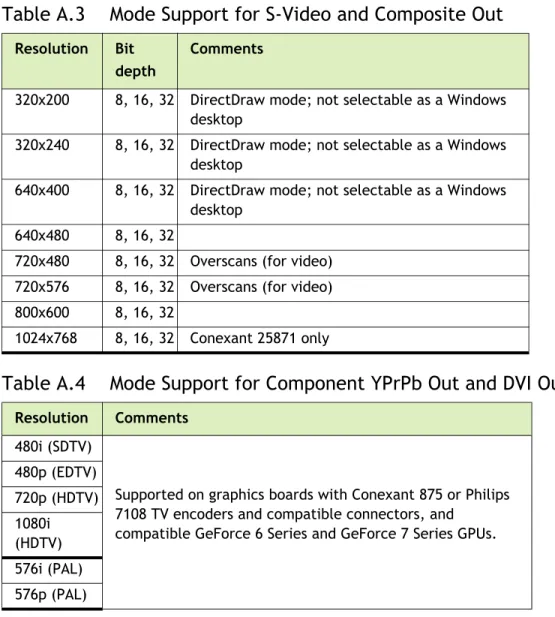
Table A.3 and Table A.4 list the NTSC, PAL, and HDTV TV‐Out modes supported by the NVIDIA driver.
The driver supports manual overscan correction for component and DVI outputs. See the ForceWare Graphics Driver User’s Guide for instructions on how to use the overscan correction features in the control panel.
Table A.3
Mode Support for S-Video and Composite Out
Resolution Bitdepth
Comments
320x200 8, 16, 32 DirectDraw mode; not selectable as a Windows
desktop
320x240 8, 16, 32 DirectDraw mode; not selectable as a Windows
desktop
640x400 8, 16, 32 DirectDraw mode; not selectable as a Windows
desktop
640x480 8, 16, 32
720x480 8, 16, 32 Overscans (for video)
720x576 8, 16, 32 Overscans (for video)
800x600 8, 16, 32
1024x768 8, 16, 32 Conexant 25871 only
Table A.4
Mode Support for Component YPrPb Out and DVI Out
Resolution Comments480i (SDTV)
Supported on graphics boards with Conexant 875 or Philips 7108 TV encoders and compatible connectors, and
compatible GeForce 6 Series and GeForce 7 Series GPUs. 480p (EDTV) 720p (HDTV) 1080i (HDTV) 576i (PAL) 576p (PAL)