CHANGE MANAGEMENT PROPOSAL:
RSHA RESTRUCTURE
Page 2
Part 1.
Formal Change Process
ITEM 1.
Purpose
This document outlines a formal change management proposal that affects the Schools of Cultural Inquiry (SCI), Art (SoA), Language Studies (SLS), Archaeology and Anthropology (SAA), and the Interdisciplinary Humanities Group (IHuG) within the Research School of Humanities and the Arts (RSHA). The primary aim is to co-locate cognate disciplines, sub-disciplines and research centres into larger AOUs.
The desired outcome is to provide an organisational structure that will enhance intellectual collaboration and research productivity and more clearly articulate research led teaching while providing a more integrated and efficient delivery of administration.
The proposal will reduce the number of AOUs to build critical mass in cognate areas, make more visible academic areas of strength, and by implication reduce administrative overheads.
These changes are not designed to directly result in staff losses nor are there changes to the undergraduate curriculum offerings.
The proposal, if accepted, would result in two head of AOU positions being disestablished but this will not change the ongoing employment status of the two affected staff. There would also be reallocation of administrative staff to support the proposed structure but there is no proposal for redundancies as part of this restructure.
The process of change for this proposed restructure will commence with a two week period of formal consultation. This consultation is about determining the principles and broad organisational structure of the affected schools within RSHA. If these are agreed this represents the end of the formal consultation process, and this will form the basis of the implementation of the proposal.
This will be followed by a 4 month period during which the broad organisational structure will be implemented to take affect from the 1st January 2014.
ITEM 2.
The proposed outcome
1. Establish a School of Languages and Literature, bringing together the current School of Language Studies and the School of Cultural Inquiry, excluding Art History. The School of Cultural Inquiry will be disestablished.
2. Strengthen Art History and Art Theory through the integration of Art History from the School of Cultural Inquiry into the School of Art.
3. Disestablish IHuG through the co-location of research centres wherever possible with AOUs to provide a strong sustainable base and enhance research capacity within the AOU, while recognising and preserving the governance and financial structure of the centres to ensure that they play an important interdisciplinary role across RSHA, the College and the
University.
4. Make more visible the emerging strength in Heritage and Museum Studies and locate it within the School of Archaeology and Anthropology which would be renamed the School of Archaeology, Anthropology, Heritage and Museum Studies.
Page 3
ITEM 3.
Background
The proposal builds on the ANU College of Arts & Social Sciences (‘the College’) significant
organisational restructure during 2009 that commenced in January 2010. This saw a shift in structure from disciplinary dispersal to integrated “clusters” of sufficient critical mass to enhance and deepen our capacity to undertake cutting edge research and teaching. There were a range of changes undertaken in 2009 but the most prominent included:
• Disestablishment of the Faculty of Arts and staff /disciplines merged into cognate organisational groups.
• The School of Social Sciences in the Faculty of Arts was disbanded and staff merged into the existing programs of Politics, History, and Sociology in the existing Research School of Social Sciences (RSSS) to form larger disciplinary and cognate-disciplinary schools.
• Disestablishment of the Research School of Humanities and the creation of the Research School of Humanities and the Arts (RSHA).
• The philosophers who were in the School of Humanities within the Faculty of Arts moved to join the School of Philosophy in RSSS.
• Remaining members of the School of Humanities morphed into the School of Cultural Inquiry located in the RSHA.
Importantly the College has improved noticeably in two key areas of the ANU by 2020 plan – our student evaluations of teaching remain high with significant improvement at the lower end and our disciplinary research strengths improved in the ERA assessments from 2010 to 2012. We have also maintained our profile in the international competitive rankings for humanities and the social sciences. However, with the schools identified in this proposal there has been a significant decline in the
undergraduate load primarily within the School of Cultural Inquiry although a number of the other schools are also experiencing a decline in load. This change management proposal more clearly identifies the largest discipline in the School of Cultural Inquiry, English literature, in an enlarged and renamed School of Languages and Literature and also brings into the enlarged school the teaching of Latin, Ancient Greek and history of the classical world and film studies which has strong alliances with literature and languages. The small group of art historians currently located within the School of Cultural Inquiry will be embedded within an enlarged School of Art alongside the Art Theorists while the growing but dispersed museums and heritage group will be co-located and visible through an enlarged and renamed School of Archaeology, Anthropology and Heritage and Museum Studies. In terms of organisational restructuring further changes in the RSHA in 2011 created the
Interdisciplinary Humanities Group (IHuG) as a new academic organisational unit (AOU) to provide an organisational framework for its key research centres that were not aligned with the existing AOUs. Then in 2012 the RSHA engaged in three other significant repositioning projects:
• major curriculum change in the School of Music with consequent staffing changes;
• a review of the Centre for European Studies (CES) with the centre relocating in 2013 to the School of Politics and International Relations (RSSS) to more visibly align with the social sciences; and • release of a discussion paper canvassing a restructure involving the School of Cultural Inquiry, the
School of Language Studies and the School of Art in order to achieve a greater concentration of cognate disciplinary areas.
Page 4 Prior to the release of the discussion paper referred to above there had been on-going discussion for some 12 months with staff in the affected areas through school meetings along with discussion by the RSHA executive. The release of the discussion paper was complemented by the commencement of an informal consultation process, where a series of working parties (with independent chairs from outside of RSHA) were established in August 2012 to consider and consult on the proposals made in the discussion paper. The working party committees were comprised of representatives from the various areas nominated by the heads of Cultural Inquiry, Art, Languages and Archaeology and Anthropology. The working parties held forums for discussions and called for submissions from any interested parties. Chairs also met one-on-one with individuals if requested to do so. These working parties presented their written reports to the Director, RSHA at the end of January 2013.
This current proposal is made after due consideration being given to the reports of the working parties by the CASS Executive. The purpose of the working parties was to focus informal consultation on the key elements of the proposed changes. There have also been discussions over the past year within the College Executive with the Heads of Schools on the broad structure being proposed. The working parties found that there were mixed views about the proposed changes but there was sufficient intellectual support for the CASS Executive to endorse the Director’s proposal to recommend progressing to the next stage of a formal change management process.
It is foreseeable that the impact of this proposal will involve:
• Disestablishment of leadership positions but no loss of academic staffing;
• A change to work practices with professional staff being relocated to support the new organisation structure and current separate academic groups interacting more closely within larger
organisational units;
• Possible impact on conditions, including change that would be likely to lead to changed responsibility levels.
Part 2.
Rationale & Nature of Change
ITEM 4.
Aims
The aim of the RSHA is to contribute to the University’s standing as one of the world’s leading research and teaching universities in the humanities and creative arts. This will be achieved through: • delivering excellence in teaching appropriate for a research intensive university;
• by creating an innovative and a challenging graduate experience; and • by undertaking the highest quality research.
Achieving this aim requires us to reduce obstacles to internal cooperation and to provide the optimal structure to facilitate our scholarship and teaching. By working together, and focusing on the future, the RSHA can create a structure that blends education and research of the highest standards within an innovative and dynamic intellectual environment with sufficient critical mass to ensure long-term sustainability.
An important aspect of this proposal is to further refine the organisational structure of RSHA in a way that will facilitate high quality research and ensure that our teaching and graduate supervision is informed by the highest quality research. This proposal will allow the RSHA to deepen the research culture within larger sustainable clusters to address declines in some of the teaching programs. It will
Page 5 also make more visible to students that the college offers courses in literature and that there has emerged a significant mass of scholars in heritage and museums studies.
Rationale: Enlarged School of Languages & Literature
The creation of a single School of Languages and Literature will enable the RSHA’s disciplinary strengths in these areas to have greater visibility nationally and internationally. Synergies exist between the study of language and English literature.
The SLS is the home for the Australian National Dictionary Centre and the disciplinary strengths of the language teaching staff are in literature and film as well as linguistics and socio-linguistics. Classics crosses the disciplinary divide between the study of language and literature as well as having a strong focus on ancient history. In the past there have been joint appointments in language and literature. The new School will enable the RSHA to maintain its strengths in English literature but open up possibilities for research collaboration and graduate education in the field of literary studies as well as new possibilities in areas such as lexicography and translations studies. A larger school will enable the development of a more effective research culture and a better framework for managing staff to create research opportunities by building on synergies that exist across the two present schools and creating economies of scale in supervision and the management of activities and teaching programs.
Rationale: Enlarged School of Art
Art History & Curatorship in the School of Cultural Inquiry and Art Theory in the School of Art jointly comprise 9.5 FTE staff (4 FTE in SCI and 5.5 FTE in SoA). Joined together in a single program within the School of Art they would create one of the strongest bodies of art theorists and historians in Australia and would enable ANU to occupy a leading global position in art history and theory. Separately neither Art History & Curatorship nor Art Theory has critical numbers to support the existing teaching load or take account of the exigencies of leaves of absence. Each will continue to depend on temporary appointments to cover leave of absences and neither can cope easily with unanticipated staffing issues.
Younger staff would have greater opportunities for research development with less teaching pressure placed upon them. The separation has been one of the reasons why ANU has not been able to take advantage of its stellar individual reputation in Art History in the award of research grants. For
example over the past 5 years there have been no ARC applications from the Art History group due to the pressure of maintaining teaching obligations.
ANU has a number of leading art historians and if they were managed more as a whole, the overall performance would be enhanced. The combined unit is likely to increase graduate coursework numbers by opening up the possibility for new programs with the option of common core teaching to both cohorts of undergraduate students. The staff members of both schools have close relationships with the national cultural institutions and a more coordinated approach will bring benefits to the ANU and increase the visibility of the exceptional contribution RSHA makes to Canberra’s cultural life. The creation of a single program of Art History and Theory will have no effect on the present degree programs but will facilitate the planning of new initiatives and coordinating staff appointments.
Rationale: New directions in the Humanities -- Heritage and Museum Studies
The RSHA has significant but dispersed strengths in this area. Individual staff have been very successful in securing grants in this area under the leadership of Professor Morphy. However if this area is to move beyond a niche research field so that it can be visibly represented in ERA then the RSHA needs to determine how this area can be structured to build a sustainable cluster that worksPage 6 effectively and does not generate internal competition within the RSHA. The informal consultation phase has recommended a process for considering whether a Heritage and Museums Centre should be established, its role and location. This proposal recommends the centre be located with the School of Archaeology and Anthropology given that they are taking the lead in developing a new
undergraduate minor in this area and the name of the School be amended to include Heritage and Museum Studies so that this emerging strength is clearly visible to undergraduate and postgraduate students.
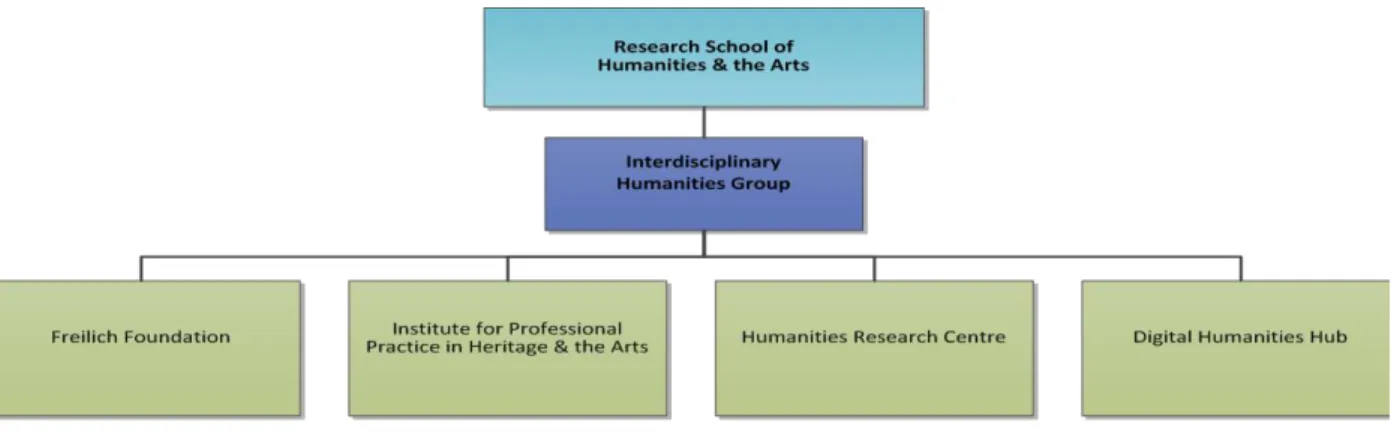
This change management proposal provides the opportunity to reassess the centres within IHuG (which is a separate AOU) and the governance around the Master in Liberal Arts program and HDR supervision currently managed in IHuG. The key question is, is IHuG achieving the aspirations that lead to its initial establishment? If not then the centres and programs need to be aligned to the appropriate disciplinary homes. If yes, then the governance structure for IHuG in relation to the other AOUs needs to be clear to ensure that it does not result in internal competition within RSHA. IHuG currently has 17.4 EFT academic staff spread across 4 centres as shown in Diagram 1. As is
consistent with research intensive centres in RSSS a significant number of staff are externally funded. In this case 10.4 of these staff are funded either from external grants or Endowment funds. The proposal is that the research centres be appropriately located with large AOUs while committing to develop a governance structure that ensures the centres continue to provide interdisciplinary research leadership across the RSHA, the College and the University. The governance structure may well vary for each research centre but this would be determined as part of the implementation phase. This model currently operates in the Research School of Social Sciences (RSSS) where all centres are housed by a teaching and research AOU. However through the consultation phase a different structural model that is intellectually sustainable may emerge.
Diagram 1: Interdisciplinary Humanities Group
ITEM 5.
Rationale for Change
Why do we need to restructure?
The RSHA needs to position itself now for a rapidly emerging global market in ideas and research of national and international significance, competition for the best students and staff, and the
globalisation of research projects that often requires teams of researchers and significant investment in research infrastructure.
Page 7 We need to prepare for generational change within the academic staff. The average age of the
academic staff in RSHA is 51 years with 72 staff aged over 55 years and the average age of the professoriate is 60 years. With this age profile there will inevitably be retirements. Building sufficient critical mass in larger AOUs from which to plan for and draw from the future disciplinary leadership is a key, although not the only driver, of this proposal.
The College continues to grapple with increasing costs of compliance with external regulations and university requirements. The staffing size of some sub-disciplines of the relevant schools of the RSHA is relatively small (see Table 1). To meet these compliance pressures, it is essential that the RSHA is structured in a way that promotes an effective and efficient operation that can better address these pressures.
Table 1: Current Academic Staffing Allocation
School & Sub- Discipline Academic Staff (FTE) Funding Level E Staff (FTE) Funding
Recurrent E Q & S Recurrent E Q & S
School of Cultural Inquiry
Art History & Curatorship 4 1
Classics & Ancient History 3.5 0.5
Literature 12.4 0.5 0.5 0.5
School of Language Studies
Languages 10.7 1 1 Linguistics 3.7 1 1.2 ANDC 1 School of Art Art Theory 4.5 1 0.5 Practitioners 25.53
School of Archaeology and Anthropology
Archaeology 4 3 1
Anthropology 13.2 4.55 3
Heritage and Museums 1 1 1
Interdisciplinary Humanities Group IHUG 1 1 Freilich Foundation 2 1 1 Humanities Research Centre 2 1.5 1 0.5
Digital Humanities Hub 1.5 1.4
Institute of Professional
Practice and the Arts 1.5 2
TOTAL STAFF 89.53 3 16.95 10.7 1 2 1. Data excludes fixed term staff whose appointment expires before 1 January 2014. 1.5 FTE funded from S funds have
underlying recurrent funded posts. Excludes RSHA Director.
2. Literature includes staff who teach into English, Gender and Film Studies. Data Source: HRMS 23 May 2013.
Page 8 Further integration into fewer but larger AOUs will:
• more effectively integrate our teaching and research;
• ensure the RSHA focuses its resources on key priorities in education and research;
• make the RSHA (and the College) more attractive to future students, particularly graduates, and to academic staff (who will be attracted to working in clusters with sufficient critical mass to foster collegiality and collaboration);
• enhance our research capacity, and position strategically for future rounds of the ERA and the ranking of disciplinary strengths, both nationally and internationally;
• allow the College to more effectively deploy its operating grant; and
• position the humanities and creative arts as an integrated, coherent and forward looking research school within the ANU with effective governance.
As already mentioned it is anticipated that this structural reorganisation will enable the RSHA to
proactively address the declines in student enrolments. Larger organisational units will allow for greater collaboration in aligning staffing to sustain teaching programs and to build new teaching initiatives that reflect emerging areas of scholarship.
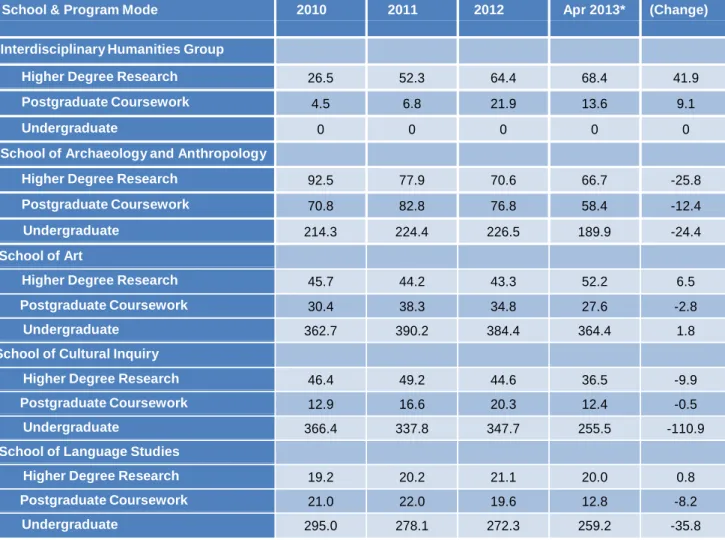
Table 2: Student load by teaching AOU, 2010-April 2013, EFTSL
School & Program Mode 2010 2011 2012 Apr 2013* (Change)
Interdisciplinary Humanities Group
Higher Degree Research 26.5 52.3 64.4 68.4 41.9
Postgraduate Coursework 4.5 6.8 21.9 13.6 9.1
Undergraduate 0 0 0 0 0
School of Archaeology and Anthropology
Higher Degree Research 92.5 77.9 70.6 66.7 -25.8
Postgraduate Coursework 70.8 82.8 76.8 58.4 -12.4
Undergraduate 214.3 224.4 226.5 189.9 -24.4
School of Art
Higher Degree Research 45.7 44.2 43.3 52.2 6.5
Postgraduate Coursework 30.4 38.3 34.8 27.6 -2.8
Undergraduate 362.7 390.2 384.4 364.4 1.8
School of Cultural Inquiry
Higher Degree Research 46.4 49.2 44.6 36.5 -9.9
Postgraduate Coursework 12.9 16.6 20.3 12.4 -0.5
Undergraduate 366.4 337.8 347.7 255.5 -110.9
School of Language Studies
Higher Degree Research 19.2 20.2 21.1 20.0 0.8
Postgraduate Coursework 21.0 22.0 19.6 12.8 -8.2
Undergraduate 295.0 278.1 272.3 259.2 -35.8 Data source: Weekly Enrolment Report, ANU Planning & Statistical Services
* Given that not all undergraduate students have enrolled in second semester and students can change courses until the third week of second semester the declines for undergraduate load should be read with caution.
Page 9
ITEM 6.
Possible Effects on Staff & Staffing Principles
The purpose of the RSHA restructure is the strategic integration and enhancement of research and education, and to provide opportunity for advancement, both of the Research School and individuals. The objective is not one of deliberate cost saving.
The University does not anticipate the loss of any academic staff positions as a result of this project, other than leadership roles within Schools being disestablished (which will not affect the ongoing employment of affected staff).
Some staff will experience a relocation of their work area. The objective will be (to the extent physically possible) to co-locate staff of each AOU in the same building or group of buildings. Administrative and academic staff may be required to relocate to a new work area as a result of the new AOUs being established or in response to any changes to administrative arrangements. The College will provide to staff information on possible relocations as it becomes available. Staff will be consulted on decisions to relocate groups of staff.
Some staff will have a change of supervisor. This will occur through changes in leadership roles and administrative arrangements. Staff will be advised in advance of any changes to their individual supervisory arrangements.
In keeping with this position, the University has agreed that the following general principles will apply to the position review, advertisement, transfer and appointment to professional staff positions within the Research School:
• It is not the intention of the University to reduce staff numbers through the project.
• It is not the intention of this project to detrimentally affect the classification of existing staff members.
• The general principle will be to directly transfer existing staff members into positions of the same or similar classification level, where positions are not new or significantly changed.
• Expressions of interest will only be sought for new or significantly changed positions where there is more than one potential candidate. The College Executive makes a commitment to conduct, in the first instance, expressions of interest only for the RSHA candidates to ensure that the RSHA staff are provided with priority opportunity.
Part 3.
Consultation & Implementation
ITEM 7.
Consultation Process
Consultation on this proposal has and will continue to be a key element of its development. As previously mentioned, a discussion paper was released in August 2012 (although there had been extensive
discussions prior to this) and was complemented by the commencement of an informal consultation process, where a series of working parties (with independent chairs) were established in August 2012 to consider and consult on the proposals made in the discussion paper. These working parties presented their written reports to the Director, RSHA at the end of January 2013 and since this time there have continued to be further discussions.
To achieve further integration and maximisation of the RSHA’s significant, but dispersed intellectual strengths, the Director, RSHA and the College Executive are now embarking on a further formal consultation process that will include all affected academic and administrative staff within the RSHA, as
Page 10 well as CASS students. The consultation process within the RSHA will be led by Professor Morphy, as Director of RSHA and overseen by a change management committee chaired by the Director of HR, Dr Nadine White.
Although the details of the final restructured RSHA are open for debate and input from all staff, the following general principles should shape this debate:
• The consultation process will focus on achieving the broad organisational framework by the 2nd August.
• The RSHA will reduce the number of schools/groups (AOUs) from six to preferably four. • The new AOUs should not be so small as to lack critical mass (ideally a minimum of 20 EFT
academic staff although for specific disciplines this may be smaller due to student load) and not so large as to hamper collegiality (approx. maximum of 45 EFT academic staff).
• Wherever possible the administration within the RSHA will be co-located and consolidated. • The RSHA will maintain a strong flexible undergraduate teaching program in the humanities and
creative arts. Educational leadership and planning will be provided by the College Education Committee’s frameworks and policy and are not part of this proposal. For example Gender,
Sexuality and Culture remains as a major in the BA and is convened out of the School of Sociology. • While recognising the importance of research centres to our interdisciplinary enterprise these will
align to an appropriate discipline, cognate or interdisciplinary cluster.
• All AOUs will contribute to the research school’s core activities of research and education at all levels.
ITEM 8.
Implementation Process
The consultation process has been and will be extensive and broad. W e propose to implement the same process used in 2009 for the College integration.
This encompasses a two stage process. The first stage is the release of this formal change management proposal focused on agreeing the broad organisational and governance structure and principles that underpin the changes. This is a relatively short process allowing a 2 week period of consultation and feedback. Following this process a finalised structure and principles document would be developed, agreed by the College Dean as the delegate and the VC with a view to its release within two weeks. The second stage involves the establishment of operational working parties in the respective schools to implement the agreed broad organisational and governance structure of the relevant AOUs.
The overall process would be overseen by the “change management steering committee” chaired by the Director of HR, Dr Nadine White. The change management steering committee will have overall
responsibility overseeing both stages 1 and 2 but will not itself be involved in detailed operational matters particularly in stage 2. In addition to the Director HR, the change management steering committee will be comprised of the Director of RSHA, two representatives from the affected heads of AOUs from within RSHA, the College General Manager, and the Dean of the College of Arts and Social Sciences. The terms of reference for the committee are at Appendix 1.
Initial communication will be through email and meetings with staff. An initial RSHA Forum meeting will be held to discuss the broad structural changes with all staff and the process with a further follow-up meeting to enable further discussions. These forums will be led by the Director of RSHA. The RSHA will have a webpage containing all the relevant documents and affected staff are invited to send their views about the
Page 11 proposals to the email [email protected]. These views will be taken into account by the Change Management Steering Committee.
Although this structural reorganisation does not affect the educational programs, CASS students will be invited to attend an information forum. Students can also direct questions about the proposed changes to [email protected].
If the principles and structure for change are agreed by the Vice-Chancellor implementation will occur over the next 4 months with the goal of the new structure being operational from 1st January 2014. The timetable is set out below.
High level activity Timeline
Release of change management proposal 22nd July Period for consultation on proposal, including school-based staff
consultation meetings 22nd July – 2nd August
RSHA Forum to release formal change management document 22nd July
CASS Student Forum 23nd July
RSHA Forum to discuss change management document 24th July
Close of formal consultation 2nd August
Consideration of feedback on change management proposal and
decision whether to endorse (or modify and endorse) the proposal by 3-17th August College Executive to advice the Delegate for the College, Dean of
CASS on the proposal. 19th August
Dean to advise the Vice-Chancellor 26th August
If decision is made to proceed the following process will apply…
Implementation to occur progressively according to an implementation
plan and working parties September – 24 December
Page 12
ITEM 9.
Contacts
This change management process will be led by Professor Howard Morphy, Director, RSHA in
consultation with the ANU HR Division. Suzanne Knight will provide executive assistance to Professor Morphy and the Change management steering committee as the project manager.
To make a submission about the change, affected staff are invited to send their views about the proposals to the email [email protected].
Name Position Contact Details
Dr Nadine White (Chair) Director, Human Resources (02) 6125 2509
Professor Howard Morphy Director, RSHA (02) 6125 2434
Ms Linda Addison College General Manager (02) 6125 5702
Professor Toni Makkai Dean, CASS (02) 6125 7173
Professor Jane Simpson Head of School of Language Studies (02) 6125 7427 Assoc Professor Kylie Message Head of School of Archaeology and
Anthropology (02) 6125 4421
Part 4.
The University’s Commitment
This change proposal is business driven change and the University will seek, wherever possible, to avoid redundancies.
ITEM 10.
Representation
Throughout this process staff members may be represented, and seek advice or assistance at any time from a person of their choice as outlined in the ANU Staff Representation Procedure which may be accessed at:
http://policies.anu.edu.au/procedures/staff_representation_procedure/procedure
Staff may not request representation by a legal practitioner unless they are directly involved in a formal disciplinary or termination of employment processes.
ITEM 11.
Status
This document outlines the formal proposal for workplace change relating to a restructure within the Research School of Humanities & the Arts.
ITEM 12.
Notification
The University has released this document to set out its specific proposal for your information and it is being circulated to:
• Staff directly affected; • Union representatives.
Page 13
Appendix 1
RSHA Change Management Steering Committee
Terms of Reference
The Steering Committee will undertake the following:
1. Oversee and monitor the implementation of the restructure of RSHA, ensuring that the project is managed appropriately and in accordance with the change management proposal and agreed principles;
2. Will oversee the process of consultation and ensure there is effective dialogue between staff, students and key decision makers;
3. Will receive and consider recommendations of various working parties associated with the project and make appropriate recommendations (on significant matters of strategy, governance or policy) for the consideration by the Dean and/or the College Executive;
4. Will not make any decision that have a direct implication for the educational program or course offerings of the College, and will reserve such decisions for the College Education Committee; and
5. Will report to the College Executive on a regular basis on progress and key issues in the project.
Membership
Dr Nadine White, Director, Human Resources (Chair)
Professor Toni Makkai, Dean, ANU College of Arts & Social Sciences
Professor Howard Morphy, Director, Research School of Humanities & the Arts Ms Linda Addison, General Manager, ANU College of Arts & Social Sciences Professor Jane Simpson, Head of School of Language Studies, RSHA
Associate Professor Kylie Message, Head of School of Archaeology and Anthropology, RSHA
Meetings & Support
The Steering Committee will ordinarily meet on a fortnightly basis throughout the remainder of 2013 and until such time that the Committee feels that the project has been sufficiently implemented that it can discontinue its operation.
The Chair of the Steering Committee will appoint the times and places for meetings.
A quorum for a meeting of the Steering Committee will be three members. Committee members may not send alternates.