Online Algorithm for Servers Consolidation in
Cloud Data Centers
Makhlouf Hadji, Paul Labrogere
Technological Research Institute - IRT SystemX
8, Avenue de la Vauve, 91120 Palaiseau, France.
Abstract—Servers consolidation (or Repacking) in clouds, consists to reassign services to physical servers, in order to efficiently reduce cost and improve infrastructure utilization. A smart placement of virtual resources is not enough to ensure system efficiency. This paper presents a novel and original online linear programming algorithm, based on b-matching theory, to optimally solve the consolidation problem with negligible SLA violations. To totally eliminate SLA violations, and to deal with dynamic workloads variations, we determine the optimal amount of a resource pool used to handle with over-used servers problem. We derive a solution whose performance is compared to a Best-Fit and a Bin-Packing formulation acting as benchmarks. Reported performance results show that the b-matching algorithm scale well and trade-off the number of migrations and servers to find optimal solutions. The b-matching uses fewer migrations but more servers to reduce SLA violations and resource pool utilization in the same time.
Keywords: Cloud Computing, VMs Consolidation, SLA, lin-ear programming, optimization, resource pool
I. INTRODUCTION
As cloud computing paradigm becomes popular and more accessible, the concept of services is enlarged allowing cloud providers to increase their revenues when satisfying various end-users requests. Some of these services are deployed and proposed by multiple providers as virtual resources at infrastructure level (IaaS services) [2]. To achieve increasing revenues, cloud providers require very efficient resource utilization and the strict respect of quality of service. Without virtual resources (VMs) consolidation, initial smart placement alone can not efficiently reduce costs since all expenses matter: hosting, energy consumption, maintenance, configuration and management costs.
This paper focuses on optimal and online repacking algorithm to reduce overall cost and improve resource sharing and utilization and, in the same time, find the optimal amount of resource pool to be used to handle with SLA violations described as the percentage of over-used servers. This problem can also be considered as a classical and NP-Hard VMs placement problem in which we look for an optimal number of servers to be used to meet end-users requests. Makhlouf Hadji is research fellow in the Technological Research Institute SystsmX, Paliseau, France. E-mail: [email protected]
Paul Labrogère is Program Director "Technologies and Tools" in the french Technological Research Institute SystemX, France. E-mail: [email protected]
This allows us to deduce that the repacking problem is also NP-Hard (see for example [7]) even for small instances of the physical substrat and the number of VMs.
An exact mathematical model is proposed to derive an appropriate algorithm for the repacking problem. The repacking is achieved via migrations while minimizing costs and disruptions when relocating the VMs. We investigate an algorithm that scale well, minimize SLA violations, converge reasonably fast and provide the best amount of resource pool to be provisioned in case of overused servers, or bursty workloads. Traditional Bin-Packing and a simple Best-Fit algorithm are used for comparison and benchmarks since they provide lower and upper bounds on performance. The Best-Fit converges very fast but is very inefficient while Bin-packing is optimal but does not scale with problem’s size. Section II of this paper presents related work on optimal placement, auto-scaling and migrations. Section III introduces our repacking algorithm based on b-matching theory, with some allowed but tunable SLA violations. Section IV com-pares the b-matching algorithm with Bin-Packing and Best-Fit acting as references and providing performance bounds.
II. RELATED WORK
A server consolidation algorithm noted "Sercon" was proposed by Murtazaev et al. in [15] to minimize simultaneously the number of used servers and migrations to achieve consolidation. They compare their algorithm with a well known placement heuristic, called FFD (First-Fit Decreasing), to solve the Bin-Packing problem at hand. Sercon is found to be efficient but since it is a heuristic it can not always find the optimal solution. Our goal is to find the optimal solutions and have instead used b-matching theory that can guarantee the efficiency of the solutions. Sedaghat et al. [16] address automation of horizontal versus vertical elasticity in Clouds. They analyze the price-performance tradeoffs with respect to VM-sizes to handle increasing load. They use a repacking approach combined with auto-scaling strategies (vertical and horizontal elasticity) and show a cost saving varying between 7% and 60% in total resource utilization cost. The proposed solution is based on a set of heuristically chosen parameters and this can lead also to undesired suboptimal solutions.
A dynamic placement for geographically distributed Clouds presented in [17] determines where to best place applications to minimize hosting costs while respecting key performance requirements. Using control theory and game theory they treat demand and dynamic pricing fluctuations jointly. This is a macroscopic study of the cloud placement problem with dynamic resource allocation. A tight bound is proposed in [4] for Bin-Packing resolution of the placement problem. They proposed a new bound for the First Fit Decreasing algorithm to approximate the optimal solution. Dynamic placement of VMs in a physical infrastructure without taking into account migrations and consolidations of servers, is not sufficient, as it leads to an under-utilization of physical servers. In Goudarzi et al. [5], VM replication is used to reduce the energy consumption of servers. The Authors create multiple copies of the VMs and then use dynamic programming and local search methods to place these copies in the best physical servers. The scalability is however not guaranteed for a large number of servers and VMs. We seek algorithms that scale to thousands of VMs and servers and provide the optimal solution.
In our work, we propose to efficiently handle with large instances of the repacking problem by supposing random hosting and reconfiguration costs. In reference [3], authors proposed a stochastic approach to deal with resource provi-sioning cost optimization. They considered demand and price uncertainty in their model to be finally solved using different approaches as Bender’s decomposition. This leads to guarantee a reduced cloud consumer cost. In our work, we propose linear programming model to consolidate the physical substrate and to reduce operational costs.
III. THESYSTEMMODEL
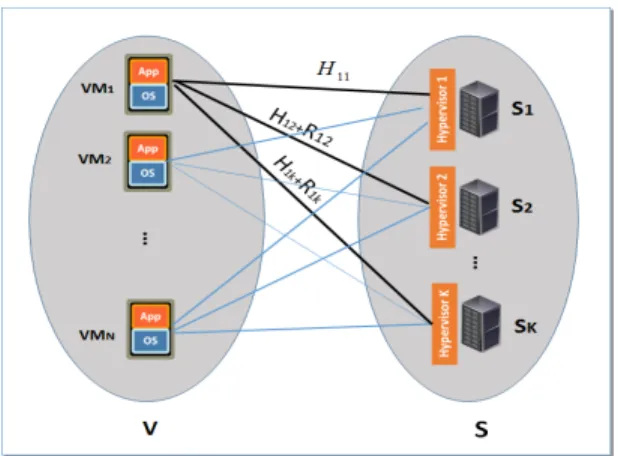
We start the repacking problem from an initial VM place-ment solution and search for an optimal consolidation via migrations of virtual resources in the physical infrastructure. Figure 1 depicts the placement problem for N VMs on K
available servers, and a resource pool to sollicite juste in case of SLA violations or in case of bursty workloads causing over-used servers (see for example [8] and [9]). Cloud services are characterized by elastic requirements from users, applications and services that induce variable workloads on the system that require consolidation to use more efficiently resources and reduce costs that would be otherwise wasted because of suboptimal utilization or exploitation. For example, VMware [10] runs in arandom wayVM consolidation every 5 minutes to improve efficiency and system capacity. This also provides the opportunity of shutting down emptied (and empty) hosts to reduce energy consumption whenever appropriate.
A. b−Matching formulation
VM repacking resorts to consolidation by moving VMs between hosts to maintain optimal placement when dynamic changes are sufficiently significant to require an adaptation. Placement needs to be dynamically and regularly updated to remain optimal. This is also needed to minimize hosting costs, energy consumption and operations costs. We focus in this
Figure 1. System Model
Figure 2. VM to server mapping weighted edge
paper on east-west migrations (i.e. horizontal elasticity) in a system of instantiated VMs on a physical infrastructure.
If aV Mi is currently hosted at a serverk, then we consider
hosting costsnoted byHe=Hik. We graphically represent the
hosting of aV Mi on a server k as an edge e= (i,k) where
i (initial extremity (i=I(e)) of e) is a virtual machine, and
k (terminal extremity (k=T(e)) of e) represents a server. Figure 2 (a) shows this description.
Furthermore, if our optimization solution recommends to move V Mi from server k0 to another server k, we will
consider reconfiguration costs (as used in [17]) noted by Re
which can be expressed as the migration costs. We note by
Re=Rik the reconfiguration costs from the server k0 (which
currently contains theV Mi) to the new host k (see Figure 2
(b) for more explanations).
Based on this configuration, one can construct a new weighted bipartite graph G= (V∪S,E), where V is the set of vertices representing virtual machines actually hosted, and S is the set of all available (powered on) servers (without the available pool of servers).E is the set of weighted edges betweenVandSconstructed as described bellow:
there is an edgee= (i,k)between eachV Miand each available
serverk, and the weight ofeis given as follows:
1) ifV Miis actually running on serverk, then the edge(i,k)
has a weightw(i,k)=H(i,k), which represents hosting costs ofV Mi in serverk.
2) ifV Miis hosted in serverk06=k, then we define a weight
w(i,k)=H(i,k)+R(i,k) which considers hosting costs of server k added to reconfiguration costs due to moving
V Mi fromk0 tok.
Figure 3 shows more details on G.
Figure 3. Complete bipartite graph construction
We also consider resource limitation constraints which consist in taking into account servers with limited resources or capacities (CPU, RAM. . .) and VM resource requirements. These constraints are important in our repacking problem and will be taken into account.
We now introduce a well known combinatorial optimization problem denoted "the minimum weight b-matching problem". It is considered as a generalization of the minimum weight matching problem. The b-matching problem’s definition is given as follows (see [11] for more details):
Definition Let G be an undirected graph with integral edge capacitiesu:E(G)→N∪∞and numbersb:V(G)→N. Then
a b-matching inGis a function f:E(G)→Nwithf(e)≤u(e),
∀e∈E(G), and∑e∈δ(v)f(e)≤b(v)for allv∈V(G).
where δ(v) represents the set of incident edges of v. For the sake of simplicity, and without loss of generality, we also note edges and vertices ofGbyE andVrespectively, instead of E(G)andV(G).
Thus, finding a minimum weight b-matching in a graph G
consists in identifying f such that ∑e∈Ecef(e) is minimum,
wherece is an associated cost to edgee.
This problem is solvable in polynomial time, as a full description of its convex hull is given in [11].
Proposition 3.1: Let G= (V∪S,E) be a weighted com-plete bipartite graph built as described in Figure 3. Then, finding an optimal VM repacking solution is equivalent to an uncapacitated (u≡∞) minimum weight b-matching
so-lution, where b(v) =1 if v∈V (v is a VM) and b(v) = minn|V|;l CPUv
∑e∈δ(v)cpuI(e)
mo
ifv∈S(vis a server).
Proof:
Once the bipartite graph is constructed, and by supposing that:
• For each vertex v∈V, then b(v) =1 which means we consider an assignment of a VM vto exactly one server. • For allv∈S, we suppose that
b(v) =min ( |V|; & CPUv ∑e∈δ(v)cpuI(e) ')
which allows us to assign different VMs to one server with respect to limited resources. A proof on how to characterize b will be given.
• Each vertex v∈V is linked to a vertex k∈S forming an edge e, with a weightwe=He+Re1e. For each edge
e= (i,j), 1e=1(i,j)=1 if V Mi is not actually hosted
in server j, and1e=0 otherwise.
A solution to the minimum weight b-matching problem on
Gis then equivalent to finding a set of servers hosting all the VMs with a minimum cost. In other words, and depending on the hosting and reconfiguration costs, we look for an optimal solution of the b-matching problem which is equivalent to finding VMs optimal assignment to the best servers with minimum costs. This solution allows us to deduce a minimum number of servers reducing energy consumption costs, and also to determine the optimal numbre of servers (resource pool) to be provisioned.
Proposition (3.1) can easily be generalized to other resources such as RAM, Disk, etc.
To formulate mathematically our model, we associate a real decision variablexe to each edgeein the bipartite graph. As
shown in Figure 3, each edge, link a VM with a server. After optimizing the system, if xe=1 then V Mi (i=I(e) initial
extremity) will be hosted by server j (j =T(e) terminal extremity).
The solution of a b-matching problem is based on solving a linear program. In other words, an integer solution of the minimum weight b-matching is found in polynomial time. This is equivalent to the optimal solution of the repacking problem described in this paper.
According to the different costs listed previously, we assign each VM to the best server with minimum cost. We can thus formulate the objective function as follows:
minZ=
∑
e∈E,e=(i,j)
(He+Re1i j)xe (1)
where1i j=
1, ifV Mi is not currently hosted in server j; 0, elsewhere.
This optimization is subject to a number of linear con-straints. For instance, the Cloud provider has to consider repacking of all VMs, and each VM will be assigned to one and only one server. This is represented by (2) (δ(v)is the set of incident edges ofvinG):
∑
e∈δ(v)
Each servervhas a resource capacity limit expressed as an integer upper bound (as a limited number of neighbors (VMs)) noted by b(v)as in (3):
∑
e∈δ(v)
xe≤b(v),∀v∈S (3)
In other words, if cpuI(e) is the required amount of CPU by V MI(e) andCPUv (v is a server) is the available amount
of CPU in server v, then resource limitation constraints are given as:
∑
e∈δ(v)
cpuI(e)xe≤CPUv,∀v∈S (4)
The constraints in (4) can be easily generalized to other resources such as RAM, storage, bandwidth, etc. Concerning the upper bound optimization problem, more details can be found in the literature (see [14] and [12] for example). In our case, we propose to use the upper bound in (5) refined as the optimization process progresses.
b(v) =min ( |V|; & CPUv ∑e∈δ(v)cpuI(e) ') ,∀v∈S (5)
Proposition 3.2:Using the following upper bound:
b(v) =min ( |V|; & CPUv ∑e∈δ(v)cpuI(e) ') ,∀v∈S (6) The constraints (3) dominate the resource limitation con-straints given by (4).
Proof: For each serverv∈S, we note by
cpumin=mincpuI(e),∀e∈δ(v)
the minimal amount of required resource (CPU in our case) by all the VMs soliciting server v. Then, one can write:
∑
e∈δ(v)
cpuI(e)xe≥cpumin
∑
e∈δ(v)xe,∀v∈S (7)
Now, using (4), we find:
cpumin
∑
e∈δ(v)
xe≤
∑
e∈δ(v)
cpuI(e)xe≤CPUv,∀v∈S (8)
We deduce the following valid inequality:
∑
e∈δ(v) xe≤ CPUv cpumin ,∀v∈S (9)By considering (3) and (9), one can remark that (3) domi-nates (9) only if we have:
b(v)≤ CPU v cpumin (10) Thus, for at least 2 VMs (|V| ≥2), and by using the fact that a server cannot host more than|V|VMs, we propose the following upper bound taking into account resources limitation constraints: b(v) =min ( |V|; & CPUv ∑e∈δ(v)cpuI(e) ') ,∀v∈S (11)
According to Proposition 3.2, resource limitation constraints (4) are not required in our model as they are dominated by (3). The new dominant valid inequality for our model is given by:
∑
e∈δ(v) xe≤b(v) =min ( |V|; & CPUv ∑e∈δ(v)cpuI(e) ') ,∀v∈S (12) Using the b-matching model with the resource limitation constraints (and inequality (12)) enables the use of the complete convex hull of b-matching and makes the problem easy in terms of combinatorial complexity theory. Reference [11] gives a complete description of the b-matching convex hull expressed in constraints (2) and (3).These two families of constraints are reinforced by blossom inequalities to get integer optimal solutions with continuous variables:
∑
e∈E(G(A)) xe+x(F)≤ ∑v∈Abv+|F| 2 ,∀A∈V∪S, (13) where F ⊆ δ(A) and ∑v∈Abv +|F| is odd, andδ(A) = ∑i∈A,j∈Ax(i j). E(G(A)) represents a subset of edges of the subgraphG(A)generated by a subset of vertices
A.
An in depth study of blossom constraints (13) is out of the scope of this paper, but more details can be found in [6] and [13].
Based on the bipartite graph G, we constructed a linear reduction of the repacking problem to the b-matching problem. The blossom constraints (13) are added to our model to get
optimal integer solutions of the repacking problem whose
model is finally given by (b(v),v∈S is set as proposed in (6)): minZ=∑e∈E,e=(i,j)(He+Re1i j)xe S.T.: ∑e∈δ(v)xe=1, ∀v∈V; ∑e∈δ(v)xe≤b(v), ∀v∈S ; ∑e∈E(G(A))xe+x(F)≤ j ∑v∈Abv+|F| 2 k , ∀A∈V∪S; F⊆δ(A),∑v∈Abv+|F| is odd ; xe∈R+, ∀e∈E; (14) We recall that the SLA violation rate is defined as the percentage of overused servers (servers that run out of space) in terms of resources (CPU for example), after the repacking solution. The mathematical formulation (14) is a linear program giving in few seconds an optimal solution of the repacking problem, dealing with resource limitation constraints with a negligible rate of SLA violations.
The variables and constants used in the final model are summarized below:
• S: is the set of vertices representing servers (hosts). • He=Hi j (in case of e= (i,j)): represents the hosting
costs of theV MI(e)(I(e) =i), hosted in a serverT(e) =j. • Re=Ri j: is the reconfiguration cost (may concern
migra-tion cost for example).
• xe: is a real variable indicating whether an edge e is
solicited (xe=1) or not (xe=0).
• bv: indicates un upper bound of the degree of a vertexv
in the bipartite graph. • δ(A) =∑i∈A,j∈Ax(i j).
• δ(v)(withvis a vertex inG) represents the set of incident edges tov.
• cpuI(e) is the VM’s CPU requirement (here, the VM is indexed by the initial extremity of the edgee).
IV. PERFORMANCE EVALUATION
We assess the performance of our proposed algorithms in terms of number of migrations, percentage of SLA violations, optimal size of resource pool and convergence times before finding a suboptimal and/or optimal solution. The evaluation provides insight on the scalability of each algorithm and its efficiency-cost tradeoff capabilities.
A. Evaluation set-up/scenario
The algorithms are evaluated using a 1.80 GHz processor with 6 GBytes of available RAM. We generate the complete weighted bipartite graph by assigning to each edge a $0-$1 random hosting cost and, without loss of generality, suppose a reconfiguration cost of $0.15 (if a VM needs to be migrated). One thousand (1000) independent graphs are generated to obtain 1000 independent runs for each simulated point in all the reported results. The number of VMs and servers varies as indicated in Table I. The required CPU (or processing power) by each VM is drawn randomly between 100 MHz and 200 MHz. The maximum available CPU on each server is generated randomly in the 300 MHz and 1024 MHz range.
B. Results
The b-matching algorithm has been implemented in C++ and evaluated through simulations. The linear program solver CPLEX [1] is used to assess performance of the b-matching solution. One thousands (1000) averaged independent runs produce each entry in Table I. The algorithms are compared in terms of convergence times to find their respective solutions (optimal and near optimal with some SLA violations). Table I reports the results of the assessment and shows clearly the known scalability problem of the Bin-Packing algorithm whose resolution times become prohibitive and unacceptable for the tuple (|V|=3000, |S|=500,700,900) corresponding to 3000 VMs on 500,700 or 900 servers. The performance of the Best-Fit comes as no surprise since it does not take cost into account when making selection of hosts and simply picks the first available least loaded node without any care for cost or optimality. Best-Fit incurs the highest costs as will be shown in ensuing assessments.
Table I
TIME RESOLUTION OF THE THREE ALGORITHMS
|V| |S| b-Matching (sec) Bin-Packing (sec) Best-Fit (sec) 50 12 0 0 0 25 0 0.02 0 40 0 0.04 0 100 25 0 0.02 0 50 0.02 0.04 0 75 0.04 0.06 0.02 500 100 0.05 0.4 0.06 250 0.1 1.30 0.20 350 0.4 2 0.30 1000 200 0.4 4 0.44 400 0.5 4.2 0.6 700 0.8 9.8 1 2000 300 0.6 48 1.3 500 1.2 14.4 2.2 700 2 36 3.6 3000 500 1.6 205 5.4 700 2.2 >4 H 7.6 900 3.2 >4 H 9.6
Our b-matching algorithm find optimal and near optimal (It can be tuned to cause a controlled amount of SLA violations) perform much better in terms of convergence time-optimality tradeoff. The b-matching algorithm provides the best tradeoff between convergence time, optimality, scalability and cost. With respect to convergence time as seen in the second column of Table I, it converges in few seconds for the scenario with 3000 VMs and 900 servers (in 3.2s compared to 9.6s of Best-Fit and the times exceeding 4 hours of Bin-Packing). In fact, the scalability test has been pushed to |V|=4000 VMs and |S|=1000 servers (a case with 4 Million variables), and our algorithm convergence time was found to be 5sec, the percentage of SLA violations to 1.5% and the cost to $553.4.
Table II
PERCENTAGE OF NUMBER OF UNUSED SERVERS
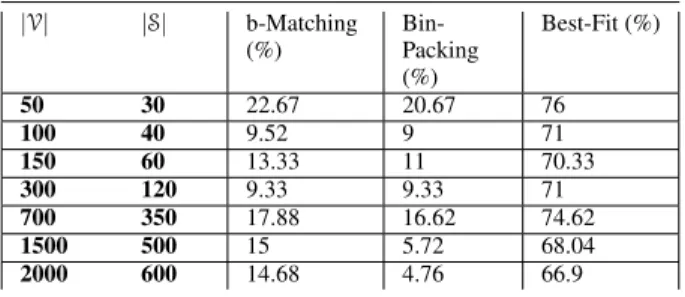
|V| |S| b-Matching (%) Bin-Packing (%) Best-Fit (%) 50 30 22.67 20.67 76 100 40 9.52 9 71 150 60 13.33 11 70.33 300 120 9.33 9.33 71 700 350 17.88 16.62 74.62 1500 500 15 5.72 68.04 2000 600 14.68 4.76 66.9
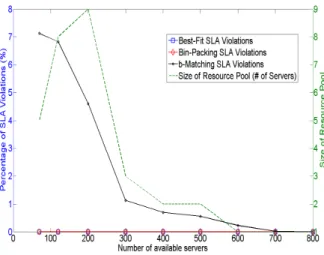
To get a better grasp of relative performance of the al-gorithms an instance of 1000 VMs hosted in a number of physical servers ranging from 20 to 200 is used to evaluate the algorithms’ SLA violations. This result should be analyzed jointly with the convergence time, the cost and the provisioned resource pool. Table I, Figures 4 and 5 and Table II reveal the characteristics of the algorithms. Figure 4 shows that the b-matching SLA violations remain below 7% (value obtained for 50 servers) and the size of resource pool is capped by 9 servers (servers types characterized as described in Section
Figure 4. Algorithms SLA violations and provisioned resource pool behavior
IV-A). The b-matching SLA violations and the resource pool’s size decrease with increasing number of servers to vanish when a large number of servers is used (>700). This means that the b-matching becomes globally more efficient when more servers are used and thus improves with scale. The b-matching algorithm achieves the best cost performance since it has consistently incured the smallest cost, very close to the Bin-Packing which does not scale (as seen in Table I where time to find a solution is the worst; >4 Hours for more than 700 VMs and 3000 servers).
Figure 5. Algorithms cost comparison
The b-matching provides the best trade-offs with rather low penalties (SLA violations < 7%). These violations vanish for large infrastructures with thousands of hosts and virtual resources. This leads to a small number of servers in the provisioned resource pool. In summary, the b-matching algorithm scale well and find optimal solutions in convergence times in line with operational systems requirements. The Bin-packing finds optimal solutions but does not scale and the Best-Fit costs is prohibitive despite its speed and simplicity. For small infrastructures hosting also a small number of VMs, the Bin-Packing can be used but the b-matching is
quite competitive.
V. CONCLUSIONS
This paper addresses the problem of VMs repacking in Cloud infrastructures. An exact and linear programming algorithm for VMs live migrations using a b-matching model is derived and evaluated. The b-matching algorithm improves as the numbers of servers and VMs increase by gradually reducing from an acceptable number of SLA violations to zero (no) violations for large instances leading to considerably reduce the amount of resource pool. The exact algorithm optimizes the various costs associated to VMs repacking.
Ongoing extensions of our work include security constraints that will be introduced as affinity and anti-affinity relationships between VMs and hosts. This constrained repacking problem becomes more complex and requires in depth Branch and Cut studies relying on the linear formulation of the b-matching model.
ACKNOWLEDGMENT
This research work has been carried out in the framework of the Technological Research Institute SystemX, and therefore granted with public funds within the scope of the French Program "Investissements d’Avenir". We also would like to thank Professor Djamal Zeghlache from Telecom SudParis, for his valuable recommendations and constructive comments.
REFERENCES
[1] http://www-01.ibm.com/software/commerce/optimization/cplex-optimizer/. May 2014.
[2] M. Armbrust.Above the Clouds: A Berkeley View of Cloud Computing. 2009.
[3] S. Chaisiri, B.-S. Lee, and D. Niyato. Optimization of resource provisioning cost in cloud computing. Services Computing, IEEE Transactions on, 5(2):164–177, April 2012.
[4] G. Dósa. The tight bound of first fit decreasing bin-packing algorithm is ffd(i)<= 11/9opt(i) + 6/9. InESCAPE, 2007.
[5] H. Goudarzi and M. Pedram. Energy-efficient virtual machine replication and placement in a cloud computing system. InIEEE CLOUD, pages 750–757, 2012.
[6] M. Grötschel, L. Lovà sz, and A. Shrijver.Geometric Algorithms and Combinatorial Optimization. Springer, 1985.
[7] M. Hadji and D. Zeghlache. Minimum cost maximum flow algorithm for dynamic resource allocation in clouds. InCloud Computing (CLOUD), 2012 IEEE 5th International Conference on, pages 876–882, June 2012. [8] http://www.citrix.com/.
[9] http://www.microsoft.com/.
[10] http://www.vmware.com/products/vsphere.
[11] B. Korte and J. Vygen. Combinatorial optimization: theory and algorithms. Springer, 2001.
[12] M. Labbe, G. Laporte, and S. Martello. Upper bounds and algorithms for the maximum cardinality bin packing problem. EJOR, 149(3):490 – 498, 2003.
[13] A. N. Letchford, G. Reinelt, and D. O. Theis. A faster exact separation algorithm for blossom inequalities. InIPCO, pages 196–205, 2004. [14] S. Martello and P. Toth. Upper bounds and algorithms for hard 0-1
knapsack problems. Operations Research, 45(5):768–778, 1997. [15] O. s. Murtazaev A. Sercon:server consolidation algorithm using live
migration of virtual machines for green computing. Inietejournals, 2011.
[16] M. Sedaghat, F. Hernandez, and E. Elmroth. A virtual machine repacking approach to the horizontal vs. vertical elasticity tradeoff for cloud autoscaling. InCAC, 2013.
[17] Q. Zhang, Q. Zhu, M. F. Zhani, and R. Boutaba. Dynamic service placement in geographically distributed clouds. InICDCS, pages 526– 535, 2012.
![Figure 1 depicts the placement problem for N VMs on K available servers, and a resource pool to sollicite juste in case of SLA violations or in case of bursty workloads causing over-used servers (see for example [8] and [9])](https://thumb-us.123doks.com/thumbv2/123dok_us/8738701.2368426/2.918.500.808.84.310/figure-depicts-placement-available-resource-sollicite-violations-workloads.webp)