LETTER TO THE EDITOR
Effects of the
STMtip on atomic positions: an explanation
for the non-observation of adsorbed molecules?
Marta M D Ramost, A M Stoneham$, A P Suttoni and J B Pethicat
t Department of Metallurgy and the Science of Materials, Oxford University, Oxford, UK
$ Materials Physics and Metallurgy Division, AEA Technology, Harwell Laboratory, Oxfordshire OX11 ORA, UK
Received 10 April 1990
Abstract. We have performed self-consistent calculations for molecules adsorbed on a metal substrate in the presence of a scanning tunnelling microscope (STM) tip. These calculations comprise (i) estimates of the inhomogeneous electric field, (ii) the self-consistent calculation of both electronic structure and molecular geometry using an extended semi-empirical molecular orbital method, and (iii) estimates of the tunnelling current using the resulting wave-functions and geometries. The STM tip causes changes in atomic positions which can complicate the link between current and geometry. In particular, induced molecular reorientation may well explain the lack of observation by STM of adsorbed CO on metals.
The scanning tunnelling microscope (STM) has demonstrated its power by providing images and surface spectra of metal, semiconductor and superconductor surfaces with atomic resolution [1-5]. Recently the first steps have been taken towards the real-space imaging of chemical reactions of adsorbed molecules [6-111. However, this work has been limited by poor conduction, by the mobility of the molecules, and by poorly characterised geometries. Our calculations offer a basis for assessing the study of adsorbed species by the STM. Our aim is to understand the way the STM tip affects the geometry of the adsorbed molecule and the consequences for the tunnelling current, One conclusion is that the effects of the tip may be substantial. In particular, the induced reorientation of adsorbed CO may explain its lack of observation in STM-based experiments.
The calculations reported here represent an initial attempt to model quantitatively and self-consistently the effect of the STM tip on the molecular conformation, and the implications of the predictions. There are, in fact, three main steps in the calculation. The first concerns the non-uniform electric field between the tip and substrate. The second includes this field in molecular orbital calculations which simultaneously optimise the geometry and calculate molecular wave-functions self-consistently. The third step uses the self-consistent wave-functions to estimate the tunnel current. Thus, for each choice of applied voltage and of tip position relative to the molecule, we can predict the molecular conformation and current systematically and consistently. There are inevitably approximations: we treat the substrate as a conducting half-space, and ignore its chemical behaviour; we work only at the CNDO (complete neglect of differential
overlap) level of self-consistent molecular orbital theory; we model the tip as a con- ducting sphere. Generalisations can be made, and would probably improve quantitative accuracy. Yet we believe the qualitative results to be reliable, and these show important features.
In the absence of the molecule, our model of the STM consists of an infinite, earthed,
flat electrode representing the substrate and a charged spherical electrode at voltage V representing the STM tip. The non-uniform field in the vacuum region can be obtained by standard but complicated methods [ 121. When the adsorbed molecule is included, we assume it is relatively unpolarisable, i.e. the non-uniform field is unaltered, but the molecule is polarised as described in the self-consistent calculation. It is possible to relax this approximation if necessary.
The present work regards the substrate as classical, and does not treat its electronic structure directly. Work to generalise this is in hand. The central problem is thus the relaxed ground-state geometry and self-consistent wave-function for the molecule subject to the non-uniform electric field already discussed. We can obtain the geometry and molecular wave-function using the CHEMOS code [ 131, which combines molecular dynamics (damped in this case) with the widely used CNDO molecular orbital method.
A second problem concerns the wave-function for the tip. As in Tersoff and Hamann’s pioneering study [ 141 we assume a spherical tip of radius R with work function
Q, and include only the s-wave component of the wave-function.
Here we follow Bardeen’s transfer Hamiltonian method [15]. The expression for the current Z involves a matrix element M,,,,, between states m of the sample s and states n
of the tip t:
M,,,,, = - 2m
1
d s * (YGVYsm-
Y,,VY;)where the integral was performed over a spherical surface centred on the tip. The other factors in Z, apart from universal constants, are Fermi functions ensuring transitions only from full to empty states and an energy conservation factor which includes the tip voltage Vas well as the individual state energies.
We have simulated the effects of an STM tip moving 3 A above a substrate on which were isolated molecules of CO, formaldehyde (H2CO) and diacetylene (H-CkC-
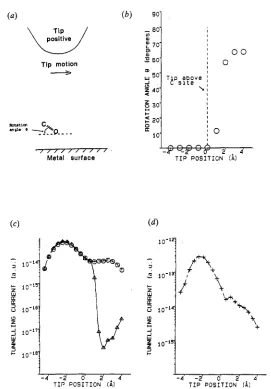
For the relatively polar molecules C O and H 2 C 0 , the main effect was a rotation of the molecule, with bond lengths and bond angles essentially constant. The rotation (figure l(a)(b)) is principally electrostatic, due to the interaction of the molecule and the applied electric field. Since the field is far from uniform, the individual atomic polarisabilities are important, not merely the total molecular polarisability
.
The CNDOmethod, like all limited-basis LCAO methods, does not accurately predict polarisabilities;
in the present case the CO moment is both too small and of the wrong sign. Our treatment of the substrate as a classical conductor will also affect detailed predictions in relation to experiments. Nevertheless, it is clear from our results that a molecule that polarised correctly would rotate strongly in the same circumstances, so our present results are a useful illustration of probable behaviour. For the relatively non-polar diacetylene only small changes of H-CkC bond angle are found, though we would anticipate more substantial effects associated with solitons or polarons in the related conducting poly- mers.
-
80-f 70'
m
E 60'
w 50'
J
40'
W
al
m
I I I I , I , I
I
Tip a b o v e
j
C s i t e
\.I
positive
U
6
30' c0
2 20'
a
1 0'
Tip motion
c3
I I I I I I 10
w Metal surface
0 0 0
J
-4' -2' 0' 2' 4' -4' -2' 0' 2' 4'
TIP POSITION IAI TIP POSITION (41
Figure I.(a) Effect of the STM tip at height L above the substrate on the geometry and orientation of an isolated adsorbed CO molecule. The reorientation angle is 8; the tip position is taken as zero for the tip directly above the undisplayed C atom. ( b ) Rotation angle as a function of tip position for a bias voltage of +4 V and h = 3
A.
( c ) Tunnelling current based on self-consistent wave-functions for optimised geometry with (i) rotation forbidden (4) and (ii) rotation allowed (-A-). The tip is 4 V above the substrate. ( d )Tunnelling current (with rotation allowed) for the tip at -4 V above the substrate, i.e. bias reversed relative to l(c).
The tunnelling current is affected by the reorientation, the effect being strongest for
although again there is a single main peak. The main change qualitatively is a small bump instead of a deep minimum, from the combination of two effects, namely the reversed rotation and the change in the ability of the atoms to accept electrons from the tip. The instability predicted [16] from long-range dispersion forces is not included here, but should be less important for these low-atomic-number systems. In the figure, we show the current (i) when rotation is prevented and (ii) when rotation is allowed. When rotation is prevented, the two-bump structure corresponds to the usual picture of a diatomic molecule, the higher b,ump corresponding to the tip being above the carbon C and the lower to the tip above the oxygen. The rotation causes a dramatic change in the character of the STM image. Indeed, rotation effectively switches off the tunnel current,
which falls by up to five orders of magnitude. The diatomic structure of the molecule is
no longer obvious, and any measurement of C-0 spacing would be speculative. We believe that tip-induced distortion is important in STM imaging. Amongst the
unexpected features of STM images (such as enhanced corrugations) it has long been noted that molecules or atoms adsorbed onto metal surfaces give negligible contrast [ 171. The effects of the adsorbates are seen clearly from reconstructions of metal surface atoms [18,19], yet the adsorbates themselves are not imaged, even though definitely present at the surface. For species such as oxygen or hydrogen this is explained plausibly in terms of absorption at surface sites [MI, but the non-observation of CO remains a puzzle. The molecule is known to be fairly well bound, so it should not be displaced laterally away from the tip too easily. Its axis is known to be not parallel to the surface in niany cases [20], so it should give good contrast in STM.
Our suggestion that the tip field alters the molecule configuration to reduce STM
contrast is supported by results of Behm er al[21] for CO on platinum. These workers found that at moderate coverages there was no sign of CO in the STM images. At high
coverages, zig-zag chains appeared above the metal atoms; the chains were assigned to CO, as it is known from LEED that a very close-packed CO layer takes on a zig-zag pattern, We suggest that when closely packed, the molecules appear in the image because they can no longer be bent over so easily by the tip field. Both the observed specific relation of the chain to the metal lattice and the known strong bonding make it unlikely that lateral displacement of the CO by the tip is significant.
We note that in the co-adsorption of CO and benzene, it is the benzene and not the
CO which is imaged [8]. The field-induced distortions in that system are likely to be complex. Finally we note that our results show a dependence of contrast on imaging voltage which would be worth checking.
One of us (MMDR) is indebted to the European Community for a Research Grant within the Stimulation Plan of the EEC.
References
[l] Binning G and Rohrer H 1987 Reu. Mod. Phys. 59 615 [2] Binning G and Rohrer H 1986 I B M J . Res. Deu. 30 355
[3] Hansma P K and Tersoff J 1986J. Appl. Phys. 61 R1
[4] Hamers R 1989 Ann. Reu. Phys. Chem. 40 531 [5] Rabe J P 1989 Adu. Marer. 8 13
[8] Lippel P H, Wilson R J, Miller M D, WO11 C and Chiang S 1989 Phys. Reo. Lett. 62 171
[9] BeebeTP.fr, WilsonTE,OgletreeDF,KatzJE, BalhornR,SalmeronMandSiekhausWJ 1989Science 243 370
[lo] Lee G, Arscott P G , Bloomfield V A and Evans D F 1989 Science 244 475
[ l l ] Hubacek J S, Brockenbrough R T , Gammie G, Skala S L, Lyding J W, Latten J L and Shapley J R 1988 [12] Smythe W R 1989 Static and Dynamic Electricity 3rd edn (Oxford: Clarendon)
[13] Wallace D S 1989 D Phil Thesis Oxford University; 1989 Harwell ReportTP1331
[14] Tersoff J and Hamann D R 1985 Phys. Reu. B 31 805
[15] Bardeen J 1961 Phys. Reu. Lett. 6 57
[16] Sutton A P and Pethica J 199OJ. Phys.: Condens. Matter 2 5317
[ 171 Tromp R M 1989 J. Phys.: Condens. Matter 1 1021 1
[18] Chua F M, Kuk Y and Silverman P J 1989 Phys. Rev. Lett. 63 386 [19] Behm R J, Hosler W, Ritter E and Binning G 1986 Phys. Reu. Lett. 56 228
[20] Zangwill A 1988 Physics at Surfaces (Cambridge: Cambridge University Press) pp 251-3 [21] Behm R J et af at press
J . Microsc. 152221