O R I G I N A L A R T I C L E
Open Access
Increasing protein production by directed vector
backbone evolution
Felix Jakob
1,2†, Christian Lehmann
1†, Ronny Martinez
1and Ulrich Schwaneberg
1,2*Abstract
Recombinant protein production in prokaryotic and eukaryotic organisms was a key enabling technology for the rapid development of industrial and molecular biotechnology. However, despite all progress the improvement of protein production is an ongoing challenge and of high importance for cost-effective enzyme production. With the epMEGAWHOP mutagenesis protocol for vector backbone optimization we report a novel directed evolution based approach to increase protein production levels by randomly introducing mutations in the vector backbone. In the current study we validate the epMEGAWHOP mutagenesis protocol for three different expression systems. The latter demonstrated the general applicability of the epMEGAWHOP method. Cellulase and lipase production was doubled in one round of directed evolution by random mutagenesis of pET28a(+) and pET22b(+) vector backbones.
Protease production using the vector pHY300PLK was increased ~4-times with an average of ~1.25 mutations per kb vector backbone. The epMEGAWHOP does not require any rational understanding of the expression machinery and can generally be applied to enzymes, expression vectors and related hosts. epMEGAWHOP is therefore from our point of view a robust, rapid and straight forward alternative for increasing protein production in general and for biotechnological applications.
Keywords:Directed evolution; epMEGAWHOP; Recombinant protein production; Lipase expression; Cellulase expression; Protease expression
Introduction
Development of cloning and expression technologies to produce recombinant proteins in prokaryotic and eukaryotic organisms enabled the production of numer-ous enzymes for diagnostic and industrial applications such as food, leather, textile or detergent industry (Kirk et al. 2002; Rai and Padh 2001). Recombinant production of proteins in prokaryotic hosts is commonly increased by optimization of cultivation or fermentation conditions (temperature, aeration, media composition and/or the fermentation type, such as batch, fed-batch or con-tinuous), codon optimization (Gustafsson et al. 2004; Li et al. 2003), co-expression of chaperones (Thomas et al. 1997), increasing the lifetime of mRNA (Terpe 2006), exchanging/modifying promoters and/or signal peptides (Caspers et al. 2010; Degering et al. 2010;
Xue et al. 1997), optimizing the distance between promoter and gene (Brosius et al. 1985), protein fu-sion technology (e.g. NusA, maltose-binding protein [MBP] or glutathione S-transferase [GST]) (Cabrita et al. 2006), or by metabolic engineering (Heyland et al. 2011; Kabisch et al. 2012).
Directed evolution has become a standard approach to tailor enzyme properties such as activity, solubility, temperature or organic solvent resistance to often non-natural requirements in industrial production. In di-rected enzyme evolution campaigns enzyme production is often unexpectedly increased in initial rounds (Tee and Schwaneberg 2007). A typical directed evolution ex-periment comprises three iterative steps of (1) diversity generation, (2) screening to identify improved variants out of a large pool of variants, and (3) isolating the genes encoding for improved variants (Shivange et al. 2009). The screening system plays a pivotal role for reliably identifying improved enzyme variants. Among the screening formats, 96-well microtiter plates are com-monly used in directed evolution experiments with
* Correspondence:[email protected]
†Equal contributors
1Lehrstuhl für Biotechnologie, RWTH Aachen University, Worringerweg 1,
Aachen 52074, Germany
2DWI an der RWTH Aachen e.V, Forckenbeckstraße 50, Aachen 52056,
Germany
throughputs of a few thousand variants per round (Tee and Schwaneberg 2007). Recent developments in high throughput screening technologies comprise through-puts of 106-108based on flow cytometry (Ruff et al. 2012; Tu et al. 2011) and microfluidics (Fallah-Araghi et al. 2012; Kintses et al. 2012). In this work we report a novel strategy to increase enzyme production in bacterial hosts (E. coliandB. subtilis), which is based on the‘megaprimer PCR of whole plasmid method’(MEGAWHOP) (Miyazaki 2003; Miyazaki 2011). In our modified error-prone MEGAWHOP method (epMEGAWHOP) mutated vector backbone libraries were generated by amplification under error-prone PCR conditions using non-mutated genes as megaprimers, and subsequently screened for increased ac-tivity. The general applicability of the developed strategy was proven by using three enzymes (CelA2, BSLA and subtilisin Carlsberg) in three different vector-systems (pET28a(+), pET22b(+) and pHY300PLK) and two differ-ent and industrially important expression hosts (E. coli (Baneyx 1999; Jana and Deb 2005) andB. subtilis(Terpe 2006; Westers et al. 2004)). In all three cases an increased enzyme production was obtained with optimized vector backbones.
Materials and methods
All chemicals were of analytical-reagent grade or higher quality and were purchased from Carl Roth GmbH (Karlsruhe, Germany), Sigma-Aldrich (Hamburg, Germany) and AppliChem (Darmstadt, Germany). En-zymes were purchased from New England Biolabs (Beverly, USA) and Fermentas (St. Leon-Rot, Germany). Oligonucle-otides were purchased from Eurofins MWG Operon (Ebersberg, Germany) in salt-free form. Plasmid extraction and PCR purification kits were purchased from Macherey-Nagel (Düren, Germany). Microtiter plates (Greiner Bio-One GmbH, Frickenhausen, Germany) were incu-bated in a Multitron II Infors shaker (Infors AG, Bottmingen, Switzerland). DNA concentrations were quan-tified using a NanoDrop photometer (ND-1000, NanoDrop Technologies, Wilmington, USA). A Mastercycler gra-dient (Eppendorf, Hamburg, Germany) and thin-wall PCR tubes (Multi ultra-tubes; 0.2 mL; Carl Roth, Germany) were used in all PCRs.
Strains and plasmids
E. coli DH5α, E. coli BL21-Gold (DE3) (purchased from Agilent Technologies; Santa Clara, USA) and B. subtilis DB104 (Kawamura and Doi 1984) were used in this study as hosts for DNA manipulation and recombinant protein production. For construction of the expression vectors for theE. colistrains (DH5α; BL21-Gold (DE3)), and the plasmids pET28a(+) or pET22b(+) (Novagen; Darmstadt, Germany) were used. In case of B. subtilis DB104 the shuttle vector pHY300PLK (Takara Bio Inc.,
Shiga, Japan) was employed. Chemically competent E. coliDH5αandE. coliBL21-Gold (DE3) cells with deter-mined transformation efficiencies of 3 × 10⁷and 3 × 10⁶ cfu/μg pUC19, respectively, were prepared in-house using the rubidium chloride method (Hanahan 1983). Transformation of B. subtilis DB104 was performed using a recently developed method which is based on natural competence (Vojcic et al. 2012).
Gene cloning, construction of expression vectors, and sequencing
CelA2
The parentcelA2(GenBank: JF826524.1; (Lehmann et al. 2012)) was ordered as a synthetic gene from GeneArt (Regensburg, Germany) with an optimized codon usage for E. coli (GenBank submission number ID1624106) flanked by anNcoI and anEcoRI restriction site. Addition-ally,celA2contains an N-terminal His-tag, followed by a TEV-protease sequence. After double digestion withNcoI and EcoRI, the fragment was subcloned into pET28a(+). The generated construct, named pET28a(+)-CelA2, was transformed intoE. coliDH5α and sequenced to exclude mutations.
Bacillus subtilis lipase A (BSLA)
After double digestion of the parentBacillus subtilis lip-ase A (BSLA) (GenBank: JX048066.1) with NdeI and XhoI, the fragment was subcloned using T4 DNA ligase into pET22b(+). The resultant recombinant plasmid, named pET22b(+)-BSLA, contains a C-terminal His-tag and a pelBleader sequence. The plasmid construct was transformed intoE. coliDH5αand sequenced to exclude mutations.
Subtilisin Carlsberg
After double digestion of a subtilisin Carlsberg variant (GenBank: HM147766.1, harboring the silent mutations C479G, T480C, G482A, G869A, T1052C and G1055C) with BamHI and XmaI, the gene was subcloned into pHY300PLK using T4 DNA ligase. The resulting recom-binant plasmid, named pHYscarlsberg was transformed intoE. coliDH5αand sequenced to exclude mutations.
DNA sequencing of all three recombinant plasmids was conducted at Eurofins MWG Operon (Ebersberg, Germany) and Clone Manager 9 Professional Edition (Sci-Ed software, Cary, USA) was used for all sequence alignments.
Generation of error-prone MEGAWHOP libraries
CGG-3’(5μM each) binding in the T7 promoter and ter-minator region. The amplification of the subtilisin Carlsberggene includes promoter, pre- and pro-sequence and was performed using unmodified DNA primers 5’ -CAGATTTCGTGATGCTTGTCAGG-3’ and 5’-CGTT AAGGGATCAACTTTGGGAG-3’ (5 μM each). For the PCR (98°C for 30 sec, one cycle; 98°C, 15 sec/63°C, 15 sec/68°C, 2 min (celA2) or 30 sec (BSLA, subtilisin Carlsberg), 25 cycles; 68°C for 10 min, one cycle), PfuS DNA polymerase (2.5 U), dNTP mix (10 mM), template (pET28a(+)-CelA2, pET22b(+)-BSLA and pHYscarlsberg: 30 ng/μL) were used. The PCR products (megaprimers) were purified using a PCR purification kit.
For the epMEGAWHOP PCR (72°C for 5 min, one cycle; 94°C for 90 sec, one cycle; 94°C, 45 sec/60°C, 45 sec/72°C, 5 min, 25 cycles; 72°C for 10 min, one cycle), Taq DNA polymerase (2.5 U), dNTP mix (10 mM) together with plasmid template (pET28a(+)-CelA2, pET22b(+)-BSLA or pHYscarlsberg: 120 ng), megaprimer (pET28a(+)-CelA2, pET22b(+)-BSLA or pHYscarlsberg: 550 ng) and 0.05 mM Mn2+ were used. Following the epMEGAWHOP PCR, DpnI digestion (20 U) of the template was performed overnight at 37°C. The epMEGAWHOP PCR product was transformed into E. coli DH5α. All colonies from the agar plates were used for plasmid isolation and subsequently transformed into their expression host. The plasmids pET28a(+)-CelA2 and pET22b(+)-BSLA were transformed in E. coli BL21-Gold (DE3) and pHYscarlsberg was transformed in B. subtilis DB104.
Indicator plates for pre-screening
In all three screening systems a halo formation can be used to semi-quantify enzymatic activity as indicator for enzyme production.
Detection of cellulolytic activity
Azo-CarboxyMethyl-Cellulose (Azo-CM-Cellulose, Megazyme, Bray, Ireland) was used as substrate for determining cellu-lolytic activity (Hughes et al. 2006). LB agar plates supplemented with 0.125% (w/v) Azo-CM-Cellulose, 50 μg/mL kanamycin and 0.1 mM isopropyl-thio-β -D-galactoside (IPTG) were used as indicator plates for pre-screening.
Detection of lipolytic activity
Tributyrin was used as substrate for lipolytic activity detec-tion (Alquati et al. 2002). LB agar plates supplemented with 100 μg/mL ampicillin, 1.5% (v/v) tributyrin, 0.15% (w/v) gum arabic were used as indicator plates for pre-screening.
Detection of proteolytic activity
Skim milk was used as substrate for proteolytic activity detection (Sokol et al. 1979). LB agar plates supplemented
with 1% (w/v) skim milk and 15μg/mL tetracycline were used as indicator plates for pre-screening.
Expression in microtiter plates
Growth conditions and expression of CelA2 in 96-well microtiter plates
Colonies displaying cellulolytic activity in the indicator agar plates were transferred into 96-well microtiter plates (flat-bottomed, polystyrene plates). Cultivation and enzyme expression in microtiter plates was performed as previously described (Lehmann et al. 2012) and superna-tants of lysates were subsequently used for kinetic characterization.
Growth conditions and expression of BSLA in 96-well microtiter plates
Colonies displaying lipolytic activity in the indicator agar plates were transferred into 96-well microtiter plates (flat-bottomed, polystyrene plates) containing 200μL LB medium supplemented with 50μg/mL ampicillin and in-cubated (pre-culture; 37°C, 900 rpm, 24 h, 70% humidity). An expression plate contained 150 μL auto-induction medium (1.2% (w/v) casein hydrolysate, 2.4% (w/v) yeast extract, 0.5% (w/v) glycerol, 0.05% (w/v) glucose, 0.02% (w/v) lactose and potassium phosphate buffer (90 mM; pH 7.0) was inoculated with the pre-culture (10μL) and incubated (main culture; 37°C, 900 rpm, 16 h, 70% hu-midity). After expression, the microtiter plates were centrifuged (4000 g, 20 min, 4°C) to separate the cells from the culture supernatant. Using the expression vector pET22b(+) includingpelBsequence, the activity of BSLA can be detected in the culture supernatant (Funke et al. 2003; Khushoo et al. 2004; Yedavalli and Rao 2013). Culture supernatant, including the BSLA was transferred after centrifugation into a 96-well microtiter plate for fur-ther analysis.
Growth conditions and expression of subtilisin Carlsberg in 96-well microtiter plates
Analysis of thelacIrepressor system
Performance of the lacI repressor system used in the above described growth and assay conditions was ana-lyzed for each pET expression system. CelA2 and BSLA production was performed in TBkan- or LBamp-medium
without supplementing IPTG or the induction compo-nents glucose and lactose.
Screening systems
Fluorometric assay for determining cellulolytic activity of CelA2
Cellulolytic activity was measured using 4-Methylumbelliferyl -ß-D-cellobioside (4-MUC) as a fluorogenic substrate (Boschker and Cappenberg 1994; Chernoglazov et al. 1989). The cultivation and enzyme reaction was performed as recently reported (Lehmann et al. 2012).
Colorimetric assay for determining lipolytic activity of BSLA
The lipolytic activity of BSLA in the supernatant was determined using p-nitrophenyl butyrate (pNPB) (Shirai et al. 1982). The final reaction contained 0.5 mM p -nitrophenyl butyrate dissolved in 10 μL acetonitril, 180 μL triethanolamin buffer (50 mM; pH 7.4) and 10 μL of five times diluted supernatant. The release of p-nitrophenolate was continuously monitored at 410 nm in a microtiter plate reader (Tecan Infinite M1000 Pro) for quantifying the BSLA production.
Colorimetric assay for determining proteolytic activity of subtilisin Carlsberg
Proteolytic activity was determined in a microtiter plate using the synthetic peptide substrate succinyl-L-Ala-L-Ala-L-Pro-L-Phe-p-nitroanilide (suc-AAPF-pNA) (DelMar et al. 1979). Proteolytic reaction of subtilisin Carlsberg was started by supplementing 10μL of the 1:20 diluted super-natant to Tris/HCl (100μL; 100 mM, pH 7.5) containing 1 mM suc-AAPF-pNA. The release ofp-nitroaniline was continuously monitored at 410 nm in a microtiter plate reader (Tecan Infinite M1000 Pro) and the determined ac-tivity was used for protease quantification.
Sodium dodecyl sulfate polyacrylamide gel electrophoresis (SDS-PAGE)
The SDS-PAGE for CelA2 was performed using a stack-ing gel (5% (w/v) acrylamide) and a separatstack-ing gel (15% (w/v) acrylamide) (Laemmli 1970). Proteins in the super-natant (including BSLA or subtilisin Carlsberg) were precipitated with trichloroacetic acid (TCA; 30% (v/v); 15 min on ice), resuspended after washing with acetone in Tris/HCl (100 mM; pH 8.0). The proteins in the supernatant after centrifugation of cell lysate (CelA2) as well as the precipitated and resuspended proteins from the cell culture supernatant (BSLA and subtilisin
Carlsberg) were loaded and separated by SDS-PAGE. Subsequently, the SDS-PAGE gel was stained with Coomassie brilliant blue.
Results
In the first sections the development of the epMEGAWHOP protocol is described and the screening for increased activity of the selected cellulase, lipase and protease. Sub-sequently, the obtained variants showing increased activity were analyzed in detail to validate the epMEGAWHOP method.
Library generation screening
Figure 1 shows the scheme of the developed epMEGAWHOP protocol starting from the generation of megaprimers by PCR (Step I). Followed by an amplification of the whole plasmid under error-prone conditions (0.05 mM Mn2+) (Step II) and digestion of the methylated template. In (Step III) the resulting circular DNA is transformed into E. coliDH5αcells.The plasmids are subsequently isolated
from E. coliDH5α and transformed into the expression host (E. coli BL21-Gold (DE3) orB. subtilis DB104) and grown on indicator plates (Step IV). Colonies showing halos are transferred into microtiter plates for quantifica-tion of enzymatic activity (Step V). Table 1 summarizes the expression constructs used for epMEGAWHOP development.
Approximately 1000 CFU were pre-screened using the corresponding agar plate detection systems for all three expression systems. Ninety promising variants were se-lected based on halo formation and rescreened more precisely in 96-well microtiter plate format. The most promising candidates (one cellulase, one lipase and one protease) were analyzed in detail to confirm that the in-creased production can be attributed to an optimized vector backbone. For the latter the wild-type genes (CelA2, BSLAand subtilisin Carlsberg) were cloned into the mutated backbone as described under Materials and Methods with subsequent rescreening in three 96-well microtiter plate measurements in which each construct was expressed 8 times per plate.
Activity and expression analysis
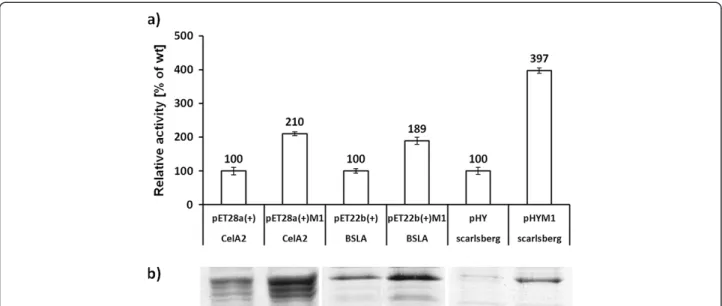
The activity of the three identified variants compared to their parents is shown in Figure 2a. Mutagenized vector backbones of pET28a(+)M1-CelA2 and pET22b(+)M1-BSLA showed compared to the respective ‘wild-type’ a 2-fold increased lipolytic and cellulolytic activity. These activity increases can be correlated to the amount of expressed enzyme which is visualized within a SDS-PAGE in Figure 2b. The mutated vector backbone of pHYM1-scarlsberg showed the highest increase in secreted subtilisin Carlsberg production (4-fold in-creased proteolytic activity). The inin-creased proteo-lytic activity correlates well with the increase in the protease content (see SDS-PAGE analysis Figure 2a, b; the whole SDS-PAGE picture is available in the Additional file 1: Figure S1).
Analysis of thelacIrepressor system
Expression under inducing and non-inducing conditions was performed to analyze whether thelacIrepressor con-tributes to increased production levels. The constructs pET28a(+)-CelA2 and pET22b(+)-BSLA are under the control of lacI repressor. Figure 3 shows under non-induced conditions a significant difference in activity/ lipase production in the pET22b(+)-BSLA expression
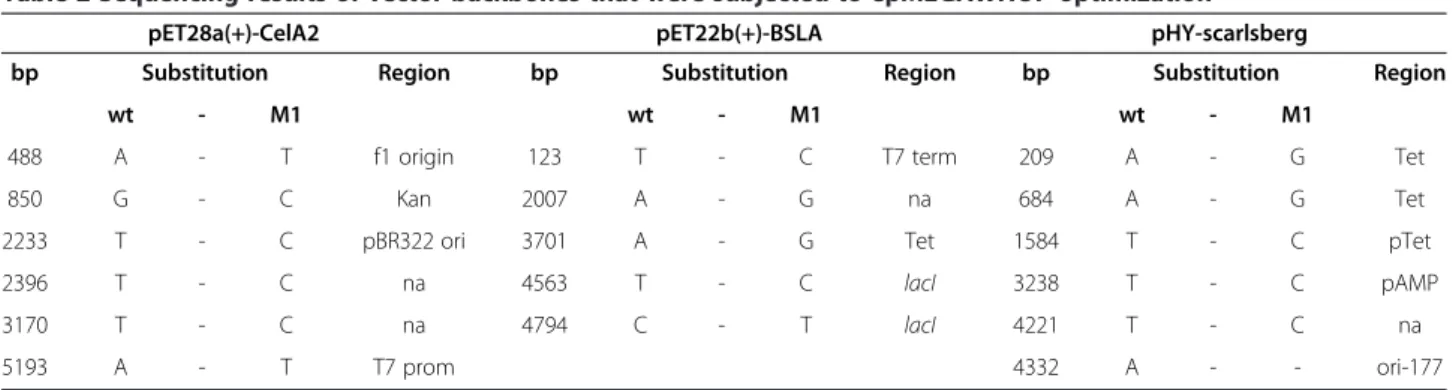
vector: the mutated backbone yielded 0.34 U/mL compared to 0.04 U/mL of the ‘parent’ pET22b(+). The latter result proves that lacI influences lipase production in pET22b(+)M1-BSLA. Sequencing re-sults confirmed two mutations in lacI (see Table 2). An opposite results was found for the pET28a (+)-CelA2 and the pET28a(+)M1-CelA2 expression systems in which under non-induced conditions only very low cellulase activities could be determined (<0.02 U/mL). These results prove that the lacI is an effective repressor even in the optimized vector back-bone. Sequencing results confirmed that there are no mutations in the lacI within the pET28a(+)M1-CelA2 expression system (Table 2). In all four constructs the lacI repressor is functional as confirmed by IPTG in-duction (Figure 3).
Sequence analysis
Sequence analysis was performed by sequencing the vec-tor backbones and inserts. An average mutation fre-quency of 1.00-1.25 mutations per 1 kb plasmid DNA was obtained (Additional file 1: Figure S2) and all inserts did not contain a mutation. Table 2 summarizes posi-tions of mutaposi-tions in the vector backbones and assigns mutations to functional regions. Interestingly, the anti-biotic resistance is mutated in all three vector systems, and functional regions such as the origin of replication (in pET28a(+)M1-CelA2; pHYM1-scarlsberg), promoter (pET28a(+)M1-CelA2), repressor (pET22b(+)M1-BSLA), and terminator (pHYM1-scarlsberg).
Discussion
The MEGAWHOP method is commonly used for clon-ing random mutagenesis libraries via whole plasmid PCR into the desired expression vector containing the parent gene (Miyazaki 2011). In general enzyme proper-ties such as activity, substrate specificity or stability are improved in directed evolution experiments employing MEGAWHOP (Agudo et al. 2012; Martinez et al. 2013; Sass et al. 2012). The developed epMEGAWHOP does not aim to improve enzymes properties. epMEGAWHOP aims to increase the enzyme production without altering its properties through vector backbone mutagenesis. The error-prone (ep-) label was placed in front of the MEGAWHOP term to point out the main difference that the vector amplification is performed under error-prone conditions.
Table 1 Overview of the expression systems used for developing and validating the epMEGAWHOP method
Expression host Plasmid Enzyme Location of expressed enzyme
E. coliBL21-Gold (DE3) pET28a(+) Cellulase (CelA2) Intracellular
E. coliBL21-Gold (DE3) pET22b(+) Lipase A (BSLA) Periplasmatic
epMEGAWHOP strategy is a novel strategy to increase enzyme production by optimizing a vector backbone through mutagenesis and high-throughput screening. The epMEGAWHOP method (Figure 1) was validated by employing three different vector constructs with three different enzymes (cellulase: pET28a(+)-CelA2; lipase: pET22b(+)-BSLA; protease: pHY-scarlsberg). A single round of vector backbone mutagenesis and screening yielded significantly increased production levels for all three enzymes (~2-fold for CelA2, ~2-fold for BSLA and ~4-fold for subtilisin Carlsberg). Control experiments
through subcloning and sequencing confirmed that only the vector backbones were mutated with an average muta-tion frequency of ~1.25 mutamuta-tions per kb. The increase in cellulase, lipase and protease production demonstrate from our point of view that epMEGAWHOP is likely a general method for increasing enzyme production. This is supported by the selection of common expression systems which cover cytosolic (cellulase), periplasmatic (lipase), and extracellular production (protease) in combination with two industrially attractive bacterial hosts (E. coli andB. subtilis). The main goal of this report is to validate
Figure 2Activity studies and SDS-PAGE visualization of produced CelA2, BSLA, subtilisin Carlsberg wild type. a)Activity measurements are performed with not optimized (left column) and mutagenized vector backbones (right column) in 96-well microtiter plate. Constructs with an M1 label habor an epMEGAWHOP optimized vector backbone;b)Visualization of production levels of CelA2 (proteins in supernatant of lysate), BSLA and subtilisin Carlsberg (proteins in culture supernatant after precipitation) by SDS-PAGE in combination with Coomassie brilliant blue staining. The reported relative activity values are the average of three 96-well microtiter plate measurements in which each construct was expressed 8 times per plate. Deviations are calculated from the corresponding mean values.
the epMEGAWHOP protocol for vector backbone optimization and not to elucidate in depth the interplay in the complex protein production machinery from the ex-pression to the produced enzyme. The effect of randomly introduced mutations in the vector backbone has to our best knowledge not been investigated in a systematic manner.
Table 2 shows that functional regions such as anti-biotic resistance, promoter, repressor or origin of repli-cation were mutated. The mutations can be classified into three groups according to the region in the expres-sion vector: 1) in the kanamycin/tetracycline resistance cassette; 2) once in the promoter and terminator region and 3) twice in the origin of replication. It is known that through the introduction of an expression vector into E. coli or other hosts for recombinant protein produc-tion, the native cell functions at many levels can be perturbed (e.g. ribosome functions, RNA turnover as well as energy and intermediary metabolism of the cell) (Bailey 1993; Hoffmann et al. 2002; Lin-Chao et al. 2006). This effect is very difficult, however, to predict or attribute to a specific change in the host metabolism, due to the com-plexity of the system. For example, a reduced but suffi-cient expression of the resistant marker could allow spending more metabolic resources into expressing the recombinant enzyme. On the other hand, a higher resist-ance marker expression could allow a higher specific growth rate of the cells which directly correlates with the rate of recombinant protein synthesis (Hoffmann and Rinas 2004).
Elucidating the influence of each mutation and each region on the cellulase, lipase, and protease production would include the introduction of the individual muta-tions in the parental vector backbones to gain a deeper understanding on the complex machinery from expres-sion system to produced enzyme.
A main prerequisite for a successful epMEGAWHOP experiments is a reliable high-throughput screening system which allows an identification of improved expression variants. It is likely that the mutational load has to be optimized depending on the vector size; an average mutation frequency of 1.25 mutations per 1 kb prove to be efficient to increase enzyme production and all three sequenced vector backbones contained five to six mutations.
In essence, we developed a novel method to increase recombinant protein production based on the random mutagenesis of vector backbones (epMEGAWHOP). The general applicability of epMEGAWHOP was vali-dated by increasing the protein production after one round of directed evolution forE. coliBL21-Gold (DE3)/ pET28a(+)-CelA2, E. coli BL21-Gold (DE3)/pET22b (+)-BSLA and B. subtilis DB104/pHY-scarlsberg. The main advantage of epMEGAWHOP is that it doesn’t require a rational understanding of the expression ma-chinery and can generally be applied to enzymes, expres-sion vectors and related hosts. Changing expresexpres-sion vector or promoter systems to achieve higher enzyme yields often requires re-optimization of media compos-ition, induction times and cell densities, together with ex-pression and harvest time, in contrast to epMEGAWHOP. Overall, epMEGAWHOP is a robust, rapid and straight forward alternative and can be used for increasing recom-binant protein production.
Additional file
Additional file 1: Figure S1.SDS-PAGE of produced cellulase (CelA2), lipase (BSLA) and protease (subtilisin Carlsberg). EV: empty vector control; WT: non-optimized vector constructs; M1: epMEGAWHOP optimized vector constructs. Red arrows indicate the bands of target proteins. Figure S2: Sequencing results: Alignments of all three vector systems
Table 2 Sequencing results of vector backbones that were subjected to epMEGAWHOP optimization
pET28a(+)-CelA2 pET22b(+)-BSLA pHY-scarlsberg
bp Substitution Region bp Substitution Region bp Substitution Region
wt - M1 wt - M1 wt - M1
488 A - T f1 origin 123 T - C T7 term 209 A - G Tet
850 G - C Kan 2007 A - G na 684 A - G Tet
2233 T - C pBR322 ori 3701 A - G Tet 1584 T - C pTet
2396 T - C na 4563 T - C lacI 3238 T - C pAMP
3170 T - C na 4794 C - T lacI 4221 T - C na
5193 A - T T7 prom 4332 A - - ori-177
The positions of the mutations in the corresponding vector backbones are based on the sequenced vector backbone prior epMEGAWHOP. Alignments of all three vector systems to the corresponding‘parents’are included in Additional file1: Figure S1. Nucleotide position 1 is the base after the stop codon (ATT, TAA) of the inserted genes.
na: no corresponding function of the gene sequence could be assigned. Kan/Tet: Kanamycin/Tetracyclin resistance gene.
compared to the corresponding‘parents’: pET28a(+)-CelA2 & pET28a(+) M1-CelA2.
Competing interests
The authors declare that they have no competing interests.
Acknowledgements
Authors thank Prof. Wolfgang Streit for providing the CelA2 amino acid sequence. This work was supported by the German Government through the Bundesministerium für Bildung und Forschung (FKZ 0315487A and FKZ 0315035A).
Received: 24 April 2013 Accepted: 11 July 2013 Published: 26 July 2013
References
Agudo R, Roiban GD, Reetz MT (2012) Achieving Regio- and Enantioselectivity of P450-Catalyzed Oxidative CH Activation of Small Functionalized Molecules by Structure-Guided Directed Evolution. ChemBioChem 13(10):1465–1473 Alquati C, De Gioia L, Santarossa G, Alberghina L, Fantucci P, Lotti M (2002) The
cold-active lipase ofPseudomonas fragi. Heterologous expression, biochemical characterization and molecular modeling. Eur J Biochem 269 (13):3321–3328
Bailey JE (1993) Host-vector interactions inEscherichia coli. Adv Biochem Eng Biotechnol 48:29–52
Baneyx F (1999) Recombinant protein expression inEscherichia coli. Curr Opin Biotechnol 10(5):411–421
Boschker HTS, Cappenberg TE (1994) A Sensitive Method Using
4-Methylumbelliferyl-ß-Cellobiose as a substrate to measure (1,4)-ß-glucanase activity in sediments. Appl Environ Microbiol 60(10):3592–3596
Brosius J, Erfle M, Storella J (1985) Spacing of the−10 and−35 regions in the tac promoter Effect on its in vivo activity. J Biol Chem 260(6):3539–3541 Cabrita LD, Dai W, Bottomley SP (2006) A family ofE. coliexpression vectors for
laboratory scale and high throughput soluble protein production. BMC Biotechnol 6:12
Caspers M, Brockmeier U, Degering C, Eggert T, Freudl R (2010) Improvement of Sec-dependent secretion of a heterologous model protein inBacillus subtilis
by saturation mutagenesis of the N-domain of the AmyE signal peptide. Appl Microbiol Biotechnol 86(6):1877–1885
Chernoglazov VM, Jafarova AN, Klyosov AA (1989) Continuous photometric determination of endo-1,ß-d-glucanase (cellulase) activity using 4-methylumbelliferyl-ß-d-cellobioside as a substrate. Anal Biochem 179(1):186–189
Degering C, Eggert T, Puls M, Bongaerts J, Evers S, Maurer KH, Jaeger KE (2010) Optimization of protease secretion inBacillus subtilisandBacillus licheniformis
by screening of homologous and heterologous signal peptides. Appl Environ Microbiol 76(19):6370–6376
DelMar EG, Largman C, Brodrick JW, Geokas MC (1979) A sensitive new substrate for chymotrypsin. Anal Biochem 99(2):316–320
Fallah-Araghi A, Baret JC, Ryckelynck M, Griffiths AD (2012) A completely in vitro ultrahigh-throughput droplet-based microfluidic screening system for protein engineering and directed evolution. Lab Chip 12(5):882–891
Funke SA, Eipper A, Reetz MT, Otto N, Thiel W, Van Pouderoyen G, Dijkstra BW, Jaeger KE, Eggert T (2003) Directed Evolution of an EnantioselectiveBacillus subtilisLipase. Biocatal Biotransform 21(2):66–73
Gustafsson C, Govindarajan S, Minshull J (2004) Codon bias and heterologous protein expression. Trends Biotechnol 22(7):346–353
Hanahan D (1983) Studies on transformation ofEscherichia coliwith plasmids. J Mol Biol 166(4):557–580
Heyland J, Blank LM, Schmid A (2011) Quantification of metabolic limitations during recombinant protein production inEscherichia coli. J Biotechnol 155 (2):178–184
Hoffmann F, Rinas U (2004) Stress induced by recombinant protein production in
Escherichia coli. Adv Biochem Eng Biotechnol 89:73–92
Hoffmann F, Weber J, Rinas U (2002) Metabolic adaptation ofEscherichia coli
during temperature-induced recombinant protein production: 1 Readjustment of metabolic enzyme synthesis. Biotechnol Bioeng 80(3):313–319
Hughes S, Riedmuller S, Mertens J, Li X-L, Bischoff K, Qureshi N, Cotta M, Farrelly P (2006) High-throughput screening of cellulase F mutants from multiplexed
plasmid sets using an automated plate assay on a functional proteomic robotic workcell. Proteome Sci 4:10
Jana S, Deb JK (2005) Strategies for efficient production of heterologous proteins inEscherichia coli. Appl Microbiol Biotechnol 67(3):289–298
Kabisch J, Thurmer A, Hubel T, Popper L, Daniel R, Schweder T (2012) Characterization and optimization ofBacillus subtilisATCC 6051 as an expression host. J Biotechnol 163:97–104
Kawamura F, Doi RH (1984) Construction of aBacillus subtilisdouble mutant deficient in extracellular alkaline and neutral proteases. J Bacteriol 160(1):442–444
Khushoo A, Pal Y, Singh BN, Mukherjee KJ (2004) Extracellular expression and single step purification of recombinantEscherichia colil-asparaginase II. Protein Expr Purif 38(1):29–36
Kintses B, Hein C, Mohamed MF, Fischlechner M, Courtois F, Laine C, Hollfelder F (2012) Picoliter cell lysate assays in microfluidic droplet compartments for directed enzyme evolution. Chem Biol 19(8):1001–1009
Kirk O, Borchert TV, Fuglsang CC (2002) Industrial enzyme applications. Curr Opin Biotechnol 13(4):345–351
Laemmli UK (1970) Cleavage of structural proteins during the assembly of the head of bacteriophage T4. Nature 227(5259):680–685
Lehmann C, Sibilla F, Maugeri Z, Streit WR, Domínguez de María P, Martinez R, Schwaneberg U (2012) Reengineering CelA2 cellulase for hydrolysis in aqueous solutions of deep eutectic solvents and concentrated seawater. Green Chem 14(10):2719–2726
Li A, Kato Z, Ohnishi H, Hashimoto K, Matsukuma E, Omoya K, Yamamoto Y, Kondo N (2003) Optimized gene synthesis and high expression of human interleukin-18. Protein Expr Purif 32(1):110–118
Lin-Chao S, Chen WT, Wong TT (2006) High copy number of the pUC plasmid results from a Rom/Rop-suppressible point mutation in RNA II. Mol Microbiol 6(22):3385–3393
Martinez R, Jakob F, Tu R, Siegert P, Maurer KH, Schwaneberg U (2013) Increasing activity and thermal resistance ofBacillus gibsoniialkaline protease (BgAP) by directed evolution. Biotechnol Bioeng 110(3):711–720
Miyazaki K (2003) Creating random mutagenesis libraries by megaprimer PCR of whole plasmid (MEGAWHOP). Meth Mol Biol 231:23–28
Miyazaki K (2011) MEGAWHOP cloning: a method of creating random mutagenesis libraries via megaprimer PCR of whole plasmids. Methods Enzymol 498:399–406
Rai M, Padh H (2001) Expression systems for production of heterologous proteins. Curr Sci 80(9):1121–1128
Ruff AJ, Dennig A, Wirtz G, Blanusa M, Schwaneberg U (2012) 1. Flow Cytometer-Based High-Throughput Screening System for Accelerated Directed Evolution of P450 Monooxygenases. ACS Catalysis 2(12):2724–2728 Sass S, Kadow M, Geitner K, Thompson ML, Talmann L, Bottcher D,
Schmidt M, Bornscheuer UT (2012) A high-throughput assay method to quantify Baeyer-Villiger monooxygenase activity. Tetrahedron 68(37):7575–7580
Shirai K, Jackson RL, Quinn DM (1982) Reciprocal effect of apolipoprotein C-II on the lipoprotein lipase-catalyzed hydrolysis of p-nitrophenyl butyrate and trioleoylglycerol. J Biol Chem 257(17):10200–10203
Shivange AV, Marienhagen J, Mundhada H, Schenk A, Schwaneberg U (2009) Advances in generating functional diversity for directed protein evolution. Curr Opin Chem Biol 13(1):19–25
Sokol PA, Ohman DE, Iglewski BH (1979) A more sensitive plate assay for detection of protease production byPseudomanas aeruginosa. J Clin Microbiol 9(4):538–540
Tee KL, Schwaneberg U (2007) Directed evolution of oxygenases: screening systems, success stories and challenges. Comb Chem High Throughput Screen 10(3):197–217
Terpe K (2006) Overview of bacterial expression systems for heterologous protein production: from molecular and biochemical fundamentals to commercial systems. Appl Microbiol Biotechnol 72(2):211–222
Thomas JG, Ayling A, Baneyx F (1997) Molecular chaperones, folding catalysts, and the recovery of active recombinant proteins fromE. coli. To fold or to refold. Appl Biochem Biotechnol 66(3):197–238
Tu R, Martinez R, Prodanovic R, Klein M, Schwaneberg U (2011) A flow cytometry-based screening system for directed evolution of proteases. J Biomol Screen 16(3):285–294
Westers L, Westers H, Quax WJ (2004)Bacillus subtilisas cell factory for pharmaceutical proteins: a biotechnological approach to optimize the host organism. Biochim Biophys Acta 1694(1–3):299–310
Xue GP, Johnson JS, Bransgrove KL, Gregg K, Beard CE, Dalrymple BP, Gobius KS, Aylward JH (1997) Improvement of expression and secretion of a fungal xylanase in the rumen bacteriumButyrivibrio fibrisolvensOB156 by manipulation of promoter and signal sequences. J Biotechnol 54(2):139–148 Yedavalli P, Rao NM (2013) Engineering the loops in a lipase for stability in
DMSO. Protein Eng Des Sel 26(4):317–324
doi:10.1186/2191-0855-3-39
Cite this article as:Jakobet al.:Increasing protein production by directed vector backbone evolution.AMB Express20133:39.
Submit your manuscript to a
journal and benefi t from:
7 Convenient online submission
7 Rigorous peer review
7 Immediate publication on acceptance
7 Open access: articles freely available online
7 High visibility within the fi eld
7 Retaining the copyright to your article