Address for correspondence Dr. P. L. Chandravathi, Department of Dermatology,
Care Hospital, Road No. 10, Banjara Hills, Hyderabad-500 034, Telangana, India
Email: [email protected]
Original Article
Psoriasis and its comorbidities
Introduction
Psoriasis is a common, immune-mediated,
multifactorial
disease
characterized
by
phenotypic diversity and genetic heterogeneity.
The condition was first described by Celsus (25
BC-50 AD), a Roman scholar who referred to
psoriasis as "impeto”.
1Psoriasis is a polygenic
disease and various triggering factors, e.g.
trauma, infections or medications, may elicit a
psoriatic phenotype in predisposed individuals.
The impact of psoriasis on quality of life is
significant given its chronicity and prevalence
(up to 2% of the population).
2Epidemiological research has shown that
hypertension, heart failure and diabetes are
significantly more common in patients with
psoriasis than in controls.
3These associations
between psoriasis and comorbidities, may be
related to their chronic and inflammatory nature,
especially due to increased proinflammatory
cytokines that are part of the pathophysiology of
such disorders.
4,5Similarities also exist among
psoriasis,
the
metabolic
syndrome
and
atherosclerosis, with all three conditions
characterized by an inflammatory process driven
by Th1 cytokines.
6,7P.L. Chandravathi, Shruti Dewang, Akhilesh Sharma, Praneet Awake
Department of Dermatology, Venereology and Leprosy, Care Institute of Medical Sciences, Hyderabad, Telangana, India
Abstract
Objective To study the relation between psoriasis and its associated comorbidities i.e. obesity, hypertension, hyperlipidemia, diabetes, thyroid abnormalities.Methods This was a case-control study, including 150 patients and 50 age- and gender-matched controls visiting dermatology department. Detailed history was taken and clinical examination was done on enrolled patients according to the clinical proforma. Investigations like complete blood picture, thyroid profile, homocysteine levels, lipid profile and fasting blood sugar levels were done.
Results Patients' mean age was 45.56±17.600 years in cases group whereas in control group was 46.060±19.659 years, P=0.868. The predominant clinical presentation was of plaque psoriasis. We found an increased prevalence of waist circumference, BMI, hypertension (systolic and diastolic), serum homocysteine and smoking. There was no statistically significant difference in HDL cholesterol, total cholesterol, fasting blood sugar, thyroid stimulating hormone, serum vitamin B12 and alcohol intake, among cases and control group.
Conclusion Psoriasis is associated with numerous comorbidities that have a major impact on patients. In our study, we found significant association with obesity, hypertension, serum homocysteine and increased prevalence of smoking in patients with psoriasis. There are limited number of studies and data in Indian population for co-morbidities in psoriasis and much more studies and research are required to study such associations in Indian population.
Key words
Results of epidemiological reports and studies
investigating the association with comorbidities
vary depending on the population studied. This
study
was
designed
to
define
the
epidemiological, clinical, and laboratory profile
of patients seen at our hospital and to investigate
the association with comorbidities and psoriasis.
Methods
A total of 150 consecutive psoriatic patients
fulfilling the inclusion criteria of age group 10 to
90 years and 50 age- and gender-matched
controls having minor skin ailments were
included attending our outpatient department at
CARE Institute of Medical Sciences during 2
years were included in the study after obtaining
consent from the patient and ethical committee
approval.
Inclusion criteria
for study population were: all
patients with clinically diagnosed and
biopsy-proven psoriasis of any morphological and
clinical variant, belonging to both sexes and
aged 10 to 90 years. Patients of psoriasis of less
than 1 month, on already systemic steroids for
more than three months or having comorbidities
diagnosed prior to onset of psoriasis were
excluded. Patients suffering from other skin
diseases of either sex and aged 10 to 90 years
were taken as controls provided they did not
have family history of psoriasis.
Study population was divided in different groups
according to age: 10 to 29 years (early age), 30
to 45 years (early middle age), 46 to 60 years
(middle age) and 61 to 90 years (old age).
Detailed history was taken and clinical
examination was done. Medical history of any
concurrent diseases was obtained. Active
screening for other diseases was performed only
if clinically indicated. Psoriatic arthropathy and
psoriatic nail disease were considered as clinical
manifestations
of
psoriasis
and
not
as
comorbidities.
Detailed medical history and examination of the
patients with particular emphasis on the onset,
distribution, and nature of psoriasis was carried
out. History of smoking and alcohol intake was
specifically looked for along with known history
of other medical ailments. Duration and number
of cigarette packs per day, type and duration of
alcohol intake and details of medications were
noted.
Central obesity was measured in every patient
according
to
American
Heart
Association/National Heart Lung Blood Institute
modified ATP111 2005 for Asians criteria i.e.
≥90 cm in Asian men and ≥80 cm in Asian
women. Definition of obesity was based on
WHO-WPR 2000 criteria for Asians: normal
BMI = 18.5-23 kg/m
2, overweight ≥23 kg/m
2and obese ≥ 25 kg/m
2.
Systolic and diastolic blood pressured was
measured in every patient. High blood pressure
was said to be present if it was persistently at or
above 140/90 mmHg. Complete blood picture,
liver function test, serum homocysteine, lipid
profile (fasting), random blood sugar, serum
creatinine, vitamin B12, thyroid profile were
performed for all the patients.
Statistics
Statistical software named Window stat version
9.2 from Indostat services was used. Student t
test and chi-square test were done to study
significance of study parameters and
p value of
<0.05 was considered to be significant. Charts,
graphs, tables were prepared using Microsoft
Excel 2007 version.
Results
96 patients were Indian males and patients were
54 Indian females and 50 healthy Indian patients
without psoriasis attending our dermatology
OPD and satisfying our inclusion and exclusion
criteria.
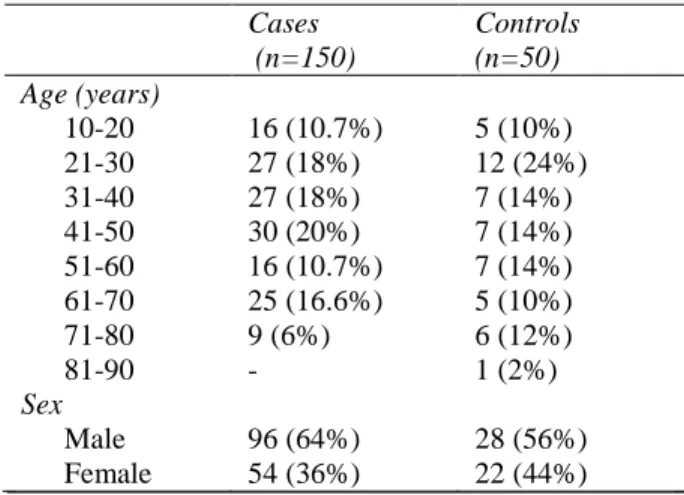
The age distribution of the study population was
between 10 to 83 years. The mean age in the
cases group was 45.56±17.600 years whereas in
Table 1 Age and sex distribution of study population and controls.
Cases (n=150)
Controls (n=50) Age (years)
10-20 16 (10.7%) 5 (10%) 21-30 27 (18%) 12 (24%)
31-40 27 (18%) 7 (14%)
41-50 30 (20%) 7 (14%)
51-60 16 (10.7%) 7 (14%) 61-70 25 (16.6%) 5 (10%)
71-80 9 (6%) 6 (12%)
81-90 - 1 (2%)
Sex
Male 96 (64%) 28 (56%)
Female 54 (36%) 22 (44%) Table 2 Frequency of smoking in the study population and controls.
Cases (n=150)
Controls (n=50) Smoking
Present 30 (20%) 3 (6%) Absent 120 (80%) 47 (84%) Alcohol intake
Present 20 (13.3%) 9 (18%) Absent 130 (86.7%) 41 (82%)
control
group
was
46.060±19.659
years
(
p=
0.868). Maximum number of patients was
distributed in the age group between 45 to 50
years (n=22, 14.7%) after that age group 25 to
30 (n=19, 12.7%).
The total number of males in study was 124
(62%) and total number of females was 76
(38%),
p
=0.313.
Table 2
shows the frequency of smoking and
alcohol intake in the study population. We found
that 30 (20%) out of 150 cases having positive
smoking history and 3 (6%) out of 50 controls
having positive smoking history (
p
=0.021).
Similarly, 20 (13.3%) out of 150 cases were had
positive history of alcohol intake and 9 (18%)
out of 50 controls had positive alcohol intake
history (
p
=0.417).
Evaluation of other comorbidities in psoriasis
showed that among patients, there was
statistically significant difference regarding
mean values of waist circumference (p<0.041),
BMI (p<0.044), blood pressure (both systolic
and diastolic) (p<0.036) between cases and
controls. The difference between mean values of
fasting blood sugar, thyroid profile, serum B12
and complete blood picture was not statistically
significant between cases and controls.
Table 3 Distribution of anthropometric, blood pressure and laboratory parameters between two groups in patients
Parameters Cases Control P value
Waist circumference (cm) 95.207±3.033 87.080±4.039 0.041*
Body mass index (kg/m2) 28.440±4.075 23.160±3.078 0.044* Systolic blood pressure (mmHg) 129.427±1.177 124.400±1.475 0.024* Diastolic blood pressure (mmHg) 84.733±0.597 81.960±0.692 0.013* Serum triglyceride levels (mg/dl) 146.260±1.056 144.140±1.533 0.298
Serum HDL (mg/dl) 37.267±0.478 38.880±0.508 0.068
Serum cholesterol (mg/dl) 211.127±1.915 208.260±3.022 0.445 Fasting blood sugar (g/dl) 100.040±2.279 92.480±2.325 0.072
Serum TSH level (U/ml) 4.642±0.270 4.356±0.336 0.573
Serum B12 level (pmol/L) 0.527±0.041 0.380±0.069 0.073
There was statistically significant difference
between mean values of serum homocysteine
(p<0.013) between cases and controls. However,
differences between mean values of TG, HDL
and cholesterol were not significant between
cases and controls.
Discussion
Psoriasis
is
associated
with
numerous
comorbidities that have a major impact on
severely affected patients. Comorbid conditions
linked with psoriasis are associated with
increasing rates of morbidity and mortality.
8Besides psoriatic arthritis, other diseases such as
metabolic syndrome and cardiovascular diseases
have emerged as important comorbidities. The
relationship between psoriasis and comorbidities
is likely linked to the underlying chronic
inflammatory nature of psoriasis.
9The age distribution of the study population was
between 10 to 83 years. The mean age in the
cases group was 45.56. Maximum number of
patients was distributed in the age group
between 45 to 50 years followed by age group
25 to 30. The total number of males in study was
124 (62%) and females patients were 76 (38%),
p
=0.313.
Table 4
compares the results of some of the
previous studies. Thus in our study we found the
significant difference between smoking, waist
circumference, BMI, hypertension and serum
homocysteine. The prevalence rate for these
variables were significantly higher in our study.
Our studies results are similar to
Krueger
et al.
9and Cohen
et al.
10but was not similar to the
studies conducted by Naldi
et al.
4There was no statistically significant difference
in alcohol intake, HDL cholesterol, total
cholesterol,
fasting
blood
sugar,
thyroid
stimulating hormone and serum B12 level
among cases and control group. Results of our
Table Comparison of studies showing association of psoriasis with its co-morbidities
Study Year No. of patients
WC B.M.I HTN Lipid profile
BS-F TSH S. B12 S. homo-cysteine
Smoking Alcohol
Naldi et al.4 2005 560 NE 0.01 (S) NE NE NE NE NE NE NE NS
Herron et al.10 2005 1998 <0.01 NE NE NE NE NE NE NE <0.01 NE
Neimann et al.11 2006 133560 0.01
(S)
NE 0.01 (S) NE 0.01 (S) NE NE NE 0.01 (S) NE
Cohen et al.12 2007 340 NE NS NS NS <0.01
(S)
NE NE NE NE NE
Altobelli et al.13 2009 1954 NS NE 0.01 (S) NE NS NE NE NE NE NE
Cakmak et al.14 2009 70 NE NE NE NE NE NE NS <0.05
(S)
NE NE
Choi et al.15 2010 197 NE 0.01 (S) 0.04 (S) 0.021
(S)
NE NE NE NE NE NE
Qureshi et al.16 2010 1060 NE NE NE NE NE NE NE NE NE <0.01 (S)
Prey et al.17 2010 NE NE 0.05 (S) NS NS NS NE NE NE NE NE
Malekzad et al.18 2011 30 NE NS 0.001
(S)
0.014 (S)
0.044 (S)
NE NE NE NE NE
Tobin et al.19 2011 20 NE <0.004(S) <0.001
(S)
NE NE NE NE <0.007 (S)
NE NE
Malhotra et al.20 2011 50 NE NE NE NE NE 0.045
(S)
0.001 (S)
NE NE NE
Mazlin et al.21 2012 2267 NE NE <0.028
(S)
NS <0.038 NE NE NE NE NE
Kumar et al.22 2012 200 NE NS <0.046 NE <0.056
(NS)
NE NE NE NE NE
Madanagobalane and Anandan23
2012 118 0.035 (S)
NE NS <0.011 NS NE NE NE NE NE
Our study 2016 150 0.021 (S)
0.044 (S) 0.036 (S)
0.298 (NS)
0.072 (NS)
0.573 NS
0.073 (NS)
0.013 (S) 0.021 (NS)
0.417 (NS) NS: not significant, S-significant association, NE -not evaluated
study are similar to that reported by previous
researchers; nonetheless, different studies were
based on different populations.
4,10-23The common pathogenesis of psoriasis and
metabolic
syndrome
might
explain
this
association. Both are T helper type 1 (Th1)
cells-mediated
disorders.
Th1
proinflammatory
mediators (TNF-∞, IL-6) overexpressed in
psoriasis lead to development of different
components of metabolic syndrome.
20Conclusion
In our study we found significant association
with obesity, hypertension, serum homocysteine
and increased prevalence of smoking in patients
with psoriasis.
All these comorbidities points towards increased
risk
of
cardiovascular
involvement
and
metabolic syndrome. Therefore, it should be
noted that the approach of the psoriatic patient
should be comprehensive and multidisciplinary
to implement preventive and early therapeutic
measures aiming to improve the rates of
mortality, hospitalization, and survival.
References
1. Lal S. Clinical pattern of psoriasis in Punjab. Indian J Dermatol Venereol. 1966;35:5-12. 2. Monk BE, Neill SM. Alcohol consumption
and psoriasis. Dermatologica. 1986;173:57-60.
3. Poikolainen K, Reunala T, Karvonen J, Lauharanta J, Kärkkäinen P. Alcohol intake: a risk factor for psoriasis in young and middle aged men? BMJ. 1990;300:780-3. 4. Naldi L, Chatenoud L, Linder D, Belloni
Fortina A, Peserico A, Virgili AR et al. Cigarette smoking, body mass index, and stressful life events as risk factors for psoriasis: results from an Italian case-control study. J Invest Dermatol. 2005;125:61-7. 5. Ryder MI, Saghizadeh M, Ding Y, Nguyen
N, Soskolne A. Effects of tobacco smoke on
the secretion of interleukin-1beta, tumor necrosis factor-alpha, and transforming growth factor-beta from peripheral blood mononuclear cells. Oral Microbiol Immunol. 2002;17:331-6.
6. Okubo Y, Koga M. Peripheral blood monocytes in psoriatic patients overproduce cytokines. J Dermatol Sci. 1998;17:223-32. 7. Flisiak I, Chodynicka B, Porebski P, Flisiak
R. Association between psoriasis severity and trans-forming growth factor beta (1) and beta (2) in plasma and scales from psoriatic lesions. Cytokine. 2002;19:121-5.
8. Gelfand JM, Troxel AB, Lewis JD, Kurd SK, Shin DB, Wang X et al. The risk of mortality in patients with psoriasis: results from a population based study. Arch Dermatol. 2007;143:1493-9.
9. Krueger G, Ellis CN. Psoriasis - recent advances in understanding its pathogenesis and treatment. J Am Acad Dermatol. 2005;53:S94-100.
10. Herron MD, Hinckley M, Hoffman MS. Impact of obesity and smoking on psoriasis presentation and management. Arch Dermatol. 2005:141:1527-34.
11. Neimann AL, Shin DB, Wang X, David J. Margolis DJ, Troxel AB, Gelfand JM et al. Prevalence of cardiovascular risk factors in patients with psoriasis. J Am Acad Dermatol. 2006;55:829-35.
12. Cohen AD, Gilutz H, Henkin Y, Zahger D, Shapiro J, Bonneh DY et al. Psoriasis and the metabolic syndrome. Acta Derm Venereol. 2007:87:506-9.
13. Altobelli E, Petrocelli R, Macaronne M, Altomere G, Argen-Jiano G, Giannettie A et al. Risk factors of hypertension, diabetes and obesity in Italian psoriasis patients: a survey on socio-demographic characteristics, smoking habits and alcohol consumption. Eur J Dermatol. 2009;19: 252-6.
14. Cakmak SK, Gül U, Kiliç C, Gönül M, Soylu S, Kiliç A. Homocysteine, vitamin B12 and folic acid levels in psoriasis patients. J Eur Acad Dermatol Venereol. 2009;23:300-3.
15. Choi WJ, Park EJ, Kwon IH, Kim KH, Kim KJ. Association between psoriasis and cardiovascular risk factors in Korean patients. Ann Dermatol. 2010;22:300-6. 16. Qureshi AA, Dominguez PL, Choi HK, Han
17. Prey S, Paul C, Bronsard V, Puzenat E, Gourraud PA, Aractingi S et al. Cardiovascular risk factors in patients with plaque psoriasis: a systematic review of epidemiological studies. J Eur Acad Dermatol Venereol. 2010;24 Suppl 2:23-30. 18. Malekzad F, Robati R, Abaei H, Hejazi S,
Ayatollahi A, Younespour S. Insulin resistance in psoriasis: A case-control study. Iran J Dermatol. 2011;14:136-9.
19. Tobin AM, Hughes R, Hand EB, Leong T, Graham IM, Kirby B. Homocysteine status and cardiovascular risk factors in patients with psoriasis: a case-control study. Clin Exp Dermatol. 2011;36:19-23.
20. Malhotra SK, Dhaliwal GS, Puri KJPS, Gambhir ML, Mahajan M. An insight into relationship between psoriasis and metabolic
syndrome. Egypt Dermatol Online J. 2011;7:2:5: 1-12.
21. Mazlin MB, Chang CC, Baba R. Comorbidities associated with psoriasis – data from the Malaysian Psoriasis Registry. Med J Malaysia. 2012;67:518-21.
22. Kumar P, Thomas J. Comorbid conditions in psoriasis – Higher frequency in females: A prospective study. Indian Dermatol Online J. 2012;3(2):105-8.