AUSTRALIAN JOURNAL OF BASIC AND
APPLIED SCIENCES
ISSN:1991-8178 EISSN: 2309-8414 Journal home page: www.ajbasweb.com
Open Access Journal
Published BY AENSI Publication
© 2016 AENSI Publisher All rights reserved
This work is licensed under the Creative Commons Attribution International License (CC BY).
http://creativecommons.org/licenses/by/4.0/
To Cite This Article: Gowri T. and Rajesh Kumar P.., Reduction of Artifacts from ECG Signal Using Efficient Fast Block LMF Based Adaptive Algorithm. Aust. J. Basic & Appl. Sci., 10(6): 135-141, 2016
Reduction of Artifacts from ECG Signal Using Efficient Fast Block LMF Based
Adaptive Algorithm
1Gowri T. and 2Rajesh Kumar P.
1Dept. of ECE, GIT, GITAM University, Visakhapatnam-530045, A.P, INDIA 2 Dept. of ECE, AUCE, Andhra University, Visakhapatnam-530003, A.P, INDIA
Address For Correspondence:
Gowri T., Dept. of ECE, GIT, GITAM University, Visakhapatnam-530045, A.P, INDIA. E-mail: [email protected]
A R T I C L E I N F O A B S T R A C T
Article history:
Received 12 February 2016 Accepted 12 March 2016 Available online 20 March 2016
Keywords:
Adaptive filter, Artifacts, ECG, Noise Cancellation.
In the biotelemetry system, it is very important to extract high resolution and valid ECG signal from the corrupted Signal. When acquiring ECG signal in the laboratory, it undergoes several artifacts, which strongly degrades the signal quality. The predominate artifacts in ECG signal are Power Line Interference, Muscle Artifacts, Baseline Wander, Electrode Motion Artifacts; and sometimes channel noise also added during transmission. The tiny features of (PQRST) ECG signal are masked due to these noises. Adaptive filters are best choice to monitor these random variations in noisy signals. In this paper, we proposed less computational efficient Fast Block Leaky LMF based adaptive algorithms. These algorithms are used to remove PLI and EM artifacts from ECG signals. We compared these proposed algorithms with Block LMS algorithm, which shows better performance in reducing artifacts in ECG signal. The simulation results show that, less computational complexity (time delay calculation) is required for Fast Block LMF based adaptive algorithm and gives good Signal to Noise Ratio.
INTRODUCTION
In this industrialized world, ever year, millions of people suffer cardiovascular disease (CVDs) (WHO 2005) reported by the World health organization, because they are not treated promptly. Biotelemetry is an effective tool for the diagnosis of cardiac abnormalities, when the patient is far from specialist help, there a doctor analyzes the signal and decides on what action to be taken, the decision sent to the patient site for immediate action (Derya et.al 2011 and McMurray et.al 2005).
In clinical laboratory when we acquiring ECG signal, the signal sometimes corrupted by numerous types of artefacts. The commonly occurred artefacts are Power Line Interference (PLI) (Suzanna et.al 1996), Baseline Wander (BW) (Sayadi et.al 2007), Electrode Motion (EM) (Wiese et.al 2005) and Muscle Artefacts (MA). These artefacts strongly affect the signal quality and are very important for clinical monitoring, diagnosis and making their efficient cancellation imperative. Therefore the separation of pure quality ECG signal from background noise corrupted ECG signal is a great importance for examination. So by using filtering techniques we have to distinct valid signal can be separated from the undesired artefacts.
et.al 1996). In such a case adaptive filter has an ability to adjust their weight coefficients based on the incoming signal.
(Thakor, et.al 1991) presented an adaptive recurrent filter to remove muscle noise using LMS algorithm, which is useful method to acquire the impulse response of the normal QRS complex. The cancellations of baseline wanders, power line interferences by using an efficient finite impulse response and state space recursive least square filter with a reduced number of taps are described in (Van Alste. et.al 1985, Razzaq. et.al 2013, Rehman. et.al 2012, Robertson. et.al 2011). (Manuel et.al 2008) developed an ECG signal enhancement method based on the empirical mode decomposition for non stationary signals.
In this paper, we proposed three algorithms: Fast Block Leaky LMF (FB-LLMF), Data Normalized Fast Block Leaky LMF (DNFB-LLMF), Error Normalized Fast Block Leaky LMF (ENFB-LLMF) and for double validation we considered FB-LLMFtoFB-LLMF algorithm. These algorithms are derived from block LMS algorithms. The efficiency of the proposed algorithms is taken by the removal of noises from ECG signals under unconventional conditions such as ECG signal with PLI and EM artefacts. The simulation results shows that FB-LLMFtoFB-LLMF algorithm and ENFB-LLMF algorithm gives the better elimination of noises present in the ECG signal of less computational complexity.
Different Adaptive Noise Cancellers:
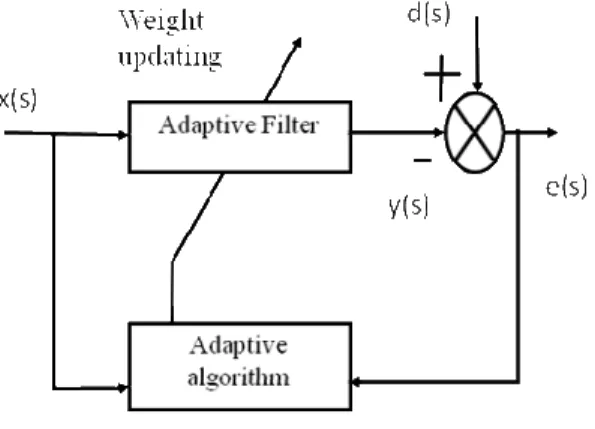
The adaptive filter structure for noise cancellation is shown in the Fig. 1. Let the reference input to the filter assigned as x(s). The tap inputs x(s), x(s – 1), x(s – 2), .... x(s –M + 1) forms the elements of the M-by-1 tap input vector x(s), Correspondingly, the weight vector represented as w( )s =[w w0, 1,....wM−1, ]T. The output y(s) is the FIR filter output.
Fig. 1: Adaptive filter structure.
The error e(s) is defined as the difference between the desired response d(s) and the actual response y(s) i.e. e(s)= d(s) – y(s). The reqcursive weight equation for the LMS algorithm is as follows.
(
s
+ =
1)
( )
s
+
µ
e s
( ) ( )
s
w
w
x
(1)The convergence of the LMS algorithm (Haykin et.al 1986) and mean square value mainly depends on the step size parameter , its value is chosen according to steepest decent phenomena is 2/ λmax, where λmax, is the maximum value in the input auto correlation matrix.
In ECG signal processing under critical conditions some of the samples in the ECG signal becomes zero, i.e., the excitation is inadequate. At these samples, the weights are varies drastically. The fluctuations in weights is called weight drift problem. For the tap weight vector in (1), we place small leakage factor γ, then in that algorithm the weight drift problem can be minimized (Gowri. et.al 2013, 2014 and Tobias. et.al 2004). This algorithm is known as the leaky LMS (LLMS) algorithm. The weight update equation for the LLMS algorithm is as follows.
(
s
+ = −
1)
(1
µγ
) ( )
s
+
µ
e s
( ) ( )
s
w
w
x
(2)In the above recursion (2), the product
µγ
is much closer to zero.In order to achieve lower steady state error (Walach et.al 1984) and increasing stability, compared to the conventional LMS algorithm, we combine the features of LMF and LLMS. The resultant algorithm is Leaky Least Mean Fourth (LLMF) algorithm and mathematically it can be written as follows.
3
(
s
+ = −
1)
(1
µγ
) ( )
s
+
µ
{ ( )} ( )
e s
s
Development of Efficient Fast Block Leaky LMF Based Adaptive Algorithm:
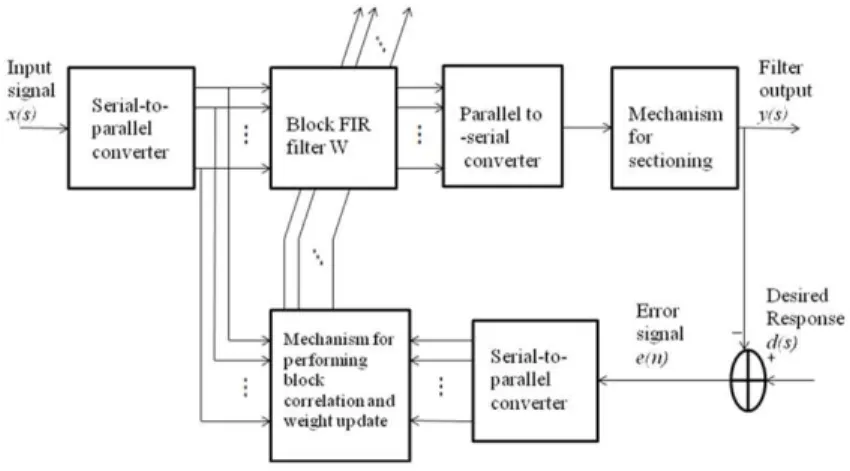
When input signal length is large then amount of adaptive filter length also required excessively long lengths. In such cases, the conventional LMS algorithm, which is simple, is computationally expensive to implement. The block processing of the data samples can significantly reduce the computational complexity of adaptive filters (Farhang-Boroujeny. et.al 1998, 2000). A typical block adaptive filter structure is shown in Fig. 2. From the figure we can observe that input signal is converted into parallel form as a specified length of the filter. Finally the result is obtained using parallel to serial converter.
Fig. 2: Block Adaptive filter structure.
In the Block LMS algorithm the computations are reduced with the help of Fast Fourier Transform (FFT) technique. For evaluating of FFT we used overlap and save method. This FFT technique gives high resolution and good accuracy. The input sequence x(s) is divided into non-overlapping blocks of length T using serial to parallel converter. These blocks of data are applied to an FIR filter of length M, one block at a time. So the processing is based on block by block (Haykin et.al 1986). The best results are achieved to choose filter length is equal to the block length. Let for the jth block the weight vector for Block LMS is given as
1
0
(
1)
( )
(
) (
)
T
i
j
j
µ
jT
i e jT
i
−
=
+ =
+
∑
+
+
w
w
x
(4)Where µ is step size parameter. We considered,
w
( )
j
is weight vector,x
(
jT
+
i
)
is the input filtercoefficients and
e jT
(
+
i
)
is output error. The filter output is written as,(
)
T( ) (
)
y jT
+ =
i
w
j
x
jT
+
i
(5)The output error is given by
(
)
(
)
(
)
e jT
+ =
i
d jT
+ −
i
y jT
+
i
(6)To achieve better filtering capability, for the elimination of weight drift problem and reduced steady state error we added to LLMF algorithm to (3), then the modified weight update equation for B-LLMF algorithm in time domain is given by
3 1
0
(
1)
(1
) ( )
(
)
(
)
T
i
j
µγ
j
µ
jT
i e
jT
i
−
=
+ = −
+
∑
+
+
w
w
x
(7)The computational complexity is more for evaluating of
y jT
(
+
i
)
andw
(
j
+
1)
factors. So for reducing this complexity we applied FFT technique based on overlap save method that is padding of zeros. The FB-LLMF weight vector is given as( ) (j+ = −1) (1
µγ
) ( )j +α
FFTφ
j 0
W W (8)
Where ( )j =FFT ( )j
0
w
W , α is constant.
which also gives fast convergence characteristic. So we applied data normalization and error normalization techniques to Fast block LLMF algorithm (8) named as Data Normalized Fast Block LMMF (DNFB-LLMF) and Error Normalized Fast Block LLMF (ENFB-LLMF) algorithms. To study the performance of the efficient adaptive noise cancellers, we carried our experiments on real ECG signals recorded from humans. For increasing of signal quality we used double validation method. That is we taken FB-LLMF final weight residue as starting value for another FB-LLMF algorithm, due to this convergence rate increases fastly and with good SNR ratio. This algorithm is known as FB-LLMFtoFB-LLMF algorithm.
Convergence Characteristics:
The convergence curves for various BLMS variant adaptive algorithms discussed in the previous sections are shown in Fig. 3. These curves are plotted between MSE and number of iterations. MSE is calculated for each sample for 5000 iterations and the average value is taken for the characterization.
These curves are obtained during the adaptive power line interference (60 Hz) cancellation using various adaptive noise cancellers individually with a adaptive filter of length 5, random variance of 0.01 and step size 0.01. From Fig. 3 it is clear that, among all the algorithms FB-LLMFtoFB-LLMF outperforms. The performance of DNFBLLMF and ENEB-LLMF are comparable to each other and superior to BLMS algorithm.
0 500 1000 1500 2000 2500 3000 3500 4000 4500 5000 -40
-35 -30 -25 -20 -15 -10 -5 0
Number of Iterations
M
S
E
BLMS FB-LLMF DNFB-LLMF ENFB-LLMF FB-LLMFtoFB-LLMF
Fig. 3: Convergence Curves of Different BLMS based adaptive algorithms.
Simulation Results And Discussion:
In our simulation purpose we collected six ECG records from MIT-BIH database (physionet- mitdb), and calculated Signal to Noise Ratio (SNR) in decibels, correlation factor, and observed the Excess MSE using different adaptive filters with MATLAB software. The output graphs shown here for data 105 record only, because of space limitation, rest are compared using table form. The number of samples is taken on x-axis and amplitude on y-axis for all figures. In our experiments, we have considered two dominant artefacts, namely PLI and EM.
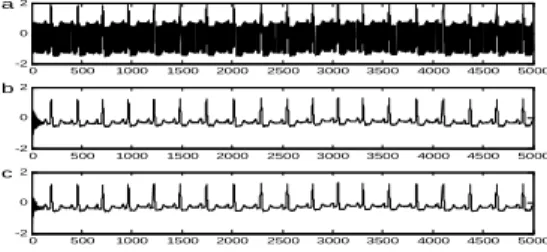
The ECG signal is corrupted with a power line noise of amplitude 1mV, with 60Hz frequency. This corrupted ECG signal is applied at input signal and sampled with a frequency of 200Hz. The reference signal is synthesized sinusoidal noise generated in the noise generator; and filter output is recovered signal. Four filter structures are designed using BLMS, FB-LLMF, DNFB-LLMF, ENFB-LLMF and FB-LLMFtoFB-LLMF algorithms. The simulation results for PLI cancellation using these algorithms are shown in Fig. 4 and Fig. 5.
0 500 1000 1500 2000 2500 3000 3500 4000 4500 5000
-2 0 2
a
0 500 1000 1500 2000 2500 3000 3500 4000 4500 5000
-2 0 2
b
0 500 1000 1500 2000 2500 3000 3500 4000 4500 5000
-2 0 2
c
Fig. 4: PLI cancellation using different adaptive algorithms.(a) Corrupted ECG (b) using BLMS algorithm (c)FB-LLMF algorithm.
FB-LLMF gets 9.833dBs and BLMS gets 8.6730dBs, these values correlate with the convergence characteristics shown in Fig. 3.
0 500 1000 1500 2000 2500 3000 3500 4000 4500 5000 -2
0 2
a
0 500 1000 1500 2000 2500 3000 3500 4000 4500 5000 -2
0 2
b
0 500 1000 1500 2000 2500 3000 3500 4000 4500 5000 -2
0 2
c
0 500 1000 1500 2000 2500 3000 3500 4000 4500 5000 -2
0 2
d
Fig. 5: PLI cancellation using different adaptive algorithms.(a) Corrupted ECG (b) using DNFB-LLMF algorithm (c)ENFB-LLMF algorithm (d)FB-LLMFtoFB-LLMF algorithm.
Table 1: SNR contrast of BLMS based adaptive algorithms for PLI removal.
S. No Rec. No BLMS FB-LLMF DNFB-LLMF ENFB-LLMF
FB-LLMFtoFB-LLMF
1. 100 8.811 9.9785 11.7516 11.7801 18.89993
2. 102 7.8468 8.99 10.7698 10.6968 16.5703
3 105 8.9134 10.0103 11.3881 11.5478 14.3494
4 108 8.4783 9.6277 11.3464 11.4893 19.1618
5 203 9.9027 11.1458 12.6732 12.904 17.6157
6 228 8.0863 9.2457 11.0143 11.0284 17.8918
Avg. 8.6730 9.833 11.4905 11.5744 17.4148
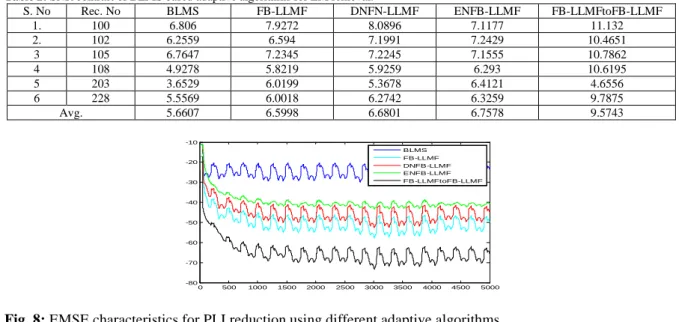
From MIT-BIH normal sinus rhythm database and noise stress test (physionet- nsrdb) the real EM noise is collected for testing of the signal using different filters in non-stationary conditions. The simulation results for PLI cancellation using these algorithms are shown in Fig. 6 and Fig. 7. The SNR calculation for cancellation of EM, using various filtering methods is shown in Table 2. From this table it is clear that FB-LLMFtoFB-LLMF algorithm effectively filters EM noise, it got an average SNR of 9.5743 dBs, ENFB-LLMF gets 6.7573 dBs, DNFB-LLMF gets 6.6801 dBs and BLMS get 5.6607 dBs. The excess mean square error (EMSE) characteristics for the removal of PLI noise and EM noise as shown in Fig. 8 and Fig. 9 respectively.
0 500 1000 1500 2000 2500 3000 3500 4000 4500 5000 -2
0 2
a
0 500 1000 1500 2000 2500 3000 3500 4000 4500 5000 -2
0 2
b
0 500 1000 1500 2000 2500 3000 3500 4000 4500 5000 -2
0 2
c
Fig. 6: EM cancellation using different adaptive algorithms.(a) Corrupted ECG (b) using BLMS algorithm (c)FB-LLMF algorithm.
0 500 1000 1500 2000 2500 3000 3500 4000 4500 5000 -2
0 2
a
0 500 1000 1500 2000 2500 3000 3500 4000 4500 5000 -2
0 2
b
0 500 1000 1500 2000 2500 3000 3500 4000 4500 5000 -2
0 2
c
0 500 1000 1500 2000 2500 3000 3500 4000 4500 5000 -2
0 2
d
Table 2: SNR contrast of BLMS based adaptive algorithms for EM removal.
S. No Rec. No BLMS FB-LLMF DNFN-LLMF ENFB-LLMF FB-LLMFtoFB-LLMF
1. 100 6.806 7.9272 8.0896 7.1177 11.132
2. 102 6.2559 6.594 7.1991 7.2429 10.4651
3 105 6.7647 7.2345 7.2245 7.1555 10.7862
4 108 4.9278 5.8219 5.9259 6.293 10.6195
5 203 3.6529 6.0199 5.3678 6.4121 4.6556
6 228 5.5569 6.0018 6.2742 6.3259 9.7875
Avg. 5.6607 6.5998 6.6801 6.7578 9.5743
0 500 1000 1500 2000 2500 3000 3500 4000 4500 5000 -80
-70 -60 -50 -40 -30 -20 -10
BLMS FB-LLMF DNFB-LLMF ENFB-LLMF FB-LLMFtoFB-LLMF
Fig. 8: EMSE characteristics for PLI reduction using different adaptive algorithms.
0 500 1000 1500 2000 2500 3000 3500 4000 4500 5000 -40
-35 -30 -25 -20 -15 -10 -5
BLMS FB-LLMF DNFB-LLMF ENFB-LLMF FB-LLMFtoFB-LLMF
Fig. 9: EMSE characteristics for EM reduction using different adaptive algorithms.
Conclusion:
For fast transmission of the signal, we derived less computational based algorithms using frequency domain technique. In this paper we developed different weight update equations based on BLMS adaptive algorithms: FB-LLMF, DNFB-LLMF, ENFB-LLMF and FB-LLMFtoFB-LLMF algorithms. To evaluate the performance of the various adaptive noise cancellers we have plotted the convergence characteristics, EMSE characteristics, calculated computational complexity in terms of time and Signal to Noise Ratio. Among this FB-LLMF based algorithm performs better in the noise removal from corrupted ECG signal.
REFERENCES
Derya E.Ü., 2011. Clinical Technologies: Concepts, Methodologies, Tools and Applications. Telemedicine and Biotelemetry for E-Health Systems. IGI Publications.
Farhang-Boroujeny, B. and K. Sann Chan, 2000. Analysis of the frequency domain block LMS algorithm,” IEEE Trans. Signal Process, 48(8): 2332–2342.
Farhang-Boroujeny, B., 1998. Adaptive Filters-Theory and Applications (JohnWiley and Sons, Chichester, UK).
Gowri, T., P. Rajesh Kumar, D.V.R. Koti Reddy, 2014. An Efficient Variable Step size Least Mean Square Adaptive Algorithm used to enhance the quality of electrocardiogram Signal. Advances in Signal Processing and Intelligent Recognition Systems, 463-475.
Gowri, T., I. Sowmya, Z.U. Rahman, D.V.R. Koti Reddy, 2013. Adaptive Power Line Interference Removal from Cardiac signals using Leaky based Normalized Higher order Filtering Techniques. IEEE 1st Int. Conf. on AIMS, 259-263.
Haykin, S., 1986. Adaptive Filter Theory. Eaglewood Clirs, NJ: Prentice-Hall.
Manuel, B.V., B. Weng, K.E. Barner, 2008. ECG Signal denoising and baseline wander correction based on the empirical mode decomposition. Comp. in Bio. and Med, 38: 1-13.
McMurray, J.J., M.A. Pfeffer, 2005. Heart failure, Lancet, 365(9474): 1877–89.
Rehman, S.A., R. Kumar, M. Rao, 2012. Performance Comparison of various Adaptive Filter Algorithms for ECG Signal Enhancement and Baseline Wander Removal IEEE-ICCCNT'12.
Razzaq, N., M.B utt, Rahat Ali, S. Md., I. Sadiq, K. Munawar, T. Zaidi, 2013. Self Tuned SSRLS Filter for Online Tracking and Removal of Power Line Interference from Electrocardiogram U2013 Proc. of lCMIC.
Robertson, F.C., T.S. Douglas and E.M. Meintjes, 2010. Motion Artifact Removal for Functional Near Infrared Spectroscopy: A Comparison of Methods, IEEE Transactions on Biomedical Engineering, vol. 57, no. 6, 1377-1387.
Sayadi, O., M.B. Shamsollahi, 2007. Multiadaptive Bionic Wavelet Transform: Application to ECG Denoising and Baseline Wandering Reduction. Eurasip J. on Adv. in Signal Processing. Article ID 41274 11 pages.
Suzanna, M., M. Martens, M. Mischi, S.G. Oei, J.W.M. Bergmans, 1996: An Improved Adaptive Power Line Interference Canceller for Electrocardiography. IEEE Trans. Bio.med. Eng. 53(11), 2220-2231.
Thakor, N.V., Y.S. Zhu, 1991. Applications of adaptive filtering to ECG analysis: noise cancellation and arrhythmia detection. IEEE Trans. Bio.med. Eng, 38(8): 785-794.
Tobias, O.J., R. Seara, 2004. Leaky Delayed LMS Algorithm: Stochastic Analysis for Gaussian Data and Delay Modeling Error. IEEE Trans. on Signal Processing, 52(6): 1596-1606.
Van Alste, J.A., T.S. Schilder, 1985. Removal of base-line wander and power-line interference from the ECG by an efficient FIR filter with a reduced number of taps. IEEE Trans. Bio.med. Eng, 32(12): 1052-1060.
Walach, E., B. Widrow, 1984. The least mean fourth adaptive algorithm and its family. IEEE Transactions on Information Theory, 30: 275–283
Widrow, B., J. Glover, J.M. McCool, J. Kaunitz, C.S. Williams, R.H. Hearn, J.R. Zeidler, E. Dong, R. Goodlin, 1975. Adaptive noise cancelling: Principles and applications. Proc. IEEE, 63: 1692-1716.
Wiese, S.R., P. Anheier, R.D. Connemara, A.T. Mollner, T.F. Neils, J.A. Kahn and J.G. Webster, 2005. “Electrocardiographic Motion Artifact Versus Electrode Impedance”, IEEE Transactions on Biomedical Engineering, 52: 136-139.
World Health Organization Report, 2005. Preventing Chronic diseases a vital investment. World Health Organization, Geneva,. Available: http://www.who.int/chp/chronic_disease_report/en/
www.physionet.org/physiobank/database/mitdb/-(Online).MIT-BIH Arrhythmia Database