IMPROVING 3D RECONSTRUCTION USING DEEP LEARNING PRIORS
Rohan Chabra
A dissertation submitted to the faculty at the University of North Carolina at Chapel Hill in
partial fulfillment of the requirements for the degree of Doctor of Philosophy in the Department
of Computer Science.
Chapel Hill
2020
ABSTRACT
Rohan Chabra: IMPROVING 3D RECONSTRUCTION USING DEEP LEARNING PRIORS
(Under the direction of Henry Fuchs)
Modeling the 3D geometry of shapes and the environment around us has many practical
ap-plications in mapping, navigation, virtual/ augmented reality, and autonomous robots. In general,
the acquisition of 3D models relies on using passive images or using active depth sensors such
as structured light systems that use external infrared projectors. Although active methods
pro-vide very robust and reliable depth information, they have limited use cases and heavy power
requirements, which makes the passive techniques more suitable for day-to-day user applications.
Image-based depth acquisition systems usually face challenges representing thin, textureless, or
specular surfaces and regions in shadows or low-light environments. While scene depth
informa-tion can be extracted from the set of passive images, fusion of depth informainforma-tion from several
views into a consistent 3D representation remains a challenging task. The most common
chal-lenges in 3D environment capture include the use of efficient scene representation that preserves
the details, thin structures, and ensures overall completeness of the reconstruction.
ACKNOWLEDGEMENTS
There are key individuals that have provided me with the support and tools that a graduate
student could want. Here, I wish to acknowledge those friends, advisors, and relatives that have
guided and inspired me throughout this doctoral endeavour.
First and foremost, I would like to thank my supervisor, Prof. Henry Fuchs for giving me
an opportunity to be part of a unique research experience under his guidance. His experience,
expertise, and thoroughness is largely responsible for the quality of research in my dissertation. I
would like to thank my loving fianc´ee, Nirupama Sharma for being very supportive and patient
with me during my every struggle as a doctorate student. I am extremely grateful to my dearest
friend Aniket Bera for helping me throughout my graduate student life. He has been the source
of motivation for my pursuit to doctorate and has helped and guided me in achieving several
milestones during my doctoral journey.
I am extremely grateful to Dr. Richard Newcombe for giving me an excellent opportunity
to work with him and his team at Facebook Reality Labs during the course of several
intern-ships and research collaborations. This fortunate collaboration with Richard gave me a chance to
use the state-of-the-art research tools and an opportunity to work with an expert research team.
Richard, also guided me in the development of several innovative ideas and technical concepts
that became an integral part of this dissertation. This dissertation would not have been possible
without his immense support and guidance.
TABLE OF CONTENTS
LIST OF TABLES . . . .
xi
LIST OF FIGURES . . . xiii
LIST OF ABBREVIATIONS . . . xix
CHAPTER 1:
INTRODUCTION . . . .
1
1.1
Motivation and Problem Statement . . . .
1
1.2
Related Work . . . .
9
1.2.1
3D Reconstruction using Traditional Methods . . . .
9
1.2.1.1
Depth Estimation . . . .
9
1.2.1.2
3D Scene Representation Methods . . . 10
1.2.2
3D Reconstruction using Learning Based Methods . . . 10
1.2.2.1
Learning Depth Estimation . . . 11
1.2.2.2
3D Scene Representation Learning . . . 11
1.3
Thesis Contributions . . . 12
CHAPTER 2:
TECHNICAL INTRODUCTION . . . 14
2.1
Deep Learning for 3D Vision . . . 14
2.1.1
Deep Artificial Neural Networks . . . 15
2.1.1.1
Artificial Neuron . . . 15
2.1.1.2
Multi Layer Perceptrons (MLP) . . . 18
2.1.1.3
Convolutional Neural Networks . . . 18
2.1.1.4
Optimization Algorithms . . . 20
2.1.2
Datasets for 3D Learning . . . 23
2.2
Depth From Stereo Vision . . . 24
2.2.1
Stereo Camera Calibration . . . 25
2.2.2
Stereo Matching . . . 27
2.2.2.1
Feature Descriptors . . . 28
2.2.2.2
Correlation Metrics . . . 29
2.2.2.3
Disparity Estimation . . . 30
2.3
3D Surface Representations . . . 32
2.3.1
Signed Distance Function . . . 33
2.3.2
Surface Representation Methods . . . 34
2.3.2.1
Radial Basis Function (RBF) . . . 35
2.3.2.2
Multi-level Partition of Unity (MPU) . . . 35
2.3.2.3
Grid Sampling . . . 36
CHAPTER 3:
LEARNING BASED DEPTH ESTIMATION FROM STEREO . . . 38
3.1
Introduction . . . 38
3.2
Background . . . 39
3.3
StereoDRNet: Dilated Residual Stereo Net . . . 40
3.3.1
Key Contributions . . . 40
3.4
Algorithm . . . 41
3.4.1
Feature Extraction . . . 42
3.4.2
Cost Volume Filtering . . . 42
3.4.3
Disparity Regression . . . 44
3.4.4
Disparity Refinement . . . 45
3.4.5
Training . . . 48
3.5
Network Details . . . 48
3.6.1
SceneFlow Dataset . . . 52
3.6.2
KITTI Datasets . . . 53
3.6.3
ETH3D Dataset . . . 57
3.7
Conclusion . . . 58
CHAPTER 4:
3D RECONSTRUCTION FROM LEARNING BASED STEREO . . . 59
4.1
Introduction . . . 59
4.2
Indoor Scene Reconstruction . . . 60
4.2.1
Comparison with MVS . . . 65
4.2.2
3D Reconstruction Details . . . 67
4.3
Effect of Refinement. . . 67
4.4
Conclusion . . . 69
CHAPTER 5:
LEARNING LOCAL SDF PRIORS FOR DETAILED 3D
RECON-STRUCTION . . . 70
5.1
Introduction . . . 70
5.2
Related Work . . . 72
5.2.1
Traditional Shape Representations . . . 73
5.2.2
Learned Shape Representations . . . 74
5.2.3
Local Shape Priors . . . 75
5.3
Review of DeepSDF . . . 76
5.4
Deep Local Shapes . . . 77
5.4.1
Shape Border Consistency . . . 78
5.4.2
Deep Local Shapes Training and Inference . . . 79
5.5
Local Shape Space . . . 80
5.5.1
Sample Generation from Depth Maps . . . 80
5.6
Experimental Setup . . . 81
5.7
Experiments . . . 83
5.7.1.1
ShapeNet (Chang et al., 2015) . . . 84
5.7.1.2
Efficiency Evaluation on Stanford Bunny . . . 85
5.7.2
Scene Reconstruction . . . 85
5.7.2.1
Synthetic ICL-NUIM Dataset Evaluation . . . 86
5.7.2.2
Comparisons for Synthetic Noise . . . 89
5.7.2.3
Evaluation on Real Depth Scans . . . 89
5.7.2.4
Evaluation on Depth Scans with Thin Structures (Straub
et al., 2019a) . . . 92
5.8
Preliminary work on Object-centric Representations . . . 97
5.9
Conclusion . . . 99
CHAPTER 6:
DISCUSSION . . . 100
6.1
Conclusion . . . 100
6.2
Limitations and Future Work . . . 102
6.2.1
Learning Multi-View Stereo . . . 102
6.2.2
Real-time Learning Stereo . . . 103
6.2.3
Generalization in Learning Stereo . . . 103
6.2.4
Estimating Confidence Maps in Learned Stereo . . . 103
6.2.5
Hierarchical Learning of Shapes . . . 104
6.2.6
Real-time Optimization of Local Shape Functions . . . 104
LIST OF TABLES
Table 3.1 – Ablation study of dilated convolution rates used in the proposed dilated
cost filtering scheme. Note that we used StereoDRNet without refinement
in this study. . . 49
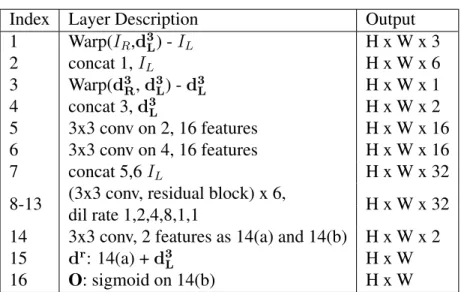
Table 3.2 – Refinement network for StereoDRNet.
d
rand
O
represent refined
dispar-ity and occlusion probabildispar-ity respectively. . . 49
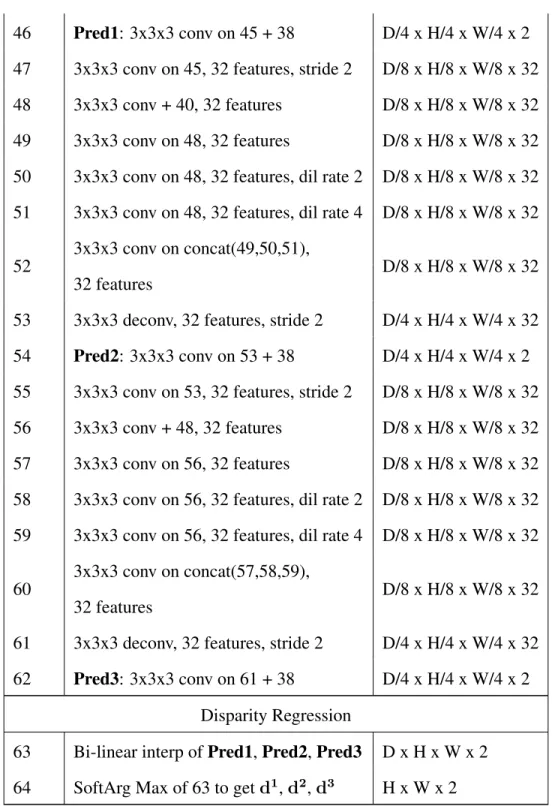
Table 3.3 – Full StereoDRNet architecture. Note that when used without refinement,
StereoDRNet just outputs
d
1,
d
2and
d
3for the left view. . . 51
Table 3.4 – Quantitative comparison of the proposed Stereo-DRNet with the
state-of-the-art methods on the SceneFlow dataset. EPE represent the mean end
point error in disparity. FPS and FLOPS (needed by the convolution
lay-ers) are measured on full
960
×
540
resolution stereo pairs. Notice even
our unrefined disparity architecture outperforms the state-of-the-art method
PSMNet (Chang and Chen, 2018) while requiring significantly less
com-putation. . . 53
Table 3.5 – Ablation study of network architecture settings on SceneFlow and
KITTI-2015 evaluation dataset. . . 53
Table 3.6 – Comparison of disparity estimation from StereoDRNet with
state-of-the-art published methods on KITTI 2012 dataset. . . 55
Table 3.7 – Comparison of disparity estimation from StereoDRNet with
state-of-the-art published methods on KITTI 2015 dataset. . . 55
Table 3.8 – Comparison of disparity estimation from StereoDRNet with
state-of-the-art published methods on ETH 3D dataset. . . 56
Table 4.1 – This table reports RMSE in 3D Reconstruction task of the proposed
Stereo-DRNet algorithm with the state-of-the-art methods in categories
includ-ing traditional multi-view stereo COLMAP (Sch¨onberger et al., 2016),
learn-ing based multi-view stereo MVSNet (Yao et al., 2018) and learnlearn-ing based
two-view stereo PSMNet (Chang and Chen, 2018). The comparison is made
on the “Sofa and cushions” scene as shown in Fig. 4.2 . . . 66
Table 5.1 –
Comparison for reconstructing shapes from the ShapeNet test set, using the Cham-fer distance. Note that due to the much smaller decoder, DeepLS is also ordersTable 5.2 –
Surface reconstruction accuracy of DeepLS and TSDF Fusion (Newcombe et al.,2011a) on the synthetic ICL-NUIM dataset (Handa et al., 2014) benchmark
. . . 86
Table 5.3 –
Surface reconstruction accuracy of DeepLS and TSDF Fusion (Newcombe et al.,2011a) on the synthetic ICL-NUIM dataset (Handa et al., 2014) benchmark
. . . 86
Table 5.4 –
Quantitative evaluation of DeepLS with TSDF Fusion on 3D Scene Dataset (Zhouand Koltun, 2013). The error is measured in mm andComp(completion) corre-sponds to the percentage of ground truth surfaces that have reconstructed surfaces within7mm. Results suggest that DeepLS produces more accurate and complete 3D reconstruction in comparison to volumetric fusion methods on real depth
LIST OF FIGURES
Figure 1.1 – A simple example demonstrating a 2D-2D correspondence example that
can help to retrieve depth information of the scene. In this example, the
pixel similarity metric (absolute difference between pixel intensities) is
used as a simple correspondence function. By plotting this similarity
met-ric cost vs. increasing depth, an optimal depth value could be found that
corresponds to the local minimum. . . .
2
Figure 1.2 – An example from (Florence et al., 2018) visualizing the dense local
fea-tures in RGB color map for two soft toys in various poses. These dense
features can be used for making dense 2D-2D correspondences in
multi-views. . . .
3
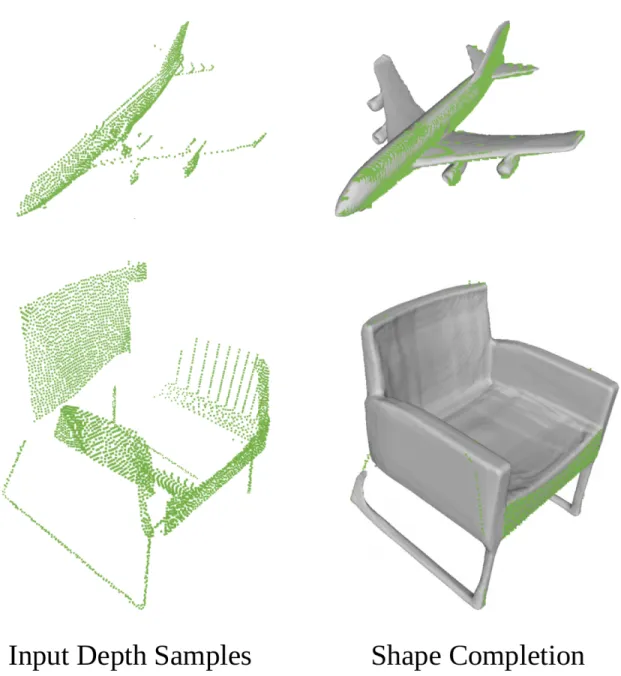
Figure 1.3 – Examples of shape competion taken from DeepSDF (Park et al., 2019).
These examples show the shape completion property of learned
implicit
surface
representation. . . .
7
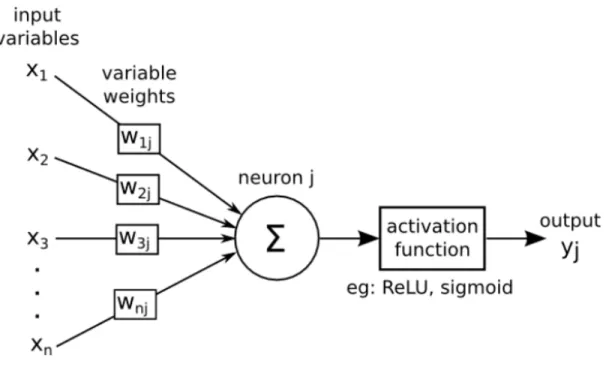
Figure 2.1 – An illustration of a typical Artificial Neuron . . . 16
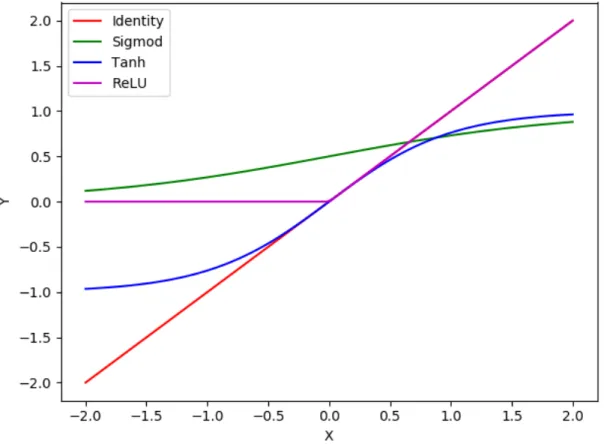
Figure 2.2 – Activation Functions . . . 17
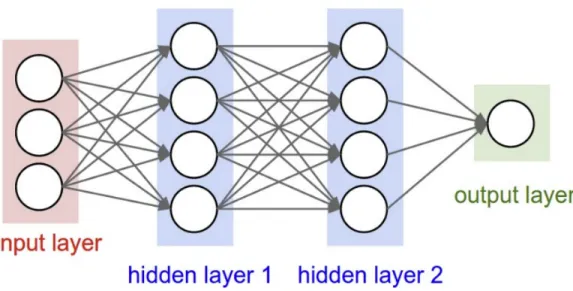
Figure 2.3 – A simple Multi Layer Perceptron . . . 18
Figure 2.4 – VGG16, a convolutional neural network model proposed by (Krizhevsky
et al., 2012) for large scale image classification tasks. . . 20
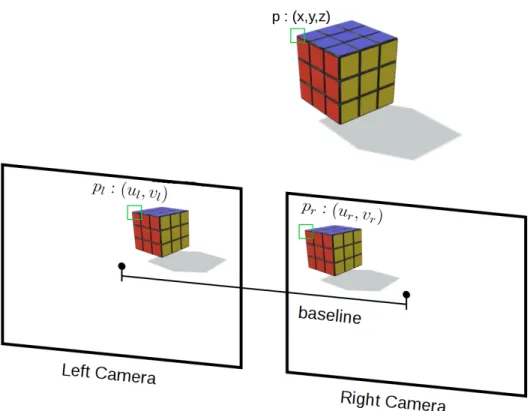
Figure 2.5 – An example showing stereo views for an object. The reference corner
point
p
(shown by green marker) of the object is viewed at different pixel
locations
p
land
p
rin left and right cameras respectively. . . 24
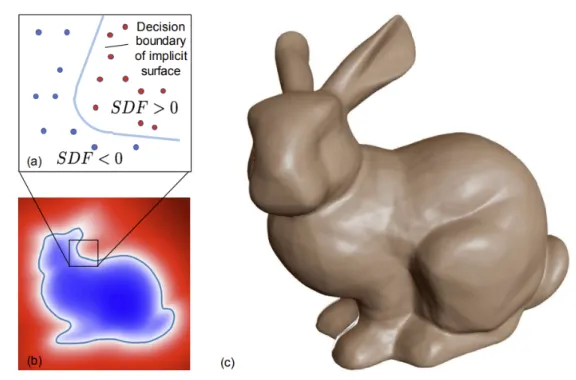
Figure 2.6 – Visualization of Signed Distance Function
f
on the Stanford Bunny 3D
model. (a) depiction of the underlying implicit surface with
SDF
=
0
on the surface contour,
SDF <
0
inside and
SDF >
0
outside the
surface boundary, (b) 2D cross-section of the signed distance field, (c)
rendered 3D surface recovered from
SDF
= 0. . . 34
Figure 3.1 – StereoDRNet network architecture pipeline. . . 42
Figure 3.2 – StereoDRNet Vortex Pooling architecture derived from (Xie et al., 2018). . . 43
Figure 3.3 – Proposed dilated cost filtering approach with residual connections. . . 43
Figure 3.5 – Disparity prediction comparison between our network (Stereo-DRNet)
and PSMNet (Chang and Chen, 2018) on the SceneFlow dataset. The top
row shows disparity and the bottom row shows the EPE map. Note how
our network is able to recover thin and small structures and at the same
times shows lower error in homogeneous regions. . . 47
Figure 3.6 – This figure shows the disparity estimation results of our StereoDRNet
and PSMNet (Chang and Chen, 2018) on the KITTI 2015 and the KITTI
2012 dataset. . . 54
Figure 3.7 – This figure shows the disparity estimation results of our refined network,
PSMNet (Chang and Chen, 2018) and DN-CSS (Ilg et al., 2018b) on the
lakeside and sandbox scenes from the ETH3D (Sch¨ops et al., 2017) two
view stereo dataset. . . 56
Figure 3.8 – This figure shows the disparity estimation results of our refined network
and several other traditional algorithms such as SGM (Hirschmuller, 2008)
and MeshStereo (Zhang et al., 2015) on three scenes from the ETH3D (Sch¨ops
et al., 2017). Notice, that StereoDRNet produces less error on object
bound-aries and maintains regularization in the prediction. . . 57
Figure 4.1 – This figure shows the proposed pipeline from input color images to
pre-dicted depth from StereoDRNet (Chabra et al., 2019) to 3D
Reconstruc-tion prepared using method described in KinectFusion (Newcombe et al.,
2011a). . . 59
Figure 4.2 – StereoDRNet enables estimation of high quality depth maps that opens
the door to high quality reconstruction by passive stereo video. In this
figure we compare the output from dense reconstruction (Newcombe
et al., 2011a) built form depth maps generated by StereoDRNet,
PSM-Net (Chang and Chen, 2018) and a structured light system (Whelan et al.,
2018) (termed Ground Truth). We report and visualize point-to-plane
dis-tance RMS error on the reconstructed meshes with respect to the ground
truth demonstrating the improvement in reconstruction over the
state-of-the-art. . . 60
Figure 4.3 – This figure shows the training scene used for all our indoor scene
recon-struction experiments. We used about 200 real stereo images in real-scene
training experiment, these views are shown in this figure by 3D axis along
with the camera trajectory visualized by the blue curve. The 3D
Figure 4.4 – We show a training example with the left image, ground truth depth and
the exclusion mask. Note that the glass, mirrors and the sharp corners
of the table are excluded from training as indicated by the yellow pixels
in the occlusion mask. Note, that this example was not part of our actual
training set. . . 62
Figure 4.5 – This figure demonstrates that our StereoDRNet network produces
bet-ter predictions on thin reflective legs of the chair and some portions of
the glass. We used occlusion mask predicted by our network to clip
oc-cluding regions. Yellow region in the ground truth are the regions that
belong to our proposed exclusion mask. . . 63
Figure 4.6 – This figure demonstrates 3D reconstruction of a living room in an
apart-ment prepared by TSDF fusion of the predicted depth maps from our
sys-tem. We visualize two views of the textured mesh and surface normals
in top and bottom rows respectively. . . 64
Figure 4.7 – Comparison of 3D reconstruction using fusion of depth maps from our
StereoDRNet network (middle), PSMNet (Chang and Chen, 2018) (right)
and depth maps from the structured light system (left) described in
(Whe-lan et al., 2018) (termed Ground Truth). We report and visualize
point-to-plane distance RMS error on the reconstructed meshes with respect
to the ground truth mesh. Dark yellow boxes represent the regions where
our reconstruction yields details that the structured light sensor or
PSM-Net were not able to capture. Light yellow boxes represent regions where
StereoDRNet outperforms PSMNet. . . 65
Figure 4.8 – This figure shows the textured 3D reconstructions of ”Sofa and cushions”,
”Plants and couch” and ”kitchen and bike” scenes developed using
Kinect-Fusion (Newcombe et al., 2011a; Whelan et al., 2018) of depth maps
gen-erated form StereoSDRNet with refinement. We visualize the camera
tra-jectory, from which the stereo images were taken, via a black curve. Note
that for clarity we visualize every 30th frame used by the fusion system. . . 66
Figure 4.9 – This figure demonstrates the surface normal visualizations of some
ob-jects (labeled with red boxes) reconstructed using
single
disparity map
from SceneFlow dataset. We report EPE in disparity space and surface
normal error in degrees. Notice, our refinement network improves the
overall structure of the objects and makes them geometrically consistent.
. . . 67
Figure 4.10 –This figure shows the surface normal visualizations of some objects
(la-beled with red boxes) reconstructed using a
single
disparity map from
our real dataset. We report EPE in disparity space and surface normal
error in degrees. Notice that our refinement network improves the
Figure 5.1 –
Reconstruction performed by our Deep Local Shapes (DeepLS) of the Burghers of Calais scene [Zhou and Koltun (2013)]. DeepLS represents surface geom-etry as a sparse set of local latent codes in a voxel grid, as shown on the right. Each code compresses a local volumetric SDF function, which is reconstructedby an implicit neural network decoder.
. . . 70
Figure 5.2 –
2D example of DeepSDF (Park et al., 2019) and DeepLS (ours). DeepSDFpro-vides global shape codes (left). We use the DeepSDF idea for local shape codes (center). Our approach requires a matrix of low-dimensional code vectors which in total require less storage than the global version. The gray codes are an in-dicator for empty space. The SDF to the surface is predicted using a fully-connected
network that receives the local code and coordinates as input.
. . . 77
Figure 5.3 –
Square (L∞norm) and spherical (L2norm) for the extended receptive fieldsfor training local codes.
. . . 79
Figure 5.4 – Instantiated local shape blocks in a scene. The blocks are allocated sparsely,
based on available depth data, which makes the approach scale well to
real world inputs. . . 80
Figure 5.5 – Interpolation in latent space of a local shape code between a flat surface
and a pole. . . 81
Figure 5.6 – This figure demonstrates how positive and negative SDF samples can be
generated for a particular depth observation. . . 82
Figure 5.7 – Fig. (a) shows the effect of changing the latent code dimensions on the
Chamfer distance test error on airplanes class of ShapeNet (Chang et al.,
2015). Fig. (b) shows an example for a scene containing
200
primitives
shapes as used for training the local shape priors. On the right side, the
instantiated local shape blocks are shown. . . 83
Figure 5.8 –
Qualitative comparison of DeepLS with DeepSDF on some shapes from the ShapeNetV2dataset.
. . . 84
Figure 5.9 –
A comparison of the efficiency of DeepLS and DeepSDF. With DeepLS, a modeltrained for one minute is capable of reconstructing the Stanford Bunny in full detail. We then trained a DeepSDF model to represent the same signed distance function corresponding to the Stanford Bunny until it reaches the same
accu-racy. This took over 8 days of GPU time (note the log scale of the plot).
. . . 85
Figure 5.10 –
Qualitative results of TSDF Fusion (Newcombe et al., 2011a) (left) and DeepLS(right) for scene reconstruction on a synthetic ICL NUM scene. The highlighted areas indicate the ability of DeepLS to handle oblique viewing angles, partial
Figure 5.11 –
Comparison of completion (a) and surface error (b) as a function of represen-tation parameters on a synthetic scene from the ICL-NUIM (Handa et al., 2014) dataset. In contrast to TSDF Fusion, DeepLS maintains reconstruction complete-ness almost independent of compression rate. On the reconstructed surfaces (which is 50% less for TSDF Fusion) the surface error decreases for both methods (c.f. Fig. 5.12). Plot (c) shows the trend of surface error vs. mesh completion. DeepLS consistently shows higher completion at the same surface error. It scores less error than TSDF Fusion in all but the highest compression setting but it produces nearly two times more complete reconstruction than TSDF Fusion at thiscom-pression rate.
. . . 87
Figure 5.12 –
Qualitative analysis of representation size with DeepLS and TSDF Fusion(New-combe et al., 2011a) on a synthetic scene in the ICL-NUIM (Handa et al., 2014) dataset. DeepLS is able to retain details at higher compression rates (lower num-ber of parameters). It achieves these compression rates by using bigger local
shape voxels, leading to a stronger influence of the priors.
. . . 88
Figure 5.13 –
The figure shows a part of the ICL-NUIM kt0 scene (Handa et al., 2014),re-constructed from samples with artitificial noise ofσ= 0.015. DeepLS shows better denoising properties than TSDF Fusion. For the whole ICL-NUIM bench-mark scene, DeepLS achieves a surface error of6.41mm with71.04%
com-pletion while TSDF Fusion has an error of 7.29 mm and 68.53 % comcom-pletion.
. . . 89
Figure 5.14 –
Qualitative results for DeepLS and TSDF Fusion (Newcombe et al., 2011a) on“Burghers of Calais scene” scenes of the 3D Scene Dataset (Zhou and Koltun,
2013).
. . . 91
Figure 5.15 –
Qualitative results for DeepLS and TSDF Fusion (Newcombe et al., 2011a) on“Lounge” scenes of the 3D Scene Dataset (Zhou and Koltun, 2013).
. . . 92
Figure 5.16 –We show qualitative comparison of DeepLS against other 3D
Reconstruc-tion techniques on a thin and incomplete dataset. We included MPU (Ohtake
et al., 2005), KinectFusion (Newcombe et al., 2011a), SSD Calakli and
Taubin (2011), PSR Kazhdan and Hoppe (2013), PFS Ummenhofer and
Brox (2015) and TSR Aroudj et al. (2017) methods in this comparison.
Notice, how most of the methods fail to build thin surfaces in this dataset.
Although, TSR fits to the thin parts but is unable to complete structures
such as the back and cylindrical legs of the stool (It fits planes to
repre-sent cylindrical legs,Fig. 5.16i). Whereas, in comparison DeepLS
recon-structs thin structures and also completes them. . . 94
Figure 5.17 –
Qualitative comparison of TSDF Fusion (left) with DeepLS (right) on real scanneddata prepared using the structured light sensor system discussed in (Straub et al., 2019a). The figure (b) is the magnified region marked with black box in figure
Figure 5.18 –
We show the scene reconstruction quality of DeepLS vs TSDF Fusion (New-combe et al., 2011a) on a partially scanned real scene dataset using the depth system described in Replica Dataset(Straub et al., 2019a). This figure shows that DeepLS provides better local shape completion than TSDF Fusion. The bottom row represents the zoomed in view marked with black box in the toprow.
. . . 96
Figure 5.19 –Completion from single-view depth images on ShapeNetV2 planes. In
both figures, the top row shows the depth image and the bottom row the
reconstructed and completed model from a different perspective. Figure
(b) shows failure cases of individual test examples that differ from the
LIST OF ABBREVIATIONS
SDF
Signed Distance Function
CHAPTER 1: INTRODUCTION
1.1
Motivation and Problem Statement
The problem of 3D Scene Reconstruction is one of the important challenges in the field of
computational photography and computer vision. The goal of this problem is to derive useful
geometric information about the environment around us. Modeling 3D environments has many
applications, such as digital mapping and navigation, virtual tourism, computer animation,
gam-ing, virtual and augmented reality (VR/AR), robot navigation. Some of these applications, such
as mapping and navigation, require accurate 3D reconstructions for precise geometry
measure-ments/estimations. Whereas some applications related to VR/AR applications require visually
pleasing, complete, and realistic 3D reconstruction to enable a feeling of presence in virtual or
augmented 3D worlds.
Many technologies and methods have been proposed to meet the needs of different
applica-tions of 3D Reconstruction. Each of these proposed methods come with their own set of strengths
and limitations. These methods can roughly be categorized into active (e.g., structured light
sen-sors and time of flight sensen-sors) and passive acquisition (using multi-view images from cameras)
techniques. Although active methods, in general, provide better scene depth information than
passive techniques, they usually require external projectors or lasers, which introduces additional
power requirements on the 3D capture system. Whereas passive techniques have the advantage of
using consumer digital cameras with low power requirements. Moreover, the prevalence and the
availability of consumer digital cameras in mobile technology widens the scope of the utility of
passive techniques in many day-to-day user applications related to 3D Reconstructions.
Figure 1.1: A simple example demonstrating a 2D-2D correspondence example that can help
to retrieve depth information of the scene. In this example, the pixel similarity metric (absolute
difference between pixel intensities) is used as a simple correspondence function. By plotting
this similarity metric cost vs. increasing depth, an optimal depth value could be found that
corresponds to the local minimum.
known as multi-view stereopsis. After decades of research in the area, the standard algorithm has
been set to estimating depth information with help of 2D-2D image correspondences, as shown
in Fig 1.1. While the standard mechanism seems very simple, solutions to many underlying
prob-lems are still not well established. For example, the optimal method for describing a good 2D-2D
correspondence function is still a challenging problem. The success of the correspondence
func-tion relies on the robustness and uniqueness of the local image descriptors. While it is simple
to obtain a strong descriptor in the regions with well-defined textures, but it is difficult to obtain
strong and unique descriptions for the regions with homogeneous texture.
Figure 1.2: An example from (Florence et al., 2018) visualizing the dense local features in RGB
color map for two soft toys in various poses. These dense features can be used for making dense
2D-2D correspondences in multi-views.
dense
image descriptors (Schmidt et al., 2016; Florence et al., 2018) as shown in Fig 1.2. These
methods use deep convolution learning framework to automatically learn robust and more general
feature descriptors with the help of known ground truth geometry of several shapes during the
training process. Unlike standard handcrafted image descriptors, these learned descriptors utilize
both local image features and global shape information. The addition of global shape information
to an image descriptor makes them robust, unique, and ideal for making dense correspondences.
The learning methods can be trained to learn descriptors for obtaining correspondences in
chal-lenging scenarios such as specular surfaces and regions with shadows. We discuss this in detail in
Chapter 3.
and how big ideally this local neighborhood should be. In general, the traditional methods in
the literature face problems defining local depth consistencies near depth discontinuities such
as corners and boundaries of the objects and thin structures like plants. Recent techniques in the
literature (Kendall et al., 2017; Chang and Chen, 2018) have tried to solve the global depth
con-sistency using a deep learning framework. By using learned convolution filters, the hard problem
of obtaining a general and robust local neighborhood depth consistency model can be solved.
Priors over local neighborhood consistencies can be learned using examples of several kinds of
shapes in the training dataset with varying thicknesses and sizes. In such frameworks, the global
scene context and semantic scene information can also be utilized. For example, the framework
can be trained to recognize pixels of an outdoor image belonging to the sky to be always at
in-finite depth. Similarly, such systems can be trained to learn priors such as walls of most of the
indoor scenes are planar. This process of learning depth cues from the scene context appears to
be similar to the human depth perception system. For example, humans can perceive approximate
scene depth with a single eye or for a single image using their knowledge of the average sizes of
individual objects and the perspective distortion. Similarly, a machine learning framework can be
trained to learn these depth cues using a variety of examples scenes during the training process.
In many applications, a depth map from a single viewpoint may not be enough to prepare a
3D reconstruction of the entire scene or an environment. A collection of depth maps from several
viewpoints should be fused together to prepare a consistent and complete 3d scene reconstruction.
The simplest 3D reconstruction representation is a collection of 3D points gathered from several
depth maps. In the literature, this representation is also known as
3D point cloud
representation.
While this representation provides accurate 3D points, it lacks surface information, which could
be useful for many applications of 3D reconstruction. In the literature, many methods have been
discussed to prepare 3D surfaces from unstructured point clouds. Most of these methods try to
formulate an
implicit surface
representation, which can be thought of as a function
F
(
p
):
, where
p
refers to any spatial point. One of the very special properties of this
implicit
func-tion
is that it is continuous, which in theory, can provide arbitrary surface resolution and has a
property of completing partially observed shapes.
In general, obtaining the true
implicit function
for an entire 3D scene is a tough problem.
Moreover, the depth samples obtained form multi-view stereo algorithms are prone to have
sev-eral kinds of noise and outliers. To make this problem tractable, the proposed methods make
several assumptions regarding the discretization of the space, noise, or uncertainty in the input
and the nature of the true surface geometry. For example, a popular method for 3D surface
re-construction (Kazhdan et al., 2006) tries to fit a global implicit function to the input set of points.
This method is shown to work very well on clean or synthetic data, but in the presence of noise,
outliers, and incomplete data, the global surface fitting is prone to produce several artifacts as no
prior information is used to predict watertight surfaces in such non-trivial cases. Scaling such
global surface fitting to large scenes also remains a challenge.
Whereas, local volumetric integration methods such as (Curless and Levoy, 1996) are more
robust to noise in the data as these methods make a scalar approximation of the true
implicit
surface
on very small cells of a regular grid. However, these methods cannot make use of the
shape completion property of the
implicit surface
representation. Moreover, such algorithms use
fixed parameters and functions to describe the region of uncertainties and fusion weights for input
samples. While this technique provides reasonable practical solutions in most cases, fixed and
heuristic functions are still prone to errors in some non-trivial cases. For example, such methods
fail to represent thin structures even at very high volumetric resolutions as the reliance on fixed
parameters and heuristic functions makes it hard to resolve both front and backside of such thin
surfaces in the presence of noise in the input samples.
representation methods reach memory limitations. Therefore, in general, the internal
implicit
surface
representation is expected to be memory efficient.
Learning
implicit surface
representation from the available ground truth shapes is an
inter-esting solution to the problems discussed above. In recent literature, some methods have been
proposed that learn the common statistics and properties of the classes of simple shapes such as
chairs, sofas. These methods take advantage of associating both the global and local shape
prop-erties to produce globally consistent 3D scene reconstructions. Majority of these methods predict
reconstructions using discrete representations such as
point clouds,
meshes
and
voxels. Like their
classical counterparts, these methods have problems related to their underlying surface
represen-tation. Very few and very recent methods, such as (Park et al., 2019), have tried to predict
implicit
surface
representation with the help of a deep learning framework. The deep learning framework
learns to separately capture both the mean and variances of the training shapes into separate
net-work parameters. In the inference process, the framenet-work utilizes the learned mean or common
properties of the trained shapes and optimizes just the variance parameters of the input shape to
fit the resultant shape to the input observations. As such methods try to learn and optimize true
implicit surface
representation, they preserve all of its properties, including shape completion
and arbitrary surface resolution without the use of any enforced assumptions and approximation,
unlike many classical approaches. We illustrate such properties in Fig 1.3.
Although, it is still challenging to express large scenes with a single true
implicit surface
representation. The authors of the work DeepSDF (Park et al., 2019) have shown the learned
implicit surface
representation of very small and simple objects such as chairs, tables, lamps,
etc. Whether such representations can be extended to large scenes efficiently still remains an
important and interesting question. In this dissertation (Chapter. 5), we try to answer this question
with a simple but promising solution.
1.
Depth estimation and 3D scene reconstruction from the input stereo images. While the
prior work in machine learning has taken long strides in solving many hard problems
re-lated to image-based 3D reconstruction and depth estimation, but still many underlying
problems need to be solved. For example, many methods in deep learning literature have
been shown to produce reasonable depth estimation from stereo images, but their depth
maps are usually not geometrically consistent enough to be fused into a consistent 3D
reconstruction. Moreover, often, the depth estimation of occluded regions is prone to be
noisy and needs to be filtered correctly before the fusion step. To tackle such problems, in
this thesis, we learn to produce occlusion aware and geometrically consistent depth
esti-mation from stereo images. Furthermore, we show that these depth images can be used to
produce 3D reconstruction of challenging indoor scenes.
meth-ods. Moreover, the resultant scene representation is still an
implicit function
and preserves
it’s properties, including shape completion and shape generation but in the scope of the
physical extent of these local shapes.
1.2
Related Work
This section starts with a summary of prior work on systems for building 3D Scene
Recon-struction using traditional methods. Next, a detailed summary of prior work is provided on
meth-ods that use machine learning for image-based 3D reconstruction. In the later section, several
methods, including learning-based depth estimation from passive images and some very recent
3D scene representation methods, are discussed.
1.2.1
3D Reconstruction using Traditional Methods
This section starts with discussing methods for obtaining depth information from general
scenes as this is the most vital requirement for any reconstruction system. Next, several
algo-rithms used in the literature for 3D scene representation are discussed.
1.2.1.1
Depth Estimation
Scene depth information can either be obtained from depth/range sensors or by using passive
stereo methods.
Active Methods
:- Traditionally, depth sensors work on the principle of Structured Light or
Time of Flight. Both these technologies are limited to work indoors and fail to work in sunlight
conditions. The range scanners such as LIDAR, etc. have low resolution and could not be used
in AR/VR based applications due to limitations in their size and resources they require. More
information on depth sensors can be found in survey (Zollh¨ofer et al., 2018).
been a lot of work in multi-view stereo based reconstruction where depth for a reference view
is obtained from many matching views. While the basic concept remains similar to two-view
stereo but having many views does not only increases the stereo search complexity but also raises
several questions related to view selection, robustness to occlusions, and geometric
consisten-cies over multiple views. A deep survey and comparisons of classical MVS based reconstruction
methods can be found in (Seitz et al., 2006). There has been a lot of work on real-time
recon-struction using passive camera motion, often known as Dense Visual SLAM (Newcombe, 2012).
These methods try to optimize for camera motion simultaneously and surface geometry
(New-combe et al., 2011b; Pradeep et al., 2013; Ummenhofer et al., 2017).
1.2.1.2
3D Scene Representation Methods
3D reconstruction using depth information has been a widely studied topic in computer vision.
The detailed state-of-the-art review can be found in the survey (Zollh¨ofer et al., 2018).
The reconstruction methods could be roughly categorized into four categories. Voxel-based
methods (Curless and Levoy, 1996; Klein and Murray, 2007; St¨uhmer et al., 2010; Newcombe
and Davison, 2010; Newcombe et al., 2011a), Points or Surfels based methods (Pfister et al.,
2000; Ummenhofer and Brox, 2013; Keller et al., 2013), Global Implicit Function approximation
methods (Carr et al., 2001; Kazhdan et al., 2006; Fuhrmann and Goesele, 2014) and Visibility or
Free Space Constraints based methods (Labatut et al., 2009; Jancosek and Pajdla, 2011; Aroudj
et al., 2017).
1.2.2
3D Reconstruction using Learning Based Methods
1.2.2.1
Learning Depth Estimation
In recent years, there has been significant improvement in the quality of depth estimation
from stereo images using machine learning techniques such as Convolution Neural Networks.
The depth maps produced by these techniques achieve much higher robustness and completion
than the previously proposed traditional methods.
The first work in this body of research, MC-CNN (Zbontar et al., 2016), proposed a siamese
neural network (Chopra et al., 2005) to compare two image patches, where the network used
the same weights while working in tandem on two different input image patches and produced a
real valued correlation between them. This learning method enabled the learning of robust stereo
cross-correlation metrics from data, which was plugged into a classical semi-global matching
process (Hirschmuller, 2008) to predict consistent disparity estimation. DispNet (Mayer et al.,
2016) improved the previous method by using an end-to-end disparity estimation deep neural
network with a correlation layer (dot product of features) for stereo volume construction. This
method enabled learning priors over the global scene context and not just the stereo-cost metric.
GC-Net (Kendall et al., 2017) improved the previous method by using high dimensional feature
vector in building stereo cost volume instead of using the dot product of feature vectors as used
in previous work. PSMNet (Chang and Chen, 2018) improved GC-Net by enriching extracted
features from CNN with a better global context using a pyramid spatial pooling process. They
also showed the effective use of residual learning networks in the cost filtering process.
Several methods such as CRL (Pang et al., 2017), iResNet (Liang et al., 2018), StereoNet (Khamis
et al., 2018) and FlowNet2 (Ilg et al., 2017) proposed depth refinement using residual learning
with guidance of photo-metric error (either in image or feature domain).
1.2.2.2
3D Scene Representation Learning
et al., 2017; Yang et al., 2017). Mesh-based methods either use existing (Sinha et al., 2016) or
learned (Groueix et al., 2018; Ben-Hamu et al., 2018) parameterization techniques to describe
3D surfaces by morphing 2D planes. Works such as (Groueix et al., 2018; Ben-Hamu et al.,
2018) use sphere parameterization to produce the closed mesh. The voxel-based method does
not usually preserve fine shape details (Wu et al., 2015; Choy et al., 2016). Octree-based
meth-ods (Tatarchenko et al., 2017; Riegler et al., 2017; H¨ane et al., 2017) alleviate the compute and
memory limitations of dense voxel methods, extending the voxel resolution up to
512
3. Aside
from occupancy grids, a class of work (Dai et al., 2017; Zeng et al., 2017; Stutz and Geiger,
2018) extract local shape geometric descriptors from signed distance functions of local grids
(Input is SDF and output is descriptor). Unlike these methods, we extract local shape descriptors
directly from depth samples and approximate globally consistent SDF for the entire shape/scene.
More relevant to my research are the methods that approximate global implicit functions.
Occupancy Networks (Mescheder et al., 2019) tries to approximate shapes using
occupancy-based implicit function; similarly, DeepSDF (Park et al., 2019) approximates shapes using Signed
Distance Fields. Fundamentally both methods use continuous surface representation, but signed
distance fields promise better resolution with minimum computation effort. Hence we adopt
DeepSDF as the backbone architecture for my work on scene reconstruction using local shape
priors.
1.3
Thesis Contributions
corners for depth prediction while transferring learning from simulation to real scenes.
Furthermore, we demonstrate that my proposed method produces consistent 3D
reconstruc-tions even in very challenging scenes with large texture-less walls, thin structures, regions
with specular highlights, and dark shadows. This work on learning geometrically consistent
depth estimation from stereo images and subsequent fusion of the learned depth into a 3D
scene reconstruction was published as StereoDRNet (Chabra et al., 2019).
CHAPTER 2: TECHNICAL INTRODUCTION
2.1
Deep Learning for 3D Vision
The extraction of meaningful information from three-dimensional (3D) sensed data is a
fun-damental challenge in the field of computer vision. Much like with two-dimensional (2D) image
understanding, 3D understanding has greatly benefited from the current technological surge in
the field of machine learning. With applications ranging from depth sensing, mapping and
local-ization, autonomous-driving, virtual/augmented reality, and robotics, it is clear why learning of
robust functions and representation models from 3D data is in high demand. Currently, both
aca-demic and industrial organizations are undertaking extensive research to explore this very active
field further.
Classic machine learning methods such as Support Vector Machines (SVM) and Random
Forest (RF) have typically relied on a range of handcrafted shape descriptors (i.e., Local
Sur-face Patches (Chen and Bhanu, 2007), Intrinsic Shape Signatures (Zhong, 2009), Heat Kernel
Signatures (Sun et al., 2009), etc.) as feature vectors from which to learn. These methods have
delivered successful results in a range of 3D object categorization and recognition tasks.
How-ever, much like in the field of 2D image understanding, there has been a shift in focus to a deep
learning approach (LeCun et al., 2015).
for the rapid improvement in 3D understanding benchmark results, including depth estimation
and 3D reconstruction tasks.
In this chapter, we first discuss the basics of deep learning, different types of neural networks,
activation functions, and common neural network architectures. Advancement in learning depth
estimation and 3D representation learning are also discussed.
2.1.1
Deep Artificial Neural Networks
Deep Learning is a set of learning methods that attempt to model data with complex
architec-tures combining several non-linear functions. The elementary building blocks to deep learning
systems are artificial neural networks that are combined together several times to yield deep
neural networks.
An artificial neural network defines a non-linear function model
f
with respect to the model
parameters
θ
(priors) and the input
x
and the function’s output
y
can be mathematically written
as
y
=
f
(
x, θ
)
. These networks can be used to learn classification or regression tasks. These
model parameters
θ
can be estimated from learning samples. The success of such functions
was proposed in universal approximation theorem (Hornik et al., 1989). Furthermore, (LeCun
et al., 1989) introduced an efficient way to compute the gradient of neural networks using a
back-propagation algorithm.
2.1.1.1
Artificial Neuron
An artificial neuron is a function
f
jof the input
x
= (
x
1, ..., x
d)
weighted by a vector of
connection weights
w
j= (
w
j1, ..., w
jd), completed by a neuron bias
b
j, and associated to an
activation function
φ
, namely
y
j=
f
j(
x
) =
φ
(
dX
k=0
w
jkx
j+
b
j)
(2.1)
Figure 2.1: An illustration of a typical Artificial Neuron
• The identity function
φ
(
x
) = 1
(2.2)
• The sigmoid function
φ
(
x
) =
1
1 +
e
−x(2.3)
• The hyperbolic tangent function(tanh)
φ
(
x
) =
e
x
−
e
−xe
x+
e
−x(2.4)
• The Rectified Linear Unit(ReLU) function
φ
(
x
) =
max
(0
, x
)
(2.5)
Figure 2.3: A simple Multi Layer Perceptron
2.1.1.2
Multi Layer Perceptrons (MLP)
A multilayer perceptron is a structure composed of several hidden layers of neurons where
the output of a neuron of a layer becomes the input of a neuron of the next layer. On the output
of last layer of MLP various activation functions can be applied. The choice of the activation
depends the type of tasks to be solved by the neural network architecture. For regression tasks
typically identity or ReLU activation functions are used and for classification tasks the choice of
sigmoid activation function is generally considered.
Multilayer perceptrons are fully connected networks, i.e., each unit (or neuron) of a layer
is linked to all the neurons of the next layer. The hyper-parameters of the architecture are the
number of hidden layers and the number of neurons in each layer. An example of simple
two-layered MLP is shown in Fig 2.3
2.1.1.3
Convolutional Neural Networks
the local connectivity of the neurons. The parameters
θ
of these networks are smaller, local, and
shared. Thus, making them powerful to train than a typical MLP. Although, CNNs can only be
used when the input data is a structured grid, they have revolutionized image processing
espe-cially in tasks of learning robust features on natural images (ImageNet (Krizhevsky et al., 2012)).
A Convolutional Neural Network can be composed of several types of layers, namely
con-volution layer, pooling layer, or fully connected layer. The discrete concon-volution between two
functions
f
and
g
is defined as
(
f
∗
g
)(
x
) =
X
t
f
(
t
)
g
(
x
+
t
)
(2.6)
For 2-dimensional signals such as images, we consider the 2D-convolutions
(
K
∗
I
)(
i, j
) =
X
m,n
K
(
m, n
)
I
(
i
+
n, j
+
m
)
(2.7)
K
is a convolution kernel applied to a 2D signal or an image
I
. The principle of 2D convolution
is to drag a convolution kernel
K
on the image. In
convolution layers, the kernels can be used to
skip pixels defined by a number
s
, known as a stride. In each layer of CNN, zero padding can be
used to control the size of the output of the layer.
Figure 2.4: VGG16, a convolutional neural network model proposed by (Krizhevsky et al., 2012)
for large scale image classification tasks.
2.1.1.4
Optimization Algorithms
The goal is to find an optimal mapping function
f
(
x
)
to minimize the loss function of the
training samples
min
θ
1
N
NX
j=1
L
(
y
j, f
(
x
j, θ
))
(2.8)
where
N
is the number of training samples,
θ
are the parameters (the weights
w
jand biases
b
j)
of the mapping function,
x
jis the feature vector of the jth input sample,
y
jis the corresponding
of stochastic gradient descent is using one sample randomly to update the gradient per iteration,
instead of directly calculating the exact value of the gradient. For detailed information on
opti-mization techniques related to machine learning we encourage readers to refer the survey (Sun
et al., 2019).
2.1.1.5
Loss Functions
Once the architecture of the network has been chosen, the parameters
θ
(the weights
w
jand
biases
b
j) have to be estimated from a learning sample. As usual, the estimation is obtained by
minimizing a loss function with a gradient descent algorithm. Broadly, loss functions can be
classified into two major categories depending upon the learning task we are dealing with —
Regression losses and Classification losses. In classification, we are trying to predict the output
from a set of finite categorical values i.e. Categorizing animals into different categories from a
large data set of images. Regression, on the other hand, deals with predicting real-valued
func-tions, for example, estimating scene depth, predicting prices of stocks, etc. We first discuss loss
functions that are used for classification tasks.
•
Binary Cross-Entropy Loss (BCE)
:- This is the most common setting for classification
problems. Cross-entropy loss increases as the predicted probability diverge from the actual
label. This loss function can be written
as:-L
= (
Y
)(
−
log
( ˆ
Y
)) + (1
−
Y
)(
−
log
(1
−
Y
ˆ
)
(2.9)
Where,
Y
is the ground truth label and
Y
ˆ
is the predicted label.
each category. We define Softmax function
p
ip
i=
e
yiPn
i=0e
yi(2.10)
The loss function is defined as
L
=
n
X
i=0
−
log
(
p
i)
(2.11)
We now discuss several commonly used regression loss functions.
•
Mean Absolute Error (L1 Loss)
:- As the name suggests, mean absolute error is measured
as the average of the difference between predictions and actual observations. We define
MAE loss as
L
=
Pn
i=0
|
y
i−
y
ˆ
i|
n
(2.12)
Where,
y
iis the ground truth value and
y
ˆ
iis the predicted value.
•
Mean Square Error (L2 Loss)
:- As the name suggests, mean square error is measured as
the average of squared difference between predictions and actual observations. We define
MSE loss as
L
=
Pn
i=0
(
y
i−
y
ˆ
i)
2n
(2.13)
Where,
y
iis the ground truth value and
y
ˆ
iis the predicted value.
•
Smooth L1 Loss (Huber Loss)
:- Smooth L1-loss can be interpreted as a combination of
L1-loss and L2-loss. It behaves as L1-loss when the absolute value of the argument is high,
and it behaves like L2-loss when the absolute value of the argument is close to zero. The
huber loss
H
xequation is:
H
(
x
) =
|
x
|
,
if
|
x
|
> α
x2|α|
,
otherwise
Where,
α
is a hyper-parameter here and is usually taken as 1. The smooth L1 loss function
can now be written as
L
=
Pn
i=0