TEACHERS’ IN-THE-MOMENT NOTICING OF STUDENTS’ MATHEMATICAL THINKING: A CASE STUDY OF TWO TEACHERS
Yanjun Liu
A dissertation submitted to the faculty at the University of North Carolina at Chapel Hill in partial fulfillment of the requirements for the degree of Doctor of Philosophy in the
School of Education.
Chapel Hill 2014
ii ©2014 Yanjun Liu
iii
ABSTRACT
Yanjun Liu: Teachers’ In-the-Moment Noticing of Students’ Mathematical Thinking: A Case Study of Two Teachers
(Under the direction of Susan N. Friel)
The purpose of this research is to access teachers’ in-the-moment noticing of students’ mathematical thinking, in the context of teaching a unit from a reform-based mathematics curriculum, i.e., Covering and Surrounding from Connected Mathematics Project. The focus of the study is to investigate the following research questions:
1. How and to what extent do teachers notice students’ mathematical thinking in the midst of instruction?
2. How and to what extent does teachers’ in-the-moment noticing of students’ mathematical thinking influence teachers’ instruction?
Conceptualized as a set of interrelated components in this study, the construct of teachers’ in-the-moment noticing of students’ mathematical thinking includes attending to students’ strategies, interpreting students’ understandings, deciding how to respond on the basis of students’ understandings, and responding in certain ways.
iv
the researcher in this study applied a new technology to explore teacher noticing, enabling two teacher participants to capture their noticing through their own perspectives while teaching in real time.
Findings indicate that teacher participants noticed for a variety of reasons, including student thinking, instructional adaptations, assessment, content, and student characteristics, focusing primarily on student thinking and instructional adaptations. Furthermore, these participants noticed student thinking in the midst of instruction to different extents, and made adjustments to instruction in different ways.
v
ACKNOWLEDGMENTS
Although my name alone stands as author of this document, it is through the work of many that it has been completed. Each deserves a note of thanks.
First and foremost, to my committee chair and advisor, Dr. Susan N. Friel: Thank you for the vision that inspired me to conceive this project. Without your support, guidance, and endless patience and encouragement, this research would not have been possible. You ignited my passion for an adventure, cheered me on as I ran my race, and always believed in me as I
fumbled my way on this exploratory journey. Thank you also for my opportunities to both teach and learn during my doctoral program at the University of North Carolina at Chapel Hill that helped to shape me into the person I will become as a mathematics educator. It has been an honor to learn from your wisdom and enthusiasm.
To Dr. Rita O'Sullivan: Thank you for having taken on a heavy load of responsibility in helping me in undertaking this dissertation, and in bringing it to a successful end. Thank you for your insights and encouragement throughout work on this project.
vi
To the two teacher participants: I am greatly indebted to you for your generosity with both time and energy. Thank you for grappling with this technology, staying late after school sharing your thoughts and insights, and welcoming me as a visitor and researcher. To your students, it was a pleasure to work with them.
To my family: Thank you for your patience and understanding. You have not always understood what I have been doing, but your support has been unwavering. Special thanks go to my aunt, Jianqiong Mo, and my cousin, Stephie Jia: The word “support” does not convey what you have provided. This could not have been done without your endless patience, timely reassurances, and countless hours of being a wonderful grandaunt and an aunt of Steffi’s
respectively. Finally to Mason and Steffi, thank you. I am blessed that you joined us. You made this all worthwhile. Thank you both for lighting the way.
vii
TABLE OF CONTENTS
LIST OF TABLES...xi
LIST OF FIGURES...xii
CHAPTER 1: INTRODUCTION ...1
The Problem...1
The Purpose of the Study ...6
CHAPTER 2: REVIEW OF THE LITERATURE ...9
Introduction...9
History of Teacher Noticing...9
Researchers’ Conceptions of Mathematics Teacher Noticing...12
Overview of Current Research Areas of Mathematics Teacher Noticing...14
What Teachers Notice...15
Differences in Novice and Expert Teachers...15
Enhancement of Teachers’ Practice...17
Overview of Current Methodologies for Studying Mathematics Teacher Noticing...19
Professional Noticing of Children’s Mathematical Thinking...22
Children’s Mathematical Thinking...23
Reform-Based Mathematics Instruction...25
A Clarification...27
viii
Case Study...31
The Curriculum...33
The Connected Mathematics Project...33
Covering and Surrounding...35
Overview of Methods...36
Participants...36
Teacher Participants...38
Student Participants...39
Field Work...40
Part 1: Initial Interview...41
Part 2: Observations and Videotaping...45
Standard video camera: rationale and design...47
New technology: rationale and design...47
Part 3: Follow-up Review of Videotapes...51
Analysis...54
Part 1: informal analysis...55
Part 2: formal analysis...56
Summary...60
CHAPTER 4: FINDINGS...62
Introduction...62
Meeting the Teachers...63
A Profile of Joe Marshall...64
ix
Teacher Beliefs and Knowledge...69
A Profile of Jennifer Goldberg...74
A Vignette...74
Teacher Beliefs and Knowledge...77
What Teachers Notice...82
Data Collection and Analysis...82
A Summary of Findings...86
Teacher Noticing of Student Thinking...91
The Case of Joe Marshall...92
An Episode...93
Analysis...96
The Case of Jennifer Goldberg...99
An Episode...100
Analysis...104
Marshall and Goldberg: A Comparison...105
The Case of Joe Marshall...105
The Case of Jennifer Goldberg ...109
A Comparison...111
Summary...116
CHAPTER 5: CONCLUSION...117
Introduction...117
Teacher Noticing of Student Thinking...119
x
Teacher Beliefs, Knowledge, and Goals...121
Limitations and Future Research...126
Limitations………...126
Recommendations………129
APPENDIX A - TEACHER RECRUITMENT SCRIPT………134
APPENDIX B - TEACHER CONSENT FORM………135
APPENDIX C - STUDENT RECRUITMENT SCRIPT………....139
APPENDIX D - STUDENT ASSENT FORM………....140
APPENDIX E - PARENTAL PERMISSON FORM………..143
APPENDIX F - PROTOCOLS FOR INITIAL INTERVIEW………148
APPENDIX G - PROTOCOLS FOR DAILY FOLLOW-UP DISCUSSION………153
APPENDIX H - INNOVATION CONFIGURATION MAPS………...155
APPENDIX I - CODING SCHEME………...160
APPENDIX J - DAILY CLIP CAPTURE………..169
APPENDIX K - CMP INVESTIGATION………..171
xi
LIST OF TABLES
Table 3.1 - Student demographics for participating classrooms...39
Table 3.2 - Student participants in participating classrooms...40
Table 3.3 - Data collection process and instruments used...41
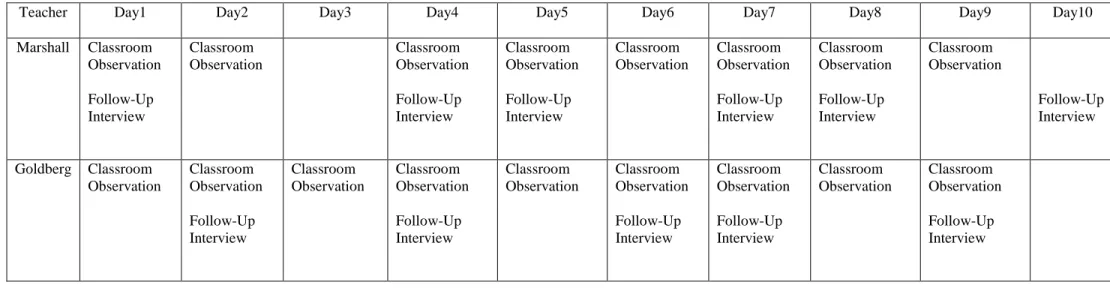
Table 3.4 - Classroom observation and follow-up interview schedule...52
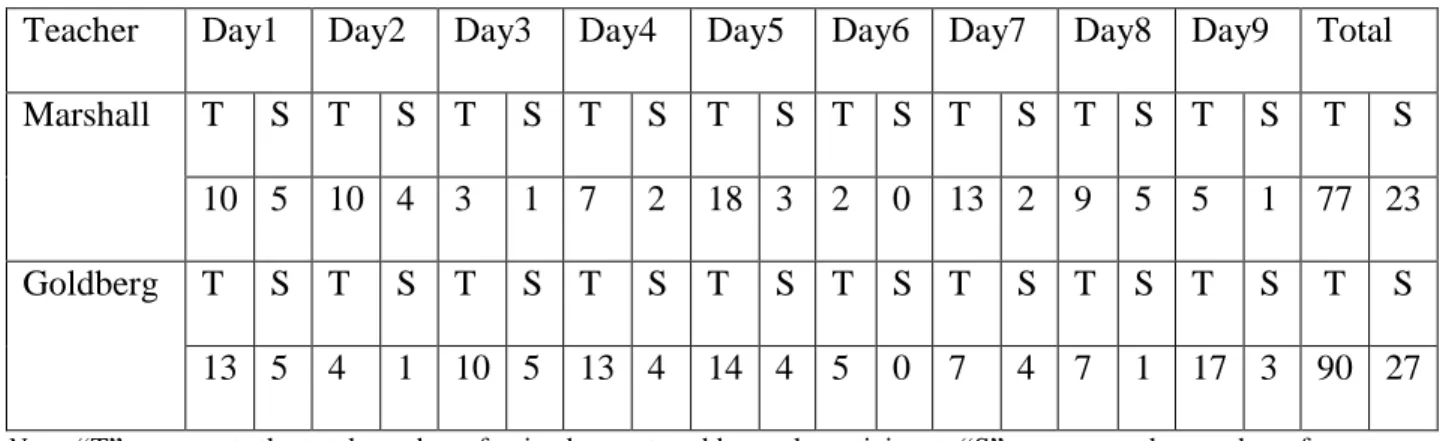
Table 3.5 - Clip capture and selection information...58
Table 4.1 - Percentage of Mr. Marshall’s reasons reported as themes for clip capture...87
xii
LIST OF FIGURES
Figure 4.1 - Student’s work on finding perimeter of a rectangle...72
Figure 4.2 - Student’s work on finding perimeter of a rectangle...80
Figure 4.3 - Using “surrounding rectangle strategy” for area and perimeter of triangles...100
Figure 4.4 - Melody’s presentation...106
Figure 4.5 - Greg’s thinking...109
1
CHAPTER 1: INTRODUCTION
The Problem
Tell me to what you pay attention and I will tell you who you are.
José Ortega y Gasset (Sherin, Jacobs, & Philipp, 2011) To pay attention implies to notice. Noticing is a part of everyday life, indicating the act of observing or recognizing something. Individuals who embrace similar goals and experiences tend to display similar patterns of noticing (Jacobs, Philipp, & Sherin, 2011). For instance, professional chess players and radiologists develop particular ways of noticing in their worlds. Teacher noticing, then, is a practice essential to the domain for which teachers are responsible, as teachers are a group of professionals who hold particular goals and experiences (Ball, 2011). Bombarded with “the blooming, buzzing confusion of sensory data” (Sherin & Star, 2011, p. 69) in the classroom, the teacher not only explains content, formulates questions, and reacts to student answers, but responds to the broader demands of the classroom environment (Doyle, 1977). According to Doyle, multidimensionality, simultaneity, and unpredictability are the most salient features of the classroom environment for teachers. Thus the noticing of teachers is conceptualized as a professional skill of processing complex classroom events (Fernandez, Coles, & Brown, 2013). The phrase teacher noticing depicts an active rather than a static process, through which teachers attend to the ongoing information presented in an environment that is multidimensional and unpredictable to some extent (Sherin, Jacob, et al., 2011).
2
presented in the classroom. When two incidents occurred within about 0.5 seconds of each other, one incident was found to cause a decrement in the recognition of the other incident (Schneider & Shiffrin, 1977). Thus, attention is selective, whether conscious or unconscious, due to focusing and capacity limitations (Jacobs et al., 2010; van Es & Sherin, 2002). Attention is also subjective instead of objective. It is highly influenced by individuals’ knowledge, beliefs, and prior
experiences. Bartlett (1932) talked about “an imaginative reconstruction” (p. 213) of incidents that had just happened, describing attention and memory as personal reconstruction flavored by instincts, interests, ideals, etc. The consciously or unconsciously selected information in the classroom, therefore, opens up a window to the “subjective worlds” (Erickson, 2011, p.21) inhabited by the teacher, telling a unique story of the teacher as the authority of the classroom, who brings experiences, resources, and perspectives to the process of noticing.
As researchers in teacher education have begun to describe their work as being about teacher noticing, it is important to ask the primary question: Why does teacher noticing matter?
Schoenfeld (2011) believes that people act on what they notice. Thus, noticing is consequential, and action is a natural consequence of noticing. Erickson (2011) proposes that teachers notice in order to take action. Noticing is considered to be a fundamental element of expertise in the act of teaching (Mason, 2002). Ball (2011) points out that the noticing required of teachers is
3
4
unfolds in the classroom while paying particular attention to the ideas that students raise. This ability to attend to important aspects of classroom interactions and then adapt instruction in the midst of teaching requires teachers to learn to notice student thinking, and also reason about it in new ways (van Es, 2011).
Therefore, in mathematics classrooms, teachers and students are expected to attend carefully to one another’s ideas, with teachers adapting their instruction, at least in part, based on
interpretation of the ideas that students raise (Smith, 1996). As Smith states, students learn well when they construct their own mathematical understanding. Rather than playing the role of knowledge source and mathematical authority, teachers must recognize students’ thinking through students’ arguments, explanations, and questions; make meaning of it, and take in-the-moment instructional actions in response to what they recognize (Luna, Russ, & Colestock, 2009). Rodgers (2002) also emphasizes that teachers need to develop their ability “to see students learning, to discern, differentiate, and describe the elements of that learning, to analyze the learning and to respond” (p. 231), given the current context of reform in the U.S. According to van Es and Sherin (2002), requisite skills that reformers have in mind when they call for flexible teaching involve first noticing what is significant in a classroom interaction, making sense of these data, and then using interpretations to inform pedagogical decisions.
However, there are studies that highlight teachers’ difficulties in attending to the details of children’s strategies and lack of understanding of children’s thinking and reasoning in
5
inability to make unplanned changes, lack of knowledge about common student conceptions and their possible sources, and failure to ascribe values to students’ ideas in the midst of instruction. Some researchers attributed these problems partially to teachers’ own traditional schooling experience. Nicol (1999), for example, talked about how teachers themselves were successful graduates of schools with mathematics classrooms and curricula that tended to focus on the learning and application of routine procedural skills, lacking adaptability and responsiveness to learners’ thinking. Others focused on teachers’ personal resources, for instance, teachers’
personal knowledge of mathematics, beliefs about the nature of mathematics, expectations about how mathematical knowledge should be communicated, experience with and expectations of students and classrooms in general, and their cultural backgrounds (Morgan & Watson, 2002). Some researchers highlighted programs of teacher education. van Es and Sherin (2002) pointed out that these programs often did not stress helping teachers learn to notice or interpret
classroom interactions. Instead, they focused on helping teachers learn to act, with instruction regarding new pedagogical techniques and new activities or tools that teachers could use. Despite the importance of these techniques and activities as resources for teachers, they did not
necessarily ensure that teachers would learn to notice or interpret classroom interactions in ways that would allow for flexibility and adaptability in their approach to teaching mathematics. Therefore, it is a big challenge to encourage teachers to perceive the teaching of mathematics differently from how they once learned it, from how their cooperative teacher taught it, from how their students will most likely have learned it, and from how other teachers in their schools may teach it (Nicol).
6
decisions is particularly relevant, and also key to provide a starting point for teachers to understand and embrace the reform vision (Rodgers, 2002). The Curriculum and Evaluation Standards for School Mathematics (NCTM, 1989) and the Principles and Standards for School Mathematics (NCTM, 2000) help to clarify the aspects of reform-based practice in mathematics education, pointing to a focus on classroom discourse, an adaptive style of teaching, and changes in instructional or curriculum materials (Sherin, 2002). In response to the NCTM standards, teachers are expected to use new curricula that have been designed with these goals and standardsin mind (Sherin). Consistent with the call for reform, these curricula emphasize
mathematical thinking and reasoning, conceptual understanding, and problem solving in realistic contexts (Remillard, 2005). As a result, they require teachers to play a substantially different role in the mathematics classrooms than what has been typically assumed (Remillard). Thus, there exists a need for mathematics teachers to take the opportunity to examine their own practice, to analyze student learning, and to explore the relationship between teaching moves and the
learning that results in the midst of everything that is happening in the classroom (van Es, 2011). In order to help teachers focus on student thinking and reasoning, opportunities may need to be created for teachers to slow the pace of their instruction so they can attend closely to what they say and do, in addition to what students say and do. This study provides a window into potential patterns of teacher noticing of student thinking in mathematics classrooms.
The Purpose of the Study
7
instruction, including student thinking, classroom discourse, teacher moves, teacher strategies, and student engagement. However, rather than attend to the specific kinds of things teachers notice, the present focus is a specialized type of noticing, i.e., teachers’ professional noticing of children’s mathematical thinking. Jacobs, Lamb, and Philipp (2010) defined professional noticing of children’s mathematical thinking as a set of interrelated skills, including attending to children’s strategies, interpreting children’s understandings, and deciding how to respond on the basis of children’s understandings. According to Jacobs et al. (2010), if instruction is to build on children’s thinking, teachers must be able to execute these three skills almost simultaneously before responding to the thinking.
This study is organized around the following two research questions:
1. How and to what extent do teachers notice students’ mathematical thinking in the midst of instruction?
2. How and to what extent does teachers’ in-the-moment noticing of students’ mathematical thinking influence teachers’ instruction?
The first question involves the patterns of teacher noticing of students’ mathematical thinking, and the extent to which student thinking is observed in the midst of other noticeable events during instruction. The second question focuses on the pathways on which relations of teacher noticing to instruction occur.
8
9
CHAPTER 2: REVIEW OF THE LITERATURE
Introduction
The purpose of this study is to investigate mathematics teachers’ in-the-moment noticing of students’ mathematical thinking in the context of the use of a reform-based mathematics
curriculum. This study is organized around the following two research questions:
1. How and to what extent do teachers notice students’ mathematical thinking in the midst of instruction?
2. How and to what extent does teachers’ in-the-moment noticing of students’ mathematical thinking influence teachers’ instruction?
Chapter 2 provides a survey of the current field of teacher noticing and is organized into four sections. First, a historical perspective on teacher noticing is provided, followed by examination of three general conceptions held by researchers studying teacher noticing. This is then followed by an overview of current studies of mathematics teacher noticing in the context of teaching and learning, and by an account of current methodologies for studying this construct. The chapter ends with a special focus on a specialized type of mathematics teacher noticing, i.e., professional noticing of children’s mathematical thinking. Although the state of research on teacher noticing is young, an overview of the field provides the background for this study that grows out of the existing body of knowledge.
History of Teacher Noticing
10
In 1904, John Dewey wrote an essay, “The Relation of Theory to Practice in Education” (Dewey, 1904). In this essay, Dewey made a distinction between children’s outer attention and inner attention, bringing up the question of whether the teacher was attending more to students’moving pencils or their moving thoughts. He seems to be reminding today’s researchers of how much we have forgotten about paying attention to what and how teachers notice (Erickson, 2011). Then, during the early years of the twentieth century, teachers were encouraged to become acute observers of children’s behavior, under the influence of the child study movement (Stern, 1930). Later, as research on cognition began to develop and thrive in the sixties and seventies, research attention also returned to the study of teacher thinking (Erickson). What Doyle (1977) described as the “most salient features of the classroom” (p. 52), that is, multidimensionality, simultaneity, and unpredictability, revealed the demand for teachers’ ability to attend to and respond to signs of potential progress or hurdles, filtered out of quickly passing data, in the act of teaching (Hammer & van Zee, 2006).
Then, in the nineties, different terms were used to explicitly emphasize the importance of skilled viewing in professions, including teaching, that require the individual’s ability to act as an effective, timely decision maker when operating within dynamic systems that involve complex cognitive tasks. For instance, Endsley (1995) used situation awareness to depict the need for crews of military aircraft, air traffic controllers, and other professionals to make decisions across a fairly narrow space of time, depending on an ongoing, up-to-date analysis of the environment. According to Endsley, this construct involved perception of meaningful elements in an
11
that is sufficient to complete the job at hand. Similarly, Stevens and Hall (1998) used disciplined perception to describe the visual practices typical of particular professions or disciplines. Finally Mason (2002, 2011) introduced the construct of intentional noticing, distinguishing professional noticing from everyday noticing. In short, learning to notice in particular ways is part of the development of expertise in a profession.
Building upon the idea of the noticing expertise of professionals, a teacher’s professional vision is concerned with the ability to notice and interpret significant interactions in a classroom (Sherin, Russ, Sherin, & Colestock, 2008). In other words, a key aspect of a teacher’s visual practices is quickly perceiving student behavior and making sense of what the behavior means in terms of student understanding and engagement (Miller, 2011). Prior research in the field of psychology has examined what people attend to as they interact with their surroundings and explored the phenomenon known as “inattentional blindness” (Simons, 2000). In essence, it is concerned with the question of how likely subjects are to notice something salient and potentially relevant that they do not expect. It has been found that, quite often, these unexpected objects or events fail to capture attention (Simons). Individuals do not see everything in a situation. Goodwin (1994) uses “highlighting”, that is, making specific phenomena salient by marking them in some fashion, to describe the act of deciding what is noteworthy and deserves further attention in a complex perceptual field. In a similar way, teacher noticing is a term that depicts the selective act of attending to certain elements in a teaching situation, as it is impossible to see everything (Sherin, Jacob, et al., 2011). Although teacher noticing is important to teaching in any domain, this dissertation is focused on noticing as a component of teaching expertise in
12
listen to students and what they listen for and the ways in which they respond to the students (Nicol, 1999).
The work on mathematics teacher noticing has ties to several other research efforts in mathematics education. Sherin, Jacobs, et al. (2011) believe that there are three areas of mathematics education research that support the idea that teacher noticing is likely to be an important and fruitful focus. These include adaptive and responsive teaching, learning from teaching, and decomposing practice. Reform mathematics promotes teaching that is attentive and adaptive to students’ interests and thinking processes (see, e.g., Remillard, 2005); learning from teaching focuses on the effort to help teachers analyze their teaching for improvement (see, e.g., Ball, Sleep, Boerst, & Bass, 2009; Hiebert, Morris, Berk, & Jansen, 2007); decomposing practice is centered on the idea that teaching can be enhanced through decomposing the complexity of mathematics teaching into specific activities, for instance, teacher noticing, and feasibly discussing these activities or constructs (see, e.g., Lampert, 2001). Linked to and supported by these research areas, the noticing of mathematics teachers has been explored in recent years to understand how teachers make sense of complex classroom environments in which they cannot see or respond to everything that is occurring (Jacobs et al., 2010).
Researchers’ Conceptions of Mathematics Teacher Noticing
In an effort to make sense of how and what mathematics teachers notice, researchers have developed various perspectives on this construct. Sherin and Star (2011) listed three general perspectives adopted by researchers studying teacher noticing. What distinguish these
13
According to Sherin and Star (2011), the first conception defines noticing as recognizing classroom phenomena that occur occasionally or infrequently. For example, a teacher might notice that a group of students who normally do not work well together are having a good
mathematics conversation. These phenomena are seen as existing outside and independent of the teacher. Researchers who embrace this notion would thus likely ignore a broad range of more routine events that take place relatively frequently.
The second conception focuses on selecting a subcomponent of the larger system. In other words, through noticing, some elements are selected over others in some manner. These selected elements do not need to be particularly surprising or interesting but are just the elements filtered out of the “blooming, buzzing confusion of sensory data” (Sherin & Star, 2011, p. 69) in some manner. Inspired by the dual-process model of cognition to some extent, Sherin and Star (2011) define noticed things or elementsas information that is passed from automatic to controlled process. According to Feldon (2007), the dual-process model of cognition asserts that
information processing occurs simultaneously on two pathways, i.e., automatic and controlled pathways. The pathways operate independently but intersect at certain points to produce human performance. The former are fast, effortless, and unconscious; the latter are slow, effortful, and conscious. Researchers who hold this view may be interested in the process through which information is passed from the unconscious to conscious pathway. For example, these
researchers may focus on the trajectory of development in teachers’ abilities to recognize and react to complex cognitive stimuli consciously.
The third conception is centered on capturing surfacing features of teachers’ reasoning about
14
For instance, van Es and Sherin (2008) examined teacher thinking through studying teachers’ comments about and interpretations of noticed elements while watching teaching videos in a video club.
Among the three conceptions, the second one is the more widely adopted perspective of studying teacher noticing, embraced by most of the researchers referred to in this review. Central to this perspective is the idea that noticing is a collection of practices designed to capture the moments when information is passed from the unconscious to conscious pathway. The purpose of studying noticing is to sensitize and enable oneself to avoid the habitual and to act freshly
rather than automatically out of habit (Mason, 2011). Furthermore, according to Sherin and Star (2011), the teacher is not separated from or outside of the data that are presented. Being a part of the multidimensional and complex environment, the teacher can play an active role in shaping and arranging what takes place in the classroom. Consequently, the teacher can influence the classroom dynamics to enable certain data to be generated and, hence, noticed. What teachers notice ends up affecting what students notice, too. On one hand, teachers are continuously making meaning in the act of teaching; on the other hand, students can be seen to be making meaning interpretively in the same time as their teachers (Erickson, 2011). Through the
conjoined effort of teachers and students, desired learning outcomes may or may not be achieved in the end, depending on what elements are noticed and how they are noticed.
Overview of Current Research Areas of Mathematics Teacher Noticing
15
teachers’ practice through noticing (Luna, Russ, & Colestock, 2009). What follows is an overview of current studies of mathematics teacher noticing from these different aspects.
What Teachers Notice
Some researchers have been engaged in identifying what teachers actually notice, that is, the specific kinds of things that teachers tend to notice while teaching or watching videotapes of teaching and learning (Luna et al., 2009). For example, an early study conducted by Erickson et al. (1986) enabled researchers to look at how and what five teacher education students noticed throughout their first year of teaching. More recently, some researchers conducted exploratory studies to capture the kinds of events that stood out to the teachers during instruction (Luna et al.; Sherin et al., 2008). Jacob et al. (2010) explored teachers’ noticing of children’s mathematical thinking, through asking the teachers to view and react to a classroom video clip and a set of written student work, attempting to identify what these teachers noticed and how they interpreted the events concerning children’s thinking. Schoenfeld (2011) summarized that all teachers engage in multiple noticing activities, including classroom management, implementing activities, and engaging in diagnostic teaching, with various time allocations observed for beginning, typically accomplished, and highly accomplished teachers.
Differences in Novice and Expert Teachers
16
about the nature of expert systems in pedagogy; they would help to identify exemplary
performances for novices to analyze; they would help to train cooperative teachers to articulate their knowledge in ways that might truly educate their novice apprentices (Berliner).
In the field of teacher noticing, researchers have contributed to this novice/expert work in various ways. Erickson et al. (1986) examined how new teachers and veteran teachers observed and made practical sense of classroom interactions daily for an extended period of time,
comparing their ways of seeing. Other researchers described how expert teachers relied more on teaching principles when discussing viewed videos and recalled and analyzed classroom events in more detail (see, e.g., Clarridge & Berliner, 1991; Glaser & Chi, 1988; Peterson & Comeaux, 1987). Miller (2011) summarized that expert teachers’ noticing was likely to differ from novice teachers’ in three aspects. Expert teachers were able to maintain attention to student
17
Enhancement of Teachers’ Practice
Beyond describing differences in novice and expert teachers, a large number of researchers have focusedon influencing what preservice or inservice teachers attend to, using videos or other technologies, with the ultimate goal of changing and improving their ways of seeing (Luna et al., 2009). They have found that teachers can improve their noticing by changing what they notice and how they reason. For instance, Rosaen, Lundeberg, Cooper, Fritzen, and Terpstra (2008) investigated to what extent and in what ways using video-based, instead of memory-based written reflection, might help preservice teachers reflect on their discussion-based teaching in a more complex manner. They reported that video-based reflection helped interns attend more to instruction and children’s classroom discussions rather than classroom management, while reflecting on their teaching. In a similar way, Star and Strickland (2008) explored what preservice teachers noticed when watching a video lesson and whether their ability to notice improved after a methods course. They found that at the beginning of the semester, preservice teachers were not particularly observant of many types of classroom events. However, after a semester of a methods course that involved watching and discussing classroom videos, field observation, peer-teaching laboratory work, and so on, there were significant increases in preservice teachers’ observation skills and ability to notice teacher and student communication during a lesson.
18
researchers focused on what and how inservice teachers noticed while participating in a video club or a series of video club meetings, in which each teacher shared clips from his or her own classroom (Sherin & Han, 2004; van Es, 2011; van Es & Sherin, 2008). For instance, van Es & Sherin (2008) identified three paths along which teachers learned to notice: direct, cyclical, and incremental. According to these researchers, a direct path could be characterized as a single qualitative shift in noticing; a cyclical path could feature a teacher cycling between perspectives over time; an incremental path could be characterized as gradual development in noticing. Their data also suggested evidence of change in these teachers’ discourse, shifting from a primary focus on the teachers to increased attention to students’ actions and ideas, and moving from simple restatements of students’ ideas to detailed analyses of student thinking. Teachers began to frame their discussions of pedagogical issues in terms of student thinking. They also found that video clubs had the potential to support teacher learning in ways that would extend to classroom instruction (Sherin & van Es, 2009).
An overview of current studies of mathematics teacher noticing reveals that researchers in this field have been interested in what teachers notice, the differences between noticing of novice and expert teachers, and how noticing expertise changes over the course of a particular
19
Overview of Current Methodologies for Studying Mathematics Teacher Noticing
While engaging in studies that have a variety of focuses, researchers have indicated that investigation of teacher noticing posed formidable methodological challenges (Sherin, Russ, & Colestock, 2011). Ericsson and Simon (1993) elaborated on how “think aloud” was used to observe and examine a subject’s behavior while performing a task in the field of psychology. However, as Sherin, Russ, et al. (2011) stated, it was simply unfeasible to ask teachers to “think aloud” in the midst of instruction because of the ongoing nature of teaching. Therefore, instead of asking teachers to verbalize their thinking while teaching, researchers rely mainly on three alternatives for accessing teacher noticing (Sherin, Russ, et al., 2011).
The first approach involves scenario methodology, presenting slides or video clips of other teachers’ teaching and asking the viewers to discuss their perceptions about and reactions to visual stimuli and information (see, e.g., Carter, Cushing, Sabers, Stein, & Berliner, 1988; Kersting, 2008; Sherin & Han, 2004). A central view of this approach is that teachers’ understanding and ability to analyze others’ practice might be reflective of the teachers’ own teaching knowledge and what and how they generally notice when presented with similar instructional situations. However, Sherin, Russ, et al. (2011) expressed concern about this approach, in that teachers’ reaction to the visual information might not be representative of their actual teaching performance when they were faced with real demands of the classroom
environment. Sherin and Han (2004) found that participating in video clubs help teachers redefine practice by engaging themselves in an activity that is very different from their usual classroom practices. In contrast to usual classroom instruction, teachers do not have to respond immediately to the situation that they view. Thus, unlike teaching, viewing classroom
20
this reflection can take place in the form of repeated viewings and analysis of an excerpt of classroom interaction, techniques that are not available to teachers during real-time instruction. For example, in a related study conducted by Levin, Hammer and Coffey (2009), there was an obvious discrepancy between what a student teacher was able to notice in terms of student thinking during a methods class discussions and what she actually attended to and reflected upon during her instruction. In addition, filtered by people who actually recorded the information, these videos might not offer teachers the same level of knowledge as that of the recorders, or provide the same level of information these teachers would have about their own classrooms, for example, student characteristics, prior learning experiences, etc.
The second approach involves asking teachers to retrospectively recall what they were noticing and thinking during their own instruction, individually or in video clubs (Sherin, Russ, et al., 2011). For instance, Borko and Livingston (1989) investigated three student teachers’ and their cooperative teachers’ thinking and actions during instruction, through analyzing their immediate postlesson reflections. Ainley and Luntley (2007) studied experienced teachers’ attentional skills using videos of these teachers’ own teaching. After watching these videos, teachers were interviewed about what they were noticing through simulated recall strategies (see also Rosaen et al., 2008). This retrospective-recall approach provides teachers the opportunity to reflect on classroom interactions and articulate what they notice, with the assistance of
prescribed reflection tools or recorded videos. However, according to Sherin, Russ, et al. (2011), this approach may not generate accurate data about teachers’ in-the-moment experiences, as they “have been removed from the demands of the classroom” (p. 82). Using this approach,
21
(Sherin et al., 2008). Luna et al. (2009) suspected that teacher noticing as it occurred after the fact was likely significantly different than what was noticed in the teacher’s very act of teaching. Distortion could result in a time and place removed from the occurrence of teachers’ in-the-moment noticing, interpretation, and instantaneous reaction during class (Sherin et al., 2008). In addition, Thomas, Wineburg, Grossman, Oddmund, and Woolworth (1998) found that teachers tended to expect viewing video to be an evaluative instead of a learning activity in a video club. The teachers discussed in their study came to use video not as a resource for trying to better understand the process of teaching and learning, but rather as a resource for evaluating each other’s practices.
Third, rather than relying on self-reports, this approach concerns making inferences from teaching videos captured and viewed by researchers (Sherin, Russ, et al., 2011). The essential idea is that researchers have the expertise to collect evidence about what teachers notice through inferring from visible actions taken by the teacher in videos of their instruction. For instance, in the study conducted by Levin et al. (2009), researchers focused on interns’ attention using field notes and videos. These researchers considered it evidence of attention to student thinking when the intern appeared to notice and respond to a student’s idea, relying on researchers’ own
22
camera in the back of the room, showing the teacher’s face from a frontal view, and viewing whole-class interactions from a fairly wide angle (Sherin et al., 2008). Therefore, it is difficult to accurately describe what teachers are noticing based on their observable behaviors and
responses, when relying on videos captured from researchers’ perspectives.
Combined, researchers have attempted to study teacher noticing using the scenario methodology, the retrospective-recall approach, and making inferences from teaching videos captured and viewed by researchers themselves. In all of this work, they do not examine teacher noticing as it occurs in the midst of instruction. Rather, they ask teachers to analyze and reflect on videos outside the context and pressure of in-the-moment instruction.
Professional Noticing of Children’s Mathematical Thinking
Despite the variety of conceptions, foci, and methodologies adopted by researchers who
23
and is responsive to student ideas, merit can be found in investigating teachers’ noticing of children’s mathematics thinking. Explicit noticing is critical to change for better teaching because if teachers do not notice, they cannot choose to teach differently.
Children’s Mathematical Thinking
Researchers who examine children’s mathematics thinking have documented how children’s intuitive or informal approaches to mathematical tasks demonstrated conceptually sound
strategies (e.g., Carpenter, Fennema, Franke, Levi, & Empson, 1999; Empson, Junk, Dominguez, & Turner, 2006; Lesh & Harel, 2003). According to Empson and Jacobs (2008), children’s mathematics implied “the existence of a coherent and logical approach to reasoning that differs in important ways from that of mathematicians and other adults” (p. 260). When children were able to make sense of learning situations based on their own personal knowledge and
experiences, and were thoughtfully guided to express their ways of thinking, they often invented or significantly extended powerful mathematical ideas and strategies (Lesh & Harel).
Although children’s mathematical reasoning or thinking is not always completely accurate, it is more powerful and productive than many teachers realize (Empson & Jacobs, 2008). An understanding of different facets of children’s mathematical thinking, for instance, conceptually sound alternatives to traditional reasoning, milestones in children’s thinking, and the evolution of mathematical intuitions with age in general, informed teachers about what to attend to in their classrooms and fostered the learning called for by reform (Empson & Jacobs). Children’s
24
and intellectual autonomy, provide opportunities for formative assessment, increase teachers’ mathematical knowledge, and support teachers’ generative learning process.
A variety of studies have shown that a focus on noticing of students’ mathematical thinking promoted both teaching and learning mathematics for understanding and led to improved student achievement. For example, Rodgers (2002) suggested that good teaching was a response to students’ learning rather than the cause of students’ learning. This researcher presented a framework for reflective inquiry into student thinking that helped teachers to change the ways they thought about their teaching and their students’ learning. In an examination of research on contemporary professional development, Wilson and Berne (1999) also described how
professional development centered on noticing of students’ thinking influenced teachers’ ways of seeing their own thinking, and teaching and learning. In addition, Franke, Carpenter, Levi, and Fennema (2001) documented teachers’ generative growth supported by professional
development that focused on analyzing children’s thinking. In the study, teachers who learned to emphasize and analyze their children’s thinking created learning communities that included their students and colleagues, resulting in improved teaching as well as student learning (see also Carpenter, Fennema, Peterson, Chiang, & Loef, 1989).
25
active support for extending that thinking. Lastly, responsive listening implied an effort to not only listen carefully to the child’s thinking but also work actively to support and extend that thinking, through drawing out, making explicit, and building on the details of the child’s thinking (see also Ball & Cohen, 1999; Sherin, 2002). In this last type of listening, student thinking
played a central role in the interactions between teachers and students.
Reform-Based Mathematics Instruction
26
Romberg (1992) stated, students should be guided to view mathematics learning as a dynamic process of “gathering, discovering and creating knowledge in the course of some activity having a purpose” (p. 61), instead of seeing it as a static process of absorbing fixed facts, concepts, and procedures.
Increased emphasis on noticing students’ capacity to not only understand the substance of mathematical concepts but also to do mathematics places great demands on teachers. The
Curriculum and Evaluation Standards for School Mathematics (NCTM, 1989) and the Principles and Standards for School Mathematics (NCTM, 2000) also call for productive classroom
discourse and changes in instructional or curriculum materials (Sherin, 2002). In order to produce these kinds of student outcomes and move student thinking from a procedural understanding to a relational and conceptual understanding, teachers are expected to create instructional environments in which students have sufficient time for exploration of
mathematical ideas and are encouraged to discuss their ideas with one another and reflect on them (Sherin). Students should also be exposed to meaningful and worthwhile mathematical tasks that are truly problematic rather than disguised ways for students to practice a known algorithm or procedure (Stein et al., 1996). Teaching in such an environment, teachers are
expected to embrace the notion of teaching as listening and interpreting rather than merely telling and explaining, to make noticing of students’ thinking one of the central tasks, and be respectful of students’ own sense-making, invention, and intellectual autonomy. Learning to notice
27
A Clarification
All of the research discussed in this review is predicted on the belief that teacher noticing is a crucial part of mathematics teaching expertise (Sherin, Russ, et al., 2011). This belief indicates that among a variety of what teachers notice, teacher noticing of student thinking is key to success of national reform of mathematics teaching and learning. Although there is agreement about what teachers should notice in mathematics classrooms, researchers who study teacher noticing do not necessarily share a common definition for this term. They conceptualize the construct, teacher noticing, in a variety of ways, mainly differing in the processes included in noticing. On the one hand, Star, Lynch, and Perova (2011) define teacher noticing as identifying what is important or noteworthy about a classroom situation. Star and Strickland (2008) consider the ability to notice important classroom features as the most foundational. They are interested in determining what teachers do and do not attend to when viewing a classroom lesson. On the other hand, van Es and Sherin (2002) propose three key aspects of noticing: (a) identifying what is important or noteworthy about a classroom situation; (b) making connections between the specifics of classroom interactions and the broader principles of teaching and learning they represent; and (c) using what one knows about the context to reason about classroom interactions.
What distinguishes the first definition from the second is that the definition given by Star et al. (2011) is limited to Part (a) of the definition provided by van Es and Sherin (2002). Although it is foundational to attend to what is noteworthy about a classroom situation, teachers’
28
2008). Finally, teacher noticing of children’s mathematical thinking is introduced as a particular focus of noticing, providing a way to begin to unpack the decision making that lays the
foundation for the teaching and learning endorsed in the current context of reform mathematics. Situated in prior research on teacher reflection, this focus of noticing resonates with Rodgers’s (2002) framework for reflection, the “reflective cycle” that consists of several stages. In this cycle, teachers first describe in detail selected noteworthy situations from their classrooms, then ascribe meaning to those events, and then decide a course of action to take.
Jacobs, Lamb, and Philipp (2010) conceptualized this particular focus of mathematics teacher noticing, i.e., teacher noticing of children’s mathematical thinking, as professional noticing of children’s mathematical thinking, recognized as a set of three interrelated skills, involving attending to children’s strategies, interpreting children’s understandings, and deciding how to respond on the basis of children’s understandings. Jacobs et al. (2010) suggested that the three skills, i.e., attending, interpreting, and deciding how to respond, take place almost
29
In this study, teachers’ professional noticing of children’s mathematical thinking not only includes attending, interpreting, and deciding how to respond, but also extends to responding. The construct is conceptualized as a process of attending, interpreting, deciding how to respond and also responding in certain ways, echoing Erickson’s (2011) notion that noticing is usually highly instrumental. That is, teachers notice in order to act or respond. Teachers often notice and do something about what is noticed, on the basis of their interpretation. The way teachers
respond then shapes subsequent events, resulting in new episodes to be noticed, interpreted, and to which teachers respond. Thus, the process of attending, interpreting, and deciding how to respond is not the end but provides starting points for responding. Similar to what Lampert (1990) notes, being able to notice, interpret, and decide how to respond does not imply that one will be able to produce such teaching. Therefore, it is necessary to look at the actual response following noticing. In light of Erickson’s assumption that a teacher’s noticing is highly
instrumental, this present study aims to investigate teachers’ noticing of children’s mathematical thinking as they are in the act of teaching, involving attending, interpreting, deciding how to respond, and also responding as introduced above. The focus of this study is to better understand teachers’ in-the-moment noticing, that is, how and to what extent teachers notice student
thinking and how and to what extent that noticing influences teachers’ instruction, in the context of the use of a reform-based mathematics curriculum. This study provides a window into
30
the above scholarship by exploring new ways of examining teacher noticing. While many of the studies focus solely on what and how teachers tend to notice outside the context and pressure of in-the-moment instruction, the specific contribution of this study is to investigate a particular focus for noticing, i.e., teachers’ in-the-moment noticing of children’s mathematical thinking, in the hope of helping to better understand teachers’ in-the-moment noticing from their own perspectives.
31
CHAPTER 3: METHODOLOGY
Introduction
This research is conducted and reported as a case study that explores teachers’ in-the-moment noticing of students’ mathematical thinking, in the context of teaching a unit from a reform-based mathematics curriculum, i.e., Covering and Surrounding from Connected Mathematics Project (Lappan, Fey, Fitzgerald, Friel, & Phillips, 2011, second edition). The focus of the study is to investigate howand to what extent teachers notice students’ mathematical thinking in the midst of instruction, and how and to what extent that noticing influences the teacher’s instruction. Specifically, this study is organized around the following two research questions:
1. How and to what extent do teachers notice students’ mathematical thinking in the midst of instruction?
2. How and to what extent does teachers’ in-the-moment noticing of students’ mathematical thinking influence teachers’ instruction?
This chapter begins with a discussion of case study research. Second, it provides a description of the reform-based curriculum and unit used by the teachers participating in this research. Next, the specific methods and the study design are outlined. Lastly, data collection and the analysis process is described.
Case Study
32
involve detailed, in-depth data collection, including the use of multiple sources of information, i.e., observations, interviews, audiovisual materials, and documents. In a case study, data converge in a triangulating fashion, and both data collection and analysis phases are guided by the prior development of theoretical propositions or frameworks (Yin). In the final phase, researchers report the meaning of the case and case-based themes (Creswell, 2007). Lincoln and Guba (1985) state that the researchers tell the lessons learned from the case or cases.
Case studies have been widely used to examine teaching and learning of mathematics. For instance, Putnam (1992) presented a case study of a fifth grade teacher, describing how her knowledge and beliefs manifested themselves in her teaching by describing two lessons about averages. Remillard (2005) provided an extensive review of case studies designed to investigate teachers’ varied use of reform mathematics curricula. A key characteristics of such case studies is that the phenomena studied are embedded in the context with all its complexity, and
researchers aim to make meaning of multifaceted teaching and learning experiences within the larger context.
33
Although these studies generally do not focus specifically on noticing of children’s mathematical thinking, the findings do suggest teachers vary in the kinds of things they notice and the extent to which they notice student thinking during instruction (Colestock, 2009; Luna et al., 2009; Sherin et al., 2008). For instance, Luna et al. found that a large percentage of the clips captured by the teacher participant concerned student characteristics or personality. Colestock recognized that the mathematics teacher participating in his study focused almost exclusively on students’ thinking. These studies are examples of how small sample sizes (i.e., number of
teachers studied) can be used to explore how and what teachers notice in the midst of instruction. Research techniques that are used in constructing such studies, for example, conducting
interviews and observations, have been used to explore how teachers pay attention to student thinking and make decisions about how to respond (e.g., Jacobs & Philipp, 2010; Sherin, Russ, et al., 2011). Additionally, other characteristics of these studies, including in-depth description and analysis of a few individuals and extensive observation, are congruent with the call for research on what teachers are noticing and how they are making sense of important events and
interactions to inform teaching decisions (Rodgers, 2002).
The Curriculum
This section provides a description of the reform-inspired curriculum and the unit that was taught during this study. Situated within the context of a problem-centered curriculum, this study was designed to reveal classroom practices from a particular perspective, that is, teacher noticing of student thinking. First, a description of the curriculum is presented.
The Connected Mathematics Project
This research studied two middle school teachers, each teaching the same unit from the
34
was originally funded by the National Science Foundation. The mathematics reform movement calls for exposing students to meaningful and worthwhile mathematical tasks and reforming the teaching of school mathematics around problem solving, sense-making, discourse, and teaching and learning for understanding. This middle school curriculum (i.e., Connected Mathematics Project) was developed for grades six, seven, and eight, focusing on in-depth investigation of mathematically rich problems and situations (Rickard, 1995; Stein et al., 1996). In such tasks, students need to make decisions about what to do and how to do it, come up with more than one solution strategy, and communicate and justify their actions and solutions in written and oral forms.
This curriculum was designed to support the Curriculum and Evaluation Standards for School Mathematics published by the National Council of Teachers of Mathematics (NCTM) in 1989. The title, Connected Mathematics Project (CMP), reflects the commitment to a complete middle school mathematics curriculum that attempts to make connections among mathematical topics, to other subject areas, between the elementary and secondary grade levels, and to the real world (Rickard, 1995). CMP devotes special attention to connections among important
35
problem-solving strategies, and ways of thinking. They learn mathematics and learn how to learn mathematics, with the aid of the teacher (Connected Mathematics Project, 2009).
Covering and Surrounding
The CMP unit Covering and Surrounding (Lappan, Fey, Fitzgerald, Friel, & Phillips, 2011, second edition)is the second of two sequenced units that together constitute the geometry strand of the sixth-grade CMP curriculum as located in a pilot version of the program. The overarching goal of this unit is to help students begin to understand measurement. In particular, the unit is aimed at exploring the relationship between perimeter and area, and effects of each of these measures on the other (Connected Mathematics Project, 2009). As the title of the unit indicates, area is a measure of the number of the square units needed to cover a shape; perimeter is a measure of the length or distance needed to surround a shape. A sub-theme throughout the unit focuses on questions of what is the greatest and what is the least, helping students to begin developing the notions of maximum and minimum. Preceded by units on number theory and fractions in sixth grade, Covering and Surrounding also reinforces students’ comprehension of these previously learned concepts.
36
Overview of Methods
In what follows, an overview of methods is provided. It begins with an explanation of teacher and student participants. Then, it describes the phases of field work, followed by procedures for data analysis.
Participants
One of the first challenges of this study was selection of teacher participants. Teachers needed to teach a unit from a reform-based mathematics curriculum, i.e., Covering and
Surrounding from Connected Mathematics Project (CMP). They needed to be open to new ideas, be willing to use a particular videotaping technology, and agree to engage in discussions of their noticing. Sixth grade teachers and students in Callaway Local School District in the
Midwestern United States were selected for recruitment for this study. This district was chosen because the reform-based middle grades mathematics curriculum (i.e., Connected Mathematics Project) had been implemented for more than ten years, and the majority of middle grade mathematics teachers (grade 6-8) had previously been involved in professional development related to the use of this curriculum. Teachers and students in the sixth grade were chosen because the unit involved in the study (i.e., Covering and Surrounding) was designed to be taught in sixth grade.
37
study and requesting information on number of years of teaching experience, number of years teaching this curriculum, and training experience in teaching this curriculum from those who were interested. The initial email contained the recruitment script approved by the University of North Carolina at Chapel Hill Institutional Review Board (IRB) (Appendix A). The original plan was to select two to four teachers from the pool of those qualified teachers willing to participate. However, only two teachers from two different schools expressed an interest in participating and were recruited based on two criteria, including teaching and training experiences.
Teaching and training experiences were considered significant for two reasons. First, Chase and Simon (1973) studied the seeing of grandmasters in chess and concluded that expertise in chess required approximately 10,000 hours in practicing, which equaled to roughly five years of full-time work. Miller (2011) connected this assertion to the domain of teaching, implying that teachers needed at least five years of full-time experience to achieve this level of expertise. Next, the researcher took into account information about these teachers’ amount of professional
development experience. As stated by Jacobs et al. (2010), although many important aspects of teaching improve with experience, teachers need more than teaching experience alone to learn to teach mathematics in ways suggested in reform documents. Wilson and Berne (1999) also emphasized the importance of professional development in teacher learning and reform movement in mathematics education. These two teachers had at least seven years of teaching experience, and received ongoing training on teaching this reform-based curriculum. Therefore, they were both selected, and provided IRB-approved consent forms (Appendix B).
38
were enrolled in a standard sixth grade mathematics class. There were also no students requiring Exceptional Children services, and every student in the class demonstrated adequate proficiency with English. Second, the class was chosen based on schedule, such that the researcher would have adequate time to arrive, set up, and transition between schools.
Students from these two classes were also recruited to participate in the study. There was a face-to-face meeting with each class for the researcher to explain the study and the student assent/parent permission forms to the students, using the recruitment script approved by the IRB (Appendix C). At the end of the meeting, each student was presented with copies of a student assent form and a parent permission form (Appendix D & E). Students were asked to discuss participation with parent(s) or guardians. Both the parent and the student needed to say “YES” for the student to be in the study and to agree to the specific components of the study, that is, to be observed, videotaped, and/or asked to provide written work. The IRB-approved parental assent and consent forms allowed students to participate in certain aspects of the study and decline participation in others. For the purposes of the study, class seating was rearranged and the cameras were positioned so that any video-recording of teaching and learning activities could include only those students who had agreed to be video-recorded.
Teacher participants. This study was carried out at East Park School and Daisy School, in the classrooms of Joe Marshall and Jennifer Goldberg, respectively. Mr. Marshall is a Caucasian man, who has taught fifth to eighth grade mathematics for 23 years, and this particular
39
the student population that are eligible for free or reduced-price lunch program. Daisy School has an enrollment of 385 students in grades one through eight (GreatSchools Incorporated, 2013). The student population is 1% African American, 2% Hispanic, 1% Asian, 3% two or more races, and 93% White. There are 44% of the student population that are eligible for free or reduced-price lunch program.
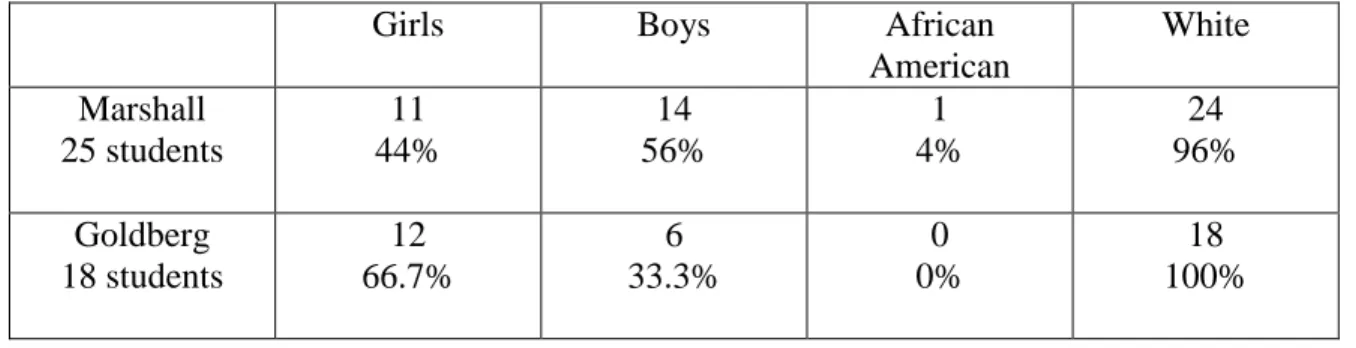
Student participants. The sixth grade class taught by Mr. Marshall was his third period and met daily from 10:44 AM - 11:37 AM. The demographics of this class appeared to be
representative of the larger school population and are provided in Table 3.1. The class selected from Ms. Goldberg’s schedule was her sixth period class and met daily after lunch and recess from1:18 PM to 2:05 PM. Although dominated by a majority of girls (see Table 3.1), this class was also adequately representative of the Daisy School student population.
Table 3.1: Student demographics for participating classrooms
Girls Boys African
American White Marshall 25 students 11 44% 14 56% 1 4% 24 96% Goldberg 18 students 12 66.7% 6 33.3% 0 0% 18 100%
40
the study, that is, they agreed to be observed and videotaped, but did not allow collection of their work. Although some students chose not to participate in the study, they were all part of the class, instruction, and tests. Accommodations were made so that non-participants were not included in the study’s data collection methods, i.e., observation, video-recording, and collection of student work.
Table 3.2: Student participants in participating classrooms Teachers Total
Students in Class
Number of Student Participants
Number of Participants Allowing: Observations
Video-Recording
Collection of Student
Work
Marshall 25 18 18 18 16
Goldberg 18 15 15 15 15
Field Work
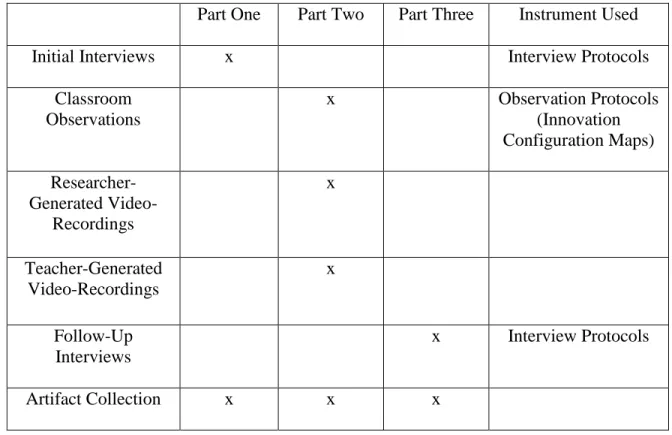
This project consisted of three main parts in the field work stage. The first part involved separate initial interviews. The second part included a series of classroom observations as well as researcher-generated and teacher-generated videotaping. The third part involved daily follow-up interviews with teachers about the video-tapes taken by them, in each classroom. There were mainly six types of data collected in this study. These data were from
initial interviews of teacher participants, daily researcher classroom observations,
daily researcher-generated whole-class video-recording,
daily teacher-generated individual/small group video-recording, daily follow-up interviews of teacher participants,
41
The data served various purposes and were collected at different points at the field work stage. Table 3.3 illustrates the process during which each type of data was collected, and instruments used.
Table 3.3: Data collection process and instruments used
Part One Part Two Part Three Instrument Used
Initial Interviews x Interview Protocols
Classroom Observations
x Observation Protocols
(Innovation Configuration Maps)
Researcher-Generated Video-Recordings
x
Teacher-Generated Video-Recordings
x
Follow-Up Interviews
x Interview Protocols
Artifact Collection x x x
An overview of the data collection process is provided below. Each part is detailed, including the purpose, design, and data collection procedures.
42
For instance, Even and Wallach (2004) suggested lack of knowledge about common student conceptions and their possible sources and failure to ascribe values to students’ ideas were preventing teachers from attending to children’s mathematical thinking in the midst of
instruction. Morgan and Watson (2002) also attributed how and to what extent teachers noticed children’s mathematical thinking to teachers’ personal knowledge of mathematics, and
expectations of students. As identified by Jacobs and Philipp (2010), instead of focusing on students’ mathematical thinking, some teachers tended to use their own mathematical thinking or general teaching moves that could be applied to any problem and any child to guide their
43
Using interview items that deal with the concepts of perimeter and area was consistent with the focus of the Covering and Surrounding unit. Centered around the same topics as the unit, these items were expected to help the researcher make better sense of the data collected from other sources, for instance, classroom observations, video-recordings, and interviews, compared with items that deal with concepts different from perimeter and area. Further, this interview was designed to assess teachers’ teaching knowledge. Thus, items framed in the context of classroom scenarios helped the researcher look at the interaction of teachers’ subject-matter knowledge with teaching knowledge. Since there was lack of information on validity and reliability of the instrument, the researcher consulted with two university mathematics educators prior to field work to ensure quality and content validity of the three interview items.
In step two, the researcher focused on collecting information on the role children’s mathematical thinking plays in teachers’ decision making. First, a short video clip was shared with each teacher participant. This clip involved a second-grade class in a suburban public school in the Midwest exploring the concept of measurement, in particular, rules of linear measure, without using conventional tools. A focus on measurement was consistent with the
Covering and Surrounding unit. Then, after showing the video to the teacher participants, the researcher asked them to respond to the following prompts verbally. Only one prompt was given out at a time, in the following order. Conversations were audio-recorded with permission: What did you notice/stood out to you about this video in general?
What did you notice about the teaching behavior from this video? What did you notice about student thinking from this video?