Drosophila DNA polymerase theta utilizes
both helicase-like and polymerase domains
during microhomology-mediated end joining
and interstrand crosslink repair
Kelly Beagan1, Robin L. Armstrong1¤a, Alice Witsell1, Upasana Roy2, Nikolai Renedo1, Amy E. Baker1¤b, Orlando D. Scha¨rer2,3, Mitch McVey1
*
1 Department of Biology, Tufts University, Medford, Massachusetts, 2 Department of Chemistry and
Department of Pharmacological Sciences, Stony Brook University, Stony Brook, New York, United States of America, 3 Center for Genomic Integrity, Institute for Basic Science, Ulsan, Korea and Department of Biological Sciences, School of Life Sciences, Ulsan National Institute of Science and Technology, Ulsan, Korea
¤a Current address: Curriculum in Genetics and Molecular Biology, University of North Carolina, Chapel Hill, North Carolina
¤b Current address: Department of Microbiology and Immunology, Geisel School of Medicine at Dartmouth, Hanover, New Hampshire
Abstract
Double strand breaks (DSBs) and interstrand crosslinks (ICLs) are toxic DNA lesions that can be repaired through multiple pathways, some of which involve shared proteins. One of these proteins, DNA Polymeraseθ(Polθ), coordinates a mutagenic DSB repair pathway named microhomology-mediated end joining (MMEJ) and is also a critical component for bypass or repair of ICLs in several organisms. Polθcontains both polymerase and helicase-like domains that are tethered by an unstructured central region. While the role of the poly-merase domain in promoting MMEJ has been studied extensively both in vitro and in vivo, a function for the helicase-like domain, which possesses DNA-dependent ATPase activity, remains unclear. Here, we utilize genetic and biochemical analyses to examine the roles of the helicase-like and polymerase domains of Drosophila Polθ. We demonstrate an absolute requirement for both polymerase and ATPase activities during ICL repair in vivo. However, similar to mammalian systems, polymerase activity, but not ATPase activity, is required for ionizing radiation-induced DSB repair. Using a site-specific break repair assay, we show that overall end-joining efficiency is not affected in ATPase-dead mutants, but there is a sig-nificant decrease in templated insertion events. In vitro, Polθcan efficiently bypass a model unhooked nitrogen mustard crosslink and promote DNA synthesis following microhomology annealing, although ATPase activity is not required for these functions. Together, our data illustrate the functional importance of the helicase-like domain of Polθand suggest that its tethering to the polymerase domain is important for its multiple functions in DNA repair and damage tolerance. a1111111111 a1111111111 a1111111111 a1111111111 a1111111111 OPEN ACCESS
Citation: Beagan K, Armstrong RL, Witsell A, Roy U, Renedo N, Baker AE, et al. (2017) Drosophila DNA polymerase theta utilizes both helicase-like and polymerase domains during microhomology-mediated end joining and interstrand crosslink repair. PLoS Genet 13(5): e1006813.https://doi. org/10.1371/journal.pgen.1006813
Editor: Lorraine S. Symington, Columbia University, UNITED STATES
Received: June 8, 2016
Accepted: May 12, 2017
Published: May 25, 2017
Copyright:©2017 Beagan et al. This is an open access article distributed under the terms of the Creative Commons Attribution License, which permits unrestricted use, distribution, and reproduction in any medium, provided the original author and source are credited.
Data Availability Statement: All relevant data are within the paper and its Supporting Information files.
Author summary
Error-prone DNA Polymeraseθ(Polθ) plays a conserved role in a mutagenic DNA dou-ble-strand break repair mechanism called microhomology-mediated end joining
(MMEJ). In many organisms, it also participates in a process crucial to the removal/repair of DNA interstrand crosslinks. The exact mechanism by which Polθpromotes these pro-cesses is unclear, but a clue may lie in its dual-domain structure. While the role of its poly-merase domain has been well-studied, the function of its helicase-like domain remains an open question. Here we report an absolute requirement for ATPase activity of the heli-case-like domain during interstrand crosslink repair inDrosophila melanogaster. We also find that although end joining frequency does not decrease in ATPase-dead mutants, ATPase activity is critical for generating templated insertions. Using purified Polθ pro-tein, we show that it can bypass synthetic substrates mimicking interstrand crosslink intermediates and can promote MMEJ-like reactions with partial double-stranded and single-stranded DNA. Together, these data demonstrate a novel function for the helicase-like domain of Polθin both interstrand crosslink repair and MMEJ and provide insight into why the dual-domain structure has been conserved throughout evolution.
Introduction
DNA double strand breaks (DSBs) and interstrand crosslinks (ICLs) compromise both strands of the DNA duplex and must be repaired to ensure cellular survival. While DSBs disrupt the physical integrity of DNA, ICLs tether DNA strands together through a covalent bond. Thus, both types of lesions can impede critical processes such as replication and transcription. ICLs require a complex network of proteins for their removal and involve multiple DNA repair pathways (reviewed in [1,2]). Because repair of ICLs can generate one- or two-ended DSB intermediates, the identification of proteins that are involved in both ICL and DSB repair might provide insight into their common mechanisms [3,4].
InDrosophila melanogaster, DNA Polymeraseθ(Polθ) has emerged as one of these
dual-function proteins. It was first identified in a mutagen sensitivity screen where mutations in
mus308, the gene encoding Polθ, caused hypersensitivity to ICL-inducing agents but not to
other DNA alkylating agents [5,6]. Polθis an A-family polymerase with homology toE.coli
Pol I and contains an N-terminal helicase-like domain connected to the polymerase domain through a long, unstructured central domain [7–9]. Both the polymerase and helicase domains are conserved among metazoans. In vertebrates, the polymerase domain also contains three insertion loops that are not present in Pol I and which are poorly conserved in invertebrates (reviewed in [10]). Early work onDrosophilaPolθshowed that it likely acts downstream of ICL “unhooking” [5], where one strand of the DNA helix is incised on both sides of the cross-link. Subsequent studies inC.elegansrevealed a conserved role for Polθin ICL repair [11]. However, the mechanisms by which Polθpromotes ICL repair remain uncharacterized.
Numerous studies have shown that Polθis also critical for alternative end-joining repair of DSBs via a pathway named microhomology-mediated end joining (MMEJ) [12–17]. MMEJ occurs when short, complementary DNA sequences located at broken DNA ends anneal and serve as primers for fill-in synthesis. An early study of Polθ-mediated MMEJ in Drosophila, using a transposon-induced gap repair system, demonstrated that repair involving annealing of 5–10 nucleotide pre-existing microhomologies was dependent on Polθ[18]. Polθhas also been shown to promote MMEJ inC.elegans[19,20], zebrafish [21], and mice [13].
Pol theta helicase-like and polymerase domains cooperate during MMEJ and ICL repair
While MMEJ acts independently of classical NHEJ proteins, 5’!3’ resection stimulates MMEJ and there is some overlap between proteins involved in the intial steps of both MMEJ and homologous recombination [22]. Following resection, microhomologies located internal to the break site can also be used for annealing, although this requires trimming of non-homologous flaps prior to synthesis [23].In vitro, the polymerase domain of Polθis sufficient to join DNA ends with limited microhomologies, though the optimal length of DNA over-hangs varies by system [12,13]. Additionally, the polymerase domain can mediate the align-ment of both internal and terminal microhomologies and displace annealed DNA during template extensionin vitro[12].
In addition to the use of microhomologies, another signature of many alternative end-join-ing events in metazoans is the presence of small insertions that appear to be derived from flanking DNA sequences [24]. It is now clear that Polθis often utilized during the generation of these templated insertions. In Polθ-null mouse B cells, programmed DSBs formed during class-switch recombination are repaired at a similar rate to wildtype but lack insertions of>1 nt, indicating that Polθis required to generate these insertions [13]. Studies with I-SceI induced chromosomal DSBs in Drosophila documented repair events with>4 nt templated insertions that were largely dependent on Polθ[25]. In addition, Polθplays a critical role in the generation of insertions during alternative end joining repair of collapsed replication forks
inC.elegans[19,20,26] and during T-DNA insertion in Arabidopsis [27].
Though the function of the polymerase domain of Polθhas been studied extensivelyin
vitro, thus far no defined role exists for the helicase-like domain. The helicase-like domain
dis-plays DNA-dependent ATPase activityin vitro, but DNA unwinding activity has not been demonstratedin vitroorin vivo[8,28]. Polθnull mouse embryonic fibroblasts are extremely sensitive to the DSB-inducing agent bleomycin and the addition of the polymerase domain alone is sufficient to restore resistance to these cells [13]. The helicase-like domain, therefore, does not appear to be required for efficient DSB repair in mammalian cells and its vital role(s), if any, in DNA metabolism have remained largely uncharacterized.
Here, we report our efforts to further elucidate the roles of the helicase-like and polymerase domains of Drosophila Polθin ICL and DSB repair. We show that purified Polθcan bypass model unhooked ICL substrates and promote the initial steps of MMEJin vitro, with minimal requirement for ATPase activity. In contrast, ourin vivoexperiments establish that both the ATPase activity of the helicase-like domain and DNA polymerase activity are critical for toler-ance or repair of ICLs and for the generation of templated insertions during alternative end joining. Tethering of these two enzymatic domains may therefore promote complex DNA transactions necessary for both types of repair.
Results
Pol
θ
ATPase activity is required for resistance to a DNA interstrand
crosslinking agent but not ionizing radiation
Fig 1. Drosophila PolθATPase activity is required for resistance to a DNA interstrand crosslinking agent but not ionizing radiation. A. Schematic of mus308 alleles and transgenes. The N-terminal
helicase-like domain (blue) and C-terminal polymerase domain (green) are connected by the central domain (gray). Control, ATPase-dead, and polymerase-dead (pol-dead) are transgenic alleles. Numbers indicate amino acid positions in the protein. B. Nitrogen mustard sensitivity survival curve for domain-specific mutants.
We exposed larvae from these transgenic stocks to increasing concentrations of nitrogen mustard and quantified survival to adulthood. Similar to previous studies, we found that homozygous mutants lacking Polθare hypersensitive to nitrogen mustard, as compared to heterozygous controls (Fig 1B). Addition of the full-length transgene rescued this sensitivity to wild-type levels. Pol-dead mutants were hypersensitive to low concentrations of nitrogen mus-tard, indicating a requirement for DNA synthesis in Polθ-mediated ICL repair. Intriguingly, we found that ATPase-dead mutants were equally as sensitive to nitrogen mustard as pol-dead mutants or flies lacking Polθ.
In mammals, the polymerase activity of Polθis required for double-strand break repair, specifically for MMEJ [12,13,17]. Interestingly, the polymerase domain of purified Polθ pro-tein alone is sufficient to join DNA endsin vitro, indicating that ATPase activity is dispensable [12]. To test whether this is also true in Drosophila, we exposed flies expressing different Polθ
transgenes to ionizing radiation (IR) in the absence of endogenous Polθ. Our previous study showed that flies lacking Polθare only sensitive to IR in the absence of homologous recombi-nation [18]. Therefore, we conducted these experiments in flies lacking RAD51 (encoded by
thespn-Agene). As expected,mus308Δ,spn-Amutants were highly sensitive to IR and
addi-tion of the full-length transgene rescued this sensitivity (Fig 1C). Indeed, a dose of 500 rads was lethal to mutants lacking Polθand RAD51, while 50 percent ofspn-Amutants were able to survive this exposure. Pol-dead and Polθnull mutants were equally hypersensitive to IR. However, ATPase-dead mutants behaved identically to the wild-type control. Thus, the ATPase activity of Polθis needed for survival following exposure to DNA interstrand cross-linking agents, but not for damage induced by ionizing radiation.
Pol
θ
can bypass unhooked ICL intermediates in vitro
To further delineate the functions of the ATPase and polymerase domains in ICL repair, we turned to anin vitrosystem. We purified full-length wild-type, ATPase-dead, and pol-dead proteins to near homogeneity from insect cells. SDS-PAGE and Western blotting confirmed the identity of full-length Polθ, although some minor degradation products were visible (S1 Fig).
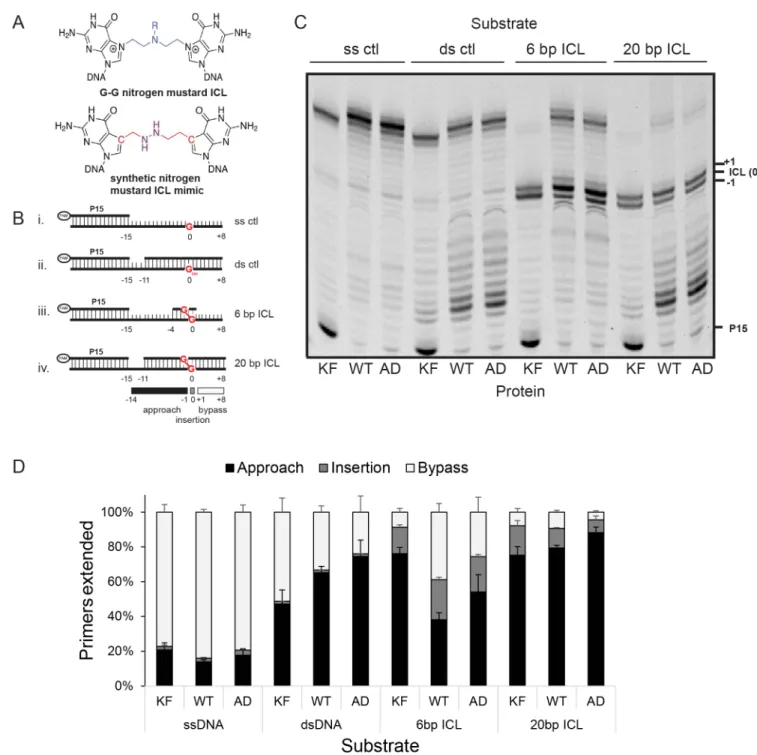
Current models suggest that during replication-coupled ICL repair, two incisions are made on either side of the ICL to release it from one strand, generating an “unhooked” ICL in which the excised fragment remains attached to other strand through the ICL itself. However, the exact location of the incisions and the length of the remaining olionucleotide attached to the duplex are currently unknown [29]. Thus,in vitrostudies of ICL bypass typically use model unhooked ICLs of different lengths [30]. We used our purified Polθproteins in primer exten-sion assays with substrates mimicking 6 base pair (bp) or 20 bp unhooked nitrogen mustard ICLs and corresponding control substrates (Fig 2A and 2B) [31,32]. Both wild-type and ATPase-dead Polθwere able to effectively extend a fluorescently labeled primer on a single-strand control template, although their activity on a partial double-single-strand control template was somewhat reduced compared to the Klenow fragment ofE.coliDNA polymerase I (Fig 2C and 2D). While both Klenow fragment and wild-type Polθcould insert a nucleotide opposite an ICL, Klenow was unable to extend past the ICL with both the 6 bp and 20 bp unhooked crosslinks (Fig 2C and 2D). By contrast, Polθwas able to efficiently carry out extension to full
Transgenes were present in a mus308Δbackground. C. Ionizing radiation sensitivity survival curve for domain-specific transgenic mutants. All transgenes were in a mus308Δ, spn-A (rad51) background. Data points represent the average of three independent trials and standard deviations are shown.*p<0.05, **p<0.01,***p<0.0001 compared to full-length control, two-way ANOVA, Tukey’s post-hoc test.
Fig 2. Efficient bypass of interstrand crosslinks by Polθ. A. Structures of a nitrogen mustard interstrand crosslink (ICL) between two guanines
and a 5-atom synthetic nitrogen mustard ICL mimic. B. Substrates used in the primer extension assays. 6-FAM labeled primer was annealed to different templates: (i.) single-stranded control containing ICL precursor G, (ii.) double-stranded control with ICL precursor G, (iii.) ICL substrate in a 6 bp duplex, (iv.) ICL substrate in a 20 bp duplex. Red highlighting indicates ICL precursor G (GOH) or crosslinks. C. Comparison of ICL bypass
between Klenow fragment (KF), wild-type Polθ(WT), and ATPase-dead Polθ(AD). 5 nM of control or ICL templates were incubated with 1 nM Klenow for 5 min or 0.2 nM Polθfor 10 min. at 37˚C. Products were separated by denaturing PAGE on a 10% gel. D. Quantification of bypass. Each lane was divided into approach (-14 to -1), insertion (0) and bypass (+1 to +8) segments and corresponding band intensities expressed as a percentage of all the products combined. Data represent the mean of three experiments and error bars indicate standard deviations.
https://doi.org/10.1371/journal.pgen.1006813.g002
product for the 6 bp ICL. The efficiency of extension was reduced with the 20 bp ICL, similar to previous reports with other polymerases [31,32]. We observed only moderately reduced extension activity with ATPase-dead Polθcompared to wild-type, suggesting that ATP hydro-lysis is not required for bypassing an unhooked ICLin vitro.
Alternative end joining is reduced in the absence of Pol
θ
polymerase
activity
Previous work from our lab showed that hypomorphic and point mutations in Polθlead to a significant decrease in DNA ligase 4-independent alternative end joining [18]. During Polθ -mediated end joining of I-SceI orPelement-induced double-strand breaks, microhomologies are often used to align DNA ends and insertions are present in approximately 25% of repair junctions [18,25]. To determine which domains of Polθmight be involved in the generation of these insertions, we utilized a well-characterized site-specific gap repair assay [33]. In this assay, a 14 kilobase transposon (P{wa}) is inserted into an intron of thescallopedgene on theX
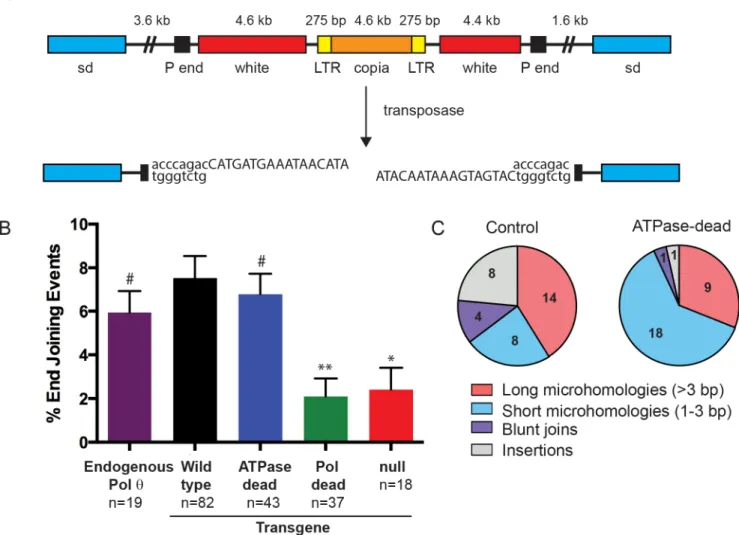
chromosome. Excision ofP{wa}is catalyzed byPtransposase, resulting in a two-ended double-strand break with 17-nucleotide non-complementary 3’ overhangs (Fig 3A). While this break can be repaired proficiently through homologous recombination, in the absence of RAD51 the break is repaired solely through end joining. Repair events that occur in the pre-meiotic male germline can be recovered from the female progeny that inherit the repaired chromosome and sequenced.
As expected, expression of wild-type Polθin amus308Δmutant background resulted in a similar frequency of alternative end-joining events to flies expressing endogenous Polθ(Fig 3B). Ablation of ATPase activity did not affect the frequency of end joining repair (Fig 3B), in agreement with previously published results that ATPase function is not required for MMEJ [12,13]. In contrast, we saw a significant decrease in end joining with the pol-dead allele, com-parable tomus308Δmutants.
In theP{wa}system, repair events accompanied by large deletions (>1.5 kilobases) that remove part of the coding region of thescallopedgene can be scored by the presence of female progeny possessing scalloped wings [34]. These deletions are thought to occur through a resec-tion-based mechanism and were previously observed in flies with Polθ-inactivating point mutations [18]. Notably, we observed a substantial increase in deletion-associated repair events in the polymerase-dead mutant compared to the full-length control and ATPase-dead mutant (S1 Table). Thus, our data suggest that Polθpolymerase, but not ATPase activity, is required to promote normal levels of alternative end joining and to suppress alternative, dele-tion-prone repair pathways.
Complex insertions generated during alternative end joining depend
upon both ATPase and polymerase activities of Pol
θ
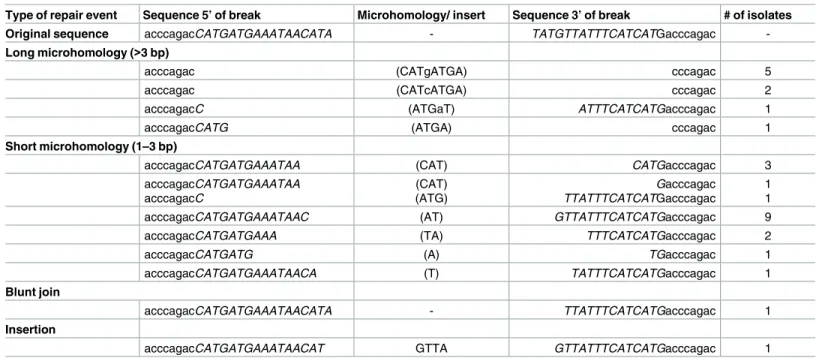
Analysis of the repair junctions recovered from theP{wa}assay showed that Polθ-proficient flies often utilized long microhomologies during break repair. We saw a particularly high usage of an 8 bp imperfect internal microhomology in both the wildtype and the ATPase-dead backgrounds (Tables1and2). In addition, we recovered many repair products from both backgrounds that appeared to be generated through annealing at short microhomologies, with a preference for microhomologies closer to the 3’ ends of the single-stranded overhangs. Thus, it appears that ATPase activity is not required to generate products through annealing at pre-existing microhomologies.
junctions recovered from the ATPase-dead mutants, significantly less than the 24% of wild-type repair junctions with insertions (p = 0.03, Fisher’s exact test; Tables1and2andFig 3C). The sole insertion event generated in the ATPase-dead mutant was a four-nucleotide insertion apparently templated from sequence immediately adjacent to the break. In contrast, repair events in flies with endogenousmus308expression or the control transgene contained inser-tions templated from sequences immediately adjacent to the break as well as internal
sequences (Table 1). Flies expressing wild-type Polθalso contained more complex events that can be explained by an iterative process of multiple rounds of synthesis, dissociation, and rean-nealing. These events were absent in ATPase-dead mutants.
Pol
θ
ATPase and polymerase activities are both used during annealing
and extension of ssDNA molecules in vitro
To further test whether the ATPase activity of Polθmight be important for the complex inser-tions observed during alternative end joining, we utilized purified proteins with substrates that Fig 3. PolθATPase activity does not affect end joining frequency but promotes the formation of complex insertions. A. Schematic of
the P{wa} construct (top). After expression of transposase, the P-element is excised leaving 17 nt overhangs (bottom). B. Frequency of end
joining repair in domain-specific transgenic alleles and controls. All transgenes are in a mus308Δ, spn-A (rad51) background. The number of independent vials (n) represented by each bar and the standard error of the mean is shown. C. Summary of junction types recovered in control and ATPase-dead transgenic alleles.*p<0.05,**p<0.01, # p = n.s. compared to wild-type control, two-way ANOVA, Tukey’s post hoc test.
https://doi.org/10.1371/journal.pgen.1006813.g003
can only support templated DNA synthesis following annealing of 2 nt or longer terminal microhomologies. We began with a partial single-stranded DNA substrate that was previously used with the human Polθpolymerase domain to simulate MMEJ-like synthesis reactions [12] (Fig 4A). Similar to the human protein, wild-type Drosophila Polθcan carry out DNA synthe-sis with this substrate (Fig 4A). The size of the product is consistent with annealing of two mol-ecules of the substrate at CCGG microhomologies, followed by extension and strand
displacement by Polθ. Interestingly, the amount of product is reduced with the ATPase-dead Polθ(Fig 4A).
Next, we tested the ability of Polθto utilize a partial single-stranded DNA substrate mim-icking the intermediates formed in theP{wa}assay (Fig 4B). Surprisingly, wild-type Polθwas able to catalyze more extension with this substrate, even though the terminal microhomology was only a 2-nt TA. While the products formed in this reaction were more variable in size, the length of the largest products was consistent with intermolecular annealing of two substrate molecules at the TA terminal microhomologies and strand-displacement synthesis to the end of the template. Repeated attempts to clone and sequence the reaction products were unsuc-cessful. Therefore, while the smaller products likely result from annealing at other microho-mologous sequences in the substrate, it is unknown whether these are intermolecular or intramolecular events. Similar to the results with the first substrate, ATPase-dead Polθ pro-duced fewer extension products, particularly the full-length products (Fig 4B).
Table 1. Control P{wa} repair junctions.
Type of repair event Sequence 5’ of break Microhomology/ insertion Sequence 3’ of break # of isolates
Original sequence acccagacCATGATGAAATAACATA - TATGTTATTTCATCATGacccagac
-Long microhomology (>3 bp)
acccagac (CATgATGA) cccagac 10
acccagac (CATGA) cccagac 4
Short microhomology (1–3 bp)
acccagacCATG (ATG) TTATTTCATCATGacccagac 1
acccagacCATGATGAAATAA (CAT) CATGacccagac 1
acccagacCATGATGAAATAAC (AT) GTTATTTCATCATGacccagac 3
acccagacCATGATGAAATAACA (TA) TGTTATTTCATCATGacccagac 1
acccagacCATGATG (A) TGacccagac 1
acccagacCATGATGAAATAACAT (A) TGTTATTTCATCATGacccagac 1
Blunt join
acccagacCATGATGAAATAACATA - ATGTTATTTCATCATGacccagac 1
acccagacCATGATGAAATAACATA - TATGTTATTTCATCATGacccagac 3
Insertion
acccagacCATGATGAAATAACATA TGTTATATGT TATGTTATTTCATCATGacccagac 1
acccagacCATGATGAAATAACAT GTTATGTTATT TATGTTATTTCATCATGacccagac 1
acccagacCATGATGAA GCCTC acccagac 1
acccagacCATGATGAAATAACA TGTTA TGTTATTTCATCATGacccagac 1
acccagacCATGATGAAATAACA ACA TATGTTATTTCATCATGacccagac 1
acccagacCATGATGAAATAACATA ACA TGTTATTTCATCATGacccagac 1
acccagacCATGATGAAATAACAT GTA TGTTATTTCATCATGacccagac 1
acccagacCATGA CC acccagac 1
Sequences of repair events showing microhomology usage and insertions obtained from Polθ-proficient flies. Microhomologies are indicated by parentheses, with imperfect microhomologies shown in lower case. Sequences from endogenous Polθand full-length controls are pooled.
The polymerase domain of human Polθhas more MMEJ activity on partial single-stranded substrates compared to single-stranded oligonucleotides with similar terminal microhomolo-gies [12]. However, when we tested the ability of both full-length and ATPase-dead Drosophila Polθto utilize a single-stranded oligonucleotide corresponding to one strand of theP{wa} sub-strate, we observed an enhanced extension activity compared to that observed with the partial single-stranded substrate (Fig 4B). The sizes of the products with the single-stranded substrate were smaller than what would be expected with intermolecular annealing at the TA microho-mology and synthesis to the end of the template. Taken together, these data suggest that Dro-sophila Polθcan utilize short microhomologies present in partially and fully single-stranded DNA as primers for DNA synthesis and that ATPase activity from the helicase-like domain promotes the efficiency of these reactions.
Discussion
Interest in Polθ-mediated DNA repair has grown following observations that Polθis signifi-cantly overexpressed in a number of different cancer types and elevated Polθlevels correspond to poorer patient outcomes [35–41]. Intriguingly, human Polθhas been shown to compete with HRin vivoand overexpression of Polθin HR-proficient non-tumor cells causes increased DNA damage foci, suggesting that high levels of Polθmay promote genome instability [14, 38]. The relationship between Polθand tumorigenesis makes Polθan appealing target for cancer therapeutics, especially because HR-deficient tumors are particularly dependent on Pol
θ-mediated repair [14,42]. Therefore, understanding the mechanisms by which Polθuses its dual-domain structure to repair DSBs and promote repair/bypass of other types of DNA dam-age is critical in order to identify possible Polθenzymatic targets. In this study, we have dem-onstrated important roles for both the ATPase and polymerase activities of Drosophila Polθ
during ICL bypass and alternative end-joining repair. Since the domains containing both of Table 2. ATPase-dead P{wa} repair junctions.
Type of repair event Sequence 5’ of break Microhomology/ insert Sequence 3’ of break # of isolates
Original sequence acccagacCATGATGAAATAACATA - TATGTTATTTCATCATGacccagac
-Long microhomology (>3 bp)
acccagac (CATgATGA) cccagac 5
acccagac (CATcATGA) cccagac 2
acccagacC (ATGaT) ATTTCATCATGacccagac 1
acccagacCATG (ATGA) cccagac 1
Short microhomology (1–3 bp)
acccagacCATGATGAAATAA (CAT) CATGacccagac 3
acccagacCATGATGAAATAA acccagacC
(CAT) (ATG)
Gacccagac TTATTTCATCATGacccagac
1 1
acccagacCATGATGAAATAAC (AT) GTTATTTCATCATGacccagac 9
acccagacCATGATGAAA (TA) TTTCATCATGacccagac 2
acccagacCATGATG (A) TGacccagac 1
acccagacCATGATGAAATAACA (T) TATTTCATCATGacccagac 1
Blunt join
acccagacCATGATGAAATAACATA - TTATTTCATCATGacccagac 1
Insertion
acccagacCATGATGAAATAACAT GTTA GTTATTTCATCATGacccagac 1
Sequences of repair events showing microhomology usage and insertions obtained from ATPase-dead mutants. Microhomologies are indicated by parentheses, with imperfect microhomologies shown in lower case.
https://doi.org/10.1371/journal.pgen.1006813.t002
these enzymatic functions are physically connected and conserved in metazoans, this implies that the two domains may cooperate during these important processes.
What is Pol
θ
doing to promote ICL tolerance?
One possible role for Polθin ICL tolerance is the bypass of unhooked crosslinked duplex DNA following single-stranded nicking by nucleases [30]. The polymerase active site of Polθ
contains several features that make it an ideal enzyme to bypass bulky lesions such as cross-links, including unique insertion loops that provide a stable interaction between a poorly matched primer and template strand [43]. Here, we have shown that Drosophila Polθis able to bypass model unhooked ICL substratesin vitro. Specifically, it can insert a nucleotide oppo-site a crosslinked base and subsequently extend from the insertion point, in the context of duplexes of variable lengths (6–20 bp) duplexes surrounding the ICL. To date, only polymerase eta has been shown to carry out extension of these substrates with similar efficiency [30,31].
Interestingly, while the ATPase activity of Drosophila Polθis required for ICL tolerancein vivo, it plays only a minor role during bypassin vitro. Perhaps ATP hydrolysis is only required for efficient bypass of an ICL in a cellular context, where the helicase-like domain could be Fig 4. PolθATPase activity is important for annealing and extension reactions in vitro. A. Polθpromotes annealing of partial single-stranded DNA (pssDNA) at terminal microhomologies and DNA synthesis. 26 nt pssDNA with a CCGG terminal microhomology is from [12]. 30 nM of pssDNA was incubated with 50 pM of Klenow fragment (KF) or wild-type (WT), ATPase-dead (AD), or Pol-dead (PD) Polθprotein for 30 min at 37˚C. B. Polθ can promote inter- and intra-molecular annealing and extension reactions on pss and ssDNA. 33 nt pssDNA with a TA terminal microhomology corresponds to the DNA product created by P{wa} excision. 33 nt ssDNA is the top strand of 33 nt pssDNA. 30 nM of pssDNA or ssDNA was incubated
with 50 pM of protein for 30 min at 37˚C. All products were separated by denaturing PAGE on a 20% gel. Percent extension was calculated by measuring band intensities of all primer extension products and dividing by total intensity of all bands in the lane.
required to displace other proteins from the site of the lesion. In support of this, protein dis-placement is a major function of several other SF1 and SF2 helicases [44–48].
Alternatively, PolθATPase activity might be necessary for efficient repair of one or two-ended DSBs that form during intermediate stages of ICL repair [1]. Our mutagen sensitivity assays were performed by treating larvae with nitrogen mustard during a time in larval devel-opment when imaginal disc cells, which are necessary for metamorphosis and adult survival, are undergoing rapid divisions. Mutations that result in an inability to repair DSBs during this developmental window will cause organismal death. A recent study using zebrafish found that Polθ-mediated end joining is most critical at the earliest stages of blastulation, when cells divide every 15 minutes [21]. Thus, Polθ-mediated end joining may be particularly crucial for the repair of crosslink-related DSBs that occur in rapidly dividing cells [49].
Although Polθis essential for ICL tolerance in Drosophila, Arabidopsis, andC.elegans, it is not required in mouse or human cell lines [5,11,50,51]. A possible explanation for this differ-ence is that another TLS polymerase with redundant activity might substitute for Polθin mammals. One potential candidate is Polν, which has been suggested to participate in ICL repair [52]; human cell lines lacking Polνare sensitive to ICL-inducing agents [53,54]. Intriguingly, the organisms which utilize Polθfor ICL tolerance (Drosophila, Arabidopsis,
andC.elegans) lack a Polνhomolog [55]. However, recent reports also demonstrate that
recombinant human Polνcannot bypass cisplatin-induced crosslinksin vitro[56], inconsis-tent with a substitution model.
Roles of Pol
θ
during alternative end joining
We found that mutations that abolish the ATPase activity of Polθdo not increase sensitivity to IR-induced DNA damage. Additionally, loss of ATPase activity does not change the fre-quency of Polθ-mediated end-joining repair following creation of a site-specific break. This reflects a similarity between Drosophila and mammalian cells, which also require polymerase activity, but not the helicase-like domain, for Polθ-mediated end joining [12,13].
Polθhas also been shown to generate templated insertions during alternative end joining [13,17,19,57]. These insertions might result from a cell’s attempt to generate microhomolo-gies suitable for alternative end joining with initially incompatible DNA ends. Strikingly, when analyzing our repair junction sequences, we found that the ATPase-dead mutants had a signif-icant, 8-fold reduction in insertion events compared to the controls and a corresponding increase in the number of repair events using 2–3 nt microhomologies. Similarly, purified Pol
θlacking ATPase activity was less efficient at annealing and extending single-stranded DNA substrates.
Previous biochemical studies have established that the polymerase domain of human Polθ
aligns substrates with long GC-rich microhomologies more efficiently than AT-rich micro-homologies and prefers using terminal micromicro-homologies over internal ones [12]. We observed a similar predisposition with our partial single-stranded substrates. However, in thein vivo P{wa}repair system, end joining occurs using a 17 nucleotide AT-rich 3’ overhang. We see fre-quent usage of a long, 10-nt microhomology internal to the break site during junction forma-tion. Utilization of internal microhomologies has also been observed in human cells [23]. Though our sequence is quite AT-rich, the most frequently used internal microhomologies have several GCs, supporting the idea that Polθmore readily aligns GC-rich sequences. Addi-tionally, in our system complex insertion events are typically templated from sequences directly adjacent to the break site. One potential explanation for this is that the AT-rich nature of the overhang results in less stable annealing between DNA ends, promoting multiple rounds of synthesis.
In vitro, the human Polθpolymerase domain efficiently uses partially single-stranded DNA with a 3’ overhang as a substrate for MMEJ, while fully ssDNA is used much less efficiently [12]. While we do observe annealing and extension products with partially single-stranded DNA, we found that full length Drosophila Polθrobustly uses ssDNA as a template for
synthe-sisin vitro. Because we failed to observe products consistent with intermolecular annealing at a
TA terminal microhomology (Fig 4C), we postulate that Polθmay also use intramolecular hairpin-like structures as a template for synthesis, in a process that we have called synthesis-dependent microhomology-mediated end joining [25]. Similar observations have been made by others studying human Polθ[57].
Conclusion
While we have learned much about the roles of Polθin alternative end joining and ICL toler-ance from biochemical studies, our findings illustrate that its functionsin vivoare likely affected by additional factors. These might include variations in DNA sequence context or chromatin structure near DNA lesions and by interactions with other proteins that remain to be identified. Furthermore, the higher-order structure of Polθin vivois likely important for its function. Crystal structures of the polymerase and helicase-like regions of Polθsuggest that these subdomains can exist as dimers and tetramers, respectively [28,43], but the oligomeric state of the full-length protein necessary for itsin vivofunctions is currently unknown.
In summary, our studies with full-length Drosophila Polθsuggest that the helicase-like and polymerase domains of Polθplay important roles during both ICL repair and alternative end joining. Given the frequent overexpression of Polθin human cancers, our findings highlight the potential utility of therapeutically targeting one or both domains to modulate its activity [14].
Materials and methods
Fly stocks and mutant creation
Fly stocks were maintained on standard cornmeal agar medium at 25˚C. Themus308D2, spn-A057, andspn-A093alleles were obtained from Bloomington Stock Center. Themus308Δallele was generated through an imprecise excision screen of theP-elementP{GSV7}GS23034(Kyoto Drosophila Genomics and Genetics Resources stock center). Themus308Δallele deletes 14,250 bp spanningmus308, its endogenous promoter, and part of the neighboring geneMen. To generate the transgenic alleles, genomic DNA encodingmus308and 1.25 kb of upstream sequence, including its endogenous promoter, was isolated and amplified with primers con-taining BglII and Acc65I restriction enzyme sites. The DNA was cloned into the pMTL vector and mutagenized through amplification-based site-specific mutagenesis. Mutagenized alleles were then cloned into the pattB expression vector. The plasmids were injected into embryos containing attP integration sites by BestGene injection services and genome integration was achieved through the Fly-C31 lambda phage recombination system [58,59]. Transformants were identified using awhite+marker present on pattB. Control, polymerase-dead, and ATPase-dead transgenes were inserted at theZH-attp-51Csite (Bloomington stock number 24483) on chromosome2.
Mutagen sensitivity assays
fresh vials for an additional 2 days. The first set of vials was treated with 250μL of nitrogen mustard solution while the second control set was treated with 250μL water. For irradiation assays, 40–50mus308 transgene; mus308Δ,spnA057/TM3females were mated to 10–15
mus308Δ,spnA093/TM6Bmales and eggs were collected on grape juice agar plates for 12 hours.
Eggs were allowed to hatch and mature to third instar larvae, then irradiated using a Gamma-tor 1000 irradiaGamma-tor. Percent relative survival was calculated using the ratio ofmus308 homozy-gous to heterozyhomozy-gous adult survival in mutagen treated vials compared to control vials. Each experiment consisted of at least 5 independent vials or 1 grape agar plate and experiments were repeated in triplicate.
P{w
a} gap repair assay
End joining repair of a double strand break was monitored after the excision of aP{wa} ele-ment as described previously [60]. A second chromosome transposase source (CyO,H{w+, Δ2–3}) was used to exciseP{wa}. Single males of the genotypeP{wa}; mus308 transgene/CyO,H
{w+,Δ2–3}; mus308Δ,spnA057/mus308D2,spnA093were mated toP{wa}females and individual
repair events were recovered in the female progeny. Progeny containing end-joining events lose a functional copy of thewhitegene, thus end-joining repair events can be quantified and recovered in female progeny with yellow eyes. For each genotype, individual male crosses were scored for eye color of female progeny. The percentage of progeny from each repair class was calculated on a per vial basis, with each vial representing an independent experiment. Statisti-cal comparisons were done with a non-parametric ANOVA followed by Tukey’s test using InStat3 (GraphPad).
Repair junction sequencing
Female progeny containing the repairedP{wa}construct were collected from the single male crosses. To isolate genomic DNA, whole flies were manually disrupted in 50 uL squishing buffer (10 mM Tris-HCl pH8, 1 mM EDTA, 25 mM NaCl, 200 g/ml Proteinase K) and incu-bated at 37˚C for 30 minutes then 95˚C for 3 minutes. Repair junctions were amplified by PCR using primers near the junction Sd5320 (ACCATTGCAAGCTACATAGCTGAC) and Sd5941R (GCCTTGCTTCTTCCACACAGCGTG). PCR products were sequenced using the Sd5320 primer.
Pol
θ
protein purification
Full-lengthmus308cDNA (Drosophila Genomics Resource Center, clone LP14642) was amplified with primers containing SalI and Acc65I restriction sites and cloned into pFastbac1 (Invitrogen, gift from Timur Yusufzai) in frame with the 6X His and FLAG tags to make pFBFL308. ATPase-dead and pol-dead mutant clones were created by site-directed mutagene-sis using Q5 polymerase (NEB, Ipswich, MA). These constructs were used with the Bac to Bac Baculovirus Expression System (Life Technologies) for expression in Sf9 cells (Orbigen, San Diego, CA.)
Sf9 cells (1 L, 6.0×10⁶cells/ml) were infected with each construct for 72 hr at 25˚C and har-vested by centrifugation. Cells were sonicated in lysis buffer containing 20 mM Hepes, pH 7.6, 500 mM NaCl, 1.5 mM MgCl2, 10% glycerol, 0.1% Triton X-100, 1 mM phenylmethylsulfonyl fluoride (PMSF), and complete EDTA-free protease inhibitor (Roche), with three 10 second bursts at 20% duty cycle with 10 seconds rest between bursts. Debris was removed by centrifu-gation and the supernatant was incubated for 4 hr at 4˚C with 200μl of anti-DYKDDDDK G1 affinity resin (Genscript). The resin was washed with 10 volumes of the lysis buffer and eluted with 250μg/ml 3X FLAG peptide (gift of S. Fuchs). The eluate was spun through a Zeba 40K
desalting column (ThermoFisher) following the manufacturer’s directions. Protein amounts were quantified by comparison with a BSA standard curve following transfer from an SDS-PAGE gel using Fastblot stain (G Biosciences).
ICL bypass assays
5-atom ICL-containing substrates were synthesized according to (Roy et al., 2016[61]). These were annealed with P15 (5’-CACTGACTCTATGATG-3’) labeled at the 5’ end with 6-FAM. ICL substrates (150 nM) and 5’ labeled primer P15 (50 nM) were annealed in 10 mM Tris-HCl pH 8.0, 50 mM NaCl, overnight at room temperature to ensure the stability of the ICLs. The ICL substrates/primers (5 nM, with respect to the primer) were incubated with Klenow (exo-) fragment or Polθin a reaction volume of 10μL. For assays with Klenow (exo-), 1 nM enzyme was used in reaction buffer NEB2 (50 mM NaCl, 10 mM Tris-HCl, 10 mM MgCl2, 1 mM
DTT). 0.2 nM Polθwas used in a reaction buffer containing 25 mM Tris-Cl pH 7.5, 10 mM MgCl2, 200μM ATP, 100μg/mL BSA and 4.8% glycerol. Reactions with Klenow (exo-) were
incubated for 5 minutes, and with Polθfor 10 minutes at 37˚C. Reactions were stopped by addition of 10μL of formamide buffer (80% formamide, 1 mM EDTA, 1 mg/mL Orange G), denatured at 95˚C for 2 minutes and chilled on ice. The products of the reaction were resolved on a 10% 7M Urea PAGE and FAM labeled DNA was visualized using a Typhoon 9400 scan-ner (GE Healthcare). Images were analyzed and quantified using ImageQuant software (Molecular Dynamics)
Pol
θ
polymerase assays
The polymerase assay was adapted from [8]. To create the 26nt pssDNA substrate with CCGG microhomology, PAGE-purified oligo 5’-CTAAGCTCACAGTG-3’ (IDT) was 5’ end-labeled with polynucleotide kinase (NEB) and ATP, [γ-32P]- 3000Ci/mmol 10mCi/ml (Perkin-Elmer). The labeled oligo was annealed to an oligo of sequence 5’-CACTGTGAGCTTAGG GTTAGAGCCGG-3’ in STE buffer (100 mM NaCl, 10mM Tris-HCl, pH 8.0, 1 mM EDTA) by heating to 85˚C and slowly cooling to room temperature. To create the 33nt pssDNA substrate with TA microhomology, PAGE-purified oligos GTCTGGGTCAGCAGGG-3’ and 5’-CCCTGCTGACCCAGACCATGATGAAATAACATA-3’ were annealed under identical con-ditions. Reaction mixtures (20μl) contained 20 mM Tris–HCl pH 7.5, 4% glycerol, 80μg/ml bovine serum albumin (BSA), 8 mM MgCl2, 16 fmol of substrate, 100μM dNTPs, and 0.25–
0.5 ng of Polθ. After incubation for 10 min at 37˚C, reactions were terminated by adding gel loading buffer (formamide, 0.1% xylene cyanol, 0.1% bromophenol blue, 20 mM EDTA) and boiling. Products were separated by 20% denaturing SDS-PAGE and band intensities were analyzed with a Biorad phosphorimager.
Supporting information
S1 Fig. Purification of FLAG-tagged Drosophila Polθ. (A) FLAG-tagged wild-type (WT), ATPase-dead (AD), and polymerase-dead (PD) Polθwas affinity purified using FLAG resin and the eluate was spun through a 40K desalting column. Shown is a nitrocellulose membrane stained with Fastblot following SDS-PAGE and transfer. (B) Western blot of the membrane probed with anti-FLAG antibody.
(PDF)
S1 Table. Loss of polymerase, but not ATPase activity, results in deletion-prone alt-EJ repair. TheP{wa}element is inserted into an intron of thescalloped(Sd) gene. FollowingP{wa}
sequence result insd-alleles that cause a scalloped-wing phenotype in female progeny. (PDF)
Acknowledgments
We thank Rick Wood, Timur Yusufzi, Steven Fuchs, and their labs for assistance with the bio-chemical experiments. We acknowledge the Bloomington Stock Center and Kyoto Stock Cen-ter for fly stocks and the Drosophila Genomics Resource CenCen-ter for themus308cDNA plasmid. We thank Matt Yousefzedah, Dale Ramsden, and members of the McVey lab past and present for helpful discussions and editing of the manuscript.
Author Contributions
Conceptualization: MM KB ODS.
Formal analysis: MM KB UR.
Funding acquisition: MM ODS.
Investigation: KB AW AB UR RLA.
Methodology: MM UR KB AW.
Project administration: MM ODS.
Resources: KB UR AW NR.
Supervision: MM ODS.
Writing – original draft: KB MM.
Writing – review & editing: MM KB AW RLA UR ODS.
References
1. Muniandy PA, Liu J, Majumdar A, Liu ST, Seidman MM. DNA interstrand crosslink repair in mammalian cells: step by step. Crit Rev Biochem Mol Biol. 2010; 45(1):23–49.https://doi.org/10.3109/
10409230903501819PMID:20039786;
2. Deans AJ, West SC. DNA interstrand crosslink repair and cancer. Nat Rev Cancer. 2011; 11(7):467– 80.https://doi.org/10.1038/nrc3088PMID:21701511;
3. Haynes B, Saadat N, Myung B, Shekhar MP. Crosstalk between translesion synthesis, Fanconi anemia network, and homologous recombination repair pathways in interstrand DNA crosslink repair and devel-opment of chemoresistance. Mutat Res Rev Mutat Res. 2015; 763:258–66.https://doi.org/10.1016/j. mrrev.2014.11.005PMID:25795124;
4. Howard SM, Yanez DA, Stark JM. DNA damage response factors from diverse pathways, including DNA crosslink repair, mediate alternative end joining. PLoS Genet. 2015; 11(1):e1004943.https://doi. org/10.1371/journal.pgen.1004943PMID:25629353;
5. Boyd JB, Sakaguchi K, Harris PV. mus308 mutants of Drosophila exhibit hypersensitivity to DNA cross-linking agents and are defective in a deoxyribonuclease. Genetics. 1990; 125(4):813–9. PMID: 2397884;
6. Leonhardt EA, Henderson DS, Rinehart JE, Boyd JB. Characterization of the mus308 gene in Drosoph-ila melanogaster. Genetics. 1993; 133(1):87–96. PMID:8417992
7. Harris PV, Mazina OM, Leonhardt EA, Case RB, Boyd JB, Burtis KC. Molecular cloning of Drosophila mus308, a gene involved in DNA cross-link repair with homology to prokaryotic DNA polymerase I genes. Molecular and cellular biology. 1996; 16(10):5764–71. PMID:8816490
8. Seki M, Marini F, Wood RD. POLQ (Pol theta), a DNA polymerase and DNA-dependent ATPase in human cells. Nucleic Acids Res. 2003; 31(21):6117–26. PMID:14576298;https://doi.org/10.1093/nar/ gkg814
9. Sharief FS, Vojta PJ, Ropp PA, Copeland WC. Cloning and chromosomal mapping of the human DNA polymerase theta (POLQ), the eighth human DNA polymerase. Genomics. 1999; 59(1):90–6.https:// doi.org/10.1006/geno.1999.5843PMID:10395804.
10. Yousefzadeh MJ, Wood RD. DNA polymerase POLQ and cellular defense against DNA damage. DNA repair. 2013; 12(1):1–9.https://doi.org/10.1016/j.dnarep.2012.10.004PMID:23219161
11. Muzzini DM, Plevani P, Boulton SJ, Cassata G, Marini F. Caenorhabditis elegans POLQ-1 and HEL-308 function in two distinct DNA interstrand cross-link repair pathways. DNA repair. 2008; 7(6):941–50. https://doi.org/10.1016/j.dnarep.2008.03.021PMID:18472307
12. Kent T, Chandramouly G, McDevitt SM, Ozdemir AY, Pomerantz RT. Mechanism of microhomology-mediated end-joining promoted by human DNA polymeraseθ. Nat Struct Mol Biol. 2015; 22(3):230–7. https://doi.org/10.1038/nsmb.2961PMID:25643323;
13. Yousefzadeh MJ, Wyatt DW, Takata K, Mu Y, Hensley SC, Tomida J, et al. Mechanism of suppression of chromosomal instability by DNA polymerase POLQ. PLoS Genet. 2014; 10(10):e1004654.https:// doi.org/10.1371/journal.pgen.1004654PMID:25275444;
14. Ceccaldi R, Liu JC, Amunugama R, Hajdu I, Primack B, Petalcorin MI, et al. Homologous-recombina-tion-deficient tumours are dependent on Polθ-mediated repair. Nature. 2015; 518(7538):258–62. https://doi.org/10.1038/nature14184PMID:25642963.
15. Beagan K, McVey M. Linking DNA polymerase theta structure and function in health and disease. Cell Mol Life Sci. 2016; 73(3):603–15.https://doi.org/10.1007/s00018-015-2078-9PMID:26514729;
16. Black SJ, Kashkina E, Kent T, Pomerantz RT. DNA Polymerase theta: A Unique Multifunctional End-Joining Machine. Genes (Basel). 2016; 7(9).https://doi.org/10.3390/genes7090067PMID:27657134;
17. Mateos-Gomez PA, Gong F, Nair N, Miller KM, Lazzerini-Denchi E, Sfeir A. Mammalian polymeraseθ promotes alternative NHEJ and suppresses recombination. Nature. 2015; 518(7538):254–7.https://doi. org/10.1038/nature14157PMID:25642960.
18. Chan SH, Yu AM, McVey M. Dual roles for DNA polymerase theta in alternative end-joining repair of double-strand breaks in Drosophila. PLoS genetics. 2010; 6(7):e1001005.https://doi.org/10.1371/ journal.pgen.1001005PMID:20617203
19. Koole W, van Schendel R, Karambelas AE, van Heteren JT, Okihara KL, Tijsterman M. A Polymerase Theta-dependent repair pathway suppresses extensive genomic instability at endogenous G4 DNA sites. Nat Commun. 2014; 5:3216.https://doi.org/10.1038/ncomms4216PMID:24496117.
20. Roerink SF, van Schendel R, Tijsterman M. Polymerase theta-mediated end joining of replication-asso-ciated DNA breaks in C. elegans. Genome Res. 2014; 24(6):954–62.https://doi.org/10.1101/gr. 170431.113PMID:24614976;
21. Thyme SB, Schier AF. Polq-Mediated End Joining Is Essential for Surviving DNA Double-Strand Breaks during Early Zebrafish Development. Cell Rep. 2016.https://doi.org/10.1016/j.celrep.2016.03.072 PMID:27149851.
22. Truong LN, Li Y, Shi LZ, Hwang PY, He J, Wang H, et al. Microhomology-mediated End Joining and Homologous Recombination share the initial end resection step to repair DNA double-strand breaks in mammalian cells. Proc Natl Acad Sci U S A. 2013; 110(19):7720–5.https://doi.org/10.1073/pnas. 1213431110PMID:23610439;
23. Wyatt DW, Feng W, Conlin MP, Yousefzadeh MJ, Roberts SA, Mieczkowski P, et al. Essential Roles for Polymerase theta-Mediated End Joining in the Repair of Chromosome Breaks. Mol Cell. 2016; 63 (4):662–73.https://doi.org/10.1016/j.molcel.2016.06.020PMID:27453047;
24. Sfeir A, Symington LS. Microhomology-Mediated End Joining: A Back-up Survival Mechanism or Dedi-cated Pathway? Trends Biochem Sci. 2015; 40(11):701–14.https://doi.org/10.1016/j.tibs.2015.08.006 PMID:26439531;
25. Yu AM, McVey M. Synthesis-dependent microhomology-mediated end joining accounts for multiple types of repair junctions. Nucleic acids research. 2010; 38(17):5706–17.https://doi.org/10.1093/nar/ gkq379PMID:20460465
26. van Schendel R, van Heteren J, Welten R, Tijsterman M. Genomic Scars Generated by Polymerase Theta Reveal the Versatile Mechanism of Alternative End-Joining. PLoS Genet. 2016; 12(10): e1006368.https://doi.org/10.1371/journal.pgen.1006368PMID:27755535;
27. van Kregten M, de Pater S, Romeijn R, van Schendel R, Hooykaas PJ, Tijsterman M. T-DNA integration in plants results from polymerase-theta-mediated DNA repair. Nat Plants. 2016; 2(11):16164.https:// doi.org/10.1038/nplants.2016.164PMID:27797358.
29. Zhang J, Walter JC. Mechanism and regulation of incisions during DNA interstrand cross-link repair. DNA Repair (Amst). 2014; 19:135–42.https://doi.org/10.1016/j.dnarep.2014.03.018PMID:24768452;
30. Roy U, Scharer OD. Involvement of translesion synthesis DNA polymerases in DNA interstrand cross-link repair. DNA Repair (Amst). 2016; 44:33–41.https://doi.org/10.1016/j.dnarep.2016.05.004PMID: 27311543.
31. Roy U, Mukherjee S, Sharma A, Frank EG, Scharer OD. The structure and duplex context of DNA inter-strand crosslinks affects the activity of DNA polymerase eta. Nucleic Acids Res. 2016; 44(15):7281–91. https://doi.org/10.1093/nar/gkw485PMID:27257072;
32. Ho TV, Guainazzi A, Derkunt SB, Enoiu M, Scharer OD. Structure-dependent bypass of DNA inter-strand crosslinks by translesion synthesis polymerases. Nucleic Acids Res. 2011; 39(17):7455–64. https://doi.org/10.1093/nar/gkr448PMID:21666254;
33. McVey M. In vivo analysis of Drosophila BLM helicase function during DNA double-strand gap repair. Methods Mol Biol. 2010; 587:185–94.https://doi.org/10.1007/978-1-60327-355-8_13PMID:20225150.
34. McVey M, Larocque JR, Adams MD, Sekelsky JJ. Formation of deletions during double-strand break repair in Drosophila DmBlm mutants occurs after strand invasion. Proc Natl Acad Sci U S A. 2004; 101 (44):15694–9.https://doi.org/10.1073/pnas.0406157101PMID:15501916;
35. Allera-Moreau C, Rouquette I, Lepage B, Oumouhou N, Walschaerts M, Leconte E, et al. DNA replica-tion stress response involving PLK1, CDC6, POLQ, RAD51 and CLASPIN upregulareplica-tion prognoses the outcome of early/mid-stage non-small cell lung cancer patients. Oncogenesis. 2012; 1:e30.https://doi. org/10.1038/oncsis.2012.29PMID:23552402;
36. Higgins GS, Harris AL, Prevo R, Helleday T, McKenna WG, Buffa FM. Overexpression of POLQ con-fers a poor prognosis in early breast cancer patients. Oncotarget. 2010; 1(3):175–84.https://doi.org/10. 18632/oncotarget.124PMID:20700469
37. Kawamura K, Bahar R, Seimiya M, Chiyo M, Wada A, Okada S, et al. DNA polymerase theta is prefer-entially expressed in lymphoid tissues and upregulated in human cancers. Int J Cancer. 2004; 109 (1):9–16.https://doi.org/10.1002/ijc.11666PMID:14735462.
38. Lemee F, Bergoglio V, Fernandez-Vidal A, Machado-Silva A, Pillaire MJ, Bieth A, et al. DNA polymer-ase theta up-regulation is associated with poor survival in breast cancer, perturbs DNA replication, and promotes genetic instability. Proceedings of the National Academy of Sciences of the United States of America. 2010; 107(30):13390–5.https://doi.org/10.1073/pnas.0910759107PMID:20624954
39. Lessa RC, Campos AH, Freitas CE, Silva FR, Kowalski LP, Carvalho AL, et al. Identification of upregu-lated genes in oral squamous cell carcinomas. Head Neck. 2013; 35(10):1475–81.https://doi.org/10. 1002/hed.23169PMID:22987617.
40. Li WQ, Hu N, Hyland PL, Gao Y, Wang ZM, Yu K, et al. Genetic variants in DNA repair pathway genes and risk of esophageal squamous cell carcinoma and gastric adenocarcinoma in a Chinese population. Carcinogenesis. 2013; 34(7):1536–42.https://doi.org/10.1093/carcin/bgt094PMID:23504502;
41. Pillaire MJ, Selves J, Gordien K, Gourraud PA, Gouraud PA, Gentil C, et al. A ’DNA replication’ signa-ture of progression and negative outcome in colorectal cancer. Oncogene. 2010; 29(6):876–87.https:// doi.org/10.1038/onc.2009.378PMID:19901968.
42. Wood RD, Doublie S. DNA polymerase theta (POLQ), double-strand break repair, and cancer. DNA Repair (Amst). 2016; 44:22–32.https://doi.org/10.1016/j.dnarep.2016.05.003PMID:27264557;
43. Zahn KE, Averill AM, Aller P, Wood RD, Doublie´ S. Human DNA polymeraseθgrasps the primer termi-nus to mediate DNA repair. Nat Struct Mol Biol. 2015.https://doi.org/10.1038/nsmb.2993PMID: 25775267.
44. Byrd AK, Raney KD. Protein displacement by an assembly of helicase molecules aligned along single-stranded DNA. Nat Struct Mol Biol. 2004; 11(6):531–8.https://doi.org/10.1038/nsmb774PMID: 15146172.
45. Byrd AK, Raney KD. Displacement of a DNA binding protein by Dda helicase. Nucleic Acids Res. 2006; 34(10):3020–9.https://doi.org/10.1093/nar/gkl369PMID:16738140;
46. Flore´s MJ, Sanchez N, Michel B. A fork-clearing role for UvrD. Mol Microbiol. 2005; 57(6):1664–75. https://doi.org/10.1111/j.1365-2958.2005.04753.xPMID:16135232.
47. Macris MA, Sung P. Multifaceted role of the Saccharomyces cerevisiae Srs2 helicase in homologous recombination regulation. Biochem Soc Trans. 2005; 33(Pt 6):1447–50.https://doi.org/10.1042/ BST20051447PMID:16246143.
48. Morris PD, Raney KD. DNA helicases displace streptavidin from biotin-labeled oligonucleotides. Bio-chemistry. 1999; 38(16):5164–71.https://doi.org/10.1021/bi9822269PMID:10213622.
49. Alexander JL, Beagan K, Orr-Weaver TL, McVey M. Multiple mechanisms contribute to double-strand break repair at rereplication forks in Drosophila follicle cells. Proc Natl Acad Sci U S A. 2016; 113 (48):13809–14.https://doi.org/10.1073/pnas.1617110113PMID:27849606;
50. Inagaki S, Suzuki T, Ohto MA, Urawa H, Horiuchi T, Nakamura K, et al. Arabidopsis TEBICHI, with heli-case and DNA polymerase domains, is required for regulated cell division and differentiation in meri-stems. Plant Cell. 2006; 18(4):879–92.https://doi.org/10.1105/tpc.105.036798PMID:16517762;
51. Shima N, Munroe RJ, Schimenti JC. The mouse genomic instability mutation chaos1 is an allele of Polq that exhibits genetic interaction with Atm. Mol Cell Biol. 2004; 24(23):10381–9.https://doi.org/10.1128/ MCB.24.23.10381-10389.2004PMID:15542845;
52. Ho TV, Scharer OD. Translesion DNA synthesis polymerases in DNA interstrand crosslink repair. Envi-ron Mol Mutagen. 2010; 51(6):552–66.https://doi.org/10.1002/em.20573PMID:20658647.
53. Moldovan GL, Madhavan MV, Mirchandani KD, McCaffrey RM, Vinciguerra P, D’Andrea AD. DNA poly-merase POLN participates in cross-link repair and homologous recombination. Mol Cell Biol. 2010; 30 (4):1088–96.https://doi.org/10.1128/MCB.01124-09PMID:19995904;
54. Yamanaka K, Minko IG, Takata K, Kolbanovskiy A, Kozekov ID, Wood RD, et al. Novel enzymatic func-tion of DNA polymerase nu in translesion DNA synthesis past major groove peptide and DNA-DNA cross-links. Chem Res Toxicol. 2010; 23(3):689–95.https://doi.org/10.1021/tx900449uPMID: 20102227;
55. Marini F, Kim N, Schuffert A, Wood RD. POLN, a nuclear PolA family DNA polymerase homologous to the DNA cross-link sensitivity protein Mus308. J Biol Chem. 2003; 278(34):32014–9.https://doi.org/10. 1074/jbc.M305646200PMID:12794064.
56. Takata K, Shimizu T, Iwai S, Wood RD. Human DNA polymerase N (POLN) is a low fidelity enzyme capable of error-free bypass of 5S-thymine glycol. J Biol Chem. 2006; 281(33):23445–55.https://doi. org/10.1074/jbc.M604317200PMID:16787914.
57. Kent T, Mateos-Gomez PA, Sfeir A, Pomerantz RT. Polymerase theta is a robust terminal transferase that oscillates between three different mechanisms during end-joining. Elife. 2016; 5.https://doi.org/10. 7554/eLife.13740PMID:27311885;
58. Huang J, Zhou W, Dong W, Hong Y. Targeted engineering of the Drosophila genome. Fly (Austin). 2009; 3(4):274–7. PMID:19823033.
59. Bischof J, Maeda RK, Hediger M, Karch F, Basler K. An optimized transgenesis system for Drosophila using germ-line-specific phiC31 integrases. Proc Natl Acad Sci U S A. 2007; 104(9):3312–7.https://doi. org/10.1073/pnas.0611511104PMID:17360644;
60. McVey M, Adams M, Staeva-Vieira E, Sekelsky JJ. Evidence for multiple cycles of strand invasion dur-ing repair of double-strand gaps in Drosophila. Genetics. 2004; 167(2):699–705.https://doi.org/10. 1534/genetics.103.025411PMID:15238522;