Duquesne University
Duquesne Scholarship Collection
Electronic Theses and DissertationsSummer 1-1-2017
Social Metacognition in Computer Supported
Collaborative Learning Environments: A
Comparison in an Online and Face-To-Face
Information Literacy Course
Marcia Elizabeth Rapchak
Follow this and additional works at:https://dsc.duq.edu/etd
This Immediate Access is brought to you for free and open access by Duquesne Scholarship Collection. It has been accepted for inclusion in Electronic Theses and Dissertations by an authorized administrator of Duquesne Scholarship Collection. For more information, please contact
Recommended Citation
Rapchak, M. E. (2017). Social Metacognition in Computer Supported Collaborative Learning Environments: A Comparison in an Online and Face-To-Face Information Literacy Course (Doctoral dissertation, Duquesne University). Retrieved from
SOCIAL METACOGNITION IN COMPUTER SUPPORTED COLLABORATIVE LEARNING ENVIRONMENTS: A COMPARISON IN AN ONLINE AND FACE-TO-FACE
INFORMATION LITERACY COURSE
A Dissertation
Submitted to the School of Education
Duquesne University
In partial fulfillment of the requirements for the degree of Doctor of Education
By Marcia Rapchak
Copyright by Marcia Rapchak
SOCIAL METACOGNITION IN COMPUTER SUPPORTED COLLABORATIVE LEARNING ENVIRONMENTS: A COMPARISON IN AN ONLINE AND FACE-TO-FACE
INFORMATION LITERACY COURSE
By Marcia Rapchak Approved May 3, 2017
________________________________ Misook Heo
Professor, School of Education, Instructional Technology (Committee Chair)
________________________________ Gibbs Kanyongo
Associate Professor, School of Education, Educational Foundations and Leadership (Committee Member) ________________________________ Sara Baron University Librarian Gumberg Library (Committee Member)
ABSTRACT
SOCIAL METACOGNITION IN COMPUTER SUPPORTED COLLABORATIVE LEARNING ENVIRONMENTS: A COMPARISON IN AN ONLINE AND FACE-TO-FACE
INFORMATION LITERACY COURSE
By Marcia Rapchak
August 2017
Dissertation supervised by Dr. Misook Heo
Because of the advances in technology for education, online learning has become more prominent, especially in higher education. Computer-supported collaborative learning (CSCL) seems especially promising in allowing students to work together in ways that they have not been able to before, both face-to-face and online. Instructors use CSCL to engage students and to increase learning. CSCL requires that students regulate each other’s learning through social metacognition; this allows the group as a whole to make use of the knowledge and skills of the group as they learn.
The purpose of this study was to compare the social metacognition of students in a CSCL environment for a face-to-face information literacy course and an online information literacy course. This allowed for the development of the Social Metacognitive Awareness Instrument (SMAI), which may be used by future researchers. When accounting for individual
metacognitive scores, students in the face-to-face version of the course had significantly higher social metacognitive awareness scores than students in the online version of the course. This study also found that students in groups had some similarities in social metacognitive scores. A student’s metacognitive score was a significant predictor of their social metacognitive score.
The results of this study indicate that more intervention may be needed for effective group work online. This also supports the research that social metacognition is an independent construct, and so social metacognition or socially-shared regulation should continue to be studied as an important factor in group work. The study also supports the research that indicates that individual metacognition can predict social metacognition. Thus, it is possible that improving individual metacognitive abilities will improve social metacognitive abilities.
DEDICATION
I would like to dedicate this dissertation to my husband, Taylor Rapchak. Thank you for your endless support and love through this journey. I cannot wait for our journeys to come.
ACKNOWLEDGEMENT
I would like to acknowledge the work of my dissertation committee through this process. My committee chair, Dr. Misook Heo, went above and beyond in her support, and I am very thankful. I also want to express thanks to Dr. Gibbs Kanyongo to meeting with me several times regarding my methodological and statistical problems and helping me work through those. Thanks to Dr. Sara Baron for agreeing to be on my committee and providing excellent feedback, all while juggling her leadership position as University Librarian. All of you provided
invaluable insight and effort in this process.
I also would like to express my gratitude to the Instructional Technology staff, faculty, and fellow students. Throughout the process, I felt well-supported and that I was part of a community. The students’ best interest were kept in mind as the program went through some changes, and the transition process was made as smooth as it could be. Thank you to cohort 7 and my adopted cohort, cohort 6, for your support and comradery.
I want to thank my friends who supported me, listened to me complain about the stress of a doctoral program, did not give me too much of a hard time for occasionally doing work instead of having fun, and gave me a needed distraction occasionally.
Many thanks to my colleagues at Gumberg and the instructors of Research and
Information Skills Lab who let me survey their students. I would not have been able to complete this dissertation without your willing cooperation and support.
I am forever thankful for my family, especially my parents. They encouraged me through this process, but more importantly, have always encouraged my curiosity and love for learning. I
am thankful for all my family (in-laws, of course, included!) for their continued support and love.
I am thankful for my cat, Schroedinger. He always made the stressful days better. Finally, I am thankful for my husband, Taylor. I could not imagine a better partner. His endless, uncomplaining, unflinching support through this process made it possible, and I am forever grateful to have him in my life.
TABLE OF CONTENTS
Page
Abstract ... iv
Dedication ... vi
Acknowledgement ... vii
List of Tables ... xiv
List of Figures ... xvi
List of Abbreviations ... xvii
Chapter I Introduction ... 1
Technology in Higher Education ... 1
Computer Supported Collaborative Learning ... 2
Online Learning in Higher Education ... 3
An Introduction to Metacognition ... 5
Metacognition and CSCL ... 6
Assessing Metacognition ... 7
Purpose of the Study and Research Questions ... 9
Significance of the Study ... 10
Definition of Terms... 12
Chapter II Literature Review ... 14
Technology in Education ... 14
Technology for Online Learning ... 15
Online Learning in K-12 Environments ... 17
Online Learning in Higher Education ... 18
Information Literacy ... 20
Information Literacy Instruction ... 21
Learning Theories that Support Technology Use ... 21
Constructivism ... 21
Social Constructivism ... 22
Social Presence ... 24
Collaborative Learning ... 25
Cooperative Learning vs Collaborative Learning ... 26
Collaborative Learning and Information Literacy ... 27
Computer Supported Collaborative Learning (CSCL) ... 28
Metacognition in Education ... 30
Self-regulation... 33
Metacognition and Other Learning Strategies ... 34
Metacognition and Satisfaction ... 35
Domain Specific or Domain General ... 35
Criticisms of Metacognition ... 36
Metacognition and Information Literacy ... 37
Social Metacognition ... 38
Scaffolding Metacognition... 41
Scaffolding Social Metacognition ... 43
Assessing Metacognition in Education ... 45
Reliability ... 47
Self-Report Instruments ... 48
Coding ... 55
Assessing Social Metacognition in Education ... 58
Summary ... 60
Chapter III Methodology ... 61
Introduction ... 61 Research Questions ... 61 Hypotheses ... 62 Null Hypotheses ... 62 Expected Results ... 63 Research Methodology ... 64 Participants ... 65 Variables ... 67 Instrumentation ... 68 Procedures ... 69 Data Analysis ... 70 Chapter IV Results ... 73
Null Hypotheses Review... 73
Descriptive Statistics ... 74
Reliability Statistics ... 77
Correlations ... 79
Null Hypothesis Analysis ... 95
Research Questions 2 and 3: Relationship Between Individual Metacognition and Social Metacognition and Group Effects ... 95
Null Hypotheses Analysis ... 103
Research Question 4: Social metacognition for online and face-to-face students ... 103
Null Hypothesis Analysis ... 109
Chapter V Conclusions ... 110 Summary of Procedures ... 110 Participant Demographics ... 111 Summary of Findings ... 111 Research Question 1 ... 112 Research Question 2 ... 112 Research Question 3 ... 112 Research Question 4 ... 112
Findings Related to the Literature... 113
Measuring Social Metacognition ... 113
Relationship between Metacognition and Social Metacognition ... 116
Comparing Online and Face-to-Face Students ... 117
Application of Findings ... 118
Future Research ... 120
Limitations ... 123
Delimitations ... 124
References ... 126
Appendix A ... 162
MAI (Schraw & Dennison, 1994) ... 162
Metacognitive scales ... 162
Questions by category ... 163
Metacognitive assessment inventory ... 164
Appendix B ... 167
LIST OF TABLES
Page
Table 1 Metacognition ... 32
Table 3 Mean Scores for MAI and SMAI ... 75
Table 4 Mean Scores for SMAI Items ... 76
Table 5 Reliability Statistics ... 77
Table 6 Item Scale Analysis ... 78
Table 7 Continuous Variable Correlations ... 80
Table 8 Normality Data for Scale Items ... 83
Table 9 Chi-Square Statistic ... 85
Table 10 Comparative Fit Index ... 85
Table 11 Root Mean Square Error of Approximation ... 85
Table 13 KMO and Bartlett's Test ... 87
Table 16 Total Variance Explained by Two Factors ... 93
Table 17 Factor Loadings After Rotation for 2 Factors ... 94
Table 18 Normality Tests for MLM ... 96
Table 19 Collinearity of Predictors ... 97
Table 20 Normality for Metacognition ... 98
Table 21 Null Model Information ... 100
Table 22 Significance of Fixed Effects for Null Model ... 100
Table 24 Wald z for Null Model ... 101
Table 26 Model Information with Groups as Level 2 Variable ... 102
Table 29 Normality Tests for ANCOVA ... 104 Table 30 Homogeneity of Regression Slopes Test ... 105 Table 31 Adjusted and Unadjusted Group Means for Social Metacognition by Course Format 107
LIST OF FIGURES
Page
Figure 1. Social Metacognition in a CSCL environment ... 7
Figure 2. Relationship between Learning Theories / Strategies and Social Metacognition ... 39
Figure 3. SurveyMonkey format for the SMAI ... 69
Figure 4. Scatterplot of Continuous Variable ... 80
Figure 5. Mahalanobis Distance for Multivariate Analyses ... 82
Figure 7. Residual Plot for Social Metacognition and Metacognition ... 99
LIST OF ABBREVIATIONS
AASL American Association of School Libraries ACRL Association of College and Research Libraries
AECT Association of Educational Communications and Technology AILI Awareness of Independent Learning Inventory
ALA American Library Association
CSCL Computer-Supported Collaborative Learning IL Information Literacy
K-12 Kindergarten through 12th grade LMS Learning Management System MAI Metacognitive Awareness Instrument
MALQ Metacognitive Awareness Listening Questionnaire
MARSI Metacognitive Awareness of Reading Strategies Inventory MCAI Metacognitive Activities Inventory
MOOC Massive Open Online Courses
MSLQ Motivated Strategies for Learning Questionnaire SMAI Social Metacognitive Awareness Instrument
Chapter I Introduction Technology in Higher Education
Walk into any classroom at a college or university, and one will most likely see some sort of technology being employed. From projectors, to Smartboards, to computer labs, to mobile devices, instructors use technology in many ways to make their instruction more dynamic and engaging. What much of the research in instructional technology attempts to establish is the impact these technologies have on student engagement and learning.
The history of technology in higher education is a long one, though it was not always used effectively. In the 1950s to early 1960s, a few universities and colleges used instructional television, but this was not found to be very beneficial, most likely because of the quality of the instruction (Reiser, 2001). With computers in the classroom, instructors began focusing on word processing and writing skills (Thomas, 1985). As software developed and computers became networked, computers could be used for simulations (Doran & Klein, 1996), in-class research (Livingstone & Shepherd, 1997), and playing educational games (Amory, Naicker, Vincent, & Adams, 1999).
In the 20th century, technology in the classroom became varied and more prolific as mobile devices became the norm. From the laptop to the smartphone, students began bringing their technology with them. Instructors found ways to have students interact with these devices in the classroom as they learn, from using iPads for problem-based learning (Omori, Wong, & Nishimura, 2013), to using smartphones as classroom response systems (Imazeki, 2014). Regardless of the new technology that is introduced in the future, instructional technologists
must determine what technology applications increase learning, and what particular use increases learning.
Computer Supported Collaborative Learning
One way to use technology to a more potent effect in the classroom is to encourage student-student interaction through Computer Supported Collaborative Learning (CSCL). Through a social constructivist lens, CSCL posits that when students work with technology together as peers, they generate and share knowledge in ways that deepen learning. CSCL not only relates to distance or online education, but can be implemented in face-to-face courses as well (Buraphadeja & Kumnuanta, 2011). It can also be used to increase the sense of community in face-to-face courses taught in a computer laboratory. Studies of knowledge acquisition in CSCL have found that students typically learn more in groups than working as individuals (Lipponen, Hakkarainen, & Paavola, 2004; Zhao & Chan, 2014). Some argue, however, that CSCL research should focus on group cognition rather than individual cognition (Stahl, 2010; Stahl, Korschmann, & Suthers, 2006). If the focus of collaborative learning is to collectively increase knowledge, then perhaps educators should be measuring progress of the group rather than the individual students. At this point, though, education emphasizes individual achievement as a measure of success.
Working with peers can motivate students and allow them to set goals for their own learning based on the performance of others (Järvelä, Häkkinen, Arvaja, & Leinonen, 2004; Tempelaar, Wosnitza, Volet, Rienties, Giesbers, & Gijselaers, 2013). This sort of self-regulation, of which metacognition is an important aspect, can have a positive impact on learning, especially online learning (Azevedo, 2005; Broadbent & Poon, 2015; Dabbagh &
Kitsantas, 2004). Encouraging group regulation and metacognition in CSCL courses can lead to better student performance and learning.
Online Learning in Higher Education
Technology has significantly impacted higher education, most notably through the advent of online learning. Online learning enrollment in higher education has increased over the past ten years, with 32% of higher education students taking at least one course online in 2011 (Allen & Seaman, 2013). In 2014, 28.5% of students took an online course, with 14% taking only distance courses (U.S Department of Education, 2016). Comparing that with the 20% who took an online course in 2008 and the 16% who took an online course in 2004 (U.S. Department of Education, 2011), online education continues to grow rapidly. Faculty support, however,
remains low while administrative support continues to increase (Allen & Seaman, 2013; Jaschik, & Lederman, 2014; Picciano, Seaman, & Allen, 2010).
How does online learning compare to face-to-face learning? Can learning outcomes be met online in the same way that they can be met in the traditional classroom? In a meta-analysis of 45 studies that covered learners at nearly all levels of education, from middle school, high school, college, professional and graduate schools, and professional training, researchers found online students performed slightly better than those students in a traditional classroom (Means, Toyama, Murphy, & Baki, 2013). Additionally, they found students in blended learning
environments performed significantly better than those in traditional environments (Means et al., 2013). In a response to the initial report from 2009 that spawned this article, however, another report showed that when focusing on postsecondary, full-semester courses, online courses did not show any advantage over face-to-face courses (Jaggars & Bailey, 2010). Additionally, the authors argue that the studies of college-level, full semester courses included advanced and/or
highly prepared students, and that students who are lower performing in general are at a greater disadvantage when taking online courses (Jaggars & Bailey, 2010). Indeed, in a large study of a community college system, Xu and Jaggars (2013) found that students enrolled in online
versions of courses were significantly more likely to drop the course and to receive a lower grade, though they did not differentiate between synchronous and asynchronous online courses. In studies of graduate students, learning outcomes were not significantly different for
asynchronous online or face-to-face students (de Jong, Verstegen, Tan & O’Connor, 2013), for face-to-face students and students in an asynchronous course with some collaborative chat (Reisetter, LaPointe, & Korcuska, 2007), or for students enrolled asynchronously, face-to-face, and in a hybrid course (York, 2008).
Though online learning may not be ideal for all situations, the research indicates that, in most cases, it is an equally effective method of instruction when compared to the face-to-face classroom (Abrami, Bernard, Bures, Borokhovski, & Tamim, 2011). Online learning will most likely not be disappearing any time soon, and thus research into what makes online instruction effective can improve the online educational experience. In a meta-analysis of 74 empirical studies, Bernard et al. (2009) found that student interaction with other students, the course content, and the instructor all had a significant positive impact on achievement and student attitudes. Notably, though, student-content and student-student interaction had a significantly larger effect size than student-teacher interaction (Bernard et al., 2009). Improving the online experience for learners by strengthening and enriching these interactions is a goal for many instructors.
An Introduction to Metacognition
The term metacognition has been attributed to John Flavell (1979) and is defined as “knowledge and cognition about cognitive phenomena” (p. 906), or, in other words, one’s understanding of one’s thinking. Flavell (1979) claimed this was something that children struggle with, but develops over time. Metacognition includes the understanding of cognition (metacognitive knowledge) as well as metacognitive skills that allow one to regulate one’s cognition (Veenman, Van Hout-Wolters, & Afflerbach, 2006), also called metacognitive control (Dunlosky & Metcalfe, 2009). Metacognitive monitoring is another aspect sometimes included in the definition of metacognition that allows individuals to assess their own learning strategies (Dunlosky & Metcalfe, 2009; Pintrich, Wolters, & Baxter, 2000); however, other researchers include this under metacognitive regulation (Schraw & Dennison, 1994). Metacognitive
knowledge includes a demonstration of understanding of how cognition works and “universals of cognition” (Pintrich, Wolters, & Baxter, 2000, p. 47). Metacognitive control can be seen when individuals take on or change a certain task to better meet their cognitive goals. Metacognitive monitoring allows individuals to reflect on their own understanding of a topic.
Multiple studies have confirmed the importance of metacognition for student learning. In their meta-analysis of the Best Evidence Synthesis systematic reviews, Slavin and Lake (2009) found that metacognition was one of the three most important strategies to increase student learning. Additionally, in their meta-analysis of 51 studies on improving student study skills to increase learning, Hattie, Biggs, and Purdie (1996) found that training was most effective when metacognitive support was employed. This meta-analysis included studies of various age
groups, from primary school students to university students. After conducting a meta-analysis of education literature, Wang, Haertel, and Walberg (1990) found that student metacognition was
most important factor to predict learning. Metacognition, according to a systematic review of online learners from studies from 2004-2014, was positively correlated to academic outcomes, but this was a weaker correlation than in the traditional-learning studies (Broadbent & Poon, 2015).
For adult online learners, self-regulation skills are important to successfully complete courses or training (Conrad, 2009; Lee, Choi, & Kim, 2013; Rakes & Dunn, 2010; Sitzmann, 2012). Lee et al. (2013) found that metacognition was the most important factor in student persistence in their study of why adult students dropped out or stayed in an online course. In a survey of graduate students in an online master’s program, the most valued aspect of online learning was self-regulated learning (Northrup, 2002). Therefore, developing metacognitive skills in online learners is of particular importance for student success and matriculation.
Metacognition and CSCL
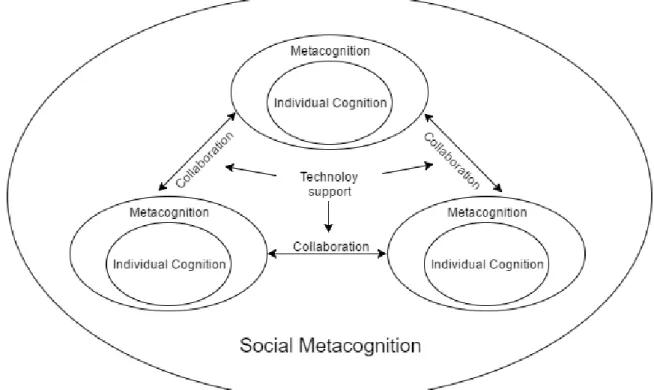
As online learning becomes available in a variety of formats with a variety of tools, there have been more opportunities for CSCL. CSCL enables collaborative knowledge production that supports student achievement over individual learning (Lou, Abrami, & d’Apollonia 2001). While students are engaged in this collaborative learning, they are expected to understand the metacognitive knowledge of the team as a whole, as well as to monitor and plan the group metacognitive functions (Chan, 2012). In other words, to be able to work collaboratively, students must consider their own understanding as it relates to the group, and must use the cognitive strengths of group members to achieve their goals. This understanding and regulation of the group cognitive process is called social metacognition (Chiu & Kuo, 2009; Niess & Gillow-Wiles, 2013). In a CSCL environment, technology can be used to support the
the individuals (see Figure 1). Social metacognition develops through a shared understanding and regulation of the cognitive efforts of the group.
Figure 1. Social Metacognition in a CSCL environment
Researchers need an accurate measure of social metacognition to distinguish it from metacognition and understand the relationship between the two. Accurate measures of social metacognition could allow instructors to measure how technological interventions contribute to social metacognition. Currently, there is not a scale that directly measures social metacognition. CSCL could facilitate this social metacognition to generate the co-regulation of learning to maximize both individual learning and group knowledge production.
Assessing Metacognition
together. Transcript coding of student communication, like in forum discussions, think aloud protocols, and interviews, provides one method of assessing metacognition in learning
environments (Akyol & Garrison, 2011; Lajoie & Lu, 2012; Meijer, Veenman, & van Hout-Wolters, 2006; Papanikolaou & Boubouka, 2010; Winne, 2010). In all of these cases,
researchers collect and categorize student statements either in the online learning environment or to the researchers. For example, a statement may indicate knowledge of cognition or regulation of cognition, prompting researchers to identify additional statements of regulation earlier or later in the course. Likewise, there may be metacognitive statements after a particular technological or pedagogical intervention in the class.
Another method of assessing metacognition is through a self-report instrument. These include the Motivated Strategies for Learning Questionnaire (MSLQ) (Pintrich, Smith, Garcia, & McKeachie, 1991), the Metacognitive Activties Inventory (MAI) (Schraw & Dennison, 1994), and the Awareness of Independent Learning Inventory (AILI) (Elshout-Mohr, van Daalen-Kapteijns, & Meijer 2004). These instruments require students complete a questionnaire, and can be used in pre- and post-test experiments or to compare student metacognitive awareness after various instructional interventions.
These assessment methods have their advantages and disadvantages that will be explored more fully in Chapter 2, but they provide a basis for research into social metacognition. Co-regulation of cognition and shared Co-regulation of cognition, where learners work within the group or as a group, respectively, to monitor, plan, and make decisions, has been analyzed through transcript analysis (Janssen, Erkens, Kirschner, & Kanselaar, 2012; Järvelä, Järvenoja,
et al., 2013). Though assessment of metacognition may appear in the assessment of some co- and shared-regulation research, the assessment of social metacognition is limited at this time. Purpose of the Study and Research Questions
The main purpose of this study is to compare social metacognition for students in an CSCL, information literacy course online and face-to-face to see if they are similar. In CSCL environments, social metacognition, like metacognition, could be positively correlated with student achievement and student retention, but instructors and instructional designers must have an accurate method of measuring social metacognition to research this relationship. This study investigated a measure of social metacognition within CSCL in a higher education environment through the modification of an existing instrument assessing metacognition. The study examined the reliability and validity of the instrument and the parsimonious factor structure of the
measurement. Additionally, the study revealed if the instrument provides information unique to social metacognition. If the instrument was found to be reliable and valid, it could be used by researchers, instructors, and instructional designers to assess and plan technological and
pedagogical interventions in CSCL. If students in online and face-to-face sections of the course had different social metacognitive scores, this could indicate that more intervention is needed in one format than the other to improve social metacognition. This study developed the social metacognitive instrument and compare student social metacognitive scores using the following research questions:
RQ1: To what extent does the two-factor model of metacognition (knowledge of cognition and regulation of cognition) apply to social metacognition? RQ2: What is the relationship between individual metacognition and social
RQ3: To what extent do students in groups in a CSCL environment in higher education agree on their ratings of social metacognition?
RQ4: How does social metacognition for students in an online information literacy course compare to the social metacognition of students taking a face-to-face information literacy course?
These questions will allow for the development and validation of a social metacognition instrument that can be used in CSCL. Additionally, it will allow researchers to see if and how metacognition and social metacognition are related. Finally, it will indicate whether social metacognitive scores differ after the same collaborative project is completed by students in online and face-to-face courses.
Significance of the Study
This study will develop a scale based on the Metacognitive Awareness Inventory that may be used in assessing social metacognition. With the focus on CSCL and social
constructivism, researchers may wish to consider not simply individual cognition and
metacognition, but also social cognition and metacognition. If the instrument proves to be valid and reliable, it can provide a quick assessment method that is less time consuming for
researchers than coding student communication. With a direct measurement of social
metacognition, instructors can quantify how collaborative work contributes to the regulation and understanding of cognition for a group rather than an individual. Understanding the relationship between CSCL environments and social metacognition can assist instructors in making
pedagogical and technological interventions that develop the social metacognition of members working in a group. Researchers and instructors could use this instrument to reveal if students in CSCL environments need scaffolding and direct instruction to develop their social metacognitive
awareness, or if this awareness is developed through collaborative assignments. Additionally, this study will determine the relationship between individual metacognition and social
metacognition. This could allow instructors to determine whether developing individual
metacognition will improve social metacognition, or if social metacognition should be developed separately. Furthermore, this instrument could be used to demonstrate how social metacognition aligns with student performance. While one study found a weaker correlation between
metacognition and online performance (Broadbent & Poon, 2015), more research is needed in this area. This research study will also compare social metacognitive awareness scores of students completing the same collaborative project online and in the face-to-face environment. This could help to indicate whether or not more social metacognitive scaffolding is needed for one environment or the other.
If there are validation issues with the instrument, this will be an important step in finding an appropriate method of assessing social metacognition. Additionally, if there is not a
significant relationship between the social metacognition instrument ratings and the
metacognition instrument ratings, perhaps an entirely new instrument needs to be developed to measure social metacognition.
Although coding can provide a view into social metacognition, students may not always explicitly communicate their metacognitive processes (Snyder & Dringus, 2014). Additionally, since a CSCL environment can be a combination of collaboration with a computer and face-to-face collaboration, some metacognitive processes could be spoken. While there are limitations with a social metacognitive self-report instrument (Winne, 2010), providing another method of assessing social metacognition could allow researchers to triangulate the social metacognitive
activity of students in CSCL through coding, tracking computer activity, and using the instrument.
Ultimately, having a social metacognitive instrument will allow instructors to better develop instruction for CSCL and other collaborative environments. Whether through providing better collaboration scripts, including more individual metacognitive exercises, creating more effective group projects, or a combination of all the above, instructors can deepen student learning through improved pedagogical strategies that support and develop social metacognition both in face-to-face courses and online.
Definition of Terms
Collaborative learning: Group members meet a goal through shared expertise, consensus building, and shared responsibilities (Panitz, 1999).
Computer-supported collaborative learning: A learning environment where students use electronic means to work together and share information (Woo & Reeves, 2007).
Constructivism: An educational theory that proposes that learning occurs when students interact with their environment (Dewey, 1938; Jonassen, 1994).
Cooperative learning: Group members have interdependence and common group goals, but individual and independent effort is required (Smith, 1996).
Information literacy: A set of abilities that allows an individual to interact effectively and ethically with the information environment (ACRL, 2015).
Knowledge of cognition: Part of the two-factor model of metacognition, an understanding of what one knows about one’s own knowledge and learning abilities. Also called metacognitive knowledge (Flavell, 1979; Pintrich, Wolters, & Baxter, 2000).
Regulation of cognition: Part of the two-factor model of metacognition, an ability to control how one learns. Also called metacognitive control (Veenman, Van Hout-Wolters, &
Afflerbach, 2006).
Metacognition: Thinking about one’s own cognitive processes (Flavell, 1979).
Metaliteracy: A recognition of students as both producers and consumers in the information environment (Mackey & Jacobson, 2010).
Social constructivism: An educational theory that proposes that learning occurs through social interaction (Palincsar, 2005; Vygotsky, 1978).
Chapter II Literature Review Technology in Education
To look at the impact of CSCL environments on social metacognition, it is important to understand the history of technology in education. Computers have had a place in the classroom for several decades. While computers were accessible remotely to schools in the 1970s, in the 1980s, microcomputers allowed them to be placed into schools and classrooms (Bigum, 2012). In the 1990s, despite increased access to computers in the classroom, use of these computers did not increase as much as expected (Cuban, 2001). Even in a 2009 survey in the United States, only 69% of the teachers surveyed indicated that they or their students used computers for educational purposes in class “sometimes” or “often”, despite 97% of the teachers having a computer in the classroom (Gray, Thomas, & Lewis, 2010).
Computers and laptops are not the only technology that can be used, with 72% of instructors in the 2009 survey indicating that they used (at least sometimes or often) projectors, 13% indicating that they use videoconferencing sometimes, 57% indicating that they use interactive whiteboards, and 35% indicated that they use classroom response systems (Gray, Thomas, and Lewis, 2010). As technology becomes more dynamic and mobile with
developments like the smartphone and tablets, students not only can engage in self-directed learning (Flewitt, Messer, & Kucirkova, 2015), but they themselves can become digital creators, creating digital stories and other digital content to present information in new ways (Alismail, 2015). While educational technology is not used by every teacher, it has had a large impact on the learning experience of most students in the United States. Students entering higher education
have most likely had an experience with learning with technology before they begin their college classes.
Technology for Online Learning
Educational technologies have also allowed for online learning. While distance
education has been around since the 1700s with correspondence courses, courses taken by mail, being advertised in the early 1700s (Willis, 1993), online courses were offered for the first time in the 1990s (Harting & Erthal, 2005). Online learning itself found its genesis from computer conferencing using Internet capabilities (Garrison, 2009). Online learning is an extension of distance learning that allows access to educational environments despite barriers of location and workplace obligations, but it has provided more opportunities for collaboration and co-learning than traditional distance education (Garrison, 2009). As technologies became more robust to allow for more interaction, not just between students and the content of the course through notes, readings, or lectures, but between students and other students, and between students and the instructor, increased adoption of online learning has occurred in both higher education and K-12 schools.
Online learning provides a flexible means for education regardless of place and time. While online learning may occur formally, it can also be an informal means of providing instruction. Massive Open Online Courses (MOOCs), badges, and online gaming all provide online learning that occurs outside a formal educational environment. Online learning can also be paired with face-to-face instruction, often called blended learning, so that some of the learning occurs through the use of technology in an online environment, and some of it occurs in a
classroom or other in-person environment. Different technologies allow for different levels of interaction and instruction in online learning. For example, discussion boards and forums allow
students and instructors to communicate asynchronously, meaning that the students and instructors do not interact in real time. Instructors can also provide direct instruction through videos, podcasts, and text. For synchronous communication, software like Adobe Connect, Google Hangouts, and GoToMeeting provide a way to integrate video conferencing, chat and polling in real time.
A popular way of providing online instruction is through a Learning Management System (LMS). This contains the tools to provide the entire online learning experience, including not only methods of communication, like voice emails and announcements, but also areas for instructors to place course content, assignment submission areas, spaces for students to post to journals and blogs, and wiki spaces. Many LMSs allow instructors to upload videos, post podcasts, and link to other instructional materials. Blackboard, Canvas, EdModo, and Moodle are all examples of LMSs.
Research on online learning covers a wide variety of topics, including comparison of face-to-face courses, effective teaching strategies, and student and instructor attitudes and preparation. While a meta-analysis has found that online instruction leads to similar or more learning than face-to-face environments, the researchers also found a lack of studies comparing outcomes in K-12 settings (Means, Toyama, Murphy, & Baki, 2013). Empirical research comparing distance education and face-to-face learning outcomes for K-12 students does exist, but much of the experimental and valid studies appear in the literature on higher education (Bernard et al., 2009; Means et al., 2013). More research is needed to confirm that K-12 has similar outcomes when comparing distance and face-to-face instruction. While this study does not address K-12 education, the methods used could be used to explore social metacognition in a K-12 environment.
Online Learning in K-12 Environments
The number of K-12 students enrolled in some sort of online education makes up about 16% of the entire student population (Watson, Pape, Murin, Gemin, Vashaw, 2014). The 2013-2014 school year saw a 6.2% increase in student enrollment from the previous year (Watson et al., 2014). Thirty states and the D.C area have schools that were entirely online in 2014-2015 (Watson et al., 2014). Much of the online education for students comes during high school, with a variety of courses being offered for high school students nationally (Watson et al., 2014). Additionally, online learning allows high school students to enroll in college courses for credit (Picciano, Seaman, Shea, & Swan, 2012).
Despite the growth in K-12 online education over the last twenty years, there remains a lack of evidence-based literature indicating that online learning is as or more effective for
students than face-to-face learning (Barbour, 2013). A meta-analysis of studies comparing online learning with face-to-face learning in online environments found that only fourteen studies collected could be included (Cavanaugh, Gillan, Kromrey, Hess, & Blomeyer, 2004). The meta-analysis found that online students performed as well as students in face-to-face classrooms (Cavanaugh et al., 2004). In a more recent meta-analysis that looked at all levels of students, K-12 students online did perform better than face-to-face students, but the effect size was not significant (Means et al., 2013). Perhaps as strategies for increasing metacognition and social metacognition are used online, comparative studies will show that online learning in K-12 environments are as successful as face-to-face environments.
Technology in the Higher Education Classroom
Like the K-12 environment, computing has had a major impact on higher education, though, like the K-12 environment, the pedagogical impact was slow. Surveys in the 1990s
indicated that lecturing was still used by a majority of the faculty, and that less than a fifth of instructors used computer-supported instruction (Cuban, 2001). It is notable, though, that in 2013-2014, the HERI survey of undergraduate instructors indicated that less than half of the instructors used lecturing as their major instructional approach, and over 50% of faculty used online discussion boards (Eagan et al., 2014).
In a survey of higher education and corporate executives in 2008, online collaboration tools were selected as the most likely to improve the quality of academia in the near future (The Economist Intelligence Unit, 2008). Blogs, wikis, social networking sites, and cloud-based tools like Google Drive provide students various methods of interacting, collaborating, co-creating, and engaging with learning in new ways (Dabbagh & Kitsantas, 2012). Along with allowing for more student-centered learning, new technologies have allowed for expanded offerings of online learning for higher education students. These new methods can impact the way that students interact with each other and with their instructors, which could also have an impact on their social metacognitive skills.
Online Learning in Higher Education
Across institutions of higher education, the importance of online learning has become clearer to their long-term strategy of success (Allen & Seaman, 2013). In the fall of 2011, over 6 million students were taking an online course, and online enrollment continues to increase each year (Allen & Seaman, 2013). In 2012, only 13.5% of institutions surveyed had no courses offered online, and 62.4% had entire programs online (Allen & Seaman, 2013). Nearly 30% of graduate students in the United States were enrolled in distance classes, with 22% in programs entirely online in the fall of 2012 (Ginder & Stearns, 2014). This is double the percentage of undergraduate students in online programs (Ginder & Stearns, 2014). With an overwhelming
majority of institutions of higher education implementing online courses and the majority launching online programs, administrators and researchers have focused on finding methods to best support and encourage students and faculty in online learning.
Barriers continue to exist to online learning in higher education, despite its widespread implementation. In 2012, according to chief academic officers, only about 30% of faculty at higher education institutions believed online learning to be legitimate and valuable (Allen & Seaman, 2013). Additionally, faculty fear that online learning could be used to replace them, are required to invest more time and resources to create effective online learning, and oftentimes do not wish to teach courses that have been pre-created (Bacow, Bowen, Guthrie, Lack, & Long, 2012). Faculty training and support are required to assuage fears of faculty and administrators who venture into online learning.
Students themselves may also experience barriers to learning online. Difficulties with time management and meeting deadlines are frequently cited by students as a reason that they did not complete a course (Kizilcec & Halawa, 2015). Student difficulties with accessing course content and using the technology can also be a barrier to student persistence in a course (Hart, 2012). Additionally, a student’s feeling of isolation between herself and the instructor, along with her isolation from other students, can contribute to a student’s lack of success in an online course (Hart, 2012).
Creating a conducive learning environment online can be difficult because of the distance in space and perhaps also time among learners and teachers. Closing this distance has several pedagogical implications. According to Moore’s (1989) influential definition of interaction, participants in online environments engage in three different types of interaction: learner-content, learner-learner, and learner-instructor. Students benefit most from having interaction at all levels
when taking an online course (Bernard et al., 2009). Instructors must design and facilitate courses that include all three types of interactions to create the most effective learning
environment. Notably, though, student-content interaction and student-student interaction has a greater impact on student learning than student-instructor interaction (Bernard et al., 2009). Thus, instructors of online learning must give students opportunities to engage with both the course content and their peers in the learning process. Collaborative learning through group projects, peer instruction and tutoring, and asynchronous and synchronous discussions provide this peer interaction, and could contribute to social metacognitive abilities.
Information Literacy
With the development of instructional technology comes the abundance of information resources available in a variety of formats, not only in the print form. As information and formats proliferate, students need to understand how to best find the resources that fit their needs.
Information literacy has traditionally been defined as the ability to find, access, evaluate, and use information ethically and effectively (ACRL, 2000). In 1989, the American Library Associated started a Presidential Task Force to investigate information literacy (Cassell & Hiremath, 2011). The American Association of School Libraries (AASL), working with the Association of
Educational Communications and Technology (AECT), developed information literacy standards for students in K-12 in 1998 (Cassell & Hiremath, 2011). In 2000, the Association of College and Research Libraries (ACRL) developed its Information Literacy Competency Standards for
Higher Education. As new technologies allowed for more student participation in being
information creators, some librarians felt that the Standards needed to be revised. In 2015, ACRL developed the Framework for Information Literacy in Higher Education. This new
concepts are necessary to understand a discipline and also transform the way that a student views a discipline (Meyer & Land, 2003). Metaliteracy focuses on students not only as consumers of information, but also as those who share and create information in collaborative environments (Mackey & Jacobson, 2010). As the information environment becomes more participatory and more complex, information literacy requires higher order thinking and metacognitive skills.
Information Literacy Instruction
Information literacy instruction takes place in a variety of venues and is taught by a variety of experts. School media specialists, guided by the AASL standards, work with teachers to acquaint students to research (Cassell & Hiremath, 2011). Academic librarians provide information literacy instruction, guided by the ACRL Standards and Framework, by having “one-shot” sessions where they meet with a class and go over basic research skills, by providing online modules, tutorials, and research guides, and by teaching for credit courses, to name a few. Many of the learning theories that shape the way technology is used in the classrooms are
shaping the way that information literacy is being taught as well. Learning Theories that Support Technology Use
Constructivism
Constructivism is a learning theory that states that students learn through their interaction with their environment. In constructivism, the teacher takes on a role as a facilitator to help the learner interact with their environments, allowing them create new knowledge (Dewey, 1938). For constructivist theorists, experiences create reality rather than vice versa (Jonassen, 1994). For Piaget (1968), a child psychologist influential in constructivist theory, learners must adapt to these experiences either through assimilation or accommodation. Learners have schemas that allow them to understand the world, and as they encounter new information, they either
assimilate it into their existing schemas, or they accommodate the information by creating a new schema (Piaget, 1968). In constructivism, students learn at an individual pace with the assistance of the instructor (Powell & Kalina, 2009). Learning always happens in context (Janssen, Erkens, Kirschner, & Kanselaar, 2010); thus, the focus of education is not to instruct, but to create learning (Barr & Tagg, 1995).
A constructivist approach to teaching means that students’ prior experiences are considered in the construction of the curriculum and that questioning and dialogue are used to generate discussion (Rovai, 2004). In the online environment, the constructivist teacher moves between expert and tutor, providing information and guiding students metacognitively (Rovai, 2004). The constructivist teacher also includes both individual work and group work so that students can become independent and collaborative learners (Rovai, 2004). Since authentic work is a key component of learning from a constructivist viewpoint (Honebein, Duffy, & Fishman, 1993), students should be given an opportunity to apply learning to authentic tasks in an online learning environment (Rovai, 2004). This shift is mirrored in the use of technology in the classroom, with a shift towards using technologies so that students can create content as a manner of authentic and independent learning.
Social Constructivism
Social constructivism, often attributed to Vygotsky (1978), focuses on the interaction of the learner with others. Vygotsky’s social constructivism shows us that individuals create and are created by systems (Wells, 2000). Their involvement in systems allows them to continuously learn and change as they interact with others, bringing in their own knowledge, tools, and
experiences. The classroom should become a “collaborative community” where students work together to explore and solve problems relevant to their situations (Wells, 2000). Because social
constructivism focuses on how social interactions not only generate knowledge, but also the mental models in which learners integrate this knowledge, the individual cannot be considered independently from the social context (Palincsar, 2005).
An important aspect of Vygotsky’s theory is the concept of scaffolding. Children work with adults to move through what is possible for them at their current state of development to the next level (Vygotsky, 1978). The zone of proximal development is the area between these states, and this changes as students become able to accomplish more and more on their own, and the zone of proximal development continues to expand to more difficult or complex skills
(Vygotsky, 1978). The support that a student receives to achieve what they need to learn next is called scaffolding (Powell & Kalina, 2009). Learning also occurs as students interact with each other. For all learners, including adult learners, collaborating allows students to scaffold for each other and learn from their social interactions (Powell & Kalina, 2009). Students achieve more in a collaborative environment than they would have on their own.
For a social constructivist setting up an online course, it is important that the interactions students have with the instructor and other students are meaningful (Woo & Reeves, 2007). Like constructivists, social constructivists believe that learning happens most effectively when
students are faced with authentic tasks and real-world problem solving (Woo & Reeves, 2007). In the computer-supported collaborative environment, students interact with each other using web-based tools to discuss, collaborate, and work on authentic problem-solving (Woo & Reeves, 2007). When students work together in an online environment, they can interact with individuals from different backgrounds who may have different perspectives (Stacey, 2007). This exposure to other ways of thinking is an essential component of social learning.
Social Presence
Social presence refers to the sense that, in a communication scenario, one is communicating with a “real” person (Short, Williams, & Christie, 1976). Social presence depends on two factors, according to Short et al. (1976) in their work on telecommunications: immediacy and intimacy. Immediacy refers to the amount of psychological distance between communicators, what Moore (1993) would call transactional distance. Intimacy relates to
physical closeness (Short et al., 1976). Communicators use body language and nonverbal cues to indicate intimacy to generate social presence, but too much intimacy is uncomfortable, so
individuals adjust to maintain a socially-appropriate level of intimacy (Short et al., 1976). Both intimacy and immediacy can be conveyed in a verbal way (Gunawardena, 1995); personal topics can generate intimacy, and psychological distance can be conveyed with a cold or formal
message.
For CSCL, social presence is necessary for effective collaboration (Gunawardena, 1995). Social constructivism purports that CSCL can encourage the exchange of differing and different ideas in a way that leads to problem-solving and knowledge construction, but this will only be effective if students feel they are part of a learning community (Gunawardena, 1995). In the online environment, social context, like familiarity with others and informal relationships in the CSCL environment, can increase social presence (Tu & McIsaac, 2002). Online communication that is emotive and clear, and interactivity, as already discussed, through immediate, casual, and inviting communication between participants, can also increase social presence (Tu & McIsaac, 2002).
Despite the physical distance of online learners, social presence can still be a strong factor in group cohesion. Undergraduate students conferencing online in a text medium in the
1990s indicated that they were able to feel strong social presence because of the participants’ ability to project an identity, despite the lack of body language (Gunawardena, 1995). Ten years later, undergraduate students in online and face-to-face seminars showed no difference in
perceived social presence (Francescato et al., 2006). Instructors must make an effort to ensure that social presence exists in the online environment. Strategies include responding in a timely manner to student emails, effectively moderating and contributing to discussions, using humor and less-formal methods of communication, making an effort to connect with students in a personal way, and giving students feedback throughout the course can increase social presence (Aragon, 2003). The relationship between social presence and social metacognition could be explored using the instrument developed in this study.
Collaborative Learning
Collaborative learning has already been mentioned as a method of student-student interaction that can increase learning from a social constructivist perspective. As described by the authors of Collaborative Learning Techniques (Barkley, Cross, & Major, 2014),
collaborative learning requires certain qualities: structured group work, effort by all students, and a deepening of knowledge. Students learn more when working together, as seen in a meta-analysis of the literature comparing learning in groups with individual learning at all student levels, including undergraduate, graduate, and professional training (Pai, Sears, & Maeda, 2015).
In a study of the critical thinking ability of students, undergraduates in the collaborative learning group demonstrated better critical thinking skills than those who learned individually, though both groups performed equally well on a recall test (Gokhale, 1995). Students working in collaborative groups to problem solve or carry out a task perform better than students who work individually (Kirschner, Kirschner, & Janssen, 2014). When students are asked to recall
information in groups, however, the groups often perform worse than individuals (Kirschner et al., 2014). In higher education, collaborative learning has been shown to be beneficial to learning for non-majors in an environmental science class (Chace, 2014), students in public speaking courses (Liao, 2014), and for students learning English as a second language
(Pattanpichet, 2011). Collaborative learning is not only supported by current learning theories, but also finds empirical support from the relevant literature. This study may indicate whether collaborative learning contributes to social metacognition.
Cooperative Learning vs Collaborative Learning
While cooperative and collaborative learning have often been used synonymously, many theorists believe they have different meanings (Barkley, Cross, & Major, 2014). Cooperative learning is more structured because it is believed, from a constructivist perspective, that the teacher has the expertise to design a cooperative learning activity that will increase individual knowledge (Barkley, Cross, & Major, 2014). Collaborative learning, on the other hand, includes shared expertise, consensus building, and shared responsibilities in the process (Panitz, 1999). Cooperative learning includes interdependence and common group goals, but students are assessed for their own efforts (Smith, 1996). Collaborative learning requires students to work toward one goal and share one grade (Misanchuk & Anderson, 2001).
Cooperative and collaborative learning positively impacted individual learning achievement in online and blended learning environments in a study of undergraduate and graduate students (Nickel, 2010). Cooperative strategies, however, led to lower group
achievement (Nickel, 2010). This is not surprising given the social constructivist approach of collaborative learning, which means that the group is invested in the entire project, not only the individual outcomes. Students were equally satisfied with either group learning approach
(Nickel, 2010). In an analysis of an online debate, those students in a cooperative (highly structured) group engaged in more critical thinking than did the collaborative (low structure) group (Joung & Keller, 2004). A meta-analysis indicated, however, that in the transfer of knowledge, cooperative and collaborative strategies were equally beneficial (Pai et al., 2015). Additionally, group interdependence, which would be an attribute of collaborative learning, has been shown to lead to increased learning and performance (Kirschner et al., 2014). In this study, students in an information literacy course completed a collaborative assignment that requires interdependence and critical thinking as a way to increase learning.
Collaborative Learning and Information Literacy
As higher-order thinking skills are embraced by instructors of information literacy, more collaborative learning and co-construction of knowledge has been implemented in information literacy instruction. A search for “information literacy” as a subject term in the database Library, Information Science & Technology Abstracts retrieves results from 1973 on, but a search for “information literacy” and “collaborative learning” as subjects in the same database retrieves results starting in 2006; this is a new development and still not widely written about as many of the articles retrieved focus on library spaces that encourage collaborative learning or librarians collaborating with faculty. Still, with the emerging focus on metaliteracy and the ability of students to contribute content to the digital world, more information literacy instructors will move toward collaborative learning where students share resources and engage in a dialogue around their understanding of information (Ravenscroft, 2011; Witek & Grettano, 2013). Students can work collaboratively with research tools that improve metacognitive skills, like collaborative concept mapping tools, social bookmarking, and social annotation tools (Lamb & Johnson, 2009). These “participatory technologies” allow students to negotiate the research
process and co-construct knowledge as they research (Farkas, 2012). Many academic library classrooms have been redesigned to facilitate collaborative learning and student participation in information literacy instruction, and this appears to be a trend that will continue as most libraries in an Association of Research Libraries survey said they had plans to renovate their learning spaces (Brown, Bennet, Henson, & Valk, 2014). Because of the importance of collaborative learning on information literacy instruction, information literacy instructors should facilitate social metacognition so that students are able to meet group goals through shared thinking.
Computer Supported Collaborative Learning (CSCL)
CSCL continues in the line of social constructivism by using technology to support collaborative group work. In CSCL, students participate in knowledge communities using information and communication technology (Lipponen, 2002). Students navigate meaning and understanding together as a way to build shared knowledge (Brodahl, Hadjerrouit, & Hansen, 2011). Instructors take on a role as a collaborative participant and facilitator, rather than the source of knowledge (Hämäläinen, 2012). Computer tools can be used to ensure that students participate in a collaborative way in the construction of knowledge and in determining the
answers to problems (Pear & Crone-Todd, 2002). CSCL does not mean that all instruction occurs online, but that the computer is used as a tool to support collaboration (Stahl, Koschmann, & Suthers, 2006).
In a meta-analysis where students of all levels used computer technology, the learning outcomes of individual students were significantly better when students worked in small groups than when they worked individually (Lou, Abrami, & d'Apollonia, 2001). Collaborative online learning has been found to be as effective in improving knowledge as collaborative learning in a face-to-face environment in a study of ten graduate seminars (Solimeno, Mebane, Tomai, &
Francescato, 2008). In a study of online collaboration comparing the performance of younger and older adults, older adults performed better in the collaborative environment than in the individual environment (Wolfson, Cavanagh, & Kraiger 2014). Younger adults did not see a significantly better or worse performance in the collaborative condition (Wolfson, Cavanagh, & Kraiger, 2014). Collaborative learning can lead to improved student learning, but it must be implemented appropriately to achieve positive results.
Creating an effective CSCL environment can be difficult because merely creating a group project does not ensure that the students are effectively collaborating (Hämäläinen, 2012).
Collaborative scripts provide a way to scaffold appropriate collaborative interactions to improve learning (Hämäläinen, 2012; Kollar, Fischer, & Hesse, 2006). Such structuring of collaborative activity increases social presence and the effectiveness of group work (Aragon, 2003). With CSCL, not only can scripts be useful in managing the collaborative learning process, but online tools can be created and used that ameliorate issues in collaborative learning as well (Figueira & Leal, 2013; Saab, van Joolingen, & van Hout-Wolters, 2012). These tools help to structure and regulate group learning to make them more effective.
Regulation of learning, or metacognition, is very important for CSCL as the group moves through the problem-solving process (Saab, 2012). While there may be a collaboration script, there is no instructor to assist students as they regulate their learning while they are working collaboratively if CSCL is entirely online (Saab, 2012). Some older collaboration scripts for CSCL focused more on how to communicate and coordinate rather than metacognitive skills (Kollar et al., 2006). For example, some collaboration scripts specify a particular task or role that an individual should take (Dillenbourg, 2002). To improve CSCL collaboration scripts, providing metacognitive strategies to generate more effective social regulation could be
beneficial to the group’s ability to generate knowledge. Even without such scripts, participants in CSCL engage in group regulation of learning in a unique manner compared to face-to-face learning because they must make their own thinking explicit to the other members of the knowledge community (Lipponen, 2002). Metacognition plays an important role in CSCL, which has received more attention in the literature recently (Volet, Vauras, Khosa, & Iiskala, 2013). This study will continue this line of inquiry by researching social metacognition in CSCL.
Metacognition in Education
Metacognitive knowledge and regulation do not necessarily predict academic success, but do have a correlation to student achievement (Tosun & Taşkesenligil, 2011). Students at the college level have varying degrees of metacognitive knowledge and abilities to regulate their cognition (Young & Fry, 2012). Within the area of metacognitive knowledge, there are three categories: declarative, procedural, and conditional (Flavell, 1979). Declarative knowledge allows students to identify the types of strategies necessary for various cognitive activities and whether or not they can accomplish these tasks, whereas procedural knowledge focuses on how to use these. Conditional knowledge allows learners to identify the situation that would call for a particular strategy (Pintrich, Wolters, & Baxter, 2000). Strategies can be as simple as
memorizing or as complex as problem solving, but these are accomplished in different ways in different scenarios.
Metacognitive monitoring, part of the regulation of cognition, allows learners to determine how easy or difficult something will be to learn, how well they have learned something, and judging their confidence in knowing something (Pintrich, Wolters, & Baxter, 2000). Other researchers have described metacognitive responsiveness as something similar,
though not precisely the same (Meijer et al., 2013). This can include internal feedback during learning, being receptive to external feedback on one’s own cognitive performance, and a general interest in cognitive performance (Meijer et al., 2013). Metacognitive accuracy is also a component of metacognitive monitoring, where students judge whether or not they have
performed well on an exam or other activity. The elements of metacognition can be seen in Table 1.
Metacognitive control, part of the regulation of cognition, is considered the planning of learning. Learners set goals, determine what strategies they will use, and determine how much time and effort to put into the learning (Pintrich, Wolters, & Baxter, 2000). This is, of course, closely related to both monitoring and knowledge. After monitoring their own understanding, students may then make choices about their own strategies. Students must have metacognitive knowledge to be able to identify strategies for each learning situation.
Table 1
Metacognition
Facet Facet Component Description
Knowledge of Cognition
Declarative Knowledge
Procedural Knowledge
Conditional Knowledge
Knowledge about oneself as a learner and metacognitive strategies
Knowledge about how to use
metacognitive strategies
Knowledge about when and why to use
metacognitive strategies Regulation of
Cognition
Monitoring
Control
Judging performance, confidence, and understanding
Planning learning strategies and setting goals
Metacognitive knowledge and the regulation of cognition may not always be accurate. Individuals may believe that they understand something that they do not, or they may take on learning strategies that are not the most beneficial to them. In several studies, though, positive metacognitive skills correlate to higher academic achievement in higher education (Chang, 2010; Inan, 2013; Lee, Choi, & Kim, 2013; Rampp & Guffey, 1999; Sharma & Bewes, 2011). Some studies have not found a significant relationship between metacognition and student achievement in higher education (Radovan, 2011; Uzun, Unal, & Yamac, 2013). These studies do not all use the same instrument to assess metacognitive strategies. Assessing metacognition in a similar