Volume 35, número 2, 2010 Artigo/Article
a pH optode baSed on tHymol blue:
appliCation to determination of Co
2uSing
floW injeCtion analySiS SyStem
M.D.P.T. Sotomayor1,*, I.M. Raimundo Jr.2, J.J. R. Rohwedder2 and G. Oliveira Neto31. Instituto de Química; Unesp – Araraquara – São Paulo – Brasil 2. Instituto de Química; Unicamp – Campinas – São Paulo – Brasil 3. Secretaria Municipal de Educação – Campinas – São Paulo – Brasil Corresponding author: Maria Del Pilar Taboada Sotomayor - IQ – UNESP
Araraquara, SP - Brazil. e-mail: [email protected]
abstract: An optode based on thymol blue (TB), an acid-based indicator, has been constructed and
evaluated as a detector in FIA system for CO2 determination. The dye was chemically immobili-sed on the surface of a bifurcated glass optical fibre bundle, using silanisation in organic media.
In FIA system, hydrogen carbonate or carbonate samples are injected in a buffer carrier solution,
and then are mixed with phosphoric acid solution to generate CO2, which diffuses through a PTFE membrane, in order to be collected in an acceptor carrier fluid, pumped towards to detection cell, in which the optode was adapted. The proposed system presents two linear response ranges, from 1.0 x 10⁻³ to 1.0 x 10⁻² mol l-1,and from 2.0 x 10⁻² to 0.10 mol l-1. The sampling frequency was 11 sample h-1, with good repeatability (R.S.D < 4 %, n = 10). In flow conditions the optode lifetime was 170 h. The system was applied in the analysis of commercial mineral water and the results obtained in the hydrogen carbonate determination did not differ significantly from those obtained by potentiometry, at a confidence level of 95 %.
Keywords: CO2, FIA, thymol blue, silanisation, pH-optode.
1 - introduCtion
Quantification of carbon dioxide is an im -portant parameter in areas such as medicine, envi-ronmental and industrial process [1,2], principally due to its important role in animal and plants meta-bolism and in the process of photosynthesis. Thus, measurement in vivo or in real time of blood PCO2 in intensive care units is considering an essential parameter in monitoring, diagnosis, and treatment
of critically ill patients subject to surgery [1,2].
In the atmosphere the CO2 presence is the result of plant respiration (production) and photosyn-thesis (consumption). However, human activities, such as heading systems, transportation, industrial
combustion, etc., and natural phenomenas, such as burning and degradation of biomass or volca-nic eruptions, are responsible for much higher le-vels of this gas in some regions [3]. In this sense, CO2 analysis is considered an essential element of environmental research [2]. CO2 determination is also vital in many biochemical industries, where it serves for the process control. The continuous analysis of the fermentation process on line is cri-tical for high product yields, minimal unwanted metabolic by products and an overall optimised control strategy [2].
With the aim of CO2 determination, nume-rous analytical procedures are known in gases and
Ecl. Quím., São Paulo, 35 - 2: 33 - 43, 2010 34
Artigo Article
by spectrophotometry based on pH-indicator sys-tems [4], turbidimetric method [5] and infrared (IR) spectrometry [6,7]. Generally, these metho-dologies are fast and produces reliably quantita-tive results. However, they are expensive, bulky and not very much robust.
It is enough notorious than in all process for determination of CO2, measurements in continuous form will be very convenient. In this
aspect, flow systems become powerful tools; prin -cipally due to they are simple, reliable and allow a high sample throughput. For the other hand, che-mical sensors are excellent devices for coupled in
flow systems.
Between, the chemical sensors,
that based on optical fibres, are usually sensiti -ve, robust, cheap and easily miniaturised [8], also the optical sensors offer the possibility of remote, continuous, multianalyte analysis in low volume locations [2]. Thus, for the CO2 determination numerous optodes have been developed. Since
those reported by Zhujun and Seitz [9] and Optiz
and Lübbers [10] in 1984, based on Severinghaus electrode [11]. In these optodes [12-19], the CO2 molecules diffuse through a hydrophobic membra-ne, which separates the sodium bicarbonate buffer internal solution from the sample, the carbon dio-xide is converted to HCO3- in the internal solution, changing its pH, which one is followed by using
colorimetric or fluorescent pH indicators. Howe -ver, the greater problems in these optodes are the internal solution use to detect the pH variations, and the type of membrane used to separate the in-ternal and the analysed solutions. Consequently, these CO2 optodes present limited lifetime and
long response times [17] difficult their coupling in flow systems.
Due to the drawbacks presented by the op-todes based on Severinghaus principle, gradual
configurations have been proposed in order to ob -tain optodes with response times suitable for use
in flow systems, and also to avoid the use of the
internal bicarbonate solution.
In the pairing method [6,7,20-24], ion-pair between a pH indicator and a phase transfer such as tetraoctylammonium hydroxide is entrap-ment in a layer of hydrophobic material such as si-licone, permeable to CO2 but not for H+ [25]. The-se optodes show extremely fast responThe-se times,
when applied in gas phase measurements, but in liquid phase the sensor should be covered with a permeable membrane for the continuous and pro-longed use [2].
Other configurations including the development of films sensors for CO2
[26-29]; coupled the fibre optic in flow cell contai -ning the indicator in solution [30] and copolyme-rised the dye in polymeric matrices [31]; or still immobilising polysiloxane directly on the glass
optical fibre [32].
Previously, we report [33,34] optodes for pH measurements, constructed immobilised che-mically acid–base indicators in a bifurcated
boro-silicate optical fibre bundle using the silanisation
procedure in organic media. These optodes were
evaluated in several flow systems showed respon -se times and lifetime satisfactory for its u-se in these systems [33], and evaluated in the indirect determination of oxalate in food samples, which the CO2 generated by the enzymatic reaction be-tween oxalic acid and oxalate oxidase [34], was satisfactorily monitored.
Despite of the numerous optodes reported in literature, still exist the necessity to developed new experimental procedures for CO2 determina-tion. In this sense, this work describe the results obtained in the evaluation of the performance of a pH optode based on thymol blue (TB) acid-based dye, chemically immobilised on the glass optical
fibre through silanisation, in the indirect determi -nation of CO2, as an alternative to the other exis-ting methods.
2 - experimental
2.1 - reagents and Solutions
All chemical reagents were of analytical grade. Buffer solutions were prepared using dis-tilled water and the actual pH of the solutions was determined by employing a pH electrode connec-ted to a pH-meter (Micronal B374).
For the construction of the pH optode, nitric acid (Merk), ethanol (Nuclear), o-Xylene (Mallin-ckrodt), 3-aminopropyl-triethoxysilane (Aldrich) and thymol blue (Synth), were used. o-Xylene was previously dried overnight with anhydrous Na2SO4 before using in the silanisation.
2.2 - Construction of tb optode
The optode was constructed as previous-ly described [33,34], by employing a bifurcated
borosilicate optical fibre bundle (5 mm diameter), made with fibres of 70 µm i.d. The surface of the
common end of the optical fibre bundle was ini -tially treated with ethanol, nitric acid and ethanol, and allowed to dry at room temperature. Then, the silanisation was carried out by introducing the common end of the bundle into a 5.0 % (v/v) 3-aminopropyl-triethoxysilane in o-xylene. After this step, the silanised common end was rinsed with o-xylene, in order to eliminate any excess of silane, then with ethanol, to clean off the sol-vent, and allowed to dry at room temperature. The immobilisation of the dye was done by introdu-cing the common end of the bundle into a 0.04 % (w/v) TB solution, containing 8.6 x 10⁻⁴ mol l-1 NaOH, and rinsed with deionised water. After all
this steps the tip of the optical fibers showed an
intense purple colour, indicating that the immobi-lisation was successful.
2.3 - instrumentation
The instrumentation employed in this work consisted of a radiometric source (Oriel 6883), with a quartz-halogen lamp (12 V, 100 W), whose radiation was modulated at 200 ± 2 Hz by means of an optical chopper (Oriel 75152) and focused onto
one arm of the optical fibre bundle. The modula -ted light source was guided to the common end of
the optical fibre, where the TB was immobilised. The reflected radiation was focused onto the en -trance slit of a monochromator (Oriel 77250) and detected by a photomultiplier tube (Oriel 77340),
connected to a lock-in amplifier (Stanford Resear
-ch System SR 510), provided with a pre-amplifier
(Stanford Reasearch System SR 552). The lock-in
amplifier was synchronised to the frequency of the
optical chopper. A PC-AT 486 microcomputer was employed to control the monochromator and the
lock-in amplifier, through an electronic interface
(ADLink ACL-811). Software was written in Mi-crosoft VisualBasic 3.0 to perform these tasks.
2.4 - flow manifold and procedure
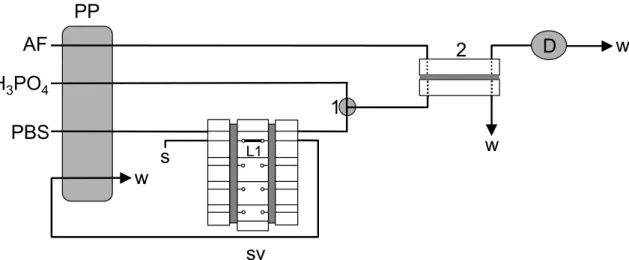
The flow manifold was assembled as sho -wn in Figure 1. Was employing a peristaltic pump (Ismatec IPC8), furnished with tygon tubes to propel the solutions. In the FIA system, hydrogen
carbonate or carbonate samples were injected into
a 0.1 mol l-1 phosphate buffer at pH 7.6 stream (PBS), using a sliding central bar sampling val-ve [35], and then were mixed with a phosphoric acid solution, in order to generate CO2. The CO2 diffused through a PTFE (Black Swam MFG. Co.) membrane placed in the gas diffusion cell “2” [36], and was collected by an adequate acceptor
fluid, which was continuously pumped towards to
detection system “D”, that include the TB
opto-de. The change of the pH in the acceptor fluid,
causes a colour change of the TB immobilised on
the optical fibre bundle, generating a variation in the reflectance intensity, which was proportional
Ecl. Quím., São Paulo, 35 - 2: 33 - 43, 2010 36
Artigo Article
6
fibre bundle, generating a variation in the reflectance intensity, which was proportional to sample
concentration.
Figure 1: Schematic diagram of the flow manifold. PP, peristaltic pump; AF, acceptor fluid; PBS,
phosphate buffer solution; s, sample; L1, loop of sampling; sv, sampling valve; 1,
mixture point; 2, gas diffusion cell; D, detection system and w, waste.
2.5
determination of hydrogen carbonate in mineral water samples
Six commercial mineral water samples collected in the Campinas city (São Paulo – Brazil)
were analysed, in which the total concentration of hydrogen carbonate was determined. Each
sample was injected directly into the FIA system, and the reflectance intensity variation was
monitored. The concentration of hydrogen carbonate in the sample was determined by interpolation,
employing the analytical curve obtained with NaHCO
3standards solutions. These results were
compared with those obtained by potentiometric titration [37], using a pH-meter (Micronal B374)
equipped with a glass electrode. The hydrogen carbonate titration in the samples was carried out
used a 0.0100 mol l
-1HCl standard solution.
3.
reSultS and diSCuSSion
3.1
Characteristics of the thymol blue optode
Thymol blue (TB) was chosen due to its aqueous solution presents two pH regions of colour
change (from 1.2 to 2.8 and from 8.0 to 9.6). On the other hand, studies carried out by Gonçalves et
al.
[4] have demonstrated the efficiency of the TB dye in aqueous solution for CO
2determination,
using FIA system and spectrophotometric detection. When TB was immobilised in a optical fibre
bundle, the pH optode presented two linear response ranges, allowing to detect pH changes from 4.0
PP
sv
AF
H
3PO
4PBS
s
w
w
1
L1D
w
2
figure 1. Schematic diagram of the flow manifold. PP, peristaltic pump; AF, acceptor fluid; PBS, phosphate
buffer solution; s, sample; L1, loop of sampling; sv, sampling valve;1, mixture point; 2, gas diffusion cell; D, detection system and w, waste.
2.5 - determination of hydrogen carbonate in mi-neral water samples
Six commercial mineral water samples col-lected in the Campinas city (São Paulo – Brazil) were analysed, in which the total concentration of hydrogen carbonate was determined. Each sample
was injected directly into the FIA system, and the reflectance intensity variation was monitored. The
concentration of hydrogen carbonate in the sample was determined by interpolation, employing the analytical curve obtained with NaHCO3 standards solutions. These results were compared with those obtained by potentiometric titration [37], using a pH-meter (Micronal B374) equipped with a glass electrode. The hydrogen carbonate titration in the samples was carried out used a 0.0100 mol l-1 HCl standard solution.
3 - reSultS and diSCuSSion
3.1 - Characteristics of the thymol blue optode
Thymol blue (TB) was chosen due to its aqueous solution presents two pH regions of co-lour change (from 1.2 to 2.8 and from 8.0 to 9.6). On the other hand, studies carried out by Gonçal-ves et al. [4] have demonstrated the efficiency of
the TB dye in aqueous solution for CO2 determi-nation, using FIA system and spectrophotometric detection. When TB was immobilised in a optical
fibre bundle, the pH optode presented two linear
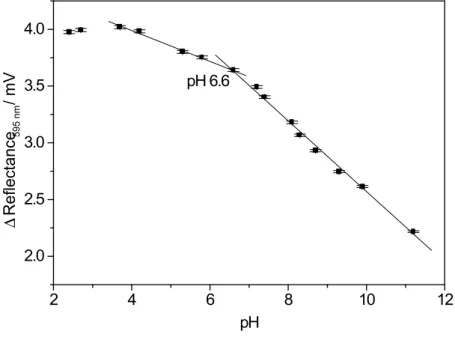
response ranges, allowing to detect pH changes from 4.0 to 11.0 as showed in Figure 2. It is a good result, because generally, optodes based on acid-base dyes presented a response range of two pH units or pKa ± 1. This peculiar profile of the
TB optode can be probably explained considering the TB dye characteristics, which presents two-pH range of colour change in aqueous solutions. The extended ranges can be attributed to the chemi-cal immobilisation of the colorimetric reagent on
different sites of the optical fibre bundle surface,
as explained previously [33], where the indicators molecules can be either strongly or weakly
bon-ded to the optical fibre, resulting in groups with different pKa´s and, therefore, extending the linear pH range. 2 4 6 8 10 12 2.0 2.5 3.0 3.5 4.0 pH 6.6 ∆ Reflectance 595 nm / mV pH
figure 2. TB optode response profile as pH function.
3.2 - optimisation of the fia system
In the determination of the CO2 with the proposed FIA system, parameters such as composition,
pH and concentration of the acceptor fluid (AF) have important effects on the sensitivity and linear response range of the method. Thus, was carry out a study on different acceptor fluids. Solutions of
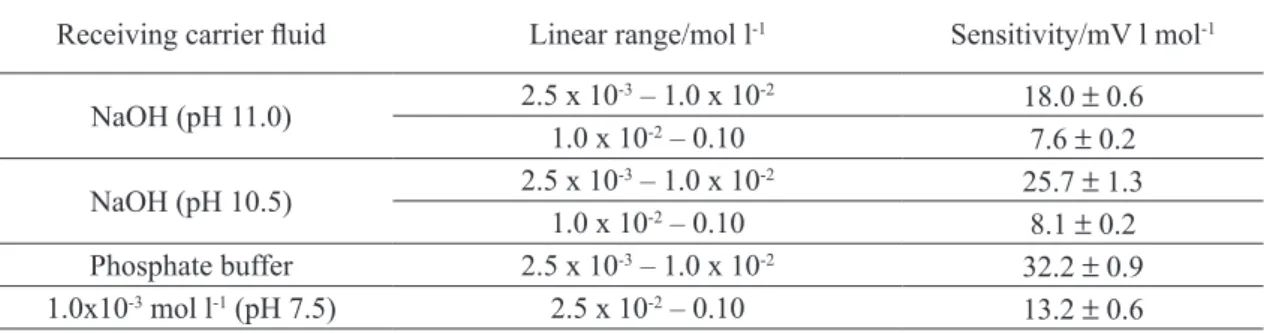
different compositions were employed with pH values in the range from 4.0 to 11.0, considering the color changes of the TB optode. The results obtained with acceptor solutions with pH lower than 5.0 were not reproducible, due to the formation of small bubbles of CO2. For 1.0 x 10⁻³ mol l-1 phosphate buffer solution (pH 7.5) provided the best results for CO2 determination in the FIA system, were ob-tained (Table 1). On the other hand, in basic solutions (pH > 9) a little leaching of the TB immobilised was observed.
Ecl. Quím., São Paulo, 35 - 2: 33 - 43, 2010 38
Artigo Article
table 1. Characteristics of the flow system as a function of pH and acceptor fluid composition (ionic strength adjusted at 0.05 mol l-1 with NaCl).
Receiving carrier fluid Linear range/mol l-1 Sensitivity/mV l mol-1
NaOH (pH 11.0) 2.5 x 101.0 x 10-3 – 1.0 x 10⁻² – 0.10 -2 18.0 ± 0.6 7.6 ± 0.2 NaOH (pH 10.5) 2.5 x 10⁻³ – 1.0 x 10⁻² 25.7 ± 1.3 1.0 x 10⁻² – 0.10 8.1 ± 0.2 Phosphate buffer 2.5 x 10⁻³ – 1.0 x 10⁻² 32.2 ± 0.9 1.0x10⁻³ mol l-1 (pH 7.5) 2.5 x 10⁻² – 0.10 13.2 ± 0.6
Vi = 1.0 ml; flow rate = 2.9 ml min-1 ; acid solution = 0.1 mol l-1 H 3PO4.
The effect of the acceptor fluid ionic strength on the FIA system performance was evaluated.
This study was carried out because is known that optodes constructed using acid-base dyes are sensitive to variation of ionic strength leading to incorrect results [38]. In this study, the ionic strength of the
acceptor fluid was adjusted in 0.01, 0.05 and 0.10 mol l-1 with NaCl. The analytical curves showed in
Figure 3 indicate that the ionic strength adjusted to 0.01 mol l-1 provides the best results, mainly for the more diluted range.
0.00 0.02 0.04 0.06 0.08 0.10 0.0 0.5 1.0 1.5 NaCl 0.01 mol l -1 NaCl 0.05 mol l-1 NaCl 0.10 mol l-1 ∆ Reflectance 595 nm / mV [CO2] / mol l -1
figure 3. Analytical curves obtained in the study carried out to evaluate the influence of the ionic strength of receiving carrier fluid in the FIA system response.
In Table 2 are shows the FIA system characteristics as a function of injected volume (Vi) of sample. Vi equal to 500 µl was used, since it provided good sensitivity and good sampling frequency. However, if the sensitivity must be improved, 1000 µl can be used.
table 2. Sensitivities and sampling frequencies obtained in the linear range from 2.5 x 10⁻² to
0.10 mol l-1, as function of the injected volume(V
i).
Vi / µl Sensitivity / mV l mol-1 Sampling frequency / sample h-1
125 0.8 ± 0.2 13
250 2.5 ± 0.1 12
500 3.6 ± 0.1 11
750 3.7 ± 0.1 9
1000 6.9 ± 0.4 8
AF = 1.0 x 10⁻³ mol l-1 phosphate buffer (pH 7.5), with ionic strength adjusted at 1.0 x 10⁻² mol l-1 with NaCl; 0.10 mol l-1 H
3PO4 acid solution and flow rate = 2.9 ml min-1.
Table 3 shown the results obtained in the study carried out to evaluate the effect of the flow rate on the FIA system performance. Even though the best results were obtained using a flow rate of 1.3 ml
min-1, it was employed a flow rate of 1.6 ml min-1, as a mean of improving the sampling frequency. table 3. Effect of the flow rate of the carrier fluid on the response and sampling frequency. ∆Reflectance at flow rate 1.3 ml min-1 = 0.64 mV; [Na
2CO3] = 0.010 mol l-1.
Flow rate / ml min-1 Sampling frequency/sample h-1 Percentage of reflectance variation
1.3 9 100
1.6 10 72
2.6 11 57
3.5 12 30
AF (acceptor fluid) 1.0 x 10⁻³ mol l-1 phosphate buffer (pH 7.5), with ionic strength adjusted at 1.0 x 10⁻² mol l-1 with NaCl; 0.10 mol l-1 H
3PO4 acid solution and Vi = 500 µl.
The composition of the acidic solution used to generate CO2 was also studied, employing suc-cinate buffer (pH 3.0), H3PO4 and H2SO4 solutions. Results summarised in Table 4 show that 0.5 mol l-1 phosphoric or sulphuric acid solutions provide the best results. Phosphoric acid was chosen in the present work because the signal was greater than that one obtained with sulphuric acid solution. table 4. Reflectance variation for various acid solutions. [Na2CO3] = 0.010 mol l-1.
Confluent fluid H3PO4 /mol l-1 H2SO4 /mol l-1 Buffer
0.5 0.1 0.5 0.1 (pH 3.0)
∆ Reflectance/mV 0.72 ± 0.02 0.64 ± 0.01 0.69 ± 0.01 0.52 ± 0.02 0.35 ± 0.02 *standard deviation for three replicates.
AF (acceptor fluid) 1.0 x 10⁻³ mol l-1 phosphate buffer (pH 7.5), with ionic strength adjusted at 1.0 x 10⁻² mol l-1 with NaCl; flow rate = 1.6 ml min-1 and V
Ecl. Quím., São Paulo, 35 - 2: 33 - 43, 2010 40
Artigo Article
3.3 - fia system performance
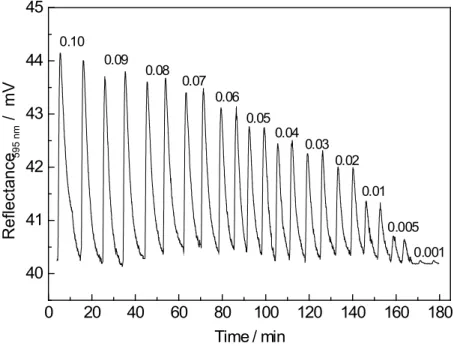
Figure 4 shows a typical response profile for this FIA system and in Figure 5 is showed the cor -responding analytical curves.
0 20 40 60 80 100 120 140 160 180 40 41 42 43 44 45 0.001 0.005 0.01 0.02 0.03 0.04 0.05 0.06 0.07 0.08 0.09 0.10 Reflectance 595 nm / mV Time / min
figure 4. FIA signals obtained in the CO2 determination (values above the peaks indicate the concentration
0.00 0.02 0.04 0.06 0.08 0.10 0.12 0 1 2 3 4 [CO2] = 0.015 mol l-1 Reflectance 595 nm / mV [CO2] / mol l-1
figure 5. Analytical curves obtained in FIA system proposed. Measurements carried out injected 500 µl of samples in a carrier of 0.1 mol l-1 phosphate buffer (pH 7.6) with 0.1 mol l-1 NaCl and 1.0 x 10⁻³ mol l-1 EDTA.
The acid solution was 0.50 mol l-1 H
3PO4 and accepter fluid 1.0 x 10⁻³ mol l-1 buffer solution (pH 7.5) with
1.0 x 10⁻² mol l-1 NaCl in a rate of 1.60 ml min-1.
At Figure 5 it can be observed two linear response ranges, the first from 0.001 to 0.010 mol l-1 and the second response range from 0.020 to 0.10 mol l-1, which presented the following linear regressions, respectively;
∆Reflectance = -0.103(± 0.017) + 109.597(± 2.007) [CO2] (r=0.9991, n=8) (1)
∆Reflectance = 1.115(± 0.033) + 27.164(± 0.621) [CO2] (r=0.9982, n=9) (2)
This peculiar profile of this FIA system can be probably explained considering the response pro
-file of TB optode as a function of pH (Figure 2). When hydrogen carbonate or carbonate samples, are injected the pH of the accepter fluid changes. These pH changes are detected by TB optode, which res
-ponds linearly until the concentration of the sample causes a pH change in the acceptor fluid of 6.6 (see Figure 2). In the proposed FIA system, the injection of samples with concentrations higher than 0.015
mol l-1, causes a pH shift in the acceptor fluid for values smaller than 6.6 (Figure 2), corresponding to the straight line with minor inclination of Figure 5. For concentrations higher than 0.015 mol l-1, a straight line from 0.020 to 0.10 mol l-1 is obtained.
The repeatability of the FIA system was evaluated by ten successive injections of 5.0 x 10⁻² mol l-1 sodium carbonate solutions, obtained a relative standard deviation value (R.S.D.) of 3.5%. This result indicates the good performance of the proposed FIA system.
The TB optode lifetime in flow conditions was c.a. of 17 days, which is in accordance with others
Ecl. Quím., São Paulo, 35 - 2: 33 - 43, 2010 42
Artigo Article
3.4 - determination of Co2 in mineral water samples
The system was evaluated by hydrogen carbonate determination in mineral water. No significant differences were found at a confidence level of 95 %, when the results were compared with those obtai -ned with potentiometric method, as showed in Table 5.
table 5. Results obtained in the determination of hydrogen carbonate concentration in mineral waters by proposed and potentiometric methods.
Sample [HCO3-] / mol l-1
Potentiometric titration Proposed method*
01 1.99x10⁻³ (1.97 ± 0.10) x10-3 02 2.01x10⁻³ (2.04 ± 0.12) x10-3 03 2.67x10⁻³ (2.68 ± 0.01) x10-3 04 2.72x10⁻³ (2.63 ± 0.05) x10-3 05 2.90x10⁻³ (2.92 ± 0.01) x10-3 06 2.02x10⁻³ (1.99 ± 0.01) x10-3
* standard deviation for six replicates
4 - ConCluSionS
The chemical immobilisation of TB dye on a borosilicate optical fibre bundle allowed the prepa
-ration of a pH optode, which presented response times sufficiently short and long lifetime to be used as a
detector in a FIA system. The results show that this system is able to determine satisfactorily carbonate, with good repeatability and accuracy.
acknowledgements
The authors are thankful to FAPESP-Brazil, for the financial support and the CNPq-Brazil for
fellowship to MDPTS.
resumo: Este trabalho mostra a construção de um optodo baseado no indicador ácido – base azul de
timol (TB) e sua aplicação como detector de um sistema para análise por injeção em fluxo (FIA) para
determinação de CO2. O indicador foi quimicamente imobilizado na superfície de um feixe bifurcado
de fibras ópticas de vidro, usando silanização em meio orgânico. No sistema FIA, amostras de carbo
-nato ou bicarbo-nato são injetadas em uma solução tampão carregadora, e a seguir são misturadas com
solução de ácido fosfórico para gerar CO2, o qual se difunde através de uma membrana de PTFE, para
ser coletado em um fluido carregador aceptor, o qual é bombeado em direção à cela de detecção, na qual
encontra-se o optodo. O sistema proposto apresenta duas faixas lineares de resposta, entre 1,0 x 10⁻³ e 1,0 x 10⁻² mol l-1,e entre 2,0 x 10⁻² e 0,10 mol l-1. A freqüência de amostragem foi de 11 amostras h-1,
com boa repetibilidade (R.S.D < 4 %, n = 10). Sob condições em fluxo o tempo de vida do optodo foi de
na determinação de bicarbonato foram similares daqueles obtidos pelo método potenciométrico, a um
nível de confiança de 95%.
palavras-chave: CO2, FIA, azul de timol, silanização,optodo para medidas de pH.
5 - references
[1] M.P. Xavier, G. Orellana, M.C. Moreno-Bondi, J. Díaz-Puente, Quim. Anal. 19 (2000) 118.
[2] A. Mills, K. Eaton, Quim. Anal. 19 (2000) 75.
[3] T.D. Rhines, M.A. Arnold, Anal. Chim. Acta 231 (1990) 231.
[4] R.I. Gonçalves, Determinação da pressão parcial do CO2,
na atmosfera e em água do mar por injeção em fluxo contínuo, com detector espectrofotométrico, Ph.D. Thesis, USP, São Paulo, 1996.
[5] W. Lang, H.U. Wolf, R. Zander, Anal. Biochem. 92 (1979) 255.
[6] G. Neurauter, I. Klimant, O.S. Wolfbeis, Anal. Chim. Acta 382 (1999) 67.
[7] A. Mills, A. Lepre, L. Wild, Sens. Actuators B 38–39 (1997) 419.
[8] K.T.V. Grattan, D. T. Sun, Sens. Actuators B 82 (2000) 40.
[9] Z. Zhujun, R. Seitz, Anal. Chim. Acta 160 (1984) 305. [10] N. Optiz, D.W. Lübbers, Adv. Exp. Med. Biol. 180 (1984) 757.
[11] J.W. Severinghaus, A.F. Bradley,J. Appl. Phys. 13 (1958) 1574.
[12] M.D. DeGrandpre, M.M. Baehr, T.R. Hammar, Anal. Chem. 71 (1999) 1152.
[13] J.W. Parker, O. Laksin, C.yu, M.L. Lau, S. Klima, R. Fisher, I. Scott, B.W. Atwater, Anal. Chem. 65 (1993) 2329. [14] M.B. Tabacco, M. Uttamial, M. McAllister, D.R. Walt, Anal. Chem. 71 (1999) 154.
[15] C. Goyet, R. David, R. Walt, P.G. Brewer, Deep-Sea Res. 39 (1992) 1015.
[16] M.F. Choi, P. Hawkins, Anal. Chim. Acta 309 (1995) 27. [17] M.D. DeGrandpre, Anal. Chem. 65 (1993) 331. [18] C. Munkholm, D.R. Walt, F.P. Milanovich, S.M. Klainer, Talanta 35 (1988) 109.
[19] O. S. Wolfbeis, Fibre Optic Chemical Sensors and Biosensors, CRC Press, Boca Raton, 1991.
[20] B.H. Weigl, A. Holobar, W. Trettnak, I. Lklimant, H. Kraus, P. O’Leary, O.S. Wolfbeis, J. Biotechnol. 32 (1994) 127.
[21] B. Müller, P.C. Hauser,Analyst 121 (1996) 339. [22] G.J. Mohr, T. Werner, I. Oehme, C. Preininger, I. Klimant, B. Kovacs, O.S. Wolfbeis, Adv. Mater. 9 (1997) 1108. [23] C. Mallins, B.D. McCraith, Analyst 123 (1998) 2373. [24] H.N. McMurray, J. Mater. Chem. 2 (1992) 401. [25] J. Lin, TrAC, Trends Anal. Chem. 19 (2000) 541.
[26] y. Kawabata, T. Kamichika, T. Imasaka, and N. Ishibashi, Anal. Chim. Acta 219 (1989) 223.
[27] A. Mill, L. Monaf, Analyst 121 (1996) 535.
[28] B.H. Weigl, A. Holobar, N.V. Rodriguez, O.S. Wolfbeis, Anal. Chim. Acta 282 (1993) 335.
[29] C. Malins, H.G. Glever, T.E. Keyes, J.G. Vos, W.J. Dressick, B.D. MacCraith, Sens. Actuators B 67 (2000) 89. [30] G. Orellana, M.C. Moreno-Bondi, E. Segovia, M.D. Marazuela, Anal. Chem. 64 (1992) 2210.
[31] C. Munkholm, D.R. Walt, F. Milanovich, Talanta 35 (1988) 109.
[32] I. Kasik, M. Pospísilová, V. Matejec, M. Chomát, K. Rose, L. Sasek, Book of Abstracts of the Europt(r)ode IV, 1998, sII11a.
[33] P.T. Sotomayor, I.M. Raimundo Jr., G. Oliveira-Neto, W.A. Oliveira, Sens. Actuators B 51 (1998) 382.
[34] M.D.P.T. Sotomayor, I.M. Raimundo Jr., G. Oliveira-Neto, L.T. Kubota, Anal. Chim. Acta 447 (2001) 33. [35] H. Bergamin Fo, J.X. Medeiros, B.F. Reis, E.A.G.
Zagatto, Anal. Chim. Acta 101 (1978) 9.
[36] O.J. Hall, R.C. Aller, Limnol. Oceanogr. 37 (1992) 1113.
[37] A. Vogel, Quantitative Chemical Analysis, Longman Group, England, 5nd edn., 1989, pp. 278-279.
[38] M.J.P Leiner, P. Hartman, Sens. Actuators B 11 (1993) 281.