Department of Teaching, Learning and Teacher Education
Department of Teaching, Learning and Teacher Education
7-2016
LinguaFolio® Implementation at the Classroom
Level: A Collective Case Study of North Carolina
Teachers
Amanda Romjue
University of Nebraska-Lincoln, [email protected]
Follow this and additional works at:http://digitalcommons.unl.edu/teachlearnstudent Part of theEducational Methods Commons
This Article is brought to you for free and open access by the Department of Teaching, Learning and Teacher Education at
DigitalCommons@University of Nebraska - Lincoln. It has been accepted for inclusion in Theses, Student Research, and Creative Activity: Department of Teaching, Learning and Teacher Education by an authorized administrator of DigitalCommons@University of Nebraska - Lincoln. Romjue, Amanda, "LinguaFolio® Implementation at the Classroom Level: A Collective Case Study of North Carolina Teachers" (2016).Theses, Student Research, and Creative Activity: Department of Teaching, Learning and Teacher Education. 68.
LinguaFolio® Implementation at the Classroom Level A Collective Case Study of North Carolina Teachers
by
Amanda Romjue
A DISSERTATION
Presented to the Faculty of
The Graduate College at the University of Nebraska In Partial Fulfillment of Requirements For the Degree of Doctor of Philosophy
Major: Educational Studies
Under the Supervision of Professor Aleidine J. Moeller Lincoln, Nebraska
LINGUAFOLIO® IMPLEMENTATION AT THE CLASSROOM LEVEL A COLLECTIVE CASE STUDY OF NORTH CAROLINA TEACHERS
Amanda Romjue, Ph.D. University of Nebraska, 2016 Advisor: Aleidine J. Moeller
LinguaFolio® is a language learning portfolio with a rich history rooted in educational research. This study explores the evolution of LinguaFolio®, a learning and self-assessment tool whose origins can be traced back to the European Language
Portfolio (ELP). LinguaFolio® is a learning tool designed to promote self-regulated language learning through goal-setting, task-based language learning, and self-assessment and reflection. This study examined the implementation of LinguaFolio® by five
experienced, exemplary teachers in order to better understand how LinguaFolio® can best be integrated into the language classroom.
LinguaFolio® is a highly customizable language learning portfolio that teachers are encouraged to adapt to their own individual contexts. The gap in the literature that this study proposes to fill is to provide illustrative examples of teacher practice with LinguaFolio®. This collective case study presents five cases of LinguaFolio® implementation in classrooms in North Carolina. Data was collected by observing
teachers in their classrooms, interviewing teachers to discuss their insights, and document collection and analysis to provide further inspiration for using LinguaFolio®.
The overarching question this study sought to answer was “How does LinguaFolio® implementation work at the classroom level?” In order to provide
perspectives on this question, five cases of implementation are presented as narrative descriptions of the observation, interviews, and documents collected in this study. Next an analysis of each case is presented, guided by the supporting research questions of this study. A cross-case analysis of the practices of the participants were situated within a framework developed throughout the literature review, the Simplified Implementation Cycle. Finally, the study concludes by reconsidering the overarching research question, considering the limitations of the study, presenting a set of suggestions for teachers wishing to implement LinguaFolio®, and directions for future research.
Keywords: LinguaFolio®, teaching methodology, language learning, self-regulated learning, autonomy, motivation, goal-setting, reflection, instructional technology
DEDICATION
This dissertation is dedicated to my daddy, Steve Goins, whose unconditional love inspired me to always keep reaching for the life I wanted. He will always be missed.
ACKNOWLEDGEMENTS
In the fall of 2010, I found great inspiration in a keynote speech given by Dr. Ali Moeller at a conference in North Carolina. As soon as she had finished speaking, I was compelled to approach her. The following year, I moved halfway across the country to study under her incomparable tutelage. I am so grateful to have become one of her students. Dr. Moeller exemplifies the heart of education. She has always been concerned with how I was developing as an entire person, not just a doctoral student. Her
encouragement and support has been vital to my learning experience. She always made sure I had what I needed to be successful. The opportunities I was exposed to were invaluable to my personal and professional growth. There are no words to fully express my gratitude to my dissertation chair, my advisor, my role model, and my friend, Dr. Ali Moeller.
The faculty I worked with at the University of Nebraska-Lincoln were absolutely top notch. I am grateful for every course and every professor. In particular, I would like to thank my committee members for facilitating this final piece of my doctoral
experience. Dr. Al Steckelberg, my instructional technology guru, has been guiding me and causing me to rethink my assumptions about learning since my very first semester of the program. So many things I have learned and am able to apply in my daily
professional work are thanks to Dr. Steckelberg’s guidance. Dr. Theresa Catalano is the single most exuberant professor it has been my pleasure to meet. Her classes were always both entertaining and educational. I learned so much from her about being a teacher and showing students that they are valued as individuals. Along with Dr. Moeller, Dr.
Catalano helped to make me a kinder and more considerate teacher. I appreciate Dr. Isabel Velázquez and her willingness to support this study, giving an outside perspective to strengthen my research. Aside from my wonderful committee members, I wish to acknowledge other faculty members who had a great deal of influence on my journey through courses and professional interactions: Dr. Ted Hamann, Dr. Guy Trainin, Dr. Margaret Latta, Mr. Bill Latta, Dr. David Brooks, and Dr. Wayne Babchuk. In addition to wonderful faculty members, UNL was blessed with several wonderful staff members whom I could not have done without. My thanks to Marjorie Bisbee, Shari Daehling, and Jess Hustad for always being so helpful and kind. Dr. Pat Tetreault, thank you for helping me see the world more clearly and for supporting me as I stumbled through learning and growing into more awareness of myself and others.
A cohort can make or break an educational experience. The friends I made while studying at UNL made the experience so much more for their willingness to support and work with me. My gratitude and love for you is without end. We had classes together, we worked together, and we shared one of the most challenging and blessed journeys
possible. My congratulations to those of you who finished before me and the best of luck to those of you still struggling toward this goal. I must extend a special thank you to those of you who took the time to encourage and support this study. Tricia Gray, Jess Sierk, and Kristen Nugent, thank you for all your feedback. Tricia Parker, Kristine Sudbeck, Jen Stacy, and Sam Zeitner, thank you for helping me still feel connected after I moved away. Aaron Musson, you probably don’t even remember, but thank you for helping me get started on the long arduous process of IRB approval! Megan Van Alstine, thank you for always making me laugh. Sarah Osborn, you were my academic soulmate and I miss you
every single day. Carolina Bustamante, thank you for being my big sister and mentor throughout my doctoral studies. Janine Theiler, Sheri Hurlbut, Oxana Clarke, Andrew Hustad, Nick Ziegler, Fei Yu, and Nan Chen, thanks for making me feel like part of the Ali family. Cohort really does not do justice to the group of doctoral students that Dr. Ali Moller puts together. We are family.
The participants in this study have my sincere gratitude forever. They invited me into their classrooms. They gave of their precious time to talk with me. It is thanks to these five wonderful women that this study can serve its intended purpose. It was an honor and privilege to witness the great work you do to help the next generation every single day. I hope my report does you adequate justice. From the bottom of my heart, I thank you.
Lastly, my heartfelt thanks go out to my family, colleagues, and friends. To those who read for me, Judson MacDonald, Bethanie Lister, Dayna Brower, and Heather Thompson, thank you so much for helping me keep calm in the final days and finish up my edits. To my brother and best friend, Morgan Prince, you keep me sane. Thank you for always being there for me. To my innumerable family and precious friends who always support me and love me, thank you. To my beautiful mom, Sherry, thank you for being there for me. Your love and encouragement mean the world to me. To my darling
boykid, Jake, I am so glad to have you in my life. To my wonderful husband, John, I would never have been able to do this without your love and support. You are the light of my life. In the end, it’s just you and me, always.
TABLE OF CONTENTS
CHAPTER 1 INTRODUCTION ... 1
The European Language Portfolio ... 3
LinguaFolio® ... 6
Researcher Connection ... 14
Research Problem ... 17
Purpose Statement ... 18
Significance of the Proposed Study ... 18
Research Questions ... 19
CHAPTER 2 LITERATURE REVIEW ... 21
Introduction ... 21
The Mapping Phase ... 24
Motivation theories. ... 25
Why are we learning? ... 32
What are we learning? ... 33
The Traveling Phase ... 36
How am I getting there? ... 36
How is the journey going? ... 41
The Unwinding Phase ... 42
How can I best showcase my journey for others? ... 42
CHAPTER 3 METHODS ... 46
Introduction ... 46
Philosophical Positioning ... 48
Constructivism. ... 48
Pragmatism. ... 50
Case Study Research ... 52
Unit and structure. ... 53
Philosophical framework. ... 54
Purpose. ... 55
An Instrumental Case ... 56
A Collective Case Study ... 57
Participants ... 57
Ethical Considerations ... 58
Do no harm. ... 59
Privacy and anonymity. ... 60
Confidentiality. ... 60
Informed consent. ... 61
Rapport and friendship. ... 61
Intrusiveness. ... 62
Data interpretation. ... 62
Data ownership and rewards. ... 63
Other issues. ... 64
Data Collection ... 65
Observations. ... 65
Interviews. ... 66
Data Analysis ... 67
Validation Strategies ... 68
Writing the Report ... 69
CHAPTER 4 CASES ... 72 Introduction ... 72 Madeline ... 73 Observation. ... 73 Interview. ... 92 Documents. ... 102 Analysis... 122 Caroline ... 127 Observation. ... 127 Interview. ... 145 Documents. ... 153 Analysis... 181 Helen ... 185 Observation. ... 185 Interview. ... 195 Documents. ... 203 Analysis... 215 Ivy ... 219 Observation. ... 219
Interview. ... 228 Documents. ... 232 Analysis... 240 Lucy ... 242 Observation. ... 242 Interview. ... 252 Documents. ... 261 Analysis... 275
CHAPTER 5 CROSS-CASE ANALYSIS ... 279
Introduction ... 279
The Mapping Phase ... 280
The Traveling Phase ... 282
The Unwinding Phase ... 286
Conclusion ... 287
CHAPTER 6 DISCUSSION ... 288
Summary of the Study ... 288
Findings and Assertions ... 290
Motivation and Goal-Setting. ... 290
Target Language Use and Task-Based Language Teaching. ... 291
Guided Reflection and Self-Assessment. ... 291
Conclusion ... 292
Limitations ... 293
Future Research ... 297
REFERENCES ... 302
Appendix A: Institutional Review Board Approval ... 324
Appendix B: Summary of Nine ELP Studies ... 326
Appendix C: Recruitment Email ... 329
Appendix D: Informed Consent Form ... 330
Appendix E: Field Note Template ... 332
Appendix F: Semi-structured Interview Protocol ... 333
Appendix G: Optional Permission for Use of Classroom Materials ... 334
TABLE OF FIGURES
Figure 1: The European Language Portfolio Timeline ... 4
Figure 2: LinguaFolio® Timeline ... 8
Figure 3: LinguaFolio® Screenshots ... 12
Figure 4: Simplified Implementation Cycle ... 23
Figure 5: NCSSFL-ACTFL Global Can-Do Benchmarks ... 34
Figure 6: Kentucky's Core Performance Competencies ... 39
Figure 7: Sample Learning Targets - Novice ... 39
Figure 8: Mitigating Risks to Participants ... 60
Figure 9: Madeline's Classroom ... 74
Figure 10: Interactive Notebook Checklist ... 75
Figure 11: Interactive Notebook Tabs ... 76
Figure 12: Memes on Madeline’s Wall ... 77
Figure 13: Objetivos - Unidad: La Ropa ... 78
Figure 14: La descripción de Luisa ... 79
Figure 15: Proficiency Levels on Madeline's Wall ... 81
Figure 16: 5-Question Peer Interview Chart ... 84
Figure 17: Madeline's Wordle ... 89
Figure 18: Día de los Muertos Cultural Comparison ... 95
Figure 19: Example of Fluency Levels - Using Gusta ... 97
Figure 20: First Five Meme Examples ... 104
Figure 22: Objetivos - Unidad: La Ropa ... 114
Figure 23: Proficiency Levels on Madeline's Wall ... 115
Figure 24: Example of Fluency Levels - Using Gusta ... 116
Figure 25: Interactive Notebook Checklist ... 117
Figure 26: Interactive Notebook Tabs ... 118
Figure 27: 5-Question Peer Interview Chart ... 118
Figure 28: La descripción de Luisa ... 119
Figure 29: Madeline's Wordle ... 120
Figure 30: Día de los Muertos Cultural Comparison ... 121
Figure 31: Caroline's Classroom ... 128
Figure 32: Grumpy Cat Meme ... 129
Figure 33: Your Path to Proficiency ... 130
Figure 34: ACTFL Upside-Down Pyramid ... 131
Figure 35: Caroline’s ACTFL 5 C's ... 132
Figure 36: Caroline's Lesson Objectives ... 133
Figure 37: SMART Acronym ... 134
Figure 38: Caroline's High Frequency Poster ... 135
Figure 39: Answering Questions ... 136
Figure 40: Conexiones Sociales ... 137
Figure 41: Tweets in Spanish Display ... 137
Figure 42: Apps for Learning ... 138
Figure 43: Caroline's Choice Board ... 139
Figure 45: Las Actividades de PeeWee ... 143
Figure 46: Authentic Tweets ... 144
Figure 47: Jefferson County's Can-Do Circles ... 146
Figure 48: Caroline's New Learning Targets ... 148
Figure 49: Learner Profile ... 149
Figure 50: Google Doc Embedded in CMS ... 152
Figure 51: Caroline's ACTFL 5 C's ... 154
Figure 52: ACTFL Upside-Down Pyramid ... 155
Figure 53: ACTFL Oral Proficiency Levels in the Workplace ... 157
Figure 54: Your Path to Proficiency ... 158
Figure 55: SMART Acronym ... 160
Figure 56: Caroline's Lesson Objectives ... 161
Figure 57: Jefferson County's Can-Do Circles ... 163
Figure 58: Caroline's New Learning Targets ... 164
Figure 59: Learner Profile ... 165
Figure 60: Google Doc Embedded in CMS ... 166
Figure 61: Answering Questions ... 168
Figure 62: Caroline's High Frequency Poster ... 169
Figure 63: Apps for Learning ... 170
Figure 64: Conexiones Sociales ... 171
Figure 65: Tweets in Spanish Display ... 172
Figure 66: Authentic Tweets Handout page 1 ... 173
Figure 68: Caroline's Choice Board ... 176
Figure 69: Caroline's Digital Choice Board ... 177
Figure 70: Escribe - Choice Board Example ... 178
Figure 71: Habla - Choice Board Example ... 179
Figure 72: Blank Memes ... 179
Figure 73: Las Actividades de Pee Wee ... 181
Figure 74: Serment D'Allégeance ... 186
Figure 75: Helen's Historical Timeline ... 186
Figure 76: The Eiffel Tower in twinkle lights ... 187
Figure 77: Helen's Agenda ... 187
Figure 78: Mad Lib ... 188
Figure 79: Modern Language Exit Proficiency Expectations ... 197
Figure 80: Google Form Video Listening Assessment ... 199
Figure 81: Helen's Can-Do Statements ... 200
Figure 82: Open-ended Reflections ... 201
Figure 83: Court Baker Assignment ... 202
Figure 84: Rubric for Court Baker Assignment ... 203
Figure 85: Serment D'Allégeance ... 204
Figure 86: Helen's Historical Timeline ... 205
Figure 87: Helen's Doodles to Facilitate CI ... 206
Figure 88: Helen's Can-Do Statements ... 207
Figure 89: Open-ended Reflections ... 208
Figure 91: Mad Lib ... 210
Figure 92: Videos about Louis XIV ... 210
Figure 93: Other Assignments about Louis XIV ... 211
Figure 94: Devoirs ... 212
Figure 95: Google Form Video Listening Assessment ... 213
Figure 96: Court Baker Assignment ... 214
Figure 97: Rubric for Court Baker Assignment ... 215
Figure 98: Ivy's ACTFL 5 C's ... 220
Figure 99: Ivy's Instagram/Selfie Board ... 220
Figure 100: Ivy's Olympic Flame of Proficiency ... 221
Figure 101: Ivy's Lesson Agenda ... 222
Figure 102: Ivy's Listening Follow-Up Activity ... 224
Figure 103: Ivy's Complex Sentences Handout ... 225
Figure 104: Ivy's Can-Do Statements ... 229
Figure 105: Ivy's ACTFL 5 C's ... 233
Figure 106: Ivy's Olympic Flame of Proficiency ... 234
Figure 107: Ivy's Can-Do Statements ... 235
Figure 108: Ivy's Lesson Agenda ... 236
Figure 109: Ivy's Listening Follow-Up Activity ... 236
Figure 110: Ivy's Complex Sentence Handout ... 237
Figure 111: Ivy's Instagram/Selfie Board ... 238
Figure 112: Lucy's Whiteboard ... 243
Figure 114: Fiesta Map of School ... 245
Figure 115: Escribir IPA Chart ... 248
Figure 116: Nearpod Question Example ... 250
Figure 117: AAPPL Measure Performance Scores ... 254
Figure 118: Interpersonal Speaking/Listening Descriptors ... 255
Figure 119: IPA Charts ... 258
Figure 120: Lucy's Whiteboard ... 262
Figure 121: Lucy's High Frequency Verbs ... 263
Figure 122: Lucy's High Frequency Verbs: Va ... 265
Figure 123: Novice Mid Screen ... 266
Figure 124: Fiesta Map of School ... 266
Figure 125: Novice High Screen ... 267
Figure 126: Escribe en Cinco #2 ... 268
Figure 127: Nearpod Answers ... 269
Figure 128: Nearpod Question Example ... 270
Figure 129: IPA Charts ... 271
Figure 130: Interpersonal Speaking/Listening Descriptors ... 272
Figure 131: Interpretive Reading & Listening Descriptors ... 273
Figure 132: Presentational Writing Descriptors ... 274
Figure 133: Simplified Implementation Cycle ... 279
In an age of standardized testing that produces an overabundance of data which can confuse even the most experienced teachers, how can teachers and students be expected to understand what students know and are able to do? Now imagine an environment where teachers empower students with learning strategies to modify their study habits, optimize their own learning, and self-assess their progress. If teachers could motivate students to take responsibility for their own learning and teach them the skills to keep learning outside the classroom, what would be out of students’ reach? Research into how learning happens has broadened our understanding of pedagogy to emphasize learning as a phenomenon that occurs within the neural networks of each individual learner (Shell et. al, 2010). That is to say, learning is something done by the learner, not something which a teacher can do to a learner. The implication for classroom teachers is that their role in the classroom shifts from a provider of content knowledge to a facilitator of learning. Within the field of language learning, a tool has emerged, first in Europe and later in the United States, which provides a framework to develop a learning environment that centers on teachers placing students in the driver's seat on their lifelong journey towards language acquisition (Ciesielkiewicz & Coca, 2013; Council of Europe, 2001; Cummins, 2007; LinguaFolio®, 2013; Little, 2003; Little, Goullier, & Hughes, 2011; Moeller, Scow, & Van Houten, 2005; Moeller, Theiler, & Wu, 2012; Schärer, 2007; Stoicheva, Hughes, & Speitz, 2009).
When teachers empower students to take charge of their own learning and extend that learning beyond the classroom environment, these students are referred to as either self-regulated learners or autonomous learners. In more general educational research, the
term “self-regulated learning” appears to be more common, whereas the term “learner autonomy” tends to be used more frequently in research specific to language learning. These terms will be defined and used interchangeably throughout this work. Learner autonomy occurs when teachers help learners to take responsibility for their own learning (Holec, 1981; Little, 2004). Zimmerman (2008) defined self-regulated learning (SRL) as “the self-directive processes and self-beliefs that enable learners to transform their mental abilities, such as verbal aptitude, into an academic performance skill, such as writing,” opposing a focus on “measures of mental ability or academic performance skill” (p. 166). Learning occurs within the brain of each individual student when neural pathways are reinforced (Shell, et. al., 2010); therefore, learning is something that must be done by a student, not something that can be done to a student. In other words, teachers must focus on helping their students develop strategies to become self-regulated learners. While Shell et. al. (2010), as well as other educational researchers, pointed out that a great deal of learning is incidental, the type of learning that teachers are concerned with is
intentional learning and requires a conscious effort by the student. Drawing from the definition from Zimmerman (2008), a focus on “self-directive processes and self-beliefs” (p. 166) is a critical consideration that teachers need in order to get students from the capacity to learn to the demonstration of learning. It is the learner who must do the mental work of learning and the teacher who must become the facilitator of those processes. This is why learner autonomy must be a primary goal in education (Candy, 1991).
LinguaFolio® is a framework for language learning and assessment designed to help teachers build student empowerment and autonomous learning (NCSSFL, 2014).
LinguaFolio® and its European predecessor, the European Language Portfolio (ELP), are accumulating a growing body of research, both empirical and anecdotal, that provides evidence that these tools promote self-regulated learning and academic achievement (Burton & Swain, 2014; Ciesielkiewicz & Coca, 2013; Little, 2009a; Little, 2003; Little, Goullier, & Hughes, 2011; Moeller, Theiler, & Wu, 2012; Ziegler, 2014; Ziegler & Moeller, 2012). Foreign language pedagogy is sometimes referred to as a swinging pendulum where various methods and tools are adopted, implemented, and discarded regularly (Long, 2009). LinguaFolio® is based on research that supports the conclusion that with appropriate advocacy and continued work it can stand the test of time. This study showcased five examples of what form LinguaFolio® implementation might take and an analysis of the similarities of these cases of implementation. The University of Nebraska-Lincoln Institutional Review Board certified this study as exempt on June 24, 2015 (see Appendix A: Institutional Review Board Approval). A brief history of the origins of LinguaFolio® and the ELP tells the story of a well-designed framework that supports autonomous language learning.
The European Language Portfolio
A quick visual and contextual representation of the ELP from 1991 to 2011 is featured in Figure 1: The European Language Portfolio Timeline. The timeline is developed primarily from Little et. al. (2011) and reveals the story of the evolution towards of the ELP which would eventually lead to the development of LinguaFolio®.
Figure 1: The European Language Portfolio Timeline
The 1991 Rüschlikon Symposium was the birthplace of a new framework and assessment tool for language learning. The Common European Framework of Reference for Languages (CEFR) and the European Language Portfolio (ELP) were born from a desire to promote language learning with emphasis on a “respect for linguistic and cultural diversity, mutual understanding beyond national, institutional and social boundaries, the promotion of pluralingual and intercultural education, and the development of the autonomy of the individual citizen” (Little, Goullier, & Hughes, 2011, p. 5). Across Europe there was an increasing need for heterogeneous communities to develop communicative and intercultural competences to facilitate daily life. A shift arose from the nebulous idea of fluency toward valuing pluralingualism. Whereas the
former connotes some distant native-like capacity, the latter focuses on what is necessary for each individual’s particular circumstances. By focusing on an individual’s daily needs from work and school to basic sustenance, goals for learning could be identified and developed. The Common European Framework of Reference for Languages (CEFR) offers a common language for understanding language learning across diverse settings. It describes, in a comprehensive, contextual manner, what learners need to be able to do with a language in order to reach various stages of proficiency (Council of Europe, 2001). Along with the ELP, the CEFR focuses language learning in a manner that is
communicative, translatable across a variety of institutions and nations, continual, pluralistic, and culturally contextual (Little, et. al., 2011). This leads toward learner autonomy for the vital goals of a more educated democratic citizenry and lifelong learning.
The 1991 draft of the CEFR was followed by a second draft presented in 1997. The second draft was accompanied by a preliminary study on the implementation of the ELP. There were various pilot studies conducted in fifteen Council of Europe member states and three international non-government organizations (INGO's) from 1998-2000. The ELP Validation Committee was formed in 2000 to review and evaluate the various forms of the ELP being used. In 2001, the European Year of Languages began. It was an opportunity created to promote language learning throughout Europe and beyond. The first ELP seminar was held in Coimbra, Portugal, in 2001 and was followed by seven additional seminars from 2001-2009 in Italy, Luxembourg, Istanbul, Madrid, Moscow, Lithuania, and Austria. Additionally, during this time period a bank of Can-Do
various levels of language proficiency. Nine ELP implementation projects reports were collected and published by Little (2003). Regular progress reports were made at the European level by Rolf Schärer, rapporteur general. In 2007, Schärer estimated that more than 2.5 million individual ELPs existed. By the end of 2010, 118 ELPs had been
validated from 32 member states and six INGOs at all levels of education and ages of learners. In 2011, an online registration system went live for self-declaration of ELP use.
The ELP is highly customizable to the various contexts in which it is used (Council of Europe, 2001). The emphasis on learner autonomy, pluralingualism, and intercultural communicative competence creates a culture of learning that is fluid, flexible, and responsive to the needs of its learners. This culture of learning is what allows for more than 100 validated versions of the ELP from various nations (Schärer, 2007).
LinguaFolio®
LinguaFolio® is a language learning portfolio developed and used in the United States that is based on the ELP. It has been actively evolving since 2002 and continues to be the subject of many educational programs and research studies. Many have
contributed to this evolution including the National Council of State Supervisors for Languages (NCSSFL), the American Council on the Teaching of Foreign Languages (ACTFL), the Council of Europe Language Policy Unit, researchers at various universities across the country, many state departments of education, and classroom language teachers.
LinguaFolio® was developed and refined primarily in order to promote language learning across the US. The importance of pluralingualism and intercultural
communicative competence may seem less obvious due to the relative geographic isolation of the United States, as compared to Europe. However, the anecdotal lack of awareness of the linguistic and cultural diversity of our ever-expanding global
community makes the LinguaFolio® initiative all the more vital. The primary goal of LinguaFolio® is to document and promote language learning and intercultural
communicative competence through student empowerment and ownership of learning (NCSSFL, 2014).
LinguaFolio®, just like the ELP, achieves its aims by promoting autonomous learning. Just as its European counterpart, LinguaFolio® employs a process of reflective learning to promote learner autonomy. Research on LinguaFolio® has begun to develop a body of evidence to support student achievement and self-regulated learning (Moeller, et. al., 2012; Ziegler & Moeller, 2012; Ziegler, 2014). These research studies, along with those previously discussed on the ELP, provide strong rationales for using LinguaFolio® that are based on more effective learning experiences for students.
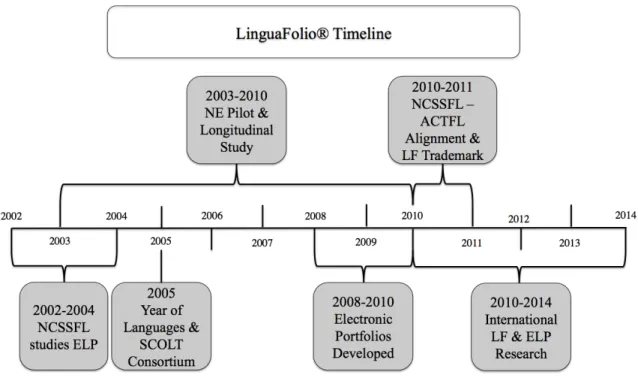
Through much international collaboration, LinguaFolio® continues to be used and researched across the United States. The timeline illustrated in Figure 2:
LinguaFolio® Timeline provides a condensed overview of the history of LinguaFolio® up to 2014.
Figure 2: LinguaFolio® Timeline
From 2002-2004, NCSSFL was engaged in learning about the ELP. In 2002, the Goethe-Institut sponsored dialogues between NCSSFL and the Council of Europe about the CEFR and ELP (Rollings-Carter, 2010; Van Houten, 2007). In 2003, twelve NCSSFL members from Virginia, Nebraska, Kentucky, and Indiana went to Germany to learn more about the ELP and the CEFR (Van Houten, 2007). These international exchanges served to provide NCSSFL, and other U.S. stakeholders, with the building blocks to develop LinguaFolio®. Efforts to develop LinguaFolio® were scattered across the United States and included many different states. Of particular note, Nebraska's efforts to
implement and study the LinguaFolio® are the most well-documented. A pilot study was conducted from 2003 to 2004 before beginning a longitudinal study in 2005. This 5-year quasi-experimental study examined goal setting and student achievement through
of a total of 1,273 students (Moeller, et. al., 2012). Additionally, various research studies have been published in Nebraska from 2009 to 2013, including Ziegler and Moeller (2012) which examined fostering self-regulated learning through LinguaFolio®, and dissertation research from Cote Parra (2009) and Clarke (2013).
In 2005, a language learning advocacy program called the Year of Languages was sponsored by ACTFL. NCSSFL chose to take LinguaFolio® as its Year of Languages project in order to promote its use and development throughout the country. Additionally, that same year at the Southern Conference on Language Teaching (SCOLT) a consortium was formed by representatives from Virginia, North Carolina, South Carolina, and
Georgia to develop materials for LinguaFolio® that could be made available online for users to download. Kentucky later joined this group as well. Since 2005, NCSSFL along with its various other stakeholders, continue to develop, refine, and promote
LinguaFolio® throughout the United States (International Project Group, 2013). In addition to Virginia, North Carolina, South Carolina, Georgia, Kentucky, and Nebraska, versions of LinguaFolio® have also been developed and used in Washington, Kansas, West Virginia, Wisconsin, Oregon, and Indiana.
Though LinguaFolio® was initially created in a paper format, it also exists in similar formats online (DuBravac, 2013). Various online versions were developed and promoted from 2008 to 2010. The University of Nebraska-Lincoln produced an online LinguaFolio® that was developed by Moeller and Panarelli. At the University of Oregon, the Center for Applied Second Language Studies (CASLS), developed their
LinguaFolio® Online is used by STARTALK1 programs across the United States. In Virginia, the Global Language Portfolio (GLP) was developed as a university-level version of the LinguaFolio® which was housed in the Blackboard learning management system (Cummins & Davesne, 2009). In 2010, North Carolina piloted their electronic version called the eLinguaFolio (elinguafolio.org).
From 2010-2011, NCSSFL partnered with ACTFL in order to better align the LinguaFolio® to the ACTFL standards of foreign language learning. The ACTFL standards are similar to the CEFR in that they provide a common understanding of what students should know and be able to do with language based on five aims
(Communication, Culture, Connections, Comparisons, and Communities). An important development of the collaboration between ACTFL and NCSSFL is the alignment of the Can-Do statements with the ACTFL proficiency levels of foreign languages in the United States. The 2010-2011 NCSSFL-ACTFL alignment of LinguaFolio® to the ACTFL standards and proficiency guidelines provided classroom teachers with measurable learning goals that were tied to a global validated proficiency scale.
In 2011, NCSSFL made the move to trademark LinguaFolio® in order to prevent any business from using the name and concept to market the portfolio. Due to this move, LinguaFolio® is available for non-commercial educational use to anyone. There is a registration feature on NCSSFL's website that allows users access to the LinguaFolio® documents. Registering also allows users to be alerted to any future updates.
1 STARTALK is a federally funded grant program which consists of an intensive summer
In addition to the previously mentioned research coming primarily from
Nebraska, international efforts to study the ELP and LinguaFolio® are ongoing. In 2010, an International Project Group was developed to unite efforts to study both the ELP and LinguaFolio®. This group consists of various partners from the South Carolina
Department of Education, the North Carolina Department of Public Instruction, the University of North Carolina-Charlotte, Trinity College-Dublin, SWA Consulting Inc., the University of Nebraska-Lincoln, and Jefferson County Public Schools in Kentucky (International Project Group, 2013). This group is responsible for focus group research conducted in May of 2013 in North Carolina. SWA Consulting Inc. is currently refining a survey instrument developed from the themes of that focus group data to distribute in order to determine the prevalence of those themes. Additional research is planned to further investigate the ELP and LinguaFolio®.
LinguaFolio® consists of three fundamental parts: the passport section, the biography section, and the dossier section (see Figure 3: LinguaFolio® Screenshots on the following page for an illustration of each). In various state versions of LinguaFolio® they are sometimes referred to by slightly different names; however, functionally, they serve three basic roles. A passport or checklist section documents progress on scales of learning objectives. A biography section gives space for learners to describe their learning experiences and reflect on how they learn. Finally, a dossier section archives learner evidence to support the self-assessments conducted throughout the passport and biography sections. Just as the ELP, LinguaFolio® is meant to be learner-centered and responsive to the needs of various educational contexts. This is why various states and educational institutions have developed their own versions of LinguaFolio®.
It is important to point out that these frameworks are not prescriptive curricula, but tools to facilitate learning whose beauty lie in their adaptability to the individual environments which they will serve (Council of Europe, 2001; Little, 2003; Ziegler & Moeller, 2012). While LinguaFolio® implementation will manifest differently in various learning environments, it would be helpful to add illustrative cases to the growing body of research on LinguaFolio® to help better elucidate the practice of its implementation (Moeller, et. al., 2012). Little (2003) presented nine examples of the European Language Portfolio (ELP) in the varying contexts in which it was used (see Appendix B: Summary of Nine ELP Studies for more on these studies) in order to provide illustrations to make the “abstract” concepts of the portfolio more “concrete” (p. 1). In a similar fashion, this research presents a qualitative, collective case study to build on existing research into LinguaFolio® and the reciprocal connections between educational theory and practice.
To this end, the remainder of this introduction will develop the researcher's connection with the topic and the rationale for the particular focus on studying LinguaFolio® in North Carolina. This introduction will conclude by developing the research problem, purpose statement, significance of this study, and the research questions it sought to answer. Chapter two will review the literature on the key
theoretical concepts which support LinguaFolio®, drawing together learner autonomy, motivation, and reflective learning as a metaphor for language learning as a lifelong journey. Chapter three will set up the specifics of the methodology of this study by exploring the choice of qualitative research in the form of a collective case study, the philosophical assumptions of the researcher, and the methods used to recruit participants, collect data, and analyze data. Chapter four will present each case individually. Chapter
five will present a cross-case analysis, a reflection on this study, and present directions for further research.
Researcher Connection
LinguaFolio® is used all over the United States but the majority of the published research on LinguaFolio® has come out of Nebraska (see Clarke, 2013; Cote Parra, 2009; Moeller, et. al., 2012; Moeller & Yu, 2015; Ziegler, 2014; Ziegler & Moeller, 2012). The rationale for conducting this study in North Carolina comes in part from the currently underrepresented nature of this work in published research, but primarily from the researcher's connection with the area. During the summer of 2008, a graduate summer institute at Appalachian State University in Boone, North Carolina, provided the researcher with her first introduction to LinguaFolio®. As an eager new adjunct fresh from her first semester of teaching Spanish, she was immediately intrigued by the concept of a framework for lifelong language learning. Unfortunately, her attempts to subsequently implement this paradigm-shifting framework resulted in frustration. Her students were accustomed to more traditional classroom methodologies and it was challenging to get them to see the value of this tool. Fortunately, her frustration only served to drive her own desire to learn more about this framework that is often described only as a new method of assessment.
In the fall of 2010, having completed her master's degree in Spanish and working on an educational specialist's degree in higher education, she was intrigued to learn about an initiative in the North Carolina public school systems to promote an online version of LinguaFolio®, appropriately dubbed eLinguaFolio. This hybrid initiative, combining LinguaFolio® with available instructional technology innovations, proved to set the
researcher on a life-altering path that comes full circle with this research study. While attending the LinguaFolio® Institute in Charlotte, North Carolina, back in August 2010, the researcher heard a keynote presentation on LinguaFolio® from the most published researcher in the United States on LinguaFolio®, Dr. Aleidine Moeller. Listening to that presentation cemented her decision to pursue a doctoral degree in education and the researcher followed Dr. Moeller back to the University of Nebraska-Lincoln to begin pursuing that goal in the fall of 2011.
Having spent the subsequent years studying foreign language pedagogy, instructional technology, and research methodology, the researcher then returned to Boone, North Carolina to finish what she began here so many years ago. Since she had been away, the Department of Public Instruction (NCDPI), Curriculum & Instruction Division, K-12 Program Areas Section - World Languages, referenced from here forward simply as the NCDPI, had continued to promote LinguaFolio® across the state of North Carolina. Since the 2010 LinguaFolio® Initiative, professional development
opportunities and online trainings had continued to promote LinguaFolio® use
throughout the state. In 2012, a LinguaFolio® Rollout Event was held which, “focused on how the use of LinguaFolio® can support language learners across the state of North Carolina” (LinguaFolio®, 2013). A highlight of this event was the Carousel stations which featured language teachers from across the state of North Carolina sharing their experiences of using LinguaFolio®. These sessions were captured and made available online (http://wlnces.ncdpi.wikispaces.net/2012LFRollout) to further support the professional development opportunities in North Carolina. In 2013, a LinguaFolio® Retreat was held in order to give new teachers the opportunity to work with teachers who
were experienced in implementing LinguaFolio®. This event gave participants the opportunity to discuss their progress with LinguaFolio® and the alignment of LinguaFolio® to various state-level educational standards and initiatives. It was an opportunity to share resources and lessons learned about LinguaFolio® training. Finally, it met a need for strategic planning for LinguaFolio® professional development needs. In August 2014, another opportunity for professional development in LinguaFolio® was included as a track of the ELL Support Conference: Growing Success for ELLS held in Greensboro, NC by the English Language Development staff at the NCDPI.
In addition to these synchronous professional development opportunities, there were also online asynchronous resources available. LinguaFolio® Training Modules have been developed by Faye Rollings-Carter through www.LEARNNC.org, a teacher training site from the University of North Carolina (UNC) School of Education, and in
collaboration with the National Council of State Supervisors for Languages (NCSSFL) in order to help teachers understand and use LinguaFolio® in their classrooms (Rollings-Carter, 2010). These modules cover the most important topics teachers needed to understand about LinguaFolio®, from its function to its implementation. In addition to the Learn NC modules on LinguaFolio®, teachers also have had access to North Carolina's Formative Assessment Learning Community's Online Network (NC
FALCON), which was another series of online professional development modules geared toward formative assessment (for more information see
http://www.dpi.state.nc.us/accountability/educators/vision/formative).
While there is currently no published research on LinguaFolio® from North Carolina, as was previously mentioned, there is a study in progress. As part of an
international collaborative effort to further investigate both LinguaFolio® and the ELP, focus group interviews were conducted in North Carolina in May of 2013. The interviews were transcribed and coded in order to draw out themes that might be used to develop a survey. This survey will be used to determine the prevalence of the data gathered
throughout the state and inspire action research studies for teachers using LinguaFolio®. The overarching question this data aims to answer is, “What teacher practices and classroom conditions lead to the successful implementation of the ELP and the LF?” (International Project Group, 2013). This line of research is very intriguing because it also seeks to understand classroom implementation of LinguaFolio®; however, where the International Project Group’s research seeks patterns of occurrences across the state, this research study aimed to focus on a more complete picture of specific cases in order to develop illustrative examples of classroom practice. Instead of focus groups to gather self-reported data on LinguaFolio® use, this study began from observation before
following-up with one-on-one interviews of the observed teachers. Direct observation by the researcher guided the interviews to be more reflective of various observed practices and provide a more complete perspective than was possible with the focus group research.
Research Problem
In their foundational work on LinguaFolio®, Moeller, et. al. (2005) pointed out the need for teachers to “extensively model” and “provide carefully scaffolded practice” for students (p. 142). In the previously mentioned five-year longitudinal study on goal setting and student achievement through LinguaFolio®, Moeller, et. al. (2012) indicated a need for qualitative studies, “that investigate both general classroom teacher effect as
well as the teacher effect component on student goal-setting processes” (p. 164). While the body of evidence supporting the effectiveness of LinguaFolio® and ELP continues to grow (see Ziegler, 2014 for example), these illustrative cases of classroom practice provide further insight into the implementation of this framework. In a similar fashion to the previously mentioned Little (2003) collection of ELP implementation stories (see Appendix B: Summary of Nine ELP Studies), this study fills a gap in the research by providing multiple case study representations of some of the ways in which
LinguaFolio® is currently being implemented in North Carolina schools. Additionally, these cases may help teachers think about how to implement LinguaFolio® within their own individual contexts through seeing the representative examples of others.
Purpose Statement
The purpose of this collective case study was to describe LinguaFolio® implementation at the classroom level by language teachers in North Carolina classrooms. The resulting descriptions serve to provide illustrative examples of
LinguaFolio® implementation at the classroom level in North Carolina through the use of instrumental cases. The implementation of LinguaFolio® is generally defined as the use of LinguaFolio® in language classrooms by teachers who have completed professional development in LinguaFolio®, such as the LearnNC modules or face-to-face NCDPI workshops.
Significance of the Proposed Study
The significance of this study lies in its ability to provide insight into the classroom practices of implementing LinguaFolio® and to determine future lines of investigation into the use of this framework. In their own exemplar from a Chinese class,
Moeller and Yu (2015) pointed out, “there is no single best method” and it is vital that teachers and students consider “their own specific context” (p. 64). In addition to rich illustrations of practice, this study adds to the evolving body of research on
LinguaFolio®, and more broadly language learning portfolios like the ELP. These illustrations of practice may also serve to guide and inspire teachers wishing to improve their practice with LinguaFolio®. This study will undoubtedly raise various questions for further research. Additionally, due to the similarities in the research topic and questions of the proposed study and the focus group study, currently underway in North Carolina, a cross-case analysis of commonalities between each case of this study may serve to provide insight on the themes drawn from the focus group studies as well for later research and comparison.
Research Questions
This collective case study aimed to investigate the implementation of
LinguaFolio® in classrooms in North Carolina in order to provide illustrative examples that answer the following overarching question:
• How does LinguaFolio® implementation work at the classroom level? Additionally, the study was guided by the following supporting questions:
• What planning do teachers do before they introduce LinguaFolio®?
• How do teachers introduce LinguaFolio® to their students?
• How and with what frequency do teachers use LinguaFolio®?
• How do teachers support learner autonomy?
• How do teachers support student goal-setting?
• How do teachers support student self-assessment?
• What materials and resources do teachers develop and/or use to support LinguaFolio® in their classrooms?
• What challenges do teachers report in relation to LinguaFolio® implementation? How do they address these challenges?
CHAPTER 2 LITERATURE REVIEW
“I wanted something that would help to change the way [my students] look at themselves as learners and I found that LinguaFolio® was really, really a wonderful tool for that.” ~Betsy Burton, language teacher in NC
Introduction
LinguaFolio® is a self-assessment tool; however, to stop there would be to miss out on the transformative power it has for language learning. Burton (2012) expressed her experience using LinguaFolio® to change the way her students saw themselves as
learners. Cote Parra (2009) provided evidence in his dissertation research that LinguaFolio® can change the way teachers see themselves and their roles in the classroom. DuBravac (2013) pointed out that, “the most astonishing advantage of LinguaFolio® is that it forces the instructor to focus on portfolio grading as a
conversation about learning rather a one-way presentation” (p. 205). The reasons for these observations are that LinguaFolio® follows a theoretically sound model of implementation. In the Unified Learning Model, Shell et. al. (2010) drew together educational research on learning to explain that learning has the potential to occur when an individual is motivated to pay attention to new material and connect that new
knowledge to previous knowledge. Stated another way, learning is being motivated to connect the new to the known. The learner must be motivated to attend and make
connections and the teacher's role is to facilitate that motivation and those connections, in the process of which learners can begin to become metacognitively aware of their
Why is learner autonomy important? Many reasons might be listed, but there are two that are highlighted of special import here. The first is the value-laden democratic pursuit of equity for the sake of the success of a democracy, which Nussbaum (2010) argued for in her text Not for Profit, following in the footsteps of countless educational researchers and philosophers before her such as John Dewey and many others. The second deals with a phenomenon that has been dubbed “the ten-year rule” to describe how long it takes for an individual to master any given topic (Brooks, 2011; Colvin, 2008; Gladwell, 2008; Willingham, 2009). Learners need the skills to become self-regulated learners because in order to reach higher levels of proficiency, they need to understand how to continue learning beyond the classroom. This is why learner autonomy must be a primary goal of education (Candy, 1991).
How do learners become autonomous? Learner autonomy should not be equated to self-instruction where learners are abandoned to their own devices, but instead to a process whereby learning is fostered by teachers in an empowered, reflective, and communicative environment (Little, 2004). Autonomy is possible through practice and metalinguistic understanding. What the teacher does to foster self-regulated learning strategies in the classroom is key. This is why this study focused solely on what the teacher did, how she facilitated autonomy. Practical examples of what this type of learning looks like in the classroom translates this theory into manageable and
understandable illustrations. When the teacher guides her students toward self-regulated learning strategies, autonomy can grow. Zimmerman (2008) defined self-regulated learning (SRL) as “the self-directive processes and self-beliefs that enable learners to transform their mental abilities…into an academic performance skill” (p. 166). Taking
the definition of learning from Shell, et. al. (2010) that learning is fundamentally about motivations and connections, it follows that students need self-regulative skills to understand and manipulate their own motivation and learning strategies. Various cycles of learning have been developed to help illustrate the essential steps toward learner autonomy. Here they will be developed and described within the metaphor of language learning as a journey. These three primary components are (1) Mapping; (2) Traveling; and (3) Unwinding, as illustrated in the phases of Figure 4: Simplified Implementation Cycle, (SIC). The SIC model was developed from the work of many educational researchers, ranging in specializations of LinguaFolio® and the ELP, motivation, and self-regulated learning, to name a few.
Figure 4: Simplified Implementation Cycle
The metaphor of language learning as a journey will be used here as a structure to organize the theoretical basis and practical implementation of LinguaFolio® as a
transformative language learning tool. The literature on self-regulation, learner autonomy, and similar terms can be quite vast; however, Dörnyei (2001) provided the “main ingredients of an autonomy-supporting teaching practice” as: (1) “Increased learner involvement in organising the learning process” and (2) “A change in the
teacher's role” (p. 104-105). When teachers give students choice, some level of authority, allow them to engage in peer teaching, project work, and self-assessment, and when teachers take on a more 'facilitative style,' learner autonomy has the basis that it needs to thrive (Dörnyei, 2001). Within the phases of the SIC model, both the teacher's and the learners' roles will be considered explicitly. However, Rollings-Carter (2010) summed up the teacher's role very well in her LearnNC LinguaFolio® module on Reflective
Teaching:
The teacher’s role in developing learner autonomy is to facilitate learning and to manage resources in a way that helps promote learning for all students…
Teachers are the ones who make things happen, like setting the stage for a role-play, providing the opportunities for learners to choose their own homework assignment, and modeling how to assess one’s own work.
The student's role is the most active. Teachers must encourage students to be active participants in the drivers' seats of their own language learning journey.
The Mapping Phase
Before beginning a journey, a route must be planned. The mapping phase can be thought about in several ways but at its most basic, this phase is concerned primarily with motivation and goals. This phase has been conceptualized in various ways by different researchers. In order to begin the reflective implementation of the ELP, Little (1999)
advised asking two important questions: “What are we learning?” and “Why are we learning it?” (p. 4). These questions call to attention the goals and motivation for beginning the journey and their answers help to develop the map for where students are going. This phase is also reflective of the work on motivation in language learning from Dörnyei (2001) that he referred to as his “Preactional Stage” which involved “setting goals; forming intentions; and launching action” (p. 22). The forethought phase of self-regulation, including the sub-processes of task analysis and self-motivation beliefs from the work of Zimmerman (2008) described the concepts of motivation and goal setting in similar ways. Moeller, et. al. (2005) also featured student-driven and teacher-driven cycles of LinguaFolio® implementation to describe these important first steps. All of these various ways of conceptualizing a reflective learning cycle can be distilled into an understanding of motivation theories and goal setting.
Motivation theories. In a recent presentation, Burton, a language teacher from NC, told workshop participants that LinguaFolio® was a tool that helped students become invested in their own learning (Burton & Swain, 2014). She related that while it helped some students to a greater degree, it helped all of her students to some degree. Burton's experiences are reflected in the research on both the European Language Portfolio (ELP) and LinguaFolio®. Students become more self-regulated and engaged learners when these portfolios are used in their language classes (Little, 1999; Little, Goullier, & Hughes, 2011; Moeller, et. al., 2012; Ziegler & Moeller, 2012). These tools begin from a place of mapping learning, taking into consideration theoretical
Dörnyei (2001) defined motivation as “an abstract, hypothetical concept that we use to explain why people think and behave as they do” (p. 1). Drive motivation theories deal with the biological motivations for certain actions (see Maslow, 1943); however, the concern here is motivation related to intentional learning, or academic motivation.
Academic motivation determines how much of a learner’s capacity for learning will be employed to reach a learning goal (Shell, et. al., 2010). Motivation is critical to learning because, “without sufficient motivation even the brightest learners are unlikely to persist long enough to attain any really useful language” (Dörnyei, 2010, p. 74). It is vital to understand motivation in order to promote learner autonomy (Nicholls, 1979). Learner autonomy, as was articulated previously, is key to the continuation of language learning beyond the classroom.
Motivation for learning is described in various ways throughout the literature. Dörnyei (2001) pointed out that motivation can be thought of in terms of direction and magnitude. That is to say, individuals have a choice to do some specific task and this action is mediated by their effort and persistence. Murphy and Alexander (2000) distilled some of the more commonly used terminology on motivation to focus on four areas: (1) intrinsic versus extrinsic motivation; (2) goals; (3) self-schema; and (4) interest.
Intrinsic versus extrinsic. First, motivation can be thought of in terms of its origins: intrinsic versus extrinsic. Intrinsic motivation refers to that which comes from within an individual and extrinsic from external sources (Huitt, 2011). Pink (2009) drew out research to indicate that while extrinsic motivation can be beneficial for menial tasks, the type of work which requires deeper thought more greatly benefits from intrinsic motivation. Willingham (2008) suggested that while extrinsic rewards work in some
cases in the short term, eventually motivation needs to become more intrinsic in order to promote lifelong learning among students. Ryan and Deci (2000a) stated that extrinsic motivators can initially motivate a learner and in some cases the extrinsic goal can become, “self-endorsed and thus adopted with a sense of volition” (p. 55). However, some studies have shown that extrinsic rewards can actually be detrimental to intrinsic motivation (Deci & Moller, 2005). Dörnyei (2001) argued that, “rewards more often than not actually do motivation a great deal of damage” because “they divert the students' attention away from the real task and the real point of learning” (p. 128). Whether motivation begins as extrinsic or not, researchers seem to agree that moving toward intrinsic motivations are better for learning. This shift characterizes a move toward learner autonomy that is more fulfilling (Ryan & Deci, 2000b; Pink, 2009). One
suggestion made by Deci & Moller (2005) to enhance intrinsic motivation is to provide learners with choices. LinguaFolio® supports this suggestion because it allows for learners to make choices about tasks and goals.
Goals. Second, motivation is related to goals. Dörnyei (2001) provided three questions that the study of motivation aims to answer: (1) Why do people decide to do something? (2) How hard will they pursue it? (3) How long will they sustain their effort? (p. 7). These questions contain an implicit assumption concerning goals. When a person makes a choice to pursue an action, this forward momentum is a goal, whether it is explicitly stated or not. Goals give purpose to learning. In fact, according to the Unified Learning Model from Shell, et. al. (2010), “all intentional learning is goal directed” (p. 69). One of the fundamental aspects of the ELP and LinguaFolio® is goal setting. Goal-setting in portfolio learning allows learners to observe their own learning which boosts
motivation (Ciesielkiewicz & Coca, 2013). The structure LinguaFolio® uses enables teachers to help learners focus on goals that are multifaceted, covering both content and personal goals, which helps learners to develop self-regulatory skills linking motivation to competency (Wentzel, 2000). Various categorizations of goals are identified in the literature. Generally, two orientations toward goals are represented: performance-oriented goals and mastery-oriented goals. When the focus of a goal is judgment of the outcome this constitutes a performance-orientation, whereas a mastery-orientation is concerned with improvement (Ames, 1992; Elliott & Dweck, 1988; Schunk & Zimmerman, 2008). For example, if a learner focuses on getting a good grade on a test, this would be a performance-oriented goal. A learner with a goal of learning to order lunch at the Mexican restaurant in Spanish would be mastery-oriented. Mastery-oriented goals can help learners persist despite obstacles (Dweck, 1986). However, it is important to note that goal-orientation should not be seen as two extremes on one continuum, both types are “distinct and separate forms of regulation” (Elliot, 2005, p. 56). Different learners may employ different goal orientations in different situations (Pintrich, 2000). In fact, both orientations can be helpful to motivation (Ziegler, 2014). In addition to goal-orientation, it is important to consider the value of a goal to the learner. A goal’s value will affect its capacity for motivation. Goal value is subjective and learned through experience, like any other type of knowledge (Shell, et. al., 2010). Through careful scaffolding, LinguaFolio® enables teachers to help students see the value of goals.
Self-schema. Third, self-schema is an important concept that underlies motivation because how teachers help learners understand themselves is a major part of
theory, self-efficacy beliefs, and expectancy theory help to explore this aspect of motivation. Teachers can use the biography section of the LinguaFolio® to explicitly model that all learners have the power to change and improve their habits for language study and become more autonomous. How students attribute success, or failure can be shaped by teachers through proper scaffolding of the biography section. Motivation can almost always trump aptitude, in other words, effort is more important than ability
(Colvin, 2008; Dörnyei, 2001; Shenk, 2010). Attribution theory deals with how a learner attributes success or failure. Weiner (1979) classified three aspects of attribution: locus, stability, and control. Locus refers to where responsibility lies for success or failure. For example, do learners view the responsibility for meeting goals as their own or as those attributed to another person, such as the teacher? Stability refers to whether success or failure is attributed to factors that are constant or changeable. For example, do learners believe they are capable or lucky? The last aspect, control refers to who has the control in meeting goals. For example, do learners feel they have control over their learning or that control is external to them? The following examples are extreme but illustrative of these terms. If students have a performance-oriented goal and fail, an attribution of the failure to an external locus, and unstable and uncontrollable factors, they may be more likely to give up. They may believe that they cannot meet the goal because the teacher does not like them, the test is too hard, and they are not smart enough. Because a mastery-oriented goal focuses on learning, rather than judgment, a learner is more likely to attribute failure to an internal locus, and stable and controllable factors. They may believe they were not understood by the waiter at the restaurant because they chose the wrong words and they need to study more. Huitt (2011) emphasized that teachers should help students develop
an attribution explanation where the locus is internal, stability is achieved by effort, and they are the ones in control of their own learning. These values are subjective and can be learned (Shell, et. al., 2010). LinguaFolio® provides the tools to help teachers support this effort-based attribution of success. By training students to self-assess and allowing them to see that effort is related to success in learning, teachers can move learners toward more self-regulated attitudes and practices. DuBravac (2013) reflected that when these self-assessment tools are employed, especially in the case of online portfolios, they can contribute to “the students’ creation of online identities and presentation of self via Facebook, LinkedIn2, or other portals” (p. 223).
How learners attribute success and failure can contribute to how they feel about themselves and their capabilities (Weiner, 2005). The beliefs individuals hold regarding their capacity to achieve goals are known as self-efficacy beliefs (Bandura, 1997). Self-efficacy beliefs have been found to be predictive of student effort (Zimmerman, 2000). These beliefs influence what individuals do, how much effort they will expend, how long they will persist, how they will proceed, and how much they will accomplish (Bandura, 1997). One way in which learners understand their capacities for meeting goals is related to expectancies. Expectancies deal with the likelihood that some action will result in a certain outcome (Vroom, 1964). Wigfield and Eccles (2000) defined expectancies as how well learners believe they will do on upcoming tasks. Expectancies are subjective and learned (Shell, et. al., 2010). While there are various ways to delineate expectancies,
2 LinkedIn is an online social networking site focused on professional and work-related
connections. It is similar to Facebook but whereas the latter is more centered on personal and social connections, the former focuses on resumes and job opportunities.
Shell et. al. (2010) identify three expectancy types related to goal motivation: means-end, outcome, and success. Means-ends expectancy deals with the likelihood that a certain action will result in a certain outcome. If learners study, they will pass the test, for example. Outcome expectancy goes a step further by allowing the learner to contemplate what the accomplishment of a goal will bring. If they get an A on the test, their parents will be proud of them, for example. Success expectancy deals with the frequency with which learners have had success when attempting a goal. If they have consistently failed math, they may conclude they are not good at math. Based on the context and their evolving experiences, learners’ expectancies change over time (Wigfield & Eccles, 2000). Expectancies, attributions, and previous experiences will help shape learners’ self-efficacy. Teachers must reinforce to students that, “enthusiasm, commitment and
persistence are key determinants of success or failure” (Dörnyei, 2001, p. 5).
Interest. Finally, interest is perhaps the least understood. Shell, et. al. (2010) stated that neither the biological nor cognitive structure of interest is fully known and that interest is highly individual and fluid. Interest can be situational, depending upon the sensory input of the environment, or personal, relating more closely to what an individual does (Shell, et. al., 2010). Willingham (2009) pointed out that one difficulty in addressing interest in the classroom is that one classroom will undoubtedly contain a plethora of personal interests. He suggested a lesson design that is reminiscent of backward design (see Wiggins and McTighe, 2005) in which the teacher begins by considering what students should know at the end of the lesson. This is how the LinguaFolio® is
structured, beginning first with goal setting. In this way, Willingham (2009) suggested that interest could be sparked by focusing on a driving question in a lesson and guiding
students to find answers, rather than providing answers in which the students have no interest. LinguaFolio® does this through the use of goals in the form of Can-Do statements and learning tasks.
Why are we learning? Why do we do what we do? Teachers may often ask themselves, “Why do some students seem to enjoy learning while others do not?” As the audience for this work is primarily academic scholars, readers should have some
experience with enjoying learning. How can this enjoyment be understood in terms that might allow teachers to promote learning in classroom environments? Research and theories have briefly been explored on motivation from various perspectives. These pieces of the motivation puzzle, along with a vast number of others, have been and are being explored by everyone from cognitive scientists to business professionals. A few interesting (if sometimes seemingly obvious) conclusions have been drawn. People do what they do because they enjoy doing those things. More often than not, creative and innovative thinking occurs when individuals are free to follow their own interests. Pink (2011) pointed to Google’s “20% time” as an example of how business can really profit from allowing employees the freedom to pursue their own interests. When an individual becomes so engaged with some task that time and distractions melt away, they enter a state that psychology researcher, Mihaly Csikszentmihalyi, coined as “Flow.”
Csikszentmihalyi (2008) defined flow as, “the state in which people are so involved in an activity that nothing else seems to matter; the experience itself is so enjoyable that people will do it even at great cost, for the sheer sake of doing it” (p. 4). This is an intrinsically motivated state that most would describe as fun or enjoyment. Taking all of this into consideration, how do teachers motivate students in the language classroom?