A Performance Test Platform
R. Heinzl, G. Mach, P. Schwaha, and S. Selberherr Institute for Microelectronics, TU Wien Gußhausstraße 27-29/E360, A-1040 Vienna, Austria E-mail: {heinzl|mach|schwaha|selberherr}@iue.tuwien.ac.at
KEYWORDS
Performance test, benchmark, graphical user interface, pro-gramming languages, web-application, Linux, posix, Bash ABSTRACT
We implemented a fully automated benchmarking system, the performance test platform (PTP). It is developed with special emphasis on flexibility and therefore uses library cen-tric application design combining several orthogonal mod-ules. The modules consist of a base of Bash shell scripts and an orthogonal web front-end written inPHP. We thereby ensure that no restrictions are imposed on the benchmarked systems. Furthermore we show the platform’s application and results obtained by benchmarking different algebraic equation specification approaches.
INTRODUCTION AND MOTIVATION
We present the performance test platform (PTP), a fully au-tomated benchmark system to consequently analyze compile-time and run-compile-time performance of different algorithms, pro-gramming paradigms, or even complete applications. The compiler attributes are fully parametrized, which allows the use of different compilers and options on multiple hosts with several operating systems. It is not only possible to pass vari-ous options to the compiler, but it is also possible to pass dif-ferent options to the newly compiled executable. The rapid development of micro processors and the huge range of cur-rently available processor types requires very complex tools to analyze applications in order to optimize their run-time performance. Additionally, compilers also undergo their own evolution and different compilers introduce a new set of opti-mization possibilities to control the new features of modern micro processors with each new generation. The possibilities of combining all of these switches and options is increasing even more rapidly and results in a staggering amount of pos-sibilities to choose from. A manual selection of settings to obtain optimal performance is therefore not an efficient task as even different types of applications require a different set of options and switches.
A project was therefore initiated with the goal to determine which compiler-options result in optimal code on different ar-chitectures, operating systems, and from different program-ming paradigms. During the development of a batch-job-system using Bash shell scripts [12] the idea to extend this to a complete performance test platform was born. Once a system consisting of several shell scripts and a hierarchical directory structure was developed, usability had to be
in-creased to make this system accessible on various platforms without manual interaction. A database system, a graphi-cal user interface, as well as graphigraphi-cal statistic modules have therefore been developed.
THE DEVELOPED PLATFORM
The base of the developed system consists of a collection of Bash shell scripts and an orthogonally implemented graphi-cal web front-end in the dynamic web programming language
PHP [5], cf. Figure 1. Both are supplemented by a MySQL -database [13] andGNU R[7], a statistical and graphical suite used to process the results and create graphical output.
Figure 1: Overview of the performance test platform.
We chose a shell-script backend to ensure the possibility to easily change parameters, templates and scripts manually or by the graphical user interface. We thereby achieve a maxi-mum of freedom and openness for a large variety of systems, languages, compilers, and algorithms to test. The database was implemented in MySQL, because it is widely available, easy to use, and very stable when using InnoDB-engines [15, 11] with foreign constraints. Using these features and a
graphical front-end such asphpMyAdmin have the possibility to apply even complex changes (i.e. changing the constraints or dependencies of tables) in an efficient and safe way. We also implemented a graphical user interface module for
GNU R to finally obtain HTML pages. It provides the fa-cilities to produce graphical output in the style of common spreadsheet-applications from performance test results. The templates used guarantee an easy way to modify the style of the resulting figures.
We chose a web front-end written inPHPto control the test platform for many reasons. First, we can use nearly every system providing a browser to control the platform, second we did not need to implement a separate GUI, and, finally, thePHPlanguage provides facilities to execute programs on different systems. We can therefore use the web-front-end with other underlying systems as well.
The most important feature of the base system is its mod-ularity and the resulting exchangeability of modules. The main modules can be used without the graphical front-end. This is ensured by using a sophisticated directory structure and small task specific shell scripts allowing modification or substitution of single tasks in the benchmark system or sin-gle configurations for one benchmark. The appearance and style of the final figures can thereby be changed without any modification of the core system itself.
The directory structure consists of a directory for each test. This root directory then contains directories for configura-tion files, source files, and templates, as well as directories for additional files, e.g. input files, concerning the simula-tion process and for each configurasimula-tion, opsimula-tion, and host. Figure 2 shows the directory tree of the test-directory.
Figure 2: The directory tree of the PTP.
The config directory contains all configuration files for a job, where each test (different language, executable, or com-piler) has its own configuration. The following table gives an overview of some of the possible tags.
Tag Explanation
xxxARCHITECxxx architecture of the system xxxLANGUAGExxx language of the tested program xxxHOSTxxx space-separated list of hosts to use
for the tests
The template directory contains templates for Make-files and time-measure scripts. The time-measure scripts are invoked by the runonhost.sh script and measure the compile time as well as the execution time. The src directory contains the sources for all tests of this job (different programs, compilers, and hosts). The zzz * directories are named according to the used ar-chitecture, the language, the compiler, and a unique ex-ecutable number. These directories contain one sub-directory per compiler-option-string. Each of these directories contains one directory per host. There are several files in these directories: makefile.conf and measure.conf are the configuration files for the Makefile and measure.sh script. Additionally, the source files along with the resulting object files and ex-ecutables and, after the tests have been run, the files containing the test results are located here.
The simulation directory contains, beside a few control files such as simulation.started and simulation.ended, the status filesimulation.status and for each host the job lists and output files. The simulation can be controlled by editing the host job lists or the two control files.
After running the tests from the web-front-end, thedocu directory contains all tables, figures and aPHP-file, which is included in the front-end-documentation. In this way it is guaranteed, that the documentation is accessible from the front-end in the typical style, but can also be used without the front-end.
The shell-scripts mirror the procedure of the benchmark test:
- First the directory structure is created and set up. - The files are then distributed and the actual tests
are run.
- The final task is to document the results. THE WEB-FRONT-END
PHP-Scripts control the basic layout, the login (see Fig-ure 3), the connection to the database as well as the report section, the control section, and the tutorial sec-tion.
Authentication is performed against the login manage-ment of the server (i.e. local accounts using PAM [1] or network accounts using NIS [2]). Therefore no sep-arate login-management nor accounts have to be
pro-Figure 3: Login to the performance test platform.
vided, but all users having valid logins at the server can login to the platform out of the box. The biggest advan-tage of this login management is its modularity, so even advanced authentication systems such askerberos [3] can easily be incorporated. Cookies are used to avoid outdated login sessions. The basic graphical layout of the PTP is different for normal users and for admins, respectively.
All reports concerning hosts, jobs and the platform can be found in the report-section (’Berichte’). Access to reports dealing with the platform is restricted to admins only, all other reports are viewable by every user of the platform.
Figure 4: List of hosts in report section.
Reports about the hosts (Figure 4) contain the names of the hosts, their operating systems, the CPU type and speed, and the amount of main memory. Information on the availability of selected hosts which can be used by the system for benchmarks is provided on a separate page (see Figure 5).
Reports about the jobs contain the root-directory of the job and its current status. Information about logins is available in the platform report section.
All controls about hosts, jobs, and the platform can be found in the control section (’Einstellungen’). A user can change only the settings of his own jobs.
Figure 5: Overview of the availability of selected hosts.
Figure 6: Mask to add a configuration: the red parts are mandatory.
The mask for adding configurations (Figure 6) refers to the configuration tags shown earlier in this paper. It is divided into several sections:
- The section ’Allgemeine Informationen’ deals with the architecture and the language and the selection of hosts that should be used.
- The ’Compiler’ section contains the name and ex-ecutable of the compiler. Compiler option strings and include paths can be specified optionally. - The next section is called ’Linker’. If this entry is
empty, the compiler executable is assumed to be used for linking as well. There are optional fields for linker flags, library paths, and libraries to link against.
- In the section ’Source-Files’ the names of the source files along with the header files needed to compile the program are specified.
- In the last section ’Make and Executable’ it is possi-ble to specify the name of the make command and the executable. Flags and switches for the make command or the executable option strings can also be entered here.
The important part of analyzing the results of the per-formance test runs is managed by a wrapper tool toGNU R. Different templates are used to interpret the corre-sponding output of the single tasks obtained by the shell scripts. Transformations of the output data, selections, and finally illustration templates have been developed to ease the complex process of intelligence collection. The ’Analyze Results’ mask is shown in Figure 7.
Figure 7: The ’Analyze Results’ mask.
The parameter for the abscissa and the set of curves can be chosen for compile times as well as execute times. All other parameters result in separate tables and figures based on given and adjustable templates.
RESULTS OF A BENCHMARK
Using the performance test platform we compared dif-ferent equation specification approaches, based on a generic scientific simulation environment [9, 14, 10] and the corresponding performance analysis [8]. Therefore we analyzed several techniques which are available in C++.
CPU type Clock speed RAM Compiler MFLOPS P4 2.8 GHz 2 GB GCC 4.0.2 2310.9 Core Duo 2.4 GHz 2 GB GCC 4.3 8804.0 Athlon 64 2.2 GHz 2 GB GCC 4.1.2 10134.0
We compared the following equation specification meth-ods:
- The expression template technique was used as de-scribed in [4].
- The GNU g++ implementation of the valarray data type was used as a test.
- Blitz++ [16]
- Naive C++ implementation
- The GSSE approach [9] based on topological traver-sal and an equation concept based mostly on the Boost Phoenix library [6].
The test is performed using a vector addition Af =
Ab+Ac+Ad, evaluated with different vector sizes. The
definitions of the corresponding data types are given in the next code snippet:
typedef s t d : : v a l a r r a y<double> A r r a y t ;
typedef b l i t z : : Array<double,1> A r r a y t ;
typedef s t d : : v e c t o r<double> A r r a y t ;
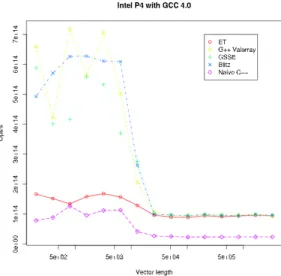
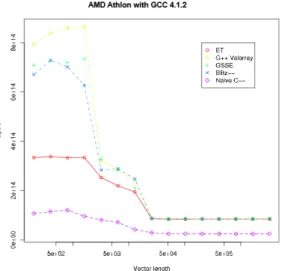
The next figures presents and compare the results ob-tained by the different approaches. The y-axis is labeled with operations per second. The vector addition is built by three operations, two additions and one assignment. Figure 8 shows the high runtime performance of an Intel P4 microprocessor as long as the values are cached.
Figure 8: Comparison of functional specification on an Intel P4 microprocessor.
Figure 9 presents the results for an Intel Core Duo mi-croprocessor. The sudden drop in runtime performance at certain vector lengths should be noted.
Figure 10 depicts the best benchmark results for an AMD Athlon 64 microprocessor with AMD rating 3500+.
Figure 9: Comparison of functional specification on an Intel Core Duo microprocessor.
Figure 10: Comparison of functional specification on an AMD Athlon 64 microprocessor.
CONCLUSION
Based on a set of Bash shell scripts, a statistical anal-ysis tool, and a comprehensive graphical user inter-face, a performance test platform was developed to ease the benchmarking processes. A completely automated process chain is thereby obtained to analyze the per-formance optimization possibilities of modern micro-processor architectures and new compiler versions. REFERENCES
[1] Pluggable Authentication Module (PAM), 1995.http://www. kernel.org/pub/linux/libs/pam/.
[2] Network Information System (NIS), 2004. RFC 3898. [3] Kerberos: The Network Authentication Protocol, 2007.http:
//web.mit.edu/kerberos/www/.
[4] D. Abrahams and A. Gurtovoy. C++ Template Metapro-gramming: Concepts, Tools, and Techniques from Boost and Beyond (C++ in Depth Series). Addison-Wesley Profes-sional.
[5] Achour, Betz, Dovgal, Lopes, Olson, Richter, Seguy, Vrana, et al. PHP Manual. http://www.php.net/manual/en/, 2006. [6] Boost Phoenix 2. Boost Phoenix 2. Boost, 2006.
http://spirit.sourceforge.net/. [7] R Foundation. The R Manuals.
http://cran.r-project.org/manuals.html, 2007.
[8] R. Heinzl, P. Schwaha, M. Spevak, and T. Grasser. Per-formance Aspects of a DSEL for Scientific Computing with C++. InProc. of the POOSC Conf., pages 37–41, Nantes, France, July 2006.
[9] R. Heinzl, M. Spevak, P. Schwaha, and T. Grasser. A High Performance Generic Scientific Simulation Environment. In Proc. of the PARA Conf., page 61, Umea, Sweden, June 2006.
[10] R. Heinzl, M. Spevak, P. Schwaha, and S. Serlberherr. Per-formance Analysis for High-Precision Interconnect Simula-tion. InProc. of the ESMC. Conf., pages 113–116, Toulouse, France, 23-25. October 2006.
[11] A. Heuer and G. Saake. Datenbanken: Konzepte und Sprachen. mitp, 2nd edition, 2000.
[12] M. Cooper. Advaced Bash Scripting Guide. http://www.tldp.org/LDP/abs/html/, 2006. [13] MySQL AB. MySQL 5.1 Reference Manual.
http://dev.mysql.com/doc/refman/5.1/en/index.html, 2006.
[14] P. Schwaha, R. Heinzl, M. Spevak, and T. Grasser. Advanced Equation Processing for TCAD. InProc. of the PARA Conf., page 64, Umea, Sweden, June 2006.
[15] H. Tuuri et al. The InnoDB Documentation.
http://www.innodb.com/support/documentation, 2007. [16] T. L. Veldhuizen. Active Libraries: Rethinking the Roles of
Compilers and Libraries, inProc.ISCOPE’98,Lecture Notes in Computer Science. Springer-Verlag, 1998.
BIOGRAPHIES
REN ´E HEINZLstudied electrical engineering at the Technische
Universit¨at Wien. He joined the Institute for Microelectronics in November 2003, where he finished his doctoral degree in Septem-ber 2007. In April 2005 he achieved first place at the doctoral competition at the EEICT in Brno. His research interests in-clude computational science, programming paradigms, high per-formance programming techniques, process simulation, solid mod-eling, scientific visualization, and algebraic topology for TCAD.
GEORG MACH was born in Vienna, Austria, in 1979. He studies electrical engineering at the Technische Universit¨at Wien. He joined the Institut f¨ur Mikroelektronik in June 2003, where he is currently working on his diploma thesis.
PHILIPP SCHWAHA studied electrical engineering at the
Technische Universit¨at Wien. He joined the Institute for Micro-electronics in June 2004, where he is currently working on his doctoral degree. His research activities include circuit and device simulation, device modeling, and software development.
SIEGFRIED SELBERHERRreceived the doctoral degree in
technical sciences from the Technische Universit¨at Wien in 1981. Since that time he has been with the Technische Universit¨at Wien as professor. Dr. Selberherr has been holding the “venia docendi” on “Computer-Aided Design” since 1984. As of 1988 he has been chair professor of the Institut f¨ur Mikroelektronik. From 1998 to 2005 he served as Dean of the “Fakult¨at f¨ur Elektrotechnik und Informationstechnik” at the Technische Universit¨at Wien. His current topics of interest are modeling and simulation of prob-lems for microelectronics engineering.