MAKROPOULOS, A. 2019. Firm failure processes and determinants of failure in EU countries and UK regions: a quantitative analysis of SMEs. Robert Gordon University [online], PhD thesis. Available from:
https://openair.rgu.ac.uk
Firm failure processes and determinants of
failure in EU countries and UK regions: a
quantitative analysis of SMEs.
MAKROPOULOS, A.
2019
This document was downloaded from
https://openair.rgu.ac.uk
The author of this thesis retains the right to be identified as such on any occasion in which content from this thesis is referenced or re-used. The licence under which this thesis is distributed applies to the text and any original images only – re-use of any third-party content must still be cleared with the original copyright holder.
FIRM FAILURE PROCESSES AND DETERMINANTS OF
FAILURE IN EU COUNTRIES AND UK REGIONS: A
QUANTITATIVE ANALYSIS OF SMEs.
ALEXIOS MAKROPOULOS
A thesis submitted in partial fulfilment of the
requirements of the Robert Gordon University
for the degree of Doctor of Philosophy
Firm Failure Processes and Determinants of Failure in EU
Countries and UK Regions: A Quantitative Analysis of
SMEs.
Alexios Makropoulos
A thesis submitted in partial fulfilment of the
requirements of the Robert Gordon University
for the degree of Doctor of Philosophy
Aberdeen Business School
Department of Accounting & Finance
Robert Gordon University
1 | P a g e
ACKNOWLEDGMENTS
I would like to thank my family, for all the patience and support throughout these years. Special thanks go to my wife Athina for her support and patience all these years. Without them, the completion of this work would have been impossible. Special thanks go to a number of people from the Robert Gordon University for the trust, support, help and guidance they gave me. First, thanks to my supervisory team, Dr. Xin Zhang for assuming a challenging role in my supervisory team and Professor Charlie Weir for changing his own personal and professional plans, in order to fully support me until the end of the PhD journey. It is hard to express my appreciation to this. Thanks to Prof. Linda Kirkham for her trust, guidance and support she gave me as Director of Research, in the early stages and in critical times of the PhD journey and subsequently to Prof. Heather Fulford who was very supportive in a number of my requests; Brian Scroggie for his generous assistance when needed. This project would not exist without the input, trust and influence of my first supervisor, Peter L. Jones (1956-2015). This PhD is dedicated to him and Professor Charlie Weir.
2 | P a g e
TABLE OF CONTENTS
ACKNOWLEDGMENTS ... 1
LIST OF FIGURES & CHARTS ... 7
LIST OF TABLES ... 7
ABSTRACT ... 11
CHAPTER 1: INTRODUCTION AND THE RESEARCH CONTEXT ... 14
1.1. Outline of the Chapter ... 14
1.2. Background of the Study ... 14
1.2.1 Business Failure ... 14
1.2.2 Business Failure Process ... 15
1.2.3 Financial Ratios and Research Approach ... 15
1.2.4 The Introduction of Non-Financial Characteristics ... 16
1.2.5 Conclusion ... 17
1.3. Motivation of the Study and Framework... 18
1.4. The Research Problem and the research plan ... 22
1.5. Definitions ... 25
1.5.1 Defining Small and Medium Sized Firms and Businesses ... 25
1.5.2 Defining Bankruptcy, Liquidation and Failure ... 26
1.5.3 Defining Financial Distress ... 27
1.5.4 Defining the Failure Process and the Transition to Failure ... 27
1.5.5 Defining Management ... 28
1.6. Structure of the Thesis ... 28
CHAPTER 2: FIRM FAILURE AND PROCESS: A REVIEW OF THE LITERATURE ... 30
2.1 Introduction ... 30
2.2 Firm Failure and Firm Failure Processes ... 32
2.2.1 Introduction to Firm Failure ... 32
2.2.2 The Firm Failure Process ... 34
2.2.3 Evaluation Overview ... 40
2.3 Definition and Legal Aspects of Failure ... 41
2.3.1 Definition of Failure ... 41
2.3.2 Insolvency Procedures of Countries ... 43
2.3.3 Legal Origins ... 53
2.3.4 Evaluation Overview and Hypothesis ... 55
2.4 Financial and Economic Drivers of Firm Failure ... 56
2.4.1 Firm-Specific Financial Characteristics ... 57
2.4.2 Economic & Business Environment Characteristics ... 66
3 | P a g e
2.5 SMEs Management and Failure ... 70
2.5.1 Management Characteristics: Background on SME Management ... 70
2.5.2 Management Characteristics: Age and Number of Directors ... 71
2.5.3 Management Characteristics: Gender Diversity ... 74
2.5.4 Evaluation Overview and Hypothesis ... 75
2.6 Sustainable Growth and Firm Failure ... 76
2.6.1 The Concept of Sustainable Growth... 76
2.6.2 Evaluation Overview and Hypothesis ... 79
2.7 The Regional Context: Intra-Country Firm Failure ... 80
2.7.1 The Regional Context: New Businesses and Firm Failure ... 81
2.7.2 The Regional Business Environment: The Industry of the firm ... 84
2.7.3 The Regional Context: Financial Ratios and the Age of the Firm ... 86
2.7.4 The Regional Context: Firm specific Management Characteristics ... 88
2.7.5 The Regional Context: Unsustainable growth ... 89
2.8 Conclusion ... 90
CHAPTER 3: RESEARCH METHODOLOGY ... 92
3.1. Introduction ... 92
3.2. Research Philosophy and Design ... 92
3.3. The Dependent Variable and Discrete Response Models ... 95
3.4. Quantitative Techniques of Firm Failure ... 99
3.4.1 Introduction to Methodological approaches ... 99
3.4.2 Factor Analysis and Cluster Analysis ... 101
3.4.3 Cross-Section Logistic Regression Models ... 103
3.4.4 Panel Data Logistic Regressions ... 106
3.4.5 Spatial Panel Regressions ... 110
3.5. Quantitative Approaches used in this Study ... 112
3.6. Conclusions ... 115
CHAPTER 4: DATA... 117
4.1 Introduction ... 117
4.2 Firm Dataset creation ... 117
4.3 The Dependent Variable ... 122
4.4 Independent & Control Variables ... 124
4.4.1 Financial Ratios ... 124
4.4.2 The Age of the Firm ... 126
4.4.3 Directors’ characteristics ... 126
4.4.4 Macroeconomic Environment ... 127
4.4.5 Industry ... 128
4 | P a g e
4.4.7 Competition from New firms in a UK region ... 129
4.4.8 Sustainable growth ... 129
4.4.9 Geographical Coordinates ... 131
4.5 Missing Values treatment ... 131
4.6 Conclusion... 133
CHAPTER 5: EU COUNTRIES’ FIRM FAILURE PROCESSES ... 134
5.1 Introduction ... 134
5.2 General Data Description ... 135
5.2.1 Descriptive statistics of failed firms ... 135
5.2.2 Data and normality ... 138
5.2.3 Correlation and Statistical Tests ... 139
5.3 Factor Analysis for Firm Failure Process ... 141
5.3.1 Factor Analysis without Directors’ Characteristics ... 141
5.3.2 Factor Analysis with Directors’ Characteristics ... 143
5.4 Cluster Analysis ... 146
5.4.1 Clusters without Directors’ Characteristics ... 146
5.4.2 Clusters with Directors’ Characteristics ... 148
5.4.3 Hypothesis Testing on Clusters ... 151
5.5 Panel Data Analysis ... 157
5.5.1 Introduction ... 157
5.5.2 Fixed or Random Effects Test ... 158
5.5.3 Independent Variables in the Panel Ordered Logistic Regression ... 159
5.5.4 Statistical Assumptions of the Panel models ... 161
5.5.5 Panel Data Results ... 162
5.5.6 Panel Regression Results’ implications on the Hypotheses ... 175
5.6 Robustness Checks ... 178
5.7 Discussion ... 180
5.7.1 Discussion on Firm Failure process ... 181
5.7.2 Discussion on Firms’ Transition to Failure ... 186
5.8 Conclusion and Chapter Summary ... 193
CHAPTER 6: UK REGIONS’ FIRM FAILURE PROCESSES ... 195
6.1 Introduction ... 195
6.2 General Data Description for UK firms ... 196
6.2.1 Regional Splits ... 196
6.2.2 Descriptive statistics of failed firms ... 197
6.2.3 Data and normality ... 201
6.2.4 Correlation and Statistical Tests ... 202
5 | P a g e
6.3.1 Factor Analysis without Directors’ Characteristics ... 205
6.3.2 Factor Analysis with Directors’ Characteristics ... 210
6.4 Cluster Analysis and the Identification of Firm Failure Processes ... 215
6.4.1 Clusters without directors’ characteristics ... 216
6.4.2 Clusters with Directors’ Characteristics ... 217
6.4.3 Intra-country firm failure processes and Hypotheses ... 219
6.4.4 Hypothesis Testing on Clusters ... 220
6.5 Panel Data Analysis for Firms’ Transition to Failure ... 226
6.5.1 Introduction... 226
6.5.2 Fixed or Random Effects Test ... 228
6.5.3 Independent Variables in the Panel Ordered Logistic Regression ... 228
6.5.4 Panel Data Results ... 229
6.5.5 Panel Regression Results’ implications on the Hypotheses ... 242
6.6 Robustness Checks ... 246
6.7 Discussion ... 250
6.7.1 Discussion on Firm Failure processes ... 250
6.7.2 Discussion on Firms’ Transition to Failure... 255
6.8 Conclusion and Chapter Summary ... 263
CHAPTER 7: SPATIAL ANALYSIS OF EU AND UK SMEs’ TRANSITION TO FAILURE ... 265
7.1 Introduction ... 265
7.2 Methodological Tools and Data ... 268
7.2.1 Data Structure and Definition of Variables ... 268
7.2.2 Spatial Weights ... 273
7.2.3 Econometric Methodology ... 276
7.2.4 Model Specification and Panel Effects ... 277
7.3 Spatial Effects in European Countries’ Firm Failure Processes ... 280
7.3.1 Fixed or Random Effects ... 280
7.3.2 Analysis on EU Countries ... 281
7.3.3 Conclusion on Spatial Effects in EU Countries ... 288
7.4 Spatial Effects in UK Countries and Regions Firm Failure Processes ... 290
7.4.1 Fixed or Random Effects ... 290
7.4.2 Analysis on UK Regions... 291
7.4.3 Conclusion on Spatial Effects in UK Regions ... 298
7.5 Alternative Specifications and Limitations ... 300
7.5.1 Limitations of the Control Variables and Alternative Definitions ... 300
7.5.2 Controlling for Alternative Definitions of the Independent Variable for UK firms ... 302
6 | P a g e
7.5.4 Controlling for the Direct and Indirect Impact of the Spatial Effects ... 304
7.5.5 Excluding 2013 from the Regression of Financial Distress ... 307
7.6 Discussion on Spatial Effects ... 308
7.6.1 Discussion on Spatial Effects ... 308
7.6.2 Discussion on EU Countries ... 310
7.6.3 Discussion on UK Regions level ... 313
7.7 Conclusions ... 315
CHAPTER 8: CONCLUSIONS AND RECOMMENDATIONS FOR FUTURE WORK ... 317
8.1 Introduction ... 317
8.2 Summary of Findings and Discussion ... 317
8.2.1 Alternative Firm Failure Processes ... 318
8.2.2 Firms’ Transition to Failure ... 320
8.2.3 Location and Spatial Effects ... 325
8.3 Contribution of the Research ... 327
8.4 Limitations of the Study ... 330
8.5 Recommendations for Future Research ... 331
8.6 Conclusion... 332
REFERENCES ... 334
APPENDIX A ... 360
APPENDIX B ... 375
7 | P a g e
LIST OF FIGURES & CHARTS
Figure 1.1: Business liquidations in some European countries ... 20
Figure 1.2: Changes in business failures (deaths) and births in England 2010-2011. ... 21
Figure 6.1: UK GVA in UK and the regions. ... 199
Chart A.1: Normality plots - Firms in EU Countries ... 373
Chart B.1: Normality plots – Firms in UK Regions ... 381
LIST OF TABLES Table 1.1: Upper limits to be considered as a micro, small or medium sized firm ... 26
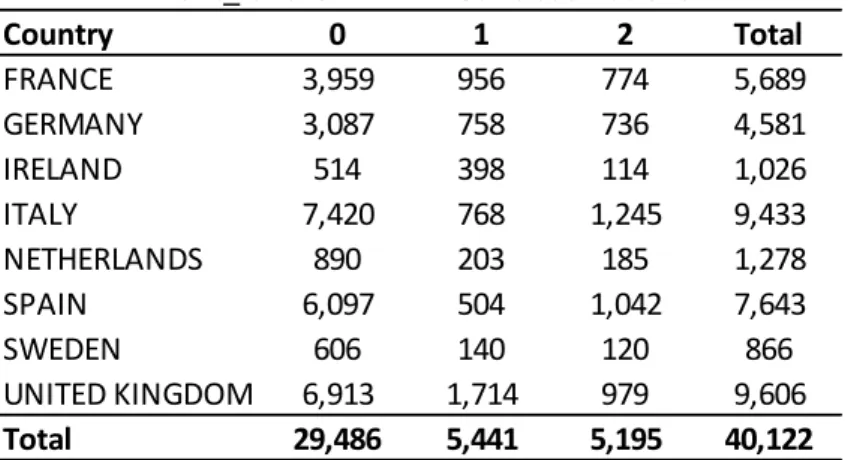
Table 4.1: Distribution of Firms in Each country ... 121
Table 4.2: Distribution of Firms in UK region ... 122
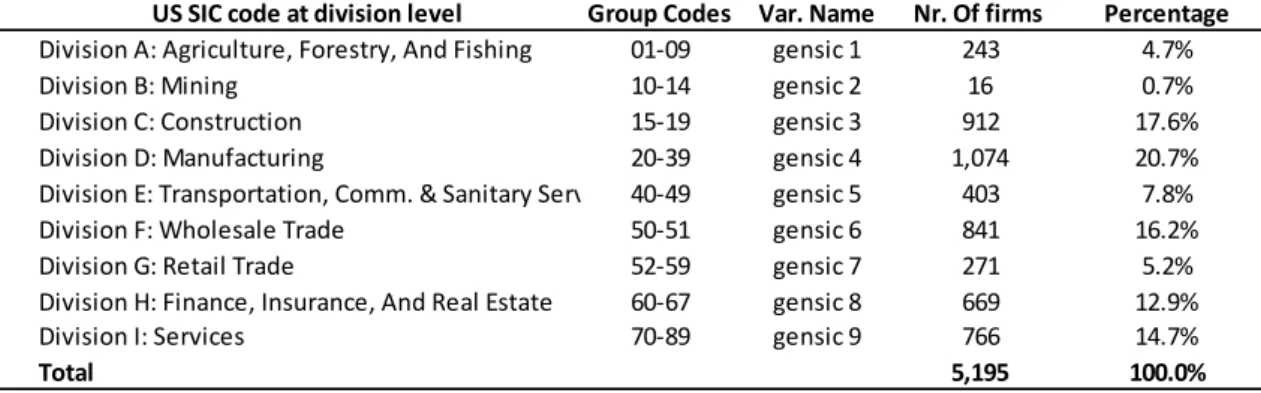
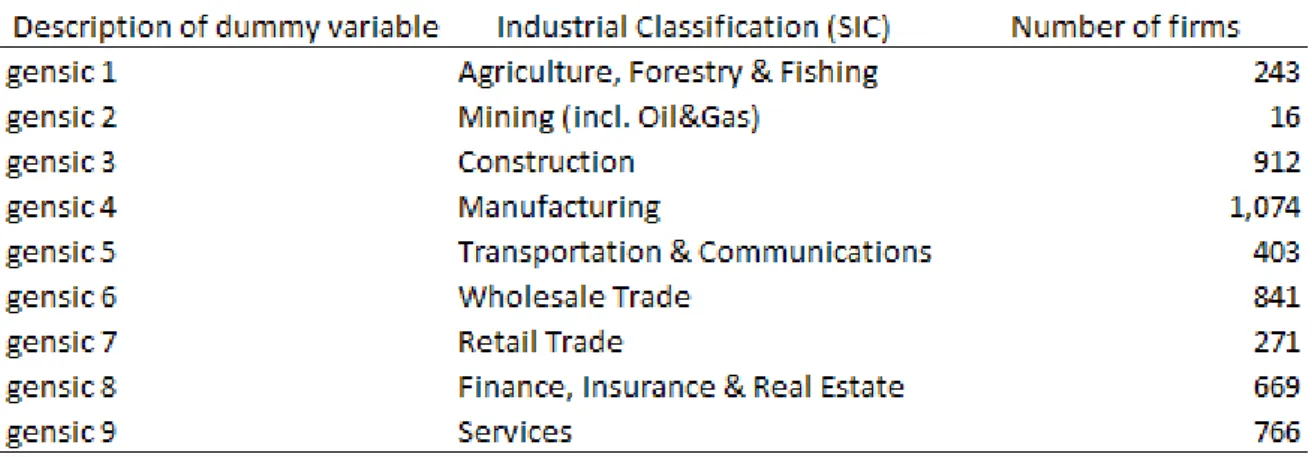
Table 4.3: Distribution of Firm- Year Observation across event_failure values. . 123 Table 4.4: Description of industry variables and number of failed EU firms in each industrial classification. ... 128
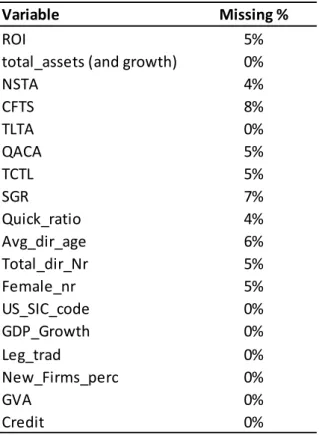
Table 4.5: Missing Values (%) in the Independent Variables ... 132
Table 5.1 Descriptive statistics of main continuous variables for firms that eventually failed. ... 136
Table 5.2: Distribution of firms in clusters (Clusters without directors’ characteristics). ... 148
Table 5.3: Distribution of firms in clusters (with directors’ characteristics). ... 150
Table 5.4: Pearson Chi-Square on Differences in Firms’ Characteristics between Firm-Clusters ... 152
Table 5.5: Median test- Pearson Chi-Square values on Differences in Financial Ratios between Firm-Clusters ... 152
Table 5.6: Description of gensic variable and number of failed firms in each industrial classification. ... 160
Table 5.7: Panel Data Regression across failed firms and clusters. ... 163
Table 5.8: Marginal effects – All EU firms ... 173
Table 5.9: Marginal effects – EU firms by Firm Failure process ... 174
Table 5.10: Summary table for Chapter 5 Hypotheses ... 175
Table 5.11: Robustness checks and comparison with the results of the original regression. ... 179
Table 6.1: Regional Concentrations of UK failed firms. ... 197
Table 6.2: Descriptive statistics of main continuous variables for UK firms that eventually failed. ... 198
Table 6.3: Average GVA growth in UK and the regions. ... 200
Table 6.4: Descriptive statistics of new firm creation as a percentage of the firm population in the UK and the regions. ... 201
Table 6.5: Skewness/Kurtosis, Shapiro-Wilk and Shapiro-Francia test of Normality for UK firms... 202
Table 6.6: Bartlett test of Sphericity and KMO for the UK Firms. ... 204
Table 6.7: Eigenvalues of VARIMAX- rotated factors (with Eigenvalues >1) for UK firms; financial ratios and firm age as variables. ... 206
Table 6.8: Factor Loadings for UK Firms without directors’ characteristics (post VARIMAX rotation). ... 209
8 | P a g e
Table 6.9: Eigenvalues of VARIMAX- rotated factors (with Eigenvalues >1); UK firms’ factor analysis with directors’ characteristics. ... 210 Table 6.10: Factor Loadings with directors’ characteristics (post VARIMAX rotation) in UK firms. ... 213 Table 6.11: Comparison of Factors for all firms sample and UK firms. ... 215 Table 6.12: Distribution of UK firms in clusters (Clusters without directors’ characteristics). ... 217 Table 6.13: Distribution of UK firms in clusters (with directors’ characteristics). ... 219 Table 6.14: Chi-Square results on hypothesis testing for UK firms. ... 221 Table 6.15: Median Test results on hypothesis testing for UK firms for continuous variables. ... 221 Table 6.16: Distribution of firms according to the year of liquidation (clusters without directors’ characteristics). ... 225 Table 6.17: Distribution of firms according to the year of liquidation (clusters with directors’ characteristics). ... 225 Table 6.18: Panel data analysis results for alternative clusters. ... 231 Table 6.19: Marginal effects – All UK firms ... 240 Table 6.20: Marginal effects – Firm Failure Processes with Directors characteristics- UK firms ... 242 Table 6.21: Summary table for Chapter 6 Hypotheses ... 243 Table 6.22: Panel data analysis results for alternative clusters using a region-specific metric for macroeconomic conditions. ... 247 Table 6.23: Robustness checks with simple logistic regression and bootstrapped errors in Panel Random Effects Ordered regression. ... 249 Table 6.24: Comparison of clusters in UK firms and all EU firms in the study. ... 254 Table 6.25: TCTL in UK firms and their failure processes in the years prior to liquidation. ... 258 Table 7.1: List of Independent Variables. ... 270 Table 7.2: Percentage of EU Firms in Financial Distress (left) and Liquidation (right): Total and by Firm Failure Process ... 272 Table 7.3: Percentage of UK Firms in Financial Distress (left) and Liquidation (right): Total and by Firm Failure Process ... 272 Table 7.4: Spatial Weights Matrix for EU countries. ... 274 Table 7.5: Spatial Weights Matrix for UK Regions ... 275 Table 7.6: Non-Spatial Panel regression on EU countries’ financially distressed firms ... 282 Table 7.7: Non-Spatial Panel regression on EU countries’ liquidated firms ... 283 Table 7.8: Spatial panel Regression results on EU countries’ firms’ financial distress ... 285 Table 7.9: Spatial panel Regression results on EU countries’ firms liquidations . 287 Table 7.10: Summary table for Chapter 7 Hypotheses on EU firms ... 289 Table 7.11: Non-Spatial Panel regression on UK regions’ financially distressed firms ... 292 Table 7.12: Non-Spatial Panel regression on UK regions’ firms that enter liquidation. ... 293 Table 7.13: Spatial panel Regression results on UK country regions firms’ financial distress ... 294 Table 7.14: Spatial panel Regression results on UK regions firms’ liquidation .... 297 Table 7.15: Summary table for Chapter 7 Hypotheses on UK firms ... 299
9 | P a g e
Table 7.15: All UK firms’ spatial panel regression with GDP growth instead of GVA
growth. ... 302
Table 7.16: Bootstrapping results in the full EU firms’ sample ... 303
Table 7.17: Bootstrapping results in the full UK firms’ sample ... 304
Table 7.18: EU Firms in Financial Distress and Liquidation: Control Variable Effects ... 305
Table 7.19: UK Firms in Financial Distress and Liquidation: Control Variable Effects ... 305
Table 7.20: Spatial Panel Regression on EU countries’ firms in Financial Distress (Excluding 2013). ... 307
Table 7.21: Spatial Panel Regression on UK regions’ firms in Financial Distress (Excluding 2013). ... 308
Table A.1: Descriptive statistics of main continuous variables for firms that eventually failed per country ... 360
Table A.2: Results of the Skewness/Kurtosis test of Normality ... 360
Table A.3 Results of the Shapiro-Wilk test of Normality ... 361
Table A.4: Results of the Shapiro-Francia test of Normality ... 361
Table A.5: Correlation matrix of variables without lags. ... 362
Table A.6: Partial Correlation matrix of variables without lags. ... 362
Table A.7: Correlation matrix of variables with lags. ... 363
Table A.8: Bartlett test of sphericity and KMO measure of sampling adequacy (incl. lags) ... 364
Table A.9: Eigenvalues of un-rotated factors; financial ratios and firm age as variables. ... 365
Table A.10: Eigenvalues of VARIMAX- rotated factors (with Eigenvalues >1); financial ratios and firm age as variables. ... 366
Table A.11: Factor Loadings for factor analysis without directors’ characteristics (post VARIMAX rotation). ... 367
Table A.12: Failed Firm Clusters (without Directors’ Characteristics). ... 368
Table A.13: Eigenvalues of un-rotated factors; factor analysis with directors’ characteristics. ... 369
Table A.14: Eigenvalues of VARIMAX- rotated factors (with Eigenvalues >1); factor analysis with directors’ characteristics. ... 370
Table A.15: Factor Loadings for factor analysis with directors’ characteristics (post VARIMAX rotation). ... 371
Table A.16: Failed Firm Clusters (Financial Ratios and Directors’ Characteristics). ... 372
Table B.1: UK Firms- Correlation matrix of variables without lags. ... 375
Table B.2: Partial Correlation matrix of variables without lags. ... 375
Table B.3: Correlation matrix of variables with lags (UK Firms). ... 376
Table B.4: Eigenvalues of un-rotated factors for UK firms; financial ratios and firm age as variables. ... 377
Table B.5: Failed UK Firm Clusters (without Directors’ Characteristics). ... 378
Table B.6: Eigenvalues of un-rotated factors for UK firms; factor analysis with directors’ characteristics. ... 379
Table B.7: UK Failed Firm Clusters (Financial Ratios and Directors’ Characteristics). ... 380
Table C.1: Distribution of firms in liquidation: All countries; firm failure processes without directors’ characteristics. ... 382
Table C.2: Distribution of firms in Financial Distress: All countries; firm failure processes without directors’ characteristics. ... 382
10 | P a g e
Table C.3: Distribution of firms in Liquidation: UK Regions; firm failure processes without directors’ characteristics. ... 383 Table C.4: Distribution of firms in Financial Distress: UK Regions; firm failure processes without directors’ characteristics. ... 383 Table C.5: Normality Tests for firms in EU Countries ... 383 Table C.6: Normality Tests for firms in UK Regions ... 383 Table C.7: Panel regression on EU countries’ financially distressed firms (without directors’ characteristics) ... 384 Table C.8: Panel regression on EU countries’ liquidated firms (without directors’ characteristics) ... 384 Table C.9: Spatial Panel regression on EU countries’ financially distressed firms (without directors’ characteristics) ... 384 Table C.10: Spatial Panel regression on EU countries’ liquidated firms (without directors’ characteristics) ... 385 Table C.11: Panel regression on UK Country regions’ financially distressed firms (without directors’ characteristics) ... 385 Table C.12: Panel regression on UK Country regions’ liquidated firms (without directors’ characteristics) ... 386 Table C.13: Spatial Panel regression on UK Country regions’ financially distressed firms (without directors’ characteristics) ... 386 Table C.14: Spatial Panel regression on UK Country regions’ liquidated firms (without directors’ characteristics) ... 386 Table C.15: Hausman Test results for the EU firms spatial regressions (financially distress) ... 387 Table C.16: Hausman Test results for the EU firms spatial regressions (liquidation) ... 387 Table C.17: Hausman Test results for the UK firms spatial regressions (financially distress) ... 387 Table C.18: Hausman Test results for the UK firms spatial regressions (liquidation) ... 388
11 | P a g e
ABSTRACT
Firm Failure Processes and Determinants of Failure in EU Countries and UK Regions: A Quantitative Analysis of SMEs.
By
Alexios Makropoulos
A thesis submitted in partial fulfilment of the requirements of the Robert Gordon University
for the degree of Doctor of Philosophy
This thesis is motivated by the fact that small and medium sized enterprises (SMEs) are of vital importance to most European countries collectively and to each country individually. For these reasons, understanding SME failure is an integral part of decision and policy making. Firm failure can be regarded as a multi-year process that develops over time. Yet, there has been limited work in the area of quantitatively identifying and analysing SME failure processes. In particular, despite evidence from the qualitative firm failure process literature on the importance that non-financial, firm-specific characteristics have on firm failure processes, the quantitative firm failure process literature has largely ignored this aspect. Likewise, the determinants of firms’ transition to failure within potential alternative firm failure processes and the importance of geographical location are often overlooked in the firm failure process literature, despite evidence in the wider firm failure literature for the contrary. For these reasons, the current evidence in the quantitative firm failure process literature is quite isolated from wider firm failure studies. This thesis aims to investigate alternative SME failure processes, the determinants of firms’ transition towards failure and the importance of firms’ geographical location by bringing evidence from other parts of the firm failure literature in the quantitative study of firm failure processes. The sample analysed consists of SMEs in eight EU countries covering the period from 2004-2013. In addition to analysing the whole sample, the failure processes and failure determinants of UK failed SMEs are also investigated.
The dataset of this study covers firm-specific characteristics such as financial ratios and directors’ characteristics, and information about the macroeconomic and business environment. In addition, the impact of geographical location is considered.
12 | P a g e
The key results of the analysis identify the existence of 4 alternative firm failure processes (new firms with inexperience boards, high growth firms, old firms, firms without board diversity) which apply across EU countries and UK regions. A number of other characteristics are also present in the alternative firm failure processes: directors characteristics are of primary importance for firm failure processes as well as firms’ transition to failure. So are the age of the firm, the legal tradition of the country, the levels of business growth and the intensity of competition due to new business entrants in an area and the geographical location of firms.
There are a number of contributions that this thesis makes to the quantitative firm failure process literature. First, given that the different failure processes were found to have differing determinants, the results show the importance of looking at individual firm failure processes rather than simply analysing all failed firms together. Second, this thesis is the first to quantitatively analyse the impact of directors’ characteristics in the identification of the alternative firm failure processes in EU and UK firms. Third, it is the first study to investigate the determinants of firms’ transition to failure within the alternative firm failure processes context where both financial distress and liquidations are considered in the definition of failure. Fourth, this thesis identifies the importance of geographical location and the existence of spatial interactions in some parts of firms’ transition to failure. As such, this thesis consolidates and analyses evidence from qualitative firm failure process studies and from wider firm failure studies in the context of quantitative firm failure process. In doing so, it applies spatial panel data analysis for first time in a firm failure process study. A number of policy implications result from these findings. Given the differences in firm-specific characteristics, the differences in the determinants of transition to failure and the geographic sensitivities that the alternative firm failure processes have, policies and decisions designed to support SMEs to avoid failure should be more targeted according to the characteristics of the firm and the process towards failure it is mostly associated with.
13 | P a g e
Keywords: SMEs, Firm failure, Firm failure process, Firms’ transition to failure, spatial analysis, directors’ characteristics.
14 | P a g e
CHAPTER 1: INTRODUCTION AND THE RESEARCH CONTEXT
1.1. Outline of the Chapter
This chapter presents an introductory overview of the purpose and scope of the thesis. Section 2 outlines the background of the study. It introduces the approaches that have been taken to firm failure and highlights areas that require further analysis. Section 3 sets out the motivations behind the study: first, whether or not firm failure processes are present in a sample of failed EU SMEs and second to investigate the extent to which different factors affect the different failure processes. Section 4 sets out the specific research questions in terms of the thesis’ aim and objectives. Section 5 defines a number of key concepts. Finally, the structure of the thesis is outlined in Section 6.
1.2. Background of the Study 1.2.1 Business Failure
Entrepreneurs, investors, employees and business suppliers and stakeholders incur significant costs when a business fails. For this reason, business failure1 has been a particularly active research area over the last fifty years and particularly since the seminal works of Beaver (1967) and Altman (1968). However, most of the research in the wider area of business’ failure has focused on failure prediction (see for example Altman, 1968; Edmister, 1972; Altman, 1984; Dimitras et al., 1999; Wu et al., 2014). This literature has concentrated almost solely on the use of financial information. However, as Argenti (1976) notes, business failure becomes evident in financial information at the penultimate stage of failure and therefore utilizing only financial information ignores the question of what were the underlying conditions that put the firm into a failure trajectory in the first place (Zavgren 1985; Argenti, 1985; Balcaen and Ooghe, 2006). One can define the failure process as a number of pre-existing, firm-specific characteristics that develop over time and result in firm failure (Argenti, 1976; Laitinen, 1991).
1 The generic term “failure” has been used, by different authors, to describe company liquidations/bankruptcies,
15 | P a g e
1.2.2 Business Failure Process
On the other hand, there has been a parallel stream of research that has observed that business failure is not an isolated or sudden event that is necessarily similar between different businesses. Instead, business failure may be regarded as a multi-year process that evolves over a period of time prior to the final failure of the firm as defined by liquidation or a bankruptcy filing (see for example Platt, 1989; Hall, 1992; Ooghe and De Prijcker 2008; Argenti, 1976; Laitinen, 1991). In other words, there is a failure process (or trajectory) that businesses follow over a number of years prior to them actually failing.
Within the area of business failure process, a significant part of research has taken a qualitative approach, using observations on the qualitative characteristics of predominantly large failed businesses over a period of years prior to their eventual failure. These studies (see for example Argenti, 1976; Richardson et al., 1994; Ooghe and De Prijcker, 2008) have focused on firm-specific characteristics as the underlying causes of business failure. Qualitative firm failure studies identified firm-specific characteristics such as the firms’ director characteristics, the growth strategy of the firm as well as the firms’ financials as significant factors in the alternative firm failure processes.
1.2.3 Financial Ratios and Research Approach
A number of researchers (see for example Laitinen, 1991; Laitinen et al., 2014; Lukason et al., 2016) have taken a different research approach when considering the business failure process. Using quantitative analytical techniques, the identification of alternative business failure processes has been investigated by using solely financial ratios, similar to the original approaches of failure prediction studies. This research stream may have been motivated by both Argenti’s (1976) work which found that financial ratios, the “symptoms of failure”, captured the underlying causes of firms’ failure, as well as from the extensive firm failure prediction literature (see for example, Altman, 1968, Altman et al., 2010). The latter, used financial ratios as predictors of the failure event. The failure prediction literature has developed to include studies analysing different countries, industries, firm sizes and quantitative techniques in addition to the financial ratios.
16 | P a g e
The wider business failure literature has employed a number of research methodologies. On the qualitative side, case studies and observations have been mostly used in the context of the failure process. On the quantitative side, the wider business failure literature has used a number of statistical techniques, from multivariate discriminant analysis, logistic regression and panel logistic regressions, as well as survival analysis with the main motivation being the identification of determinants that discriminate between failed and non-failed firms. On the other hand, the failure process area has traditionally considered only failed firms in the research, given that the main aim was to identify alternative processes of failure. However, the quantitative failure process literature has limited itself to a combination of factor and cluster analysis in the attempt to identify key characteristics that differentiate the alternative failure processes. This literature, however, has limited evidence on the determinants of businesses’ transition to failure in the alternative firm failure processes.
Regardless of the methodological approach undertaken, the business failure process literature has identified a number of failure processes. Such findings have come from a number of single country studies (see for example Argenti, 1976; Laitinen, 1991) as well as from some multi-country studies (see for example Laitinen et al., 2014; Laitinen and Lukason, 2014) which looked to see whether failure processes differ between countries. Typically, such studies suggest that, depending on the country and on the type of the firm that every study considers, there are typically between 3-6 distinct firm failure processes.
1.2.4 The Introduction of Non-Financial Characteristics
Whilst business failure process studies have been looking at samples of liquidated firms to understand the pre-existing conditions that the alternative firm failure processes could have in common, a wider firm failure literature has also developed. Financial ratios as predictors of business’ failure have been well established as an important source of information, despite the fact that there has been no common agreement on which particular financial ratios should be used in order to better identify businesses that are about to fail (Charitou et al., 2004). This has led to the criticism that financial ratio-only driven studies have limited theoretical
17 | P a g e
foundations and therefore their results may be inherently unstable if not used in specific timeframes prior to the failure event (Balcaen and Ooghe, 2006; Laitinen, 1993).
Nevertheless, within the wider business failure prediction literature, there has been increasing evidence that the management of the businesses can also be used as a predictive indicator or can, in general, be a determinant of failure (Franco and Haase, 2010; Ropega, 2011; Wilson et al., 2014). The foundations of this argument were based on the wider corporate governance literature as well as from empirical evidence showing that certain characteristics of businesses’ directors and board structures may contribute to business’ performance as a consequence of increased social and human capital and to improved group dynamics at board level (Wilson et al., 2013; Shehata et al., 2017).
Other studies have showed the importance of sectoral impacts on firm failure. In addition, macroeconomic conditions, the availability of finance and the legal environment, particularly when comparing business failures in different countries, have included in studies looking at business failure. This has been particularly true since the financial crisis of 2007-2008 and the associated credit crunch that led businesses to fail (see for example, Carling et al., 2007; La Porta et al., 1997; La Porta et al., 1998; Wang 2012). These characteristics have been also identified as significant determinants of firm failure in aggregate business failure studies, which, however, are primarily limited to the corporate sector (see for example, Liu, 2006; Jones, 2013) rather than SMEs.
A number of the above firm-specific characteristics have been used in qualitative firm failure process studies together with environment-specific characteristics (see for example Ooghe and DePrijcker, 2007; Richardson et al., 1994) as differentiators of alternative failure processes. However, these elements have been ignored by quantitative firm failure process studies.
1.2.5 Conclusion
Overall, wider firm failure studies focus on a number of determinants that assist the prediction, or explanation, of business failures. These include firm-specific characteristics that emphasise on financial ratios and the business’ management.
18 | P a g e
Factors external to the business are also frequently considered as determinants of business failure. These studies focus on failure as a time-specific event. On the other hand there is a view that firm failure is a process that evolves over a number of years. The qualitative business failure literature included non-financial characteristics into the identification of the alternative firm failure processes but has not considered SMEs; instead most of the research focus has been on large corporates. On the other hand, the quantitative firm failure process literature has occasionally considered SMEs but has neglected any non-financial information when identifying the alternative firm failure processes. In both cases, the firm failure process literature identifies alternative failure processes but stops short of investigating whether any of the factors included in the identification of the alternative failure processes are also determinants of the businesses’ transition to the ultimate failure stage that is liquidation. Moreover, despite the existence of studies including firms from a number of countries, little attention has been given to the role of geographic/ spatial effects on businesses’ transition towards failure.
1.3. Motivation of the Study and Framework
This study is motivated by three main factors. The first is based on the fact that small and medium sized enterprises (SMEs) are of vital importance to most European countries. The second relates to the importance of identifying the alternative business failure processes, and their determinants, in order to inform better decision-making and better, more relevant polices that will support them and help them to thrive. The third is related to the importance of geographical location and potential interactions that may occur between firms in nearby areas. First, the EU has introduced many policies designed to support and encourage SMEs. The aim of these policies is to promote business success and avoid business failure. For example, policies to support SME growth such has the “Think Small First”, the “Small Business Act” (Commission of the European Communities, 2008), the “Entrepreneurship 2020 Action plan”, and the “Competitiveness of Enterprises and small and medium-sized Enterprises” program (2013) have all been designed to support SME growth and to avoid SME failure. Policies that support SMEs are important because SMEs represent the majority of the business population in the European Union. In addition, they are also a major source for peoples’
19 | P a g e
employment. In the U.K., SMEs accounted for 59.3% of the private sector employment (Federation of Small Businesses, 2013). In the EU, SMEs account for c.66% of the private sector employment (European Commission, 2018).
Second, in relation to the failure process research on SMEs, one can observe that whilst the wider business failure literature has evolved with alternative methodologies and consideration of non-financial characteristics as determinants of failure. However, there has been no such progress in the failure process literature where alternative failure processes have been identified solely in terms of financial ratios. Further, no analysis has been undertaken to understand which of these are actually determinants of the firms’ transition to failure. Yet, the identification of failure processes is important because failure is a situation that evolves over a number of years and needs to be understood before any avoidance actions can be taken. Such knowledge can then inform policy and decision-making. Third, in a business environment where business interact with each other via their business networks, aggregate firm failures in one location can affect firm failures in other locations. Such information is also important for policy making at country and regional levels.
Overall, despite the European Union’s (EU) efforts to avoid business failures by supporting and giving alternative opportunities to entrepreneurs with failed firms, SME bankruptcies in the EU show clear signs of differences between some key European countries (Figure 1.1). One can see that, for example, liquidations in the U.K. and Germany on the one hand and Sweden and Netherlands, on the other hand are having quite different levels which are not just simply correlated with their country level economic conditions. The former two (UK and Germany) have higher bankruptcy rates in 2011 compared to 2013, while the latter two (Netherlands and Sweden) have the opposite trend. Therefore this raises the question of whether SME support policies could be better managed if a better understanding of the underlying reasons of SMEs’ failure was available. This has to be considered in the context of the current research that, particularly on the quantitative side, treats the business failure as a sudden event. Likewise, the failure process literature neither considers non-financial characteristics in the
20 | P a g e
alternative failure processes nor considers the determinants of the firms’ transition towards failure between the failure processes.
Figure 1.1: Business liquidations in some European countries
Source: Company Insolvencies in Europe, (Coface, 2015; p.1)
Likewise, there is limited evidence on whether the geographical location within one country has any significance in firms’ failure. The wider business failure research provides evidence that the spatial location of the firm does matter if one has to distinguish between (for example) different regions as the business environment (such as the competition from new firms) may differ in each region (Lane and Schary, 1991; Keeble and Walker, 1994). In that sense, there is evidence that within the United Kingdom (UK), the percentage of failed businesses may differ substantially (figure 1.2) between different regions (within England and Wales in this case). There also appears to be some correlation with the percentage of new business in these areas, in line with the literature observations (Lane and Schary, 1991; Keeble and Walker, 1994). This can be observed in figure 1.2 which shows that the percentage of business failures (in 2010-2011) differed between different regions in England. London was the region with the most failures. Additionally it was the region with the most start-ups.
21 | P a g e
Figure 1.2: Changes in business failures (deaths) and births in England 2010-2011.
Source: Business births, deaths and survival rates, ONS (2012)
Despite the evidence, the aspect of location, expressed by different countries or by different areas (for example regions) within a country has been largely neglected, especially when the determinants of businesses’ transition to failure are considered. Yet, such findings could help entrepreneurs, investors and decision makers to better allocate resources and improve policy design accordingly. Additionally, the identification of failure processes and their determinants could assist further in the wider failure literature as failure prediction applications could be more targeted to certain firm failure processes.
To conclude, the key motivator is understanding SMEs failures processes in different locations: within EU countries and within a country - the UK. This is because failure is not a sudden event, identical for each business and therefore should not be treated as such. The importance of location, be it between countries or within a country (at regional level) has received little attention in the context of SME failure processes. In this context there appears to be some neglect of alternative quantitative techniques that could provide further insights in the current quantitative firm failure process literature.
There are two additional issues that motivate the analysis. First, the current literature relating to business failure processes has somewhat neglected the
22 | P a g e
importance of not only identifying the alternative failure processes but also of identifying the determinants of the transition towards failure – within the population of businesses that belong to the alternative failure processes. This is crucial because, having identified different failure processes, it may be that the determinants of the transition to failure differ across different processes.
Second, aside from financial ratios, the quantitative failure process literature has neglected key firm-specific characteristics and their role in firm failure. This is in spite of the findings in the qualitative failure process literature that they significantly affect failure. Further, there is no evidence of how, or if, non-financial ratio determinants are significant contributors to businesses’ transition to failure between EU countries and within different areas of one country - the UK.
1.4. The Research Problem and the research plan
As described in the previous section, a number of salient areas remain under-developed in the current literature. First, the majority of the qualitative work on firm failure processes considers large corporations rather than small and medium sized- businesses (hereafter called “firms” or SMEs).
Second, the quantitative literature has focused solely on financial ratios when investigating firm failure processes for both large corporations and for SMEs. As such, the current quantitative research on firm failure processes ignores findings from qualitative studies in the same area, that suggest that non-financial characteristics, especially related to the management of the business, are important when one wants to identify the alternative failure processes. In addition, evidence from the wider business failure literature is also ignored.
Third, whilst the wider business failure research considers the determinants of business failure, quantitative firm failure process studies have so far identified a number of firm failure processes in different countries but there has been limited analysis of the extent to which the characteristics that differ between alternative firm failure processes are actually statistically significant determinants of the firms’ failure when firms are transitioning towards their terminal failure (liquidation) state.
23 | P a g e
Fourth, whilst firm failure process studies have taken place in a number of different countries (including a number of multi-country studies), the geographic element has received relatively limited attention, and then only from a firm-specific perspective. The geographical location is associated with observed and unobserved characteristics. For the former, there is limited evidence on whether firm failure processes differ between countries or within different regions of a country. In addition the current failure process literature does not explain what role, if any, country-specific characteristics (such as the legal environment) or region-specific characteristics (such as the competition from newly established firms) play in the firms’ transition towards failure within these failure processes.
Fifth, the methodologies that have been used so far in firm failure process studies are restricted to the identification of the alternative failure processes by using factor and cluster analysis. Therefore, further insights may be gained by employing additional techniques, for example, panel data regression analysis and by assessing the importance of spatial location, using spatial data analysis. This may provide a better understanding of the factors that determine the path of firm failure.
The study aims to address the above issues by using a sample of failed firms from 8 European countries, covering the period 2004-2013. This period (the maximum number of years available in the Amadeus database) covers the financial crisis that resulted in a number of failed firms in the subsequent years. Moreover, it allows each firm in the sample to have a substantial number of observation years prior to failure. The countries were selected so as for each country represented in the sample to have a substantial number of failed businesses. The selected sample of countries ensures that a diverse business economic and legal tradition background is represented in the sample. As such the sample represents 8 countries with different economic environments during the period under investigation. These countries are also representative of the key legal traditions that exist in EU. The sample size in terms of firms’ numbers and number of countries presents an improvement and an extention of the current quantitative firm failure process literature. Further details on the sample are given in Chapter 4. This thesis seeks to address the following aims and objectives:
24 | P a g e Main Aim:
To enhance the quantitative firm failure process literature on SMEs, by incorporating elements from the qualitative failure process and the wider firm failure literature.
Objectives:
1) To investigate the alternative firm failure processes between EU countries and within one country’s regions - the UK, by considering financial ratios and the age of the firm.
2) To investigate the impact of firms’ management characteristics, in addition to the financial ratios and the age of the firm, in the identification of failure processes and their transition to failure between EU countries and within one country’s regions - the UK.
3) To investigate the influence of business environment factors, management characteristics and excessive growth, in firms’ transition towards failure in the alternative failure processes in EU countries and within one country’s regions - the UK.
4) To investigate the influence of location at firm level and aggregate firm transitions towards failure in the alternative failure processes between EU countries and within the UK.
In order to achieve the aim and objectives, the thesis is structured around a number of hypotheses. The hypotheses associated with the alternative firm failure processes and with firms’ transition to failure are developed in the literature review section. Once the alternative firm failure processes are identified (from the financial ratios and the age of the firm) these hypotheses consider wider comparisons both for the firm specific characteristics that were used to identify the alternative processes and for characteristics associated with the economic and business environment of the firms in the alternative processes. The hypotheses associated with the influence of the geographical (spatial) location and firms’ aggregate transition towards failure are developed in the methodology chapter. Subsequently, these hypotheses are analyzed in three empirical chapters; one analyses the firm failure process and determinants of transition to failure in EU
25 | P a g e
countries; the second analyses the firm failure process and determinants of the transition towards failure in the UK regions; the third uses aggregated failures across the EU countries and the UK regions, to investigate the influence of geographic (spatial) effects in firms’ failure.
As a result, the thesis makes a number of contributions. The first is to extend the quantitative firm failure process literature by incorporating and quantifying elements from the wider firm failure process and firm failure literature. It does so by looking for evidence across a number of EU countries and also within the regions of the UK. The second contribution is to consider the determinants of firms’ transition to failure, for first time in a quantitative firm failure process study. The third is to investigate the importance of geographical location in firms’ failures between EU countries and within the UK is investigated for first time in the firm failure process context. The findings of this study should provide contributions and implications for policy and decision makers. The identification of the firm failure process that firms belong to and the identification of its determinants of transition to failure can provide a valuable insight to initiate failure avoidance actions and policies.
1.5. Definitions
In business failure studies, authors have used a number of different definitions for similar things. In order to avoid confusion, this section provides definitions for all the terms that are used in this thesis.
1.5.1 Defining Small and Medium Sized Firms and Businesses
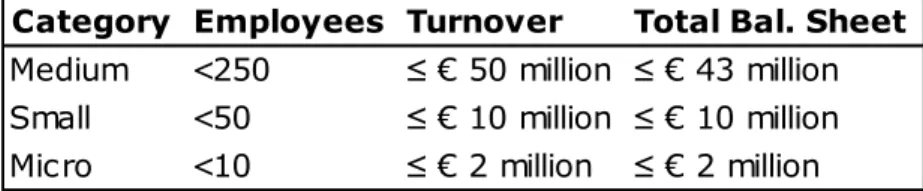
There is a wide variety of definitions in the literature for the SMEs. This study uses the EU definition for micro, small and medium sized firms as presented in Table 1.1.
26 | P a g e
Table 1.1: Upper limits to be considered as a micro, small or medium sized firm
Source: Official Journal of the European Union L 124, p. 36
Both EU and UK firms in the sample are using the same criteria (see for details Chapter 4 - Data). The terms “SME” and “firm” are used interchangeably in this study.
1.5.2 Defining Bankruptcy, Liquidation and Failure
The definition of failure has been used in many alternative ways in business failure studies. On occasion the term “failure” has been used to denote financial distress (see below). On other occasions “failure” has been used as synonymous with business exits from the industry, including business mergers and acquisitions as well as simply the ceasation of trading. Finally, the term “failure” has been used to denote bankruptcy or liquidation of a business2.
Therefore, in this thesis the term failure is used to denote bankruptcy/liquidation. This is regarded as the terminal stage of a firm’s operation. In this thesis, there is no direct distinction between compulsory and voluntary liquidations because such procedures differ between countries and as such this type of information is of limited use. In any case this study is interested in identifying the processes and determinants of failure (liquidation) and as such the initiator of the procedure is not the point of interest. However, the study does control for the interim status of financial distress (see below) to control for the firms’ whose transition to failure was due or partly due to financial distress.
2 The term bankruptcy and the term liquidation are broadly similar and are used interchangeably in this thesis. Some countries use the term liquidation and others the term bankruptcy. Whilst this study makes no distinction between them, the term failure is used instead.
Category Employees Turnover Total Bal. Sheet
Medium <250 ≤ € 50 million ≤ € 43 million Small <50 ≤ € 10 million ≤ € 10 million Micro <10 ≤ € 2 million ≤ € 2 million
27 | P a g e
1.5.3 Defining Financial Distress
Financial distress is a situation that precedes bankruptcy in many cases (Platt and Platt, 2002). However, there is not a consistent definition of financial distress in the literature. For example, negative equity may be defined as the situation where a firm has negative net operating income over a number of years (Hofer, 1980) or major restructuring and layoffs (Hill, 1996). In the context of this thesis the term financial distress is used to denote firms with negative equity positions. In such firms the liabilities are greater than their total assets and as such their owners are in negative equity and therefore financially distressed. Altman (2000) has used also the same definition for a failure prediction study. Financial distress is used as an interim status in the transition towards failure; a number of firms first go into negative equity and then fail. However, some firms fail without being in financial distress first.
1.5.4 Defining the Failure Process and the Transition to Failure
The term “Failure Process”, was first introduced by Argenti (1976) and has subsequently been adopted by much of the literature in this area (see for example Laitinen, 1991; Ooghe and De Prijcker, 2008; Lukason et al., 2016). As mentioned above, a firm’s failure process is defined as a number of pre-existing, firm-specific characteristics that develop over time and result in failure. For example, the existence of a board of directors with little experience in a firm with weak returns on investment (ROI) is a combination of existing firm-specific characteristics that evolve over time. These characteristics may interact with the firm’s external environment and lead to failure. The term “Failure Trajectory” is sometimes used sometimes in the literature (see Argenti 1976) interchangeably with the Failure Process. This study however will use the term failure process.
In this thesis, the term “transition to failure” is used to denote the interim stages that a firm may encounter across time as it moves towards its eventual failure. The transition to failure describes the firm’s journey under two conditions: first, from being active and under no financial distress to becoming bankrupt and second, being potentially financially distressed prior to becoming bankrupt. The term is used in this study when consideration is given not in the characteristics of
28 | P a g e
the alternative firm failure processes but to the determinants of failure; that is the characteristics that are statistically significant determinants of the firms’ transition from commercially active to failure.
1.5.5 Defining Management
This thesis examines the firms’ directors’ characteristics and gender diversity as proxies of a firm’s management knowledge, experience and social and human capital. The definition of directors for the EU countries implies ownership to the firm and is related to people that are on a firm’s board. The UK firms, however, include a wider definition of directors in the main section of the analysis that includes managers in senior positions (such as chief accountant) but not necessarily ownership or board presence. However, a strict definition (that implies ownership), of directors in UK firms has also been used in an additional robustness analysis with no material differences in the results.
1.6. Structure of the Thesis
The rest of the thesis is outlined below. Chapter 2 provides a literature review. The chapter first considers the characteristics and the determinants that have been associated with firm failure. The chapter provides a synthesis and critical analysis of the determinants of firms’ failure from the wider failure literature and then proceeds with looking at cross country comparisons. Subsequently, the chapter presents and evaluates the current literature on firm failure process. Finally the chapter summarises evidence on the same characteristics but for studies that cover intra-country comparisons.
In doing so, chapter 2 covers the areas that firm failure studies have historically identified as important determinants of firm failure. As such, the chapter starts with the external environment, looking at the legal aspects of firm failure in the countries that the sample of this study covers. Then, the chapter proceeds with a section dealing with the external environment of the firms and then considers the firm-specific characteristics such as the firms’ financials, the management characteristics and the presence of excessive growth that has been frequently mentioned in firm failure process studies. This chapter also sets the hypotheses in relation to the alternative firm failure processes and the determinants of firms’
29 | P a g e
transition to failure. These are to be tested in Chapters 5 and 6 and are used to enable the thesis to reach its aim and objectives.
Chapter 3 describes the research methodology that this thesis has adopted. The research philosophy and the design of the study are presented. The techniques that are used are discussed together with a brief historical review on the techniques that have been previously used in the area of firm failure and firm failure process. This chapter also sets the hypotheses in relation to the existence of geographical (spatial) effects in aggregate firm failures in the failure processes of the EU countries and the UK regions. These hypotheses are to be tested in Chapter 7.
Chapter 4 presents the data used in the study. It presents the data sources and some basic descriptive statistics. The chapter also defines the dependent and independent variables used in the study.
Chapter 5 is the first empirical chapter. It presents the analysis and the discussion of the results associated with the country-level firm failure process and the determinants of transition to failure of the EU firms of the sample. The relevant hypothesis are also discussed.
Chapter 6 is the second empirical chapter. It presents the analysis and the discussion of the results associated with the regional-level firm failure process and the determinants of transition to failure for the UK firms in the sample. The relevant hypothesis are also discussed.
Chapter 7 is the third empirical chapter. The chapter presents the analysis and the discussion of the existence of spatial effects in firms’ transition towards failure. This is undertaken both for the firms in the EU countries and for firms in the UK regions. The relevant hypothesis are also discussed.
Chapter 8 concludes the Thesis. It provides a summary, evaluation and critical analysis of the findings and discusses their policy implications. The chapter also acknowledges the limitations of the research and proposes possible areas for future research.
30 | P a g e
CHAPTER 2: FIRM FAILURE AND PROCESS: A REVIEW OF THE LITERATURE
2.1 Introduction
The main aim of this study is to enhance the quantitative firm failure process literature on SMEs, by incorporating elements from the qualitative failure process and the wider firm failure literature. This aim is to be achieved within the context of a number of different EU countries and within the regions of one country, the United Kingdom. The key objective of this chapter is to introduce the key aspects of the wider firm failure literature that are involved in a cross-country and in a within-country context. In addition, emphasis will be given to the literature on firm failure process. Hypotheses in relation to firm failure process and the determinants of firms’ transition to failure are also introduced in this chapter, aligning it with the aim of the study. The hypotheses related to the spatial and geographical location of the firm are introduced in Chapter 3 as they are more technical in nature. Comparing the failure processes of firms across European countries and within one European country (the U.K.) requires a compilation of different literature sources around the topic of firm failure. This is because there appear to be three key parallel frameworks in the wider firm failure literature: the firm failure process literature, the failure prediction literature and the wider failure literature. The failure process literature includes qualitative and quantitative studies and considers firms’ failure as a multi-year process that evolves due to a number of underlying reasons within a firm. The failure prediction literature mainly considers failure as an event and usually employs quantitative techniques. The failure prediction literature is particularly important in terms of the selection of financial variables. The wider failure literature may consider both the failure event and the process and usually analyzes one particular characteristic that may be associated with firms’ failure, for example, the association of firms’ failure with the origins of a country’s legal framework.
The perspective this chapter discusses is a blend of the literature coming from the failure prediction studies as well as from the failure process and wider firm failure studies. In particular, the qualitative firm failure process framework that considers the firm’s management, the firm’s age, the firm’s financials and the economic and
31 | P a g e
business environment is used as the basic framework on which evidence from wider failure studies are adding evidence. Whilst there is evidence of firm failure and firm failure process studies that consider different countries, the spatial impact of location has not received much attention in the literature. In particular, there is no evidence of spatial analysis within the context of firm failure process studies. On that end, the methodology chapter (Chapter 3) offers some technical guidance on spatial analysis and proposes the hypotheses for that part of the thesis.
A major distinction in firm failure studies lies on the size of the firms. Corporate failure studies tend to be distinctive to SME failure studies. This is because of the different characteristics that SMEs have compared to large corporates. In fact, SMEs tend to be more owner-centric and more opaque than their bigger (and possibly listed) counterparts. SMEs are also riskier with much higher population and higher probabilities of default (Dietsch and Petey, 2004) and therefore failure. In line with the aim and objectives of this study, the emphasis of this chapter is on the SMEs. However, references are made to the large corporate literature in cases where there is a lack of evidence from the SMEs. Such references are therefore made in order to assist hypothesis formulation and the drawing of inferences. In terms of defining the SMEs, Ooghe and DePrijcker (2008) classified SMEs as firms those with less than 100 employees while Richardson et al. (1994) did not give a clear definition on “small firm”. In any case, given the nature of the research that compares European SMEs, the European definition of SMEs is adopted and presented in Chapter 1.
The legal entity of the firms is generally ignored in both aspects of the literature while the distinction between listed and non-listed firms is rarely the case, especially in the SMEs’ literature where the vast majority of firms are assumed to be non-listed. However, the legal aspects of the failure definition may be of interest as they are related with the definition of the liquidation status.
The literature of the firm failure process has shaped the framework of this study. The qualitative firm failure process literature suggests that a firm’s failure is caused by management issues, combined with weak financial performance, often unsustainable growth and greater adversity of sector and business environment characteristics. From the above, only the weak financial performance has been
32 | P a g e
empirically used in quantitative firm failure process studies (see for example Laitinen, 1991; Laitinen et al., 2015).
On the other hand, the wider firm failure literature that investigates single determinants that are linked to firm failures is much wider than the literature for the failure process. For this reason, each of the literature sections provides evidence from the wider stream of firm failure literature. For example, the concept of rapid growth is fundamental in the failure process literature while at the same time the closely related concept of unsustainable growth is also related to firm failure without considering the wider failure process concept. One should be careful with the literature’s definition of the firms’ failure process (described in section 2.2) and with its stages. The latter describes the transition between a firm being “healthy”, a firm being in financial distress and a firm becoming bankrupt and being liquidated.
The remainder of the chapter is organized as follows. Section 2.2 explains the distinction between failure event and failure process and discusses and evaluates the literature on the firm failure process. Section 2.3 provides evidence on the legal origins of the legal legislation that shapes different kinds of firms failure across countries; section 2.4 presents the financial and economic drivers of firms’ failure; section 2.5 presents the management of small firms and its connection with failure whereas section 2.6 presents the concept of sustainable growth and its connection with failure. Finally section 2.7 presents the reasons why intra-country failure comparisons may be of interest to the academic literature and extends the discussion of the previous sections but in an intra-country context. Section 2.8 concludes the chapter. In each section, research hypothesis are formed, where relevant. These are analysed in the empirical chapters of this thesis. 2.2 Firm Failure and Firm Failure Processes
2.2.1 Introduction to Firm Failure
The research perspective around firm failures can be categorized in two different types. The first presents firm failure as an event that “happens” and it is a matter of research to find the appropriate predictors of the failure event which are effectively the symptoms of the failure. Therefore, this body of research aims to